Those Out Of The Way

How ought Christians treat people who don’t understand God’s ways? There’s a very real temptation to belittle and criticize others for not believing the same things we do. Yet that’s not the sort of spirit God looks for in those who follow Him.

While keeping the Feast of Tabernacles (Sukkot) this year, one of the speakers shared a story from his time at a Bible college (click here for sermon recording). He and his classmates were assigned to read Emily Dickinson and analyze her theology. They picked it to bits, critiquing every way she didn’t understand their church’s teachings on the purpose and future of mankind. When they presented it to their teacher, they expected high marks.

Instead, the teacher grew angry. “You’re belittling the miracle of your calling,” he said. When we as Christians expect those who’ve not been called into God’s truth to understand, we aren’t acknowledging the miracle God performed when He enlightened us. When we condemn those who are earnestly seeking God and don’t have all the pieces, we condemn ourselves for a lack of compassion (and for arrogance in thinking we have all the right answers). We become like those Jesus criticized “who trusted in themselves that they were righteous, and despised others” (Luke 18:9-14).click to read article, "Those Out Of The Way" | marissabaker.wordpress.com
Seeking Their Good

God never intended for His people to stand in condemnation on those who don’t understand His ways. Yes we’re to know the difference between right and wrong and urge people to repent of their sins and build a relationship with God, but we’re not to attack them. We have a command to judge ourselves and we’re given limited judgement within the church (e.g. not allowing someone who openly practices sin, in spite of their profession to follow Jesus, to fellowship in the church see 1 Cor. 5:1-13). But is not godly to belittle and criticism people. Instead, we should respect the potential God has placed within all humans. Read more

Religion and the INFJ

I’ve often seen INFJs described as an intensely spiritual type. Yet a little while ago, in an online INFJ group, someone posted that most INFJs are atheist or agnostic. Being a type that appreciates truth, someone else set up a poll trying to see if that was really the case.

It’s a small, volunteer sample group, but the results were interesting. 36% identified as atheist, agnostic or non-religious. That’s the same percentage that identified with a Christian religious sect. The remaining 28% identified as “spiritual” or with a non-Christian religion.

click to read article, "Religion and the INFJ" | marissabaker.wordpress.com
image credit: Amanda Jordan via StockSnap

INFJs approach religion much like we approach everything else: with an open, inquisitive mind looking for patterns, especially those relating to people. Our relationship with spirituality largely depends on how we were raised and the direction our lives took from there. But it also depends on our journeys of personal growth, how the religions we encounter line-up with our convictions, and whether or not faith “makes sense” to us.

The Hypocrisy Factor

Many INFJs I’ve seen talking about being non-religious started out in a church of some sort and then left. As with many people who leave churches, hypocrisy is often cited as the reason. INFJs are exceptionally good at detecting deception. We can read people well and pick up on inconsistencies in their patterns of behavior very quickly. At the same time, we want to believe the best of people and it can take a long time for us to admit someone who we value would betray us. Read more

Battling Our Thorns In the Flesh

We’ve all “sinned, and come short of the glory of God” (Rom. 3:23, KJV). We know this, and repenting of those sins in our pasts and accepting Jesus as our savior to wash them away was a first step in becoming Christian. Even after conversion, though, we’re not perfect. God keeps forgiving us when we repent, but we still fall short of perfect obedience. I think it’s also fair to say all or most of us have struggled with some sins more than others.

I’m sure we can all think of someone else like this. Someone who you’d think has been in the church long enough to “get over” their bitterness, or lust, or covetousness, or whatever the particular problem is. But if we think about it, many of us are in the same boat. We’re often more understanding toward our own struggles, but we still have them. Or perhaps we’re even harder on ourselves than we are on others.click to read article, "Battling Our Thorns In the Flesh" | marissabaker.wordpress.com

So what do we do? How do we deal with our own sin struggles and react to those around us when they come short of God’s commands?

The Simple Answer

There are several ways people with a tendency toward a certain sin might react. They could ignore and hide it, ashamed to have thoughts and desires they know are wrong. They might flaunt it, choosing to live in sin because “that’s just how I am.”

The problem with the first is we have to face our struggles and talk about them with God, at the very least. You can’t overcome something you’re ignoring. With the second, the problem is that people who are openly and willfully sinning can’t be allowed to stay in the church (1 Corinthians 5). If you’re going to follow Christ, you have to stop practicing immorality. Read more

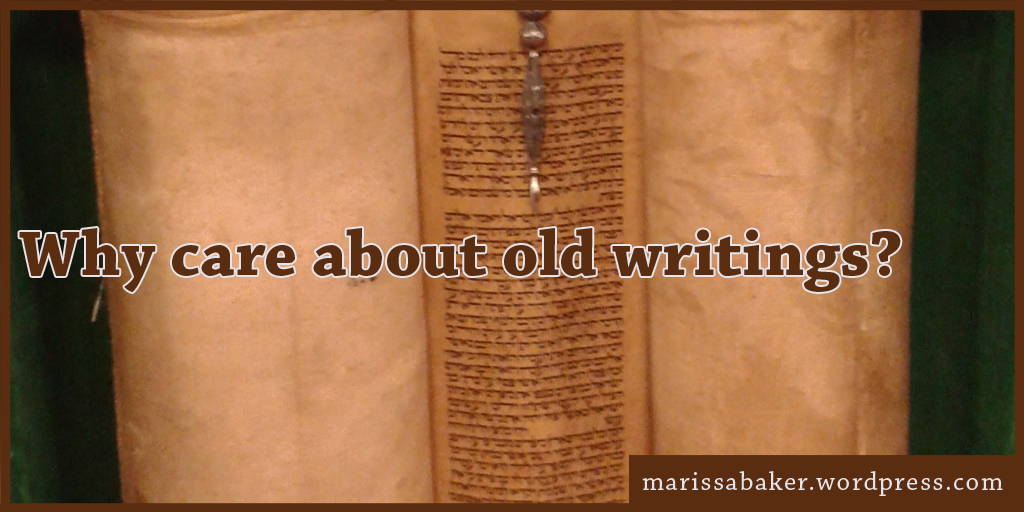
Why do we care about old writings?

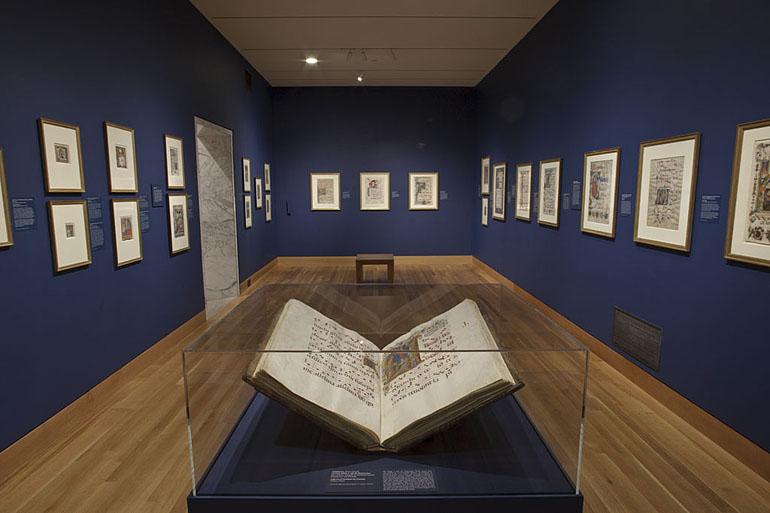
A few years ago when I was in college, one of my professors organized a small group of interested students and took us up to the Cleveland art museum. The purpose of our visit, a touring exhibit of religious artifacts from medieval Europe, was interesting, but that wasn’t what lured me there. It was the museum’s permanent collection of illuminated manuscripts.

These manuscripts date from the Middle Ages. Every page was carefully copied by hand, and they didn’t just stop there. Illuminating a manuscript with (real) gold, silver, and bright colors in illustrations and elaborate first letters turned them into works of art. The sort of books you took the time to create like this were held in high value (many are religious texts).

Why care about old writings? | marissabaker.wordpress.com
photo of Cleveland’s “The Glory of the Painted Page” collection

It’s no secret I love books. But most of the books on my shelves are, in the strictest sense, disposable and replaceable. They were impersonally mass-printed in a factory. Any meaning that particular copy has is unique to me. But for the handwritten manuscripts each copy is unique. They’re irreplaceable. And they were created with love.

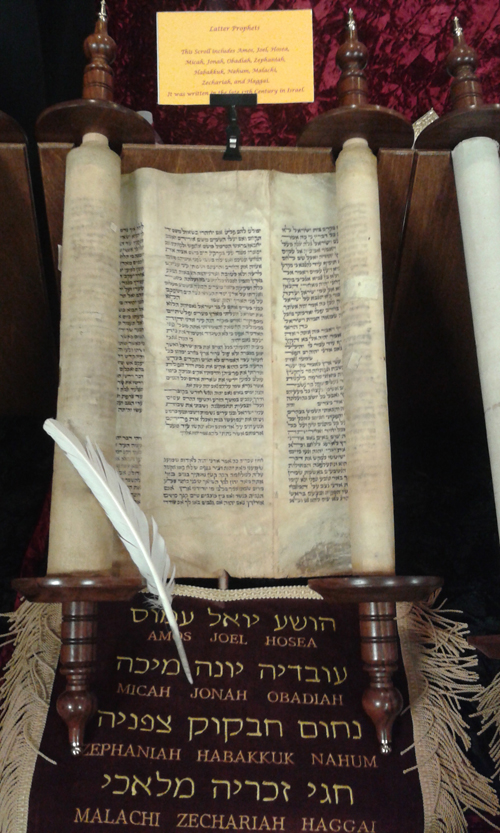
That’s also true of the ancient writings I saw yesterday. The Ancient Hebrew Scroll Project is one of only 2 or 3 complete sets of the Tanakh (Old Testament), and it’s the only one you’ll ever have a chance to see. It tours in public and there’s never any admission fee. The oldest scroll is a 600 year old Torah. Others are around 250 years old, with the exception of some scrolls too rare to obtain old copies (those are newly commissioned). Several survived the Holocaust, including a Haftorah that was bayoneted six times by Nazis.

Why care about old writings? | marissabaker.wordpress.com
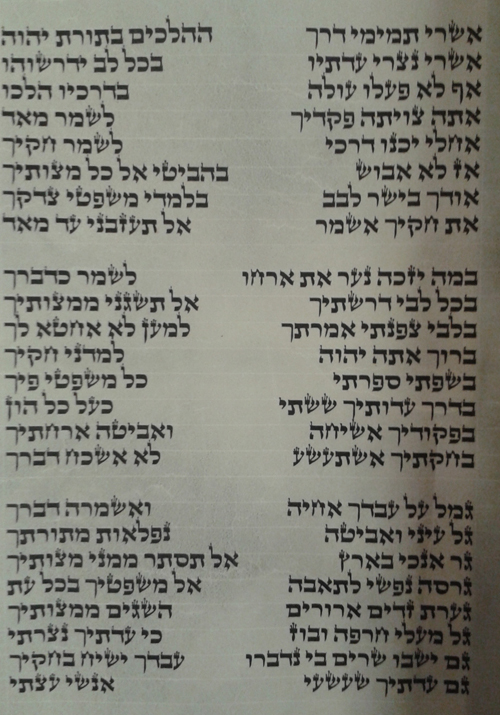
The beginning of Psalm 119 on a scroll written in 2009. Notice you can see the lines are written in sets of 8, each starting with the same Hebrew letter (that’s why it’s divided alphabetically in your English Bibles; because of the type of poem/song it is)

Every single Bible scroll, the new and the old, was created the same way. Two Levites stand holding a completed scroll open before a scribe. The scribe reads one word aloud, then writes it using a pen made from a turkey feather dipped in ink made from gall nuts, gum-Arabic, and ash. He does this for every single word with the exception of the YHWH name of God. For this word, he will not speak it aloud and before writing it he washes his hands and takes up a pen only used to write the Name.

Once the scroll is finished, the scribe counts every letter to make sure it adds up to the correct number for that scroll. If it passes that test, he gives it to another scribe for re-counting, spell-checking, and format inspection. If that scribe gives it the go-ahead, it’s given to another scribe. Only after two scribes double-check the first scribe’s work is the scroll kosher.

Why care about old writings? | marissabaker.wordpress.com
Latter (aka “Minor”) Prophets. Scroll written the late 17th Century

“So what?” some people ask. Who cares about hand-writing things like this in the age of computers? And yet this is how the Bible was preserved intact and unchanged for thousands of years. It’s the only way any writing from pre-1440 got passed down to us. There’s something about the process itself that lends meaning to the books and scrolls created with such careful attention.

New, fast, and disposable isn’t always better. There’s value in taking time to pour love and great care into something that will last. That’s one of the lessons the old writings teach us. They give us a chance to stop and ponder what we value. Something preserved in this way has to matter or it’s not worth taking the time.

Why care about old writings? (or, On Torah Scrolls and Illuminated Manuscripts) | marissabaker.wordpress.com

If there were no computers or printing presses any more, which writings would you value highly enough to copy by hand letter by letter so nothing was lost?

Save

Save

Save

Return to The Lord

Have you ever felt like your relationship with God wasn’t what it should be? I think if we’re honest, we’ve all had seasons in our lives where we knew we weren’t quite right with God. Some of us are going through that right now. Sometimes we know what put that distance in our relationship with Him, sometimes we’re not quite sure how we drifted away. We just know we need to get back.

The Jews and Messianic believers say the month leading up to Yom Teruah (Feast of Trumpets) and the 10 Days of Awe between Trumpets and Yom Kippur (Day of Atonement) are a season of teshuva. This word literally means “return.” It is derived from the word shub (H7725), which is the form used in scripture. When the Old Testament talks about people turning away from their sins, this is the word typically used (examples: 1 Kings 8:47; Eze. 14:6; 18:30). We also translate shub and teshuva as repentance.Shabbat Shuvah | marissabaker.wordpress.com

  • (Side Note: the English word “repent” in the KJV Old Testament is usually translated from nacham (H5162), to be sorry, and is most often used of God. However, our modern understanding of repentance is better expressed by shub or teshuva.)

The Theological Wordbook of the Old Testament says that all the “idioms describing man’s responsibility in the process of repentance … are subsumed and summarized by this verb shub. For better than any other verb it combines in itself the two requisites of repentance: to turn from evil and to turn to the good” (entry 2340).

Four Steps

Today is the Sabbath between Trumpets and Atonement. It’s traditionally known as Shabbat Shuvah, the Sabbath of Return. While repentance is something we do year round, this is a fitting season to think more deeply about where we stand with God and in what ways we need to turn back to Him. Read more

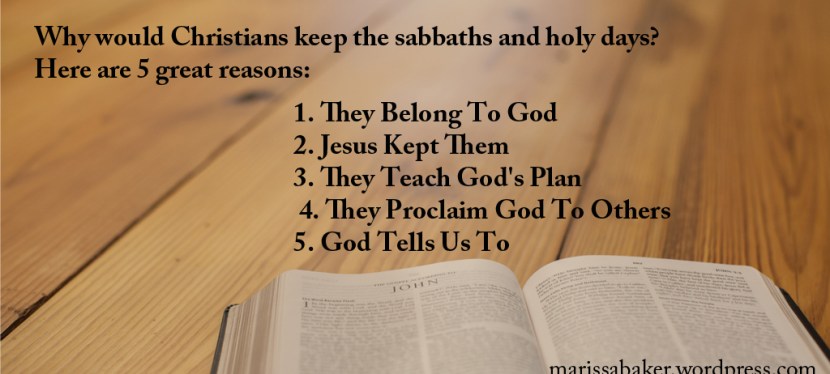
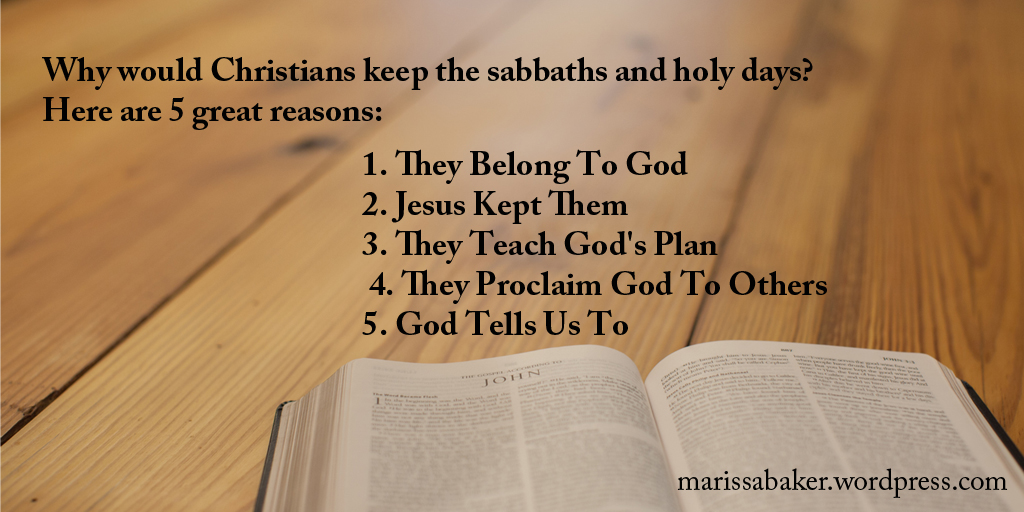
Top 5 Reasons for Christians to Keep God’s Holy Days

Today we celebrate Yom Teruah, also called Feast of Trumpets and Rosh Hashanah. But why? After all, I’m Christian and most people think of this as a Jewish holiday. Same goes for Yom Kippur/Day of Atonement, which we’ll observe 10 days from now, and Sukkot/Feast of Tabernacles that starts in two weeks.

I believe these festival observances, along with others already completed this year, are for Christians today. When Jesus came to this world, it wasn’t to set up a new religion. He was the next step in God’s plan for the world and these days are part of the covenant He makes with His family. He’s still inviting us to gather for “reunions” at certain times of the year.Top 5 Reasons for Christians to Keep God's Holy Days | marissabaker.wordpress.com

1. They Belong To God

And the Lord spoke to Moses, saying, “Speak to the children of Israel, and say to them: ‘The feasts of the Lord, which you shall proclaim to be holy convocations, these are My feasts.” (Lev. 23:1-2)

The holy days aren’t Jewish or exclusively Old Testament. They belong to God Himself. We talk about Leviticus 23 as the chapter where God gives Israel the Feasts, but that’s not quite accurate. God doesn’t say, “Here are your holy days, Israel.” He says, “These are the feasts of the Lord, holy convocations which you shall proclaim at their appointed times” (Lev. 23:4). Read more