Necessary Fire

I started this study intending to focus on the idea of Jesus Christ in us, but got distracted by the Greek word translated “reprobate” in 2 Corinthians 13:5. Digging into the root words, I found that it is a negative form of a word that refers to the process of refining metals with fire. Therefore, “reprobate” in this verse could be understood to mean someone who has not been refined by fire. Intriguing …

Untried Metals

Examine yourselves, whether ye be in the faith; prove your own selves. Know ye not your own selves, how that Jesus Christ is in you, except ye be reprobates? (2 Cor. 13:5)
"Necessary Fire" a blog post by marissabaker.wordpress.comThe word “reprobate” is from the Greek adokimos (G96). It means “Unapproved, unworthy, spurious, worthless.” It is the negative form of dokimos (G1384), which means “Proved, receivable, tried as metals by fire and thus be purified. … Hence, to be approved as acceptable men in the furnace of adversity” (Zodhiates). Here are a few places it is used:

For not he that commendeth himself is approved, but whom the Lord commendeth. (2 Cor. 10:18)

Study to shew thyself approved unto God, a workman that needeth not to be ashamed, rightly dividing the word of truth. (2 Tim. 2:15)

So, we can say that to be “reprobate” means to be the opposite of approved and refined. It is someone who has not be proved by God and tried “as silver is tried” (Ps. 66:10). In several scriptures, our refinement is likened to the purification of metals, which must be heated in a furnace to remove impurities (Zech. 13:9; Mal. 3:3). Being tested and proved is a necessary step in becoming acceptable.

Burning Buildings

In 1 Corinthians 3, Paul writes about building our lives on the foundation of Jesus Christ (1 Cor. 3:11). He is the only foundation upon which we can build a proper Christian life. However, we each build with different materials, and with differing degrees of success.

"Necessary Fire" a blog post by marissabaker.wordpress.comNow if any man build upon this foundation gold, silver, precious stones, wood, hay, stubble; every man’s work shall be made manifest: for the day shall declare it, because it shall be revealed by fire; and the fire shall try every man’s work of what sort it is. If any man’s work abide which he hath built thereupon, he shall receive a reward. If any man’s work shall be burned, he shall suffer loss: but he himself shall be saved; yet so as by fire. (1 Cor. 3:12-15)
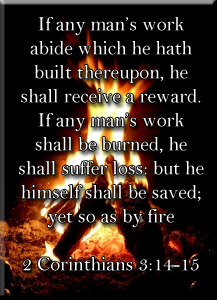
Note that the people whose work endures and those who get burned down to the foundation both have to go through the trying fire. No one is excepted from being tried in the furnace of adversity. Some come through stronger. Some “suffer loss,” but are saved to begin building again with better materials. It is part of God’s plan for making us part of His family.

If ye endure chastening, God dealeth with you as with sons; for what son is he whom the father chasteneth not? But if ye be without chastisement, whereof all are partakers, then are ye bastards, and not sons. (Heb. 12:7-8)

Without refinement and trials, we would be among those described as “reprobates” and bastards.” We need to be purified to be part of God’s family and to become a fit place for Jesus Christ to dwell.

A Habitation of God

In the verse following 1 Corinthians 3:11-15, we are told what type of building we are becoming. “Know ye not that ye are the temple of God, and that the Spirit of God dwelleth in you?” (1 Cor. 3:16). This is why we need to be refined. As we are now, we are not fit vessels to house God’s spirit and the presence of Jesus Christ. If we keep Their commandments and submit to Their work in our lives, though, we can be.

Jesus answered and said unto him, If a man love me, he will keep my words: and my Father will love him, and we will come unto him, and make our abode with him. (Jn. 14:23)

God the Father and our Lord Jesus Christ are not in the habit of holding people at arm’s length. They desire a close, personal relationship with us. They want to dwell in us now, and they want us to literally be part of Their family in the future. The writer of Hebrews describes us as a house which is built by and belongs to Christ, “if we hold fast the confidence and the rejoicing of the hope firm unto the end” (Heb. 3:6).

Now therefore ye are no more strangers and foreigners, but fellowcitizens with the saints, and of the household of God; and are built upon the foundation of the apostles and prophets, Jesus Christ himself being the chief corner stone; in whom all the building fitly framed together groweth unto an holy temple in the Lord: in whom ye also are builded together for an habitation of God through the Spirit. (Eph. 2:19-22)

One of our purposes on this earth is to be the place where God dwells. There was a time when He put His presence in a physical temple here on earth, and now He puts His presence inside the people He has chosen — a people refined in the furnace of adversity and approved by Him.

Earthen Vessels

"Earthen Vessels" a blog post by marissabaker.wordpress.com
These pots are from my first ceramics assignment.

Have you ever taken a pottery or ceramics class? In my hand-formed ceramics course that I took in college, the first assignment was to make a collection of small vessels — pots, vases, bowls, things like that. The first attempts were lumpy, unusable things. One collapsed in on itself, but it looked like a cat with a squished-in nose so I drew whiskers and eyes on the clay and kept it. Some that I thought were good enough broke in the firing. By the time I was finished, I had a small collection of “earthen vessels” that could be used to hold something, but were not much to look at on their own. It is these oddly shaped pots that I thought of when reading this verse:

For it is the God who commanded light to shine out of darkness, who has shone in our hearts to give the light of the knowledge of the glory of God in the face of Jesus Christ. But we have this treasure in earthen vessels, that the excellence of the power may be of God and not of us. (2 Cor. 4:6-7)

We are not fit to hold “the light of the knowledge of the glory of God in the face of Jesus Christ.” But our very inadequacy serves as a helpful reminder that this glory does not belong to us, and that we need to be re-made by Him. Thankfully, God is a much better potter than I am. He isn’t limited by the fact that clay pots can’t be reformed after firing. We can be fired and re-molded multiple time, “being confident of this very thing, that He who has begun a good work in you will complete it until the day of Jesus Christ” (Phil. 1:6)

Trusting The Potter

At a certain level, we are literally made of earth. The clay and potter analogy extends farther than the verses that plainly describe God as our potter.

And the Lord God formed man of the dust of the ground (Gen. 2:7)

Remember, I pray, that You have made me like clay. And will You turn me into dust again? (Job 10:9)

He knows our frame; He remembers that we are dust. (Ps. 103:14)

We are earthen vessels that God is sculpting in His own image. We are being made and remade to be fit vessels for holding God’s Holy Spirit and the very mind of Jesus Christ.

But now, O Lord, You are our Father; we are the clay, and You our potter; and all we are the work of Your hand. (Is. 64:8)

image from amchurch.net

Sculpting can be a painful process. In my ceramics class, we made hand-thrown tiles. When making tile this way, you take a lump of clay and drop or throw it onto a flat surface, pounding it until it flattens itself out enough that you can pat or roll it smooth and cut it into tiles. If the clay was animate, I suppose it would have thought this was torture, but it is a necessary step to make usable tiles. If something goes wrong, you squish the clay back up in a lump and start throwing it all over again.

Then I went down to the potter’s house, and there he was, making something at the wheel. And the vessel that he made of clay was marred in the hand of the potter; so he made it again into another vessel, as it seemed good to the potter to make. Then the word of the Lord came to me, saying: “O house of Israel, can I not do with you as this potter?” says the Lord. “Look, as the clay is in the potter’s hand, so are you in My hand, O house of Israel! (Jer. 18:3-6)

Sometimes, we might think we don’t like what God is turning us into or we find the sculpting process too painful. That’s why we need to keep our eyes on the goal, and remember Paul’s assurance “that the sufferings of this present time are not worthy to be compared with the glory which shall be revealed in us” (Rom. 8:18).

“Woe to him who strives with his Maker! Let the potsherd strive with the potsherds of the earth! Shall the clay say to him who forms it, ‘What are you making?’ Or shall your handiwork say, ‘He has no hands’? (Is. 45:9)

Antidote to Pride

"Earthen Vessels" a blog post by marissabaker.wordpress.comPaul said God has shone His light into our hearts, through we are only imperfect earthen vessels, so “that the excellence of the power may be of God and not of us.” God has chosen to share His mind and presence with His called-out people. That incredible gift could either puff us up — “God chose me because I’m something special” — or inspire humility — “if I’m special, it is only because God made me so by choosing me.”

But God has chosen the foolish things of the world to put to shame the wise, and God has chosen the weak things of the world to put to shame the things which are mighty; and the base things of the world and the things which are despised God has chosen, and the things which are not, to bring to nothing the things that are, that no flesh should glory in His presence. (1 Cor. 27-29)

Pride is one of the things God hates. I doubt very much that He would indwell a person whose habitual attitude is one of arrogance. In Proverbs 6, the list of things “the Lord hates” begins with “a proud look” (Prov. 6:16-17). In Psalms, God says, “The one who has a haughty look and a proud heart, Him I will not endure” (Ps. 101:5). We certainly do not want to foster an attitude that is unendurable to God.

Christ assured Paul, “My grace is sufficient for you, for My strength is made perfect in weakness” (2 Cor. 12:9). I wonder if the flip-side is true as well, that Christ’s strength cannot be “made perfect” in someone who thinks they do not need Him. The rest of the verse would seem to bear this out: “Therefore most gladly I will rather boast in my infirmities, that the power of Christ may rest upon me.” We may be tiny vessels made of clay, but we need not be ashamed of our weakness because it allows Christ to live and work in us.

Gift of Mortality

We tend to approach death with a kind of horror, even though we know that it is not permanent (1 Thes. 4:13-18). It is natural to value life, to not want to die and to not want to lose the people we love. I think much of our longing to live forever comes from a desire God has given us to become part of his family. But sometimes I hear people say they want to live forever, and they mean an indefinite extension of our human lives here on the earth.  Personally, I wouldn’t want to live with myself the way I am now for that long.

Elves leaving Middle Earth, from The Lord of The Rings

When I think about the idea of immortality or living a really long time as a human, it makes me think of Tolkein’s elves in Middle Earth. Unless something interferes (they can be killed and they can fade away with grief) they’ll live forever. One of the things I find most interesting is that in The Silmarillion, the immortality of the elves is described as a sorrow and death is presented as a gift given to men.

the children of Men dwell only a short space in the world alive, and are not bound to it, and depart soon whither the Elves know not. Whereas the Elves remain until the end of days, and their love of the Earth and all the world is more single and more poignant therefore, and as the years lengthen ever more sorrowful. For the Elves die not till tile world dies, unless they are slain or waste in grief (and to both these seeming deaths they are subject); neither does age subdue their strength, unless one grow weary of ten thousand centuries; and dying they are gathered to the halls of Mandos in Valinor, whence they may in time return. But the sons of Men die indeed, and leave the world; wherefore they are called the Guests, or the Strangers. Death is their fate, the gift of Iluvatar, which as Time wears even the Powers shall envy.

Sown in Weakness

Death became something that every human being must face as a consequence of Adam and Eve’s sin. I wonder, however, if after the fall mortality might have been as much a gift as a curse. Yes, death is a penalty associated with disobedience to God and it is an enemy that will be conquered in the future. But the absence of death in our fallen state would not have been a kindness.

Foolish one, what you sow is not made alive unless it dies. And what you sow, you do not sow that body that shall be, but mere grain—perhaps wheat or some other grain. But God gives it a body as He pleases, and to each seed its own body. (1 Cor. 15:36-37)"Gift of Mortality" a blog post by marissabaker.wordpress.com

We are “bare grain,” as the KJV says, which after it dies to this existence will spring up into the far more glorious body that God gives us. Thank God that immortality is not give not us as we are now — corrupted, dishonored, weak, and natural. Living like this forever would not be a gift. We cannot have eternal life as we are now, nor would we want to. We need to be changed first.

For this corruptible must put on incorruption, and this mortal must put on immortality. So when this corruptible has put on incorruption, and this mortal has put on immortality, then shall be brought to pass the saying that is written: “Death is swallowed up in victory.” (1 Cor. 15:53-54).

When I Am Weak

"When I Am Weak" a blog post by marissabaker.wordpress.comI hope all of you had a wonderful Thanksgiving. My family gathered at my Uncle’s house for turkey, lots of mashed potatoes, euchre playing, and several enthusiastic Apples to Apples games that could probably have been heard by people driving by in their cars.

Today, I have another C.S. Lewis quote to share with you. As I think I mentioned in last week’s post, I’ve been reading The Problem of Pain. In chapter 6, he makes this statement: “tribulations cannot cease until God either sees us remade or sees that our remaking is now hopeless.”

Comfortable Dirtiness

To put this statement in context, Lewis was talking about human tendency to only turn our attention to God when things are going badly in our lives. When we are scared or in pain, we rush to God and ask him to take it away and bring us through the trial. But all to often, we try our best to forget the thing that brought us back to God as soon as that prayer is answered.

God has had me for but forty-eight hours and then only by dint of taking everything else away from me. Let Him but sheathe that sword for a moment and I behave like a puppy when the hated bath is over — I shake myself dry as I can and race off to reacquire my comfortable dirtiness, if not in the nearest manure heap, at least in the nearest flower bed. And that is why tribulations cannot cease until God either sees us remade or sees that our remaking is now hopeless.

We need our weaknesses and our sufferings to help bring us into God’s family. I did a search for the word “suffer” in the KJV, and found it used more than 50 times to refer to Christ’s suffering and/or the necessity of us following in His footsteps.

For to you it has been granted on behalf of Christ, not only to believe in Him, but also to suffer for His sake (Philippians 1:29)

Importance of Fire

Beloved, do not think it strange concerning the fiery trial which is to try you, as though some strange thing happened to you; but rejoice to the extent that you partake of Christ’s sufferings, that when His glory is revealed, you may also be glad with exceeding joy. (1 Peter 4:12-13)

The analogy of a refining fire is one that is frequently used in scripture. Gold and silver are purified by fire (Zech. 13:9), pottery needs fired to give it strength (Is. 64:8). We tend often think of fire as a bad thing, perhaps because of the association with fiery punishment. But fire in the context of trials has a positive connotation. Even if the affects are unpleasant, the result should be us moving ever closer to glory.

But may the God of all grace, who called us to His eternal glory by Christ Jesus, after you have suffered a while, perfect, establish, strengthen, and settle you. (1 Peter 5:10)

God Hasn’t Given Up

There are two ways we can take the idea Lewis expresses when he says, “tribulations cannot cease until God either sees us remade or sees that our remaking is now hopeless.” We can either get depressed and worn down by the realization that trials will not end until we are perfected, or we can look at trials as proof that God hasn’t given up on making us like Christ.

And lest I should be exalted above measure by the abundance of the revelations, a thorn in the flesh was given to me, a messenger of Satan to buffet me, lest I be exalted above measure. Concerning this thing I pleaded with the Lord three times that it might depart from me. And He said to me, “My grace is sufficient for you, for My strength is made perfect in weakness.” Therefore most gladly I will rather boast in my infirmities, that the power of Christ may rest upon me. Therefore I take pleasure in infirmities, in reproaches, in needs, in persecutions, in distresses, for Christ’s sake. For when I am weak, then I am strong. (2 Corinthians 12:7-10)

Free In Christ

I didn’t realize until I saw this post still in drafts that there wasn’t a Saturday post last week. Oops. Well, here it is now.

Then Jesus said to those Jews who believed Him, “If you abide in My word, you are My disciples indeed. And you shall know the truth, and the truth shall make you free …

“Most assuredly, I say to you, whoever commits sin is a slave of sin. And a slave does not abide in the house forever, but a son abides forever. Therefore if the Son makes you free, you shall be free indeed.” (John 8:31-32, 34-36)

What happens once we are made free from sin? Some people (especially those in Western cultures, I suspect) tend to think of freedom as license to do whatever they want. This is not what is meant by the freedom that we are given in Christ.

And having been set free from sin, you became slaves of righteousness. (Rom. 6:18)

The Bible reveals that we have only two options: service to sin or service to God. Though we are “not under law but under grace,” that does not give us license to disobey. Under the New Covenant, God’s commandments are still in effect, and He requires obedience from those who love Him (John 14:15, 21).

What then? Shall we sin because we are not under law but under grace? Certainly not! Do you not know that to whom you present yourselves slaves to obey, you are that one’s slaves whom you obey, whether of sin leading to death, or of obedience leading to righteousness? (Rom. 6:15-17)

"Free In Christ" marissabaker.wordpress.comThis does not mean we can earn eternal life by obedience — it is a free gift from God (Rom. 6:23). However, we can show by disobedient actions that we refuse to accept His gift. When we do that, it’s as if someone pulled us from a burning building and said, “Don’t go back in there,” and instead of obeying we marched right back inside because we thought the heat felt good.

Once we have been redeemed by Jesus Christ, we have to respond by walking not “according to the flesh, but according to the Spirit” (Rom. 8:1). We will surely slip and fall, but we have to stop willfully sinning and make a genuine effort to change and obey. The habit of our life has to become Christ-imitating instead of sinful.

For this is the will of God, that by doing good you may put to silence the ignorance of foolish men — as free, yet not using liberty as a cloak for vice, but as bondservants of God. (1 Pet. 2:15-16)

The Subject of Kneecaps

I’m a little fuzzy on the subject of violence in the Bible, and talking with or reading the opinions of other Christians doesn’t make it any less confusing. We can all agree murder is wrong. After that, there doesn’t seem to be much agreement at all. Should a Christian use violence, sometimes even deadly violence, to save someone’s life or defend themselves?

Zoë: “Preacher, don’t the Bible have some pretty specific things to say about killin’?”

Book: “Quite specific. It is, however, somewhat fuzzier on the subject of kneecaps.”

— Firefly, episode 9 “War Stories”

In this situation in Firefly, Shepherd Book armed himself and joined his shipmates to rescue Malcolm Reynolds from torture and death. He did not violate the commandment “You shalt not murder,” or even the King James’ rendering “Though shalt not kill” (Ex. 20:13). But does this kind of violence violate the spirit, if not the letter, of such commandments? If he had killed in self-defense, would it have been wrong?

Murder vs. Killing

I don’t think there is any question about murder being wrong. Even in societies without the Bible as a guide, laws against murder are usually part of the culture. It’s on the subject of “killing” where things get sticky for Christians. If someone is attacking your family, is it permitted to use violence to stop them? Does unintentionally killing someone who is trying to harm you make guilty of murder in God’s eyes?

The Hebrew word translated “kill” or “murder” in Exodus 20 is râtsach (H7523). Strong’s defines it as, “to dash in pieces, that is, kill (a human being), especially to murder.” Like many Hebrew words, the exact meaning is dependent on the context, and The Complete WordStudy Dictionary: Old Testament points out that the word is used “to indicate premeditated murder” as well as “an accidental killing,” slaying someone as an “act of revenge,” and “death by means of an animal attack.” Other scriptures help narrow down the definition, as C.S. Lewis points out in this quote from Mere Christianity.

It is no good quoting “Thou shalt not kill.” There are two Greek words: the ordinary word to kill and the word to murder. And when Christ quotes the commandment He uses the murder in all three accounts. … All killing is not murder any more than all sexual intercourse is adultery.

The Issue of Hate

Should Christians defend themselves? "The Subject of Kneecaps" marissabaker.wordpress.comC.S. Lewis was not a pacifist (he wrote a whole article on the “why” of this viewpoint, but I have yet to find a copy). I admire his writings, but there are other people whose opinions I admire who are adamant that it is wrong for a Christian to serve as a soldier and wrong for a person to kill someone in self-defense.

For some people, I think the distinction between murder and killing comes down to the idea of a death being accidental and/or premeditated. We know from the instructions God gives for cities of refuge (Joshua 20) that accidental killings  do not come under the death-penalty ascribed to murder. The reasons given for not condemning a man who accidentally caused his neighbor’s death are these: “he struck his neighbor unintentionally, but did not hate him beforehand” (Josh. 20:5).

People seem to go two ways on interpreting this verse. One: killing someone in self defense does not constitute murder because you “did not hate him before hand.” It was not a premeditated, vengeful killing, therefore it is considered an accident. C.S. Lewis seems to come down on this side when he says, “We may kill if necessary, but we must not hate and enjoy hating.”

Whoever hates his brother is a murderer, and you know that no murderer has eternal life abiding in him. (1 John 3:15)

Deliberate Self-Defense

The second argument I’ve heard goes something like this: planning to defend yourself makes the death premeditated. You might not be deliberately trying to kill a specific person, but if you intend to kill whoever attacks you and your family, the killing was planned. This also means you don’t fulfill the requirement “he struck his neighbor unintentionally.”

Something doesn’t sit well with me about this last viewpoint. Perhaps it’s partly the implication that most people who intend to defend themselves if attacked also have a desire to kill (which I don’t see in the people I know who are prepared to defend themselves). There are also elements of hypocrisy. The person who thinks self-defense is wrong will probably not hesitate to call 911, and if the person attacking them is killed by police officers I’m not sure they’d feel terribly guilty.

I don’t have much of a conclusion for this post. In theory, I tend to lean more towards C.S. Lewis’s views. In practice, though, one of the reasons I quit Tae Kwon Do is because I hated even practicing how to hurt people. What are your thoughts on this subject?