Letting Our Messiness Out So We Can Heal

They say confession is good for the soul. Usually when I think of confession, though, I picture a scene from a crime drama. I’ve never really studied the idea in its Christian context until writing this post.

Recently during a small group meeting, a friend made the statement that holding in our mess can prevent healing. I quickly scribbled it down in my notes since that’s an idea I’ve been championing since I started talking more openly about my anxiety. To give you some context for this comment, we’d just read this verse:

Confess your offenses to one another, and pray for one another, that you may be healed. The insistent prayer of a righteous person is powerfully effective. (James 5:16, WEB)

Given James’ word choices here, we can say for certain that he’s telling us there’s a connection between healing and openly acknowledging the ways we slip into error. The Greek words are specifically about confessing faults, offences, and trespasses. I don’t think it’s too much of a stretch, though, to extend this principle to other struggles as well including those that are not, strictly speaking, sinful.

To share a personal example, trying to hide my mental health struggles only made them worse. I felt shame and guilt around my anxiety and depression. I worried that others would find out about them, which just increased my levels of anxiety. I didn’t start to find healing until I opened up about my struggles to friends, family, a counselor, and even publicly here on this blog.

Bringing Dark Things To Light

God has a habit of shining light into dark places. Jesus even went so far as to say “nothing is hidden that will not be revealed; nor anything secret that will not be known and come to light” (Luke 8:17, WEB). While God works in ways that are mysterious and sometimes hidden from us, there is no darkness in Him. He is all light and those who love Him want to walk in that light. Read more


How To Find Peace With What God Expects: Learning From Moses’ Five Questions

Have you ever heard someone say that if you’re doing what God wants you to do you’ll know because you’ll have peace with it? This is one of those Christian-ish sayings that sounds good at first, but doesn’t always hold up to more rigorous scrutiny.

Take Moses for example. When God called him to lead the children of Israel out of Egypt Moses did not feel peace with this mission. In fact, he tried to talk God out of picking him five times in this conversation. I find it interesting that God wasn’t angry with the fact that Moses didn’t have a peace with his calling at first. The Lord only got angry when Moses begged Him to send someone else.

God doesn’t need us to feel like we can handle what He asks us to do (He’ll help us out with that). He just needs us to be willing to trust where He’s leading and walk forward with Him. That’s part of what His responses to Moses’ five questions can teach us.

First Question

Moses said to God, “Who am I, that I should go to Pharaoh, and that I should bring the children of Israel out of Egypt?” (Ex. 3:11, WEB)

It’s a reasonable question, one we would expect from the man later described as “very humble, more than all the men who were on the surface of the earth” (Num. 12:3, WEB). In fact, if Moses was the sort of person who thought he was perfectly qualified and able to do this God probably wouldn’t have chosen Him. Our Lord has a practice of choosing “the lowly things of the world … that no flesh should glory before God” (1 Cor. 1:28, 29, WEB).

He said, “Certainly I will be with you. This will be the token to you, that I have sent you: when you have brought the people out of Egypt, you shall serve God on this mountain.” (Ex. 3:12, WEB)

God’s answer to the human question, “Who am I?” is “I will be with you.” It’s not about who we are when we’re called to do something for God. It’s about who He is and His power to work in and through humble, teachable people. Read more

There’s Only One Sovereign, And It Isn’t Me

One of the things I’ve discovered as I’ve confronted and worked through my anxiety is that (for me at least) much of it is connected to control. I fear being controlled, losing control, and not having control. Not being able to predict, plan, and prepare for things can leave me shivering, sweating, and struggling to breathe.

I know part of this goes along with anxiety as a mental health condition. But there’s also a layer that’s something human beings — no matter how their brains function — have struggled with for years. We don’t want to accept “that control is an illusion. There is only one Sovereign … and it isn’t me” (What Does Your Soul Love?).

Now, by saying this I don’t mean for us to think, “Great, one more thing I need to ‘fix’ about myself. As if there wasn’t enough on the list already.” That kind of response is still trying to cling to our own control over the situation. Not only that, it leads to self-condemnation which (as a friend recently reminded me) is not a good place to be. Instead, the solution to grasping for control we can’t really have is to surrender everything to God and trust Him to be God.

Let Go, and Let God

I’ve been reading a new book, which will be out in September, called What Does Your Soul Love? by Alan and Gem Fadling. Chapter 8’s title is “Control: What Are You Clinging To?” Reading it has been a challenging, but it’s one that I’ve found both convicting and helpful.

“Much of the anxiety we carry is actually brought on by our own fear and a desire for control. We want to put our fears to rest, so we try to control people and situations …

“Letting go is one of the greatest gifts you can give yourself … [It] is a process, and the loving arms of God are a good place to start” (What Does Your Soul Love?)

Of course, my first response to this was trying to come up with a plan for how I can get better at letting go. Then the book hit me with the line, “We want to get control of our transformation and cling to personal strategies of how to make it happen.” I do that. Even reading this book is another step in trying to get reliable, controllable strategies for fixing myself.

“Sometimes, my implicit prayer when it comes to change has ended up as something like, ‘Lord, change me … as long as I can be in control of how it happens.'” (What Does Your Soul Love?)

Ouch. I do that, too. The unknown is scary, but “I’m afraid” isn’t a good excuse for not putting yourself in God’s hands. Attempting to control things ourselves certainly isn’t safer than trusting the only all-powerful and all-loving Beings in the universe. The Father and Jesus are perfectly capable of handling anything we face and They want us to let Them help. Also, They’re not going to condemn us for struggling. God is love, and filling us with His love is how He transforms us. Read more

The Value of Being Slow To Anger

The Old Testament often describes God as “slow to anger.” A more literal translation of the Hebrew is actually “long-nosed,” which makes no sense in English. But it’s a picture of a person who takes a long time to reach the point where they’re so angry that their nostrils flare and the air whooshes through their nose like a bull about to charge.

The phrases “slow to anger” and“long-suffering,” are both translated from two Hebrew words — “long” and “breath/passion/heat/anger.” The Greek equivalent is typically translated “patience” or “long-suffering.” It’s not about never getting angry, but about having control over when that happens and not flying off into a rage.

Anger is not inherently sinful. God gets angry, and Paul also tells us we can be angry without sinning (Eph. 4:26). But God doesn’t get angry quickly or without good cause, and we shouldn’t either. So how can we become “slower to anger” and “longer suffering”?

Quick Anger Fuels Strife

I think the dividing line between anger that is and is not sinful can be found in the effect that it has. Jesus throwing those who were exploiting believers out of the temple? Righteous anger. Me getting so upset at someone that I say something nasty which leads to conflict? Sinful anger.

God hates arrogance, wicked schemes, and discord. So if your anger is causing these (or anything else He hates), then it is leading to sin. There are several Proverbs addressing this. Here are a few: Read more

When You’re Crushed Like Dust

Have you ever felt like your spirit is crushed and your heart broken? Like you’ve been pounded into dust or smashed to smithereens?

Those are the definitions for the Hebrew words shabar (H7665, broken) and dakka (H1793, crushed). I bring them up because I want to talk about this verse from Psalms:

Yahweh is near to those who have a broken heart, and saves those who have a crushed spirit. (Psalm 34:18, WEB)

When you’re ground down like dust and broken into pieces, God is there beside you. We often want Him to prevent or remove bad things but it seems that in most cases His preference is to walk with us through hardship rather than stop it from ever happening. We are promised deliverance, but in His timing, not ours.

Suffering and Deliverance

Let’s read some of the context for this verse (you can click here to read the whole Psalm).

The righteous cry, and Yahweh hears, and delivers them out of all their troubles. Yahweh is near to those who have a broken heart, and saves those who have a crushed spirit. Many are the afflictions of the righteous, but Yahweh delivers him out of them all. (Psalm 34:17-19, WEB)

It’s clear from this psalm that righteousness doesn’t exempt us from bad situations. In fact, “many are the afflictions of the righteous” and they have to cry to Yahweh for deliverance. That holds true for believers throughout the ages.

I endured those persecutions. The Lord delivered me out of them all. Yes, and all who desire to live godly in Christ Jesus will suffer persecution. (2 Tim. 3:11-12, WEB)

Here’s Paul, centuries after David, expressing the same truths. Those who follow God must expect to endure afflictions and persecutions, but they can also expect deliverance. Read more

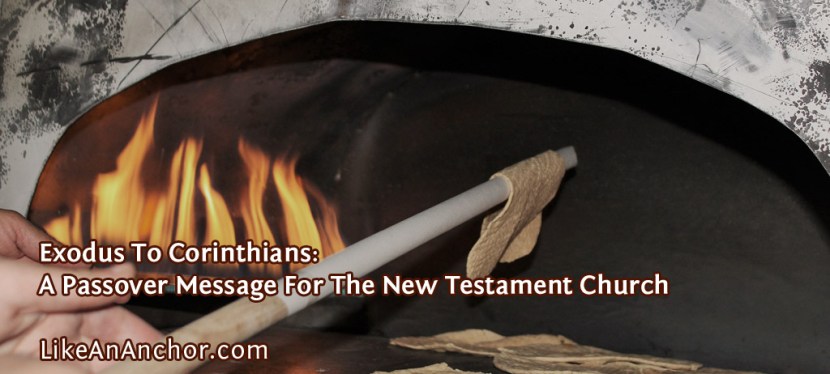
Exodus To Corinthians: A Passover Message For The New Testament Church

In 1 Corinthians, Paul makes several references to leavening and to Passover. For many readers today, these references mean very little because so many Christian churches have left the roots of their faith, which Paul was referencing here. In order to really understand key passages of 1 Corinthians, we need to understand Passover and the Feast of Unleavened Bread.

I know some (perhaps quite a few) of you are Christians who don’t keep Passover, but I hope you’ll still keep reading today’s post. I think you’ll find it interesting and maybe it’ll give you something new to think about and study.

Passover Background

The Passover story begins in Exodus 12. We’re nearing the end of the plagues of Egypt, and the Lord is telling Moses what the Israelite must do to avoid the final plague — the death of the first born. In the first month of the year, on the evening that begins the 14th day (Hebrew days begin at sunset), Israel was to kill a young male lamb, paint the door posts of their houses with its blood, then roast the lamb whole and eat it with unleavened bread and bitter herbs (Ex. 12:1-13).

This day shall be to you for a memorial, and you shall keep it a feast to Yahweh: throughout your generations you shall keep it a feast by an ordinance forever. (Ex. 12:14, WEB)

The Lord goes on to describe a festival of unleavened bread (matzah) that follows the Passover. For seven days, no leavening (hametz) is permitted in anyone’s house and whoever eats leavened food will be cut off from God’s people (Ex. 12:15-20). Later instructions in Leviticus clarify the timing of all this, stating that Passover is on the 14th and Unleavened Bread begins with a holy convocation on the 15th, then ends with another holy convocation on the seventh day (Lev. 23:4-8). The two holy days are Sabbaths of rest where you are not to work, much like the weekly Sabbath.

The New Covenant Passover

Moving into the New Testament, the gospels make careful note of Passovers that Jesus kept during his ministry. The first is recorded in John 2:13-23. The second is skimmed over, though Luke 6:1 probably references the last day of Unleavened Bread. John 6:4 mentions the third Passover, and Christ’s final Passover is recorded in detail by all four gospels because that was the day He died.

He said to them, “I have earnestly desired to eat this Passover with you before I suffer, for I tell you, I will no longer by any means eat of it until it is fulfilled in God’s Kingdom.” (Luke 22:15-16, WEB)

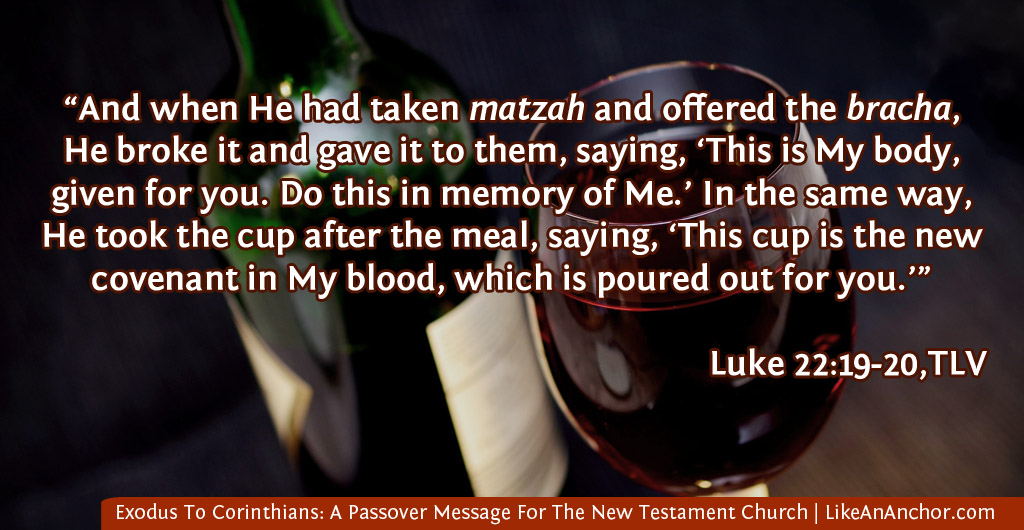
He then proceeded to institute new Passover symbols for New Covenant believers. Jesus will not partake of the Passover again until the kingdom of God comes in the future, but He tells us to do so in memory of Him (Luke 22:17-20).

For I received from the Lord that which also I delivered to you, that the Lord Jesus on the night in which he was betrayed took bread. When he had given thanks, he broke it, and said, “Take, eat. This is my body, which is broken for you. Do this in memory of me.” In the same way he also took the cup, after supper, saying, “This cup is the new covenant in my blood. Do this, as often as you drink, in memory of me.” (1 Cor. 11:23-25, WEB)

Exodus To Corinthians: A Passover Message For The New Testament Church | LikeAnAnchor.com
Photo credit: congerdesign via Pixabay

Honoring Jesus By Keeping The Passover

The passage we just read from 1 Corinthians 11 is part of the most obvious Passover reference in this letter. Paul goes on to share instructions on how we’re supposed to prepare for Passover, as well as warnings about the dangers of not keeping Passover the correct way. Read more