The Martian Chronicles

I’d actually forgotten this was on my Classics Club Book List and just started reading it because I saw it on the shelf. Now I have to write something. But first …

I just read some really exciting literary news that I want to share with you. There’s going to be a web-series re-telling of The Scarlet Pimpernel in a modern setting (think something like what The Lizzie Bennet Diaries did with Pride and Prejudice). You can find more about it at Yet Another Period Drama blog or The Day Dream blog. It sounds fantastic, and I’m so looking forward to seeing it next year.

Anyway, back to Mars.

*insert obligatory spoiler warning*

I really wasn’t sure what to expect from this book. All I knew was that it was written by Ray Bradbury (which pretty much guaranteed it would be intriguing) and it had something to do with Mars. The inside cover of my edition reads, “Ray Bradbury’s Mars is a place of hope dreams, and metaphor.” With that introduction, I was not expecting more than 20 people to have been killed by page 65 (and many more in the following pages). Warning: this is not a “happy” book.

If you’re not expecting a light, happy read, though, this book is fascinating. I think most of us know by now that Mars is not inhabited (as least not by aliens of this sort), but the world Bradbury creates on Mars still seems entirely possible. He has no trouble convincing his readers into a “willing suspension of disbelief,” probably because he doesn’t try. He just writes these stories as if they are real (but more in the sense of myth than history), and we’re perfectly happy to go right along with this fiction.

One of my favorite parts of the book was actually Bradbury’s introduction (You might be a writer if … you’re as intrigued by the author’s description of his writing process as you are by the book itself). He describes the stories that became The Martian Chronicles as “a series of Martian penseés, Shakespearean ‘asides,’ wandering thoughts, long night visions, predawn half-dreams.” He thought they weren’t anything special, until an editor “suggested that I might have woven an unseen tapestry.”

The Martian Chronicles was published in 1950. Since then, it has never been out of print, and my edition notes that it “has been read by more readers around the world than almost any other work of science fiction.” But Bradbury himself didn’t think of it as “science fiction.” This is what he said this book was:

It is King Tut out of the tomb when I was three, Norse Eddas when I was six, and Roman/Greek gods that romanced me when I was ten: pure myth. If it had been practical technologically efficient science fiction, it would have long since fallen to rust by the road. But since it is a self-separating fable, even the most deeply rooted physicists at Cal-Tech accept breathing the fraudulent oxygen atmosphere I have loosed on Mars. Science and machines can kill each other off or be replaced. Myth, seen in mirrors, incapable of being touched, stays on. If it is not immortal, it almost seems such.” — Ray Bradbury, introduction to The Martian Chronicles

Religion on Mars

There are so many threads that weave together The Martian Chronicles. It covers book banning, inadvertent genocide, the nature of man, implications of telepathy, ethics of murder — the list goes on and on. So I’m going to pick just one “thread” to talk about here, and that’s religion.

On Mars, science and religion are not incompatible — they are interconnected. Unfortunately, we only learn this after most of the Martians are already gone and it is too late for the knowledge to help mankind put back together what we separated.

Science is no more than an investigation of a miracle we can never explain, and art is an interpretation of that miracle.” — Ray Bradbury, The Martian Chronicles

Mankind has it all wrong, according to one character who may or may not have lost his mind. Instead of letting science, religion, and art flow into each other, as the Martians did, we tried to separate them. In the process, we lost ourselves and our faith. Then, not content with damaging one world and its people, we moved on to Mars, and killed it.

But The Martian Chronicles isn’t just about all the mistakes humanity made as a whole. It’s about the individuals who lived, loved, killed, and died for a whole host of different reasons. It’s about the priest who believes that even the glowing blue lights on Mars — the last Martians — have a soul and deserve to hear about Christ. It’s about the father who launched his family toward an abandoned Mars to save them from a dying earth. It’s about the young Martian whose telepathy turned him/her into a chameleon as he/she tried desperately to cure their loneliness by becoming a human family’s dead child. It’s about how these people respond to the unknown, and what beliefs they cling to in the end.

I read this book quickly, because I was so intrigued by it, but not so quickly as I have read other novels. It demands more than a cursory glance, and I think it warrants at least one re-reading. If you like “thinking books,” or sci-fi of any kind, I highly recommend giving The Martian Chronicles a try.


Click here to get a copy of The Martian Chronicles. Please note that this is an affiliate link. This means that, at no additional cost to you, I will receive a commission if you click on the link and make a purchase.

The Phantom of the Opera

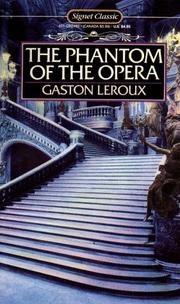
I choose The Phantom of the Opera by Gaston Leroux as the first book to read off my Classics Club book list for one simple reason. I had a dream about it.

The edition I read

Now, understand I’ve never read this book before. It’s not even one I checked out of the library, flipped through, and lost interest in. So when I dreamed about seeing the written pages of this book morph into film-like scenes that were not in the 2004 film or the play I saw this year, I decided I needed to read this book. It’s not unusual for me to dream vividly, but it was a bit odd to construct such an elaborate version of  something I hadn’t thought about recently.

So I ordered it into the library and read it (in translation, unfortunately, since my French isn’t very good). And I was pleasantly surprised to enjoy the book. It must have been almost 10 years ago that I first became seriously interested in the musical The Phantom of the Opera, and at the time I decided against reading the book because so many reviewers I read said they were disappointed. They said if you like the play, don’t bother reading the book because Andrew Lloyd Webber somehow managed to pull brilliance out of a terrible novel.

Overall Impressions

It is not a terrible novel, though I understand why some readers didn’t like it. Many who love the musical expect a more romantic Phantom character, while Leroux’s Erik (a.k.a. The Phantom) is firmly rooted in a Gothic tradition of villainy. He sleeps in a coffin. His lair includes a torture chamber. He has no nose in his deathly-pale face.

But we’ll get to comparing it with the play later. For now, back to the book. It is written as if by a narrator who began studying the events surrounding the tragedy of the Paris Opera House about 30 years after its haunting by the “ghost.” This haunting coincided with the famous disappearance of Christine Daaé and the Vicomte de Chagny. Our narrator connects these two events, interviews the only witness who is both surviving and locatable, and happens into possession of some very intriguing documents attesting to the ghost’s antics. In short, he is uniquely positioned to be the only person qualified to uncover the truth regarding the opera ghost.

Parts of the story are told as we would think of a “normal” 3rd-person narration, others are the narrator’s conjectures about what might have taken place, still others are written as if borrowed from the memoirs of a few key characters. This rather disconnected narrative style works surprisingly well, and there were only a few places where I thought it jarring to be reminded that the narrator is supposedly piecing this story together from multiple sources of evidence.

Comparing Phantoms

The Phantom of the Opera (1925)

Probably the main change from the book to the play is how Erik is portrayed. This blog post about The Many Faces of Erik collects pictures of the Phantom’s portrayal in film and on stage, both before and after Webber’s musical. I could have nightmares about that face from the 1925 version, but it’s probably the closest to Erik in the book.

Erik is described as having “a death’s head,” and his hands are skeletal and cold. Even the most ghoulish Phantom make-up in Andrew Lloyd Webber’s musicals can be hidden under a half-mask. In the book, the entire man is deformed in some vague way that can’t really be hidden. The people who glimpse him even in disguise get the impression of a ghost or skeleton.

And his character is more twisted in the book as well. In the play, we know the Phantom as a genius who has gone mad and kills to protect his secrets. In the book, we are given more of Erik’s back-story and made to see him not as an unstable, unloved man who is carried away by his passion, but as a violent man without a conscience who has a history of inventing new ways to kill and torment people for pleasure. He captures our imagination, our horror, our pity, but not our love.

Angel of Music

Christine and Raoul’s back-story was very similar in the book and play, with the book simply being more fleshed-out. I liked Raoul less in the book, though. He seems a rather pale, helpless character who follows Christine around vacillating between hating of her for loving someone else and being willing to do anything to protect her from Erik. If he was translated perfectly from the book to the musical and the changes for the Phantom left in place, I doubt there’s be any part of me hoping for Raoul to win Christine.

Poor Christine, in the book and play, was doomed by her father’s promise to send her the Angel of Music. This is built-up even better in the book, with her father telling stories about how the greatest musicians heard the Angel of Music, who moved them from talented to unforgettably brilliant. Christine’s father was a great violinist, but never heard the Angel. His daughter, however, was waiting for him to send one from heaven, and when Erik first sings to her she asks if he is her Angel. He grasps the title eagerly, and she’s lost to his music.

His voice first appears in the book simply as a speaking voice — the man Raoul hears but cannot find in Christine’s dressing room and the invisible speaker in Box 5. Madam Giry calls it “such a lovely man’s voice … so soft and kind.” When Erik finally sings, the word “captivating” hardly seems to do the listeners’ reactions justice:

The voice without a body went on singing; and certainly Raoul had never in his life heard anything more absolutely and heroically sweet, more gloriously insidious, more delicate, more powerful, in short, more irresistibly triumphant. He listened to it in a fever and he now began to understand how Christine Daaé was able to appear one evening, before the stupefied audience, with accents of a beauty hitherto unknown, of a superhuman exaltation, while doubtless still under the influence of the mysterious and invisible master.

Sierra Boggess as Christine and Ramin Karimloo as The Phantom in “Phantom Of The Opera At Royal Albert Hall.”

The voice was singing the Wedding-night Song from Romeo and Juliet. Raoul saw Christine stretch out her arms to the voice as she had done, in Perros churchyard, to the invisible violin playing The Resurrection of Lazarus. And nothing could describe the passion with which the voice sang: “Fate links thee to me for ever and a day!”

The strains went through Raoul’s heart. Struggling against the charm that seemed to deprive him of all his will and all his energy and of almost all his lucidity at the moment when he needed them most, he succeeded in drawing back the curtain that hid him and he walked to where Christine stood. (from Chapter IX)

Michael Crawford (original Broadway cast), Ramin Karimloo (25th anniversary cast), and Cooper Grodin (touring cast I saw in Columbus) have voices like this. That spectacular voice, which mesmerizes Christine and the audience, is the secret of Erik’s allure. Without it, he would just be a hideous man with an even more hideous soul hiding under an opera house. But add this voice, and he becomes something unforgettable — the dark menace who should be repulsive but is somehow irresistible.


Click here to get a copy of The Phantom of the Opera. Please note that this is an affiliate link. This means that, at no additional cost to you, I will receive a commission if you click on the link and make a purchase.

The Classics Club

In my never-ending search for new things to write about, I stumbled upon The Classics Club by way of Carissa’s post at Musings of an Introvert. I love classic literature (not really a surprise to most of you — if someone doesn’t like at least some classic literature they probably shouldn’t major in English), so why not come up with a reading list and blog about each title? That will give me topics for 10 of Mondays blog posts for the next five years.

The Classics Club | marissabaker.wordpress.com

The challenge for those who join The Classics Club is to make a list of at least 50 books and read through it in no more than 5 years. I thought 10 books a year would be thoroughly doable (to put this in perspective, I’ve read 45 books so far this year), and so I posted my list and I’m signing up today. Some of them are re-reads, but most of the ones on the list are new to me. The titles on the list may change as I read, but here are the one I’m starting out with (*indicates a re-read):

  1. Adams, Richard: Watership Down*
  2. Anonymous: The Arabian Nights
  3. Austen, Jane: Lady Susan
  4. Beagle, Peter S: The Last Unicorn
  5. Bradbury, Ray: The Martian Chronicles
  6. Bronte, Anne: The Tenant of Wildfell Hall
  7. Bronte, Charlotte: Villette
  8. Burke, Edmund Burke: Reflections on the Revolution in France
  9. Burnett, Frances Hodgson: A Little Princess*
  10. Burnett, Frances Hodgson: The Secret Garden*
  11. Burney, Frances: Evelina*
  12. Burney, Frances: The Wanderer
  13. Burroughs, Edgar Rice: Tarzan of the Apes*
  14. Cooper, James Fenimore: The Red Rover*
  15. Cooper, James Fenimore: The Water-Witch
  16. Dickens, Charles: Bleak House
  17. Dickens, Charles: Oliver Twist
  18. Dickens, Charles: The Mystery of Edwin Drood
  19. Dostoevsky, Fyodor: The Brothers Karamazov
  20. Doyle, Sir Arthur Conan: The Hounds of the Baskervilles
  21. Doyle, Sir Arthur Conan: The Memoirs of Sherlock Holmes
  22. Doyle, Sir Arthur Conan: The Sign of Four
  23. Dumas, Alexandre: The Count of Monte Cristo
  24. Eliot, George: Adam Bede
  25. Eliot, George: Middlemarch
  26. Gaskell, Elizabeth: North and South*
  27. Gaskell, Elizabeth: Wives and Daughters
  28. Hardy, Thomas: Far From the Madding Crowd
  29. Hawthorne, Nathaniel: The House of the Seven Gables
  30. Hawthorne, Nathaniel: The Scarlet Letter
  31. Homer: The Iliad
  32. Homer: The Odyssey
  33. Keats, John: Poems
  34. Leroux, Gaston: The Phantom of Opera
  35. Malory, Sir Thomas: Le Morte d’Arthur
  36. Montgomery, L.M.: Emily of New Moon
  37. Poe, Edgar Allen: Collected Stories and Poems
  38. Radcliffe, Ann: The Mysteries of Udolpho
  39. Rousseau, Jean-Jaques: Emile
  40. Scott, Sir Walter: Waverly
  41. Shakespeare, William: Henry IV, part 1
  42. Shakespeare, William: Henry IV, part 2
  43. Shakespeare, William: Measure for Measure
  44. Shakespeare, William: Othello
  45. Shelley, Mary: Frankenstein
  46. Stevenson, Robert Louis: The Black Arrow*
  47. Swift, Jonathon: Gulliver’s Travels
  48. Tolstoy, Leo: Anna Karenina
  49. Twain, Mark: The Adventures of Tom Sawyer*
  50. Wells, H.G.: The Invisible Man