
The Importance of Spiritual Vigilance

Last week, we started a series of posts on spiritual warfare. Following the outline Paul gives us in Ephesians, we began with “be strong in the Lord, and in the strength of His might” (Eph. 6:10, WEB). Knowing where we get the strength to fight a spiritual war lays the groundwork. The next point is realizing what we’re up against.

Put on the whole armor of God, that you may be able to stand against the wiles of the devil. For our wrestling is not against flesh and blood, but against the principalities, against the powers, against the world’s rulers of the darkness of this age, and against the spiritual forces of wickedness in the heavenly places. (Eph. 6:11-12, WEB)

No wonder we need to be strong in the Lord! Those are adversaries we can’t even see, much less fight on our own. Thankfully, God doesn’t expect us to.

The Importance of Spiritual Vigilance | marissabaker.wordpress.com
Photo credit: Pearl via Lightstock

The Battle Is Won

When Jesus came to this earth as a human, lived a sinless life, then died for our sins, He assured Satan’s defeat. It’s such a sure thing that scripture talks of Satan (whose name means “adversary”) as having already been defeated even though he still has a little while to keep influencing people here on earth (Rev. 12:12).

having stripped the principalities and the powers, [Jesus] made a show of them openly, triumphing over them in it. (Col. 2:15, WEB)

Shortly before His crucifixion, Jesus told His followers that the “Prince of this world” was about to be cast out (John 12:31). Other verses speak of Christ having “led captivity captive” (Eph. 4:8; Ps. 68:18) and of binding Satan to destroy his kingdom (Luke 11:17-23). Those all point to the truth that Jesus has already sealed our Adversary’s fate.

Since then the children have shared in flesh and blood, [Jesus] also himself in the same way partook of the same, that through death he might bring to nothing him who had the power of death, that is, the devil, and might deliver all of them who through fear of death were all their lifetime subject to bondage. (Heb. 2:14-15, WEB)

Jesus has brought the devil to nothing. The Adversary can seem pretty scary at times, but ultimately, he can’t win. Jesus made certain that God wins this fight. So really all we need to do if we want personal victory is to stay on the winning side.

But The Threat Is Out There

All this isn’t to say we shouldn’t have a healthy level of caution. Just because Satan’s defeat is assured doesn’t mean he can’t still affect us. He’s a very real threat and underestimating him can leave us in a vulnerable position. The Adversary is a roaring lion, not a declawed house cat. Read more

What Does It Mean To Be Strong In The Lord?

Ephesians 6 is the most famous passage talking about spiritual warfare. And because I’ve been rolling the idea of doing a study series on the armor of God/spiritual warfare around in my mind for some time now, it makes sense to start there. So let’s jump right in.

Finally, my brethren, be strong in the Lord, and in the power of his might. (Eph 6:10, KJV)

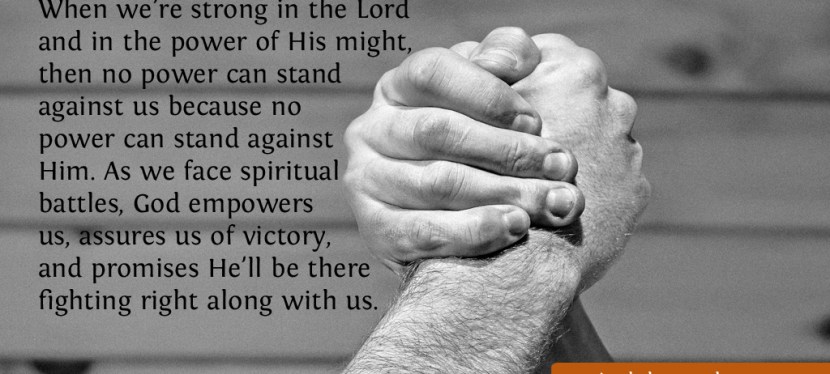
Before we can start getting ready to fight a spiritual battle, we must recognize where the strength to do such a thing comes from. On our own, we couldn’t fight spiritual adversaries. We need to “be strong in the Lord” to do that. But what does being strong in Him really mean?

Becoming Empowered

The word translated “be strong” is endunamoo (G1743). It comes from a combination of the word en (G1722), which is a preposition meaning in, by, or with, and dunamoo, which is a form of dunamis (1411). Dunamis means “inherent power,” such as Jesus used to perform miracles (Luke 8:46). So this word in Ephesians means to be filled with inherent, active, achieving power. And because we’re strong “in the Lord,” it’s the same kind of power He has.

I can do all things through Christ, Who empowers me. (Phil. 4:13, HBOO)

We, who have no hope of standing up against a spiritual onslaught on our own, can do “all things,” including spiritual warfare, when Jesus empowers us. That means the One who can cast out devils with a word and who saw Satan fall like lightning from heaven (Luke 10:17) isn’t just fighting on our behalf. He’s sharing His power with us so we can fight alongside Him.

Read more

How Does It Feel To Be Human?

OneRepublic’s song “Human” is about a man who’d fallen out of contact with God and now turns to Him when things are going badly. They “had a conversation” where the singer asks questions and pours out his frustrations. Then God “said the strangest thing.”

He said, “How does it feel to be human?
Do some of the best plans you make get ruined?
Do people curse you when flowers ain’t blooming?
How does it feel?”
He said, “How does it feel to be human?
If I could for one day I just might do it
Dance ’til the sun comes up to my music
How does it feel?”

While OneRepublic doesn’t sing “Christian music,” the band members are Christians and they know just as well as we do that God does have experience being human as Jesus Christ. But even knowing that, I think most of us can identify with the feeling in this song. We know Jesus lived as a human. But sometimes we still don’t feel like He can fully sympathize with exactly how hard it is. That it must have been easier/different for Him since He was fully God at the same time He was fully human.

Even More Than Salvation

If someone asked you why Jesus became human, most of us would say, “To save us” (or some variation on that idea). And that’s certainly accurate, for “Christ Jesus came into this world to save sinners” (1 Tim. 1:15, WEB). That is not, however, the only reason He came to this earth.

Some of the other reasons Jesus gave for Him coming into the world include preaching the gospel (Mark 1:38; Luke 4:43) and witnessing to truth (John 18:37). As we read through the gospels, it becomes clear that the work given to Jesus by the Father involved more than “just” dying in our place to cleanse us from sin. I hate saying “just” becasue salvation is such an incredible gift on its own that it should blow our minds. But Jesus wanted to do even more for us. And one of the things He wanted to do was learn how it feels to be human. Read more

How Visible Is Your Commitment to Christ?

The culture we live in is not a godly one. None of us can say we live in a “Christian nation.” While we may share some values with the dominant culture(s), living the way Jesus did involves a very different lifestyle than the ones that are most socially acceptable.

That leaves Christians with a choice. We can either lie-low and try to fit in as much as we can, or we can embrace the fact that a commitment to living like Christ involves living counter-culturally. The later is hard. But if we want to become part of God’s family, we have to become like Him instead of staying like the world.

How Visible Is Your Commitment to Christ? | marissabaker.wordpress.com

We need a transformative relationship with Jesus

It’s not something we like to think about, but the scriptures indicate that not everyone who thinks they’re following Jesus will actually end up in His kingdom. One of these passages is found in Jesus’ sermon on the mount. It’s a serious, scary warning that we do well to pay attention to.

Not everyone who says to me, ‘Lord, Lord,’ will enter into the Kingdom of Heaven; but he who does the will of my Father who is in heaven. Many will tell me in that day, ‘Lord, Lord, didn’t we prophesy in your name, in your name cast out demons, and in your name do many mighty works?’ Then I will tell them, ‘I never knew you. Depart from me, you who work iniquity.’ Everyone therefore who hears these words of mine, and does them, I will liken him to a wise man, who built his house on a rock. (Matt. 7:21-24, WEB)

We learn several important things from this passage. Firstly, it’s possible to think you’re following Jesus and still not be in a relationship with Him. Whether or not He knows you is more important than the showy things you do in His name.

Secondly, He tells us how to become people He knows. We must do His Father’s will, hear His teachings, and act on them. Those actions will give us a strong foundation so that when life pounds on us we won’t fall (Matt. 7:25-27). It’s also going to drastically change how our lives look. Read more

Should You Do What You Think Is Right?

“Always let your conscience be your guide.”

“Follow your heart.”

“Trust yourself.”

Those are the kinds of self-affirming advice we often hear. The basic argument is that most of us are pretty good people and if we listen really closely to our inner guiding light, then we’ll make good decisions.

But as Christians, we’re not supposed to do what’s right in our own minds. We’re supposed to do what God thinks is right. To some, this might just seem like a subtle shift in semantics. Of course what I think is right and God thinks is right are the same thing. Aren’t they?’

Not necessarily. While the holy spirit is transforming us to “have the mind of Christ,” we’re not all the way there yet. That’s one reason why it’s so important to spend time studying scripture — to make sure we know how God thinks and line-up with Him.Should You Do What You Think Is Right? | marissabaker.wordpress.com

What God Has To Say About Your Heart

When God made the choice to destroy everyone but Noah and his family in a flood, He did so after seeing “that every imagination of the thoughts of man’s heart was continually only evil” (Gen. 6:5, WEB). Even though we are made in God’s image, every single person has sinned and we’re corrupted by the fallen world we live in. And yet even in this state, human’s tend to trust that they know what’s right. But we’re often very wrong.

Yahweh says: Cursed is the man who trusts in man, and makes flesh his arm, and whose heart departs from Yahweh. … The heart is deceitful above all things, and it is exceedingly corrupt: who can know it? I, Yahweh, search the mind, I try the heart, even to give every man according to his ways, according to the fruit of his doings. (Jer. 17:5, 9-10, WEB)

Human being can’t trust their hearts. You might get some things right, but you can’t even really know yourself unless you ask God to share His perspective on you. But that verse in Jeremiah is addressed to the person who’s heart departs from the Lord. What about once you are in relationship with God and making Him the one your trust? What does that do to your heart? Read more

What Sort Of Relationship Does God Want Us To Have With His Bible?

When we’re trying to become more like God there are typically four scriptural tools people talk about using: prayer, study, meditation, and fasting. Today, let’s take a closer look at studying. Even though I do study my Bible (as these blog posts will attest), I don’t think I’ve ever studied the topic of studying.

So I ran a search for the word “study” in the New Testament and it didn’t show up in the WEB translation at all. The two uses in the KJV are both translated from different Greek words and neither means what we associate with the English word “study.” But just becasue that English word isn’t used much doesn’t mean the concept behind saying we should study God’s word isn’t correct. Miriam-Webster’s dictionary for students defines “study” as “the act of making an effort to learn by reading, practicing, or memorizing.”  So I guess our question for today become whether or not that’s the sort of relationship God wants us to have with His word.

What Sort Of Relationship Does God Want Us To Have With His Bible? | marissabaker.wordpress.com
Photo credit: Anggie via Lightstock

Scripture Tied To Salvation

In his second letter to Timothy, Paul tells him what knowing God’s holy writings can do in a person’s life. That seems a good place to start our study:

From infancy, you have known the holy Scriptures which are able to make you wise for salvation through faith, which is in Christ Jesus. Every Scripture is God-breathed and profitable for teaching, for reproof, for correction, and for instruction in righteousness, that the man of God may be complete, thoroughly equipped for every good work. (2 Tim. 3:15-17, WEB)

We could pretty much end this blog post right here. If you want to become “wise for salvation through faith” and be “complete, thoroughly equipped for every good work” then you need to get to know God’s word. Paul makes it very clear that a person who is committed to following God needs to make themselves familiar with the Scriptures that we now call the Bible.

This passage also establishes that scriptures comes straight from God, not human beings (see also 2 Pet. 1:19-21). As such, it’s profitable for us. These writings teach, reprove, correct, and instruct us in righteousness. And we need righteousness, becasue “the unrighteous will not inherit the kingdom of God” (1 cor. 6:9, WEB). Clearly, effort put toward learning, practicing, and memorizing God’s word is going to pay-off. And this isn’t the only scripture that says so. Read more