How To Clean A Temple

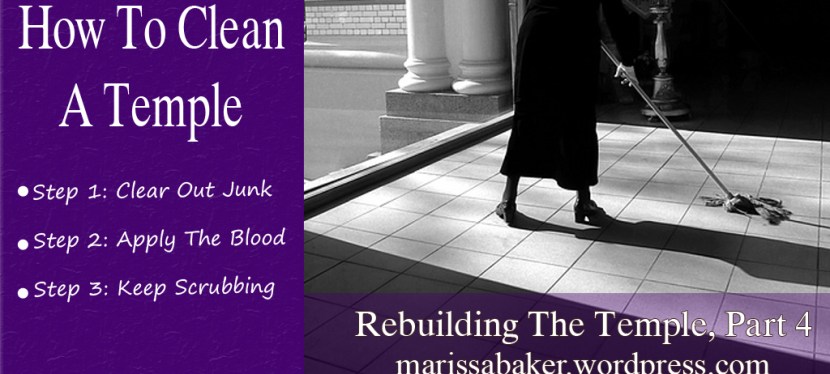
We’ve talked about how to build up spiritual temples and the fact that the churches today need a good temple cleaning, but not much about the practical how-to for cleaning temples. Back when there was a physical temple standing, God gave specific instructions about how to purify the temple and clean it when things got dirty. You couldn’t just throw some soapy water across the floor and say, “Clean!” Today, we are the temple of God, and He has set in place ways of cleaning us out as well.
How To Clean A Temple| marissabaker.wordpress.com

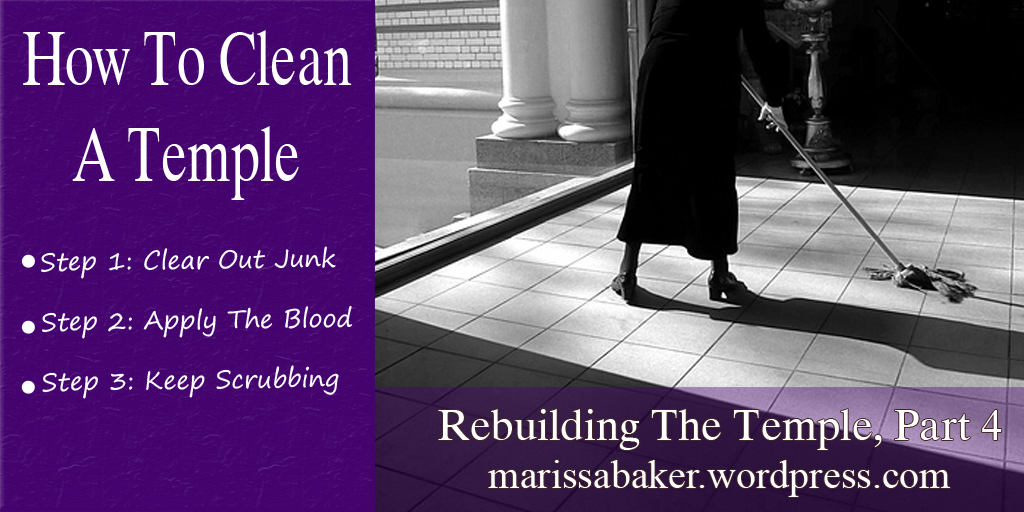
Step One: Clear Out Junk

One of the most complete Old Testaments accounts we have of cleansing a temple took place in the days of king Hezekiah.

In the first year of his reign, in the first month, he opened the doors of the house of the Lord and repaired them. Then he brought in the priests and the Levites, and gathered them in the East Square, and said to them: “Hear me, Levites! Now sanctify yourselves, sanctify the house of the Lord God of your fathers, and carry out the rubbish from the holy place. For our fathers have trespassed and done evil in the eyes of the Lord our God; they have forsaken Him, have turned their faces away from the dwelling place of the Lord, and turned their backs on Him. They have also shut up the doors of the vestibule, put out the lamps, and have not burned incense or offered burnt offerings in the holy place to the God of Israel. (2 Chr. 29:3-7)

And they gathered their brethren, sanctified themselves, and went according to the commandment of the king, at the words of the Lord, to cleanse the house of the Lord. Then the priests went into the inner part of the house of the Lord to cleanse it, and brought out all the debris that they found in the temple of the Lord to the court of the house of the Lord. And the Levites took it out and carried it to the Brook Kidron.
Now they began to sanctify on the first day of the first month, and on the eighth day of the month they came to the vestibule of the Lord. So they sanctified the house of the Lord in eight days, and on the sixteenth day of the first month they finished.
Then they went in to King Hezekiah and said, “We have cleansed all the house of the Lord, the altar of burnt offerings with all its articles, and the table of the showbread with all its articles. Moreover all the articles which King Ahaz in his reign had cast aside in his transgression we have prepared and sanctified; and there they are, before the altar of the Lord.” (2 Chr. 29:15-19)

I find it very interesting that, in addition to purifying the house and cleansing it (presumably with water and blood) the priests had to carry out debris and rubbish. There were things inside the temple defiling it that needed to be thrown out before the other purification could take place.

This puts me in mind of two incidents that took place during Jesus’ ministry. In several Bibles I’ve read, the section heading here reads “Jesus Cleanses The Temple.”

Now the Passover of the Jews was at hand, and Jesus went up to Jerusalem. And He found in the temple those who sold oxen and sheep and doves, and the money changers doing business. When He had made a whip of cords, He drove them all out of the temple, with the sheep and the oxen, and poured out the changers’ money and overturned the tables. And He said to those who sold doves, “Take these things away! Do not make My Father’s house a house of merchandise!” Then His disciples remembered that it was written, “Zeal for Your house has eaten Me up.” (John 2:13-17)

This happened in John chapter 2, at the first Passover during Jesus’ ministry. That means one of the very first things He did as part of His ministry was throw certain things and people out of God’s temple. It was a pivotal moment, and it didn’t just happen once. A very similar incident occurs right before His last Passover.

Then Jesus went into the temple of God and drove out all those who bought and sold in the temple, and overturned the tables of the money changers and the seats of those who sold doves. And He said to them, “It is written, ‘My house shall be called a house of prayer,’ but you have made it a ‘den of thieves.’” (Matt. 21:12-13)

Look how important this was to Jesus. He made a whip to drive out sheep, oxen and people. He poured the exchangers’ money onto the floor, and threw tables over. He probably raised His voice as He ordered out people who’d made His father’s house a vehicle for personal gain. He spent the time leading up to two Passovers before His sacrifice, which fulfilled all the blood sacrifices of the Old Testament, throwing defiling elements out of the temple.

Is there anything that needs thrown out of our lives before God can really start to work with us? The temple today is in our minds, so that’s where we need to look. Anything inside us that is crowding God out of His temple must be thrown out. Jesus can help with that if we ask Him, but – like the priests in Hezekiah’s day – we have to be willing to carry out the rubbish and dump it somewhere it won’t come back.

Step Two: Apply The Blood

Back in the Old Testament, the physical temple had to be cleaned and purified before God would put His presence there. Even when the first tabernacle was built and things started out exactly as God commanded, purification was a daily necessity. I suspect this was because people were involved, and no matter how hard we try we still can’t keep things clean enough for God on our own.

And you shall offer a bull every day as a sin offering for atonement. You shall cleanse the altar when you make atonement for it, and you shall anoint it to sanctify it. (Ex. 29:36)

As Israel fell into sin, the temple was often neglected. Throughout history, it was forgotten by Israel, defiled with idols, and ravaged by conquers. Whenever Israel came back to God, the temple needed fresh purification.

Thus says the Lord God: “In the first month, on the first day of the month, you shall take a young bull without blemish and cleanse the sanctuary. The priest shall take some of the blood of the sin offering and put it on the doorposts of the temple, on the four corners of the ledge of the altar, and on the gateposts of the gate of the inner court. And so you shall do on the seventh day of the month for everyone who has sinned unintentionally or in ignorance. Thus you shall make atonement for the temple. (Ezk. 45:18-20)

The animal sacrifices used to purify the physical temple were a stand-in pointing to how Jesus’s sacrifice would purify His people. “It is not possible that the blood of bulls and goats could take away sins,” but Jesus was able with one offering” to have “perfected forever those who are being sanctified” (Heb. 10:4, 14).

Remember that the tabernacle and then the temple layouts were divided into different sections. In the book of Hebrews, it talks about how there was a main section of the tabernacle where the priests served throughout the year, and then the Holy of Holies which the high priest could only enter once a year on the Day of Atonement (Yom Kippur).

Now when these things had been thus prepared, the priests always went into the first part of the tabernacle, performing the services. But into the second part the high priest went alone once a year, not without blood, which he offered for himself and for the people’s sins committed in ignorance; the Holy Spirit indicating this, that the way into the Holiest of All was not yet made manifest while the first tabernacle was still standing. It was symbolic for the present time in which both gifts and sacrifices are offered which cannot make him who performed the service perfect in regard to the conscience — concerned only with foods and drinks, various washings, and fleshly ordinances imposed until the time of reformation. (Heb. 9:6-10)

What’s really interesting is that in the Greek, there’s one word to describe the entire temple complex and another word to describe the inner sanctuary or Holy of Holies. It’s this second word, naos, which is used when talking about us as the temple of God. The book of Hebrews tells us there is a spiritual version of the Holy of Holies in heaven, where Christ presented His blood to atone for our sins, but each Christian today is also a type of spiritual Holy of Holies.

And according to the law almost all things are purified with blood, and without shedding of blood there is no remission. Therefore it was necessary that the copies of the things in the heavens should be purified with these, but the heavenly things themselves with better sacrifices than these. For Christ has not entered the holy places made with hands, which are copies of the true, but into heaven itself, now to appear in the presence of God for us; not that He should offer Himself often, as the high priest enters the Most Holy Place every year with blood of another — He then would have had to suffer often since the foundation of the world; but now, once at the end of the ages, He has appeared to put away sin by the sacrifice of Himself. (Heb. 9:22-26)

The high priest was the only one ever allowed into the Holy of Holies, just as Jesus Christ was the only one who could clean the spiritual temple. The law requires blood purification of holy things, and Jesus is the only one who’s blood is precious enough to cleans a polluted spiritual temple. Accepting Him as our Savior and asking Him to wash away our sins is a vital step in cleaning the spiritual temple.

Step Three: Keep Scrubbing

As the great High Priest over the church today, Jesus is the only one with a right to come into the temple and clean it out. We can help as best we can, but we must never forget that He’s the one doing the cleansing. It was His sacrifice that removed sin once and for all, and He’s the one continually working to clean His people.

looking for the blessed hope and glorious appearing of our great God and Savior Jesus Christ, who gave Himself for us, that He might redeem us from every lawless deed and purify for Himself His own special people, zealous for good works. (Tit. 2:13-14)

John the Baptist testified of Jesus Christ that He would baptize His people “with the Holy Spirit and fire” (Luke 3:16). When we accept Jesus Christ as our savior and are baptized in His name, we’re washed with His blood and covered in the spirit of God. That’s just the beginning of our purification process, though.

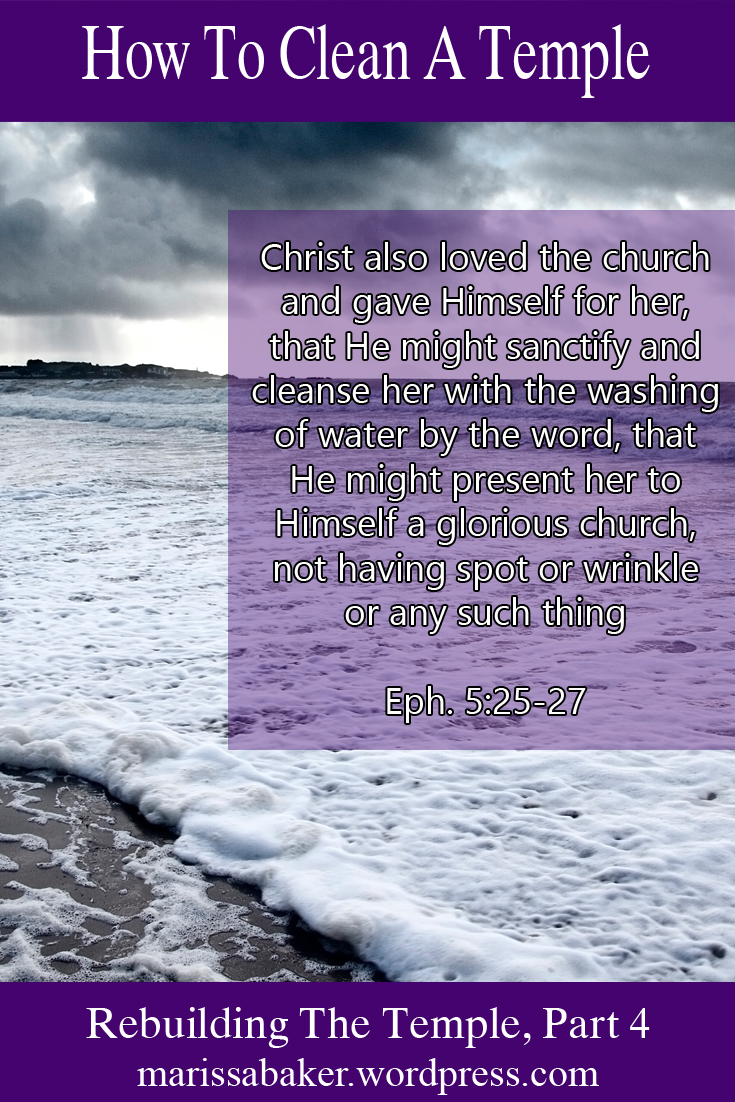
Husbands, love your wives, just as Christ also loved the church and gave Himself for her, that He might sanctify and cleanse her with the washing of water by the word, that He might present her to Himself a glorious church, not having spot or wrinkle or any such thing, but that she should be holy and without blemish. (Eph. 5:25-27)

The church today is God’s temple – His personal dwelling place – and we must do all we can to set it to rights by working on ourselves individually and collectively under the Headship of our High Priest Jesus Christ. The closer we draw to Christ and the more we point others to Him, the cleaner this temple will get.

Back in the Old Testament, the priests were assisted by Levites whose “duty was to help the sons of Aaron in the service of the house of the Lord, in the courts and in the chambers, in the purifying of all holy things and the work of the service of the house of God” (1 Chr. 23:28). This was supposed to keep happening on a continual basis. In much the same way, we have to continue repenting when we fall short and continue submitting to the refining process Christ is accomplishing in our lives.
How To Clean A Temple| marissabaker.wordpress.com

credits for photos used in blog images:


Obstacles To Temple Building (Lessons from Haggai, part three)

Both letters to the Corinthian church remind them, “You are the temple of God.” Each member of Christ’s church is a temple, and we’re being built up into a spiritual house of God. This applies to the body as a whole, as well as to individuals.

We’ve been spending time in the book of Haggai the past couple weeks, talking about God’s challenge to the people who were neglecting His temple and what we can do about building up the temple we have today. Like those of us in the modern churches of God, the people of Haggai’s time faced a number obstacles to temple building. They let these obstacles discourage them for many years, but it turns out they weren’t really anything to worry about. Once the people turned back to God and started working on what He commanded, the obstacles didn’t seem so significant.

Obstacles To Temple Building | marissabaker.wordpress.com

Droughts

This isn’t so much an obstacle as it is a result of neglecting the temple in the first place. God tells the people their lives lacked good things “because of My house that is in ruins, while every one of you runs to his own house” (Hag. 1:9).

Therefore the heavens above you withhold the dew, and the earth withholds its fruit. For I called for a drought on the land and the mountains, on the grain and the new wine and the oil, on whatever the ground brings forth, on men and livestock, and on all the labor of your hands.” (Hag. 1:10-11)

Confronted with these struggles, the people might have said, “We can’t build God’s house while so many bad things are happening.” It would have been an understandable reaction from a human perspective. Nothing we do is bearing fruit, so why bother with the temple? God wouldn’t be happy if that falls apart like everything else. But in reality, all the problems they were seeing came as a result of neglecting the temple.

In our own lives, we often find ourselves discouraged from contributing in our local churches, or distracted by other worries from building-up the people around us. We might think we have very little time or ability to contribute to  God’s temple because there’s so much other stuff going on, and often going wrong. In reality, if we prioritize God’s temple, the other things in our lives will start to fall into place (or at least get easier to deal with because we have God on our side).

Then Haggai, the Lord’s messenger, spoke the Lord’s message to the people, saying, “I am with you, says the Lord.” So the Lord stirred up the spirit of Zerubbabel the son of Shealtiel, governor of Judah, and the spirit of Joshua the son of Jehozadak, the high priest, and the spirit of all the remnant of the people; and they came and worked on the house of the Lord of hosts, their God (Hag. 1:13-14)

We need to let God “stir up” our spirits. Focusing only on things that are going wrong in our lives, and then trying to fix them without working on God’s temple, is just going to make things worse.

Comparisons

The previous temple had been the one built by Solomon. Physically speaking, it was the most glorious temple ever built for God. The people working on this new temple knew they couldn’t approach that magnificence, and it was discouraging.

Who is left among you who saw this temple in its former glory? And how do you see it now? In comparison with it, is this not in your eyes as nothing? Yet now be strong, Zerubbabel,’ says the Lord; ‘and be strong, Joshua, son of Jehozadak, the high priest; and be strong, all you people of the land,’ says the Lord, ‘and work; for I am with you,’ says the Lord of hosts. ‘According to the word that I covenanted with you when you came out of Egypt, so My Spirit remains among you; do not fear!’ (Hag. 2:3-5)

You’ll hear something similar today in the church – people looking back to a time when the church was larger, or had more money, or seemed more influential, or had more respect in U.S. Culture. But God doesn’t want His people looking backwards except for productive reasons.

We can learn from past mistakes or take encouragement from past examples of God’s goodness, but being paralyzed in the present because you’re living in the past is unacceptable. God is moving us toward a great and glorious future, and that’s where we must look if we want His blessing now as we build the temples of our lives and churches.

Unstable Foundations

Whatever you’re building, it has to start with a firm foundation. The temple of God is no exception.

“For thus says the Lord of hosts: ‘Once more (it is a little while) I will shake heaven and earth, the sea and dry land; and I will shake all nations, and they shall come to the Desire of All Nations, and I will fill this temple with glory,’ says the Lord of hosts. ‘The silver is Mine, and the gold is Mine,’ says the Lord of hosts. ‘The glory of this latter temple shall be greater than the former,’ says the Lord of hosts. ‘And in this place I will give peace,’ says the Lord of hosts.” (Hag. 2:6-9)

These passages are prophetic, reaching beyond the completion of that physical temple to a new house constructed by God Himself. Part of it is being fulfilled today, as we are “being built up a spiritual house, a holy priesthood” (1 Pet. 2:5), and part will be fulfilled in the future.

but now He has promised, saying, “Yet once more I shake not only the earth, but also heaven.” Now this, “Yet once more,” indicates the removal of those things that are being shaken, as of things that are made, that the things which cannot be shaken may remain.
Therefore, since we are receiving a kingdom which cannot be shaken, let us have grace, by which we may serve God acceptably with reverence and godly fear. For our God is a consuming fire. (Heb. 12:26-29)

The author of Hebrews looked back to these verses in Haggai when talking about our future kingdom. To get there, we’re going to have to go through “shakings.” In my Messianic congregation, the Rabbi has given several messages where he reminds us that “everything which can be shaken will be shaken.” In other words, things that are not firmly grounded on Jesus Christ will topple over.

Unclean Hearts

Sometimes, we ourselves can be the obstacles standing in the way of building up a people that glorifies God. Other people can also act as obstacles, of course, but we have to be very careful to make sure we’ve gotten any beams out of our own eyes before trying to pick slivers out of someone else. We must examine our own hearts for uncleanness before we can hope to help others who are engaged in temple building.

And Haggai said, “If one who is unclean because of a dead body touches any of these, will it be unclean?”
So the priests answered and said, “It shall be unclean.”
Then Haggai answered and said, “‘So is this people, and so is this nation before Me,’ says the Lord, ‘and so is every work of their hands; and what they offer there is unclean. And now, carefully consider from this day forward: from before stone was laid upon stone in the temple of the Lord – since those days, when one came to a heap of twenty ephahs, there were but ten; when one came to the wine vat to draw out fifty baths from the press, there were but twenty. I struck you with blight and mildew and hail in all the labors of your hands; yet you did not turn to Me,’ says the Lord. (Hag. 2:13-17)

This takes us right back to where we started this chapter. If bad things are happening in our lives, it should prompt us to engage in self-examination and turn back to God – not stop building up God’s house.

What sort of things do you see holding the church back from growth? what steps could we take to overcome them?

Obstacles To Temple Building | marissabaker.wordpress.com

credits for photos used in blog images:

  • Roadblock” by Greg Westfall, CC BY via Flickr
  • Roadblock” by Olle Svensson, CC BY via Flickr

Building Up Temples (Lessons from Haggai, part two)

Inspired by Haggai’s message to those rebuilding the temple in 520 B.C., we started a conversation about the state of the church in last week’s post. Via Haggai’s prophecy, God challenged His people about their choice to neglect rebuilding His temple. Sadly, today, there is a similar neglect in building up the individuals in God’s church, who are described as His temple. We talked about that last week, though. This week, we’re going to talk about what to do about it.

Edification

Having challenged the people with their lack of productivity, God again asks them to consider their ways.

Thus says the Lord of hosts: “Consider your ways! Go up to the mountains and bring wood and build the temple, that I may take pleasure in it and be glorified,” says the Lord. “You looked for much, but indeed it came to little; and when you brought it home, I blew it away. Why?” says the Lord of hosts. “Because of My house that is in ruins, while every one of you runs to his own house. (Hag. 1:7-9)

For us in the spiritual temple, we need to be careful to maintain a balance between individual growth and serving the body. Though our lives depend on developing a close, personal relationship with God, He never intended for us to act in isolation. Rather, the more we become like Christ, the more we should want to serve our brethren. Focusing only on building your own house is selfish, and is not pleasing to God.

In the Greek New Testament, every time we’re told to edify one another, it’s related to the idea of building a house. The Greek word for house is oikos (G3624), and it’s the root word for oikodomeo (G3618). This word literally means “to be a house builder,” and is translated “build,” “edify,” and “embolden.” This connection even exists in English – the word “edify” is related to “edifice.”

having been built on the foundation of the apostles and prophets, Jesus Christ Himself being the chief cornerstone, in whom the whole building, being fitted together, grows into a holy temple in the Lord, in whom you also are being built together for a dwelling place of God in the Spirit. (Eph. 2:20-22)

We know Jesus is ultimately the Builder who is creating His church (Matt. 16:18). He builds the house, has more glory than the house, and rules us “as a son over His own house” (Heb. 3:1-6). He does, however, have people within the house working with Him as He builds us up.

For we are God’s fellow workers; you are God’s field, you are God’s building. According to the grace of God which was given to me, as a wise master builder I have laid the foundation, and another builds on it. But let each one take heed how he builds on it. For no other foundation can anyone lay than that which is laid, which is Jesus Christ. (1 Cor. 3:9-11)

This principle works on an individual as well as a group level. You are a temple of God, and you are part of the House of God. Everything that you build must be founded on Jesus Christ, or it’s not going to last. In contrast, if we commit to building up God’s temple properly, He will be pleased and glorified. As we talked about last week, it’s not just the responsibility of people in leadership positions, either. We’re all to be teaching and building up one another.
Building Up Temples | marissabaker.wordpress.com

Where to Build?

Any good building has to start with a good foundation. With God’s spirit in us and the Son of God as our foundation, we have all the tools we need to build well in the eyes of God. He’s given us the opportunity to build something glorious, if we’ll take it.

For no other foundation can anyone lay than that which is laid, which is Jesus Christ. Now if anyone builds on this foundation with gold, silver, precious stones, wood, hay, straw, each one’s work will become clear; for the Day will declare it, because it will be revealed by fire; and the fire will test each one’s work, of what sort it is. (1 Cor. 3:11-13)

We get out of our walk with God what we put into it. If we give Him the perishable, useless stuff of our lives – the stubble left over after we do what we want – then our house will burn back down to the foundation and we’ll have to start over. But if we give Him our best, we will endure and be rewarded.

If anyone’s work which he has built on it endures, he will receive a reward. If anyone’s work is burned, he will suffer loss; but he himself will be saved, yet so as through fire. Do you not know that you are the temple of God and that the Spirit of God dwells in you? (1 Cor. 3:14-16)

God’s glory once filled the tabernacle and the physical temples, and He wants to fill His temple today as well. But He won’t dwell in a defiled, falling-apart temple. It is our responsibility as His temples and as His church to put our best effort into making this building something fit for God’s use.

What Next?

I don’t want to end this post without actually giving some practical steps we can take to help rebuild God’s temple. Principles are good, but what does it really look like to edify other people and to build on the foundation of Jesus Christ?

  • Don’t shy away from talking about spiritual things. There’s often a tendency when we get together for church to chat, gossip, and just share what’s been going on since we saw each other last. But if we’re there with people who love God to honor God, we should be talking about Him at least a little, right?
  • Avoid negativity whenever possible. If you’ve had a terrible week and you need to vent, go ahead and give people the opportunity to comfort and encourage you. But if everything coming out of your mouth is critical, complaining, or pessimistic you’re not helping anyone (including yourself). It takes about 5 positive comments to balance out 1 negative remark. What ratio are you offering God’s temple?
  • Stop thinking small in terms of what the church is. The church isn’t United Church of God, or Living Church of God or whatever your local church calls itself. The church is every individual within the Body of Christ, and that’s where we need to be serving and edifying.
  • Study the Bible, especially Jesus Christ’s example. Corporate growth starts with individual growth, and individual growth starts with developing a relationship with Jesus Christ. He’s the foundation we have to build on, and the One who builds us up.

What would you add to this list? please share in the comments below!

Building Up Temples | marissabaker.wordpress.com

Credits for photos used in blog images:

Consider Our Temples (Lessons from Haggai, part one)

The book of Haggai largely concerns rebuilding on the site of Solomon’s temple, which was destroyed in the Babylonian invasion chronicled in 2 Kings 25 (around 586 B.C.). A group of Jewish exiles under the leadership of Zerubbabel returned to the land in 536, but by the time Haggai wrote in 520 they’d not yet rebuilt the temple.

Considering that the church today is called God’s temple, I wondered what spiritual parallels there might be between Haggai’s call for obedience in rebuilding the the temple, and us today. This book begins by quoting people who said it wasn’t yet time to build God’s house (Hag. 1:2). God challenged them whether it was right for them to have spent the past 16 years on their own projects instead of His temple (Hag. 1:3-4)

Now therefore, thus says the Lord of hosts: “Consider your ways! You have sown much, and bring in little; you eat, but do not have enough; you drink, but you are not filled with drink; you clothe yourselves, but no one is warm; and he who earns wages, earns wages to put into a bag with holes.” (Hag. 1:5-6)

Let’s suppose for a moment that this isn’t just talking to the people tasked with rebuilding God’s temple 2,500 years ago – that this is speaking to the church today as a spiritual temple. What is it telling us?

Consider Our Temples | marissabaker.wordpress.com

Sowing

you have sown much, and bring in little

In one of Christ’s parables, sowing seeds in a field is compared to spreading God’s world (Mark 4:14-20). Many churches are good at the sowing part – we scatter the gospel out over the internet, radio, television and into people’s homes as magazines. Truly, we “have sown much.”

The first part of this phrase applies to us, so what about the second? We’ve sown, but is it bearing fruit as God intended, “some thirtyfold, some sixty, and some a hundred”? I think the state of the church and the world today answers this question for us. Churches are divided, scattered and squabbling. Growth is down, and the world has lost respect for Christianity.

“Do you not know that you are the temple of God and that the Spirit of God dwells in you? If anyone defiles the temple of God, God will destroy him. For the temple of God is holy, which temple you are.” (1 Cor. 3:16-17)

If our efforts aren’t bringing forth the fruits they should, perhaps we should follow the instructions in Haggai to consider our ways in regards to God’s temple. The defilement Paul talks about in 1 Corinthians doesn’t come from an attack on God’s temple from the outside. It comes from within individuals — those of us who aren’t keeping our hearts and minds pure as we follow after Christ — and it hurts the temple as a whole.

Eating

you eat, but do not have enough

One of the ways the Bible talks about the World of life is as nourishment, comparing it to food. Jesus Himself, the living Word, is called the Bread of Life (John 6:35). If we’re studying our Bibles and going to church then we are eating from the words of God, but are we eating enough?

For though by this time you ought to be teachers, you need someone to teach you again the first principles of the oracles of God; and you have come to need milk and not solid food. For everyone who partakes only of milk is unskilled in the word of righteousness, for he is a babe. But solid food belongs to those who are of full age, that is, those who by reason of use have their senses exercised to discern both good and evil. (Heb. 5:12-14)

If we’re not studying more deeply on our own, and if the teachers in the temple aren’t providing strong meat, then God’s church won’t grow. It won’t have enough food.

Drinking

you drink, but you are not filled with drink

Though it does require some action on our part, the blood of Jesus Christ’s sacrifice is the only way to cleanse a defiled, polluted temple. The law requires blood purification of holy things, and the only sacrifice precious enough to cleanse a spiritual temple was that of Jesus Himself (Heb. 9:22-24).

Then Jesus said to them, “Most assuredly, I say to you, unless you eat the flesh of the Son of Man and drink His blood, you have no life in you. Whoever eats My flesh and drinks My blood has eternal life, and I will raise him up at the last day. For My flesh is food indeed, and My blood is drink indeed. He who eats My flesh and drinks My blood abides in Me, and I in him. (John 6:53-56)

1 Corinthians 11 helps clarify this by quoting Jesus at the Passover, saying, “This cup is the new covenant in My blood. This do, as often as you drink it, in remembrance of Me” (1 Cor. 11:25). To drink of Jesus Christ, we have to enter into covenant with the One who gave His life for His temple. It can’t just be lip-service either or sipping at the cup but not letting Him in. We have to be “filled with drink.”

Clothing

you clothe yourselves, but no one is warm

We often say the “poor, blind and naked” church of Laodicea represents the end-time church (Rev. 3:17-18). It follows, then, that if we are living in the end times we should expect to see Laodicean attitudes in our lives and churches. Jesus wouldn’t have sent this letter if it wasn’t a very real issue that we need to recognize and take steps to correct.

We don’t like to think about this, though, so we say the Philadelphian and Laodicean eras overlap and that we’re Philadelphians living in a Laodicean world. But the letters weren’t written to the world – they were written to us. A self-assured comment that, “Well, at least I’m not a Laodicean,” sounds an awful lot like, “I am rich and have need of nothing.” We say we’re clothed, but many in the church are not warmed.

If a brother or sister is naked and destitute of daily food, and one of you says to them, “Depart in peace, be warmed and filled,” but you do not give them the things which are needed for the body, what does it profit? (James 2:5-1)

This example works on a spiritual as well as a physical level. If someone is hungering after the word of God and yearning for the warmth of companionship with brethren, we’re not helping them by simply handing them a pamphlet or ignoring them while we hang out with our friends. We have to be the type of temple that can truly fill those needs for nourishment and warmth.

I dare say the Laodiceans weren’t literally walking around in the nude, but they were missing a key component of spiritual clothing. In Rev. 19:8, it says the bride’s white garment “is the righteous acts of the saints.” Perhaps these righteous actions are what is missing in the lives of those in churches where “no one is warm.”

Working

he who earns wages, earns wages to put into a bag with holes

The person described in this part of Haggai is working, but to no effect. Everything he struggles to earn is immediately lost because it’s not stored properly.

Do not lay up for yourselves treasures on earth, where moth and rust destroy and where thieves break in and steal; but lay up for yourselves treasures in heaven, where neither moth nor rust destroys and where thieves do not break in and steal. For where your treasure is, there your heart will be also. (Matt. 6:19-20)

Even if we’re working on things that could be good and useful, it’s not beneficial unless we’re doing it for God. We should be His workmen, serving the High Priest in His temple. Paul tells us to present ourselves to God as able and willing workers (2 Tim. 2:15). It’s impossible to work for God without earning wages which will endure into the next world, but it’s equally impossible to lay up treasure for ourselves if we are not working for the things of God.

Consider Our Temples | marissabaker.wordpress.com

Ever since reading Haggai, I can’t get the subject of rebuilding temples off my mind. I think it’s clear to most of us today that the church isn’t everything that it could, or should, be as the body of Jesus Christ. We lay blame in all sorts of places — church leadership, other organizations, the state of the world today — but those excuses only go so far. If we believe that nothing can stand against us while God is on our side, then these obstacles lose their power. If we believe that the church is defined as the individuals who make of the body of Jesus Christ, then the state of the church is the responsibility of each individual.

I plan to spend quite a bit of my study time over the next few weeks on this topic, and I expect it will fill at least two more blog posts. I invite you to join me in diving into God’s word, studying what He has to say about His temple, and praying for the state of His church.

What’s one change you think is key to strengthening God’s church? Comment below!


Replacing Worry (Lessons from Zephaniah)

We live in the midst of a dangerous, confusing world, and it’s getting worse as we move ever closer to the time of Christ’s return.

And you will hear of wars and rumors of wars. See that you are not troubled; for all these things must come to pass, but the end is not yet. For nation will rise against nation, and kingdom against kingdom. And there will be famines, pestilences, and earthquakes in various places. All these are the beginning of sorrows. (Matt. 24:6-8)

Our first instinct when things get bad is to worry and panic. This is precisely what we’re told not to do. Easier said than done, though, isn’t it? Worry’s not something you can just turn off — you have to replace it with something else.

No Reason for Fear

Zephaniah prophesied during the reign of King Josiah, so things were going pretty well at the time for the nation of Judah. Even so, he warned about a time much like our own when things would start looking pretty bleak for God’s people. In the midst of these dark prophecies, though, Zephaniah’s book gives great reason for not giving in to fear.

In that day it shall be said to Jerusalem: “Do not fear; Zion, let not your hands be weak. The Lord your God in your midst, the Mighty One, will save; He will rejoice over you with gladness, He will quiet you with His love, He will rejoice over you with singing.”(Zeph. 3:16-17)

Replacing Worry | marissabaker.wordpress.comGod doesn’t just tell us not to have fear. He gives us assurances designed to make fear impossible. “Fear not” because God Himself is with you to save you. “Fear not” because of His steadfast love, which Paul says nothing can separate us from (Rom. 8:35-39). “Fear not” because the Lord delights in you (Deut. 10:15; Is. 62:4).

He Himself has said, “I will never leave you nor forsake you.” So we may boldly say: “The Lord is my helper; I will not fear. What can man do to me?” (Heb. 13:5-6)

I still struggle with removing fear on a practical level, but abstractly I know fear simply doesn’t make sense for a Christian. The God who created the universe personally guarantees that He won’t abandon you. I always find things I’m scared of less frightening if there’s a good friend beside me, and what better friend could we have to cling to for assurance and stability in times of fear than God Himself?

Live By Faith

We replace worry with faith by consistently turning to God.

Seek the Lord, all you meek of the earth, who have upheld His justice. Seek righteousness, seek humility. It may be that you will be hidden in the day of the Lord’s anger. (Zeph. 2:3)

Seeking after God and consistently following His commands is the best way to get close to Him, which is the best place to be in times of trouble. No matter what happens, our focus must stay on God as we live by faith.

Therefore you also be ready, for the Son of Man is coming at an hour you do not expect. (Matt. 24:44)

Living without fear doesn’t involve burying our heads in the sand and ignoring things that might make us afraid. Rather, it involves a watchful readiness while living in the faith and confidence of our Messiah.

Who then is a faithful and wise servant, whom his master made ruler over his household, to give them food in due season? Blessed is that servant whom his master, when he comes, will find so doing. (Matt. 24:45-46)

Replacing Worry | marissabaker.wordpress.comWhen we stand before Christ at the end of this earth or the end of our lives — whichever comes first — we want to be found “so doing.” Consistent growth and faithfulness will be rewarded.

But what if you’re lacking in faith, and still suffering from worry? Ask God for help. He won’t turn down a sincere plea for help, even if it’s help with our unbelief.

 But let him ask in faith, with no doubting, for he who doubts is like a wave of the sea driven and tossed by the wind. For let not that man suppose that he will receive anything from the Lord; he is a double-minded man, unstable in all his ways. (James 1:6-8)

Brethren, let us pray for stability in our walk with God — to be grounded so firmly on the Rock of Jesus Christ that we won’t be tossed about with fear. Wavering and worry go hand-in-hand, and we need God’s help to overcome that and “continue in the faith, grounded and steadfast” (Col. 1:23).

Behaviors, Boundaries and Bromance

Is what we consider appropriate behavior and boundaries as Christians based on the Bible, or on our culture?

Clearly, it’s a little of both. We avoid plain “thou shalt nots” (e.g. the culture says sex is great in many contexts; we teach sex is only appropriate in the type of marriage God set up in the garden of Eden), yet we tend to go with what’s culturally appropriate in how we interact with others (e.g. in Western churches we don’t “greet all the brethren with a holy kiss” though Paul and Peter both tell their readers to).

Part of this makes perfect sense. You don’t dress exactly like people did in Bible times because 1) you can’t find ankle-length robes for everyday wear in stores, 2) clothing designed for a Middle Eastern climate isn’t practical world-wide, and 3) these styles would be considered inappropriate or even immodest in some cultural contexts. So we apply the principle of dressing appropriately rather than trying to recreate Biblical fashion.

But what about other topics? How much should we go with what is culturally appropriate verses what is traditionally appropriate in Christian communities?

Brotherly Affection

marissabaker.wordpress.com

After my brother came back from teen camp, I learned that a pastor’s wife was concerned about the hand-holding, arms around shoulders, and hugging going on between the young men at camp. She was especially worried by the use of the term “bromance,” and how the teens’ behavior might be seen in light of the recent Supreme Court decision.

I understand why this upsets adults who have seen their culture change from “men don’t have feelings” to one that encourages male expression of emotion and accepts homosexuality (two things not necessarily related, except in this sort of discussion). I know why young men expressing affection for their guy friends scares middle aged and older adults. I’m just not sure God shares their fears.

Then he [Joseph] fell on his brother Benjamin’s neck and wept, and Benjamin wept on his neck. Moreover he kissed all his brothers and wept over them, and after that his brothers talked with him.(Gen 45:14-15)

Similar scenes play out when Esau and Jacob are reunited (Gen. 33:4), when Joseph sees his father again (Gen. 46:29), when the Prodigal son returns (Luke 15:20), and when Paul says good-bye to the Ephesians elders (Acts 20:36-37). Now, you might say they just got swept away in emotional reunions or partings and that this wasn’t common among friends and brothers, but what about this scene?

When Jesus had said these things, He was troubled in spirit, and testified and said, “Most assuredly, I say to you, one of you will betray Me.” Then the disciples looked at one another, perplexed about whom He spoke. Now there was leaning on Jesus’ bosom one of His disciples, whom Jesus loved. Simon Peter therefore motioned to him to ask who it was of whom He spoke. Then, leaning back on Jesus’ breast, he said to Him, “Lord, who is it?” (John 13:21-23)

Obviously Jesus wasn’t doing anything wrong — He never sinned! Yet if our young men in the church lean against each other at a supper table, we lecture them on the evils of “bromance.” We make a digression every time we teach on 1 Samuel 20 to explain that David and Jonathan weren’t gay and that there’s nothing wrong with close friendships between guys, but then we lecture young men who have close friends? Talk about mixed signals!

There are appropriate and inappropriate ways to interact with other people, but we can’t just make the blanket statement that the Bible forbids physical expressions of affection between two men (or two women, but “besties” aren’t my topic right now). I think we do our young people a grave disservice when we imply that there’s something unnatural about their friendships and make no effort to teach them how to express affection as men and as women. Just saying, “That’s bad, so don’t do it” isn’t going to work–touch is too important as a bonding mechanism among humans and there simply isn’t a Biblical basis for putting distance like that between friends.

Men and Women

All that being said about affection in friendships, there are stricter rules governing the interactions between men and women. I do think it is possible for men and women to be “just friends,” but the closer male and female friends get (physically or emotionally), the harder it is to keep the friendship casual. God created men and women to be attracted to each other–the very first human relationship was a romantic one (Gen. 2:18-24).

I find it interesting that in Genesis 20, when Abimelech takes Sarah away from Abraham thinking she is his sister, that God tells Abimelech in a dream, “I also withheld you from sinning against Me; therefore I did not let you touch her” (Gen 20:6). While this Hebrew word can euphemistically mean “to lie with a woman,” it’s not the typical word used for sex in the bible. Rather, it’s the word used to command Adam and Eve not to touch the forbidden fruit (Gen 3:3). For Abimelech, just touching another man’s wife would have been sin even though he did it in ignorance.

Flee sexual immorality. Every sin that a man does is outside the body, but he who commits sexual immorality sins against his own body. Or do you not know that your body is the temple of the Holy Spirit who is in you, whom you have from God, and you are not your own? For you were bought at a price; therefore glorify God in your body and in your spirit, which are God’s. (1 Cor. 6:18-20)

Though I appreciate the fact that we now live in a culture where I can give my guy friends a quick hug when I see them or put a hand on their shoulders in comfort, I wonder sometimes if we’ve reacted so strongly against the whole courtship idea of “never touch someone of the opposite sex” that boundary lines are becoming blurred.

More and more often at church events, I’m seeing guys and girls hanging on each other, sitting in each other’s laps and cuddling. Some of this is more than is even culturally acceptable among people who are “just friends,” and it confuses people when you try to explain you’re not in a romantic relationship (sometimes, it even confuses one of the two people involved in the friendship). I see no evidence that the Bible encourages or permits unrelated men and women to be as affectionate toward one another as they would be with their male or female friends.

Do not rebuke an older man, but exhort him as a father, younger men as brothers, older women as mothers, younger women as sisters, with all purity. (1 Tim. 5:1-2)

Notice that not only should we treat our brethren as family, but that we should do so “with all purity.” The woman in Song of Solomon wishes her beloved were seen by others as her brother so she could show him affection in public (Song. 8:1-2) — implying we can show our relatives a level of affection that would be inappropriate among friends and brethren (just as there are things you don’t do with your friends or siblings because they progress to a deeper level of intimacy only allowed in marriage).

Physical touch implies a certain level of intimacy, and different touches belong to different levels of closeness. I use this in my fiction writing all the time — a touch on the arm signals two people are comfortable with each other, an arm around the shoulder is a more intimate boundaries-invading touch that you don’t let just anyone do, hands on someone’s waist or lower back is even closer, and touching someone’s face is extraordinarily intimate (in writing romantic scenes, this often accompanies a kiss). We need to be aware of what our touch is communicating to people–both those we’re interacting with, and those observing us.

Judging What’s Right

In addition to the explicit and implied Biblical guidelines for interacting with same-sex and opposite-sex friends, there are a few other principles we need to consider.

Prove all things; hold fast that which is good. Abstain from all appearance of evil. (1 Thes. 5:21-22, KJV)

We’re not supposed to do things that appear evil or may be perceived as sin, even if we think it’s right and acceptable —  “do not let your good be spoken of as evil” (Rom. 14:16). Let’s say you’re a young person and you know in your heart that hugging and cuddling with your best friend is part of a pure, godly relationship. But what do you do if several people confront you about it, saying that it appears wrong and it’s causing other young people to stumble?

Therefore let us not judge one another anymore, but rather resolve this, not to put a stumbling block or a cause to fall in our brother’s way. (Rom. 14:13)

The freedom we feel knowing we did nothing immoral isn’t always enough. If it’s a question of whether or not to follow a clear command, then we always “ought to obey God rather than men” (Acts 5:29). But if it’s a case of something being permitted rather than commanded, we have to use our best judgement and think about how it impacts others.

There’s nothing “wrong” with a group of close male friends sharing hugs and acting closer than brothers. There’s nothing “wrong” with two female friends sharing a close, affectionate relationship. There’s nothing “wrong” with a woman greeting her brother in Christ with a chaste hug. But all these things can have a hurtful affect if we’re not careful. Just as a couple examples, how do our relaxed boundaries in female friendships affect women struggling with homosexual desires? how does a girl’s feeling that it’s okay to give her guy friends long hugs play with their emotions (or vice versa)? how do “bromances” affect the members of Christ’s body who are offended by the casual play on words?

It is good neither to eat meat nor drink wine nor do anything by which your brother stumbles or is offended or is made weak. Do you have faith? Have it to yourself before God. Happy is he who does not condemn himself in what he approves. But he who doubts is condemned if he eats, because he does not eat from faith; for whatever is not from faith is sin. (Rom. 14:21-23)

God is watching to see why we do what we do. He’s looking for faith, purity of heart, and a concern for how our actions affect other people. This might be as simple as young men avoiding the word “bromance,” two girls putting an arm around each other’s shoulders instead of sitting in each others laps, or guys and girls giving each other quick hugs instead of an embrace. Or it might require more thoughtfulness and self-examination about how your boundaries and behaviors are affecting other people, and yourself.

Update 9/22/2017: I don’t mean to imply that we must conform ourselves to other people’s standards. We are told to show consideration for our brethren and not do things with the intent that they stumble into sin, but our primary concern should be following God. So if we are going to do something that other Christians may consider unacceptable  we should be able to respectfully respond to them with Biblical evidence that we are behaving in a right and proper manner in God’s eyes. We don’t have to change just to make them happy but we should be able to support our actions from the Bible, just as we’d expect someone who asked us to change something to support their request from the Bible.

marissabaker.wordpress.com

Credits: Background picture for the images used in this post by Hernán Piñera, CC BY-SA via Flickr.

Save