Justice Belongs To God

One of the things we discussed in last week’s post about a Christian’s role in seeing justice done was that there are very few situations where God says it’s okay for us to judge other people. There’s an important reason for that which we only just touched on last week. It’s that justice and the application of judgement belong to God. We are to become like Him, yes, but there are certain roles that He does not share with us, at least not yet.

Paul says that one day the saints will judge the world and even angels. We’re not there yet, though there are certain situations where we can practice such as settling disputes in the church or discerning when there’s a sin being committed (1 Cor. 5:1-5, 11-13; 6:1-3). We’re not entrusted with final judgement, though, nor with the execution of justice or vengeance. In fact, we’re instructed to step aside and let God handle it whenever we’re tempted to take any vengeful action.

Judged by the Word of God

Back in Deuteronomy, Moses told Israel not to show partiality in judgement or be afraid of judging fairly (no matter what other people think) “for the judgement is God’s” (Deut. 1:17 all scriptures from the WEB translation). Judgement belongs to God, and He cares a great deal about seeing justice done properly. That’s one of the main reasons “You shall not pervert justice. You shall not show partiality. You shall not take a bribe” (Deut. 16:19). Of course, these instructions were given to handle legal disputes in a nation where God’s law was the standard of government. We now live in nations with secular law systems and most of us aren’t involved in that. But the principles still apply. God cares about justice done rightly, and His definition of “rightly” might not always match with our human impulses. Read more

Persevere, Grow, Love: Jesus’s Message To The End-Time Believers

A lot of people want to know if we’re living in the end times. Is this it? Have the events of Revelation started? Will Jesus return soon? And there are plenty of people willing to answer them by setting dates, making predictions, or identifying the mark of the beast. There’s much fear, much distraction, and an eagerness — sometimes almost a desperation — to figure things out. We often overlook that the apostle John offered a simple answer to this question nearly 2,000 years ago.

Little children, these are the end times, and as you heard that the Antichrist is coming, even now many antichrists have arisen. By this we know that it is the final hour. (1 John 2:18, all quotes from WEB translation)

We are living in the end times, and have been for as long as there’s been a new covenant church. Whether Christ returns this year, the next, or 100 years from now the things He had to say about how His people should prepare for the end of this world do apply to us. An end will come for each of us one way or another (whether we die or Christ returns before that), and we are told to be ready.

Near the end of His human ministry, Jesus’s disciples asked, “tell us, when will these things be? What is the sign of your coming, and of the end of the age?” (Matt. 24:3). In Matthew 24:4-41 He answered their question by describing what “the beginning of sorrows” will look like, how things will get worse, and signs that His coming is near. He also clarifies that we do not know “the day or hour” but that we can still be ready and watchful. He then expounds on how to do that through a series of parables. Read more

The Central Question of Job: A Broader Perspective On Suffering

Suffering, and questions about why God allows it, are the main thing Job and his friends talk about through the majority of the Bible book that bears Job’s name. We often say that it is a book about suffering. Since reading Philip Yancey’s book The Bible Jesus Readhowever, I’ve realized Job’s story is actually about a whole lot more than suffering.

Yancey says that if you’d asked him what Job was about, he would have once said, “It’s the Bible’s most comprehensive look at the problem of pain and suffering” (p. 46). But then he took a closer look. Job asks all the questions we want God to answer about suffering, but then the book points us to a completely different way of looking at the problem.

The Stage Is Set

The book of Job begins by setting the stage for a dramatic story. We’re introduced to Job, a man who “was blameless and upright, and turned away from evil” (Job 1:1, quotes from WEB translation unless otherwise noted). He had ten children and exceedingly great wealth, as we’d expect such a good man to have in light of God’s promises to bless those who follow Him. And then something happened.

Unbeknownst to Job, he becomes the central figure in a wager between Yahweh (God’s proper name, see Ex. 3:14-15) and Satan (which means adversary). The “god of this world,” who actively opposes all Yahweh’s plans, comes before Yahweh and issues a challenge in response to a question.

Yahweh said to Satan, “Have you considered my servant, Job? For there is no one like him in the earth, a blameless and an upright man, one who fears God, and turns away from evil.”

Then Satan answered Yahweh, and said, “Does Job fear God for nothing? Haven’t you made a hedge around him, and around his house, and around all that he has, on every side? You have blessed the work of his hands, and his substance is increased in the land. But stretch out your hand now, and touch all that he has, and he will renounce you to your face.” (Job 1:8-11)

God holds up Job as an example of a faithful person. Satan challenges that Job only follows God because he gets something out of it. This begins what Yancey calls “a cosmic drama in heaven — the contest over Job’s faith” (p. 49). Satan has attacked God’s character, alleging that He basically bribes people to follow Him. God gives Job the opportunity to prove otherwise (p. 52). Read more

The Light From The Beginning, Part Two

Jesus Christ identified Himself as the light of the world. This would have been no surprise to people familiar with the scriptures, for God has always connected Himself with light. It’s a common analogy in scripture — light is found with God and whatever is not of God is in darkness. As I’ve studied this concept, I’ve been excited to realize the Light connection goes even deeper than I originally knew (and probably far deeper than I’ve yet discovered as well). To quote Paul, “Oh the depth of the riches both of the wisdom and the knowledge of God! How unsearchable are his judgments, and his ways past tracing out!” (Rom. 11:33, WEB)

Last week, we started with a side-by-side comparison of the opening verses from Genesis and John’s gospel. As we learned in that post, John and several Jewish rabbis identify the Light spoken of in Genesis with the Messiah. We know this Messiah is Jesus (Messiah and Christ both mean “anointed, who says He came to this earth in human form as “the light of the world”). You’ll want to make sure you’ve read last week’s post before continuing with this one. Click here to go back and read “The Light From The Beginning, Part One.”

From Darkness to Light

God has “called you out of darkness into his marvelous light” for a reason (1 Pet. 2:9). God longs for a relationship with us, but “God is light” and we cannot enter the relationship that He wants to have with us if we are walking in darkness.

This is the message which we have heard from him and announce to you, that God is light, and in him is no darkness at all. If we say that we have fellowship with him and walk in the darkness, we lie, and don’t tell the truth. But if we walk in the light, as he is in the light, we have fellowship with one another, and the blood of Jesus Christ, his Son, cleanses us from all sin. (1 John 1:5-7, WEB)

It is one of the central truths of the Christian faith that God loves us and wants us to be in relationship with Him. Light does not, however, fellowship with darkness (2 Cor. 6:14). Apart from the work of Jesus in us as the Light, we would not be able to draw close to God. Following Him is what takes us out of darkness to walk in Light. Read more

The Light From The Beginning, Part One

Let’s start today’s post by comparing two passages of scripture:

In the beginning was the Word, and the Word was with God, and the Word was God. The same was in the beginning with God. All things were made through him. Without him, nothing was made that has been made. (John 1:1-3, WEB)

In the beginning, God created the heavens and the earth. The earth was formless and empty. Darkness was on the surface of the deep and God’s Spirit was hovering over the surface of the waters. God said, “Let there be light,” and there was light. (Gen. 1:1-3)

In him was life, and the life was the light of men. The light shines in the darkness, and the darkness hasn’t overcome it. (John 1:4-5)

God saw the light, and saw that it was good. God divided the light from the darkness. God called the light “day”, and the darkness he called “night”. There was evening and there was morning, the first day. (Gen. 1:4-5)

Clearly, John meant us to connect the opening of his gospel with Genesis through his phrase, “in the beginning.” But that’s not the only connection. Light also links these two accounts. It’s not until later in the creation story that God makes the sun, stars, and moon, so this first Light must be something else. And it’s something powerful enough to cause Day and Night before any of the physical light sources we know of existed.

Messiah in Light

John identifies this Light at creation with the Messiah, Jesus (John 1:6-16). (Language note: Messiah is the Hebrew word for Christ. Both words mean “anointed”.) It’s not just Christians who’ve made this connection, though. Even Jewish rabbis who are still waiting for a Messiah other than Jesus recognize the Light in Genesis does refer to the Messiah.

God’s first words in the Bible are: ” ‘Let there be light!’ And there was light. And God saw the light, that it was good.” When we study the creation account closely we notice that it was not until the fourth day that God created the “two great lights”, the sun and the moon. The Sages understood this too to be a Messianic allusion, and so the Midrash known as Pesikhta Rabbah, which was read from the 9th century on in connection with feast days, asks, “Whose is this light which falls upon the congregation of the Lord?” and answers, “It is the light of the Messiah” …

The Rabbis considered the Aramaic word Nehora, ‘light’, to be one of the secret names of the Messiah, since we read in the Aramaic part of the book of Daniel that, “He knows what dwells in darkness, and light dwells with him” (2.22). (from “The Messiah In The Old Testament In The Light of Rabinnical Writings” by Risto Santala)

The Yalkut, a rabbinic anthology from the medieval period, says this:

‘And God saw the light, that it was good.’ This is the light of Messiah … to teach you that God saw the generation of Messiah and His works before He created the universe, and He hid the Messiah … under His throne of glory. (quoted in “What The Rabbis Know About The Messiah” by Rachmiel Frydland)

Even without knowing who the Messiah is, these rabbis understood that the Light in Genesis points to Messiah, whom they saw as the “center of all creation”

Read more

Do I Love God Enough To Obey Him?

The apostle John had a particularly close relationship with Jesus. Though Jesus loved all of “his own who were in the world,” John is identified in particular as a disciple “whom Jesus loved” (John 13:1, 23; 19:26; 20:2, 21:7, 20-24). If we want to know Jesus — and we do, because that’s part of salvation and eternal life (John 17:3; Phil. 3:8) — then who better to learn from than John?

We’re taking a short break from our series on godly wisdom because I really felt like this was the topic I should be studying this week. Love and relationship are so important to God. Knowing Him and being known by Him are central to salvation, Christianity, and our eternal hope. We have to know Him in His way, though. Jesus said there will be people at the end who think they know Him and yet never had a relationship with Him (Matt. 7:21-23). That’s a scary thought, but John makes sure to leave us guides in his writings for how to love Jesus and how to tell whether or not we truly know Him.

Knowing God is Essential to Life

John’s writings are among my favorite in the New Testament. He highlights Jesus’ power and divinity — the things that make Him so much higher than us — more than any other gospel writer, yet He also highlights Jesus’s love and His longing for relationship — the things that make Him closer to us. The way John talks about Jesus and the Father makes it clear that the powerful, eternal, creator God longs for a relationship with us.

In the beginning was the Word, and the Word was with God, and the Word was God. The same was in the beginning with God. All things were made through him. Without him, nothing was made that has been made. In him was life, and the life was the light of men. … The Word became flesh, and lived among us.  (John 1:1-4, 14, WEB)

Jesus came here not just to die for our sins and reconcile us to God, but also to get to know us. He is the good shepherd who knows His sheep and is known by His own, who choose to follow Him (John 10:14, 27). He calls us His followers, friends, chosen, and beloved (John 15:12-16). And He reveals that knowing Him and the Father is key to eternal life (John 17:3). The importance of knowing and being known by God cannot be overstated.

Keeping the Words of the Lord

We often like to think of concepts like love and grace as something with “no strings attached.” If there’s a commitment or reciprocation implied, then we may start to get defensive and resent that it’s not “freely given.” That idea would have been ludicrous to the people of Jesus’ day. Grace is a reciprocal arrangement (we don’t have time to go into that in this post, but click here for an excellent booklet on the subject). Love has to do with commitment and covenants that attach us to God. In a way that seems odd to modern readers, relationship with God is connected to obedience and law.

“One who has my commandments and keeps them, that person is one who loves me. One who loves me will be loved by my Father, and I will love him, and will reveal myself to him.” … “If a man loves me, he will keep my word. My Father will love him, and we will come to him, and make our home with him.” (John 14:21, 23, WEB)

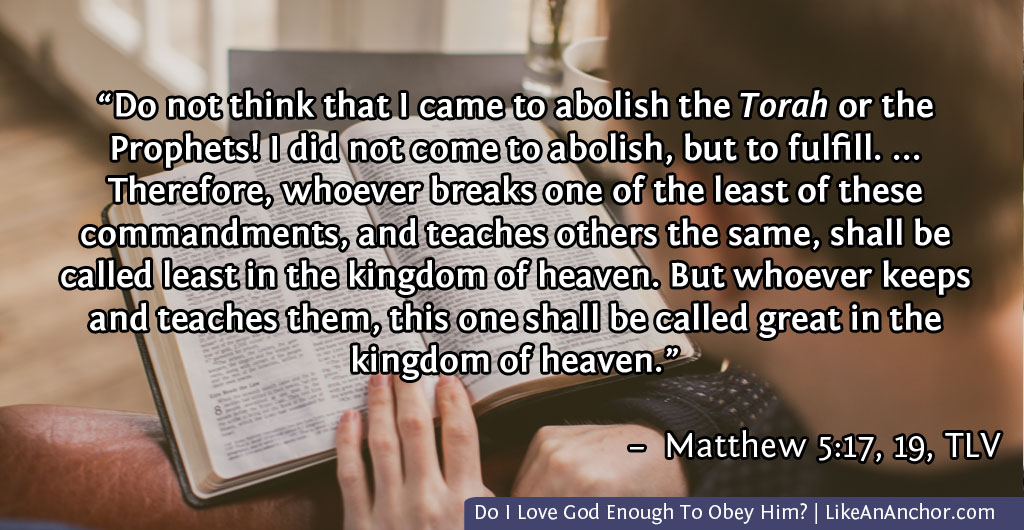
Really knowing Jesus goes beyond saying we believe in Him. It includes letting that belief change the way we live. We demonstrate how much we respect and care about Him by living according to His commandments. And since John points out that Jesus is also the Word — one of two God-beings who’ve been here for eternity — that includes the commands He gave in the Old Testament as well as the New. Jesus stated in no uncertain terms that He wasn’t here to get rid of everything He’d taught before as the Word, but rather to elevate those commands to an even higher level under a New Covenant (Matt. 5:17-48).

Do I Love God Enough To Obey Him? | LikeAnAnchor.com
Photo credit: Anggie via Lightstock

Knowing and Commandment Keeping

John further explores the topic of knowing Jesus in his first epistle. He begins, much as he did in writing his version of the gospel, with Jesus’ eternal existence as the Word of life. Then he shares that “God is light, and in him is no darkness at all,” which means we have to walk in light in order to fellowship with God (1 John 1:1-2:2).

This is how we know that we know him: if we keep his commandments. One who says, “I know him,” and doesn’t keep his commandments, is a liar, and the truth isn’t in him. But God’s love has most certainly been perfected in whoever keeps his word. This is how we know that we are in him: he who says he remains in him ought himself also to walk just like he walked. (1 John 2:3-6, WEB)

As this letter continues, John keeps coming back to themes of love, law, sin, and relationship with God. 1 John is one of those Bible books that it’s good to read in one setting (it’s not that long) to get a better feel for the points the writer is making in-context. As you read through it, one thing he continues to repeat is that we can’t have a relationship with God if we insist on breaking His commandments.

Choosing Righteousness as God’s Children

Whoever remains in him doesn’t sin. Whoever sins hasn’t seen him and doesn’t know him. Little children, let no one lead you astray. He who does righteousness is righteous, even as he is righteous. (1 John 2:1-2, WEB)

If we go back toward the beginning of the letter, we see John has already clarified that the children of God don’t practice sin, but if we slip up we can still repent and Jesus will restore our relationship with God (1 John 2:1-2). He’s not saying a Christian who sins is automatically disqualified for salvation. But he is saying that salvation comes with the expectation from God that we’ll respond to His work in us by starting to live lives modeled after His righteous standards.

We declare by our choices whether we are children of God, who practice righteousness, or children of the devil, who practice lawlessness (1 John 3:8-10). Again and again John emphasizes that children of God keep God’s law, chiefly the two laws that Jesus and Paul identified as the most important  — love God and love others (Matt. 22:36-40; Rom. 13:9-10). All other commands hinge on those two. God is love and we need to love as He does, in deed and in truth (1 John 3:11-24; 4:7-21). That’s just how we do things in the family of God.

How I Love Thy Law

As John wraps-up this letter, he ties what he’s written about loving and knowing God together with what he wrote about loving our brethren. He also addresses a common complaint about how “hard” it is to obey God.

By this we know that we love the children of God, when we love God and keep his commandments. For this is loving God, that we keep his commandments. His commandments are not grievous. (1 John 5:2-3, WEB)

Many people think of commandment keeping as something burdensome, but John tells us that’s far from true. Living within God’s law yields blessings, not hardship. Our attitude toward God’s law should be like that expressed in Psalm 119. This psalmist is in love with the law because it belongs to the God whom he loves. God’s laws are an expression of His character. If we want to be like the Lawgiver and receive the blessings that come from walking with Him, then we’ll respect His word.

Psalm 119 speaks of God’s law as a source of delight, strength, liberty, hope, comfort, life, wisdom, righteousness, peace, and much more. How we keep God’s law is different now — elevated to a spiritual level in the New Covenant — but it still matters (this is largely what Romans is about). God cares about the relationship we have to His words and whether or not we love Him enough to do what He tells us to do. Which brings us to the question of today’s title, “Do I love God enough to obey Him?”

It’s easy to say we love God but it’s harder to follow-through on the things that prove our love is genuine. If we truly love Him, though, obeying His word shouldn’t be a problem for us. It’ll still be a struggle at times to submit our own will to that of our sovereign God, but it’s something worth doing. The blessings of knowing God far outweigh any aspects of obedience that we might find inconvenient. And when we love God and follow His words, continuing to turn back to Him if/when we make mistakes, then we’ll have the assurance that we know Him and are known by Him as well.