Focusing On Authority Misses the Point (How Do Women Serve in the Church?)

I recently read a social media discussion centered on the issue of women in ministry. Without going into too much detail, the original post criticized the idea of “women pastors,” and subsequent comments went in the direction of debating whether or not women had any authority roles in the church. As I read these comments, I started feeling uncomfortable. It’s not as if I’m unfamiliar with this topic or I don’t have my own ideas on whether women are “allowed” to teach, speak, pray, prophecy, or lead in churches (one example: my post “Women Who Speak in Scripture”). But the focus on who gets to have authority struck me as wrong. If we focus discussions like this on who is in charge, I think we’re missing one of the New Testament’s big points about how all Christians are supposed to relate to one another.

Jesus’s Take on Authority

Authority is not a bad thing. Jesus taught with authority, used the authority His father gave Him for good (such as to forgive sins), and currently has “all authority in heaven and on earth” (Matt. 7:29; 9:6; 28:18; John 5:27; 10:18). He also clarifies that His authority comes from God–it’s legitimate authority conferred upon Him by the highest authority (John 12:49). As someone with authority, He could and did give His disciples certain authority, such as over unclean spirits (Matt. 10:1).

In these verses, the Greek word translated “authority” is exousia (G1849). Thayer’s dictionary lists several primary meanings: “1. power of choice, liberty of doing as one pleases … 2. physical or mental power … 3. the power of authority (influence) or right (privilege) 4. the power of rule or government.” Like the English word “authority,” it can refer to legitimate, well-wielded authority or it can have a darker side. We see that in a discussion Jesus had with His disciples at least twice: once after James and John asked for authority in His kingdom and once at the Passover when all the disciples debated who would be the greatest after Jesus died.

Now when the other ten heard this, they were angry with the two brothers.  But Jesus called them and said, “You know that the rulers of the Gentiles lord it over them, and those in high positions use their authority over them. It must not be this way among you! Instead whoever wants to be great among you must be your servant, and whoever wants to be first among you must be your slave—just as the Son of Man did not come to be served but to serve, and to give his life as a ransom for many.”

Matthew 20:24-28, NET

 A dispute also started among them over which of them was to be regarded as the greatest. So Jesus said to them, “The kings of the Gentiles lord it over them, and those in authority over them are called ‘benefactors.’ Not so with you; instead the one who is greatest among you must become like the youngest, and the leader like the one who serves. For who is greater, the one who is seated at the table, or the one who serves? Is it not the one who is seated at the table? But I am among you as one who serves.

Luke 22:24-27, NET

“Authority” in these verses is exousia (or it is in Luke 22; Matthew 20 uses katexousiazo, a derivative meaning “to exercise authority, wield power” [G2715, Thayer]). In this case, it’s talking about people among the nations who have worldly authority. The phrase “lord it over” is another word: kurieuo in Luke 22, which means “to be lord of, to rule, have dominion over” (G2961, Thayer) and katakurieu in Matthew, a related word meaning “to bring under one’s power … to hold in subjection to be master of, exercise lordship over” (G2634, Thayer). It’s definitely not a good thing in this context, and Jesus clearly tells his disciples not to act this way. If you want to be great in His church, then you serve.

When I saw people arguing things like, “How dare women try to get authority over men?” or “I can’t stand that only men get authority, why can’t women like me be in charge?” I thought about these verses. There are certain kinds of authority given to people in the church (and legitimate roles instituted by Jesus or those He taught directly, such as apostle, pastor, and deacon), but if we’re concerned about who gets to lord it over other people then we’re missing the point. No one is supposed to be lording it over other people or coveting a position where they could do that. We’re supposed to be humble and focus on service.

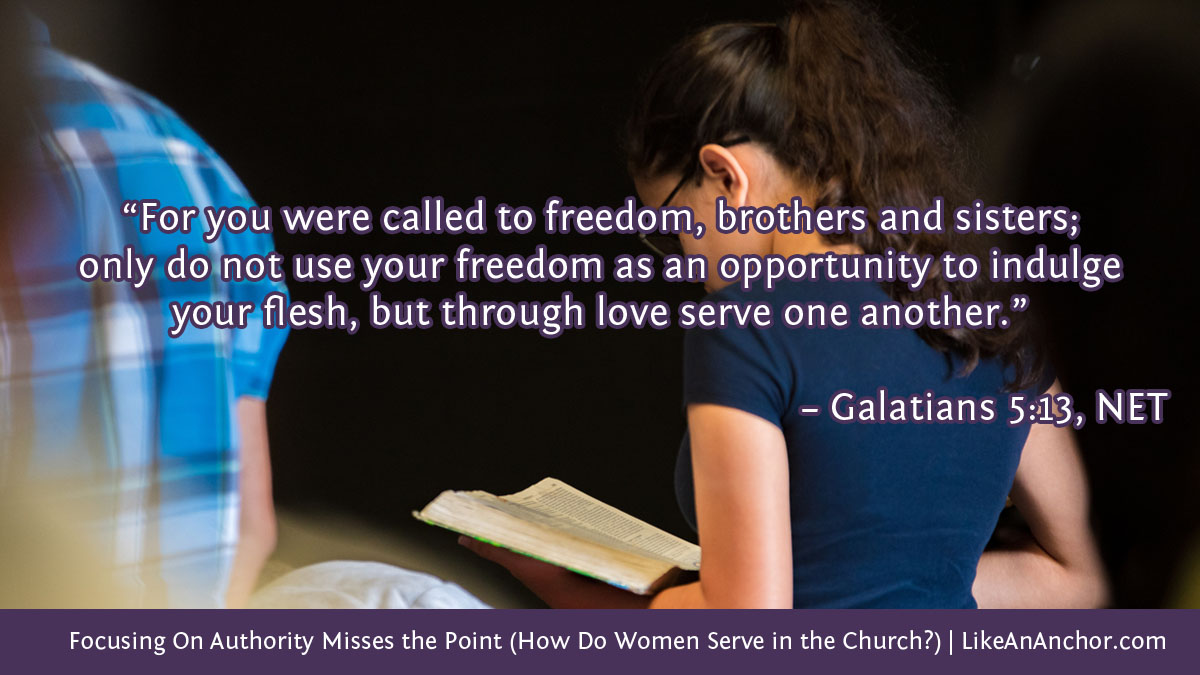
Image of a young woman standing in church reading the Bible overlaid with text from Gal. 5:13, NET version:  “For you were called to freedom, brothers and sisters; only do not use your freedom as an opportunity to indulge your flesh, but through love serve one another.”
Image by José Roberto Roquel from Lightstock

Who Can Serve and How?

Maybe instead of asking, “Can women have authority in the church?” we should ask, “Can women serve in the church?” The answer to that is a resounding “Yes!” supported by the examples of many women in the Old and New Testaments. What gets more to the heart of the original debate, though, is the question, “How do women serve in the church?” We have examples to answer that question as well. We know for certain that women in the Bible served God’s people in these ways:

There may even have been a woman apostle, Junia (Rom. 16:7), but her exact role is so hotly debated that I didn’t put “apostle” on my list (scholars pretty much agree that she was a woman, but not on whether the phrase used in this verse indicates she could have been an apostle). Clearly, women were heavily involved in the church, both in what we think of as “behind the scenes” roles and (apparently more rarely, though female prophets are relatively common) in the more public leading, serving, teaching, preaching roles. When God uses a woman to do something in scripture, we really can’t argue that the church shouldn’t allow women to do those same things today.

Things Women (Probably) Don’t Do

It’s worth noting some of the roles that we don’t see examples of women in. If we look at the lists of ministry gifts/roles in 1 Corinthians 12:28 and Ephesians 4:11, we see “first apostles, second prophets, third teachers, then miracles, gifts of healing, helps, gifts of leadership, different kinds of tongues” (1 Cor. 12:28, NET) and “some as apostles, some as prophets, some as evangelists, and some as pastors and teachers” (Eph. 4:11). Let’s use those lists as a guide for examining women’s possible roles in the church.

We might have one possible example of a woman as an apostle, but no specific examples of them as pastors (from the same Greek word translated “shepherd”) or evangelists (Greek word only used 3 times). However, “evangelist” is a title that comes from the Greek verb euaggelizo (G2097), “to bring good news” or preach the gospel (Thayer). It is likely that women did participate in that activity (Acts 8:1-4; Phil 4:2-3). We also don’t have specific examples of women performing miracles or healings. But we know for certain that women can be prophets, that women teach even if not called “teacher” as a title, that they fill helper roles, that they can have leadership-related gifts, and that those at Pentecost spoke in different languages just like the apostles and other men (Acts 1:14; 2:1-4).

It seems, then, that we can say women did not serve as pastors/shepherds in the Bible and that they were not typically apostles or evangelists. The only other church “authority” roles I can think of in the New Testament are elder, bishop/overseer, and deacon/servant. We have a concrete example of a woman as a deaconess/servant, but no women in the overseer role. “Elder” seems to refer to men most of the time, but the feminine version of the Greek word is used in 1 Tim. 5:2. I suspect that when “elder” is used to refer to respected older people in the church it often includes men and women, but when it’s used to refer to an ordained role in the church it typically or exclusively refers to men. That said, we also don’t have any verses directly saying, “women cannot be pastors.”

You might be uncomfortable with how ambiguous I’m being here, but it is deliberate. The need to have hard rules defining what women and men can and cannot do is a product of Western cultural mindset being applied to the Biblical text. We want specific and inflexible rules for things, but Eastern cultures (like those of Biblical writers) see rules differently: “rules apply except when the one in charge says otherwise. Westerners might consider this arbitrary; many non-Western Christians consider this grace” (Misreading Scripture With Western Eyes, Richards & O’Brien, p. 174). As an example, one of the authors of this book recounts a time when he was invited to speak to a group of pastors in Indonesia. He was shocked, knowing the group’s bylaws say pastors must be male, to see a few women in the audience. When he asked about it, he was calmly told, “Yes, and most of them are [male]” (p. 169). The Indonesian man he spoke with saw nothing strange about an exception to the rule. Perhaps Christians at the time Paul wrote Romans would have heard us say, “Women can’t be apostles,” and responded by saying, “That’s right, except for the times when they are apostles.”

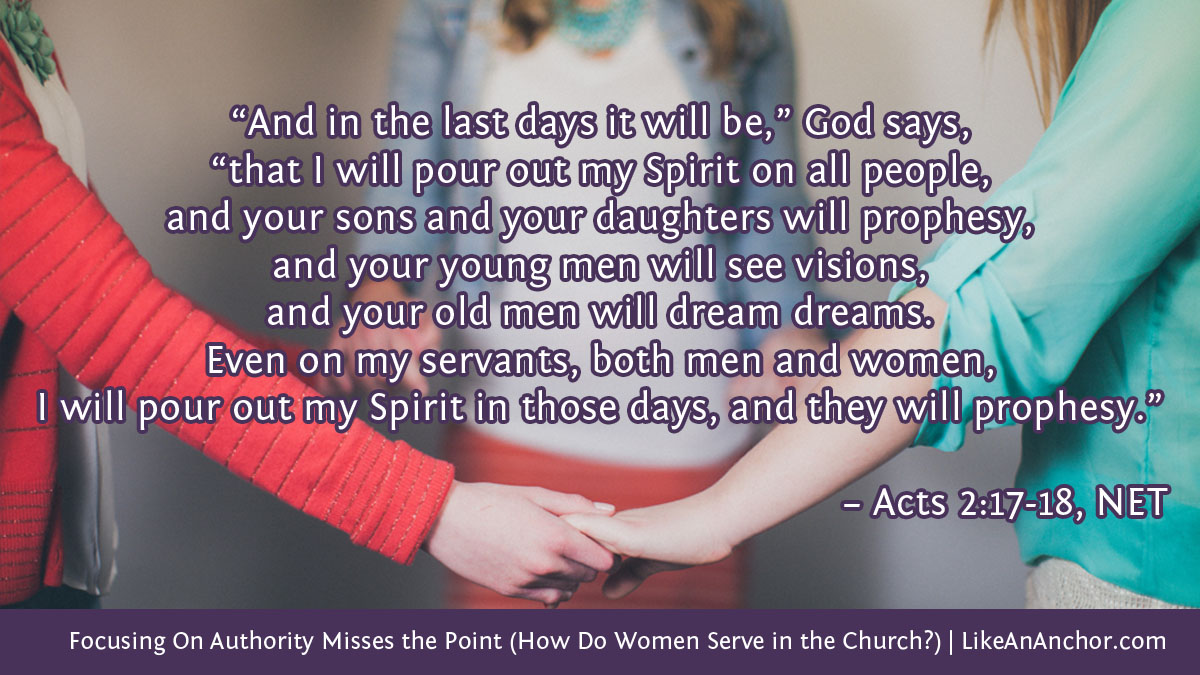
Image of three women holding hands to form a circle and pray, overlaid with text from Acts 2:17-18, NET version: “And in the last days it will be,” God says, “that I will pour out my Spirit on all people, and your sons and your daughters will prophesy,
and your young men will see visions, and your old men will dream dreams. Even on my servants, both men and women, I will pour out my Spirit in those days, and they will prophesy.”
Image by Pearl from Lightstock

But What About 1 Timothy 2?

Because we’ve been talking about authority, we need to address 1 Timothy 2:12, where Paul wrote, “I don’t permit a woman to teach, nor to exercise authority over a man” (WEB). Seems straightforward enough, until we start looking at the context and Greek words. Paul doesn’t use any of the typical words for authority here, but rather the incredibly rare word authenteō. This word may refer to wrongly used authority and/or could be connected to astrology practiced by some pagan women at the time, but it’s hard to say for sure since this is the only time it’s used in the Bible and it’s rarely used in contemporary writings (“The Strangeness of 1 Timothy 2:12,” Andrew Bartlett). Paul also uses a different phrase, “I don’t permit,” than he typically uses when laying down rules for the churches.

We also should take note of the fact that Timothy was in Ephesus when he received this letter, a church that Paul specifically brought Priscilla and Aquilla into and where he left them to serve (including teaching Apollos when they arrived [Acts 18:18-28]). It makes a whole lot more sense to interpret this as a prohibition against women usurping (KJV), dominating (ASV), or lording it over (TLB) a man (note that “man” is singular in the Greek, not the plural “men”) rather than a general rule that women never speak or have any authority, particularly given how involved some women were in ministry in the New Testament.

This analysis might seem pedantic or as if we’re trying to “get around” this scripture, but when you come across something in Paul’s writings that is hard to understand (and a lot of things are [2 Pet. 3:16-17]) we need to look at how it fits with the rest of scripture. Our interpretation of what he says has to match other things in the Bible. In this case, if scripture shows women consistently involved in various types of ministry work–including, occasionally, what we’d think of as “authority” roles like prophet or church host–then Paul’s words here can’t be a prohibition on women serving in the body of believers. It would go against precedent in the entire Bible–including Jesus’s radical treatment of women as equals and Paul’s own writings about how God views converted men and women on a cosmic scale (1 Cor. 11:11-12; Gal. 3:28)–if Paul were making a blanket declaration against women serving in the church. It is much more likely that he is telling Timothy not to let women in Ephesus do things that men wouldn’t be allowed to do either (e.g. lord it over others in the church or teach things related to astrology).

It seems very strange to me that we pull out a few isolated phrases Paul uses (1 Cor. 11:3; 14:34; 1 Tim. 2:12) and come up with this whole doctrine that women can’t ever teach, speak, or have public roles in the church. What about the whole rest of the Bible? What about how Jesus treated women? It seems just as misguided to me as those who take Paul’s statement, “you are not under law but under grace” (Rom. 6:14, NET) to mean that New Covenant Christians don’t have to obey God. We need to be careful about things like this, and test our assumptions (even if they’ve been assumptions for centuries of church history) to make sure they actually fit what God teaches through His word.

Motivated by Service and Humility

Image of two clasped hands, overlaid with blog's title text and the words, "When God uses a woman to do something in scripture, we really can't argue that the church shouldn't allow women to do those same things today. It’s not about who has authority; it’s about serving where God wants us to."
Image by Anggie from Lightstock

As we look at the roles we see women in the Bible filling or not filling, we need to be careful how we conceptualize authority related to those roles. The point isn’t to figure out who is most important (e.g. is it the male pastor or the female prophet?) but to serve God with the gifts He provides in the role He supplies. If God calls a woman to host the church in her home, that’s what she does. If He gives a woman the gift of prophecy, then she’s supposed to prophecy.

Likewise, if He chooses not to place women in the role of ordained pastor, elder, or overseer, that is God’s choice and the New Testament makes it seem like this is indeed the case (at least most of the time). Most men don’t fill those roles either; other roles are more commonly needed in the church. We’re not supposed to be jealous of or resent people who have roles that we think of as more authoritative than us any more than Jesus resents His Father for being greater than Him (to be clear, there is no resentment or competition between Jesus and the Father [John 10:29-30; Phil. 2:5-11]).

 Instead of being motivated by selfish ambition or vanity, each of you should, in humility, be moved to treat one another as more important than yourself. Each of you should be concerned not only about your own interests, but about the interests of others as well. You should have the same attitude toward one another that Christ Jesus had,

who though he existed in the form of God
did not regard equality with God
as something to be grasped,
but emptied himself
by taking on the form of a slave

Philippians 2:3-7, NET

No one in God’s church is supposed to seek authority roles for the prestige or the power. We should seek to serve with humility, the same way that Jesus modeled. In a healthy church following God’s lead, we’ll filter into the roles most suited to the gifts He has given us (ideally without doctrinal misinterpretation or other people’s “selfish ambition or vanity” blocking someone from what they’re supposed to be doing). It doesn’t always work that way because the church is composed of people–redeemed people working on becoming more like God, but still people who can make mistakes. We need to have patience with each other in that. For example, it is not wrong for me to want churches I’m involved with to let me exercise my teaching gifts (and other women to exercise their gifts), but it is wrong when I feel as if I deserve more recognition and responsibility than I get or when I resent other people who have the opportunity to use their gifts differently than I do.

Two of the things that we’re called to do is submit “to one another out of reverence for Christ” (Eph. 5:21, NET) and “through love serve one another” (Gal. 5:13, NET). We’re not called to seek authority or argue about who gets to be in charge. Ultimately, Jesus is the one in charge as head of the church (Eph. 1:22; Col. 1:18). The rest of us are here to serve in a variety of different capacities, but all of them characterized by encouragement, love, and humility (see, for example, John 13:35; 2 Cor. 1:24; Eph. 4:1-3; Col. 3:12-13). If we think any of this is about being in charge, claiming authority over others, or getting what we think we’re owed, then we’ve missed the whole point.


Featured image by Shaun Menary via Lightstock

Song Recommendation: “Way Maker” by Mandisa

Wanting Children While Single

You snuggle babies every chance you get, longing for the day when you might hold your own child. Or perhaps you don’t hold babies any more because the ache of wishing they were yours is just too much. That’s the kind of grief and longing we associate with women in relationships who want to have a child and can’t get pregnant. Yet this desire isn’t confined to women with a man in their lives whom they love.

I’ve always felt guilty for how much I sympathize with the barren women of the Bible. As far as I know, I could have children if I found the right guy to marry and it seems rude to compare myself with women who are physically unable to have children. It also seems out-of-order to long for children before meeting the man I’d want to be their father.

click to read article, "Wanting Children While Single" | marissabaker.wordpress.com
image credit: Jordan Whitt via StockSnap

I’m not alone, though. A woman I met through this blog while working on The INFJ Handbook shared her desire for children by asking why so many children are born into broken families while we, who would make good moms, are left barren. Since then, I’ve come across other women who feel the same way. If you’re committed to not having sex before marriage and/or not having children without a man in your life, then single women can know the pain of empty arms that long to hold a child.

Cultural Back-lash

Longing for children is unpopular in today’s society. We’ve become so obsessed with the fact that women are more than “baby producing machines” that the notion of being a mother has becomes synonymous with female oppression. Instead of seeing motherhood as a beautiful thing that many women desire, we’re told kids should take a back-seat to your career, your other desires, and your empowerment as a woman. And if having kids is actually one of your top life goals? well, clearly you’re still living in the pre-feminism dark ages. Read more

Mighty Women

It seems odd to me that I’ve read the “virtuous woman” passage scores of times without bothering to look up the word “virtuous.” The Hebrew word, chayil, was mentioned in the first message given as my Feast of Tabernacles (Sukkot) site this year. I even had it in my notes, but forgot about it. God brought it to my attention again at the end of the Feast, when a man handed me a booklet titled “A Mighty Warrior: The Hebrew-Biblical View of A Woman” by Dr. Frank T. Seekins. I can take a hint — one Bible study/blog post coming right up!

Mighty Women | marissabaker.wordpress.com

Into The Hebrew

Chayil (H2428) carries the basic meaning of “‘strength,’ from which follow ‘army’ and ‘wealth'”(Theological Wordbook OT, entry 624). It’s used about 20 times of God’s might or power, and about 85 times to describe an attribute of people.

When chayil is used of people, there’s a marked difference in how it’s translated for men and women. For men, we find translations like “mighty man” or “mighty men of valor.” The Theological Wordbook of the Old Testament notes, “The individual designated seems to be the elite warrior similar to the hero of the Homeric epic.” For women, however, “it is translated ‘virtuous’ (ASV, RSV ‘worthy’ or ‘good’), but it may well be that a woman of this caliber had all the attributes of her male counterpart.”

While Biblical women were not typically warriors and did not serve in the army, we do have the example of Deborah acting the part of a “mighty woman of valor.” We also know from passages like Ephesians 6:11-13 and 2 Timothy 2:3-4 that all Christians are spiritual warriors. God’s women must be just as valiant as His men!

Your neck is like the tower of David, built for an armory, on which hang a thousand bucklers, all shields of mighty men. (Song 4:4)

O my love, you are as beautiful as Tirzah, lovely as Jerusalem, awesome as an army with banners! (Song 6:4)

Both these passages from Song of Solomon are descriptions that the male lover, who represents Christ, uses toward the female lover, who represents the church. Great men aren’t frightened of strong women; they embrace them as allies.

A Little More History

You might wonder why English translators decided to use “virtuous” or “good”for chayil when the Hebrew leans more toward “strong” and “mighty.” I suspect there were two reasons. Firstly, the original meaning of “virtue” in English was closer to chayil. It arrived in English around 1200 from Old French with the meanings, “force; strength; vigor; moral strength.” Originally, the Latin virtatum meant “high character; goodness; manliness; valor; bravery” (Online Etymology Dictionary).

Secondly, with prevailing attitudes of gender around the time early Bibles like the 1611 King James Version were released, translators were probably hesitant to call women “mighty” or “powerful.” By the 1590s, “virtuous” was losing the more martial aspects of the meaning, shifting toward moral characteristics. In reference to women, “virtuous” became used as a synonym for “chastity.” In the King James Version you can still see this word used for “power” in the New Testament passages where dunamis (G1411) is translated “virtue” (Mark 5:30; Luke 6:19, 8:46). In the New King James, references to Christ were changed from “virtue” to “power,” but the “virtuous woman” in Proverbs 31 only changes to a “virtuous wife.”

It’s true that high moral standards are essential for godly women. Commands regarding modesty and chastity are recorded elsewhere (1 Tim. 2:9), and the character of the Proverbs 31 woman is beyond reproach. But there’s more to being a “virtuous woman” than we might assume from what we’ve grown up hearing about “traditional gender roles.” The word “virtue” has suffered a similar fate as “meekness,” which our culture thinks of as synonymous with “doormat” while the original meaning carried the idea of strength submitted to God.

Mighty Women | marissabaker.wordpress.com

Allies in Battle

God created men and women to fight for Him together. They’re both supposed to be strong and they’re both supposed to support each other.

Men and women were created by God to be allies. As a culture, we have lost the concept of powerful allies; the very thing that Proverbs 31 is telling men to value. …

When a woman’s power is undercut, a situation is created where men and women become enemies. Instead of supporting each other, we battle and undermine God’s call to reflect Jesus relationship with His bride, the church. …

The Biblical concept is clear — A woman of power is to be valued and supported. It is God’s call for women (and men) to become mighty and powerful. (Seekins, p. 2)

I think many women balk at the Proverbs 31 model because it seems so domestic and submissive. “I don’t want to be a stay-at-home barefoot-and-pregnant good little wife,” some protest. “Why would God ask for such an outdated model of femininity?” But when we look closer at Proverbs 31, we find that’s not actually what it’s saying.

The first two descriptions show a woman who does her husband “good and not evil,” and who has earned his complete trust (Prov. 31:11-12). Her husband is respected by all, and it’s implied this is in no small part owing to her support as his ally (Prov. 31:23). In addition, she cares for the poor and needy, practicing the command to “love your neighbor” (Prov. 31:20). She’s respected by her children, husband and the community, and her opinion is highly valued (Prov. 31:28-29, 31).

The Proverbs 31 woman is shown actively doing productive things. She works with her hands, engages in trade “like the merchant’s ships,” and oversees workers in her household (Prov. 31:13-16, 19, 22, 24). She’s not full of anxiety because she has confidence in her ability to care for her business and family (Prov. 31:18, 21, 27).

Strength and honor are her clothing; she shall rejoice in time to come. She opens her mouth with wisdom, and on her tongue is the law of kindness. (Prov. 31:25-26)

It’s still an intimidating picture to try and live up to, but there’s no reason to reject it as demeaning to women. If anything, this “outdated” model is far more powerful than anything modern women’s empowerment movements have come up with.

When a woman understands her calling to be a mighty warrior and a perfect ally, she will conquer and control life. She will remember that the men in her life are not the enemy; her weapons are not meant to be used against them. The weapons of her strength and power are to be used against their enemies (Seekins, p. 23).

God calls all of us to “be strong in the Lord and in the power of His might” (Eph. 6:10). Both men and women need to recognize this, and embrace our roles as “heirs together of the grace of life” (1 Pet. 3:7), fighting as allies for and alongside the Captain of our Salvation, Jesus Christ.

Save

Another 5 Favorite Proverbs

Another Five Favorite Proverbs by marissabaker.wordpress.comI’ve finished making my way through a study of Proverbs, in preparation for my church’s women’s group discussion about favorite proverbs that is taking place this afternoon. My first post covered five proverbs from chapters 1-10, the second covered five from chapters 11-20, and this last post is for chapters 21-31. I still haven’t decided which of these 15 is my favorite, but at least I’ve narrowed it down to 15.

11: Reputation

A good name is to be chosen rather than great riches, loving favor rather than silver and gold. (Prov. 22:1)

I just heard a sermonette last week about God giving people names with meanings that fit the roles He designated them for — Jesus = savior; Paul = small; Peter = a little stone; Abraham = father of a multitude. From what I understand, names in Hebrew thought are inseparable from the essence, character, and reputation of a person. Therefore, it is better to have a good reputation, a name worthy of respect, than to have great riches.  The word for “favor,” which is described as better than silver and gold, is from the word chen (H2580), and it means “favor, kindness, grace, loveliness, charm, preciousness.”

12: Deliverance

For a righteous man may fall seven times and rise again, but the wicked shall fall by calamity. (Prov. 24:16)

It doesn’t promise that if you are a just person you will never fall — it says you will be able to get back up rather than fall deeper into mischief. “Many are the afflictions of the righteous,” David said, “but the Lord delivers him out of them all” (Ps. 34:19). If — when — we fall, we  can be assured that God is holding our hand and will help pick us back up (Ps. 37:24).

13: Friends

Faithful are the wounds of a friend, but the kisses of an enemy are deceitful. (Prov. 27:6)

King Lear would have been a very different play had the titular character been heeding this advice. When a friend wounds you, it is generally 1) an accident, or 2) with a view to your good. David wrote, “Let the righteous strike me; it shall be a kindness. And let him rebuke me; it shall be as excellent oil; let my head not refuse it” (Ps. 141.5). It might make us angry at first, but if we are honest with ourselves, we can often see that we were reproved out of love, and that we become better people with a stronger friendship as a result. In contrast, listening to the flattering words of those who secretly seek our hurt can only lead to grief.

14: Guardrail

Every word of God is pure; He is a shield to those who put their trust in Him. (Prov. 30:5)

“The Guardrail,” from joyfultoons.com

Here we leave Solomon’s proverbs and read “the words of Agur the son of Jakeh” (Prov. 30:1). This is a two-fold promise. Firstly, that God’s words are free of imperfections. As such, it is all profitable and no part should be ignored or neglected (2 Tim. 3:16). Secondly, that the Lord shields those who trust in Him. This was a frequent subject in Psalms, such as “For the Lord God is a sun and shield; the Lord will give grace and glory; no good thing will He withhold from those who walk uprightly” (Ps. 84:11). Connecting these two points is the fact that God’s commands are designed to protect us, as illustrated by this comic I saw on Facebook the other day.

15: Beauty

Charm is deceitful and beauty is passing, but a woman who fears the Lord, she shall be praised. (Prov. 31:30)

This is from the end of the virtuous woman passage contained in “words of King Lemuel, the utterance which his mother taught him” (Prov. 31:1). When I was younger, I latched on to this verse as a substitute for my perceived lack of beauty — if I couldn’t be pretty, I could at least fear God and earn praise that way. As I’ve become more comfortable with myself and more mature as a Christian, my views on this verse have changed. I concentrate more on the last half of the verse, asking “How can I be a woman who fears the Lord?”

Do not let your adornment be merely outward—arranging the hair, wearing gold, or putting on fine apparel — rather let it be the hidden person of the heart, with the incorruptible beauty of a gentle and quiet spirit, which is very precious in the sight of God. (! Pet. 3:3-4)