I have two reason why you’re getting a rambling post about how I spent yesterday rather than a nice, neat article:
1) NaNoWriMo
50,000 words in 30 days = one novel, and not much sleep. I’ve done it twice before, and I’m trying again this year with a Young Adult novel full of super humans (click to visit my writer’s website). I’m prepared with enough Lindt hazelnut truffles to reward myself every 5,000 words (plus a few extras, just in case).
2) Zoo Day!
Months ago we got half-price tickets to the Columbus Zoo, and just never seemed to find time to use them. Then we realized they expired in February, and it wasn’t getting any warmer, so we went yesterday. It was so cold that most of the South-Asian and African animals weren’t out, but the predators were very active.
the Amur leopards were moving too fast for my camera
Very, very active, in some cases. The brown bears were chasing each other all over their exhibit, my family saw a tiger try to pounce on one guy through the glass, and there was a cheetah stalking a child being pulled in a wagon.
huge brown bears
We also saw an extremely rare creature — an awake koala. They sleep 22 hours a day if given the chance, and I think this is the only time I’ve ever seen one moving.
hungry koala
I’d say the dinosaurs were even more rare, but they weren’t moving much. Didn’t even try to snatch a tourist out of the boat ride, so I suspect they were animatronic.
It’s a dinosaur!
The aquarium in Columbus might not be huge by public aquarium standards, but it’s certainly one of the most impressive at a zoo. I love the manatees. Columbus and Cincinnati are the only aquariums in the U.S. outside of Florida that help with manatee rescue and rehabilitation.
Stubby can’t be released into the wild because of propeller damage to her fluke and an autoimmune disease that affects her skin
And last but not least … I found a yurt!
yurt, a.k.a. one of the cutest structures known to man
I’ve been nominated for The One Lovely Blog Award by INFJ Ramblings and Wild Blue, and am very pleased to accept. Thank you both! Here’s some info about the award:
The One Lovely Blog Award nominations are chosen by fellow bloggers for those newer and up-and-coming bloggers. The goal is to help give recognition and also to help the new blogger to reach more viewers. It also recognizes blogs that are considered to be “LOVELY” by the fellow bloggers who choose them. This award recognizes bloggers who share their story or thoughts in a beautiful manner to CONNECT with viewers and followers. In order to “accept” the award the nominated blogger must follow several guidelines:
Thank the person who nominated you for the award. Add the One Lovely Blog logo to your post. Share 7 facts or things about yourself. Nominate 15 or more bloggers you admire and inform the nominees by commenting on their blog.
Here are seven facts about me. I’ll try to pick some that you don’t already know from reading this blog.
I have three freshwater fishtanks. Inhabitants include an upside-down catfish named Bilbo and an anglefish named James Fingolfin.
I’m interested (read: vaguely obsessed) with cryptozoology and have collected a box full of articles, completed more than one cryptozoology-themed art project, and own 8 books devoted to the subject.
Tiger also appreciates psychology literature on dreaming. He’s a well-read cat.
My cat is almost the same age as my little brother (they are 16 going on 17 *cue music*).
I love names. My current favorite first-middle combinations are Callen Alexei, Killian Asher, Marina Simone, and Ashlyn Rebekah.
My favorite fairy tale in every form is “Beauty and the Beast.” Jeanne-Marie Leprince de Beaumont’s version is my favorite “original” fairy tale, Beauty and the Beast is my favorite Disney film, and Rose Daughter by Robin McKinley is my favorite fairy-tale retelling.
I’m using Duolingo to refresh/build up my French vocabulary. This program let’s you unlock additional lessons, like flirting, which it told me I “mastered” yesterday. Voulez-vous danser avec moi?
And here are my nominations, in no particular order (yes, I know it’s less than 15).
I’d actually forgotten this was on my Classics Club Book List and just started reading it because I saw it on the shelf. Now I have to write something. But first …
I just read some really exciting literary news that I want to share with you. There’s going to be a web-series re-telling of The Scarlet Pimpernel in a modern setting (think something like what The Lizzie Bennet Diaries did with Pride and Prejudice). You can find more about it at Yet Another Period Drama blog or The Day Dream blog. It sounds fantastic, and I’m so looking forward to seeing it next year.
Anyway, back to Mars.
*insert obligatory spoiler warning*
I really wasn’t sure what to expect from this book. All I knew was that it was written by Ray Bradbury (which pretty much guaranteed it would be intriguing) and it had something to do with Mars. The inside cover of my edition reads, “Ray Bradbury’s Mars is a place of hope dreams, and metaphor.” With that introduction, I was not expecting more than 20 people to have been killed by page 65 (and many more in the following pages). Warning: this is not a “happy” book.
If you’re not expecting a light, happy read, though, this book is fascinating. I think most of us know by now that Mars is not inhabited (as least not by aliens of this sort), but the world Bradbury creates on Mars still seems entirely possible. He has no trouble convincing his readers into a “willing suspension of disbelief,” probably because he doesn’t try. He just writes these stories as if they are real (but more in the sense of myth than history), and we’re perfectly happy to go right along with this fiction.
One of my favorite parts of the book was actually Bradbury’s introduction (You might be a writer if … you’re as intrigued by the author’s description of his writing process as you are by the book itself). He describes the stories that became The Martian Chronicles as “a series of Martian penseés, Shakespearean ‘asides,’ wandering thoughts, long night visions, predawn half-dreams.” He thought they weren’t anything special, until an editor “suggested that I might have woven an unseen tapestry.”
The Martian Chronicles was published in 1950. Since then, it has never been out of print, and my edition notes that it “has been read by more readers around the world than almost any other work of science fiction.” But Bradbury himself didn’t think of it as “science fiction.” This is what he said this book was:
It is King Tut out of the tomb when I was three, Norse Eddas when I was six, and Roman/Greek gods that romanced me when I was ten: pure myth. If it had been practical technologically efficient science fiction, it would have long since fallen to rust by the road. But since it is a self-separating fable, even the most deeply rooted physicists at Cal-Tech accept breathing the fraudulent oxygen atmosphere I have loosed on Mars. Science and machines can kill each other off or be replaced. Myth, seen in mirrors, incapable of being touched, stays on. If it is not immortal, it almost seems such.” — Ray Bradbury, introduction to The Martian Chronicles
Religion on Mars
There are so many threads that weave together The Martian Chronicles. It covers book banning, inadvertent genocide, the nature of man, implications of telepathy, ethics of murder — the list goes on and on. So I’m going to pick just one “thread” to talk about here, and that’s religion.
On Mars, science and religion are not incompatible — they are interconnected. Unfortunately, we only learn this after most of the Martians are already gone and it is too late for the knowledge to help mankind put back together what we separated.
Science is no more than an investigation of a miracle we can never explain, and art is an interpretation of that miracle.” — Ray Bradbury, The Martian Chronicles
Mankind has it all wrong, according to one character who may or may not have lost his mind. Instead of letting science, religion, and art flow into each other, as the Martians did, we tried to separate them. In the process, we lost ourselves and our faith. Then, not content with damaging one world and its people, we moved on to Mars, and killed it.
But The Martian Chronicles isn’t just about all the mistakes humanity made as a whole. It’s about the individuals who lived, loved, killed, and died for a whole host of different reasons. It’s about the priest who believes that even the glowing blue lights on Mars — the last Martians — have a soul and deserve to hear about Christ. It’s about the father who launched his family toward an abandoned Mars to save them from a dying earth. It’s about the young Martian whose telepathy turned him/her into a chameleon as he/she tried desperately to cure their loneliness by becoming a human family’s dead child. It’s about how these people respond to the unknown, and what beliefs they cling to in the end.
I read this book quickly, because I was so intrigued by it, but not so quickly as I have read other novels. It demands more than a cursory glance, and I think it warrants at least one re-reading. If you like “thinking books,” or sci-fi of any kind, I highly recommend giving The Martian Chronicles a try.
Click here to get a copy of The Martian Chronicles. Please note that this is an affiliate link. This means that, at no additional cost to you, I will receive a commission if you click on the link and make a purchase.
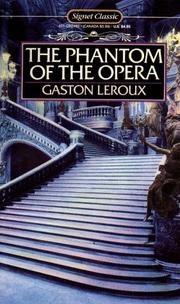
I choose The Phantom of the Opera by Gaston Leroux as the first book to read off my Classics Club book list for one simple reason. I had a dream about it.
The edition I read
Now, understand I’ve never read this book before. It’s not even one I checked out of the library, flipped through, and lost interest in. So when I dreamed about seeing the written pages of this book morph into film-like scenes that were not in the 2004 film or the play I saw this year, I decided I needed to read this book. It’s not unusual for me to dream vividly, but it was a bit odd to construct such an elaborate version of something I hadn’t thought about recently.
So I ordered it into the library and read it (in translation, unfortunately, since my French isn’t very good). And I was pleasantly surprised to enjoy the book. It must have been almost 10 years ago that I first became seriously interested in the musical The Phantom of the Opera, and at the time I decided against reading the book because so many reviewers I read said they were disappointed. They said if you like the play, don’t bother reading the book because Andrew Lloyd Webber somehow managed to pull brilliance out of a terrible novel.
Overall Impressions
It is not a terrible novel, though I understand why some readers didn’t like it. Many who love the musical expect a more romantic Phantom character, while Leroux’s Erik (a.k.a. The Phantom) is firmly rooted in a Gothic tradition of villainy. He sleeps in a coffin. His lair includes a torture chamber. He has no nose in his deathly-pale face.
But we’ll get to comparing it with the play later. For now, back to the book. It is written as if by a narrator who began studying the events surrounding the tragedy of the Paris Opera House about 30 years after its haunting by the “ghost.” This haunting coincided with the famous disappearance of Christine Daaé and the Vicomte de Chagny. Our narrator connects these two events, interviews the only witness who is both surviving and locatable, and happens into possession of some very intriguing documents attesting to the ghost’s antics. In short, he is uniquely positioned to be the only person qualified to uncover the truth regarding the opera ghost.
Parts of the story are told as we would think of a “normal” 3rd-person narration, others are the narrator’s conjectures about what might have taken place, still others are written as if borrowed from the memoirs of a few key characters. This rather disconnected narrative style works surprisingly well, and there were only a few places where I thought it jarring to be reminded that the narrator is supposedly piecing this story together from multiple sources of evidence.
Comparing Phantoms
The Phantom of the Opera (1925)
Probably the main change from the book to the play is how Erik is portrayed. This blog post about The Many Faces of Erik collects pictures of the Phantom’s portrayal in film and on stage, both before and after Webber’s musical. I could have nightmares about that face from the 1925 version, but it’s probably the closest to Erik in the book.
Erik is described as having “a death’s head,” and his hands are skeletal and cold. Even the most ghoulish Phantom make-up in Andrew Lloyd Webber’s musicals can be hidden under a half-mask. In the book, the entire man is deformed in some vague way that can’t really be hidden. The people who glimpse him even in disguise get the impression of a ghost or skeleton.
And his character is more twisted in the book as well. In the play, we know the Phantom as a genius who has gone mad and kills to protect his secrets. In the book, we are given more of Erik’s back-story and made to see him not as an unstable, unloved man who is carried away by his passion, but as a violent man without a conscience who has a history of inventing new ways to kill and torment people for pleasure. He captures our imagination, our horror, our pity, but not our love.
Angel of Music
Christine and Raoul’s back-story was very similar in the book and play, with the book simply being more fleshed-out. I liked Raoul less in the book, though. He seems a rather pale, helpless character who follows Christine around vacillating between hating of her for loving someone else and being willing to do anything to protect her from Erik. If he was translated perfectly from the book to the musical and the changes for the Phantom left in place, I doubt there’s be any part of me hoping for Raoul to win Christine.
Poor Christine, in the book and play, was doomed by her father’s promise to send her the Angel of Music. This is built-up even better in the book, with her father telling stories about how the greatest musicians heard the Angel of Music, who moved them from talented to unforgettably brilliant. Christine’s father was a great violinist, but never heard the Angel. His daughter, however, was waiting for him to send one from heaven, and when Erik first sings to her she asks if he is her Angel. He grasps the title eagerly, and she’s lost to his music.
His voice first appears in the book simply as a speaking voice — the man Raoul hears but cannot find in Christine’s dressing room and the invisible speaker in Box 5. Madam Giry calls it “such a lovely man’s voice … so soft and kind.” When Erik finally sings, the word “captivating” hardly seems to do the listeners’ reactions justice:
The voice without a body went on singing; and certainly Raoul had never in his life heard anything more absolutely and heroically sweet, more gloriously insidious, more delicate, more powerful, in short, more irresistibly triumphant. He listened to it in a fever and he now began to understand how Christine Daaé was able to appear one evening, before the stupefied audience, with accents of a beauty hitherto unknown, of a superhuman exaltation, while doubtless still under the influence of the mysterious and invisible master.
Sierra Boggess as Christine and Ramin Karimloo as The Phantom in “Phantom Of The Opera At Royal Albert Hall.”
The voice was singing the Wedding-night Song from Romeo and Juliet. Raoul saw Christine stretch out her arms to the voice as she had done, in Perros churchyard, to the invisible violin playing The Resurrection of Lazarus. And nothing could describe the passion with which the voice sang: “Fate links thee to me for ever and a day!”
The strains went through Raoul’s heart. Struggling against the charm that seemed to deprive him of all his will and all his energy and of almost all his lucidity at the moment when he needed them most, he succeeded in drawing back the curtain that hid him and he walked to where Christine stood. (from Chapter IX)
Michael Crawford (original Broadway cast), Ramin Karimloo (25th anniversary cast), and Cooper Grodin (touring cast I saw in Columbus) have voices like this. That spectacular voice, which mesmerizes Christine and the audience, is the secret of Erik’s allure. Without it, he would just be a hideous man with an even more hideous soul hiding under an opera house. But add this voice, and he becomes something unforgettable — the dark menace who should be repulsive but is somehow irresistible.
Click here to get a copy of The Phantom of the Opera. Please note that this is an affiliate link. This means that, at no additional cost to you, I will receive a commission if you click on the link and make a purchase.
I knew I would love the latest Doctor Who episode, “The Robots of Sherwood.” I’ve been curious about it since the first set photo of Clara in a Medieval dress was released, and giddy with anticipation when the title let me know it had something to do with Robin Hood. I can’t remember not being fascinated by Robin Hood. The first time I met him was in the animated Disney film, which my Mom says we brought home from the library so often that the librarians teased her, “Aren’t you ever going to buy that movie?” I vaguely recall finding a copy of Howard Pyle’s “The Merry Adventures of Robin Hood” in a little back corner of the library, then buying my own copy and wearing it out (quite literally — the cover fell off).
“There’s no such thing as Robin Hood”
“The Robots of Sherwood” begins with Clara making a request I can easily identify with: take me to meet Robin Hood. The Doctor obliges by setting course for 1190-ish, though he maintains that Robin Hood is merely a legend even after the TARDIS is shot by the famous bowman. The episode progresses in a lighthearted story that covers classic elements of both Doctor Who and Robbin Hood, and culminates with a conversation between the Doctor and Robin about how history lost sight of Robin the man and turned him into stories, much like the stories Clara tells Robin about the Doctor.
Doctor: “I’m not a hero.”
Robin: “Neither am I. But if we both keep pretending to be, perhaps others will be heroes in our name. Perhaps, we will both be stories.”
Are They Heroes?
As a child-fan of Robin Hood, I saw him as an heroic figure — the good in a good-verses-evil conflict. But even the versions of the legends specifically written for children have a complicated definition of morality. Robin Hood steals and kills people (typically in defending himself or others) to fight against a government which commits worse crimes. But does he really have the right to take justice into his own hands when his country’s law dictates that justice belongs to appointed authority figures and his God says, “Vengeance is mine, I will repay”? (Robin is presented as Catholic in most legends.) I want to root for him and justify his every action, but I can’t always do that.
Errol Flynn (who the Doctor has apparently fenced with) as Robin Hood
It’s much the same with the Doctor. He flies around the universe saving people, but there’s often a lot of things that go wrong. As a show, Doctor Who has a surprisingly high casualty rate. In the tenth episode of “new-Who,” the 9th Doctor joyfully shouts, “Everybody lives, Rose! Just this once — everybody lives!” And as far as I can remember, it really was “just this once” that everyone makes it to the end credits alive. And the Doctor has a thoroughly dark side which complicates defining him as a hero (if you need convincing, here’s an article discussing the Doctor’s 13 Darkest Moments).
So, are they heroes? Depends on your definition.
A hero is someone who has given his or her life to something bigger than oneself. — Joseph Campbell
A hero is an ordinary individual who finds the strength to persevere and endure in spite of overwhelming obstacles. — Christopher Reeve
A hero is no braver than an ordinary man, but he is braver five minutes longer. — Ralph Waldo Emerson
These sound like rather good descriptions of the Doctor and Robin Hood. I couldn’t find the quote (even with Google’s help!), but I read once that heroes are simply people who’ve been observed doing what good men do as a matter of course. There’s some question of whether or not the Doctor qualifies as a “good man,” but he has been seen doing good and heroic things. As for Robin, all but the earliest legends present him as someone who does more good than harm. Even if they’re not “heroes,” they want to be.
The “Real” Robin Hood
Robin Hood by Louis Rhead
Speaking of the earliest legends, I’m going to digress for a moment and talk about my one peeve with how this episode portrays Robin Hood. I’ve done no little research into the history of the Robin Hood legends, and know that the earliest tales set him during the reign of Edward III (1327-1377), not during the time of King Richard and Prince John. The earliest version of his character that we can track down presents him as a “famous cutthroat” and “forest outlaw” who was both intriguingly mysterious and alarmingly unknowable (Stephen Knight; Robin Hood: A Mythic Biography).
Now, for Doctor Who’s version we could say that the Robin legends took on a sinister aspect in the 100-some years following Clara and the Doctor’s meeting with the “real” Robin, before shifting back to something closer to “reality” in the 1590s, when stories of Robin Hood as a displaced earl begin showing up. But it would have been much more in keeping with the records we have of Robin Hood legends, to present Robin Hood in Doctor Who as a clever, outlawed yeoman. Someone could have at least done enough research to know that the legend of Robin Hood splitting his opponent’s arrows at an archery tournament didn’t show up at all until the 1820 publication of Sir Walter Scott’s Ivanhoe (though it did make for a humorous scene with the Doctor).
Perhaps Mark Gatiss, who wrote this episode, agrees with his version of Robin Hood that, “History is a burden; stories can make us fly.” And I’m inclined to cut him some slack, in terms of how “authentic” Robin Hood has to be for Doctor Who. Most viewers just want to see the typical aspects of Robin Hood — the fight on a bridge between Robin Hood and a stranger, the archery competition for a golden arrow, the battle between Robin and the Sheriff of Nottingham — with the familiar Earl of Locksley back-story. At this point, trying to bring Robin back to something the Doctor and Clara might actually have discovered in history would have been more confusing than anything else. Gatiss made up for ignoring the oldest Robin Hood source material by including references to multiple version of Robin Hood in film, an almost-quote from Shakespeare, and several nods to both classic and new-Who. All-in-all, it was a thoroughly enjoyable, though fairly typical, episode of Doctor Who.
One of the things you’ll notice if you read things written by INFJs (including the comments under web articles and blogs) is how much those four little letters mean to us. There are other Myers-Briggs types who couldn’t care less what label someone else “slaps on them” and certainly make no effort to search out a description of their personality type. They simply don’t see the need (which is, somewhat ironically, usually typical of their personality type).
INFJs are not like that. We’re on a search for what David Keirsey calls “self-actualization” even before we realize it. We know we’re different than most other people (about 99% of other people, in fact), but we don’t know why. Many INFJs grow up thinking there’s something wrong with them, either because they are flat-out told that or because they notice they are so different.
I discovered my personality type through an Internet quiz when I was in high school. These quizzes are not always accurate, but the one I happened to stumble across was close enough to recognize me as an INFJ. Everything I read in those results, and in the INFJ profiles that I hunted down next, sounded so familiar. Suddenly I wasn’t the only person with vivid dreams that seemed to blur lines between real and imaginary, or the only person who felt everything deeply and yet couldn’t seem to connect with someone in a conversation. My helplessness with numbers and difficulty working with facts might be inconvenient, but wasn’t abnormal any more. I didn’t have to try and ignore my intuition or try to come up with a logical reason for everything – I could simply accept the fact that intuition is how my mind works.
Other INFJs have similar stories, stories which I’d love to hear. In fact, I’m interested in any stories you INFJs out there would like to share. I’m writing an e-book, and think it would be so much more meaningful if I could include personal stories from other INFJs as well. If you think you might like to contribute, check out this post for details.


 One of my favorite parts of the book was actually Bradbury’s introduction (You might be a writer if … you’re as intrigued by the author’s description of his writing process as you are by the book itself). He describes the stories that became The Martian Chronicles as “a series of Martian penseés, Shakespearean ‘asides,’ wandering thoughts, long night visions, predawn half-dreams.” He thought they weren’t anything special, until an editor “suggested that I might have woven an unseen tapestry.”
 There are so many threads that weave together The Martian Chronicles. It covers book banning, inadvertent genocide, the nature of man, implications of telepathy, ethics of murder — the list goes on and on. So I’m going to pick just one “thread” to talk about here, and that’s religion.
 . Please note that this is an affiliate link. This means that, at no additional cost to you, I will receive a commission if you click on the link and make a purchase.


 . Please note that this is an affiliate link. This means that, at no additional cost to you, I will receive a commission if you click on the link and make a purchase.


 Like An Anchor