Beginning To Walk

We’re up to week 4 out of 7 in the count to Pentecost, and deep in a study about the Holy Spirit. The reason I wrote last week’s post explaining my beliefs about the Holy Spirit was so I could better write an exploration of what the Holy Spirit does and is used for by God. There is much to cover, so this will probably spill over into at least one more post.

Baptism

When John the Baptist was preaching and answering questions about the water baptism he was performing, he spoke of a greater Baptist who would baptize in something greater than water.

I indeed baptize you with water unto repentance, but He who is coming after me is mightier than I, whose sandals I am not worthy to carry. He will baptize you with the Holy Spirit and fire. (Matt. 3:11)
"Begining To Walk" by marissabaker.wordpress.comMy Dad has an excellent series of posts on his blog (starting with this one) dealing with the ongoing baptism of the Holy Spirit. If you’re interested, click over there and check them out. Here, though, I’m going to focus on just a small aspect of this baptism.

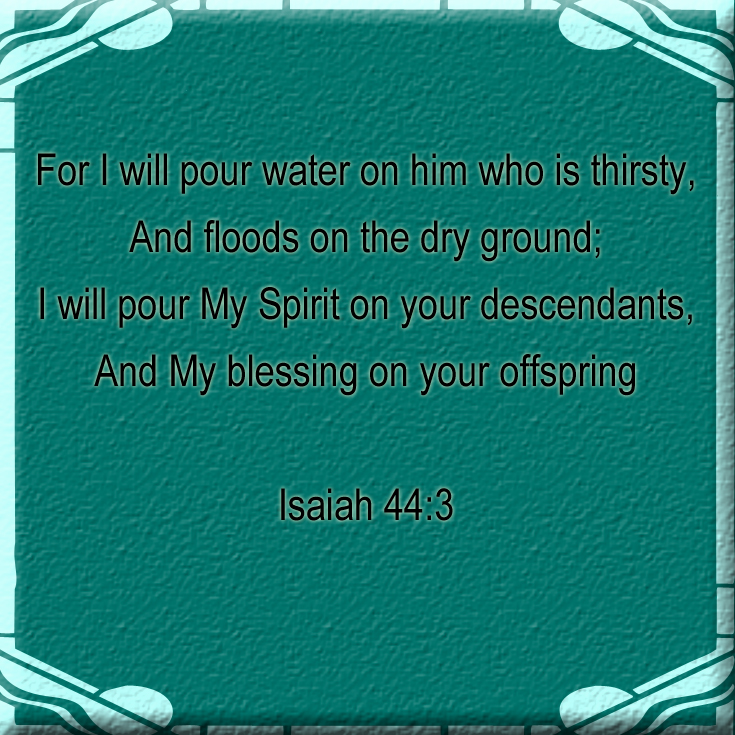
Just as water is the medium of our physical baptisms, so is the Holy Spirit the substance with which Jesus Christ baptizes us. Fittingly, then, the Spirit is compared to “rivers of living water” in John 7:37-39 and is said to be poured out in Isaiah 44:3. The Spirit is something we can be immersed in, and which works a real change in us.

Jesus answered, “Most assuredly, I say to you, unless one is born of water and the Spirit, he cannot enter the kingdom of God.” (John 3:5)

Being born into God’s family takes time and is an ongoing process. The starting point is when God’s Spirit begins interacting with our spirits and opening our minds to understand His mind.

Family

God’s calling goes beyond a mental awakening, though. The interaction of His Spirit with us changes our entire way of life.

For those who live according to the flesh set their minds on the things of the flesh, but those who live according to the Spirit, the things of the Spirit. For to be carnally minded is death, but to be spiritually minded is life and peace. Because the carnal mind is enmity against God; for it is not subject to the law of God, nor indeed can be. (Rom. 8:5-7)

The Holy Spirit is essential for us to even be capable of keeping God’s laws. Without God’s Spirit essence present and working in us with power, we “cannot please God” (Rom. 8:8) and we could not be part of His family.

Therefore, brethren, we are debtors—not to the flesh, to live according to the flesh. For if you live according to the flesh you will die; but if by the Spirit you put to death the deeds of the body, you will live. For as many as are led by the Spirit of God, these are sons of God. For you did not receive the spirit of bondage again to fear, but you received the Spirit of adoption whereby we cry out, “Abba, Father.” The Spirit itself bears witness with our spirit that we are children of God, and if children, then heirs—heirs of God and joint heirs with Christ, if indeed we suffer with Him, that we may also be glorified together. (Rom. 8:12-17)

From these verses, we learn that it is the presence of God’s Spirit in us that makes us His children. This comes as a result of Christ’s indwelling presence (Rom. 8:9-11). Two weeks ago, we read parts of John 14, 15, and 16 and talked about how the Holy Spirit acts as Christ’s representative on earth and in us. Through the Spirit, He and God the Father dwell in us and work directly with our innermost being.

 For this reason I bow my knees to the Father of our Lord Jesus Christ, from whom the whole family in heaven and earth is named,  that He would grant you, according to the riches of His glory, to be strengthened with might through His Spirit in the inner man, that Christ may dwell in your hearts through faith; that you, being rooted and grounded in love, may be able to comprehend with all the saints what is the width and length and depth and height — to know the love of Christ which passes knowledge; that you may be filled with all the fullness of God. (Eph. 3:14-19)

Worship

So, we see Jesus baptizing us with the Holy Spirit to begin a process of making us part of God’s family. Both the Father and Christ then work in us through Their Spirit to change our hearts and minds to bring us into fellowship with Them.

For through Him [Jesus] we both have access by one Spirit to the Father. Now, therefore, you are no longer strangers and foreigners, but fellow citizens with the saints and members of the household of God, having been built on the foundation of the apostles and prophets, Jesus Christ Himself being the chief cornerstone, in whom the whole building, being fitted together, grows into a holy temple in the Lord, in whom you also are being built together for a dwelling place of God in the Spirit. (Eph. 2:18-22)
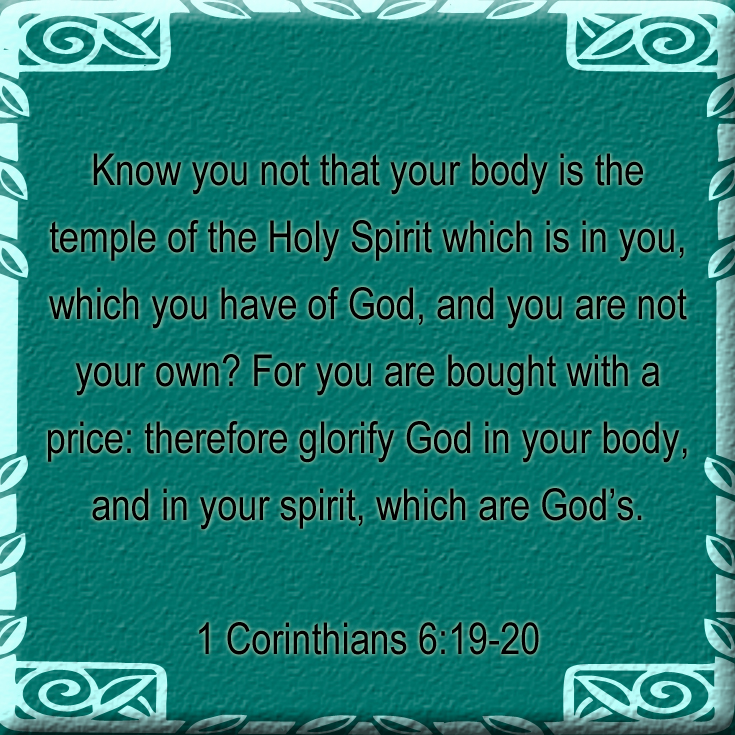
"Begining To Walk" by marissabaker.wordpress.comWhen God’s Spirit dwells in us, we become His temple (1 Cor. 3:16). It is our responsibility to live in a way that glorifies “God in your body and in your spirit, which are God’s” (1 Cor. 6:20).

But the hour is coming, and now is, when the true worshipers will worship the Father in spirit and truth; for the Father is seeking such to worship Him. God is Spirit, and those who worship Him must worship in spirit and truth. (John 4:23-24)

We can’t truly worship God unless we are doing so in our spirits — in the part of us that is immaterial and given by God. The interaction between our spirits and God’s Spirit must go both ways. He cannot work in us unless we respond to Him in spirit and in truth. As Matthew Henry said in his commentary on Romans 8:26, “We must not sit still, and expect that the Spirit should do all; when the Spirit goes before us we must bestir ourselves. We cannot without God, and he will not without us.”

This is just the beginning, my friends. Once God starts to communicate with our spirits, and we respond to Him, we begin a journey toward being part of His family. And His presence — His Holy Spirit — is there with us every step of the way.

Fruity Thumbprint Cookies

Fruity Thumbprint Cookie recipe by marissabaker.wordpress.comReally wanted a filled cookie the other day, so I compared several recipes online and came up with this. The previous recipe I’d been using made fewer cookies with the same amount of butter, so this is definitely an improvement. We used black raspberry jelly from a local Amish store and they were delicious.

Fruity Thumbprint Cookies

print this recipe

Fruity Thumbprint Cookie recipe by marissabaker.wordpress.com
all ready for dipping

1 cup butter

1/2 cup brown sugar

2 eggs, separated

1 teaspoon vanilla

2 cups flour

1/4 teaspoon salt

1 cup chopped nuts

3/4 cup fruit jam or jelly

Using an electric mixer, cream butter and sugar on high speed until smooth (about 2-3 minutes).

Fruity Thumbprint Cookie recipe by marissabaker.wordpress.com
filling the cookies

Beat egg yolks and vanilla into the butter mixture. Reserve egg whites. Add flour and salt and mix until just combined. Refrigerate dough for at least 30 minutes.

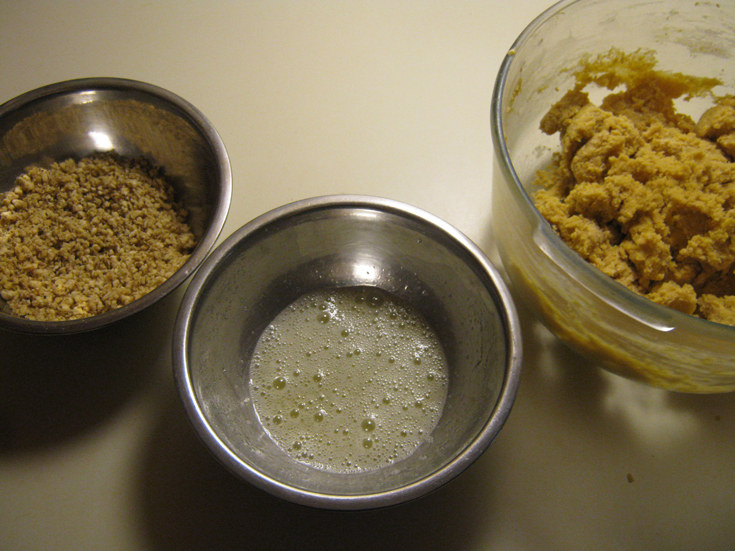
Preheat oven to 350°F and line baking sheets with parchment paper. Beat egg whites in a small bowl until bubbly and frothy.

Form dough into 1-inch balls and dip in the egg whites, then roll in chopped nuts. Place on the cookie sheets. Flatten balls slightly, then press with your thumb or a small spoon to make a well in the center. If dough cracks, reshape with fingers. Fill each indentation with 1/2 teaspoon jam.

Bake cookies for 10-12 minutes or until slightly firm and barely golden on the edges. Let cookies cool for a minute or two on the cookie sheet, then transfer to a wire rack.

Fruity Thumbprint Cookie recipe by marissabaker.wordpress.com
all done

Glaze (optional)

1 cup powdered sugar

1 Tablespoon cream or milk

1 teaspoon vanilla or almond extract

Stir glaze ingredients together until smooth, adding sugar or milk to reach desired consistency. Drizzle over cooled cookies and allow a couple hours for glaze to set.

Fruity Thumbprint Cookie recipe by marissabaker.wordpress.com
glazed versions after I ran out of crushed walnuts

What Is The Holy Spirit?

One of the big ways that my faith diverges from “standard” Christian doctrine has to do with the Holy Spirit. I don’t believe that a Trinity is the best way to describe the nature of God as revealed in scripture. If you’re reading how I talk about the Holy Spirit and how more well-known Christian authors talk about the Spirit you’ll notice few differences, but we are approaching this topic from very different assumptions.

This post is week 3 of 7 in our count to Pentecost, which makes it a good time to talk about the Holy Spirit. I grew up in a church that teaches that the Holy Spirit is the power of God and the part of Him that communicates with our spirits rather than a third person in a Trinity. We believe the Godhead consists of two Beings — God the Father and The Word who became Jesus Christ.

As I’ve studied the topic for myself, this has become my belief as well. The governing principle for how I (try to) approach faith and study is that because the Bible is God’s word it acts as the ultimate authority on any subject. Church traditions and teachings can be valuable resources, but if they ever contradict the Bible then they’re the ones who are wrong. That’s how I approach the topic of the Holy Spirit. Start with the Bible, then see which teachings and traditions line-up with what God has revealed through His word.

Understanding And Relationship

One of the core principles of the doctrine of the Trinity is that it cannot be understood. Walter Martin says, “the Trinity is still largely incomprehensible to the mind of man. Perhaps the chief reason for this is that the Trinity is a-logical, or beyond logic” (Essential Christianity, 1975, page 21). Proponents of the Trinity get around this problem by saying we shouldn’t try to fully understand God anyway because He is so far above us.

This sounds good at first — after all the Lord’s judgments are “unsearchable” and “His ways past finding out” (Rom. 11:33). It would be the height of hubris to think that a statement God makes about Himself is invalid because we can’t understand it. However, He does not tell us He exists as a Trinity. I find it hard think that the God who makes eternal life contingent on knowing Him would make the most basic fact of His nature so obscure, hidden, and mysterious. Read more

Peanut Noodle Stir-Fry

Peanut Noodle Stir-fry recipe by marissabaker.wordpress.comWhen stir-frying with rice noodles for the first time, the obvious thing to do is not start with a recipe. Right? Even though I did just that, the result was pretty tasty, if I do say so myself. I made it twice in less than a week. There’s just something about the rice noodles and peanut butter together that tastes really good.

Peanut Noodle Stir-fry

Marinade

1 pound chicken breast

1/2 teaspoon baking soda

1 Tablespoon soy sauce

1 Tablespoon rice wine

Peanut Noodle Stir-fry recipe by marissabaker.wordpress.com
ingredients ready

Sauce

1 Tablespoon peanut butter

1 teaspoon sesame oil

2 Tablespoons soy sauce

1 Tablespoon rice wine vinegar

1/2 cup chicken broth

2 Tablespoons brown sugar

Cooking

2 nests Thai rice noodles

2 teaspoons sesame oil

4-5 carrots, thinly sliced

1-2 heads broccoli cut small

Slice chicken thinly. Marinade for 20 minutes in the baking soda, soy sauce, and rice wine. Meanwhile, mix sauce ingredients in a small sauce pan and prepare vegetables.

Peanut Noodle Stir-fry recipe by marissabaker.wordpress.com
let’s eat!

Heat 2 teaspoons sesame oil in wok over medium heat. Cook chicken in oil until no longer pink.

Prepare rice noodles according to package directions. Begin cooking sauce by heating over medium-high heat until bubbling. Simmer 1-2 minutes.

While sauce and noodles are cooking, add vegetables to the wok with the chicken and stir-fry until crisp-tender. Add cooked noodles to the wok, and pour sauce over everything. Stir-fry an additional 2-3 minutes, then serve.

Comfort and Peace

It’s Sabbath number 2 out of 7 in our count to Pentecost (Lev. 23:15-16). As we get closer to Pentecost, I wanted to focus more of my studies on the Holy Spirit. I’ve already written about the Holy Spirit in the book of Acts, but there is so much more to cover.

This week, while reading through John 14, 15, and 16, what stood out to me was the word “comforter” (KJV) to refer to the Holy Spirit, particularly in connection with this verse:

Peace I leave with you, My peace I give to you; not as the world gives do I give to you. Let not your heart be troubled, neither let it be afraid. (John 14:26)

I have a troubled heart. By myself, I’m worried, fearful, distracted, anxious, and would rarely leave the house. But the better my relationship with God is, the more at peace I am. This is a subject close to my heart, because I know first-hand how much worse my anxiety gets if I drift away from God and the comfort of His presence.

Comfort

The word “comforter,” or “helper” in the NKJV, is used in John 14:16, 14:26, 15:26; and 16:7. It’s from the Greek word parakletos (G3875), which is the same word used to describe Jesus Christ as our “advocate” in 1 John 2:1. According to the Complete Word Study Dictionary of the New Testament by Dr. Spiros Zodhiates, it refers “to an aid of any kind. … one who comes forward on behalf of and as the representative of another.” It is translated “comforter” or “helper” because the root word, parakaleo (G3870), means “to aid, help, comfort, encourage.”

"Comfort and Peace" marissabaker.wordpress.com

The use of this word here in John seems to tie the work of the Holy Spirit directly to Christ’s role as our Comforter. He said the Spirit “will testify of Me” and that it was good for the disciples that He leave them so that He could send the Holy Spirit (John 15:26; 16:7). Again quoting Zodhiates’s dictionary, it says the Spirit “undertakes Christ’s office in the world while Christ is not in the world as the God-man in bodily form,” acting as “Christ’s substitute on earth.”  Perhaps this is why we are told “if anyone does not have the Spirit of Christ, he is not His” (Rom. 8:9).

On Our Behalf

One of the themes in the book of Hebrews is what Christ does on our behalf. He was made like us and suffered in our place so that He could be our “merciful and faithful High Priest” who makes “propitiation for the sins of the people” and “is able to aid those who are tempted” (Heb. 2:176-18).

For we do not have a High Priest who cannot sympathize with our weaknesses, but was in all points tempted as we are, yet without sin. Let us therefore come boldly to the throne of grace, that we may obtain mercy and find grace to help in time of need. (Heb. 4:15-16)

Because of what Christ did, and does, for us, we have assurance that we can obtain help from God. Our High Priest “is also able to save to the uttermost those who come to God through Him, since He always lives to make intercession for them” (Heb. 7:25). He died to obtain our “eternal redemption,” and now appears “in the presence of God for us” (Heb. 9:12, 24).

These roles Christ is filling for us should be a great comfort. Read Hebrews 10:19-25 — it is not a description of someone who is fearful or discomfited. We have boldness in Jesus, a “full assurance of faith,” and know that we can receive abundant comfort from Him and the Father through the Holy Spirit.

Blessed be the God and Father of our Lord Jesus Christ, the Father of mercies and God of all comfort, who comforts us in all our tribulation, that we may be able to comfort those who are in any trouble, with the comfort with which we ourselves are comforted by God. For as the sufferings of Christ abound in us, so our consolation also abounds through Christ. (2 Cor. 1:3-5)

Peace

The assurance of having Jesus present through the Holy Spirit as our Comforter, Advocate, and Helper should work a change in the state of our hearts. In John 14, He said that He gives His peace to us. This word “peace” is from the Greek eirene (G1515), and it means “a state of untroubled, undisturbed, well-being.” It can mean an “absence or end of strife,” but that is not necessary for the inner peace which Christ is referring to here, and which is a fruit of the Spirit (Gal. 5:22).

Be anxious for nothing, but in everything by prayer and supplication, with thanksgiving, let your requests be made known to God; and the peace of God, which surpasses all understanding, will guard your hearts and minds through Christ Jesus. (Phil. 4:6-7)

In Ephesians, Jesus Christ is called “our peace” because He brought us into covenant with God and gave us “access by one Spirit to the Father”  (Eph. 2:13-18). He made peace between us and God by removing the sin which separated us from Him, and gives us inner peace as a result of this new relationship.

For God has not given us a spirit of fear, but of power and of love and of a sound mind. (2 Tim. 1:7)

Look at what we are given. Power that makes us able and capable (G1411 dunamis). Love which actively and benevolently does good (G26 agape). Discipline, self-control and sound judgement (G4995 sophronismos). That is just part of the comfort and peace that God makes available to us through His Spirit if we remain in fellowship with Him.