I made pesto a little while ago to go with some bread. Now we’re out of bread and I’m left with almost a full batch of pesto. Whatever should I do with it all? Here’s one answer (also yet another way to use the monster heads of broccoli out in the garden).
I’m sure it would taste even better with fresh pesto but, alas, I didn’t get my herb garden planted and I have no basil. Instead, I used a recipe I pulled off the Internet some years ago for dried basil pesto. It’s not as good, but it works in a pinch. If you haven’t any other pesto you like to use, scroll down to the end for that recipe.
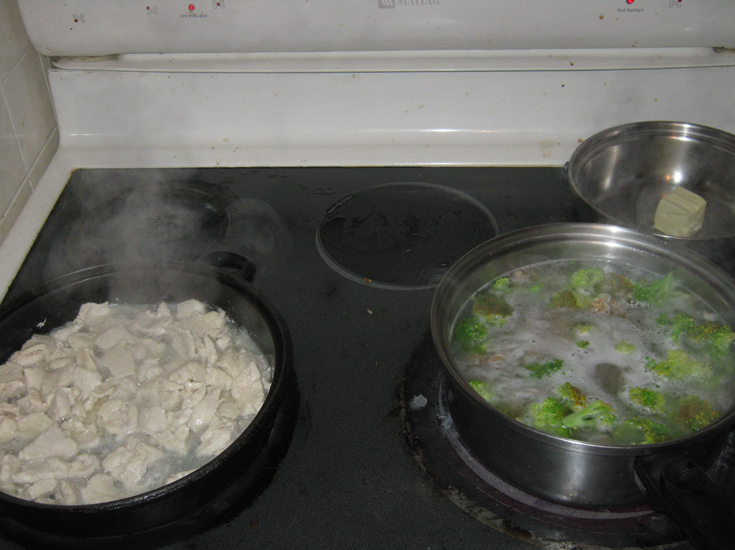
Cook pasta with broccoli until al dente according to package directions. Meanwhile, heat olive oil in skillet. Cook chicken until no pink remains.
Add cream of chicken soup, pesto, and milk to the skillet with the chicken. Bring to a boil and cook on low for 5 minutes. Add cooked pasta and heat through before serving.
Dried Basil Pesto
up close with the pesto
1/2 cup dried basil
1/4 cup walnuts
3 cloves garlic
1/2 cup Parmesan cheese
1/2 – 3/4 cups olive oil
Pulse first four ingredients in food processor until walnuts are chopped. Add olive oil and run blender for about 30 seconds. Chill until ready to use.
I recently read two separate articles that said this verse is inaccurate or at least grossly misinterpreted: “God will not allow you to be tempted beyond what you are can endure.” The example used was that Christians who commit suicide were obviously given a trial they couldn’t bear on their own, and they needed outside help. But does needing help from other people really invalidate this scripture, or is there something else going on?
Faithful to Help
The phrase quoted above is just a piece of a sentence in 1 Corinthians. Let’s look at the whole verse to get some context.
No temptation has overtaken you except such as is common to man; but God is faithful, who will not allow you to be tempted beyond what you are able, but with the temptation will also make the way of escape, that you may be able to bear it. (1 Cor. 10:13)
First we see the idea that no matter how alone or oppressed we feel, we’re not being given trials greater than that which is common to man — someone else, somewhere, has gone through something similar. This includes other human beings, of course, but it also includes Jesus Christ.
For we do not have a High Priest who cannot sympathize with our weaknesses, but was in all points tempted as we are, yet without sin. Let us therefore come boldly to the throne of grace, that we may obtain mercy and find grace to help in time of need. (Heb. 4:15-16)
Not only are trials like ours held in common with other people, but our Lord and Savior went through similar temptation and sufferings. One of the main reasons He did that was so that He could understand what we’re going through and offer His aid. As it says in 1 Cor. 10:13, “God is faithful,” and He will do that for us.
Secondly, we see that the promise which says God won’t let us be tempted beyond our endurance comes with an explanation for how He will do that. It’s not just that God protects us from trials unless we can get through them by gritting out teeth and pushing forward on our own. He “will also make the way of escape, that you may be able to bear it.”
Needing Others
This “way of escape” is intriguing. The wording implies intervention by God to create “escapes” for us in our trials, and action necessary on our part to take the offered escape. I imagine this sort of thing will look very different depending on the type of trial and who is going through the trial. Sometimes it may be what we think of as a literal escape, with the trial or temptation coming to an end. Or it could be that something changes to make the trial bearable. I’m sure we’ve all known someone with a long standing trial (like illness or chronic pain) who still has peace and joy in their lives.
and the peace of God, which surpasses all understanding, will guard your hearts and minds through Christ Jesus. …And my God shall supply all your need according to His riches in glory by Christ Jesus. (Phil. 4:7, 19)
Do we trust God to truly do this, to give us every thing we need in every circumstance? People will say something like, “well, that’s not true. You can’t just go through life with an ‘I don’t need anything but God” attitude. We need other people.” True to a certain extent, but where do you think those other people come from?
Good friends — the people you can really talk with about anything and go to when you need help — are rare. We call them a blessing. So when we have people like this in our lives, I’d say that comes under God supplying all our needs, including our need for companionship. Perhaps sometimes the “way of escape” so we’re able to bear a trial comes in the form of another person. It could be a friend, or someone you barely know. Maybe it’s a therapist or a minister to offer counsel. Perhaps it’s a brutally honest sibling to knock some sense into you (hopefully not literally).
I’ve been on the receiving end of this from someone I’d only just met. I was at a church-sponsored weekend and feeling particularly vulnerable emotionally. I thought I was doing a pretty good job of hiding my heartache, but apparently not, because a girl I’d been introduced to barley two days ago sought me out the last evening to ask what was wrong. The story spilled out and I started crying. Then she prayed aloud for me. It was incredible — I felt God’s Spirit present in a way unlike I’d ever felt before. That wasn’t the conclusion of that trial, but it did mark the escape for climbing out of it and back towards God.
When God sends us someone to help us through a trial, we should be careful not to push them away. But this works from both sides. We can also be the person who is provided by God to offer help.
Being a Blessing
Have you ever considered that? When we’re talking about trials, I think we’re more often inclined to think of how someone else can help us than how we can help other people. But if we expect that we’re going to benefit from the comfort and help of other believers, we should also expect that God wants to use us to help them.
Let nothing be done through selfish ambition or conceit, but in lowliness of mind let each esteem others better than himself. Let each of you look out not only for his own interests, but also for the interests of others. (Phil. 2:3-4)
We’re supposed to be looking after our brethren, building them up, making sure they’re okay, and being sure to offer real encouragement and help rather than empty platitudes when they need aid.
If a brother or sister is naked and destitute of daily food, and one of you says to them, “Depart in peace, be warmed and filled,” but you do not give them the things which are needed for the body, what does it profit? (James 2:15-16)
It is similarly un-helpful (and can even be harmful) to just slap a scripture on someone’s emotional wounds and walk away. Saying, “God will supply all your needs” or “don’t worry, He won’t give you anything you can’t endure” isn’t any help unless we’re willing to be used by God to supply those needs by listening to them, praying with and for them, and keeping in touch with them.
Example of Love
A new commandment I give to you, that you love one another; as I have loved you, that you also love one another. By this all will know that you are My disciples, if you have love for one another.” (John 13:34-35)
Love – agape – within the church is the sign that we are followers of Christ. That’s how important it is to have self-sacrificing love that seeks the good of others. Romans 12:1 talks of us presenting ourselves as “a living sacrifice.” We can look at the life of Jesus Christ to see a perfect example of what it means to live as a sacrifice in service to God. Have you ever noticed how much of His ministry involved helping other people? Pretty much all of it. And now He tells us that we and every one of our fellow believers are highly valued as His own temple and body “which He purchased with His own blood” (Acts 20:28).
If we’re going to claim that level of importance in God’s eyes, we must see others in the same light. Do we treat other people as if Christ is living in them? and we have to do this for our brethren whether or not we think it looks like Christ is in them. If we’re being honest, we know that we’ve also been seen doing things that are not Christ-like. We must be forgiving toward others if we want to be forgiven (Matt 6:12, 14-15). Really, we’re left without any good excuses for not helping others when we see them in need. If we’re following Jesus Christ, we will be loving and serving other people as much as possible. It’s as simple (and as complicated) as that.
So to answer the question that is the title of this post, I believe God does not let us go through trials or temptations that it is impossible for us to bear. They might not turn out the way we expect them to, but if we stay close to God we will turn out the way He expects us to. He will send us escapes and aid, and will open our eyes to recognize His help. And sometimes we’ll have the chance to follow Jesus’ example and be used by God to help another person.
The garden has started supplying us with giant bowls of lettuce, more beans than we know what to do with, crunchy green cabbages, baskets full of sugar snap peas, and the first zucchini of the summer. That means two things around here — salads and stir fries.
cabbage, zucchini, and peas are all from our garden
Couple days ago I wanted to do a stir fry with chicken as a the main dish, rather than stir fry as a side, but didn’t feel like something as sweet as my Sesame Stir Fry or a recipe which required quite so much time/effort to cook the chicken as the Simple Chicken Stir Fry. So I made something up. It’s an easy recipe — just throw the chicken and marinade ingredients together, mix up some sauce, cook the chicken, add vegetables, and then pour the sauce on at the last minute. I ground some peppercorns over it to make it look pretty and so I could call it pepper chicken. Enjoy!
Heat oil in a wok or deep skillet over medium-high heat. Add chicken and stir fry until cooked through. Add chopped vegetables and stir fry until they are tender but not so soft they become mushy. Add sauce, and stir (it will thicken quickly). Removed from heat and grind peppercorns over the stir-fry. Serve with rice.
start stirring as soon as you add the sauce to avoid lumps as it thickens.
There seems to be a movement in some of the Christian relationship blogs I read to debunk the “myth” of soul mates. The argument can be summed up in this quote from Boundless.org’s article Myths About Soul Mates: “Believing that ‘the one’ is out there, waiting to ‘complete you,’ inevitably leads to discontentment and maybe even divorce.” Another of their articles, Hoping for a Soul Mate, quotes Atlanta psychiatrist Frank Pittman as saying, “Nothing has produced more unhappiness than the concept of a soul mate.” If you’re not familiar with these arguments, I encourage you to glance at one or both links before reading on.
Just so we’re all starting out on the same page, here’s a composite definition of what the articles I referenced above seem to mean when they use the term “soul mate”:
A soul mate is your perfect match, who complements all your weaknesses and strengths and loves you unreservedly for who you are. There is only one soul mate for each person, and you’re on a search to find them so they can “complete you.”
These articles say this is an impossible ideal and it becomes dangerous when we start holding the person we’re in a relationship with to impossible and unrealistic expectations. And I do acknowledge this is a danger if we’re focused on the idea of finding one perfect mate (see this scene in Ever After for a humorous example of a few problems which can result).
Given these compelling arguments about the dangers of having an expectation like this in dating, you might be wondering why I’m writing a post about believing in soul mates. I have a slightly different take on the idea of soul mates, though.
My Idea of a Soul Mate
I imagine there are several people out there who have the potential to be our “soul mates.” For me, I think this would look like a relationship where I feel safe sharing my inner thoughts, feelings, and emotions. Someone who can understand, relate to, or at least appreciate the parts of my mind which I so rarely share, and with whom I can connect on a “kindred spirits” level. It almost goes without staying that this kind of connection must have a spiritual/religious component as well — I doubt I could be in this kind of relationship with someone who does not share my faith. I think there’s also a bit of truth in the idea of finding a mate who “completes” you, not in the way that most people might think of it but in the way that God meant when He created a husband and wife to be two parts of a whole.
As I mentioned, in this theory there are multiple people with whom the potential exists for forming a soul mate connection. You might meet several, but your goal should be that your relationships only reach a “soul mate level” with one of these people. I suspect that there’s a point in a good relationship where the other potential soul mates no longer matter because a “sole soul mate” relationship has been forged.
This is where the idea of commitment comes in. Once you choose to marry someone, you’re also choosing to cultivate a soul mate relationship only with them (the first article I linked to actually touches on this point). This is also why can be dangerous to form deep emotional intimacies with someone of the opposite sex who you don’t intend to marry (or whom you’re not sure yet if you will marry) — sharing your heart without the promise of commitment to a sole soul mate relationship seems like a good way to get your heart broken.
I’m sure not everyone will agree with this idea, and really I don’t expect them to. There’s so much variation in our individual personalities, tastes and ideas that it seems ridiculous to expect everyone to want and expect the same thing from a romantic relationship.
Jane Eyre (INFJ) and Edward Rochester (ENTP or ENTJ)
When David Keirsey wrote his personality theories based on Myers-Briggs, he suggested that each of his four personality groups would be looking for, and be, a different kind of romantic partner. He describes the Artisans (Myers’ SP types) as Playmates, who are “exciting and fun” and usually end up married to Guardians (SJ types), who are looking to fill a Helpmate role. Rationals (NT types) want a Mindmate with whom they can have intellectual discussions and explore “abstract rather than concrete” ideas. They often marry the Idealists (NF types, like my INFJ personality), who are searching for Soulmates.
What Idealists wish for in their spouse is a Soulmate, a spouse who knows their feelings without being told of them, and who spontaneously expresses words of endearment, words that acknowledge their mate’s unique identity. Idealists want the marital relationship to be, as they put it, “deep and meaningful,” Other types will settle for much less than this. … suffice it to say that Idealists are asking their spouses for something most of them do no understand and do not know how to give. (Please Understand Me II, p.146)
Well, that sounds depressingly unattainable. Honestly, when I was reading this book the first time the beginning of this paragraph had me nodding and thinking it sounded exactly just right, but that final sentence is really discouraging. Still, I don’t think I have such unrealistic expectations as Keirsey describes Idealists as having in other parts of his book (though it does sound idyllic). Maybe he’s right and 80-85% of the population will tell me I’m crazy to hope for a “soul mate.” But hopefully someday I’ll be able to say, like the bride in Song of Songs, “I found him whom my soul loves” (Song. 3:4, WEB).
Last week, we talked about living our whole lives in the context of praising God. This study is directly related to that, and I want to begin by quoting a scripture that I almost referenced in that post but decided to save until today.
Therefore, whether you eat or drink, or whatever you do, do all to the glory of God. (1 Cor. 10:31)
I don’t know about you, but I know that right now my life isn’t at the point where I can say that every single thing I do is done with the intention of bringing God glory. But that is part of our goal while we are here on this earth. Every aspect of our lives should be contextualized by our relationships with God and Jesus.
Every Single Thing
The idea of every part of our lives being lived for God’s glory can be a daunting prospect, as this level of self-control seems almost impossible to attain. That overwhelmed feeling is usually how I react to reading this verse:
Casting down arguments and every high thing that exalts itself against the knowledge of God, bringing every thought into captivity to the obedience of Christ (2 Cor. 10:5)
“Every thought”? That’s a tall order. It’s a bit less daunting, though, when we remember Jesus Christ’s words to the disciples in Matthew 19:26 — “With men this is impossible, but with God all things are possible.” Self-control is also one of the fruits of the Holy Spirit, so we know that it is attainable with God’s help (Gal. 5:22).
I also suspect that, while there may be some days when we literally have to battle every thought, that it gets easier. The closer we grow to God, the more automatic it will be to think and act like Him. Christ Himself is being formed in us (Gal. 4:19), along with His mind and thought processes (Phil. 2:5). Letting, inviting, asking Him to dwell in us is a step toward living all our lives for God’s glory (John 15:4, 8).
Let the word of Christ dwell in you richly in all wisdom, teaching and admonishing one another in psalms and hymns and spiritual songs, singing with grace in your hearts to the Lord. And whatever you do in word or deed, do all in the name of the Lord Jesus, giving thanks to God the Father through Him. (Col. 3:16-17)
You Are Dead
If we go back to the beginning of Colossians 3 to get context for the verse we just quoted, we find an interesting introduction to a passage that talks about putting to death our sins (verse 5) and putting on the new man who looks like Christ (verse 10).
If then you were raised with Christ, seek those things which are above, where Christ is, sitting at the right hand of God. Set your mind on things above, not on things on the earth. For you died, and your life is hidden with Christ in God. (Col. 3:1-3)
If we really are living as if we are dead to the world and our only life is wrapped up in Christ, of course we’ll be living for His glory.
How shall we who died to sin live any longer in it? Or do you not know that as many of us as were baptized into Christ Jesus were baptized into His death? Therefore we were buried with Him through baptism into death, that just as Christ was raised from the dead by the glory of the Father, even so we also should walk in newness of life. (Rom. 6:2-4)
Earlier, I suggested that we should be growing to the point where reacting in the same way that Christ would respond is automatic. If we struggle with anger, for example, it might still be our first impulse but we should be becoming more practiced at replacing it with love. C.S. Lewis had this to say about what first impulses can tell us about ourselves.
Surely what a man does when he is taken off his guard is the best evidence for what sort of a man he is? Surely what pops out before the man has time to put on a disguise is the truth? If there are rats in a cellar you are most likely to see them if you go in very suddenly. But the suddenness does not create the rats: it only prevents them from hiding. In the same way the suddenness of the provocation does not make me an ill-tempered man; it only shows me what an ill-tempered man I am. (C.S. Lewis, Mere Christianity)
As we mature as Christians we should be quicker to recognize our tendencies to sin, and with Christ in us we now have the power to resist temptation before it becomes sin. It is imperative that we be aware of and active in this process. We cannot passively overcome sin.
Therefore do not let sin reign in your mortal body, that you should obey it in its lusts. And do not present your members as instruments of unrighteousness to sin, but present yourselves to God as being alive from the dead, and your members as instruments of righteousness to God. (Rom. 6:12-13)
As human beings, we can’t be without a “master” — we’re either serving sin, or we’re serving God (Rom. 6:16-23). If we’re serving God in “obedience leading to righteousness,” then we’re also making conscious choices to not obey, or yield to, sin.
Bought and Redeemed
When Jesus Christ died for us, He ransomed us free from servitude to sin. We belong to Him, not to ourselves. Acts 20:28 describes the Church as “purchased with His own blood.” Peter says that false teachers who spread “destructive heresies” are “even denying the Lord who bought them” (2 Pet. 2:1). It is important that we recognize, rather than deny, this fact.
Jesus’ incredible sacrifice cleansed us so that we could “serve the living God” (Heb. 9:14). He made a relationship possible between us and our creator. He established a new covenant “on better promises” that offers us eternal life as part of God’s family (Heb. 8:6). We don’t belong to this world or to Satan or to ourselves any more — we have been ransomed away from slavery to sin and to our own individual weaknesses. We now belong to the One who ransomed us, as His servants, His friends, His bride, His family, His body, His church, and His temple.
Do you not know that your bodies are members of Christ? … Or do you not know that your body is the temple of the Holy Spirit who is in you, whom you have from God, and you are not your own? For you were bought at a price; therefore glorify God in your body and in your spirit, which are God’s. (1 Cor. 6:15, 19-20)
Our physical bodies and our spirits — the intangible part of that makes me “me” and can communicate with God’s Spirit — belong to God. This fact does not, however, mean that we don’t have free will. Even within the choice to follow God (and it is a choice), there are many other choices we’ll have to make. I’ve been talking about this in relation to careers with a new friend I met through this blog. Our latest e-mails brought up the idea that God doesn’t care so much what you do to earn a living (with, you know, the obvious exceptions of earning money in a way contrary to the laws of God and man) as He cares how you conduct yourself in your work and whether or not you’re growing close to Him.
We Give You Glory
Returning to 1 Corinthians 10:31, which opened this post, the context is whether or not Christians could eat meat that was sacrificed to idols. That’s not really an issue for us today, but there’s still a lesson we can learn. Paul says it’s okay to eat or not eat this kind of meat, so long as the way you conduct yourself glorifies God.
Whatsoever is sold in the shambles, that eat, asking no question for conscience sake: for the earth is the Lord’s, and the fulness thereof. If any of them that believe not bid you to a feast, and ye be disposed to go; whatsoever is set before you, eat, asking no question for conscience sake. But if anyone says to you, “This was offered to idols,” do not eat it for the sake of the one who told you, and for conscience’ sake; for “the earth is the Lord’s, and all its fullness.” “Conscience,” I say, not your own, but that of the other. For why is my liberty judged by another man’s conscience? But if I partake with thanks, why am I evil spoken of for the food over which I give thanks? Therefore, whether you eat or drink, or whatever you do, do all to the glory of God. Give no offense, either to the Jews or to the Greeks or to the church of God, just as I also please all men in all things, not seeking my own profit, but the profit of many, that they may be saved. (1 Cor. 10:25-33)
Either choice was morally and legally acceptable before God on its own. But because we belong to God, Paul says that our choices need to be examined in the light of “will it bring God glory?” and “will it profit my brethren?” In the same way, once we answer the question, “can I, or can I not” do something legally in God’s eyes, we should then ask, “should I , or shouldn’t I?” It’s a matter of where our hearts are, and what is our motivation. This same topic is also discussed a few chapters earlier in 1 Corinthians, and that passage adds an even stronger warning.
But food does not commend us to God; for neither if we eat are we the better, nor if we do not eat are we the worse. But beware lest somehow this liberty of yours become a stumbling block to those who are weak. For if anyone sees you who have knowledge eating in an idol’s temple, will not the conscience of him who is weak be emboldened to eat those things offered to idols? And because of your knowledge shall the weak brother perish, for whom Christ died? But when you thus sin against the brethren, and wound their weak conscience, you sin against Christ. (1 Cor. 8:8-12)
That is serious. When our choices, even if they are perfectly acceptable based on our own knowledge, hurt our brethren, it is a sin against Christ. It’s the seam idea expressed in Matthew 25 — “inasmuch as you did not do it to one of the least of these, you did not do it to Me” (Matt. 25:41-46). It’s not enough to act based on knowledge of God’s laws, though that is certainly important. We must also be acting based on love, which builds up our brethren, and for the glory of god (1 Cor. 8:1-7).
In conclusion, the song “Glory” by Casting Crowns has been running through my head for two weeks, so I’m going to share it here:
This recipe was originally the Teriyaki Chicken Casserole from ohsweetbasil.com. She starts with the fried-rice already made according to another recipe on her site, but I’ve formatted the recipe presented here so you can make it all at once (I’ve also changed some ingredients for everything except the sauce). You don’t even need to use day-old rice, like for most fried rice recipes.
In a medium saucepan, stir together the soy sauce, water, brown sugar, honey, ground ginger, sesame oil, and garlic. Bring to a boil and cook for 1 minute.
In a small bowl, stir together the water and cornstarch. Add 1 teaspoon of the hot soy mixture to the cornstarch mixture and then slowly pour everything into the boiling soy mixture, whisking until it begins to thicken. Set aside.
ingredients
Rice
2 Tablespoons soy sauce
1 Tablespoon rice wine
1 Tablespoon brown sugar
1/2 teaspoon white sugar
1/8 teaspoon ginger
1/8 teaspoon red pepper flakes
2 eggs
3 cups cooked jasmine rice
1 Tablespoon sesame oil
Olive Oil cooking spray
In a small bowl, whisk together the soy sauce, sugar, ginger and crushed red pepper. Set aside. Spray wok with olive oil and bring to medium heat. Lightly whisk together the eggs and add to the pan. Let it cook until set, flipping or stirring as needed to keep from burning. Removed eggs form the wok and cut them up.
Add sesame oil to wok. Add the rice, cooking until hot and the rice is beginning to pop. Add the sauce mixture, stirring to combine. Add the eggs, and stir until heated through.
finished rice
Casserole
shredding the chicken
2 chicken breasts
2-3 carrots
1 head broccoli
10 snow peas
Place the chicken in an 8×8-in. baking dish and pour 1 cup of the teriyaki sauce over the chicken. Bake for 30 minutes at 350°F. Remove from the oven and shred.
Cut up and steam the vegetables. Place rice, chicken, and vegetables in a 9×13-in. baking dish. Add 3 tablespoons of the leftover teriyaki sauce and stir to combine. Place the dish back in the oven for 15 minutes, remove from the oven and drizzle with a little more sauce. Serve immediately.

 1 pound chicken breast, thinly sliced














 This recipe was originally the




 Like An Anchor