
Warning: English nerd content ahead.
I’ve been quite fond of Shakespeare since high school. Freshman year I watched Kenneth Branagh’s Henry V and then read the play for extra credit. I loved it so much I choose to read it again the year we studied British literature, along with Taming of the Shrew (my mother’s choice) and As You Like It (recommended by a teacher).
Since homeschoolers can pick their own curriculum and my mom hated reading Shakespeare’s tragedies when she was in school, I didn’t get a hold of those until college. There, I discovered Hamlet was almost as good as Henry. Almost, but not quite. When I took a Shakespeare class where the professor included Henry V on his syllabus I was in literature nerd heaven.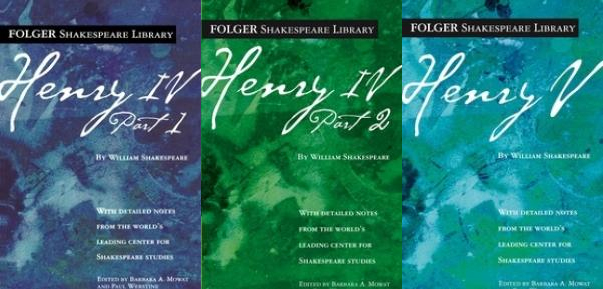
The only strange thing (to me at least) about this whole Henry obsession is that it took me so long to read Henry IV, Part One and Henry IV, Part Two. In these plays, the character I knew as noble King Henry V is the riotous Prince Hal. I did put them on my Classics Club book list, but I probably wouldn’t have read these plays for another year or so if I hadn’t decided on a futuristic/sci-fie re-imagining of Shakespeare’s Henriad for my NaNoWriMo novel (click here to learn more). I’d seen them, though, in BBC’s The Hollow Crown.
This brilliant adaptation is remarkably faithful to both Part One and Part Two (it leaves out more scenes and changes a few parts of Henry V, but that play’s not the topic of our post today). I enjoyed reading the Henry IV plays, in part because of associating the on-paper scenes with what I’d seen in The Hollow Crown. Here’s a small clip of Tom Hiddleston as Henry, but you should really check out the series and watch it for yourself.
For reading Part One, I picked up a copy without annotations or notes. I was rather pleased with myself that I didn’t feel like I needed them. This is also the play I enjoyed most. It feature a more straight-forward and active story line, and more scenes with Prince Hal. I tend to prefer Shakespeare’s main plots and noble characters to the sub-plots and more comedic characters, and that held true for these history plays.
Part Two follows the Henrys less and I’m glad I had a Folger edition to read for that. There were whole sections of Falstaff’s speeches that left me puzzled (the notes made me feel better, though — apparently scholars can’t figure out some of his lines either). You need this play to get from Part 1 to Henry V, but it’s my least favorite of the three.
Whether or not you already love Shakespeare, I’d recommend starting with The Hollow Crown if you’re interested in these plays. They’re really meant to be seen and heard more than read. I suspect the man who begged pardon of his 17th century audience for daring “On this unworthy scaffold to bring forth / So great an object” as Henry’s life would approve of the scope film provides for storytelling (Henry V, 1.1.11-12).
Click here to get a copy of Henry IV Part One



 Like An Anchor