Think INFJs are hard to figure out? Have you found yourself puzzled by an INFJ’s contradictory words and behavior? Well there’s no need to worry any more. I’ve got your quick, easy, and not-at-all-confusing guide to finding out if an INFJ agrees with you. No more will those mysterious unicorns of the personality type world confuse you in conversation. No longer will their confrontation-avoidance leave you wondering whether an INFJ actually agrees with what you’re saying or is simply making you think they do so you won’t get upset with them.
Nodding mostly means we’re listening to you, so this could really go either way. Cross-check with other signs.
Eye Contact
Making eye contact typically means the INFJ agrees with you. Not making eye contact could mean one of three things: they disagree with you, they don’t care, or they agree with you but don’t want to admit it.
Non-Committal Sounds
An INFJ who’s making sounds like “um-hum” while glancing away looking for an escape doesn’t agree with you. But if they’re making the same sound with eye-contact while leaning toward you and smiling, then you’re good. Probably. Read more →
Is being afraid a sin? I think most of us, me included, would say it isn’t sinful in and of itself. Fear is often a natural gut reaction to things happening around us, and it serves a self-preservation role. It only becomes an issue if we act on it wrongly or let it paralyze us and prevent right action. But maybe I’m wrong. Maybe I’m letting my own fears cloud my perspective on this issue. Because it seems God takes our fearfulness more seriously.
He that overcometh shall inherit all things; and I will be his God, and he shall be my son. But the fearful, and unbelieving, and the abominable, and murderers, and whoremongers, and sorcerers, and idolaters, and all liars, shall have their part in the lake which burneth with fire and brimstone: which is the second death. (Rev. 21:7-8, KJV)
Some translations say “cowardly” instead of “fearful,” but the Greek deilos really does mean timid or afraid. Strong’s dictionary adds that it implies faithlessness. Hence Jesus’ question, “Why are you so afraid? How is it that you have no faith?” to the disciples in a storm (Mark 4:37-40, WEB). Is it really the case that God sees our fears and timidity as lack of faith?
The Bible talks about fear in both positive and negative ways. The kind of fear that is connected with reverence and respect for God and His authority is good. In fact, it’s essential.
This is the end of the matter. All has been heard. Fear God, and keep his commandments; for this is the whole duty of man. For God will bring every work into judgment, with every hidden thing, whether it is good, or whether it is evil. (Ecc. 12:13-14, WEB)
Fear of God has long been a commanded part of following Him (Deut. 5:29; 6:2; 10:12). And in the New Testament, the apostles tell us to perfect “holiness in the fear of God” (2 Cor. 7:1, WEB), to “work out your own salvation with fear and trembling” (Phil. 2:12, WEB), and to live our lives on earth “in reverent fear” (1 Pet. 1:17, WEB). Read more →
I talk with quite a few people who have Intuitive type personalities and grew up feeling misunderstood. They knew they were different from other people but didn’t know why and that led to feelings of loneliness and isolation. In some cases this feeling came from a lack of people they could truly connect with. But others encountered outright rejection or bullying.
As we grew up and started learning about our personality types, the feeling of being different started to make sense. Intuitive types do see the world differently from most other people — we only make up 30% of the world’s population. The other 70% of people are Sensing types. And becasue the Intuitive/Sensing side of our personalities describes how we perceive things and learn new information, it plays a huge role in how we frame our conceptions of the world. It’s no wonder that Intuitives feel different from the majority of the people they meet.
There’s something incredible about learning you’re not alone. That there really are other people out there who process the world in much the same way you do. People whose eyes won’t glaze over when you dive deep into theoretical discussions, who won’t panic when you suggest a new perspective on traditional ideas, and who think talking about the future framed in all of human history is a great way to spend their afternoons.
I think Intuitives need other Intuitives around. I grew up with Intuitive siblings, eventually made several Intuitive friends, and now have the Intuitive Awakening group on Facebook. For close relationships, matching on your Intuition/Sensing preference is going to make it much easier to identify with and understand the other person. And I’m pretty sure any Intuitive with Intuitive friends or family is nodding their heads while reading this. We crave the opportunity to connect with other people who will understand us and validate our way of processing the world. It’s part of being human.
Inaccurate Sensing Stereotypes
But we can take our need for Intuitive connection to an unfortunate extreme and decide that other Intuitives are the only people worth talking with. People with this mindset say that Sensing types are too superficial, too selfish, too close-minded, and too judgemental for them to really connect with (a claim that is, when you think about it, an example of the mindset they’re accusing Sensors of having). Read more →
If you ask the church that I’ve spent most of my life in what their mission is they have a ready answer: preaching the gospel and preparing a people. I can’t speak for your churches, but I imagine many (perhaps even most) of them would also point to some version of what we call The Great Commission as their mission statement.
Jesus came to them and spoke to them, saying, “All authority has been given to me in heaven and on earth. Go, and make disciples of all nations, baptizing them in the name of the Father and of the Son and of the Holy Spirit, teaching them to observe all things that I commanded you. Behold, I am with you always, even to the end of the age. (Matt. 28:18-20, WEB)
Is this a commission? yes, it’s “an instruction, command, or duty given to … group of people.” Is it great? since it came from Jesus and involves a responsibility given His disciples, yes. But is it really meant as the defining mission statement for the entire church from Jesus’ resurrection to His return? I’m not so sure.
The religious leaders of Jesus’ day were the group He spent the most time criticizing and correcting. They professed to follow God’s highest standards but were in reality hypocrites. They did righteous looking things just to get attention (Matt. 23:5). They went to great lengths to convert people only to pervert their faith (Matt. 23:15). They placed too high an emphasis on money received as tithes and offerings (Matt. 23:16-19). They neglected the “weighty matters” of God’s law and instead followed their own traditions. They even turned the temple itself into a marketplace where they exploited people coming to worship God (John 2:14-16).
The scary thing is, these people honestly thought they were the most righteous God-followers out there. That serves as a warning today that church leaders and organizations have to be very careful where they place their focus. And so do we as individual members of Christ’s body.
A Greater “Commission”
We certainly shouldn’t ignore Christ’s instruction to go, disciple, baptize, and teach. But we need to make sure we’re thinking of that command from Matthew 28 in its proper context. Because there are two other commissions that Jesus plainly told us are His greatest commands. Read more →
There are very few things I enjoy more than bringing home a new blanket and burrowing deep into its soft, fluffy folds. The Big One throws from Kohls are my particular weakness — oversized, incredibly soft, and occasionally on sale for $10. I can’t get enough of them. They’re scattered around the house. I rarely sit down even in the summer without draping one over my legs. I sleep with one inside my sheets so I can feel the soft plushness against my skin.
If you’re familiar with Myers-Briggs personality types and what I just shared about fluffy blankets was all you had to go from in typing me, you’d probably say I was a Sensing type. After all, S-types are the ones that pay attention to and enjoy sensory details. Intuitive are too head-in-the-clouds to care about things like this (if you want to be hard on them) or they have “better things to think about” (if you’re more of an intuition snob).
But I’m an INFJ, which means Extroverted Sensing is the mental function I’m least comfortable with. So why am I obsessed with texture? Because it’s not just fluffy blankets. If you walk through a store with me you’ll see I touch clothing, purses, blankets, etc. as I walk by. I once bought a purse just because the leather felt soft as butter (that description doesn’t make much sense, but it’s what popped into my head at the time).
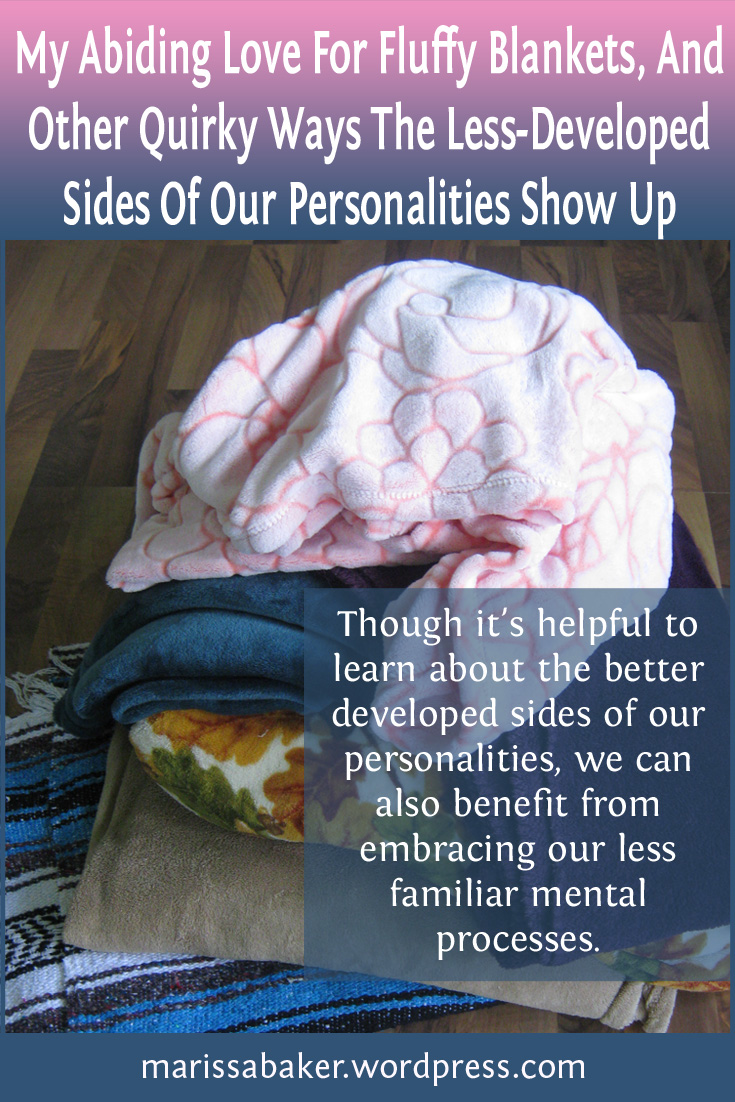
real photo of my fluffy blanket collection
Disclaimer: some of the links in this post are affiliate links. This means that, at no additional cost to you, I will receive a commission if you click on the link and make a purchase on that website.
The thing is, our inferior functions aren’t just hiding somewhere waiting to show up and wreck your life when you get stressed. That’s why I like Personality Hacker’s car model,* which describes your fourth-favorite mental process as a 3-year-old. When things are going wrong the screaming 3-year-old is going to consume all your time. This is more scientifically called being “in the grip” of your inferior process. But when you’re pretty well balanced it’ll be napping or happily cooing in the backseat (perhaps while stroking a plush throw).
You’ll probably never be really comfortable or effective at using your inferior function for day-to-day living. But you can befriend that side of your psyche instead of trying to ignore it or seeing it as an enemy. You can also focus on developing your inferior function, as I suggested in my post “Getting In Touch With Your Sensing Side” for INFJs and INTJ. And you can also enjoy and accept the quirky little ways it’s already showing up in your life.
Maybe you’re a dominant intuitive who loves sensory details like fabric texture or subtle spices in food.
Maybe you’re a dominant sensor and you enjoy escaping into theoretical worlds through fantasy and sci-fi.
Maybe you’re a dominant feeler who’s fascinated by computer programing or logic puzzles.
Maybe you’re a dominant thinker and spend your down-time reading touching stories about people’s lives.
fluffy blankets + pillows = heaven
As helpful as it is to learn about the better developed sides of our personalities, it’s not all that useful to identify with them completely. If an INFJ thinks of themselves only as an introverted intuitive who makes decisions based on their feelings, they’ll be ignoring key aspects of their personalities. And when we do that, we not only cheat ourselves of growth potential but also start drawing more rigid “us versus them” lines in our minds. I mean that in the sense of ideas like, “I’m an intuitive, so I can’t communicated with sensors.” But if we can recognize that our personalities are deeply nuanced, we’ll also realize we have more in common with “other people” than we might have thought at first.
Personality types aren’t meant to make you think of yourself as better than everyone else. They’re meant to help you recognize your unique gifts and also appreciate the gifts of other people (hence the title of Isabel Myers’ book, Gifts Differing). And once they help you discover the ways you’re different the typology framework can also help you discover ways you’re similar to other people. Even a type that you share no letters with and seems your complete opposite (INFJ and ESTP, for example) shares the same mental processes as you, just in a different order.
Do any of you see your inferior function showing up in your habits, quirks, and preferences? What sort of things do you do and enjoy that aren’t “typical” for your personality type?
My family and I just got back on Thursday evening from a wonderful Sukkot (Feast of Tabernacles) gathering in eastern Pennsylvania. While it was packed full of spiritual lessons, there wasn’t much time for the sort of personal Bible studies that typically end up becoming blog posts on Saturdays. So today I’m just going to share a few lessons I learned this past week:
I can organize people. If I’d known agreeing to plan a singles/young adult activity would have ended up involving 30+ people doing 5 different activities I would have probably wanted to hide under a desk. But it all went really well and I had lots of help from people who volunteered (or had someone volunteer them) to lead some of the activities.
The only ancient text with anywhere near as many copies still around as there are for the Bible is Homer’s Iliad and Odyssey. Stacked together, the existing copies for both those works would only be a few feet tall. In contrast, a stack of all the surviving Biblical manuscripts would be so tall it’s nearly outside earth’s atmosphere. Wow! (One of the speakers shared this fact in a Bible study about the reliability of the Bible.)
Spending a week with my boyfriend (who joined my family and our church group for the Feast) does not make living an 8-hour drive apart any easier. I suppose it’s a good thing that I miss him so much, though, since otherwise I’d have to re-think whether or not we should be dating. In related news, my new favorite love song is “Over And Over Again.” They played it at the dance our church group hosted and not only is my boyfriend a really good dancer but he also sings ❤
The “fear not” reminders just keep coming at me. On the second day of Sukkot someone gave a message about why those who are “fearful” are lumped in with murderers, sorcerers, etc. as people who won’t be in God’s kingdom (Rev. 21:8). The Greek word means “timid” or “cowardly” and carries the implication of faithlessness, as in a Christian who is too scared to act in faith doesn’t trust God enough. Thankfully, we serve a God who embodies the kind of love that casts out fear and who has the strength to help us overcome fears. That’s a reminder I need as I prep for giving my second seminar (I’m actually speaking in front of people again!) in a few months.
It’s always interesting to look back on sermons, Bible studies, and conversations at the Feast and find common themes. This year, I noticed an emphasis on shifting our focus as we move toward God’s kingdom. Instead of just focusing on, “How can I get into God’s kingdom?” we should be thinking about, “How can I be the kind of person God wants to bring into His family?” Those thoughts are related of course, but one’s focused on what we get out of our Christian walk and the other is focused on becoming like God in how we live our lives and interact with other people.
I’ve got a few other thoughts on things I learned and heard this Feast/Sukkot, but they’d be better served by each having a blog post all to themselves so we’ll wait on that. I hope you’ve all been having a wonderful week and have a fantastic weekend! I should be back to more of my usual posting routine by Monday, so I’ll “see” you then 🙂

 Like An Anchor