Inheriting Our Hope by Faith and Perseverance

There are so many encouraging Bible passages, and many of them also give us hints as to what we should focus on to maintain a correct mindset as we do our best to live godly lives. It is easy for our perspective to shift away from how God sees things to a narrower, world-focused view if we are not vigilant about holding onto the vision He gives us. Scriptures that mention the rewards God has in store for those who maintain their focus on Him can also help us figure out how to maintain that focus. Today, I want to look at one such passage in Hebrews.

Hebrews 6 begins by saying that we need to progress beyond the foundational principles of faith (“repentance from dead works, of faith toward God, of the teaching of baptisms, of laying on of hands, of resurrection of the dead, and of eternal judgment.” [Heb. 6:1-2, WEB]). Once we’re solid on the foundations, we’re supposed to keep learning and growing. With that reminder, the author of Hebrews then delivers one of the most sobering warnings in the entire Bible.

For it is impossible in the case of those who have once been enlightened, tasted the heavenly gift, become partakers of the Holy Spirit, tasted the good word of God and the miracles of the coming age, and then have committed apostasy, to renew them again to repentance, since they are crucifying the Son of God for themselves all over again and holding him up to contempt.

Hebrews 6:4-6, NET

That’s a frightening thing to think about. Our salvation is securely assured on God’s side of things, but we can still “lose” it in the sense that we can choose to utterly reject the gifts that God has given us. Most warnings in the Bible don’t just stand on their own, though. Whenever you see a “something horrible will happen if you do this” statement, there’s almost always a “but something wonderful will happen if you do this” statement close by to give us guidance and encouragement.

But in your case, dear friends, even though we speak like this, we are convinced of better things relating to salvation. For God is not unjust so as to forget your work and the love you have demonstrated for his name, in having served and continuing to serve the saints. But we passionately want each of you to demonstrate the same eagerness for the fulfillment of your hope until the end, so that you may not be sluggish, but imitators of those who through faith and perseverance inherit the promises.

Hebrews 6:9-12, NET

This is the section of scripture that caught my eye a couple weeks ago and inspired today’s study. There’s a lot of encouragement here. God is not unjust, nor does He ignore and forget the things that we do to serve Him and His people. We don’t need to worry that we won’t be good enough for Him so long as we keep trying. He only rejects those who fully understood His gifts and yet contemptuously reject Him, not those who are struggling. It is better, though, to “not be sluggish,” and so the writer of Hebrews warns us and then urges us onward.

There are two specific things the author of Hebrews seeks: “we passionately want each of you to demonstrate the same eagerness for the fulfillment of your hope until the end” and to be “imitators of those who through faith and perseverance inherit the promises.” Those are the two things I want to focus on today.
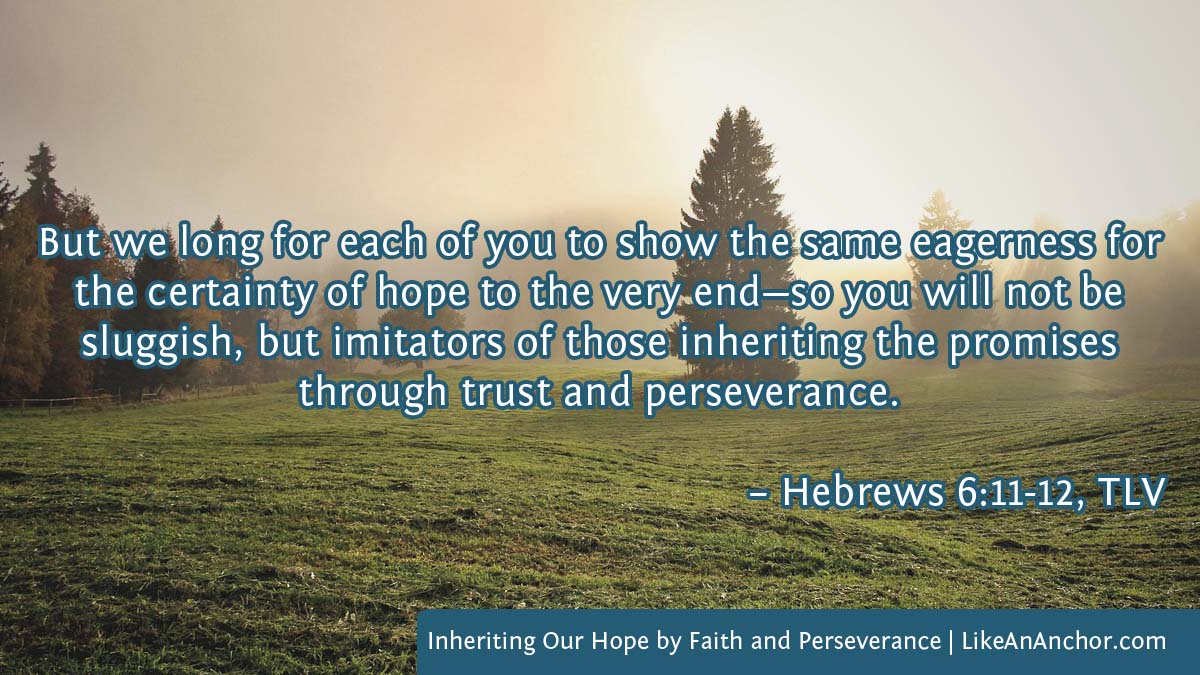
Image of a grassy field with a few trees and a misty sky overlaid with text from Hebrews 6:11-12, TLV version: "But we long for each of you to show the same eagerness for the certainty of hope to the very end—so you will not be sluggish, but imitators of those inheriting the promises through trust and perseverance."
Image by W P from Pixabay

Eager for Hope

We passionately want each of you to demonstrate the same eagerness for the fulfillment of your hope until the end, so that you may not be sluggish, but imitators of those who through faith and perseverance inherit the promises.

Hebrews 6:11-12, NET

Laundry, dishes, going to work, cleaning the toilet, scooping cat litter, cooking meals, reading depressing news stories–it can all pile up until it starts to feel like that’s the only thing going on in your life with a few windows for hobbies, Bible study, and friends. But we need to remember that the day-to-day things are not actually the most important things in our lives. When we follow God, we have a hope for the future that contextualizes everything else.

For we know that the whole creation groans and suffers together until now. Not only this, but we ourselves also, who have the firstfruits of the Spirit, groan inwardly as we eagerly await our adoption, the redemption of our bodies. For in hope we were saved. Now hope that is seen is not hope, because who hopes for what he sees? But if we hope for what we do not see, we eagerly wait for it with endurance.

Romans 6:22-25, NET

The groaning and suffering is temporary. The redemption of our bodies will be just the start of our eternity in God’s family. We ought to remember that, and eagerly anticipate the fulfillment of our hope. When we can look ahead, we can more easily hold on to the joy and peace that God offers to His people.

Faith and Perseverance
We passionately want each of you to demonstrate the same eagerness for the fulfillment of your hope until the end, so that you may not be sluggish, but imitators of those who through faith and perseverance inherit the promises.

Hebrews 6:11-12, NET

We inherit God’s promises through faith and perseverance. Faith in scripture is a very active thing; we don’t just passively have faith, we demonstrate it by our actions and it transforms our lives. When our faithfulness, steadfastness, and trustworthiness in relation to the covenant commitment we’ve made to follow God is tested, that testing produces endurance or perseverance.

My brothers and sisters, consider it nothing but joy when you fall into all sorts of trials, because you know that the testing of your faith produces endurance. And let endurance have its perfect effect, so that you will be perfect and complete, not deficient in anything.

James 1:2-4, NET

Perseverance and endurance are closely related concepts. In Greek, it’s makrothumia (G3115) and hupomone (G5281). Makrothumia, used in Hebrews 6, means “patience, endurance, constancy, steadfastness, perseverance” (Thayer’s definition). It is also translated “longsuffering” in some verses. Hupomone, used in James 1 and 1 Timothy 6, carries the idea of “steadfastness, constancy, endurance.” It is “characteristic of a man who is not swerved from his deliberate purpose and his loyalty to faith” no matter what he is called upon to endure. (Thayer’s definition). The words are very similar, and together provide a picture of the type of commitment we must develop as part of our faith in God.

But you, as a person dedicated to God … pursue righteousness, godliness, faithfulness, love, endurance, and gentleness. Compete well for the faith and lay hold of that eternal life you were called for and made your good confession for in the presence of many witnesses.

1 Timothy 6:11-12, NET

As we commit ourselves to following God and enduring to the end, keeping our hope for the future at the forefront of our mind helps contextualize everything else going on in our lives. It also helps to remember that people of faith who have gone before us also had to inherit the promises through faith and perseverance. No one has an easy road to the kingdom of God. But with His help and by holding onto a right perspective on what’s going on, we can also eagerly hold onto hope and inherit the promises.


Featured image by Aria Film from Pixabay

Wisdom and the Proverbs 31 Woman

As I was recently re-reading Proverbs 31, I was struck by the opening line: “The words of King Lemuel—the revelation which his mother taught him” (Prov. 31:1, WEB). Taking the text at face-value, it seems that this section of Proverbs was written by someone called King Lemuel, but he’s recording his mother’s advice rather than writing something of his own composition. Unless Priscilla is indeed the author of Hebrews (which is a distinct possibility), this is probably the closest thing we have to a section of scripture written by a woman.

On the one hand, it is not remarkable that God would include a woman’s writings in scriptural canon. Men and woman are spiritually equal in His eyes (Gal. 3:28) and He has used women throughout history to serve in many roles including leader, teacher, and prophet. Of course God could include women’s writings in His Bible if He wanted to. But on the other hand, it is important to recognize this unnamed woman’s contribution because so many people don’t think God uses women in any sort of formal teaching role.

As I studied this passage of scripture this week, a footnote in the New English Translation caught my eye. The translators suggested that we might read Proverbs 31:10-31 not only as part of King Lemuel’s mother’s advice but as the conclusion for the whole Book of Proverbs. Some have said that “The poem captures all the themes of wisdom that have been presented in the book and arranges them in this portrait of the ideal woman” (Claudia V. Camp, Wisdom and the Feminine in the Book of Proverbs, qtd. in NET study note on Prov. 31:10). The Biblical proverbs frequently personify wisdom as a woman (Proverbs 1:20-33; 4:4-13; 8:1-9:11), and it would be in keeping with that to wrap-up the Book of Proverbs by talking about a good and wise woman.

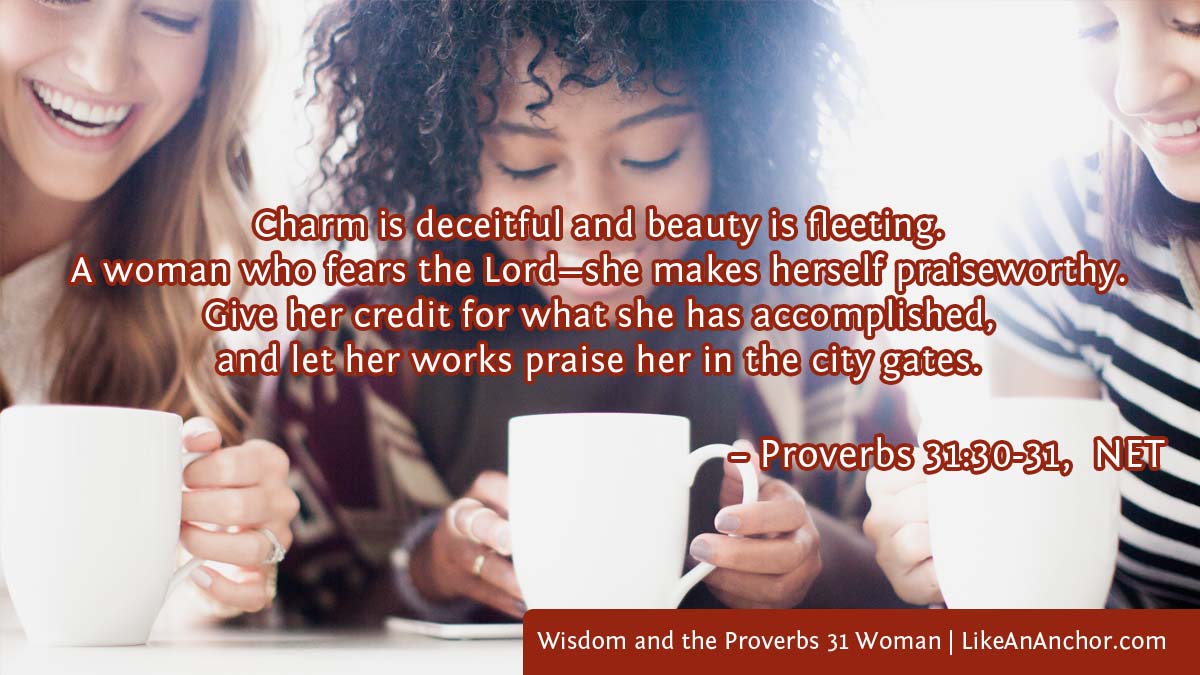
Image of three happy women overlaid with text from – Proverbs 31:30-31,  NET version:  Charm is deceitful and beauty is fleeting. A woman who fears the Lord—she makes herself praiseworthy. Give her credit for what she has accomplished, and let her works praise her in the city gates.
Image by Pearl from Lightstock

Comparing Scriptures Side-By-Side

King Lemuel is a mysterious figure. We don’t know anything about him other than that his mother gave him the advice recorded in Proverbs. There are no other clues to his identity or where and when he ruled. The first part of Proverbs 31 focuses on advice about being a good king (Prov. 31:2-9). The advice includes don’t spend all your energy enjoying women and alcohol, secure legal rights for those who can’t speak for themselves, and judge righteously.

The remainder of the chapter is the famous “Who can find a virtuous woman?” passage. In Hebrew, this is an acrostic poem (each verse starts with the letters of the Hebrew alphabet, in order). It has often been read as a template for all godly women, though this seems to be stretching the meaning. For one thing, the woman talked about here is a wife and mother, which leaves some of the roles she fills out of reach for single or childless women. For another, the woman is wealthy and entrepreneurial, something that is not necessarily true of all godly women. If this is part of Lemuel’s mother’s advice for her son, we can read this as a description of the type of wife King Lemuel’s mother wanted him to look for. We can apply it more broadly as a pattern of wisdom and valor that both women and men can learn from (see NET study note on Prov. 31:10), but it does not seem that Proverbs 31:10-31 is meant as an exact pattern all women must follow.

Remember this quote we started with: “The poem captures all the themes of wisdom that have been presented in the book and arranges them in this portrait of the ideal woman” (Claudia V. Camp, qtd. in NET study note on Prov. 31:10). In light of that thought, I thought it might be interesting to put the virtuous woman passage alongside some of the sections of Proverbs where wisdom is personified as a woman.

Who can find a worthy woman?
For her value is far above rubies.

Proverbs 31:10, WEB

For wisdom is better than rubies.
All the things that may be desired can’t be compared to it.

Proverbs 8:11, WEB

The heart of her husband trusts in her.
He shall have no lack of gain.
She does him good, and not harm,
all the days of her life. …

Her husband is respected in the gates,
when he sits among the elders of the land.

Proverbs 31:11, 23, WEB

Wisdom is supreme.
Get wisdom.
Yes, though it costs all your possessions, get understanding.
Esteem her, and she will exalt you.
She will bring you to honor when you embrace her.
She will give to your head a garland of grace.
She will deliver a crown of splendor to you.

Proverbs 4:7-9, WEB

She seeks wool and flax,
and works eagerly with her hands.
She is like the merchant ships.
She brings her bread from afar. …

She arms her waist with strength,
and makes her arms strong.
She perceives that her merchandise is profitable. …

She makes linen garments and sells them,
and delivers sashes to the merchant.
Strength and dignity are her clothing.
She laughs at the time to come. …

Give her of the fruit of her hands!
Let her works praise her in the gates!

Proverbs 31:13-14, 17-18a, 24-25, 31 WEB

“I, wisdom, have made prudence my dwelling.
Find out knowledge and discretion. …
With me are riches, honor,
enduring wealth, and prosperity.
My fruit is better than gold, yes, than fine gold,
my yield than choice silver.
I walk in the way of righteousness,
in the middle of the paths of justice,
that I may give wealth to those who love me.
I fill their treasuries.”

Proverbs 8:12, 18-21, WEB

She opens her arms to the poor;
yes, she extends her hands to the needy.
She is not afraid of the snow for her household,
for all her household are clothed with scarlet. …

She opens her mouth with wisdom.
Kind instruction is on her tongue.
She looks well to the ways of her household,
and doesn’t eat the bread of idleness.

Proverbs 31:20-21, 26-27, WEB

Wisdom has built her house.
She has carved out her seven pillars.
She has prepared her meat.
She has mixed her wine.
She has also set her table.
She has sent out her maidens.
She cries from the highest places of the city:
“Whoever is simple, let him turn in here!”
As for him who is void of understanding, she says to him,
“Come, eat some of my bread,
Drink some of the wine which I have mixed!
Leave your simple ways, and live.
Walk in the way of understanding.”

Proverbs 9:1-6, WEB

Charm is deceitful, and beauty is vain;
but a woman who fears Yahweh, she shall be praised.

Proverbs 31:30, WEB

The fear of Yahweh is the beginning of wisdom.
The knowledge of the Holy One is understanding.
For by me your days will be multiplied.
The years of your life will be increased.

Proverbs 9:10-11, WEB

Virtue and Wisdom

Image of a man and woman studying the Bible together, overlaid with blog's title text and the words, " The "virtuous woman" of Proverbs 31 isn't just a list of things for godly women to do. It's something men and women can learn from as we apply the Book of Proverbs' lessons about wisdom in our lives."
Image by Anggie from Lightstock

Modern readers often think of “virtue,” particularly related to women, as involving chastity and meekness. There’s a lot more to it than that, though. Proverbs 31:10 is one of several passages where the meaning has become obscured at the English language changes. Back in 1611, King James translators chose “virtuous woman” knowing that the word had been connected with “moral life and conduct, uprightness of life, the opposite of vice; a particular moral excellence” since around the year 1200 (“virtue,” etymonline.com). They may have chosen “virtue” instead of “valor” because around the 1590s, “virtue” also started to refer to women’s “chastity, sexual purity,” but it was an accurate translation choice at the time. Modern translations typically try to get away from those connotations of “virtuous” by using phrases like “a worthy woman” (WEB), “a wife of noble character” (NET, NIV), or “a capable wife” (CJB).

“a woman of valor.” This is the same expression used to describe Ruth (e.g., Ruth 3:11). The term חַיִל (khayil) here means “moral worth” (BDB 298 s.v.); cf. KJV “a virtuous woman.” Elsewhere the term is used of physical valor in battle, e.g., “mighty man of valor,” the land-owning aristocrat who could champion the needs of his people in times of peace or war (e.g., Judg 6:12). Here the title indicates that the woman possesses all the virtues, honor, and strength to do the things that the poem will set forth.

NET translation note on Prov. 31:10

The Proverbs 31 portrait of a woman who posses moral worth, virtues, honor, and strength isn’t just a list of things that godly women should do (a list which, as I have written about before, can seem intimidating or out of reach for some women). It is an example of what godly women can look like, the conclusion to the Book of Proverbs, and perhaps a continuation of themes personifying wisdom as feminine. This is a passage that men and women can learn from, particularly in the sense of examples for how to apply wisdom in our lives.


Featured image by MarrCreative from Lightstock