Unveiled

How many people do you really open up to? Even if you’re an “open book,” there are probably things you don’t share with everyone. There are secrets, aspects of our personality, and thoughts that we only show closest friends, family or a spouse. You may have parts of you hidden so deep no one sees them.

not sure who to credit; found on Pinterest

What about in your relationship with God? Even though He knows everything about us, we can still chose to hold things back from Him. We can tell Him to stay away, keeping Him at arms length and refusing to let go and surrender to His work in us.

Opening up and letting myself be seen is a challenge I face in human relationships, and in this fall holy day season I’ve been thinking about whether I try to do the same thing with God. I think that I’m more open with Him than with anyone else, but are there still things that I’m trying to hold back or hide?

Open To Me

Jesus is supposed to be our friend and lover. He wants to know you more thoroughly than anyone else ever will, but He wants you to chose that relationship. He won’t force Himself into your life, though He will knock.

I sleep, but my heart is awake; it is the voice of my beloved! He knocks, saying, “Open for me, my sister, my love, my dove, my perfect one; for my head is covered with dew, my locks with the drops of the night.” (Song 5:2)

The woman in this part of the Song of Songs has “slumbered and slept,” and now Christ is outside asking to come in. “He sues for entrance who may demand it; he knocks who could easily knock the door down” (Matthew Henry’s Commentary). He doesn’t upbraid her for shutting Him out — He just wants her to let Him in. Have we also locked Him out? perhaps through carelessness if not deliberately?

she did not say, I will not open, but, How shall I? Note, Frivolous excuses are the language of prevailing slothfulness in religion; Christ calls to us to open to him, but we pretend we have no mind, or we have no strength, or we have no time (Matthew Henry)

Matthew Henry talks about this as “The slights which careless souls put upon Jesus Christ,” and which actually demonstrate “a great contempt” for their savior. When we ignore Jesus’ request to come into our lives, we reject His work in us.

Here, in the Song, the woman finally opens the door when she sees His hand at the door. Unfortunately, she waited too long for welcoming Christ in to be easy.

I opened for my beloved, but my beloved had turned away and was gone. My heart leaped up when he spoke. I sought him, but I could not find him; I called him, but he gave me no answer. The watchmen who went about the city found me. They struck me, they wounded me; the keepers of the walls took my veil away from me. (Song 5:6-7)

If we aren’t willing to open ourselves up to Christ when He knocks, He will be harder to find. If we don’t unveil ourselves to Him, we might find ourselves lost, alone and stripped of our covering pretenses before we find Him again. This can happen multiple times in a Christian’s life, just as this pattern is repeated in the Song (Song 3:1-4). Our lives are often a dance of drifting away and coming back to Christ.

Torn Veils

Unveiled | marissabaker.wordpress.comVeils keep us from fully experiencing God. The veil in the temple separated the Holy of Holies — where God’s spirit appeared — from the rest of the temple complex. Prior to Christ’s sacrifice, only the High Priest could enter, and only once a year (Heb. 9:1-8). The moment Jesus died, “the veil of the temple was torn in two from top to bottom” (Matt. 27:51). His death removed the most visible separation between God and His people.

There was another veil mentioned in the Old Testament that Paul talks about in the New. After Moses spoke to God, he shone so much with God’s reflected glory that Israel feared him. Moses wore a veil to hide his shining face before everyone but God (Ex. 34:29-35). Paul wrote about this veil in his second letter to Corinth.

But their minds were blinded. For until this day the same veil remains unlifted in the reading of the Old Testament, because the veil is taken away in Christ. But even to this day, when Moses is read, a veil lies on their heart. Nevertheless when one turns to the Lord, the veil is taken away. (2 Cor. 3:14-16)

Christ has torn away all the veils between the Lord and His people. The temple veil which tore at His death opened the way into His sanctuary, and when we turn our hearts to Him He takes away the veil shielding true understanding of the Torah.

But we all, with unveiled face, beholding as in a mirror the glory of the Lord, are being transformed into the same image from glory to glory, just as by the Spirit of the Lord. (2 Cor. 3:18)

We have to unveil our faces if we want to see His unvelied face. To know Him, we must want to be known. He took the first step — will we be equally open with Him?

Being Seen

Psalm 139 talks about God knowing us thoroughly — all our thoughts, every part of our personality. It also includes a very important line where David invites God into this deep, intimate relationship.

Search me, O God, and know my heart; try me, and know my anxieties; and see if there is any wicked way in me, and lead me in the way everlasting. (Ps. 139:23-24)

David’s willingness to be seen by God, and his request that God know him, are key to the sort of closeness described earlier in Psalm 139. Today, we can have that same sort of intimacy with our Lord if we let Him in.

Behold, I stand at the door and knock. If anyone hears My voice and opens the door, I will come in to him and dine with him, and he with Me. (Rev. 3:20)

Our Beloved is knocking on our doors, asking us to let Him in. Turn your face to Him, take off the barriers you’re putting up between you and Jesus. See, and be seen.

Unveiled | marissabaker.wordpress.com

Credits for photos used in blog images this week:

  • Veil” by Dan Thoburn, CC BY via Flickr
  • Red Drapery” by Sherrie Thai, CC BY via Flickr
  • Diamond Samples” by Seth Lemmons, CC BY via Flickr
  • Song 7:5” by Raffaele Esposito, CC BY via Flickr

Thirst

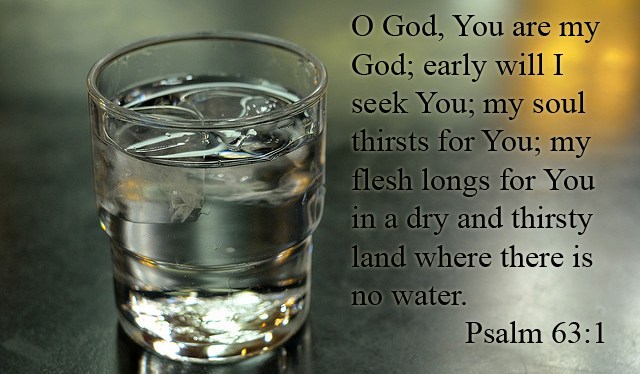
I woke up this morning and reached for my water bottle. It wasn’t there, of course, since today is Yom Kippur (Day of Atonement) and we started fasting last night as the sun set. What struck me was how automatic the gesture was — I always have a bottle of water nearby, and grabbing it when I feel thirsty is almost unconscious.

So I asked myself, “Do I long for God the way I crave water when fasting?” Jesus called Himself the “living water.” Just as we need water to survive physically, so we need Him to survive spiritually. And yet somehow, I don’t think we are as attentive about drinking Him in as we are physical water. We should keep Him even closer than I usually keep my water bottle, and turn to Him at every reminder just like we take a drink whenever our throats feel a bit dry.

Thirst | marissabaker.wordpress.com
photo credit: [cipher], CC BY-SA, via Flickr
The Jews consider Yom Kippur the most solemn and holy day of the entire year, and I’m inclined to agree with them. This isn’t to belittle any of the other holy days or the weekly Sabbath, but God does seem to put a special importance on this day. For one thing, it’s the only day when He strictly specifies “you shall do no work at all.” The other holy days are also days of rest, but He uses a different phrase for that: “you shall do no customary work” or “No manner of work shall be done on them; but that which everyone must eat—that only may be prepared by you.”

And the Lord spoke to Moses, saying: “Also the tenth day of this seventh month shall be the Day of Atonement. It shall be a holy convocation for you; you shall afflict your souls, and offer an offering made by fire to the Lord. And you shall do no work on that same day, for it is the Day of Atonement, to make atonement for you before the Lord your God. For any person who is not afflicted in soul on that same day shall be cut off from his people. And any person who does any work on that same day, that person I will destroy from among his people. You shall do no manner of work; it shall be a statute forever throughout your generations in all your dwellings. It shall be to you a sabbath of solemn rest, and you shall afflict your souls; on the ninth day of the month at evening, from evening to evening, you shall celebrate your sabbath.” (Lev. 23:26-32)

On the Day of Atonement, everything stops. We stop eating, we stop drinking, and we stop doing any work. Usually, my morning routine goes like this: pray, feed fish, make breakfast, read a book, Bible study, yoga, then start working. On the Sabbaths, I usually only do the first three and then head off for per-services dance practice. But today, the only thing I have to think about is thirsting after God. I took a minute to feed the aquarium fish, but that’s it. I don’t have to worry about making breakfast or scheduling my day. I can listen to Hillsong music, pray, study, and turn my thoughts into this impromptu blog post.

I wonder if my younger self would have believed she’d learn to look forward to the Day of Atonement. Fasting doesn’t make me terribly ill, but it’s not really easy for me either, and I often thought of it as something we just had to get through before the Feast of Tabernacles. But, God be praised, I’m starting to learn more about how amazing this day is and why He considers it so important.

I pray each of you has a blessed, refreshing Yom Kippur that draws you closer to God.

G'mar Chatimah Tovah -- traditional greeting for this season. Literally," A good final sealing" or idiomatically, "May you be inscribed (in the Book of Life) for Good"
G’mar Chatimah Tovah — traditional Hebrew greeting for this season. Literally,” A good final sealing” or idiomatically, “May you be inscribed (in the Book of Life) for good”

Learning from Our Stress Function – Inferior Thinking

Disclaimer: some of the links in this post are affiliate links. This means that, at no additional cost to you, I will receive a commission if you click on the link and make a purchase on that website.

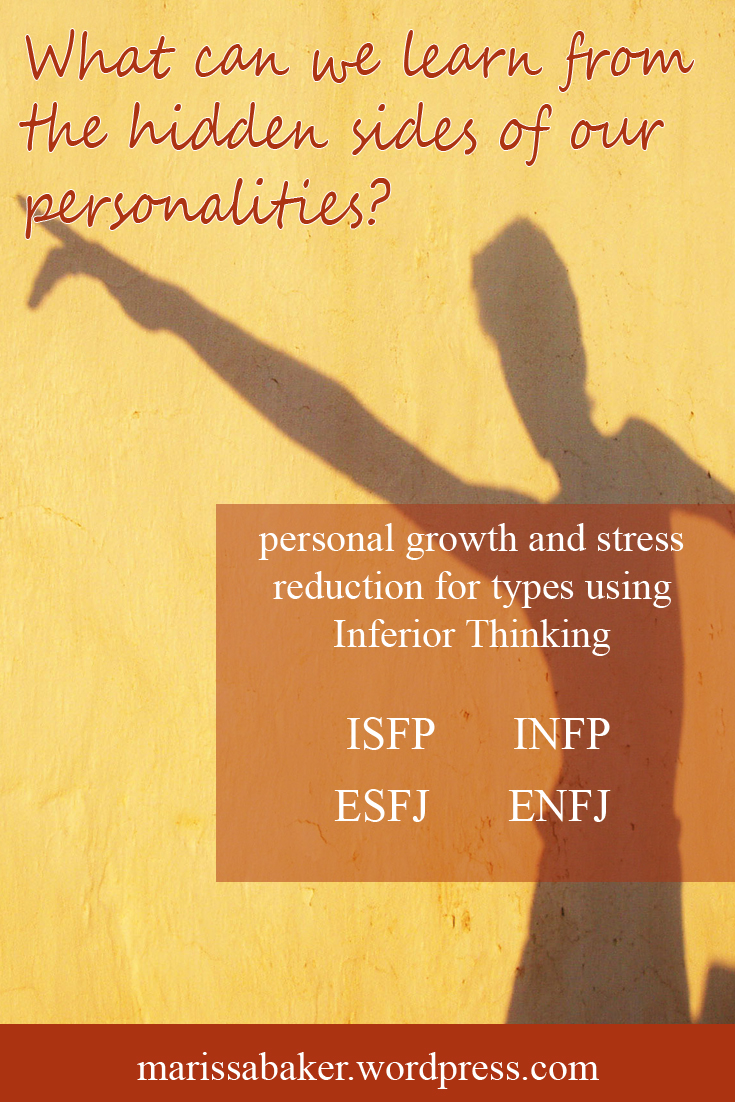
When we’re talking about someone’s personality type in the Myers-Briggs system, we usually talk about their primary and secondary functions (also called mental processes). An ISFP, for example, leads with a process called Introverted Feeling (a judging/decision making function), which is supported with Extroverted Sensing (a perceiving/learning function). An ENFJ, on the other hand, leads with Extroverted Feeling, supported by Introverted Intuition. Using Personality Hacker’s car model,* we can compare our primary function to an adult driving a car, and the secondary function to a second adult navigating in the passenger seat.

Each type also has a tertiary function (the opposite of their secondary function), and an inferior function (the opposite of their primary function). These are less well developed. In the car model, our tertiary function is like a 10-year-old sitting behind the co-pilot, and the inferior function is like a 3-year-old sitting behind the driver. The processes you use most readily are the ones typically visible, and they define your personality as others usually see it. Our less developed functions play a significant role as well, though. Today, we’ll be looking at types which use Thinking as an inferior function.

Learning from Our Stress Function - Inferior Thinking | marissabaker.wordpress.com

Everyday Life

Inferior functions often show up in the type of hobbies people choose. INFPs and ISFPs, for example, may enjoy strategy games or something like crossword puzzles to engage their Thinking side. More than other types, though, dominant Feeling types often choose careers that tap-into less dominant functions (Was That Really Me?* Quenk 149). An ENFJ might use their thinking and intuitive sides to work with computers, or an ISFP could work in engine repair using their sensing and thinking sides. In this case, they’d be using their dominant function in hobbies and play, and their less-developed functions at work. ENFJs, ESFJs, ISFPs, and INFPs in this type of situation often retreat into nature or opt for a more social activity to relax.

Characteristics of Inferior Thinking

ESFJs and ENFJs use dominant Extroverted Feeling, which makes Introverted Thinking their inferior function. It’s their least developed function, and has different characteristics than the Introverted Thinking used by types like ISTPs and INTPs. Naomi Quenk says inferior Introverted Thinking displays the following traits (I’ve put the traits of dominant Ti in parenthesis):

  • Excessive criticism (Impersonal criticism)
  • Convoluted logic (Logical analysis)
  • Compulsive search for truth (Search for accuracy and truth)

ISFPs and INFPs also lead with a feeling function, in this case Introverted Feeling. This makes Extroverted Thinking their stress function, and it looks different than the Thinking used by ENTJ and ESTJ types. Here are the traits Quenk associates with inferior Extroverted Thinking (and their counterparts in Te-dominant types).

  • Judgements of incompetence (Competence)
  • Aggressive criticism (Truth and accuracy)
  • Precipitous action (Decisive action)

Stress Reactions

Inferior Thinking types are sensitive about how other people perceive their intellect. They’re very careful when handling facts and can become irritated or defensive if people question their competence (or if they feel someone might question them). When stressed, they’re quick to point out other peoples’ errors and judge them as incompetent, often aloud. Normally, dominant Feeling types value peace and harmony, but when stressed they are much quicker to voice their criticisms.

They can also turn this “excessive” or “aggressive” criticism inward. I have several good friends who are ExFJ types, and they are very hard on themselves whenever something goes wrong or pulls them into depression. It’s very frustrating to outside observers because it’s almost impossible to talk them out of self-criticism. When working out of their stressed function, Feeling types, especially ESFJs and ENFJs, often insist on solving problems alone and fall into a pattern of “convoluted logic” (Quenk 154). One ENFJ that Naomi Quenk interviewed talked about coming up with a plan to break her leg in an accident so she wouldn’t have to participate in a sporting event that had her stressed out (she didn’t actually go through with it).

Stressed Feeling types often feel compelled to take some kind of action to correct a problem and regain control. The introverts, whose stress function is extroverted, usually try for outward action without thinking it through (Quenk 108). Extroverts, with their inferior introverted function, are more likely to take internal action and seek out books or lectures they think might help (Quenk 155).

Getting Out of Stress

All Feeling types benefit from alone time away from everyday routine to process stressful situations. Introverted types especially say that their “grip experience” needs “to expire on its own” (Quenk 115). They need time to process what’s going on without other people trying to interfere too soon. Some INFPs and ISFPs, especially women, want to talk eventually but not right away.

ESFJs and ENFJs do need alone time, but they also need someone to bounce ideas off of much more than the introverted types. They need a friend who is willing to listen without criticism, take them seriously, remind them of their good qualities, and reassure them that they’re a good person (Quenk 163). Many Extroverted Feelers also appreciate someone taking the time to involve them in a low-pressure social activity.

Learning From the Inferior

For many people, the side of their personality that’s related to the inferior function stays a mystery throughout their lives. Type theorists say that most people who successfully incorporate their inferior function do so around middle age, but you can start working on it sooner. Isabel Meyer suggested that every type can, and should, exercise all their functions on a regular basis when making decisions. Dominant Feeling excels in weighing how much you care about different options, takes into account others’ well-being, and seeks the most authentic and harmonious solution. Making a conscious effort to incorporate Thinking adds a level of impersonal analysis that helps when working with facts and making long-term plans (Meyers, Gifts Differing*, 197).

Naomi Quenk says that ENFJs and ESFJs who successfully incorporate their inferior functions learn to take better care of themselves rather than always putting others first. They’ll often dig into their inner lives more fully and give themselves permission to explore interests they’d pushed aside when younger — like one ENFJ who left a successful law practice to become a minister (Quenk 165). The introverted types also become more comfortable with themselves, and more confident when making decisions. Incorporating their inferior Thinking helps INFPs and ISFPs cope with their own shortcomings and relax (Quenk 117, 118). It also helps both types learn to deal with outside criticism effectively.

Learning from Our Stress Function - Inferior Thinking | marissabaker.wordpress.com

credits for pictures used in blog images:

*indicates affiliate links

Shabbat Shuvah (Lessons from Zechariah)

The fall holy days are yearly reminders that this world isn’t permanent. Yom Teruah (Feast of Trumpets) pictures Jesus Christ’s return and signals preparation for His arrival. Yom Kippur (Day of Atonement) reminds us of the price paid to redeem us and points to a day in the future where Satan is finally locked away. Sukkot (Feast of Tabernacles) looks forward to the establishment of God’s kingdom on earth.

Peter talks about this day of the Lord’s return in his second epistle, and asks a very important question.

Therefore, since all these things will be dissolved, what manner of persons ought you to be in holy conduct and godliness, looking for and hastening the coming of the day of God, because of which the heavens will be dissolved, being on fire, and the elements will melt with fervent heat? (2 Pet. 3:11)

We know what’s coming, at least in part. We don’t know when, but we know the world isn’t sticking around. We also know that God expects certain things from His people if they want to receive a reward of righteousness in the final judgement.

Return To God

Shabbat Shuvah | marissabaker.wordpress.comIn traditional Jewish teachings, this Sabbath between Yom Teruah and Yom Kippur is known as Shabbat Shuvah — the Sabbath of Return. It also plays on the word “teshuva,” meaning repentance, since that’s a central theme of these days. This is a topic dear to Zechariah, who comes next in my study of the minor prophets.

Like Haggai, where we spent so much time a few weeks ago, Zechariah wrote his book of prophecy during Zerubbabel’s temple rebuilding. More than Haggai, he also writes about future events pictured by these holy days. Even with a focus on the future, though, the first thing recorded in this book is a plea for immediate action.

In the eighth month of the second year of Darius, the word of the Lord came to Zechariah the son of Berechiah, the son of Iddo the prophet, saying, “The Lord has been very angry with your fathers. Therefore say to them, ‘Thus says the Lord of hosts: “Return to Me,” says the Lord of hosts, “and I will return to you,” says the Lord of hosts. “Do not be like your fathers, to whom the former prophets preached, saying, ‘Thus says the Lord of hosts: “Turn now from your evil ways and your evil deeds.”’ But they did not hear nor heed Me,” says the Lord. (Zech. 1:1-4)

God is telling these people, and us along with them, that it’s not too late to learn from past mistakes. They can still wake up and turn their lives around by returning to God. They don’t have to repeat the mistakes of past generations who ignored God’s warnings, and neither do we.

How to Change

Peter answers his question about what type of person we ought to be in the verses following what we already quoted in the introduction.

Nevertheless we, according to His promise, look for new heavens and a new earth in which righteousness dwells. Therefore, beloved, looking forward to these things, be diligent to be found by Him in peace, without spot and blameless (2 Pet. 3:13-14)

This is a description of who we can become in Christ — a goal to strive for. If we go back to Zechariah now, we find some specific instructions for how to become holy, blameless and at peace.

In Zechariah chapter 7, the Lord reproves Israel for a number of sins. They did everything for themselves rather than to exalt the Lord (Zech 7:5-7). They ignored God’s simple commands and outright rejected His law (Zech. 7:9-12). This rebellion resulted in punishment, but God planned to turn it around to blessing when Israel returned to following Him.

“For thus says the Lord of hosts: ‘Just as I determined to punish you when your fathers provoked Me to wrath,’ says the Lord of hosts, ‘And I would not relent, so again in these days I am determined to do good to Jerusalem and to the house of Judah. Do not fear. These are the things you shall do: speak each man the truth to his neighbor; give judgment in your gates for truth, justice, and peace; let none of you think evil in your heart against your neighbor; and do not love a false oath. For all these are things that I hate,’ says the Lord.” (Zech. 8:14-17)

If we want to get right with God, we can’t keep doing things He hates. We have to turn our lives around and get rid of deception, squabbling, unrighteousness, vengeance and all forms of evil. These are simple commandments, but truly keeping them can seem like a tall order. Thankfully, we don’t have to do this alone.

By God’s Spirit

Like ancient Israel, we’ve spent far too much time looking to something other than God for answers. We try to fix ourselves with self-help books, center ourselves with meditation, protect ourselves with prepping, and listen to talks about all we can accomplish on our own. None of things I used as examples are inherently wrong, but they always have to come after our relationship with God. If we try to use them as a stand-in for things only God can supply or look to them first when we need help, they become idols.

Ask the Lord for rain in the time of the latter rain. The Lord will make flashing clouds; He will give them showers of rain, grass in the field for everyone. For the idols speak delusion; the diviners envision lies, and tell false dreams; they comfort in vain. Therefore the people wend their way like sheep; they are in trouble because there is no shepherd. (Zech. 10:1-2)

All we have to do to start seeing results is return to God. He’s eager to give us good things if we’ll only ask Him. This doesn’t mean everything will start going right and trials will disappear immediately, but God does promise to work good in your life if you’re walking with Him. A relationship with God always yields better long-term fruits than seeking answers elsewhere.

A couple weeks ago, we talked about obstacles we face today when trying to build up God’s temple — both the church as a whole and ourselves as individuals. Like Haggai, Zechariah delivers a message from God of encouragement to Zerubbabal to persevere in building the temple. It’s a famous verse, and applies just as much today as it did back then.

So he answered and said to me: “This is the word of the Lord to Zerubbabel: ‘Not by might nor by power, but by My Spirit,’ says the Lord of hosts. ‘Who are you, O great mountain? Before Zerubbabel you shall become a plain! And he shall bring forth the capstone with shouts of “Grace, grace to it!”’” (Zech. 4:6-7)

If we, too, are walking in the spirit of the Lord and following His will, we can fill in our names here. Jesus told us faith can move mountains, and I don’t think He was joking. Whatever your “mountain” is, stop trying to shove against it by your own might and power. Turn back to the Lord, and He’ll turn that thing into a plain — even ground so you can move forward to keep building and singing His praises.

Shabbat Shuvah | marissabaker.wordpress.comCredits for photos used in blog images:

Heart of David

A good friend just released his first album. I may be a little biased, but I really like it. My favorites right now are “Smokey Mountains,” “Make Me Real,” “Psalm 70,” and “What I’m Waiting For.” Why not click over, give it a listen, maybe download it and let him know what you think?

corbinisme's avatarCorbin-is-me

folder

This is my first album that I’ve produced. While it’s not professional quality, and I have no formal training in music, recording, or producing, I have a joy and passion for music! I wanted to give “my firstfruits” to God, so this album contains songs that are peaceful, calming, and songs that speak of God, and the desires of my heart. It may not be everyone’s cup of tea, but it was important for me to publish these songs first as I strive to put God first.

Currently available for download at the following links

Will be available soon-ish on iTunes, Google Play, Amazon Music, Spotify, etc…

View original post

Updated “God’s Love Story” E-Book

In honor of the fall Holy Days season, which we kicked-off yesterday with Yom Teruah (Feast of Trumpets), I’m re-releasing an updated version of my “God’s Love Story” booklet. It’s now available in multiple e-book formats through Smashwords and Amazon (the book is free on Smashwords, but Amazon doesn’t have that option when you’re setting up a new e-book).Updated "God's Love Story" E-Book by Marissa Baker

Throughout history, God calls out to His people asking one simple question, “Do you love Me?” Christianity isn’t a boring “let’s go to church and sit in a pew for an hour” sort of religion. It’s a romance with the creator of the universe; a “fairy tale” staring the Prince of Peace, Who laid down His life to rescue His bride from captivity to sin.

Click here to download “God’s Love Story” for free on Smashwords