The Feeling of Being Different: Interplay of INFJ and Enneagram Four

I’ve talked with dozens, perhaps hundreds, of INFJs since I started this blog and wrote the first edition of The INFJ Handbook. One thing that most of us have in common is the feeling that we’re alien; that we don’t belong in the cultures, social groups, and/or families that we find ourselves in. Even if the people around us are welcoming, accepting, and seem to love us as we are we often feel as if there’s still something different about us.

Part of an INFJ’s feelings of alienation can be explained through type theory. Intuitives only make up about 30% of the population, and that means the way we process information and perceive the world is different than the way most people do. That difference is neither good nor bad; it’s just how our minds are hardwired. But as INFJs, we’re also FJ types who interact with the outer world using Extroverted Feeling. This is a cognitive function that’s keenly aware of values, ideals, behaviors, and cultural expectations. We notice when there’s something about us that doesn’t fit in, and it often bothers us.

Since I discovered the Enneagram and, years later, decided it might actually be a useful tool, I’ve started wondering if part of this feeling of being different might be connected to our Enneagram types. While INFJs can have any Enneagram type, some are more common than others. According to a survey conducted by Heidi Priebe in 2016, just over 30% of INFJs are Fours on the Enneagram, which makes it the most common Enneagram number for INFJs. It’s also my Enneagram type, and that’s the one I’m going to focus on today. If you’re wondering how different Enneagram types show up for INFJs, check out Susan Storm’s article “Your INFJ Personality Type and Your Enneagram Type.”

Why Fours Are Different

Myers-Briggs® types are typically describe in neutral or positive terms. You’ll also find information about the dark side of each type, but for the most part you’re likely to feel pretty good about yourself after reading your type description. That’s not the case with the Enneagram. When I first started reading about the Enneagram, what I noticed most is that it describes the core wounding message you internalized as a child and which you’re stuck with you your entire life.

I did not like this view. Truly, though, I probably wouldn’t have been so upset by the Enneagram’s description of Fours if part of me didn’t already believe that I was broken, abandoned, and envious of people who seem to have whatever basic human ingredient I’m missing. It wasn’t until years later, when I started seeing a counselor about my anxiety, that I realized I had internalized messages like this even though I grew up in a loving, supportive, stable home.

According to my favorite Enneagram book — The Road Back To You: An Enneagram Journey to Self-Discovery by Ian Morgan Cron and Suzanne Stabile — “The wounding message Fours hear all the time is, ‘There’s something off about you. No one understands you, and you’ll never belong.’” Fours feel as if there’s something essential lacking; like we missed out on some important ingredient when God was putting people together. We’re not sure what it is, but we’re sure others have it and we don’t.
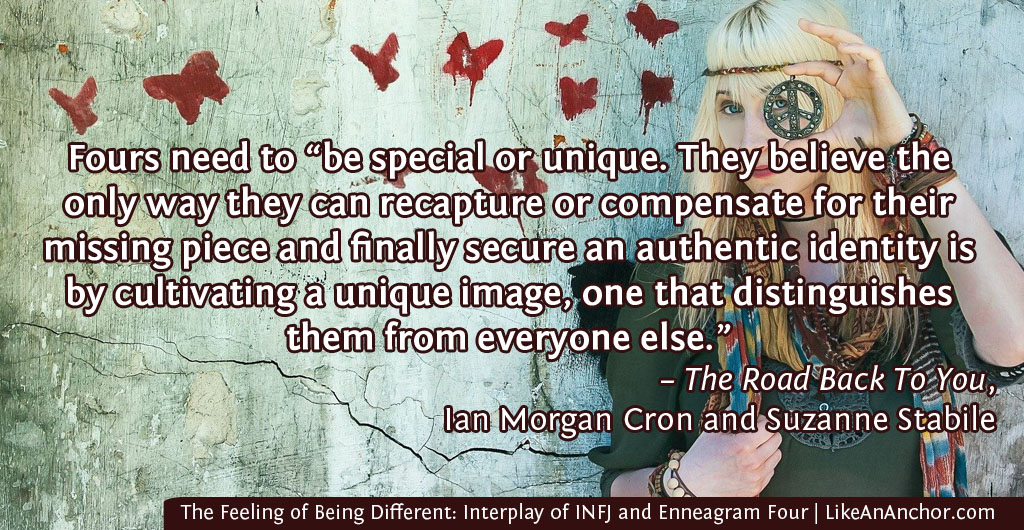
Photo credit: tookapic via Pixabay

Wanting To Be Different, but Maybe Not Too Much

While some INFJs feel that their uniqueness is a burden, I’d venture a guess that most of us don’t really want to give it up (at least not entirely). The whole “otherworldly INFJ thing” can get ridiculous at times but many of us not-so-secretly like our unicorn status. I wonder if perhaps this might have to do with Fours being a common Enneagram type for INFJs

The Road Back To You says that Fours need to “be special or unique. They believe the only way they can recapture or compensate for their missing piece and finally secure an authentic identity is by cultivating a unique image, one that distinguishes them from everyone else.” I don’t know about you, but reading that connected with something deep inside me.

As an INFJ, part of me wants to be a chameleon to fit in with the people around me, but another part strongly wants an authentic identity (so much so that for a while I thought I might be an INFP, since Introverted Feeling is often associated with authenticity). This is probably the reason I started “dressing like a hippy” (to quote family members and friends who noticed my style change). I wanted a way to make myself visibly unique without stepping too far outside accepted behavior.

I suppose the holy grail for type Four INFJs is to find a way to express their individuality without feeling as if they have nowhere they fit. We want to be unique and different, but not so much that it messes with the harmony we need to have in our relationships.

Healing The Broken Things

The Feeling of Being Different: Interplay of INFJ and Enneagram Four | LikeAnAnchor.com
Photo credit: JoBischPeuchet via Pixabay

I’ve come to realize that if there’s something inside us that feels broken, missing, and wrong, then running away from it or pushing it deep down inside us isn’t a good idea. It’s far better to let ourselves feel things and process our complicated emotions, particularly if they keep coming back to bite you after you think you shut them down (note: I’m not a therapist or psychologist. There are exceptions to every rule, and some things are best dealt with in a therapy setting. If you’re struggling with something, I encourage you to seek out professional help).

The Enneagram can be a useful tool for helping us identify and face unhelpful messages we’ve internalized. And it’s not depressing to read about those messages once you realize the Enneagram does include descriptions of healthy, average, and unhealthy versions of all the types, along with advice for how to grow into a healthier version of your type. What form that advice takes depends on who’s using the Enneagram. For example, The Road Back To You is written from a Christian perspective, and so the advice in that book is framed through that lens.

Before offering their 10 tips for Fours’ personal growth the authors write, “Fours need to hear this loud and clear: there’s nothing missing. It may be hard to believe, but God didn’t ship them here with a vital part absent from their essential makeup.” I teared up reading that the first time. I’m not convinced of it all the way deep down inside yet, but I want to be. And I’ve been heading that direction a lot more steadily over the past couple years thanks to  tools like schema therapy.

Grow As Yourself

One of the most important messages an INFJ hears from Myers-Briggs® is that you’re not broken. You’re a perfectly normal INFJ, and it’s okay if that’s different than the majority of other people.

One of the most important messages we can hear from the Enneagram is that it’s okay to feel broken. None of us are perfect and we don’t have to be; we just need to grow, and realizing what sorts of foundations we’re starting with can be a great first step for that.

 

If you’d like to know more about the INFJ personality type, check out my book The INFJ Handbook. I’ve updated it with a ton of new information and resources. You can purchase it in ebook or paperback by clicking this link.


Featured image credit: congerdesign via Pixabay

How Can A Christian Know When To Follow Human Authority and When To Obey God Rather Than Man?

I’ve been pondering the question posed in today’s title for a number of years now. How much obedience do we owe to human authorities, both inside and outside the church? Is a Christian allowed, per scripture, to speak against people in authority? Are they ever encouraged to stand up and fight against authority that is unjust and immoral? And why are churches, even those that preach the importance of obeying God’s word, so reluctant to talk about submission to authority passages like Romans 13:1-7 and 1  Peter 2:13-19?

Until fairly recently, this was mostly an intellectual puzzle for the American church. Then came questions about baking cakes for same-sex weddings, then whether or not to assemble for services when governors shut down states, now debates over the mask issue, and rising fears that a Covid vaccine might be the Mark of the Beast. We live in confusing times, and they’re forcing us to face questions and wrestle with decisions some of us haven’t had to deal with before.

Those of us who prize our independence might be angry about infringements on our freedom, wrestling with whether to follow our personal choices or do as we’re told. Those of us who struggle with anxiety might be scared — paralyzed, even — both by everything that’s going on and by not knowing what is the right thing to do. Those who are people-pleasers might be running up against the fact that we’ll need to pick a side and can’t make everyone happy.

Today’s post isn’t going to offer answers for the specific issues we’re facing right now. Rather, I hope to highlight scriptures that provide principles which we can use whenever we struggle with how to respond to human authority in a way that honors God. This is a question we will face at some point, if we aren’t facing it already. We need to be prepared to answer these questions, to ourselves and when asked by others, in a Biblically solid way. Read more

Writing (Like Life) Is an Individual Growth Process

I started graduate school last week! It’s a Master’s program of Rhetoric and Writing, and it means I suddenly have less time for blogging than I did before. But it also means I’ve been reading a number of books and scholarly articles that are prompting me to think more deeply on topics related to teaching and the writing process.

That might not sound, at first glance, like something that has to do with “finding our true selves in the people God created us to be.” However, I’m struck by similarities between best practices for teaching students to improve as writers and what I know about personal growth. We don’t all follow the exact same patterns for personal growth, nor do we all grow at the same pace and in the same way. Similarly, one-size-fits-all is not a great approach to teaching writing. There are, of course, certain things we look for in “good writing” — a strong thesis, structure that supports the thesis, integration of quotes and examples, etc. But to a certain extent, whether or not something is “good writing” also depends on the individual writer. Read more

How To Fertilize Your Spiritual Garden

Last week, I wrote quite a lengthy post about why it’s so important to tend our spiritual lives as we would a carefully cultivated garden. God desires growth from us, and we need to put effort into that if we want to stay in a close relationship with Him. It’s important to know how highly God values growth, for Jesus warns if we don’t use the gifts He has given us there’s a very real chance they’ll be taken away. Knowing God wants and expects us to grow isn’t much use, though, unless we also talk about how to make growth happen.

Abide in Jesus

When Paul talks about people in ministry “planting” and “watering” spiritual gardens, he also makes very clear that it is God who “gives the increase” (1 Cor. 3:6-9). Growth and fruitfulness happen because of God’s work in our lives. We’re involved, but we don’t make it happen.

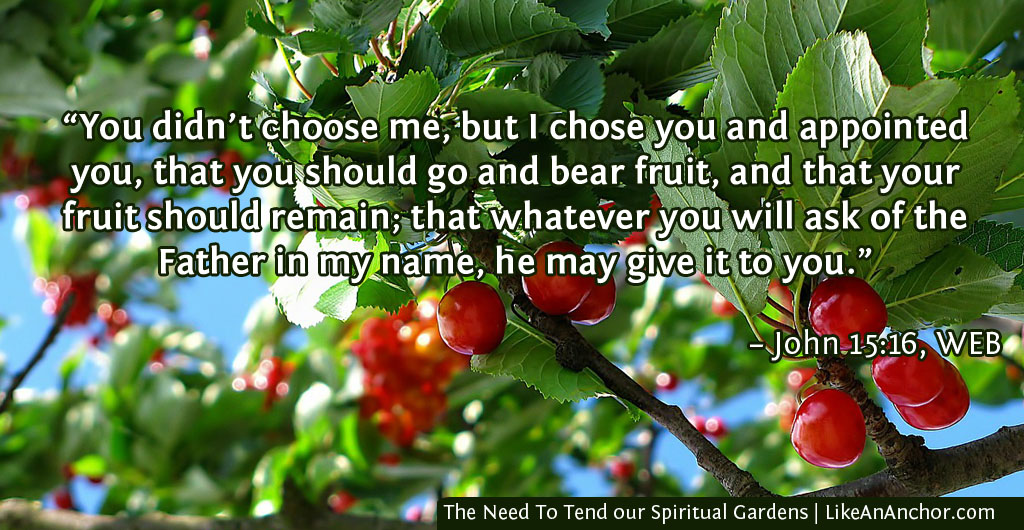
“Remain in me, and I in you. As the branch can’t bear fruit by itself unless it remains in the vine, so neither can you, unless you remain in me. I am the vine. You are the branches. He who remains in me and I in him bears much fruit, for apart from me you can do nothing.” (John 15:4-5, all quotes from WEB translation)

This is the first principle of spiritual growth. There are things we can and should be doing to grow God’s gifts and bear fruit for His glory. But the best efforts on our part will accomplish nothing if we are not firmly attached to Christ. Without Him, we’re like plants that have no root system. We can’t grow unless we’re abiding in Him. “Being filled with the fruits of righteousness” only comes “through Jesus Christ, to the glory and praise of God” (Phil. 1:11). Read more

How Do I Know If I’m an INFJ or an INTJ?

After someone learns about Myers-Briggs® types and starts taking online tests, one question that often comes up is how to tell the difference between two similar types. Maybe the tests you took gave you a couple different results. Or maybe you started reading about the types and discovered more than one sounds a lot like you. If you’re trying to decide whether you’re more of an INFJ or an INTJ type, I hope this article will help.

I’m an INFJ and my sister is an INTJ, and we’re both fairly typical examples of our types. Looking at the two of us it’d be almost impossible not to tell the difference between our personalities. But there’s also a huge amount of similarities between our two types — especially for what’s going on inside our heads and also how we respond to stress.

Just looking at the names of these personality types, we might think that the only difference is that one’s a Thinking type and the other Feeling. That’s true, but it’s not the full story. When we dive deeper into the cognitive functions that describe the mental processes each Myers-Briggs® type uses, it becomes easier to see the differences and similarities between these types more clearly. If you’re not familiar with cognitive functions, click here to read “The Simplest Guide to Myers-Briggs® Functions Ever.” INFJ and INTJ share the same Intuitive and Sensing functions, but have different Thinking and Feeling functions, as shown in this graphic:How Do I Know If I'm an INFJ or an INTJ? | LikeAnAnchor.com

The way these cognitive functions work together makes INFJs and INTJs very different in certain ways and very similar in others. The two types can often find lots of common ground and make great friends. And there are also several key differences in how they approach the world that makes it possible for us to tell them apart. Read more

The Need to Tend Our Spiritual Gardens

Suppose you and your neighbor were to plant a vegetable garden. One of you put the plants and seeds in, watered them once, then stepped back to let it all grow naturally. The other watered and weeded diligently, trimmed where needed, staked up the vines, and poured time and attention into the garden. The first will have a small harvest, if any, from plants choked by weeds and eaten by bugs. The second will enjoy a bountiful harvest of tasty, healthy vegetables. That’s the analogy Gary Thomas uses in his book Sacred Pathways to talk about growth in the Christian life.

“Some of us live with the mistaken impression that our faith needs only to be planted, not tended. Becoming a mature Christian, some think, is like becoming six feet tall — it either happens or it doesn’t. This is not the view of those who have written the classics of our faith or the view of the writers of scriptures (see, for example, Philippians 2:12-13; 1 Timothy 4:15-16; James 1:4; 2 Peter 1:5-11).” — Gary Thomas, Sacred Pathways, p. 232

The Bible is full of talk about spiritual growth and fruitfulness. We can’t do anything to earn salvation or accomplish reconciliation with God on our own — that only happens through the work of Jesus Christ. But once He gives us the precious gift of salvation He expects us to do something with it. That “something” can be summarized as “grow.”

Growing Your Gift

Examples of God’s expectation for growth are found in the parables of the talents and of the ten pounds. A lord goes to a far country, entrusting great wealth to his servants. When he returns, every servant who increased their gift (no matter by how much) is praised as “good and faithful,” and welcomed into the lord’s kingdom. There’s one servant, though, who did nothing with their gift except hide it. It sat in the ground, useless. This servant is the only one who is not praised. The lord actually takes their gift away and then casts them out (Matt. 25:14-30; Luke 19:11-27).

I honestly don’t see how people can read the Bible and still teach “once saved, always saved.” It is true that no one has the power to take you away from God (John 10:28-29), but you can reject God’s gift, or continue in sin without repenting, or neglect to use and grow what He’s given you (Heb. 10:26-31; Gal. 5:16-21; Matt. 18:21-35). Even the Apostle Paul didn’t think he could sit back and relax, assured that he’d get eternal life no matter what he did post-conversion (Phil. 3:11-14; 1 Cor. 9:27).

If we choose to do things that separate us from God and don’t then come back to Him and ask for forgiveness, we could miss out on the kingdom. God tells us how to get there and He even died to make it possible. He very much wants us to accept, use, and grow the gift He’s given us. But He won’t force us to.

The Need To Tend our Spiritual Gardens | LikeAnAnchor.com
Photo credit: J Garget via Pixabay

Tending To Your Salvation

Talking about how God can take back gifts which He gives (a Biblical idea that’s found right there in the Jesus’s parables) is not designed to make us live in a state of uncertainty and terror, wondering if we’re “really saved.” Paul clearly didn’t think he should live in despair and doubt because he hadn’t yet attained the end goal of a Christian life. On the contrary, it motivated him to keep growing and striving to follow God.

God doesn’t really ask much of us when you boil it all down. Just the things needed for a good relationship. Love Him. Respect Him. Abide by the boundaries He sets. Apologize if you do something to wrong Him. Use the gifts He’s given you instead of setting them aside like they don’t matter.

So then, my beloved, even as you have always obeyed, not only in my presence, but now much more in my absence, work out your own salvation with fear and trembling. For it is God who works in you both to will and to work, for his good pleasure. (Phil. 2:12-13, all quotes from WEB translation)

Salvation is something Jesus accomplished once for all humanity, and He is the only path to eternal life (Heb. 9:12; 10:11-12; Acts 4:12). Salvation is also a life-long process that we’re involved with as God works in and through us.

Be diligent in these things. Give yourself wholly to them, that your progress may be revealed to all. Pay attention to yourself and to your teaching. Continue in these things, for in doing this you will save both yourself and those who hear you. (1 Tim. 4:15-16)

Paul isn’t telling Timothy that he can save himself or his congregants in the same sense that Christ saved us. But he is pointing out that we are involved in the ongoing aspects of salvation. To return to the garden analogy, people can plant and water spiritual gardens but only God can make them grow (1 Cor. 3:6-9). We’re expected to work on growing, but God’s the one who makes all that growth possible.

The Need To Tend our Spiritual Gardens | LikeAnAnchor.com
Photo credit: congerdesign via Pixabay

Producing Fruit to Glorify God

Paul describes us in 1 Corinthians as “God’s farming.” In Romans, he uses another agricultural analogy by describing the people of God as trees with grafted branches. Israel is God’s olive tree, and when He opened salvation up to a wider group of people it was like He “grafted in” branches from wild olive trees. As the farmer, God is allowed to graft in or prune out as He pleases. He can even graft people back in after they’ve been cut out so long as they repent and turn back to Him in sincerer belief (Rom. 11:16-24). And we get to play a role in whether or not we stay grafted in.

“I am the true vine, and my Father is the farmer. Every branch in me that doesn’t bear fruit, he takes away. Every branch that bears fruit, he prunes, that it may bear more fruit. … I am the vine. You are the branches. He who remains in me and I in him bears much fruit, for apart from me you can do nothing. If a man doesn’t remain in me, he is thrown out as a branch and is withered; and they gather them, throw them into the fire, and they are burned.  … In this my Father is glorified, that you bear much fruit; and so you will be my disciples. (John 15:1-2, 5-6, 8)

In another place, Jesus tells us that we will know false prophets by their fruits. We can discern whether or not someone is trustworthy by how they live and the fruits they produce. God applies the same logic to us; He knows us by our fruits (Matt. 7:17-23). And we are warned, like the people John the Baptist preached to, “every tree therefore that doesn’t produce good fruit” (e.g. “fruits worthy of repentance”) “is cut down, and thrown into the fire” (Luke 3:7-9).

The Need To Tend our Spiritual Gardens | LikeAnAnchor.com
Photo credit: Jiří Rotrekl via Pixabay

God Is Eager To Help Us Grow

Now, don’t go thinking all this talk of pruning and burning is happening because God doesn’t like us or wants to terrify us. He’s not up there waiting for any excuse to wack us out of the Vine. On the contrary, these things serve as a warning so that we’ll understand exactly how important it is that we stay close to Jesus Christ (the source of our life, as the roots that feed a plant) and commit to living in a Godly way (having a character that produces spiritual fruit). So long as we make even the tiniest effort, God is ready and eager to facilitate our growth.

Consider the lilies, how they grow. They don’t toil, neither do they spin; yet I tell you, even Solomon in all his glory was not arrayed like one of these. … Don’t seek what you will eat or what you will drink; neither be anxious. … But seek God’s Kingdom, and all these things will be added to you. Don’t be afraid, little flock, for it is your Father’s good pleasure to give you the Kingdom. (Luke 12:27, 29, 31-32)

The Need To Tend our Spiritual Gardens | LikeAnAnchor.com
Photo credit: Delynn Talley via Pixabay

One of the key characteristics of God’s kingdom is that it grows (Luke 13:18-21). And we’re invited to be a part of that. Seek Him. Grow with Him. Keep adding to your faith moral excellence, knowledge, self-control, perseverance godliness, brotherly affection, and love (2 Pet. 1:5-8). Produce fruit of love, joy, peace, patience, kindness, goodness, faith, gentleness, and self-control (Gal. 5:22-23).

One of the most encouraging studies I’ve ever done (for me at least) was on how God talks about human perfection. So long as we’re growing toward the goal of being perfect, as He is perfect, He treats us as if we’re already there. We don’t have to get everything right all the time or worry we’re not good enough. The only way to fail is to not even try. So long as we put effort into tending our spiritual gardens and do not neglect the gifts He has given us, God will make certain that we live abundant, fruitful lives that lead to the best eternal outcome.


Featured image credit: Dean Moriarty via Pixabay