Have a blessed Feast of Pentecost/Shavu’ot my friends!

Finding our true selves in the people God created us to be
Have a blessed Feast of Pentecost/Shavu’ot my friends!
In Genesis 29, we’re briefly introduced to a woman who plays a key role in Biblical history. Though she is largely overlooked, her legacy shaped the religion we now call Christianity in fascinating ways.
Now Laban had two daughters: the name of the elder was Leah, and the name of the younger was Rachel. Leah’s eyes were delicate, but Rachel was beautiful of form and appearance. (Gen 29:16-17)
The matriarchs of Genesis see themselves as filling their godly role when they have children who grow up to play key roles in Biblical history. These women are heroes of motherhood as well as of faith. They have their own speaking lines, personalities, and relationships with God, but they’re typically remembered in terms of the children they raised.

Leah mothered 6 of Jacob’s 12 sons, as well as the only daughter recorded for any patriarch. Her sons Levi and Judah were the ones God used to found lines of priests and kings. Though the story of Rachel and her son Joseph overshadow the other sons in Genesis, kingship and priesthood play a huge role in God’s plan and there’s much we can learn from Leah’s take on the birth of her sons. Read more

I was only planning to read female authors from my Classics Club list this year (since they’re having their Women’s Classic Literature event), but a recent film trailer took me back to Tarzan of the Apes (1912) by Edgar Rice Burroughs. When I first read Tarzan as a young teen, “with the noble poise of his handsome head upon those broad shoulders, and the fire of life and intelligence in those fine, clear eyes” he became one of my (many) literary crushes (Chapter XIII).
While he was “muscled as the best of the ancient Roman gladiators … yet with the soft and sinuous curves of a Greek god,” what impressed me most was that Tarzan taught himself to read from books he found in his human parents’ cabin. He could read and write fluent English by the age of 18, even though the only other language he had any experience with was the limited vocabulary of the fictive “anthropoid apes” who raised him. By the end of the book, he speaks fluent French as well. I consider myself reasonably intelligent, had the advantage of not being raised by apes, and I haven’t even managed to become bi-lingual.

Yet shadowed by these descriptions of a super human Tarzan is a disturbing form of racism. Racism is evident from the moment the first black characters appear in the story, yet it goes far deeper than a matter of antiquated ideas about race popping up in the way a Classics author writes descriptions. Burroughs’ racism in Tarzan represents a mindset heavily influenced by evolutionary ideas about biology and race. Read more
I’m borrowing the title for this post from a sermon I heard last month. The speaker said “Does my personal example matter?” was a question Google didn’t have an answer for, and he was right — searching this phrase only turns up results on “personal matters” and “personal opinions.” Searching for “Why is it important to set a good example?”, though, turns up some interesting results. On the first page, you’ll see articles on parents setting a good example for children, leading by example in the workplace, and the importance of role models. Clearly, there are those who believe your personal example does matter.
Most of the articles I saw connected setting an example with leadership. Indeed, this is inherent to the English definition of the word “example” (as found on Merriam-Webster.com):
: a person or way of behaving that is seen as a model that should be followed
: one that serves as a pattern to be imitated or not to be imitated
: one that is representative of all of a group or type
In the Greek, we have several words translated “example,” but they build a similar picture to our English idea. Tupos (G5179) means a print, prototype, pattern or model. Hupogrammos (G5261) is something that’s written down so it can be copied. Hupodeigma (G5262) refers to an example, pattern, or representative of a type. Deigma (G1164) means an example, specimen, or sample.
As Christians, we’re called both to follow an example and to be an example.
For to this you were called, because Christ also suffered for us, leaving us an example, that you should follow His steps (1 Pet. 2:21)
This verse is the only time hupogrammos is used in scripture. The word comes from hupo (before/under) and grapho (to write). It paints a picture of a teacher writing out letters and phrases for a student to copy. In effect, Peter is telling us to study and “trace over” the lines of Christ’s life exactly.
We can also learn from the examples of our fellow believers. James tells us to “take the prophets, who spoke in the name of the Lord, as an example of suffering and patience,” and mentions Job as a specific example (James 5:10-11). These and others, like the people in the faith chapter, are positive examples modeling Godly life.
Other examples show us what not to do. Israel’s history was “written for our admonition” and “these things became our examples, to the intent that we should not lust after evil things as they also lusted” (1 Cor. 10:11, 6). Ananias and Sapphira are another example of how we ought not to act. Such examples serve as a model of what happens when we stray from God.
Jesus Christ is the key to knowing which examples to follow. Paul writes, “Imitate me, just as I also imitate Christ” (1 Cor. 11:1). We need to know the example of Christ, follow Him, and check our role models against the pattern He set. Only then will be be able to tell which examples are worth imitating.
I mentioned earlier that setting a good example is connected with being a leader. Everyone in the church has leadership and ministerial responsibilities, though to different extents and in different roles. We’re all part of “a royal priesthood, a holy nation, His own special people, that you may proclaim the praises of Him who called you” (1 Pet. 2:9). Part of this calling involves Jesus Christ making “us kings and priests to His God and Father” (Rev. 1:6). Those are roles of responsibility, roles that people look to for an example.
As we follow the Lord, we can inspire and reach others by our examples, as the Thessalonians did. Paul wrote to them, saying, “you became examples to all in Macedonia and Achaia who believe. For from you the word of the Lord has sounded forth,” and not just locally. Their faith in God “has gone out, so that we do not need to say anything” (1 Thes. 1:7-8). Their example was more effective at preaching than words.
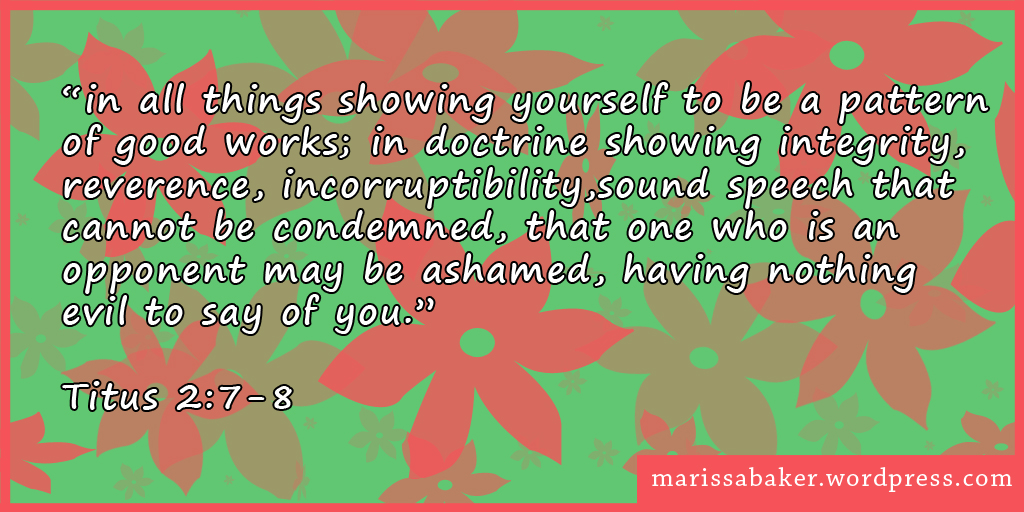
Indeed, we teach by what we do equally (if no more) effectively than by what we say. Writing to a young minister, Paul told him to teach “sound doctrine,” yes, but also to lead by example — “showing yourself to be a pattern of good works; in doctrine showing integrity, reverence, incorruptibility” (Tit. 2:1, 7).
Shepherd the flock of God which is among you, serving as overseers, not by compulsion but willingly, not for dishonest gain but eagerly; nor as being lords over those entrusted to you, but being examples to the flock (1 Pet. 5:2-3)
In addition to patterning an example for other believers, we’re also supposed to be examples of what a Christ-follower looks like.
Let no man despise thy youth; but be thou an example of the believers, in word, in conversation, in charity, in spirit, in faith, in purity. (1 Tim. 4:12, KJV)
No matter our age, ability, gift, or role in the church, we can serve as a representative of the Christian type. We are “the epistle of Christ … written not with ink, but with the Spirit of the living God; not in tables of stone, but in fleshy tables of the heart.” (2 Cor. 3:3). We can be seen, “known and read of all men” (2 Cor. 3:2). Indeed, as some have said, you may be the only Bible some people ever read.
Our example doesn’t just “matter.” It’s powerful. We have the amazing opportunity, and responsibility, to show the world how God’s people are supposed to live — to be Christ’s body as we model His love for our brethren and for everyone on the planet.

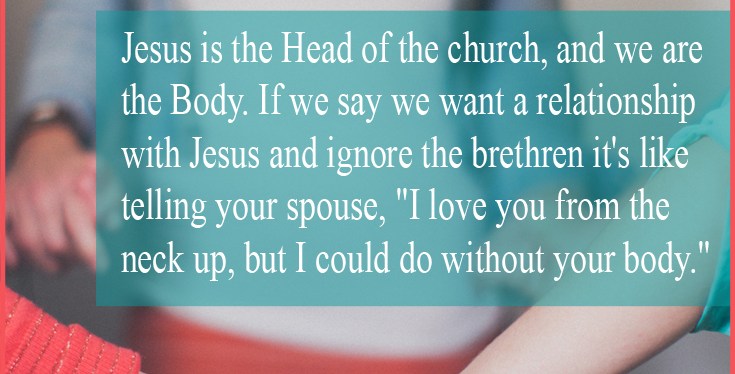
Not too long ago, I heard an analogy on a Christian radio station that stuck with me. It was a pastor trying to convince listeners they need a church to fellowship with. He said that since the church is Jesus Christ’s body and He is the Head, if we say we want a relationship with Jesus and ignore the brethren it’s like telling your spouse, “I love you from the neck up, but I could do without your body.”

This analogy is not an exaggeration. John’s writings make very clear the high value Jesus puts on love among believers. If we can’t love our brethren, we’re actually incapable of loving God. Read more

A couple days ago, we finally got a new trailer for Star Trek: Beyond that felt a bit more like “real Star Trek.” Now, there are Trekkies who will say none of the new films are “real Trek,” but I’m not one of them. Though parts of Star Trek (2009) and Star Trek: Into Darkness (2013) irritated me as a life-long Trekkie, overall I thought they were good stories and I’m nothing but pleased with the cast’s performances of my favorite characters (especially Karl Urban as Doctor McCoy).

I did, however, feel these films were missing a focus that has always been core to the idea of Star Trek. Star Trek’s mission is about exploration, science, new cultures, and ideas. It’s not a space-battle heavy type of science fiction nor was it a “crisis of the week” type of show. It’s much more thoughtful than that. The new movies engaged with ideas of this nature to a certain extent, but they were also fast-paced, explosion-heavy, and largely earth-centric blockbuster films. The first trailer for Star Trek: Beyond made it look like the new film took that to an extreme. It was so bad that Simon Peg admitted he “didn’t love it” and told Trek fans “hang in there, be patient.”
In this new trailer we get discussion about Kirk’s motivation and character. We finally see hints of exploring new worlds, engaging with different cultures, and wrestling with tough ideas. This makes me happy because, at its core, Star Trek is about people trying to do the right thing in complicated situations. Trek should engage with current cultural topics in a unique way. It should support the idea that “good” and “right” are a real things rather than abstract concepts while also acknowledging it’s not always easy to know what’s the good and right thing to do.
Here’s some examples of what I’m talking about. I could list many others (the TNG episode “Measure of a Man,” for one), but for the sake of space I limited it to three episodes. *Spoilers for all episodes below*
Written by science fiction legend Harlan Ellison, “City on the Edge of Forever” is regarded by many as hands-down the finest episode in the Original Series and perhaps all of Star Trek. After Doctor McCoy inadvertently alters earth’s history, Kirk and Spock travel back to the 1930s to repair the time-line, at which point Kirk (predictably) falls for a woman who needs to die for history to play-out as it should. Edith Keeler is a social-worker who runs a soup kitchen and seeks peace for the entire planet. In the correct timeline, she dies in a car accident. If Doctor McCoy saves her life, her peace movement delays U.S. involvement in World War II.

Kirk is the product of a society with the type of peaceful, one-world government Edith dreams of and fights for. He agrees with her ideologically, but he also knows that if she lives Germany’s victory prevents the formation of his unified future-earth. The whole episode grapples with the ideas of responsibility and accountability. Letting someone die is wrong, but letting a planet’s future die would also be wrong. Which is the lesser evil? Can we allow one personal tragedy in order to prevent a global catastrophe? Those are questions we’re still wrestling with today.
While not one of my favorite episodes, “In the Pale Moonlight” is a good example of what we’re talking about today. The story is set during the Dominion War, and the Federation is losing. To borrow from Memory Alpha’s description, “Captain Sisko enlists Garak’s help to ‘persuade’ the Romulans to join the Federation/Klingon alliance to win the war. Sisko unwittingly learns that to save the Federation, he may have to sell his soul and the values Starfleet stands for.” Sisko, and the audience, wrestle with the question of how far the “good guys” can or should go to win a war. He begins with “good intentions,” but they’re the sort that proverbially pave a road to hell.

As the plan becomes ever more complex, he moves from spying, to fabricating false evidence, to paying off dangerous criminals with the ingredients for biogenic weapons, and finally he becomes complicit in an assassination. But Sisko hasn’t gone off the deep end — he simply came up with a plan, received approval, and kept moving forward with sanction from the Federation. Though the assassination wasn’t part of the original plan, there aren’t any repercussions for it. Romulus declares war and the Alpha quadrant is saved. Mission accomplished. But not without great moral wrestling. The episode ends with Sisko staring into the camera ending his personal log with the words, “So I will learn to live with it…Because I can live with it…I can live with it.”
Star Trek Continues really feels like a 4th season of the Original Series, and it continues Star Trek’s rich history of dealing with complicated ethical questions and current cultural issues. In this episode (click to watch), the Enterprise rescues a frightened Orion slave girl from a damaged ship. Having been taken from her family and enslaved, Lolani’s situation is very much akin to trafficked victims here on earth. You might think freeing her is the obvious, moral thing to do, but Star Trek is never simple. The episode wrestles with other issues as well, such as whether or not Lolani’s victimization can excuse her crimes and to what extent Kirk and his people can legally help her.

Since the Orion system isn’t part of the Federation and their law demands any slaves found revert to Orion control, the Federation insists Kirk return Lolani rather than risk an international incident. Kirk initially complies, then chooses to rescue her in violation of Starfleet orders. Before he can, Lolani kills herself and her master by destroying the ship. It’s too late for his change of heart to help; for his moral core to over-ride his nation’s law. That saves the Federation from war with the Orions, but what does it do to Kirk’s soul?
I’m hoping Star Trek: Beyond and the new series coming next year continue Trek’s history of tackling complex ideas, pushing us outside our cultural comfort zones, and looking at issues and ideas from multiple angles. I want more stories that make us think while they’re entertaining us.
 Like An Anchor