Walking by Faith (and next e-book announcement)

I just got back yesterday from an incredible  service-themed Young Adult weekend. It didn’t start out all that well for me, though. The day before I left I started feeling nervous (which is normal for me going into social events) but then by the time I left on Friday I had a shaking-crying-hyperventilating panic attack (which is becoming less and less normal/frequent for me).

I was really caught off-guard by this. I knew several people there — not just as acquaintances, but as friends — and I’d been eagerly looking forward to this event for weeks. I chalked it up to my too-active imagination combined with uncertainty about Friday evening’s schedule, breathed deep, prayed, turned Fallout Boy up, and started driving …

… and hit heavy traffic and rain (my two least favorite things to drive in). That left me running 20 late to met the people I was supposed to be car pooling with to the house I didn’t have an address for. Thankfully, one of the people I was meeting is also one of only 2 out of 100+ people at the weekend with my phone number, and he texted me the address. I proceeded to enter said address in my GPS and it took me to a house with no cars in the driveway.

It is either a testament to my stupidity or my faith that I walked up and rang the doorbell. Turns out, my friend accidentally sent me to another church member’s home (whose name I recognized, though I’d never met them) and they fed me cheese, gave me the correct address, and sent me on my way. Oddly, that’s when I felt a sense of peace for the first time all day. I was late, I was temporarily lost and yet God showed me that these worries coming true weren’t anything He couldn’t handle.
Walking by Faith | marissabaker.wordpress.com
photo credit: Dan4th Nicholas, CC BY via Flickr

Saturday brought a great round of seminars and an excellent sermon on foot washing and Passover. Nothing to worry about, until game night happened. I’m sure I’m in the minority judging by how many people said they had a wonderful time, but any sort of game that involves doing something in front of other people or in a group or on a team makes me intensely uncomfortable, especially if you add competition. The first two games were mixers where you asked someone a question and their name. I literally remember nothing from meeting people this way (does it even count as a “meeting” then?). Next was that game where you tie a balloon to your ankle and try to keep it from getting popped while popping everyone else’s balloon. I could have kissed whoever it was that popped my balloon the moment the game started.

That’s the last game I “played” (I stepped on my own balloon when they started round two) and I thoroughly enjoyed the rest of my evening talking with two other people who saw no appeal in participating. Give me a deep conversation with someone over competitive and/or rambunctious games any day. Now that’s how to meet new people. (Side-track back to the topic of social anxiety: game night continued throughout my conversations and there was a Bag of Doom from which they were drawing names to participate in a novelty challenge which you had to do while standing in the center of a room surrounded by 80-something people watching you. Can anyone say “introvert’s worst nightmare”?)

I think one of the biggest lessons I learned this weekend was that my fears were either 1) groundless or 2) didn’t have the power to hold me back. The fact that I had a panic attack before leaving turned into a blessing because it gave me the choice between either canceling my plans or praying through it and trusting God. I chose the later, and I kept encountering situations that could make me feel nervous and which reminded me to stay in prayer all weekend. Every single one of the things I was worried about worked out for the best, and the only part of that I can take credit for is that I took the step to go to the weekend and start a few conversations. The rest was all God.

This brings us in a very round-about way back to the topic of the weekend — service. Specifically, “Unlocking Your Desire To Serve.” As many of you know, I consider this blog a sort of ministry and it’s been growing in ways that amaze me and make me want to do more. One of the big things that holds me back is my own fears, including my fear of panicking when it’s important that I talk with people about my faith. So for me, blending this weekend’s focus on service with a need to rely on God for help working through my anxiety was a powerful experience.

  • If you gave up reading that long rambling post and started scrolling, here’s the e-book announcement:

Something I haven’t shared with many people is that in my local Messianic congregation I’ve been receiving words, prayers, and hints from brethren for the last several months along the lines of “God’s going to do something big in/with your life soon.” I even finally have a hint as to what that might involve after I came back from services a few weeks ago with a title for an e-book in my head which I promptly sat down and outlined. I’ve barely worked on it since, but this weekend was exactly what I needed to reconfirm that God wants me to be sharing my gifts through writing and that He’s more than capable of overcoming deficiencies on my part.

My first step is officially announcing the project here on this blog. The working title is “Rise Up, My Love” and the focus will be on reigniting the church’s passion for God (so, basically this blog in book form). I’m not committing to a release-date quite yet (it would be lovely to have it out by Sukkot/Feast of Tabernacles this fall, but I think a full year might be more realistic judging by how long it took to write The INFJ Handbook). I’ll keep you posted on details.


Why Do We Keep The Passover?

Happy New Year! Today is the first day of the Hebrew month Nisan (also called Abib), and the first day of the sacred year on the Hebrew calendar (Rosh Hashana starts the civil year). This means Passover is exactly 14 days away. As we draw nearer this important holy day, I wanted to shift our focus onto why Passover is so important for Christians today.

As I started thinking about reasons to keep Passover, I realized I’d either have to make this a series of posts or be much more concise than the subject deserves. Instead of a series (though there will be other Passover posts coming up), I decided to just write a brief overview of some reason to keep Passover and then invite you to join me in exploring them further. If this post inspires any of you to study Passover, I hope you’ll share your thoughts in the comments. And if you write a blog post about Passover, please share a link here so we can all read it.

Why Do We Keep The Passover? | marissabaker.wordpress.com
photo credit: “Remember this day…” by Tim Sackton, CC BY-SA

It’s A Command

Exodus chapter 12 describes the events of the first Passover in Egypt, when the children of Israel were protected from the plague that killed all Egyptian firstborn. After delivering instructions specific to that Passover, the Lord reveals that Passover celebration will continue forever among His people. Read more

Not Wanting To Write

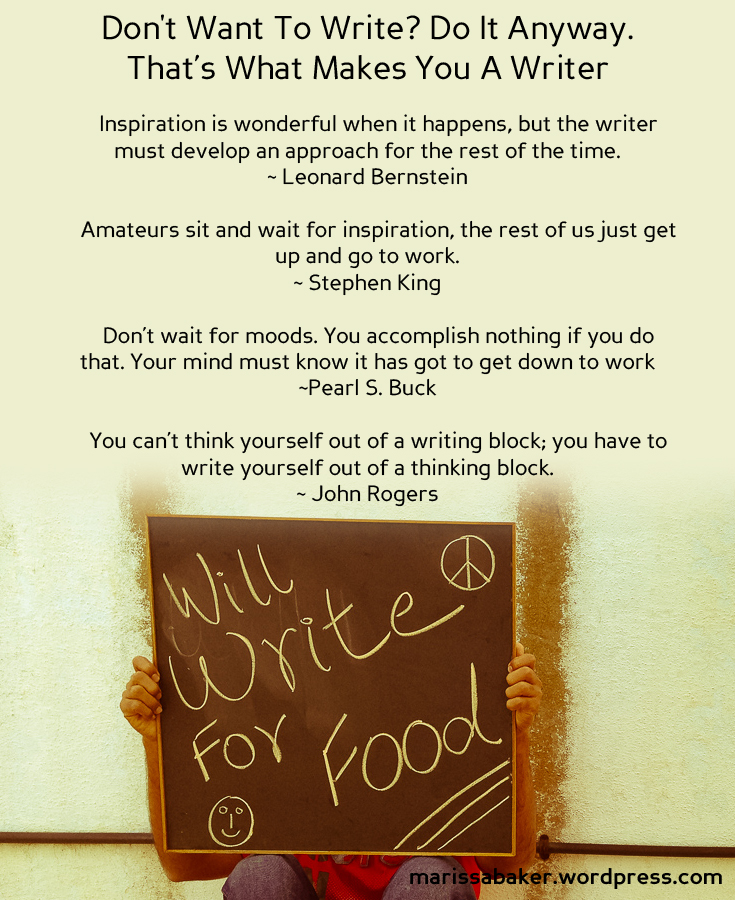
It’s about 4:30 in the afternoon Sunday as I write this. Usually by this time I’m either proof-reading a completed post for Monday or wrapping-up my work on a finished idea. What’s worse, I don’t even I care that haven’t written a post yet. I mean, I’d probably care tomorrow when I wake up and realize I failed all of you readers, but at this point I’ve had too little sleep and too much Netflix to function as my normal self.

Well, perhaps not entirely. At least I’m writing about not wanting to write. It’s a start. I’ve been writing professionally long enough to know you can’t just sit around waiting for inspiration to strike if you want to get a blog post, article, story or book written. People who do that aren’t writers.

Not Wanting To Write | marissabaker.wordpress.com
photo credit: “Content writer” by Ritesh Nayak, CC BY-SA via Flickr

If you aren’t a writer you can get away with not writing when you don’t want to. Hobbies and pastimes are voluntary. But when writing is what you do you don’t just stop. In fact, if you’re doing things right, most of the time it feels like you can’t stop writing. For writers, not-writing should feel stranger than writing.

There’s a myth out there that writing is easy (“Oh, so you’re a writer? That’s cool. I might write a novel in my spare time some day”). It’s not. Yes, there will be days when the words flow out and you’re convinced what you’re writing is pure genius and you just know these words have the power to touch people’s souls. But mostly you have to sit down everyday with your pen or your laptop or your typewriter and make the words move from brain to fingers.


Struggling to write is perfectly okay just so long as you don’t give up. I suppose it’s that way with most things, actually. Anything worth doing is going to be hard at some point. What’s important is that we don’t stop, at least not for long. By all means take a break, eat a little chocolate and watch some anime (my sister hooked me on Fullmetal Alchemist Brotherhood), but don’t stay there.

It’s about 7:30 in the afternoon as I finish writing this. Look at that — we’ve got a finished blog post, even with the distractions of searching for quotes about writing and playing Star Trek Online. And you know what? I think I just might keep writing. My short story collection needs one more story, and there’s a character named Taline just waiting to be discovered …


Seeking The Lord

What should your heart be set on once you give your life to the Lord? Is it keeping the commandments? going to church? an active prayer life? acts of service? Those are all good things, but they should be a side-effect of our primary focus. In other words, they’ll happen because we want to keep the Law, fellowship with other believers, pray, and serve when our hearts are in the right place.

Seeking The Lord | marissabaker.wordpress.com
picture credit: “Pearls” by FergieFam007, CC BY-SA via Flickr

In Christopher West’s book Fill these Hearts, he quotes mid-twentieth century artist and writer Caryll Houselander as saying, “If instead of using the expression ‘spiritual life’ we used ‘the seeking,’ we should set out from the beginning and go on to the end with a clearer idea of what our life with God will be on this earth” (56). Our conversion isn’t a static state. It’s a continuous search for closeness with God. Read more

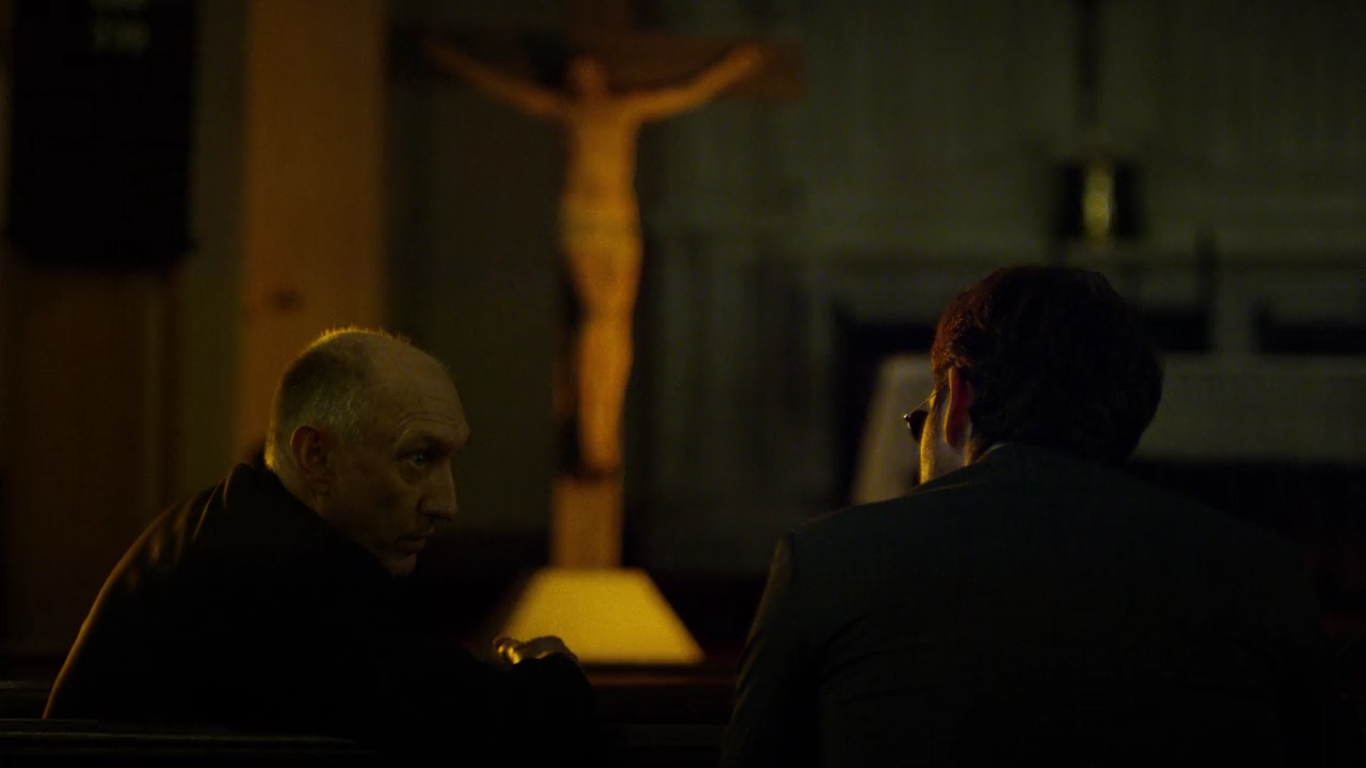
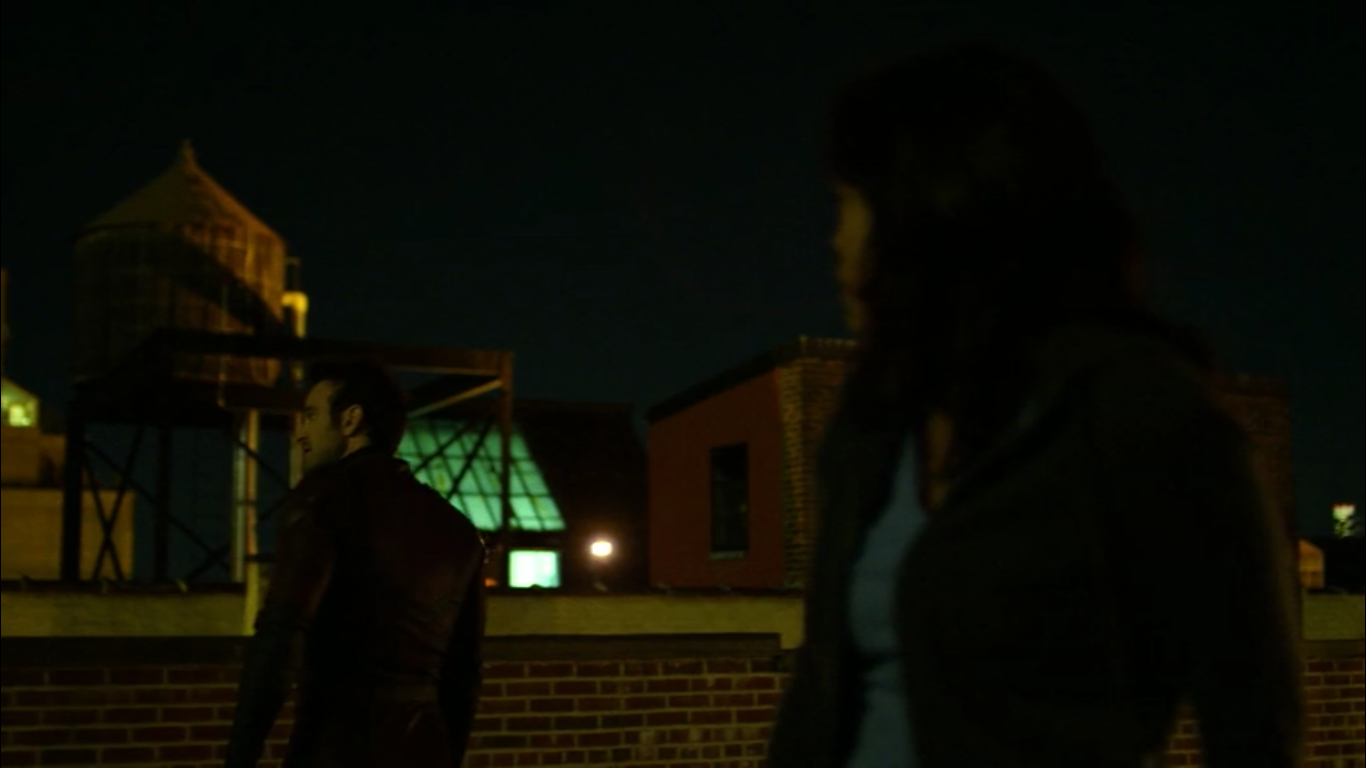
Wrestling With Faith: Religion in Marvel’s Daredevil

Before Daredevil premiered on Netflix in April of last year, the closest Marvel’s Cinematic Universe came to portraying a superhero of faith was Captain America’s line, “There’s only one God, ma’am, and I’m pretty sure he doesn’t dress like that” in The Avengers three years earlier. As much as I like and admire Steve Rogers as a character, however, I’m not sure I’d describe him as a man of faith. Certainly he’s a moral man who believes in God, but his faith doesn’t play a major role that we can see on-screen.

Matt Murdock (played by Charlie Cox), on the other hand, is a character defined by his faith. The way he’s portrayed in the Netflix series leaves no doubt that Matt is a staunch Catholic and that his faith influences every decision he makes. The religious elements don’t make Daredevil any less violent (this is not a show for children or squeamish adults), but the series’ engagement with religious themes does make it one of the most intriguing things on screen right now.

Wrestling With Faith: Religion in Marvel's Daredevil | marissabaker.wordpress.com

It’s rare to see a character portrayed as unabashedly Christian in today’s culture, at least outside of films produced by a faith-based group such as Sherwood Pictures. It’s even rarer to see a man of faith cast as the hero of a gritty drama. Yet Matt Murdock is a practicing Catholic who proclaims his belief on-screen, as well as a seriously impressive superhero.

Quick note: I’ll be honest, I don’t know all that much about Catholicism. I’ve known Catholics and counted several my friends, read a few books written by Catholic authors (both fiction and non-fiction), and encountered some facts about Catholicism in studying British history, but I wouldn’t really consider myself knowledgeable on the subject. If you’re reading this as a Catholic and I say something stupid, please correct me with love in the comments 🙂

Quicker note: this article contains spoilers for both seasons of Daredevil. Spoilers for Season 2 will be clearly noted.

To Kill, or Not To Kill

Everything about Matt’s choices is influenced by his Catholicism. He won’t kill because he firmly believes it is morally wrong. That is explored strongly in the first season, when we learn Matt refuses to kill his enemies and tries his best to prevent others, including his allies, from killing as well. It’s back again in the second season when

SPOILER WARNING

we learn in flashbacks that Matt’s college romance with Electra ended after she asked him to kill the man who murdered his father. A few episodes later, we find out that she has a mission to pull Matt away from the faith that was, in part,why he’s not still fighting alongside Stick. It didn’t work. Matt wasn’t a perfect enough Christian to say no to premarital sex or to leave Electra when she was stealing cars and breaking into people’s houses, but his faith runs too deep for the possibility of murder to not act as a wake-up call.

(end spoilers)

Unlike Batman, who doesn’t (typically) kill because it’s part of his crime-fighting code, Daredevil doesn’t kill because it’s part of his faith. The only way he would consider breaking the law of God that prohibits murder is if he thinks sacrificing his soul would save enough people to make it worthwhile. That’s why he considers killing Wilson Fisk near the end of Season 1. “I know my soul is damned if I take his life,” Matthew says, “But if I stand idle” people “will suffer and die.”

Wrestling With Faith: Religion in Marvel's Daredevil | marissabaker.wordpress.com
Daredevil S1, E9

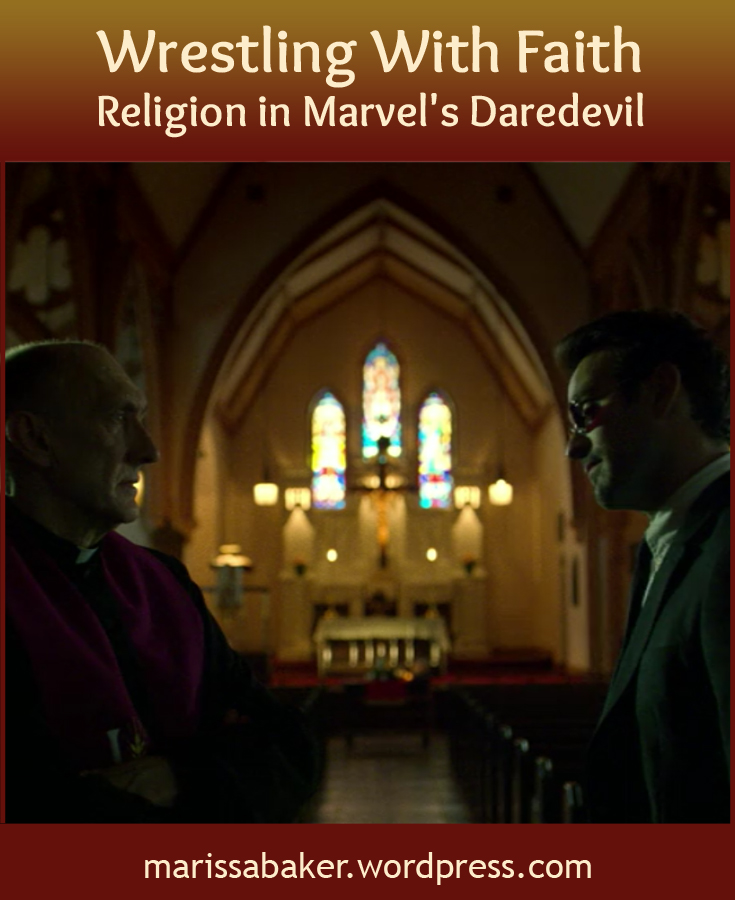
For most action heroes, there wouldn’t even be a question of what to do — you just go out and kill the bad guys. Matt, however, cares about what taking another person’s life says about him. He doesn’t take this question to his bartender or girlfriend though (as an equally introspective but less religious character might). He takes it to his faith in the form of his priest, Father Lantom, who reminds him, “There is a wide gulf between inaction and murder, Matthew. Another man’s evil does not make you good. … the question you have to ask yourself is are you struggling with the fact that you don’t want to kill this man, but have to? Or that you don’t have to kill him, but want to?”

A Question of Motive

In the same conversation where Father Lantom talks with Matt about whether or not Matt should kill Fisk, he also says, “Few things are absolute, Matthew. Even Lucifer was once an angel. It’s why judgment and vengeance… are best left to God. Especially when murder is not in your heart.” When Matt asks how Lantom can know what’s in his heart, the priest responds, “You’re here, aren’t you?” The fact that Matt wrestles with how his faith fits into his mission to fight for justice is one thing that proves he’s a good man. Our motivations matter.

Matt works as a lawyer by day trying to right wrongs within the system, then goes out at night as Daredevil trying to bring justice to the people who were overlooked by the law. In the first episode of Season 2, Matt tells Foggy that the woman they helped as lawyers by recommending a battered women’s shelter would have been murdered by her husband before her escape if Daredevil hadn’t put the man in a hospital. Daredevil goes around fixing the problems that Matt Murdock can’t.

An article that appeared on Slade.com last year said Netflix’s Daredevil understands that Matt’s religion is “essential to his identity … which is what makes the show work.” The article continues, “Murdock’s brutal justice is more than his way of taking personal responsibility for the sins of others; it’s his way of atoning for his own. Murdock’s real superpower, and also his biggest foe, is his Catholicism” (from “Daredevil’s Greatest Superpower Is His Catholicism“). Matt’s religion is what drives him to fight for justice, yet it’s also what makes him question himself at every turn.

Guilt and Redemption

Throughout his crusade, Matt punishes himself as much as the people he’s after. In “Daredevil, Catholicism, and the Marvel Moral Universe,” Leah Schnelbach connects this with “mortification of the flesh.”While Matt Murdock does qualify as a powered-person in the MCU, his powers don’t give him fast healing or make him invincible. To fight evil, “He has to keep getting hit, keep getting wounded. Over the course of the show, we see this process–old wounds reopen, cuts heal slowly, bruises linger, and each fight seems more labored. … The point is that he keeps going anyway” (click here to read the full article). Matt’s only partly joking when he responds to Claire describing him as “blind vigilante who … can take an unbelievable amount of punishment without one damn complaint” by saying, “The last part’s the Catholicism.”

Wrestling With Faith: Religion in Marvel's Daredevil | marissabaker.wordpress.com
Daredevil S2, E10

Mortification of the flesh is a concept very much tied to penance in the Catholic version of Christianity. It’s referenced even more clearly into Daredevil in Season 2, again by Claire (mild spoiler warning). Matt’s beating himself up (metaphorically, this time) for not saving a group of people soon enough. She suggest he take off his “hair shirt” and “start thinking about climbing down off that cross of yours and spending some time with us normal people for a change.” The idea of Matt martyring himself is a theme throughout both seasons.

MAJOR SPOILER WARNING

One of the aspects of Season 2 I found most interesting was the association of Matt with Jesus Christ. He’s not portrayed as a “Christ-figure” per say, but there’s more going on here than just Claire’s overt reference to Matt crucifying himself. Much like I argued when talking about Luke and Vader in Star Wars, we can compare Matt’s insistence that redemption is possible for Electra to God “not wishing that any should perish, but that all should come to repentance” (2 Pet. 3:9, ASV). While Matt is willing to die for her, what’s more poignant is that he’s willing to sacrifice himself by living for her.

I struggled with this scene in the final episode. Why would Matt give up everything he’s working for in Hell’s Kitchen to run away with such a morally dark character as Electra? Upon further reflection, I realized he didn’t intend to abandon his faith by offering to take this action. While being with Electra does bring out the “devil” side of him, he’s not offering to run off with Electra just so he can be free of responsibility or guilt. He wants to do this because of his stated reason — that she “gets” the part of him that no one else understands — and because of the redemption theme running through this season. He has to believe Electra can be good and he’ll give up his own life to help make that possible.

(end spoilers)

Matt’s not a perfect Christian or a perfect Catholic. Some might even question whether or not he qualifies as a “good man” after putting so many people (criminals, yes, but still people) in the hospital. Where do we draw the line? and what is the responsibility of a moral man confronted with evils that he can fight, but isn’t sure at what cost? Those are the sort of questions that Marvel’s Daredevil offers for our consideration. It’s not interested in a sanitized version of Christianity that focuses on faultless people living lives of bliss and, quite frankly, I’m not either. And neither’s the Bible, if the struggles of David, Peter, Paul and so many others are any indication. God never tells us our walk with Him will be without wrestling. It’s how we respond to the crises of faith — the moments where we wonder if all this is worth it — that count.

Save

Courage To Feel

I recently finished reading, and then immediately re-reading, Fill These Hearts by Christopher West. It’s a powerful rebuttal to the lie that Christianity is a joyless religion of laws and suppressed desires. West touches on many points regarding marriage and the plan of God that I hit in my book God’s Love Story, a subject you know is dear to my heart. I could probably write half a dozen posts inspired by Fill These Hearts (I already quoted from it in last week’s post), but here’s the part I want to focus on today:

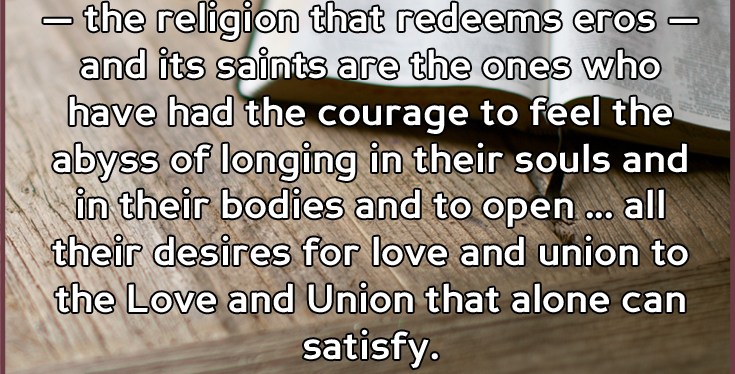
Christianity is the religion of desire — the religion that redeems eros — and its saints are the ones who have had the courage to feel the abyss of longing in their souls and in their bodies and to open … all their desires for love and union to the Love and Union that alone can satisfy. … the saints have learned to open eros (their yearning for love) to Eros (God’s passionate love for them).” (p. 39)

Seeing God’s love described as Eros might make you a little uncomfortable at first (it had that effect on me). Eros is the Greek word for passionate or sexual love. This word doesn’t even appear in scripture, although erotic love is alluded to. The word we usually associate with God’s love — and rightly so — is agape. Read more