Classics Club — The Iliad

I’m not actually all that far behind on my reading for the Classics Club book challenge — I’m just behind on blogging about the books. Right now, I’m halfway through Anna Karenina, and I recently finished Tenant of Wildfell Hall and The Iliad. Since I also have to write about The Iliad for the high school curriculum I’m building (which my brother is trying out this year), that’s the one I wanted to talk about today.

Usually, I like to read something about the author’s history and the time period framing their writings when I explore a piece of classic literature. Unfortunately, we don’t know much about Homer. There’s even debate about whether or not he’s the one who wrote down the epic poems he (probably) composed. The introduction to the Robert Fagles translation seems to lean toward Homer writing his own poems down once the art of writing was reintroduced to Greece, though it’s all “pure speculation.” I suppose in some way the mystery surrounding these texts makes them even more intriguing.

Having once been told by a nihilistic classmate that nothing original has been written since Homer, I was rather curious to finally read The Iliad. While I can’t say I agree with him, it’s not hard to see The Iliad‘s influence on modern literature, and when I get around to reading The Odyssey (also on my Classics list) I’m sure I’ll notice even more themes that show up in modern plot and characterization.

What intrigued me most, though, was the portrayal of women in The Iliad. Though several women have lengthy passages of dialogue (including Helen and Hector’s wife Andromache), and goddesses play a huge role in the plot, they’re all show in some kind of captivity to men. No matter how strong of a character Andromache is, once she loses Hector she has no social position and no hope of avoiding slavery. Paris stole Helen, and she makes no secret of how badly that has affected her and how little she respects him. Other female characters, like Briseis, are already captives in the Achaean camp. Even the goddesses are under Zeus’s power, and his threats toward Hera starting in Book 1 portray an eyebrow-raising level of domestic abuse on Olympus.

The intriguing part is that Homer doesn’t give the impression that this portrayal of women is entirely okay. He does imply it’s “normal” for that time period, but he takes great care to show the womens’ side of the story more than one might expect in a poem mainly about the wars of gods and men. We see goddesses scheming to get around restrictions of the gods. We get plenty of dialogue from Helen, showing that ten years haven’t simply turned her into a submissive or entirely complicit captive even though her inner turmoil is ignored by both Aphrodite and Paris. Even Briseis — the captive Agamemnon steals from Achilles — has a chance to give her side of the story and make sure no one forgets that she (and by extension the other female captives mentioned as spoils of war or offered as prizes at Patroclus’ funeral games) is a human being.

It makes me miss having University access to databases full of scholarly journals — I’d love to read what people who have the time/resources to study these characters better are writing. I did find one interesting article, though: The Portrayal of Women in the Iliad by S. Farron. He says, “Homer had different attitudes from his characters. He knew that women are complete human beings and constantly emphasized how deep and intense their feelings are.” I’d agree with this writer that Homer was trying to craft real characters, not urge social reform, but it’s still intriguing that he realized women were worth writing well. He treated them as real characters with emotions and thoughts that were relevent to the story, which is more than his male characters did.


Click here to get a copy of The Iliad. Please note that this is an affiliate link. This means that, at no additional cost to you, I will receive a commission if you click on the link and make a purchase.

Pointing To Christ

Sukkot/the Feast of Tabernacles is over for another year. We kept the Feast on the East Coast this year, and I’ve come back with collections of new friends, sea shells, and blog pot topics mined from messages we heard.

The Feast pictures Christ’s Millennial reign described in Revelation 20:4 and other prophecies. In this verse, the saints are said to “live and reign with Christ for a thousand years.” Revelation 1:6 and 5:10 describe our role as “kings and priests.” There’s quite a bit of responsibility contained in those roles, but it boils down to one simple task. In the words of a gentleman who spoke on the second day of the Feast, “kings and priests point others to Christ.”

Pointing To Christ | marissabaker.wordpress.com

Kings

When Israel asked for a king, God called it a rejection of Him because they preferred having a physical ruler and military commander to trusting in Him (1 Sam. 8:7, 19-20). This request wasn’t unexpected, though, and God already had guidelines for kings in place. Only a native Israelite could rule (Deut. 17:15), he wasn’t allowed to amass a huge army, or take the people back to Egypt, or marry many wives (Deut. 17:16-17), and he had to write a copy of the law (Deut. 17:18).

And it shall be with him, and he shall read it all the days of his life, that he may learn to fear the Lord his God and be careful to observe all the words of this law and these statutes, that his heart may not be lifted above his brethren, that he may not turn aside from the commandment to the right hand or to the left, and that he may prolong his days in his kingdom, he and his children in the midst of Israel. (Deut. 17:19-20)

Knowledge of God, reverence for Him, obedience, and humility are key qualifications for kingship. The first king, Saul, was chosen because he could lead armies and was humble (1 Sam. 9:16, 21). When he lost that humility and stopped obeying God, he was rejected as king (1 Sam. 15:11, 17).

And when He had removed him, He raised up for them David as king, to whom also He gave testimony and said, ‘I have found David the son of Jesse, a man after My own heart, who will do all My will.’ (Acts 13:22)

To become kings, we must have a heart like the King of kings. God won’t let people rule in His family if they aren’t on the same page as Him. There’s a psalm David apparently wrote for his successor, Solomon, that talks about this.  Psalm 72 points to Messiah’s reign and describes God as a great King, whose example of righteous judgement and commitment to His people lesser rulers would do well to imitate. Kings are supposed to model what Jesus Christ is like, and point to Him by their example.

Priests

When there was a tabernacle or temple standing, priests were always there. Their job was to minister before the Lord and “to bless in His name” (Deut. 10:8). They were also involved in settling judicial disputes, especially in the time before the kings (Deut. 21:5).

One of the primary ministerial responsibilities of the priests involved offering sacrifices. People couldn’t just sacrifice to God anywhere — they had to come to the temple and have a priest present it on their behalf. Today, Christ fills that role of intermediary between believers and God. He has helpers, though, just as the High Priest did in the Old Testament.

Pointing To Christ | marissabaker.wordpress.comyou also, as living stones, are being built up a spiritual house, a holy priesthood, to offer up spiritual sacrifices acceptable to God through Jesus Christ.  (1 Pet. 2:5)

We’re already becoming a priesthood today, and we’ll be doing even more in the future. As priests, we serve and point others to our High Priest, Jesus Christ (Heb. 4:14-5:10). The quallifications for this type of service are very similar to those for a king.

Then I will raise up for Myself a faithful priest who shall do according to what is in My heart and in My mind. I will build him a sure house, and he shall walk before My anointed forever.  (1 Sam. 2:35)

To walk before God’s Anointed, the Messiah, forever, we must tune-in to His heart and mind. We have to follow His lead, teaching others about Him and pointing to the High Priest. Everything we do in any sort of leadership role — now or in the future — is done in service to the King of kings and Priest above all priests. Pointing others to Him is the best thing we can do for the people we’re called to serve.

The Sidney Psalms

I’ve been reading a fascinating book. A wonderful professor introduced me to the writings of Sir Philip Sidney in a 16th Century Lit class, but it wasn’t until I was chatting with a friend about Shakespeare’s influence on the language used in the King James Bible that I remembered Sidney and his sister, Mary Sidney Herbert, Countess of Pembroke, translated the psalms.

The Sidney Psalter contains of 43 psalms translated by Sidney before his death in 1586, which were then edited by Mary when she finished translating the remaining 150 psalms. Though 16th century writers knew the Psalms were poems, it wasn’t until the 18th Century that an English scholar discovered the rules which governed Hebrew poetry. That didn’t stop several writers, including the Sidneys, from trying out translations in meter and rhyme.

According to Hannibal Hamlin (who taught at The Ohio State University and wrote the introduction and notes for the Oxford World Classics edition), the Sidneys stayed close to the original meaning of the psalms and focused their creativity on the poetic form. “The Psalter contains 150 Psalms,” Hamlin writes, “including the 22 sections of the long Psalm 119, and among these 172 poems the Sidney’s repeat only one form (both stanza and meter) exactly.”

I’m so impressed with these translations. They’re the psalms I love, written in a way that reminds me of my favorite Romantic poets (who were undoubtedly influenced by the Sindeys’ writings).

Psalm 23

The Lord, the Lord, my Shepherd is,
And so can never I
Taste misery:
He rests me in green pastures His:
By waters still and sweet,
He guides my feet.

He me revives; leads me the way
Which righteousness doth take,
For his name’s sake:
Yea, though I should through valleys stray
Of death’s dark shade, I will
No whit fear ill.

For Thou, dear Lord, Thou me besettest
Thy rod and thy staff be
To comfort me:
Before me Thou a table settest,
Even when foe’s envious eye
Doth it espy.

Thou oilst my head, Thou fillest my cup;
Nay more, Thou endless good,
Shalt give me food.
To Thee, I say, ascended up,
Where Thou, the Lord of all,
Dost hold thy hall.


Giving God More Than The Leftovers (Lessons from Malachi)

In most Bibles, Malachi is the last book in the Old Testament, leading directly into the Gospels. It’s an intensely personal book where the Lord challenges His people regarding the way they worship Him. This happened some time after the temple rebuilding described in Haggai and Zechariah — long enough for the spirit of revival to wear off and the people to grow lax in their worship.

Malachi’s call to return to God comes before the first coming of Christ, but it’s equally relevant as we wait for His second coming. Like Israel at this time, we could slip into lax, lukewarm worship that doesn’t honor God and won’t qualify us to live in His family.

Honoring God

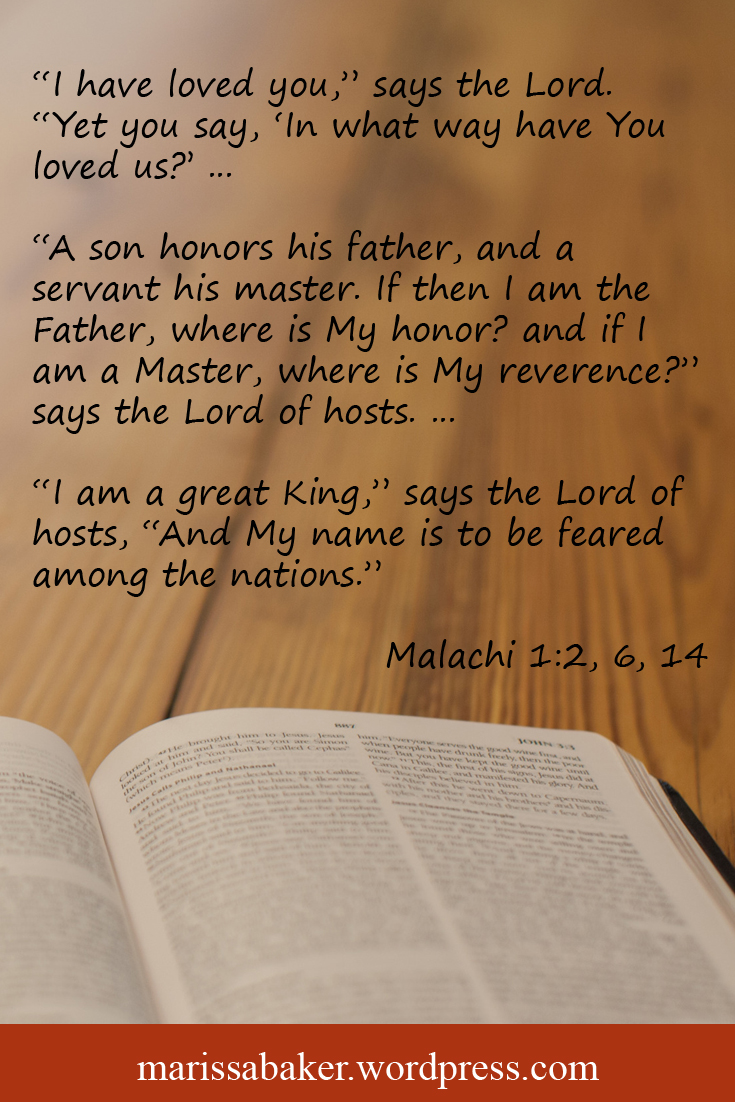
God opens this book with the words, “I have loved you.” He’s writing a letter to Israel, and that’s the first thing He says. The very next thing is Israel’s question, “In what way have You loved us?” (Mal. 1:2). It’s a common, heart-breaking theme in the scriptures — God loves us, but we don’t love Him back and we won’t even admit the problem is ours.

“A son honors his father, and a servant his master. If then I am the Father, where is My honor? And if I am a Master, where is My reverence? says the Lord of hosts to you priests who despise My name. Yet you say, ‘In what way have we despised Your name?’ You offer defiled food on My altar, but say, ‘In what way have we defiled You?’ By saying, ‘The table of the Lord is contemptible.’ And when you offer the blind as a sacrifice, is it not evil? And when you offer the lame and sick, is it not evil? Offer it then to your governor! Would he be pleased with you? Would he accept you favorably?” says the Lord of hosts. (Mal 1:6-8)

When we offer God our time, money, and/or efforts on a level that wouldn’t be acceptable to other humans, we’re demonstrating contempt for God. If you rush through prayer in a way that would be rude if you called up your Dad on the phone, then you dishonor God. If you volunteer to help out with something at church and turn in a performance that wouldn’t be good enough for your boss at work, you dishonor God. He deserves our best, not our leftovers.

You also say, ‘Oh, what a weariness!’ and you sneer at it,” says the Lord of hosts. “And you bring the stolen, the lame, and the sick; thus you bring an offering! should I accept this from your hand?” says the Lord. “But cursed be the deceiver who has in his flock a male, and takes a vow, but sacrifices to the Lord what is blemished — for I am a great King,” says the Lord of hosts, “And My name is to be feared among the nations. (Mal. 1:13-14)

We know from the story of the widow’s mite that God respects sincere offerings, however small. But we also know from the story of Ananias and Sapphira that pretending to give God one thing and then trying to slip in something of lesser value is abhorrent to Him.

Warnings for Priests

Malachi's Message | marissabaker.wordpress.comI think about this when I see a minister stand up in front of his congregation and say he just pulled an old message out of his files for today. A message about one of your old messages, which you freely admit you just cycle through every once in a while, just doesn’t seem like giving God your best. It’s something we all have to beware of — any time we set things we’re doing for God at a lower priority we’ve fallen into a dangerous attitude.

“And now, O priests, this commandment is for you. If you will not hear, and if you will not take it to heart, to give glory to My name,” says the Lord of hosts, “I will send a curse upon you, and I will curse your blessings. Yes, I have cursed them already, because you do not take it to heart.” (Mal. 2:1-2)

These messages to priests can apply to all of us. After all, Peter tells use we’re a “priesthood” being built up to serve God (1 Pet. 2:5, 9). However, the warnings are more serious the more responsibility a person has in the household of God. “For everyone to whom much is given, from him much will be required” (Luke 12:48).

“For the lips of a priest should keep knowledge, and people should seek the law from his mouth; for he is the messenger of the Lord of hosts. But you have departed from the way; you have caused many to stumble at the law. You have corrupted the covenant of Levi,” says the Lord of hosts. “Therefore I also have made you contemptible and base before all the people, because you have not kept My ways but have shown partiality in the law.” (Mal. 2:7-9)

God has little patience for leadership that fails His people, as evidenced by Jesus Christ’s reaction to the scribes and Pharisees. He even said if we can’t do better than the religious leaders of His day, then we will not enter God’s kingdom (Matt 5:20). These were people who memorized the Old Testament, tithed regularly, and were held in high regard for their religious learning, yet Jesus said that people like them won’t be part of His family because their attitudes were wrong.

Doing Better

So much of the minor prophets’ messages to ancient Israel put me in mind of our nation today. We started out with at least the intention of being a Godly country, but we don’t even a have that any more. In addition, many of the churches have become slack in keeping the law of God.

Yet from the days of your fathers you have gone away from My ordinances and have not kept them. Return to Me, and I will return to you,” says the Lord of hosts. “But you said, ‘In what way shall we return?’ “Will a man rob God? Yet you have robbed Me! But you say, ‘In what way have we robbed You?’ in tithes and offerings. You are cursed with a curse, for you have robbed Me, even this whole nation.” (Matt. 3:7-9)

When we turn away and refuse to render “to God the things that are God’s” (Matt. 22:21), we bring a curse on ourselves. To do better and “return to God,” we have to turn completely away from sin and start serving God.

We live in a world that says evil is good (Mal. 2:17), that boasts of pride and wickedness (Mal. 3:15), oppresses the innocent, and regards not God (Mal. 3:5). Our lives as part of God’s church — His temple — must be a sharp contrast to this attitude.

“Behold, I send My messenger, and he will prepare the way before Me. And the Lord, whom you seek, will suddenly come to His temple, even the Messenger of the covenant, in whom you delight. Behold, He is coming,” says the Lord of hosts. “But who can endure the day of His coming? And who can stand when He appears? For He is like a refiner’s fire and like launderers’ soap. He will sit as a refiner and a purifier of silver; He will purify the sons of Levi, and purge them as gold and silver, that they may offer to the Lord an offering in righteousness. (Mal. 3:1-3)

God’s not going to let His people stay polluted by the world. I believe this prophecy is being fulfilled now — that Jesus Christ, our High Priest, is in His temple right now purifying His servants. If we learn through this refining process to serve God in righteousness, we will be part of His family. We have to acknowledge our shame and guilt, turn around, and begin serving God as we never have before. We need to stop being scared and live boldly for Jesus, meeting together to encourage each other and built up the temple.

Then those who feared the Lord spoke to one another, and the Lord listened and heard them; so a book of remembrance was written before Him for those who fear the Lord and who meditate on His name. “They shall be Mine,” says the Lord of hosts, “On the day that I make them My jewels. And I will spare them as a man spares his own son who serves him.” Then you shall again discern between the righteous and the wicked, between one who serves God and one who does not serve Him. (Mal. 3:16-18)

A Faith For Me

A couple weeks ago, Personality Hacker released a podcast about personality types and religions. They spent much of their time talking about faith traditions in the United States and how different personality types gravitate towards different religious expressions. As an example, they talk about the personalities attracted by Baptist and Presbyterian faiths. FP types are more likely to gravitate toward the Baptist faith, which values “personal faith expression.” Since Presbyterians are “more organized as a collective” with “codified belief systems,” that tends to attract FJ and TJ types. TP types are the most likely to leave a religion, and don’t fall neatly into either of these example categories.

It’s a fascinating topic, though at first it seems rather obvious. Of course different personality types are attracted to different types of religions. Someone who isn’t comfortable without outward displays isn’t going to join a Pentecostal group. Someone who hates rules and ritual won’t become Catholic. At Personality Hacker, they boiled it down to a question of whether or not your faith encourages and allows you to use the dominant aspect of your personality.

“If your driver process is not being respected, honored or allowed to manifest … you will eventually leave” — Antonia Dodge

ESFJs and ENFJs lead with Extroverted Feeling, and they’ll leave a faith tradition that doesn’t encourage harmony among the members. INTPs and ISTPs lead with Introverted Thinking, and they’ll leave a faith that doesn’t make rational sense. And so different types gravitate towards different religions, or move away from religion, when they aren’t allowed to be themselves.

A Faith For Me | marissabaker.wordpress.com

Let’s switch gears for a minute. One of the core aspects of Christianity is the belief that we’re right and everyone else is wrong. That’s overly simplistic, but if you’re a worshiper of the Christian God, then you also have to believe that He’s the only true God. Even the demons know this (James 2:19). There are other things that people worship as a god, but the Bible is very clear that 1) Christians shouldn’t run after other gods and 2) those “gods” aren’t on anything like the same level as our God.

You shall worship no other god, for the Lord, whose name is Jealous, is a jealous God (Ex. 34:14)

Know this day, and consider it in your heart, that the Lord Himself is God in heaven above and on the earth beneath; there is no other (Deut. 4:39)

This might be the least talked about truth in Christianity. We don’t want to offend non-Christians and we’re not sure how to handle doctrinal conflicts with other Christian groups. So we talk about finding the religion that “works for you,” or a “faith tradition that expresses who you are.” If really pushed to admit it, though, I think most Christians will say they believe their particular brand of Christianity is more right than the others.

Jesus Christ isn’t the Head of many different churches, though. He’s the head of one true Church which is composed of His called-out people scattered throughout many different groups. There are many groups out there who claim to be part of this one true church, but are they? What does a true church look like?

A Faith For Me | marissabaker.wordpress.com

As I think about the topic of personality types in religion, I’ve reached a sobering conclusion. If your brand of Christianity is driving a certain personality type away, there’s something wrong with it. We tend to assume that if people are leaving church there’s a problem with them, and in some cases that may be. However, if all INTPs and INTJs (or any other personality types) are leaving that means this particular church is failing to engage a group of God’s children.

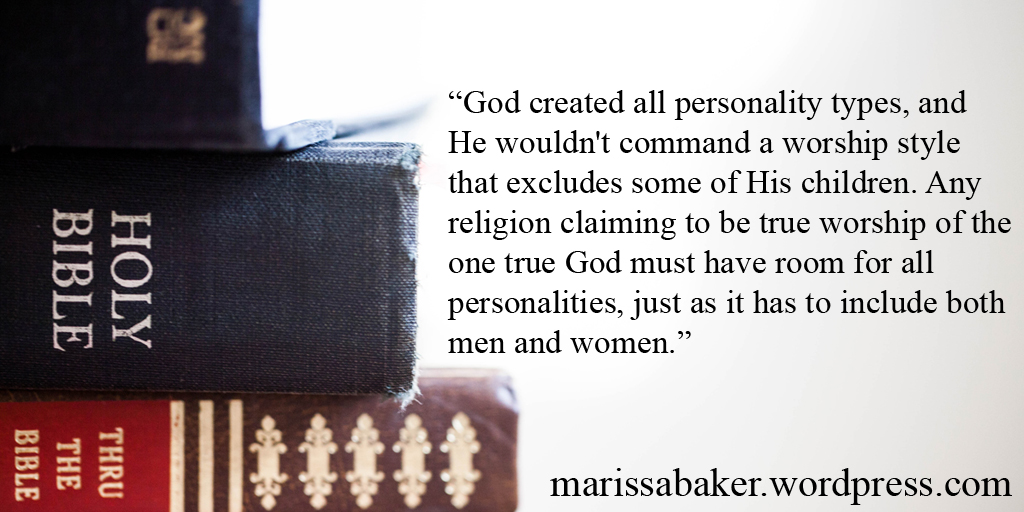
God created all personality types, and He wouldn’t command a worship style that excludes some of His children. Any religion claiming to be true worship of the one true God must have room for all personalities, just as it has to include both men and women. God wouldn’t give people a personality type that isn’t compatible with worshiping Him, so if certain types are driven away because they are not “respected, honored or allowed to” use their gifts, then there must be something wrong with how we humans are constructing our churches.

Unveiled

How many people do you really open up to? Even if you’re an “open book,” there are probably things you don’t share with everyone. There are secrets, aspects of our personality, and thoughts that we only show closest friends, family or a spouse. You may have parts of you hidden so deep no one sees them.

not sure who to credit; found on Pinterest

What about in your relationship with God? Even though He knows everything about us, we can still chose to hold things back from Him. We can tell Him to stay away, keeping Him at arms length and refusing to let go and surrender to His work in us.

Opening up and letting myself be seen is a challenge I face in human relationships, and in this fall holy day season I’ve been thinking about whether I try to do the same thing with God. I think that I’m more open with Him than with anyone else, but are there still things that I’m trying to hold back or hide?

Open To Me

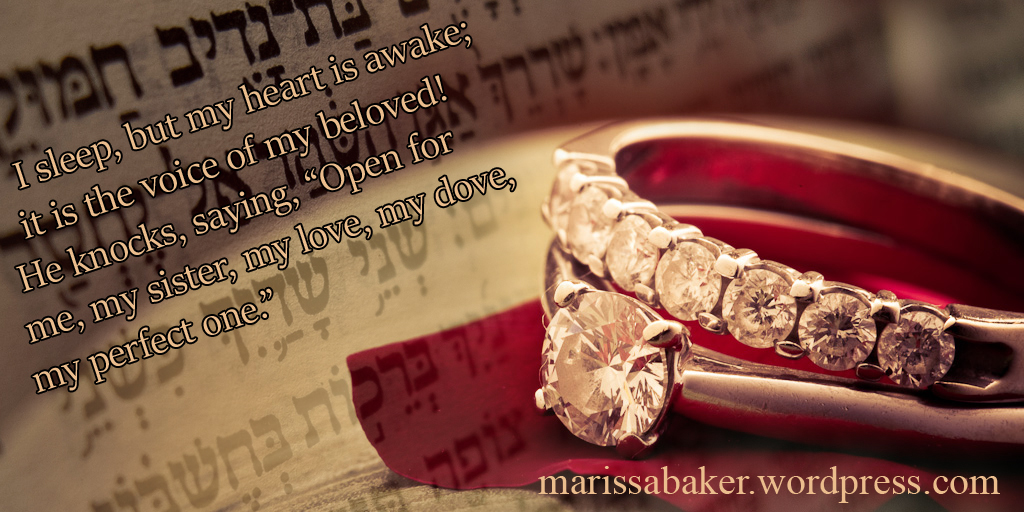
Jesus is supposed to be our friend and lover. He wants to know you more thoroughly than anyone else ever will, but He wants you to chose that relationship. He won’t force Himself into your life, though He will knock.

I sleep, but my heart is awake; it is the voice of my beloved! He knocks, saying, “Open for me, my sister, my love, my dove, my perfect one; for my head is covered with dew, my locks with the drops of the night.” (Song 5:2)

The woman in this part of the Song of Songs has “slumbered and slept,” and now Christ is outside asking to come in. “He sues for entrance who may demand it; he knocks who could easily knock the door down” (Matthew Henry’s Commentary). He doesn’t upbraid her for shutting Him out — He just wants her to let Him in. Have we also locked Him out? perhaps through carelessness if not deliberately?

she did not say, I will not open, but, How shall I? Note, Frivolous excuses are the language of prevailing slothfulness in religion; Christ calls to us to open to him, but we pretend we have no mind, or we have no strength, or we have no time (Matthew Henry)

Matthew Henry talks about this as “The slights which careless souls put upon Jesus Christ,” and which actually demonstrate “a great contempt” for their savior. When we ignore Jesus’ request to come into our lives, we reject His work in us.

Here, in the Song, the woman finally opens the door when she sees His hand at the door. Unfortunately, she waited too long for welcoming Christ in to be easy.

I opened for my beloved, but my beloved had turned away and was gone. My heart leaped up when he spoke. I sought him, but I could not find him; I called him, but he gave me no answer. The watchmen who went about the city found me. They struck me, they wounded me; the keepers of the walls took my veil away from me. (Song 5:6-7)

If we aren’t willing to open ourselves up to Christ when He knocks, He will be harder to find. If we don’t unveil ourselves to Him, we might find ourselves lost, alone and stripped of our covering pretenses before we find Him again. This can happen multiple times in a Christian’s life, just as this pattern is repeated in the Song (Song 3:1-4). Our lives are often a dance of drifting away and coming back to Christ.

Torn Veils

Unveiled | marissabaker.wordpress.comVeils keep us from fully experiencing God. The veil in the temple separated the Holy of Holies — where God’s spirit appeared — from the rest of the temple complex. Prior to Christ’s sacrifice, only the High Priest could enter, and only once a year (Heb. 9:1-8). The moment Jesus died, “the veil of the temple was torn in two from top to bottom” (Matt. 27:51). His death removed the most visible separation between God and His people.

There was another veil mentioned in the Old Testament that Paul talks about in the New. After Moses spoke to God, he shone so much with God’s reflected glory that Israel feared him. Moses wore a veil to hide his shining face before everyone but God (Ex. 34:29-35). Paul wrote about this veil in his second letter to Corinth.

But their minds were blinded. For until this day the same veil remains unlifted in the reading of the Old Testament, because the veil is taken away in Christ. But even to this day, when Moses is read, a veil lies on their heart. Nevertheless when one turns to the Lord, the veil is taken away. (2 Cor. 3:14-16)

Christ has torn away all the veils between the Lord and His people. The temple veil which tore at His death opened the way into His sanctuary, and when we turn our hearts to Him He takes away the veil shielding true understanding of the Torah.

But we all, with unveiled face, beholding as in a mirror the glory of the Lord, are being transformed into the same image from glory to glory, just as by the Spirit of the Lord. (2 Cor. 3:18)

We have to unveil our faces if we want to see His unvelied face. To know Him, we must want to be known. He took the first step — will we be equally open with Him?

Being Seen

Psalm 139 talks about God knowing us thoroughly — all our thoughts, every part of our personality. It also includes a very important line where David invites God into this deep, intimate relationship.

Search me, O God, and know my heart; try me, and know my anxieties; and see if there is any wicked way in me, and lead me in the way everlasting. (Ps. 139:23-24)

David’s willingness to be seen by God, and his request that God know him, are key to the sort of closeness described earlier in Psalm 139. Today, we can have that same sort of intimacy with our Lord if we let Him in.

Behold, I stand at the door and knock. If anyone hears My voice and opens the door, I will come in to him and dine with him, and he with Me. (Rev. 3:20)

Our Beloved is knocking on our doors, asking us to let Him in. Turn your face to Him, take off the barriers you’re putting up between you and Jesus. See, and be seen.

Unveiled | marissabaker.wordpress.com

Credits for photos used in blog images this week:

  • Veil” by Dan Thoburn, CC BY via Flickr
  • Red Drapery” by Sherrie Thai, CC BY via Flickr
  • Diamond Samples” by Seth Lemmons, CC BY via Flickr
  • Song 7:5” by Raffaele Esposito, CC BY via Flickr