Memorial Day

photo credit: Vjeran Pavic, CC BY-ND

It is the Soldier, not the minister
Who has given us freedom of religion.
It is the Soldier, not the reporter
Who has given us freedom of the press.
It is the Soldier, not the poet
Who has given us freedom of speech.
It is the Soldier, not the campus organizer
Who has given us freedom to protest.
It is the Soldier, not the lawyer
Who has given us the right to a fair trial.
It is the Soldier, not the politician
Who has given us the right to vote.
It is the Soldier who salutes the flag,
Who serves beneath the flag,
And whose coffin is draped by the flag,
Who allows the protester to burn the flag.

— quote from Charles Michael Province, U.S. Army

There Remains A Sabbath

I’ve mentioned before that I keep Saturday as a Sabbath rest, but I don’t think I’ve talked about why. Not every Christian is convicted of this, but I’m seeing more and more acknowledging the value of “sabbathing.” It’s just a small step from realizing that God’s command to rest is good, to resting on the day He set aside from the beginning of creation.

Thus the heavens and the earth, and all the host of them, were finished. And on the seventh day God ended His work which He had done, and He rested on the seventh day from all His work which He had done. Then God blessed the seventh day and sanctified it, because in it He rested from all His work which God had created and made. (Gen. 2:1-3)

There Remains A Sabbath | marissabaker.wordpress.com

This verse tells us God chose a certain day, the seventh, as a day of rest. He gave this day a special blessing, and set it apart for sacred use. “Sanctified” in the Hebrew carries the sense of separating something from “the common or profane” and placing it in “the sphere of the sacred” (Theological Wordbook of the Old Testament, p.1989). That’s what God did with the Sabbath day from the beginning of the world. Read more

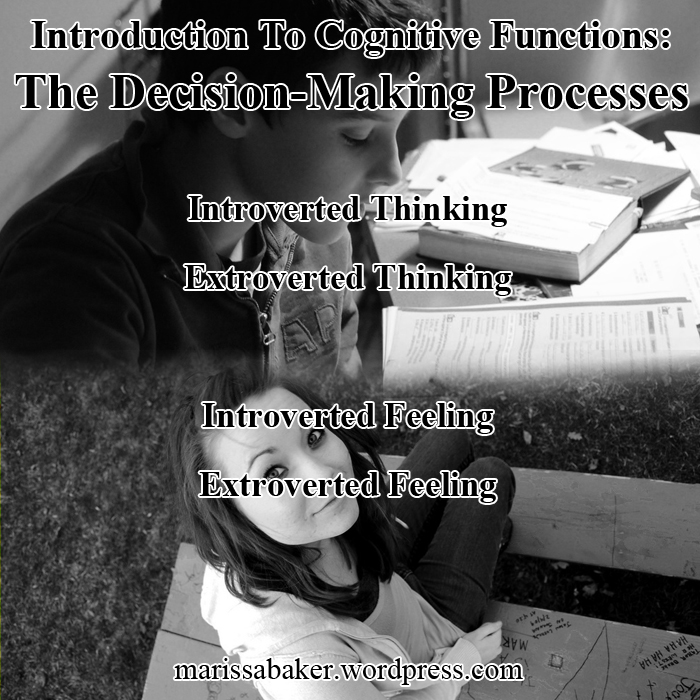
Introduction To Cognitive Functions: The Decision-Making Processes

Introduction To Cognitive Functions: The Decision-Making Processes | marissabaker.wordpress.com
image credits: Bailey Weaver, CC BY
Roberto Faccenda, CC BY-SA

If you’ve been hanging around Myers-Briggs enthusiasts for a while, you’ve probably heard about the Jungian cognitive functions. They are key to understanding Myers-Briggs theory, but they can also be very confusing. Basically, the four letters in a Myers-Briggs type tells you what type of mental processes you use most effectively in making judgements and decisions (Thinking or Feeling) and perceiving the world (Intuition or Sensing). It also tells you whether you are more oriented to the outer world or inner world (Extrovert or Introvert).

Everyone has and uses four functions (out of a possible eight). Your primary function is the one you’re most comfortable with and use most effectively. It’s supported by your secondary function, which acts as a sort of co-pilot. The third and fourth functions are less well developed, and while we have access to them they are not used as effectively. You can look up your type’s cognitive functions on several websites, including PersonalityJunkie.

Last week’s post focused on the four perceiving/learning functions, so this week we’ll cover the judging or decision-making functions. Everyone has an introverted or extroverted form of Thinking or Feeling in their function stack. We use one or the other most effectively when making decisions and thinking about what the world “should” be like. Most Myers-Briggs enthusiasts still refer to these functions by their full names or abbreviations, but I think the Personality Hacker labels are easier to use when first learning about cognitive functions so I’ll include those as well.

Thinking

Thinking types prefer to make decisions using an impersonal, logical approach. They value truth more than tact, prize accuracy, and want to make fair decisions.

Accuracy/Introverted Thinking (Ti)

Accuracy is mostly concerned with whether or not data, ideas, and observations make sense to the individual. Types with this function are less concerned with drawing conclusions from data, and more concerned with creating theories, questions, and insights that line up with their internal fact-checking system. Types who use Accuracy rely more on their own power of observation and thoughts on a given subject than on outside sources when making decisions.

This is the perceiving process used most effectively by ISTPs, INTPs, ESTPs, and ENTPs. The introverts use it as their primary function, the extroverts use it as a co-pilot to support their dominant learning function.

Effectiveness/Extroverted Thinking (Te)

As an outward-focused Thinking function, Effectiveness relies on facts and data gathered from outside sources when making decisions. These types want to experiment to find out what works and what doesn’t, and how they can be most efficient. It’s a practical function focused on finding solutions, discovering and classifying facts, and setting goals.

This is the perceiving process used most effectively by ESTJs, ENTJs, ISTJs, and INTJs. The extroverts use it as their primary functions, the introverts use it as a co-pilot to support their dominant function.

Feeling

Feeling types prefer to make decisions based on their personal values and how the decisions will affect other people. They want to maintain interpersonal harmony, and may soften truth in an effort to be tactful.

Authenticity/Introverted Feeling (Fi)

As an Introverted Feeling function, Authenticity wants to understand the self. These types make decisions based on what feels right, as influenced by abstract ideals. It is a focused, deep sort of way to experience emotion that many Authenticity types find hard to express to other people.

This is the perceiving process used most effectively by ISFPs, INFPs, ESFPs, and ENFPs. The introverts use it as their primary function, the extroverts use it as a co-pilot to support their dominant function.

Harmony/Extroverted Feeling (Fe)

When feeling is turned outward, Harmony focuses on getting everyone else’s needs met when making decisions. These types adapt themselves to given situations trying to fit in, and value the ideals and customs of their community. Harmony seeks true peace and understanding between people, and is adept at sharing feelings to create sympathy.

This is the perceiving process used most effectively by ESFJs, ENFJs, ISFJs, and INFJs. The extroverts use it as their primary functions, the introverts use it as a co-pilot to support their dominant function.

Thoughts on John 9

I don’t often spend most of a week studying just one chapter of the Bible, but John 9 captured my attention and didn’t let go. It is the story of Jesus healing a blind man, and unlike many miracles which are recorded in just a few short verses, this story takes up an entire 41-verse chapter.

This chapter is packed full of interesting things to learn. I focused on three main points that I noticed for this post, but I’m sure there’s more. If anyone else feels moved to study John 9, I’d love to hear your thoughts!

A Reason For Suffering

Now as Jesus passed by, He saw a man who was blind from birth. And His disciples asked Him, saying, “Rabbi, who sinned, this man or his parents, that he was born blind?”

Jesus answered, “Neither this man nor his parents sinned, but that the works of God should be revealed in him. (John 9:1-3)

The assumption the disciples made is all too common, even today — that the bad things which happen to us and others are a kind of punishment. Sometimes, however, God allows trials of various sorts to affect us because they fit into His plan for doing good. In this particular case, the man’s blindness was used to introduce him to Jesus and demonstrate to other people that Jesus is the Son of God.

It worked, too. This healing caused a huge stir in the Jewish community. This was partly because of the spectacular nature of the miracle, and partly because Jesus healed on the Sabbath. As the Word of God, Jesus was the One who told Israel about the Sabbath in the first place — He knew how to keep it holy. Doing good on the Sabbath wasn’t a sin, but it did anger the Pharisees because it violated some rules they’d added.

 Therefore some of the Pharisees said, “This Man is not from God, because He does not keep the Sabbath.” Others said, “How can a man who is a sinner do such signs?” And there was a division among them. (John 9:16)

Though they publicly condemned Jesus, they weren’t so sure behind the scenes. This miracle made them think, and I wonder if some of them eventually became believers. Nicodemus couldn’t have been the only Pharisee wondering if maybe, just maybe, Jesus really was the Christ (John 3:1-2).

A Simple Testimony

After he was healed, the man who’d been blind doesn’t leap, shout, and tell everyone what happened. He didn’t do anything to call attention to himself, and only talked about the miracle when people started asking him what happened.

He answered and said, “A Man called Jesus made clay and anointed my eyes and said to me, ‘Go to the pool of Siloam and wash.’ So I went and washed, and I received sight.” (John 9:11)

After hearing this, the people took him to the Pharisees and he repeated his story again (verse 15). Not believing him, they called in his parents, who were scared of being excommunicated and wouldn’t say anything except to affirm that he had, indeed, been blind (verse 18-23).

So they again called the man who was blind, and said to him, “Give God the glory! We know that this Man is a sinner.”

He answered and said, “Whether He is a sinner or not I do not know. One thing I know: that though I was blind, now I see.” (John 9:24-25)

I think what the Pharisees were trying to do was convince this guy to say God healed him, and leave Jesus out of it. That never works — for “whoever denies the Son does not have the Father either” (1 John 2:23). When the Pharisees kept pressuring him, this man delivered a very simple testimony that enraged the Pharisees, who prided themselves on their intellect and knowledge of God.

The man answered and said to them, “Why, this is a marvelous thing, that you do not know where He is from; yet He has opened my eyes! Now we know that God does not hear sinners; but if anyone is a worshiper of God and does His will, He hears him. Since the world began it has been unheard of that anyone opened the eyes of one who was born blind. If this Man were not from God, He could do nothing.” (J0hn 9:30-33)

There’s something to be said for paying attention to “the simplicity that is in Christ” (2 Cor. 11:3). The man who went with the simple, obvious explanation — that Jesus is a good man who performed a miracle — was much closer to God than the thoroughly educated church leaders.

A Personal Connection

After testifying to Jesus’ work in his life, the Pharisees excomunicated the formerly blind man (verse 34). This relates back to an earlier verse, which tells us “the Jews had agreed already that if anyone confessed that He was Christ, he would be put out of the synagogue” (John 9:22). This doesn’t sound so bad to us today — if we get kicked out of one church there are plenty more right down the street. In the Jewish culture of Jesus’ time, though, it meant banishment from religious life.

In his definition of aposunagogos (G656), Zodhiates notes that the highest degree of “casting out” (there were three) is “an exclusion from all the rights and privileges of the Jewish people, both civil and religious. The offender was considered as dead.” Jesus warned His followers about this possibility in John 16:2. Following Jesus was a huge, dangerous step for Jews. It meant risking isolation from other people and, if you believed the Pharisees, from God.

Jesus heard that they had cast him out; and when He had found him, He said to him, “Do you believe in the Son of God?”

He answered and said, “Who is He, Lord, that I may believe in Him?”

And Jesus said to him, “You have both seen Him and it is He who is talking with you.”

Then he said, “Lord, I believe!” And he worshiped Him. (John 9:35-38)

We don’t often see examples of Jesus making follow-up visits with people He healed, but it is clear from these verses that He was keeping track of what happened with this man. As soon as He heard about the Jews excommunicating the formerly blind man, Jesus tracked him down to encourage him and confirm his faith. This man was cast out by the Jews, but he was welcomed by the Messiah.

I’m touched by the personal attention Jesus gave this individual, and the parallels with our own calling. Jesus healed him, apparently without being asked to, and changed his whole life. In much the same way, God may call us when we’re not even looking for Him and don’t know how desperately we need His life-changing power.

This healing opened the blind man’s spiritual as well as physical eyes. Many of us today can relate the rejection he experienced when he started to share the story of how Jesus touched his life. I hope we can also relate to the comfort of having a personal connection with this great Being, who doesn’t leave people alone to navigate their new-found faith.


Introduction To Cognitive Functions: The Learning Processes

Introduction To Cognitive Functions: The Learning Processes | marissabaker.wordpress.com
image credits: martinak15, CC BY
ShellVacationsHospitality, CC BY

Understanding the Jungian cognitive functions is key to Myers-Briggs typing. Unfortunately, it can also be very confusing. Basically, the four letters in a Myers-Briggs type tells you what kind of mental processes you use most effectively in making judgements and decisions (Thinking or Feeling) and in perceiving the world (Intuition or Sensing). It also tells you whether you are more oriented to the outer world or inner world (Extrovert or Introvert).

Everyone has and uses four functions (out of a possible eight). Your primary function is the one you’re most comfortable with and use most effectively. It’s supported by your secondary function, which acts as a sort of co-pilot. The third and fourth functions are less developed, and while we have access to them they are not often used effectively. You can look up your type’s cognitive functions on a variety of websites, including PersonalityJunkie.

For this first post, we’ll focus on the perceiving or learning processes (there will be a part two next week for the decision-making processes). Everyone has an introverted or extroverted form of Sensing and Intuition in their function stack. We use one or the other most effectively when learning new things and interacting with new ideas. Most Myers-Briggs enthusiasts still refer to these functions by their full names or abbreviations, but I think the Personality Hacker labels are easier to use when first learning about cognitive functions so I’ll include those as well.

Sensing

Sensing types are primarily concerned with what exists in concrete, observable reality. They focus on either the past or the present, and would rather work with something tangible than something theoretical. They can enjoy life in the moment and appreciate sense-impressions like good food and attractive surroundings.

Memory/Introverted Sensing (Si)

Personality Hacker says “that people use this process to learn new information based on their memories.” Isabel Meyer said a person using Introverted Sensing “sees things highly colored by the subjective factor,” and develops an inner self that may appear eccentric because of their unique way to seeing the world. However you phrase it, the Memory process is concerned with collecting sensory information and taking the time to check it for reliability and see how it fits in with their other ideas.

This is the perceiving process used most effectively by ISFJs, ISTJs, ESFJs, and ESTJs. The introverts use it as their primary function; the extroverts use it as a co-pilot to support their dominant decision-making function.

Sensation/Extroverted Sensing (Se)

The difference between the introverted Memory process and the extroverted Sensation process is that Se types process their sensory impressions externally. They want to experience and interact with something when they encounter it, rather than after-the-fact. People who use Sensation as their primary or secondary process have a reputation as adrenaline junkies.

This is the perceiving process used most effectively by ESTPs, ESFPs, ISTPs, and ISFPs. The extroverts use it as their primary functions; the introverts use it as a co-pilot to support their dominant decision-making function.

Intuition

Intuitive types are primarily concerned with what could be. They focus on patterns and future possibilities, and would rather deal with theory and potential than something that’s already here. They are imaginative, original, and value achievement and inspiration.

Perspectives/Introverted Intuition (Ni)

When focused inward as the Perspectives process, an intuitive type is concerned with deep insights and understanding patterns that form inside their mind. Perspectives types are extremely creative, and analyze external data as well as internal thoughts and feelings to come to an understanding about how their minds work. We then use our self-insight to interpret life and promote understanding (as Isabel Myers puts it).

This is the perceiving process used most effectively by INFJs, INTJs, ENFJs, and ENTJs. The introverts use it as their primary functions; the extroverts use it as a co-pilot to support their dominant decision-making function.

Exploration/Extroverted Intuition (Ne)

Extroverted Intuition is also concerned with ideas, possibilities and a desire to understand, but it’s focus outward. Often, these types will perform experiments just to see what will happen. Personality Hacker calls this process Exploration because “the best pattern recognition system for the outer world is to mess with everything that can be messed with, and to explore, explore, explore.”

This is the perceiving process used most effectively by ENTPs, ENFPs, INTPs, and INFPs. The extroverts use it as their primary functions; the introverts use it as a co-pilot to support their dominant decision-making function.


Ready To Be Faithful

How do you know when you’re ready for baptism?

For those in churches that teach baptism is the sign of our covenant with God, this is a weighty question. If you’re just coming into the church, how do you know when you’re ready to go through with this ceremony? If you grew up in the church, how do you know God is really calling you into covenant with Him? What should you look for, and what do you need, before you get baptized?

The answer is both simpler and more complicated than you might think. It has very little to do with how long you council with a minister or how many baptism booklets you read, and everything to do with the state of your heart. Before we get into the body of this post, though, (just so we’re starting out on the same page) here’s a bit of background. I believe baptism by full immersion in water is an outward sign of an adult Christian’s covenant with God. I grew up in a Christian community that taught this, and I was baptized shortly after my 19th birthday.

Repent

Ready To Be Faithful | marissabaker.wordpress.com
bg image credit: Kelly Hunter, CC BY

When John the baptist began his ministry, he preached “Repent, for the kingdom of heaven is at hand!” (Matt. 3:2).  Those who came to be baptized confessed their sins as part of the baptism (Matt. 3:6). To further emphasize the need for repentance, he told the Pharisees and Sadducees who came to his baptism to “bear fruits worthy of repentance” if they wanted to be saved (Matt. 3:8).

In the Bible, repentance is “regret accompanied by a true change of heart toward God” (G3340, Zodhitates). To enter covenant with God, the first requirement is that we realize we are sinners, genuinely regret the wrongs we’ve committed, and recognize our need for Jesus Christ’s atoning sacrifice.

Now when they heard this, they were cut to the heart, and said to Peter and the rest of the apostles, “Men and brethren, what shall we do?”

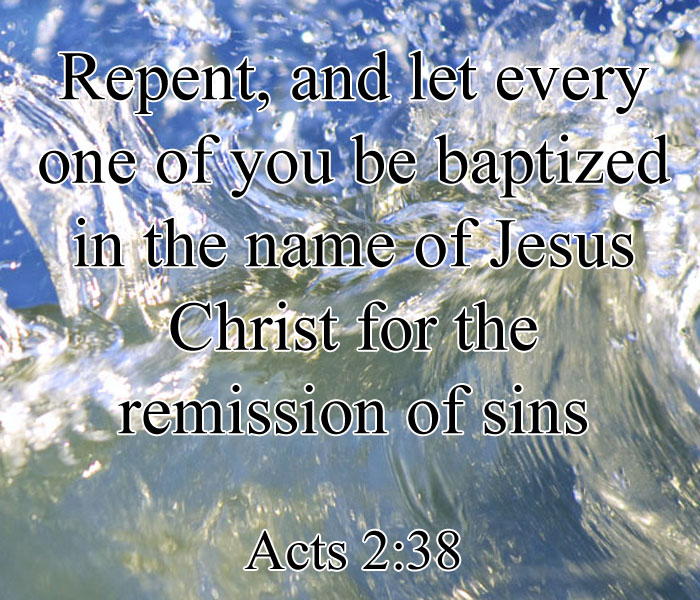
Then Peter said to them, “Repent, and let every one of you be baptized in the name of Jesus Christ for the remission of sins; and you shall receive the gift of the Holy Spirit. (Acts 2:37-38)

In general the steps are: 1) repentance, 2) baptism, 3) receive the Holy Spirit (there are exceptions to this order, as in Acts 10). Often, we feel like we need reach perfection, or at least be “good enough” before baptism. Really, though, we need to realize we are not perfect so we can commit and submit to God. Then, after we realize how desperately we need Him and ask Him to be part of our life, He gives us the tools we need to grow toward perfection.

Believe

Looking at another baptism recorded in Acts, we find one more requirement for baptism. Here, Philip is teaching an Ethiopian eunuch about Jesus.

 Now as they went down the road, they came to some water. And the eunuch said, “See, here is water. What hinders me from being baptized?”

Then Philip said, “If you believe with all your heart, you may.”

And he answered and said, “I believe that Jesus Christ is the Son of God.”

So he commanded the chariot to stand still. And both Philip and the eunuch went down into the water, and he baptized him. (Acts 8:36-38)

In the New Testament, “believe” is translated from the same words as “faith” — pisteuo (G4100), a mental persuasion, faith, or belief, and pistis (G4102), ” a knowledge of, assent to, and confidence in certain divine truths” (Zodniates).

But without faith it is impossible to please Him, for he who comes to God must believe that He is, and that He is a rewarder of those who diligently seek Him. (Heb. 11:6)

Your faith doesn’t have to be perfect before you get baptized, but you should believe that God exists, that Jesus is the Messiah, and that They have a plan for your future. Maybe our faith is young or small, and we’re at a place where we’re saying, “Lord, I believe; help my unbelief!” (Mark 9:24). That’s okay. God knows we’ll still have work to do after baptism. In fact, He expects us to keep growing after we commit to Him.

Commit

Ready To Be Faithful | marissabaker.wordpress.com
bg image credit: Kelly Hunter, CC BY

When you’re counseling for baptism, ministers typically have you read the “count the cost” scriptures in Luke 14:25-33. We learn we can’t cling to anyone or anything other than Christ. We’re told we must be prepared to give up everything we have. Before taking this step in our relationship with God, we must seriously evaluate our commitment level. Christianity isn’t something you can do part-time or half-way. We have to be all-in.

I’m willing to venture a guess that those of us who’ve been baptized didn’t really understand exactly what we were getting into. Our knowledge and understanding deepen so much as we grow, and the commitment I made at baptism means more to me now than it did back in 2008. We don’t need have perfect knowledge before we get baptized — we just need to know we’re willing to follow God no matter what. I’ve heard it compared to marriage. You don’t have to be perfect to get married, or even understand everything about marriage, but you do have to make a commitment that you’ll be faithful.

I will betroth you to Me forever; yes, I will betroth you to Me in righteousness and justice, in lovingkindness and mercy; I will betroth you to Me in faithfulness, and you shall know the Lord. (Hos. 2:19-20)

If our commitment to God is a marriage (2 Cor. 11:2), then baptism is when we say our vows. We promise to stay faithful to Him in sickness and in health, to follow His authority, and to work through our problems with Him instead of running away. Baptism is a promise of faithfulness to our faithful Creator. If we’re ready to be faithful, then we’re ready to be baptized.