I was nominated by PearlGirl of INFJ Ramblings. Thank you so much! I wish I could nominate you back — you’re one of the bloggers whose posts I actually read on a regular basis 🙂 I’m so glad we connected through our blogging about INFJ things.
The Rules
Post the award on your blog
Thank your nominator because they’re awesome
List 7 facts about yourself
Nominate 15 other blogs for their awesomeness
Post the rules so people know them
Seven Facts About Me:
I can’t decide whether my favorite color is rose-pink or grass-green. Or possibly plum-purple.
Even though my “to-read” list is humongous, there are a few books I take the time to re-read every year or so. Mara: Daughter of the Nile by Eloise Jarvis McGraw is at the top of that list. Seriously, drop everything and go read that book. There’s danger, love, intrigue, sacrifice and the only romantic attempted murder I’ve ever seen in fiction.
Much as I love Jane Austen, my favorite classic is actually Jane Eyre by Charlotte Bronte.
I love kayaking. It’s the only “sport” type of activity that I truly enjoy, even though it has been life-threatening twice (caught in bad weather on Lake George and knocked up-side-down in shallow, fast-moving water on the Mohican River).
I’m considered a “Garden Specialist” on eHow, and publish quite a few articles on that site.
Cheesecake is my favorite dessert, and since I started coming up with my own cheesecake recipes I’ve become something of a cheesecake snob.
My Nominees:
Yes, you’re supposed to nominate 15 other bloggers and I’ve only nominated 7. I’ll try and make up for that by telling you why I like each one.
2HelpfulGuys — I only recently started following them, but I like what I’ve read so far.
Baptism For Life — this is my dad’s blog, and while I know he won’t take the time to accept the nomination you really should check out his posts if you’re looking for inspiring bloggers.
Idle Wanderings — I always enjoy Charity’s posts and if you’re watching Grimm, I highly recommend her recent articles.
Introvert, Dear — a blog and Facebook group that is great to follow if you’re an introvert and/or HSP
Science and Faith — he’s a new blogger, and the first two posts are great. Looking forward to more!
See, there’s this thing called biology… — occasionally I disagree with this blogger. Usually, though, I’m bouncing up and down in my seat pointing at the screen and saying “That’s exactly what I think!”
SmileSupport313 — her posts are always encouraging. And she’s one of my very best friends, so of course her blog is worth reading.
I’ve been reading Captivating by John and Stasi Eldredge (or rather, re-reading, though it’s been 6 or 7 years and I only realized I read it once before when I recognized passages that spoke to my heart the first time). One of the main themes, and the one that left an impression on me from my first reading, is how much God wants me. He truly longs for a relationship with each of us, and it goes far beyond what we often mean when we say “God loves me.” God loves everyone. He has to, right? But when God tells us He loves us, He doesn’t mean an automatic benevolence that happens just because “God is love.” He means a real, passionate desire to be in relationship with you.
To be spiritual is to be in Romance with God. The desire to be romanced lies deep in the heart of every woman. It is for such that you were made. And you are romanced, and ever will be.” – from Captivating
This is speaking directly to women, so perhaps it won’t resonate so much with my guy readers. But God’s longing to be in relationship with us applies to both men and women in His church. Perhaps a glimpse of how being romanced by God looks to a woman will give you gentlemen some insight into what it means when Christ calls the Church His bride.
Almost 10 years ago, I started collecting favorite quotes in a notebook. One of the very first things I wrote down were the lyrics to “All I Ask Of You” from The Phantom of the Opera. On the opposite page, I lined it up with scriptures that spoke about the love between us and Jesus. Years later, I turned that into a video I never shared. For today’s post, I went back and updated that video with a few new scriptures. I think perhaps this is the best way to share what I’m trying to say today. Enjoy 🙂
Last week we started a study about whether or not the commands and instructions given to Biblical Israel apply to us as Christians today. I answered with a qualified “yes” — we are spiritual Israel, which is not so much separate from physical Israel as it was the next step in God’s plan for His chosen nation. Now, the question becomes, “How many of the laws given to Israel apply under the New Covenant?”
I’ve grown up believing that the Ten Commandments, including Sabbath keeping, carry over into the New Covenant, along with the Lev. 23 Holy Days and the clean and unclean meats laws. I still believe that, but now I’m starting to wonder why we keep those things and not others like the command to put tassels on our garments (Num. 15:37-41) or blow shofars on Holy Days (Ps. 81:3-4). When I ask this question, I’m usually told that not everything from the Old Covenant applies, and when I ask how they know which ones to keep they say, “It’s our tradition.” In my mind, that’s not a good enough answer, so it’s time for some Bible Study.
A New Priesthood
If you read through the laws of the Old Testament, you find quite a lot about the Levitical priesthood. Some of these are described as “a statute forever to their generations on behalf of the children of Israel” (Ex. 27:21), yet it is evident that Christ’s priesthood supersedes that system. If the switch to the New Covenant changed that, how much else was changed?
For the priesthood being changed, of necessity there is also a change of the law. (Heb. 7:12)
But now He has obtained a more excellent ministry, inasmuch as He is also Mediator of a better covenant, which was established on better promises. (Heb. 8:6)
When it talks about a change of the law, I think we often imagine quite a disconnect between the Old and New Testament. We think of change as in something old being replaced by something completely new, but I think perhaps the change is more in how God’s laws apply.
For this is the covenant that I will make with the house of Israel after those days, says the Lord: I will put My laws in their mind and write them on their hearts; and I will be their God, and they shall be My people. (Heb. 8:10)
The Old Covenant was replaced with the New (Heb. 8:13), but God’s laws were not done away with. Even before the Old Covenant was instituted at Mount Sianai, God had laws in place. We can see this in Genesis 26:5, where God says, “Abraham obeyed My voice and kept My charge, My commandments, My statutes, and My laws.” Since God is unchanging, His standards for what He expects from us do not change either.
Jesus said, “till heaven and earth pass away, one jot or one tittle will by no means pass from the law till all is fulfilled” (Matt. 5:18) In the Greek, this means “filled to the fullest extent.” The laws were brought to a spiritual plane, much as physical Israel became spiritual Israel. You still keep the physical laws, but there is a spiritual aspect as well, and we are held accountable for what goes on inside us as much as for what we actually do (Matt. 5:17-30).
Updating The Law
The laws governing the Levitical priesthood are examples of parts of the Old Covenant that have already been filled to the fullest extent by Jesus Christ. We don’t have a physical priesthood any more because He is our High Priest forever. We don’t sacrifice animals any more because Christ’s sacrifice completely fulfilled all the Old Testament commands for blood sacrifices.
For Christ has not entered the holy places made with hands, which are copies of the true, but into heaven itself, now to appear in the presence of God for us; not that He should offer Himself often, as the high priest enters the Most Holy Place every year with blood of another — He then would have had to suffer often since the foundation of the world; but now, once at the end of the ages, He has appeared to put away sin by the sacrifice of Himself. (Heb. 9:24-26)
Without a physical priesthood or temple, many of the ceremonial laws no longer apply to spiritual Israel. Though we as the New Testament church can examine and learn from them and how they foreshadowed Christ’s role as priest and sacrifice, people in the church no longer serve as priests and we no longer sacrifice animals.
Similarly, there were civil laws given to govern the nation of Israel that are not in effect now because the church is scattered through other physical nations with their own laws. Many of the civil laws had a moral aspect, though, and this is updated for us to follow under the New Covenant. Take, for example, the law that said a man and woman who commit adultery must both be put to death (Lev. 20:10). The Pharisees brought Jesus just such a case, and Jesus told them, “He who is without sin among you, let him throw a stone at her first” (John 8:7). When all her accusers left, Jesus told the woman, “Neither do I condemn you; go and sin no more” (John 8:11).
Jesus didn’t say that she hadn’t committed a sin. He said that there was room for mercy and forgiveness even of sins that had formerly incurred a physical death penalty. For judicial matters, Christians are now under the laws of the countries we live in. For moral matters, God’s laws are applied to spirit and in truth with an emphasis on mercy. Is there a guy in your church shaking up with his step-mother? We don’t stone them as was the case in ancient Israel (Lev. 20:11), but we do make it clear that behavior like this is morally wrong and won’t be tolerated in the church (1 Cor. 5:1-13). If he repents, you have to welcome him back just like God welcomes us back into relationship with Him when we repent of our sins (2 Cor. 2:3-11).
There are also aspects of the Old Testament laws that we are specifically commanded to continue observing. This includes the weekly Sabbath (Heb. 4:9) and Passover (Luke 22:19-20). We infer from these specific commands, and from the fact that Jesus and His disciples observed the other Holy Days, that all those days are still commanded observances. Even more obvious is the fact that we should be keeping the Ten Commandments, which are succinctly comprehended in the two greatest commandments.
Jesus answered him, “The first of all the commandments is: ‘Hear, O Israel, the Lord our God, the Lord is one. And you shall love the Lord your God with all your heart, with all your soul, with all your mind, and with all your strength.’ This is the first commandment. And the second, like it, is this: ‘You shall love your neighbor as yourself.’ There is no other commandment greater than these.” (Mark 12:29-31)
God’s focus is on our hearts, and whether or not we choose to keep His commandments tells Him what our hearts are like. Jesus said, “If you love Me, keep My commandments” (John 14:15). The implication is that if we don’t keep His commandments, we are telling Jesus we don’t love Him. If our hearts are right, obedience to God naturally follows.
My feelings on the question, “What is applicable under the New Testament?” is that everything God didn’t specifically replace/update to a spiritual level (the priest hood, physical temples, civil laws) are probably still in effect. It’s up to us to seek out the spiritual reasons for these commands and find a way to physically keep them. There are still some I’m not sure about — like those tassels on the borders of our garments or what we’re supposed to do on New Moons — but I want to keep searching and learning. I want to worship God the way He tells me to, not the way I think sounds like a good idea.
You know that feeling when you’re having a conversation with someone and can’t think of a reply, then the perfect words come to you three days later in the shower? Something similar happened to me a couple weeks ago. I was talking with someone who doesn’t think shofars are necessary in church services, and asked what he thought of Psalm 81 that tells us to blow the shofar “for this is a statute for Israel, a law of the God of Jacob” (Ps. 81:3-4). His response was, “We’re not Israel. We’re spiritual Israel, but we’re not Israel.”
The subject rolled around in my mind for a week before I decided to write about it. Whether or not the Old Testament commands given to physical Israel apply under the New Covenant is a much broader issue than shofars. I think its an important question to answer, because if the answer is “yes” then there are quite a few things most of us Christians have been wrongly ignoring, and that’s a dangerous thing to do.
Welcomed Into Israel
In the Old Testament, Israel was God’s chosen people — the small group He decided to work with and make His own.
Now therefore, if you will indeed obey My voice and keep My covenant, then you shall be a special treasure to Me above all people; for all the earth is Mine. And you shall be to Me a kingdom of priests and a holy nation.” These are the words which you shall speak to the children of Israel. (Ex. 19:5-6)
In much the same way, the New Testament church is a fairly small group of chosen people, called into a special relationship with God.
But you are a chosen generation, a royal priesthood, a holy nation, His own special people, that you may proclaim the praises of Him who called you out of darkness into His marvelous light; who once were not a people but are now the people of God, who had not obtained mercy but now have obtained mercy. (1 Pet. 2:9-10)
At this point in the history of the church, God wasn’t exclusively working with the physical nations of Israel any more. He was calling Gentiles as well. It’s very interesting to see how this calling is described.
Therefore remember that you, once Gentiles in the flesh — who are called Uncircumcision by what is called the Circumcision made in the flesh by hands — that at that time you were without Christ, being aliens from the commonwealth of Israel and strangers from the covenants of promise, having no hope and without God in the world. But now in Christ Jesus you who once were far off have been brought near by the blood of Christ. (Eph. 2:11-13)
The process by which Jesus Christ welcomes us into His church also makes us part of Israel. In Jesus Christ, we are no longer “aliens from Israel” and “strangers from the covenants” because He “has made both one, and has broken down the middle wall of separation” between physical Israel and the Gentile nations (Eph. 2:14).
Spiritual Israel
It is evident that there are differences between spiritual Israel and physical Israel. Paul addresses this in several epistles. The Old Covenant contained in it the promise of Messiah, and the ones in Israel who recognized Jesus as that Messiah became spiritual Israel as they transitioned to the New Covenant. At that point, God opened up salvation to the non-Israelitish people as well.
that He might make known the riches of His glory on the vessels of mercy, which He had prepared beforehand for glory even us whom He called, not of the Jews only, but also of the Gentiles? As He says also in Hosea: “I will call them My people, who were not My people, and her beloved, who was not beloved.” “And it shall come to pass in the place where it was said to them, ‘You are not My people,’ there they shall be called sons of the living God.” Isaiah also cries out concerning Israel: “Though the number of the children of Israel be as the sand of the sea, the remnant will be saved.” (Rom. 9:23-27)
This “remnant” is a small part of the physical nation of Israel, and now includes Gentiles as well “according to the election of grace” (Rom. 11:5). It is what God intended all of Israel to be, and that’s what we are grafted into (Rom. 11:13-24). The rest of Israel is still “beloved for the sake of the fathers” because of the promises God made to Abraham, Isaac, and Jacob (Rom. 11:28). Now, though, “God has committed them all to disobedience, that He might have mercy on all” (Rom. 11:32). That indicates He will treat those who’ve ignored Him as if they are outside of Israel so they can eventually be welcomed in as former strangers rather than punished as children who should have known better.
So the question, “Are we Israel?” seems to have answered itself. Paul even tells us quite plainly in Galatians that we are “the Israel of God” (Gal. 6:16). We’re also told that we are under the New Covenant which was promised to Israel.
Because finding fault with them, He says: “Behold, the days are coming, says the Lord, when I will make a new covenant with the house of Israel and with the house of Judah — not according to the covenant that I made with their fathers in the day when I took them by the hand to lead them out of the land of Egypt; because they did not continue in My covenant, and I disregarded them, says the Lord. For this is the covenant that I will make with the house of Israel after those days, says the Lord: I will put My laws in their mind and write them on their hearts; and I will be their God, and they shall be My people.” (Heb. 8:8-10)
When Jesus Christ came, He didn’t bring a new religion — He came as the next step in God’s plan. “Christianity” is the name that was given because the rest of the world thought it was just a new sect of Judaism. In reality, though, this is what God intended Israel to become all along. Instead of starting with the idea, “I’m Christian, so how much of this Old Testament stuff do I have to keep?” we should start at the beginning and see how the Old Covenant relates to the New Covenant. Some things did change, and some things did not change. That sounds like a good topic for next week’s blog post.
People have been trying to use personality types to find their perfect romantic match since typology first became popular. In a previous posts about Myers-Briggs types and love languages, I talked about how falling in love — and staying in love — with someone is so much more complex than simply matching personality types. Sometimes when browsing personality type forums, I’ll come across posts from people asking how to find and attract a someone of a specific personality type (often it’s an ENTP asking for step-by-step instructions to win an INFJ, which I find hilarious). It’s like some of us think that if we can just find someone who is our ideal type-match, then we’ll be happy because we caught the mythical “compatibility” creature.
Disclaimer: some of the links in this post are affiliate links. This means that, at no additional cost to you, I will receive a commission if you click on the link and make a purchase on that website.
Now, I do have some personality types I find more attractive romantically than others, but it’s not always the types I’m “supposed” to like according to Myers-Briggs or Keirsey theories. Even Isabel Myers was happily married to a man who her theory said should have been incompatible. An understanding of love languages and a mutual willingness to understand and work with each other is one piece of the puzzle. Another is something I just learned this week from Personality Hacker.*
The “Genius System”
Personality Hacker was founded by Antonia Dodge and Joel Mark Witt, who use what they call the “Genius system” to divide Myers-Briggs types into four groups based on the last two letters in a person’s type. In terms of function stacks, this means they group types based on whether the type introverts or extroverts their Judging function. The groupings end up looking like this:
According to a new article on Personality Hacker, each of these groups look for and expressed love in a unique way. Most people would tell an INFJ to look for a relationship with an ENFP or an ENTP and avoid their opposite type, ESTP. This system stays that an ENFP and and ENTP express love in completely different ways, but ENTPs and ESTPs are actually very similar in how they love. That would explain why some INFJs find ENFPs really attractive, while others prefer ESTPs or ENTPs. It’s not so much about matching two specific types, as it is about finding types who express love in a way you relate to and understand. This Genius style take on the MBTI adds an intriguing aspect to the subject of personality types in relationships. You can check out the Personality Hacker podcast on how each type says “I Love You”* for a full explanation, but here’s my brief take on what this means:
Types of Love
“Harmony” types, who use Extroverted Feeling as their first or second function, feel loved when they are connected, safe, cared for, and accepted as their authentic selves. They express love in a similar way, by encouraging the people they love and keeping in touch with them. They are primarily concerned with harmonious relationships and emotional connection.
The types who use Introverted Feeling, “Authenticity” in the Genius System, highly value honesty in relationships. They feel loved when they know someone is being real with them and is supportive of their own authentic expressions. Authenticity types express love by giving people space to be themselves and being willing to work through problems in the relationship.
“Effectiveness” types, those who use Extroverted Thinking, value independence in relationship. They want to know that the person who loves them is supportive of their goals and can be trusted to function on their own. They are loyal and protective towards those they love, and give them room to be themselves.
Those who use Introverted Thinking, “Accuracy” types, feel loved when they are respected. They want to know that the person who is in love with them thinks they are impressive and that the relationship makes sense. In return, they are protective, non-judgmental, and strive to bring the best version of themselves to the relationship.
Matching Types
Ultimately, typology is simply a tool we can use to understand each other. When we understand ourselves and the people around us, we have a better idea of what we’re looking for in a romantic relationship. I think that’s really the best way to apply Myers-Briggs theory to romance. We can’t just say that all INFJs’ ideal match is an ENTP — people are far more nuanced than that, even within a type. But the better we understand how we’re wired and what makes us feel loved, the more likely we’ll be able to recognize whether a potential romantic partner would be a good or a bad match for us.
This is one of the things Debra Fileta talks about in her book and blog True Love Dates. You have to know yourself before you try to get to know other people in a romantic context, otherwise you have no idea what you’re looking for in a relationship. So maybe the first thing we should do when looking at the Genius System types is find which group we fit into. If we know who we are, we’re one step closer to knowing what we want.
I’m a writer. I spend most of my day with words. I put them together, move them around, edit them out and put new ones in — all trying to find just the right combination to deliver information, move you to tears, make you laugh, or give you something to think about. So when the Bible describes Jesus Christ as “the Word,” I see that from a the perspective of someone who loves words and realizes how powerful they can be. I express myself best through written words, and that is also the main way God has chosen to express Himself to us.
Have you ever wondered why that is? Why did God make sure we had a written record of Him? in theory, He could have taught everything by speaking directly through prophets right up into the present day, much like He did for a good part of Biblical history. Even through there was a written record in the Torah, then the complete Old Testament and finally the canonized Bible, throughout most of history people simply didn’t have access to a written copy of God’s word. For the past couple thousand years or so, though, God has communicated to His people primarily through His written words.
I suspect part of this is because the church is now scattered over the entire world rather than concentrated in a single nation — God was expanding His family, and in the new church that Jesus Christ is building it simply isn’t practical or necessary to have His people going to a rabbi or prophet to find out what God wants. Now, every individual who has been called is given the opportunity to have a relationship directly with the Father and with the Word, and that relationship largely depends on us picking up God’s written word and asking Him to teach us.
Re-creating Us
Let the word of Christ dwell in you richly in all wisdom, teaching and admonishing one another in psalms and hymns and spiritual songs, singing with grace in your hearts to the Lord. And whatever you do in word or deed, do all in the name of the Lord Jesus, giving thanks to God the Father through Him. (Col. 3:16-17)
This is the same Greek word, logos (G3056), used to describe Jesus as the Word. Logos means an articulate expression of intelligence. When Christ is named the Word, it is in reference to His role as the One who reveals the intelligent thoughts of the God family. Here in Colossians, what we’re talking about is the words He spoke in His role as the Word.
These verses are telling us to look at every word that Jesus shared with us, and let those words dwell inside us along with the wisdom we need to understand His words. It’s telling us to share those words with others, and let them work a change inside you that alters your own words and deeds. When the word of Christ is in you, then the “intelligent expression” coming out of your mind and mouth will be a reflection of His intelligence.
A good man out of the good treasure of his heart brings forth good things, and an evil man out of the evil treasure brings forth evil things. But I say to you that for every idle word men may speak, they will give account of it in the day of judgment. For by your words you will be justified, and by your words you will be condemned. (Matt. 12:35-37)
This is another Greek word, rema (G4487), which refers to spoken words or commands. Instead of referencing the intelligence behind the words, it refers to the subject matter being discussed. It’s telling us that we will be judged, not just for the motivation behind our words, but also for the subjects we choose to speak about. Christ’s words in us are good treasures of our hearts, and with Him inside us the words we speak will become good, and glorify God.
If you abide in Me, and My words abide in you, you will ask what you desire, and it shall be done for you. By this My Father is glorified, that you bear much fruit; so you will be My disciples. (John 15:7-8)
Our relationship with the Word and the presence of His words in us makes it possible for us to glorify God with the fruits of our life. “The worlds were framed by the word of God” — so just imagine what an amazing work those powerful words can do inside of us! (Heb. 11:3).
Spirit and Life
It is vitally important that Jesus Christ, “the Word of life” (1 John 1:1), and the words that He taught become a part of us. Without a good relationship with the words of God, we will not be saved.
Therefore lay aside all filthiness and overflow of wickedness, and receive with meekness the implanted word, which is able to save your souls. But be doers of the word, and not hearers only, deceiving yourselves. For if anyone is a hearer of the word and not a doer, he is like a man observing his natural face in a mirror; for he observes himself, goes away, and immediately forgets what kind of man he was. But he who looks into the perfect law of liberty and continues in it, and is not a forgetful hearer but a doer of the work, this one will be blessed in what he does. (James 1:21-25)
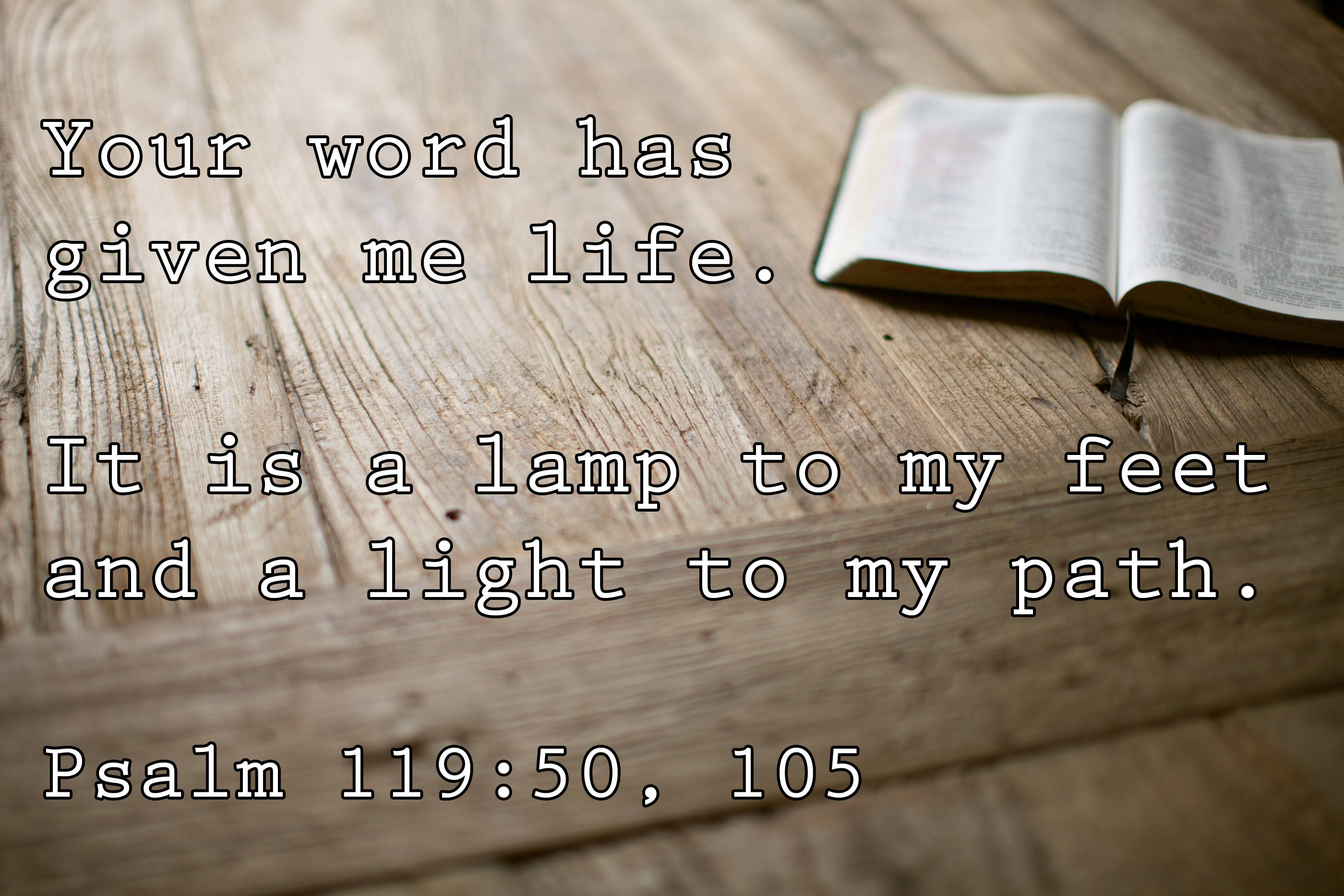
The words of God speak to our hearts and spirits. They show us who and what we are and give us tools to change and grow. Jesus said, “The words that I speak to you are spirit, and they are life” (John 6:63). Do we treat the word of God like that? Do we hold on to it and treasure it as a source of life and of the Spirit? as a key to intimacy with God?
For this commandment which I command you today is not too mysterious for you, nor is it far off. It is not in heaven, that you should say, ‘Who will ascend into heaven for us and bring it to us, that we may hear it and do it?’ Nor is it beyond the sea, that you should say, ‘Who will go over the sea for us and bring it to us, that we may hear it and do it?’ But the word is very near you, in your mouth and in your heart, that you may do it. (Deut. 30:11-14)
Paul quotes directly from this in Romans 10:5-10, leaving no doubt that this passage is relevant under the New Covenant as well as the Old. It’s like we talked about last week — God “is not far from each one of us; for in Him we live and move and have our being” (Acts 17:27-28).
As we become more and more like the Father and Jesus, our thoughts should be more like Their thoughts, our words more like Their words. We’ve been given a written record of how They think and speak, and we’ve been given His Spirit so we can comprehend what They are telling us (1 Cor. 2:10-12). The Word dwelling in us is an incredible opportunity to know and understand our creator.
 I was nominated by PearlGirl of INFJ Ramblings. Thank you so much! I wish I could nominate you back — you’re one of the bloggers whose posts I actually read on a regular basis 🙂 I’m so glad we connected through our blogging about INFJ things.



 Like An Anchor