Mushroom-Herb Chicken

Mushroom-Herb Chicken receipe marissabaker.wordpress.comThis is the first of two recipes I make that begins with lightly seasoned chicken breasts and a cast-iron skillet. Here’s a link to the original recipe: Mushroom-Herb Chicken at myrecipes.com. I’ll post the other one, a Thai-inspired recipe, next week. For now, though, enjoy what might very well be the first thing I’ve posted here that goes well with potatoes.

Mushroom-Herb Chicken

print this recipeMushroom-Herb Chicken receipe marissabaker.wordpress.com

4 (6-ounce) skinless, boneless chicken breast halves

1/4 teaspoon salt

1/4 teaspoon black pepper

1 teaspoon olive oil

Place each chicken breast in a zip-lock back or between two sheets of heavy-duty plastic wrap. Pound to 1/3-inch thickness. Sprinkle chicken evenly with salt and pepper.

Mushroom-Herb Chicken receipe marissabaker.wordpress.comHeat olive oil in a large skillet over medium-high heat. Add chicken to pan and cook 5 to 6 minutes on each side or until browned with no pink in the center.

Mushroom-Herb Chicken receipe marissabaker.wordpress.com1 (8-ounce) package mushrooms

1 teaspoon olive oil

1/3 cup rice wine or dry sherry

1 teaspoon dried marjoram leaves

3 green onions

While chicken cooks, thinly slice mushrooms and green onions. Remove chicken from pan and add more oil. Add mushrooms to pan and cook for one minute, stirring constantly. Add sherry and marjoram, then return chicken to pan. Cover and cook 3 to 4 minutes or until mushrooms are tender and chicken is done.

Serve immediately, over herbed mashed potatoes

Mushroom-Herb Chicken receipe marissabaker.wordpress.comMushroom-Herb Chicken receipe marissabaker.wordpress.com

The Mystery of the Weigh Stations

Weigh Station: CLOSED

I drove over 1,000 miles last weekend on the way to and from visiting a dear friend. On the way, I had ample opportunity to muse about the complexities and mysteries of life, including weigh stations.

You know what I mean — those little places along highways ostensibly built as “a checkpoint along a highway to inspect vehicular weights” (according to Wikipedia). But they’re never open. There’s usually a sign that says “weigh station” and then in glowing letters it says “closed.” I think prior to this trip I’d seen only one that was open and had a truck driving into it. Coming home I did see a weigh station sign with glowing letters that said “open,” but I never saw the weigh station. Very mysterious if you ask me.

And yes, I did do my research on this and found out about the electronic bypass systems with scales embedded in the road so trucks can be weighed without actually entering the weigh station. But the weigh stations are still there, mostly closed from what I’ve seen, and I wonder what they might be used for. Here are my top theories:

  1. They are entrances to secret government facilities, hiding in plain sight like the purloined letter. And being a weigh station, even an out-of-use one, means no one would think it too terribly odd if a truck drove in and delivered secret something or others.
  2. The entire weigh station thing is a cover for an alien invasion. They landed here and set up weigh stations, edited Wikepedia, and no one noticed because everyone assumed the stations were someone else’s jurisdiction.
  3. 42. It’s the answer to life, the universe, and everything, so I’m assuming that includes weigh stations.
  4. They actually are what they claim to be, but have now been taken over by some kind of secret organization. I’m picturing men in floor-length cloaks with masks whispering “What’s the password?” and speaking in Latin.
view from my car of a weigh station I passed on the way home
view from my car of a closed weigh station I passed on the way home

Personally, I’m leaning toward number 2. But that might just be because I’m starting to get excited about Falling Skies coming back on the 22nd.

What are your off-the-wall or so-strange-it-just-might-be-real theories? Doesn’t have to be about weigh stations — could be anything that has the potential to be far more interesting than most people assume.


Should God’s Daughters Prophesy?

As a jumping-off point for today’s post, I want to tell you a bit about a booklet my mother recently dredged up from an old filing cabinet. It was “The Christian Woman” by Ronald L. Dart (published 2000 by Christian Education Ministries). The first part was about the history of women’s (mis)treatment in the church over the years, contrasting that with the high value Jesus placed on women. After that he moved into more controversial waters of women’s role in the church, which is what I want to dive into today as well.

One of the things I appreciated about this booklet was the distinction Dart drew between personal and public ministries to explain why our churches have traditionally assigned preaching and teaching roles to men. He does not believe that women were not meant to have an active role in the church, but rather that their role should look different than men. It’s basically an extension of the different-but-equal mentality we’ve adapted toward the roles of godly men and women.

Prophetic Gifts

Near the end of this booklet, Dart addresses the idea of spiritual gifts in the church. He argues that because “There are diversities of gifts, but the same Spirit” that no one should be exulted or demeaned based on the gift they do or do not have, i.e. women should not be looked down on because they do have a gift/calling to preach. Quoting page 38, “there are many other gifts that are vital to the church — faith, healing, prophecy, discernment, and especially the greatest gift of all, love.”
Should God's Daughters Prophesy? marissabaker.wordpress.comThis surprised me a bit, because I know of people who wouldn’t include “prophecy” in a list of gifts that women might have. If you go with “inspired speaking” as the meaning of “prophecy” in this context, that’s too close to preaching and teaching for them to be comfortable with the idea of women being involved.

Yet God would not give someone a gift He did not intend them to use, and we can see quite clearly in Acts 21:9 that Philip the Evangelist “had four virgin daughters who prophesied.” This word translated “prophesied” is the Greek propheuo (G4395) and it can either mean “to foretell things to come” or “to tell forth God’s message.” A prophet in this sense is “one who speaks out the counsel of God with the clearness, energy, and authority which springs from the consciousness of speaking in God’s name and having received a direct message from Him to deliver” (Zodhiates). Women may not have been giving sermons in church, but they were not keeping silent about God’s message.

Another example in the New Testament of women prophesying is found on the Day of Pentecost in Acts 2. The opening verses say “they were all with one accord in one place” and that “they were all filled with the Holy Spirit and began to speak with other tongues, as the Spirit gave them utterance” (Acts 2:1, 4). We know from Acts 1:14 that this “all” included women, which is also mentioned when Peter explains what is going on.

But this is what was spoken by the prophet Joel: “And it shall come to pass in the last days, says God, that I will pour out of My Spirit on all flesh; your sons and your daughters shall prophesy, your young men shall see visions, your old men shall dream dreams. And on My menservants and on My maidservants I will pour out My Spirit in those days; and they shall prophesy.” (Acts 2:16-18)

My Gift?

I first became interested in exactly what the word “prophecy” refers to several years ago. There was a Bible study in our local church group about discovering your spiritual gifts. A quiz was passed out to help point you in the right direction, and my result was tied between the “cognitive” gift of prophecy and the “emotional” gift of mercy/compassion. I’m starting to see the mercy/compassion side more now as I become more aware of strengths in my personality type. The prophecy part, though, has been terribly confusing for me.

The word translated “prophecy” in the spiritual gifts passage in 1 Corinthians 12 is propheteia (G4394), and it is derived from the word used in Acts. The 5th, 6th, and 7th definitions in Zodhiates’ Complete WordStudy Dictionary of the New Testament help shed some light on what someone is supposed to do with a gift of prophecy.

(V) A prophecy is something that any believer may exercise as telling forth God’s word. …

(VI) Prophecy was a distinctive charisma (5486), gift, distinguishable from that of the apostle and the teacher. While the apostle was  a traveling missionary, the prophets and teachers were in general attached to a specific church. … Neither the prophet nor teacher was appointed by the apostles, as were bishops and elders; the gifts were an endowment of the spirit and both fulfilled the function of speaking in the Spirit.

(VII) That which is revealed constitutes a prophecy. The reception of such revelation and its communication did not entail states of rapture or ecstasy accompanied by unintelligible utterances. … Prophecy was a gift exercised with a consciousness of the subject, and it issued in something logically intelligible.

For years I had absolutely no idea what to do with this if it was indeed my gift. This blog has now given me an outlet, but I still wonder if there is something more I ought to be doing. Paul says, “he who prophesies speaks edification and exhortation and comfort to men” (1 Cor. 14:3). By this definition, the role of someone with a gift of prophecy is to build up others, encourage them towards virtue, and to console them. This can certainly be done in writing, and I pray my posts here could be described as words that edify, exhort, and comfort. But that doesn’t quite seem like enough.

I beseech you therefore, brethren, by the mercies of God, that you present your bodies a living sacrifice, holy, acceptable to God, which is your reasonable service. … Having then gifts differing according to the grace that is given to us, let us use them: if prophecy, let us prophesy in proportion to our faith (Rom. 12:1, 6)

Any one have thoughts on this? What should one do if one has the gift of prophecy? As we grow in the faith, our use of the gifts given by God should become more noticeable and effective, right? How should that look in “women professing godliness” (1 Tim. 2:10)?

Ways to Teach

I just quoted part of 1 Timothy 2 where Paul speaks about the conduct of women in the church. Reading on, we come to one of the (in)famous verses about women keeping silent in church.

Let a woman learn in silence with all submission. And I do not permit a woman to teach or to have authority over a man, but to be in silence. For Adam was formed first, then Eve.(1 Tim. 2:11-13)

The focus of these verses seem to be about not upsetting God’s ordained order, much like in 1 Corinthians 14. Because husband and wife relationships model the relationship between Christ and the church, husbands are the head in a marriage (Eph. 5:22-32). It would be indecent for the church to try and take over Christ’s roles, and it would be similarly unseemly for women to “usurp authority over a man” (as the KJV reads). While the conduct of unmarried women is not mentioned directly, I think we can infer that they should also behave in a respectful manner toward men in authority in the church, though no specific man has the authority of a husband over them.

This does not mean women could never teach under any circumstances. The word “teach” here in 1 Timothy 2:12 is didaskalia (G1319). Like prophecy, it is a spiritual gift (Rom. 12:7). Zodhiates says that “Prophecy was a specialized form of teaching,” and has the following to say about differences between the two.

The differences between the two apparently lay in the fact that while prophecy was the utterance of a revelation received directly from God, teaching was the utterance of what one had gained by thought and reflection. The teacher must be led and guided by the Spirit to be a true teacher and have genuine spiritual teaching, but what he said was in a real sense his own. Some prophets were able also to teach, but not all teachers were able to prophesy.

I’m not exactly sure which scriptures he uses to arrive at this distinction, so I quote it as “food for thought” and to segue into connecting teaching and prophecy as what I’ll call “gifts of meaningful instruction.”

We can find several examples of godly women in instructive roles. Both Priscilla and her husband were involved in teaching Apollo (Acts 18:26) and Paul calls them his “fellow workers in Christ Jesus” (Rom. 18:3). There’s the aforementioned daughters of Philip who prophesied (Acts 21:9). We can assume Timothy’s mother and grandmother both taught him (2 Tim. 1:5). Paul instructs older women to be “teachers of good things” and in particular to “admonish the young women” (Tit. 2:3-4). Women are described as praying and prophesying (1 Cor. 11:5). Miriam (Ex. 15:20), Deborah the judge of Israel (Judges 4:4), Huldah (2 Kings 22:14; 2 Chron. 34:22), Isaiah’s wife (Is. 8:3), and Anna (Luke 2:36-37) are all called prophetesses.

Decently and In Order

The important thing to remember if we want to teach as women in the church is that we must still hold to the instructions for godly femininity. If we are not adorned with a “a gentle and quiet spirit” while teaching, then we’re doing something wrong (1 Pet. 3:4). If our teaching challenges proper godly authority or is inconsistent with instruction that believers submit “to one another in the fear of God,” then something’s wrong (Eph. 5:21). We must not contribute to confusion in the church, but “Let all things be done for edification” (1 Cor. 14:26)

Let two or three prophets speak, and let the others judge. But if anything is revealed to another who sits by, let the first keep silent. For you can all prophesy one by one, that all may learn and all may be encouraged. And the spirits of the prophets are subject to the prophets. For God is not the author of confusion but of peace, as in all the churches of the saints.

Let your women keep silent in the churches, for they are not permitted to speak; but they are to be submissive, as the law also says. And if they want to learn something, let them ask their own husbands at home; for it is shameful for women to speak in church. (1 Cor. 14:29-35)

Both the booklet I referenced at the beginning of this post and Zodhiates’ commentary in my study Bible agree that this instruction of silence for women is specific rather than general. The church at Corinth apparently had a problem with maintaining order in church gatherings. The phrase “keep silent” is also used in verse 28 to instruct a man who speaks in an unknown tongue to stay silent if no interpreter is present.

Should God's Daughters Prophesy? marissabaker.wordpress.comThe word “to speak” used in this chapter is laleo (G2980) which, depending on the context, can simply mean to utter words or “to talk at random.” In the context of verse 34, Zodhiates says it should be interpreted as “uttering sounds that are incoherent and not understood by others.”  It is less an instruction for women to never speak, than it is a warning not to babble meaninglessly just for the sake of being heard.

I also find the emphasis on asking their husbands “if they want to learn something” interesting. That seems to indicate some women were interrupting the church meeting to ask clarifying questions or to debate something they really didn’t understand. That would conflict with Paul’s wrap up for this chapter: “Let all things be done decently and in order” (1 Cor. 14:40)

But I want you to know that the head of every man is Christ, the head of woman is man, and the head of Christ is God. Every man praying or prophesying, having his head covered, dishonors his head. But every woman who prays or prophesies with her head uncovered dishonors her head, for that is one and the same as if her head were shaved. (1 Cor. 11:3-5)

I’m not going to get into the head coverings discussion. I just want to point out here that Paul was discussing “God’s ordained order” (as my study Bible titles this section) and the fact of women praying and prophesying was mentioned rather casually. It is not the subject of this passage — it’s simply accepted as one of the things both men and women were doing in the church. There is a right way and a wrong way to pray or prophesy, but both men and women were speaking about God’s message. As far as  I can tell, we should be doing this still.

I don’t know for sure what this should look like in the churches today. I’m not ready to advocate women giving formal sermons, but women are studying their Bibles and many of us are learning things we feel like we should be sharing. There have to be more ways for us to serve than by supervising the snack table.

Steak Marinade

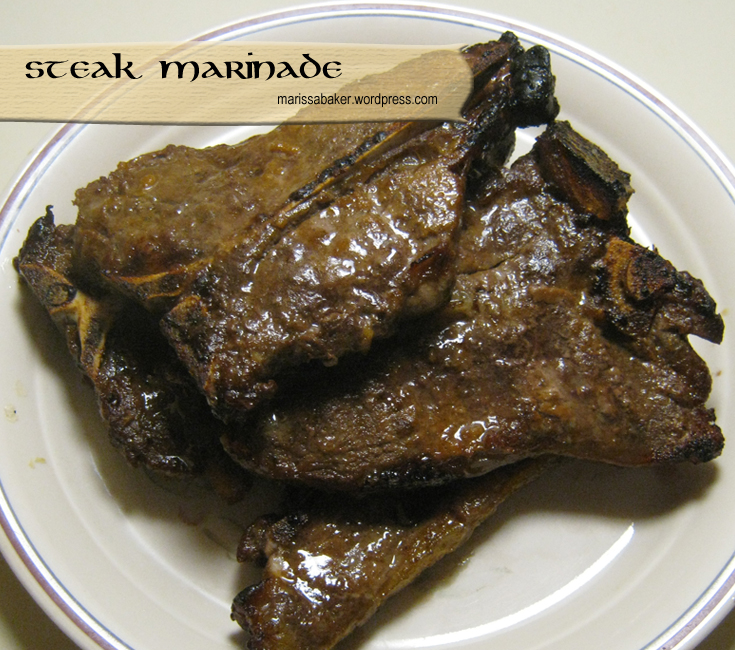
Steak marinade made without Worcestershire sauce. marissabaker.wordpress.com

This recipe came about because I didn’t have any Worcestershire sauce in the house and wanted to marinade a steak.  Apparently most people who marinade steaks consider it an essential ingredient, so I had to come up with something of my own. This is such a big hit at our house, we haven’t tried any other recipe since.

Steak Marinade

Steak marinade made without Worcestershire sauce. marissabaker.wordpress.com1/2 cup pineapple juice

1/2 cup soy sauce

1 Tablespoon brown sugar

1 Tablespoon honey

2 Tablespoons apple cider vinegar

1 Tablespoon olive oil

2 garlic cloves, minced

1/8 teaspoon cloves

1/8 teaspoon onion powder

1/8 teaspoon chili powder

Steak marinade made without Worcestershire sauce. marissabaker.wordpress.com

Add all ingredients to a container large enough to hold 4 to 6 steaks. Whisk ingredients until thoroughly combined. Add steaks and marinade in the refrigerator for 2 to 6 hours. If not all the steaks are covered with marinade, turn them in the container several times while marinading.

Steak marinade made without Worcestershire sauce. marissabaker.wordpress.comRemove steaks from marinade. Broil or grill steaks until they’re cooked how you like them. Bush with the left-over marinade once or twice while cooking.

INFJ — Finding Our Label

INFJ -- Finding Our Label marissabaker.wordpress.com
my mind is an interesting place

One of the things you’ll notice if you read things written by INFJs (including the comments under web articles and blogs) is how much those four little letters mean to us. There are other Myers-Briggs types who couldn’t care less what label someone else  “slaps on them” and certainly make no effort to search out a description of their personality type. They simply don’t see the need (which is, somewhat ironically, usually typical of their personality type).

INFJs are not like that. We’re on a search for what David Keirsey calls “self-actualization” even before we realize it. We know we’re different than most other people (about 99% of other people, in fact), but we don’t know why. Many INFJs grow up thinking there’s something wrong with them, either because they are flat-out told that or because they notice they are so different.

I discovered my personality type through an Internet quiz when I was in high school. These quizzes are not always accurate, but the one I happened to stumble across was close enough to recognize me as an INFJ. Everything I read in those results, and in the INFJ profiles that I hunted down next, sounded so familiar. Suddenly I wasn’t the only person with vivid dreams that seemed to blur lines between real and imaginary, or the only person who felt everything deeply and yet couldn’t seem to connect with someone in a conversation. My helplessness with numbers and difficulty working with facts might be inconvenient, but wasn’t abnormal any more. I didn’t have to try and ignore my intuition or try to come up with a logical reason for everything – I could simply accept the fact that intuition is how my mind works.

Other INFJs have similar stories, stories which I’d love to hear. In fact, I’m interested in any stories you INFJs out there would like to share. I’m writing an e-book, and think it would be so much more meaningful if I could include personal stories from other INFJs as well. If you think you might like to contribute, check out this post for details.

Gleaning Firstfruits

Before getting to today’s topic, I just wanted to mention how much I’ve enjoyed doing an actual count-down this year instead of just putting Pentecost on the calendar. It’s helped me focus my Bible study and kept me in mind of the timing for God’s calender rather than feeling like Pentecost sneaked up on me. Today is the 7th Sabbath in our count, which means Pentecost is tomorrow!

And you shall count for yourselves from the day after the Sabbath, from the day that you brought the sheaf of the wave offering: seven Sabbaths shall be completed. Count fifty days to the day after the seventh Sabbath; then you shall offer a new grain offering to the Lord. (Lev. 23:15-16)

Though this is one of the easiest Holy Days to see evidence of in the New Testament (largely due to the giving of the Holy Spirit in Acts), I think we’ll spend most of our time today in the Old Testament, particularly in the book of Ruth.

Lawns of Gleaning

Pentecost, also called the Feast of the Firstfruits/Harvest/Ingathering, is a harvest-time festival. The count to this day begins with a wave-sheaf “of the firstfruits of your harvest,” and the offerings on the day of Pentecost include “two wave loaves of two-tenths of an ephah” of “fine flour” “baked with leaven” that are described as “the firstfruits to the Lord” (Lev. 23:10, 17). After a lengthy passage of instructions for Pentecost, there is a verse that does not quite seem to fit.

When you reap the harvest of your land, you shall not wholly reap the corners of your field when you reap, nor shall you gather any gleaning from your harvest. You shall leave them for the poor and for the stranger: I am the Lord your God. (Lev. 23:22)

This is a repetition of a command also recorded in Leviticus 19:9-10, a command so important to God that He not only gave it twice, but He put one of those commands in the passage describing His most Holy Days. We can get some idea of how this practice works, and perhaps why it is so important, by looking at the book of Ruth.

‘Ruth Gleaning’ watercolor by James Tissot (1896)

There’s a note in my study Bible that says, “by New Testament times” the book of Ruth was being “read at the Feast of Harvest (Pentecost) because much of the story is set in the harvest fields.” It was one of five books “read publicly at the Feasts of Israel.”

I dare say we all know the story. Naomi and her family moved to Moab during a famine in Israel. There, her two sons married. About 10 years later, Naomi’s husband and sons were dead and she returned home to Israel accompanied by her daughter in law, Ruth. We jump into the story as Ruth and Naomi arrive in “Bethlehem at the beginning of barley harvest” (Ruth 1:22).

So Ruth the Moabitess said to Naomi, “Please let me go to the field, and glean heads of grain after him in whose sight I may find favor.” And she said to her, “Go, my daughter.” Then she left, and went and gleaned in the field after the reapers. And she happened to come to the part of the field belonging to Boaz, who was of the family of Elimelech. (Ruth 2:2-3)

As we read further, we see Boaz went above and beyond what God’s law strictly required a landowner to leave for the poor. He offers Ruth protection and water, and asks her not to glean in any other field where he could not guarantee her safety (Ruth 2:8-9). Behind-the-scenes, he told his reapers to let grain fall for her on purpose and not to stop her if she wanted to glean even among the sheaves of grain (Ruth 2:15-16).

Unmerited Favor

There is much of Christ’s character visible in how Boaz treats Ruth when she first arrives in his field. Like Boaz did for Ruth, Jesus offers us His personal protection. He asks us not to stray from His laws because they are designed to keep us safe from the consequences of sin. He says, “If anyone thirsts, let him come to Me and drink” (John 7:37). Our response to this unearned favor ought to be much the same as Ruth’s.

So she fell on her face, bowed down to the ground, and said to him, “Why have I found favor in your eyes, that you should take notice of me, since I am a foreigner?” (Ruth 2:10)

This is much the same question David asked God in Psalms 8:4 and 144:3 — “What is man that You are mindful of him?” Every human is small and insignificant compared to God, and those of us who God has chosen for His particular attention are unimportant even by human standards.

But God has chosen the foolish things of the world to put to shame the wise, and God has chosen the weak things of the world to put to shame the things which are mighty; and the base things of the world and the things which are despised God has chosen, and the things which are not, to bring to nothing the things that are, that no flesh should glory in His presence. But of Him you are in Christ Jesus, who became for us wisdom from God—and righteousness and sanctification and redemption — that, as it is written, “He who glories, let him glory in the Lord.” (1 Cor. 1:27-31)

"Gleaning Firstfruits" marissabaker.wordpress.comGod is gleaning His firstfruits from the world’s rejects. He is taking people who are nothing and turning us into something glorious. He is taking strangers — like the Moabite Ruth — and adopting them into His family through Christ’s sacrifice.

But now in Christ Jesus you who once were far off have been brought near by the blood of Christ. …Now, therefore, you are no longer strangers and foreigners, but fellow citizens with the saints and members of the household of God (Eph. 2:13, 19)

Our Redeemer

The adoption process by which we become God’s children is, as we discussed last week, linked inseprably to Christ’s redeeming work (Eph. 1:5-7; Rom. 8:23; Gal. 4:3-7). There is a parallel for this as well in the story of Ruth, in the role Boaz plays as a kinsman redeemer.

And her mother-in-law said to her, “Where have you gleaned today? And where did you work? Blessed be the one who took notice of you.” So she told her mother-in-law with whom she had worked, and said, “The man’s name with whom I worked today is Boaz.” Then Naomi said to her daughter-in-law, “Blessed be he of the Lord, who has not forsaken His kindness to the living and the dead!” And Naomi said to her, “This man is a relation of ours, one of our close relatives.” (Ruth 2:19-20)

My study Bible says this last phrase could be translated “one that hath right to redeem.” We find the basis for the practice of a kinsman redeeming land in Leviticus 25: 25, 48-49. To prevent an inheritance from leaving the family, someone who was closely related, financially able, and willing to fill this role could redeem land that was sold. In some cases, as here in Ruth, when the man who the land originally belonged to had left a childless widow, the redeemer was expected to marry her per the command in Deuteronomy 25:5-10.

We see all this played out in Ruth 4:4-10 where Boaz must offer a more closely related kinsman the opportunity to redeem Naomi’s family’s land and marry Ruth.  This man refuses (which, being the hopeless romantic I am, I suspect was Boaz’s plan all along).

Stepping back a chapter and looking at Ruth’s request that Boaz play the part of a redeemer, we read about a practice that seems rather unusual. Since Naomi counsels this action and Boaz knew how to respond, I assume Ruth asking him to be her family’s redeemer (perhaps even this method of asking) was not considered unusual in their culture. Per Naomi’s instructions, Ruth lies down at Boaz’s feet when he is asleep and waits for him to notice her.

And he said, “Who are you?” So she answered, “I am Ruth, your maidservant. Take your maidservant under your wing, for you are a close relative.” (Ruth 3:9)

Looking at the Hebrew for “wing”, The Complete WordStudy Dictionary for the Old Testament says “the idiom to spread (one’s) wings over means to take to wife.” This same word is used in Ruth 2:12 when Boaz tells Ruth, “The Lord repay your work, and a full reward be given you by the Lord God of Israel, under whose wings you have come for refuge.” Ruth is asking Boaz for a type of protection that mirrors the relationship between God and Israel. The comparison is drawn even more strongly reading God’s words to Israel in Ezekiel 16.

“When I passed by you again and looked upon you, indeed your time was the time of love; so I spread My wing over you and covered your nakedness. Yes, I swore an oath to you and entered into a covenant with you, and you became Mine,” says the Lord God. (Ezk. 16:8)

In the same way, we who are part of the church have been “betrothed you to one husband” — Jesus Christ — and will be married “to Him who was raised from the dead” after He died in order to redeem us (2 Cor. 11:2; Rom. 7:4).

Taken together, the book of Ruth and the Feast of Pentecost teach us about the glorious unmerited favor that God pours out on us. We were strangers like Ruth and were not only invited to partake in what God provides, but cared for deeply and betrothed to His own Son, who gave His life to redeem His firstfruit Bride.