When we started raising our own beef, I decided it was time to experiment. So one time when I was putting a roast into the crock pot, I just started dumping spices in, added some of that red wine vinegar that was left over from a salad dressing, and thickened it to make a gravy. This is the result. My brother, who can single-handedly eat 1/3 to 1/2 of the roast by himself, tells me this is one of his favorite meals.
I add as many vegetables as the crock-pot will hold
In crock-pot, whisk the tapioca starch with about ½ cup of the water. Add the remaining water, broth, and seasonings. Whisk until thoroughly combined.
Place roast in the crock-pot. Cut enough potatoes and carrots to fill most of the remaining space in the crock-pot. Turn the crock pot on to cook at low or high heat (see below). Stir at least once in the first hour, to prevent starch from sticking to the bottom of the crock pot as it thickens.
Cooking times will vary between crock pots. As a general guide, cook on low heat for 6 to 7 hours, or until the meat is cooked through and falls apart. If speed is important, cook on high heat for about 4 hours. In this case, the roast will be less tender.
When my cousin went to see The Phantom of the Opera, she was disappointed because the Phantom had a lack-luster voice. That was not the case last night at the Ohio Theatre in Columbus. Cooper Grodin turned in an amazing performance, which was well-supported by a talented cast including Grace Morgan as Christine and Ben Jacoby as Raoul.
This was my second time seeing a touring Broadway production in Columbus (the first was Wicked, last July). My sister and I are in serious danger of becoming theater addicts. We love the atmosphere (especially in a theater as lovely and historic as this one in Columbus), the excuse to dress elegantly, the quality of the music, and the set changes. Before going to Wicked, I had no idea set design was so elaborate.
One thing I love about Phantom is that since it is a play about stage actors, the audience switches from being viewers at the play The Phantom of the Opera to being part of the play as an audience for the plays enacted in the Opera Populaire. We became part of the Phantom’s opera house. Sometimes, he seemed to be singing just over my shoulder because of speakers at the back of the theater (which were only used for his character). Then, near the end when Raoul orders the doors bared against the Phantom’s escape, we heard doors shutting behind us.
Christine’s has long been one of my favorite roles to sing, and the English major in me also likes to analyze her character. From reading stage directions (included in the booklet that came with my copy of the CD), it often seems like she’s in a trance — as if the Phantom is a student of Franz Mesmer and has been practicing a form of hypnotism on Christine. She’s not mad — at least insofar that she’s not imagining the Phantom — and she’s not stupid. She, like the entire play and audience, is under the Phantom’s spell.
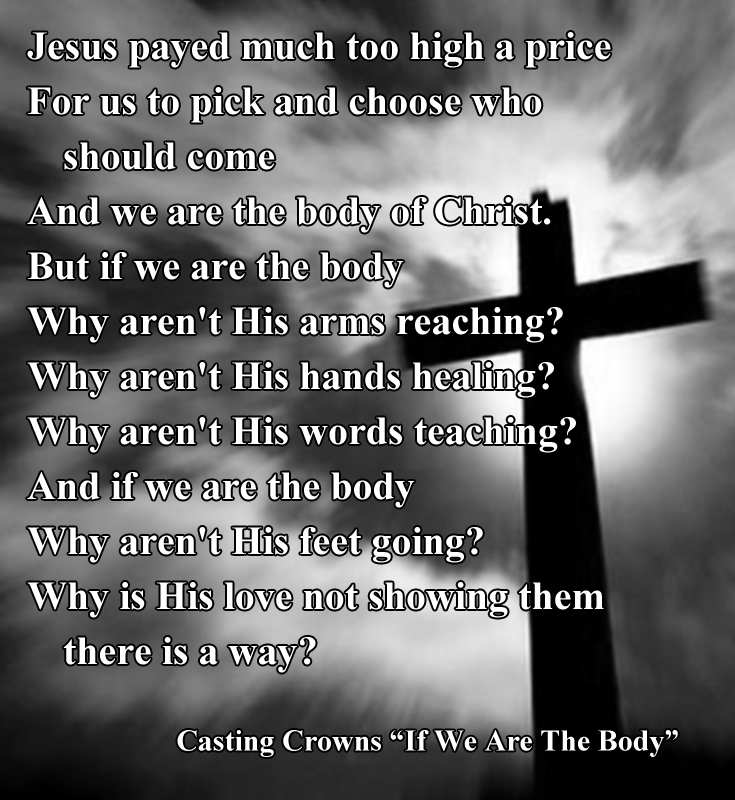
I wrote last week about questions the church can ask herself regarding our role as the body of Christ. Like the Casting Crowns song “If We Are The Body,” it was meant as a challenge for the church as a whole to reach out with compassion, heal others, teach Jesus Christ’s words, walk in His steps, and love everyone. The reason for this is mentioned in the line which provides me with a title: “Jesus payed much too high a price / For us to pick and choose who should come / And we are the body of Christ.”
What Price?
Christ said, “I am the good shepherd. The good shepherd gives His life for the sheep” (John 10:11). That, in a nutshell, is the price paid. He willingly gave up first His eternal existence with the Father and then His human life to be a sacrifice for sins (John 1:1-2, 14). A more complete picture of what this entailed can be found in Isaiah 52:13-53:12. Here’s a few verses:
He is despised and rejected by men, a Man of sorrows and acquainted with grief. And we hid, as it were, our faces from Him; He was despised, and we did not esteem Him. Surely He has borne our griefs and carried our sorrows; yet we esteemed Him stricken, smitten by God, and afflicted. But He was wounded for our transgressions, He was bruised for our iniquities; the chastisement for our peace was upon Him, and by His stripes we are healed. (Is. 53:3-5)
I have a hard time thinking of what to write after this. It’s so deeply moving to think of how much He suffered for my sake, and for your sake, and for the entire world (John 1:29; 4:42; 6:33; 12:47).
For God so loved the world that He gave His only begotten Son, that whoever believes in Him should not perish but have everlasting life. For God did not send His Son into the world to condemn the world, but that the world through Him might be saved. (John 3:16-17)
I find it interesting that John 3:16-17 doesn’t say that Christ died to save the church — it says He died for the entire world. The goal is to save as many people as possible (2 Pet. 3:9).
Paid For Whom?
No one can come to Christ unless the Father draws them (John 6:44), and once that happens “he who believes in the Son has everlasting life” (John 3:36). If someone shows up at church with that one requirement — belief in Jesus Christ — then we have no right to turn them away. Their belief is a sign that God is working with them. Look how strongly Christ rebuked His disciples when they thought certain people were not worth His time:
Then they brought little children to Him, that He might touch them; but the disciples rebuked those who brought them. But when Jesus saw it, He was greatly displeased and said to them, “Let the little children come to Me, and do not forbid them; for of such is the kingdom of God. Assuredly, I say to you, whoever does not receive the kingdom of God as a little child will by no means enter it.” (Mark 10:13-15)
In Matthew, Jesus further said, “Whoever receives one little child like this in My name receives Me. Whoever causes one of these little ones who believe in Me to sin, it would be better for him if a millstone were hung around his neck, and he were drowned in the depth of the sea” (Matt. 18:5-6) Since we are all God’s children, whatever age we are, I think it safe to extend what Christ says concerning His little ones to every new believer. James 2 talks about not showing partiality, or respecting people based on how much money they have. This principle can be extended to other factors as well. Take the example of “strangers” who joined Israel in the Old Testament.
“Also the sons of the foreigner who join themselves to the Lord, to serve Him, and to love the name of the Lord, to be His servants — everyone who keeps from defiling the Sabbath, and holds fast My covenant — even them I will bring to My holy mountain, and make them joyful in My house of prayer. Their burnt offerings and their sacrifices will be accepted on My altar; for My house shall be called a house of prayer for all nations.” The Lord God, who gathers the outcasts of Israel, says, “Yet I will gather to him others besides those who are gathered to him.” (Is. 56:6-8)
In our modern churches of God, a similar situation might be new people coming into the church without a Worldwide background and no clue who Mr. Armstrong was. Or maybe people in other groups that we not-so-secretly wonder if they are really part of the body. It is not our place to make judgements about who is and who is not part of Christ’s body and living in His sheepfold (John 10:16). If someone believes in Him, we should welcome them with open arms. If they keep His Sabbaths and enter into covenant with Him, like the strangers in Israel, we must not dismiss them.
Then Peter opened his mouth and said: “In truth I perceive that God shows no partiality. But in every nation whoever fears Him and works righteousness is accepted by Him.” (Acts 10:34-35)
This statement should disabuse us of any notion that people of a certain social class or church background or ethnic group are in some way better or worse than others. The Pharisees had that idea — “We have Abraham as our father” — and John the Baptist told them they were a “brood of vipers” and “that God is able to raise up children to Abraham from these stones” on the ground near the river. Their background did not matter, only that they repent and “bear fruits worthy of repentance” (Matt. 3:7-9).
What Should We Do?
The Father and Jesus want to save every single person who will let them. Are we helping them in that goal as members of the body of Christ? Or are people “tripping over me” when they try to reach God (Rom. 14:13)? We are so quick to take and cause offense, to indigently puff up and bluster at people over even trivial things like music selection, whether or not to worship with hands raised, and are jeans appropriate for church services. But look at Paul’s attitude:
Give no offense, either to the Jews or to the Greeks or to the church of God, just as I also please all men in all things, not seeking my own profit, but the profit of many, that they may be saved. (1 Cor. 10:32-33)
How much less strife would there be within the church and in our interactions with those who do not yet believe if this were our attitude!
Let each of us please his neighbor for his good, leading to edification. For even Christ did not please Himself; but as it is written, “The reproaches of those who reproached You fell on Me.” (Rom. 15:2-3)
When we set aside our selfishness and look after other people before ourselves, we are following in Christ’s footsteps. When we are becoming like the “head over all things to the church,” we truly begin acting like the body of Christ (Eph. 1:22-23). We are supposed to imitate God and “walk in love, as Christ also has loved us and given Himself for us, an offering and a sacrifice to God for a sweet-smelling aroma” (Eph. 5:2). In the night He was betrayed, Jesus said, “This is My commandment, that you love one another as I have loved you” (John 15:12). Lest we think this statement is ambiguous, John spells it out clearly in his first epistle: “By this we know love, because He laid down His life for us. And we also ought to lay down our lives for the brethren” (1 John 3:16). Still, we might try to find some wiggle-room in this command. It only says to love the brethren — I don’t have to love all those other people, right? Wrong.
But I say to you, love your enemies, bless those who curse you, do good to those who hate you, and pray for those who spitefully use you and persecute you, that you may be sons of your Father in heaven; for He makes His sun rise on the evil and on the good, and sends rain on the just and on the unjust. For if you love those who love you, what reward have you? Do not even the tax collectors do the same? And if you greet your brethren only, what do you do more than others? Do not even the tax collectors do so? Therefore you shall be perfect, just as your Father in heaven is perfect. (Matt. 5:44-48)
Well there it is — not a smidgin of wiggle-room left. We have to love everyone the way God loves them and the way He loves us. Jesus paid the highest price ever paid so that the world could be saved. He is not going to look kindly on our actions if we try to pick and choose who is worth our love and who we should “let in” to His body. That’s not our call.
I posted a form of this bread before — trying to turn it into a lemon-almond loaf — but it’s this version that I keep going back to when I want to make a lemony quick bread. This bread has a light lemon flavor — not too sweet, not too lemony. When you bake it, it almost develops a glaze on the top. The original recipe baked it in one loaf pan, but I was having trouble getting it to cook through without burning the edges, and then the center of the bread got squishy. Baking it in two pans, or four mini-loaf pans as I did here, or seems to do the trick.
Mix together flour, pudding mix, sugar, baking powder, and salt in a small bowl. Set aside. In large bowl, whisk together the milk, eggs, and butter. Add vanilla and lemon and mix well. Add the flour mixture, along with poppy seeds. Mix until just combined.
Grease and flour two 9x5x3-inch loaf pans, or four mini-loaf pans. Pour the batter into the prepared loaf pans and bake at 350°F for 35-45 minutes, or until toothpick inserted near the center comes out clean.
Allow loaves to cool in the pan on a wire rack for 10-15 minutes, then remove from pan to finish cooling on a wire rack. Allow to cool completely.
one of my bookshelves, complete with a dusty dinosaur
Our local library system has a book sale once a month, where they sell books, CDs, and other items pulled from the library collection or donated to the Friends of the Library. When I was there last Thursday, the room normally filled with VHS tapes and a couple DVDs had been taken over by history books. Not only that, but the shelves regularly allotted to history books were full, as was a shelf near the front of the building for new 900s books. It was as if they had gutted their history collection.
I managed to restrain myself and only brought home a few Medieval books that will be useful for research, but even through they are sitting on the floor for lack of shelf space I don’t feel good about that decision. I wish I could have given more of them a home. I’m not a bibliophile who refuses to destroy an old moldy paperback because it deserves respect as a book, but I don’t like to see perfectly good history books sitting unwanted on the shelves.
At least our library can sell them. Other libraries are chucking books in the trash when they pull them off the shelves. Not just the old moldy books either, these include new hardcovers. It makes me sad, and I want to bring them home and give them a nice comfortable spot on my shelves. The irony is, to make room for all these books I want to “rescue,” I’ll have to get rid of some books currently in my home library. Maybe I’ll donate them to the library book sale.
Today’s post is inspired by a Casting Crowns song called “If We Are The Body.” I’ll add a video of it at the end of this post, so you can listen to it if you’re not familiar with the song. It is basically a challenge to the Christian church — if we really are Christ’s body (and we know from verses like Colossians 1:18 that we are), why isn’t the church as a whole acting more like Jesus Christ?
Arms Reaching
♪ ♫ But if we are the body, Why aren’t His arms reaching?
Do we have the same kind of compassion that Christ showed? He wept over Jerusalem because His people rejected His attempts “to gather your children together, as a hen gathers her chicks under her wings” (Matt. 23:37; Luke 19:41-42). He was constantly reaching out to help, encourage, and teach people.
But when He saw the multitudes, He was moved with compassion for them, because they were weary and scattered, like sheep having no shepherd. (Matt. 9:36)
Each of us can bear witness to the compassion and mercy of God in our lives. Take just a moment to think about all the forgiveness He has shown you, all the times He picked you up out of hopelessness — and then look at the next chapter in Matthew.
When Jesus sent out His twelve disciples, He instructed them to do the same thing He was doing: “preach, saying, ‘The kingdom of heaven is at hand.’ Heal the sick, cleanse the lepers, raise the dead, cast out demons. Freely you have received, freely give” (Matt. 10:7-8). It’s this last sentence that I want to focus on. Are we giving compassion, forgiveness, and help to others as freely as Christ gives those things to us? Or are we holding ourselves back from reaching out to certain people?
Hands Healing
♪ ♫ Why aren’t His hands healing?
We often seem to gloss over the phrase “gifts of healing” when reading about spiritual gifts in the church. We say that since we don’t see people today performing the same kinds of miracles that were happening in Acts 3:1-10 and 5:12-16, that these gifts are not present in today’s church. Paul did not, however, indicated that there will be a time when certain gifts simply are not around.
But the manifestation of the Spirit is given to each one for the profit of all: for to one is given the word of wisdom through the Spirit, to another the word of knowledge through the same Spirit, to another faith by the same Spirit, to another gifts of healings by the same Spirit, (1 Cor 12:7-9)
The word translated “healing” here is iama (G2386). It is much like our English word, and means a “cure, the result of the process of healing.”It is used in the gospels of Christ healing with a touch or by a “word of power.” Of the gifts in 1 Corinthians 12, Zodhiates points out that iama is always plural, and that the Lord gave “gifts or abilities to provide the means of various healings in His divine providence whether they be with or without medicine.”
I suspect that the gifts of healing can include a wide range of emotional, physical, mental, and spiritual healing. Some people have a gift for counseling others through emotional distress. Others with a gift for physical healing might practice a form of medicine. Those with a gift of faith can pray, trusting this promise:”the prayer of faith will save the sick, and the Lord will raise him up” (James 5:15).
There is no reason to assume the lack of showy miracles means there are no gifts of healing in the church. Not every person in the body of Christ will have a gift of healing (1 Cor. 12:28-30), but if those who have been given this gift are using it, then the overall body will have healing hands.
Words Teaching
♪ ♫ Why aren’t His words teaching?
The verse I most often see/hear people turn to in the context of the church’s responsibility to teach is at the end of Matthew. Jesus told His followers, “Go therefore and make disciples of all the nations … teaching them to observe all things that I have commanded you” (Matt. 28:19-20). Often, I think churches approach this verse one of two opposite and extreme directions. One is to adopt disciplining the nations as the chief and greatest occupation of the church. The other is to ignore it completely and say it’s not our place to “shove our religion down someone’s throat.”
As in many things, the balanced view is both rarer and a better goal. We cannot afford to ignore a clear instruction from Jesus Christ to teach, but if we adopt this as the one great commission of the church, we risk overlooking Christ’s instruction to “feed My sheep” — to care for and teach people who are already in the church. In Paul’s continuing discussion about spiritual gifts, he says,
Even so you, since you are zealous for spiritual gifts, let it be for the edification of the church that you seek to excel. (1 Cor. 14:12)
The reason to want spiritual gifts is so that we might build-up, teach, and help each other within the church. Then, when conditions inside the church are as they should be, God will bring in new believers.
But if all prophesy, and an unbeliever or an uninformed person comes in, he is convinced by all, he is convicted by all. And thus the secrets of his heart are revealed; and so, falling down on his face, he will worship God and report that God is truly among you. (1 Cor. 14:24-25)
How many of our church congregations would inspire this kind of reaction in someone who just walked through the door? TV shows, radio spots, websites, magazines, and booklets might help someone find a church group, but it’s the people who will inspire them to stay. If a new believer doesn’t see evidence that God is truly among us and hear His words being taught, they will keep looking for a church that actually acts like part of the body of Christ.
Feet Going
♪ ♫ And if we are the body, Why aren’t His feet going?
When studying for this section, I was surprised to find how prominently feet figure in the Bible. The Lord “will not allow your foot to be moved” (Ps. 121.3), He delivers “my feet from falling” (Ps. 116:8), and His “word is a lamp unto my feet” (Ps. 119:105). The Israelites “feet did not swell” during all their years of wandering in the wilderness (Neh. 9:21). People sat at and anointed Jesus’ feet (Luke 7:38; 8:35; 10:39; John 12:3). Jesus washed the feet of His disciples (John 13:5-6). John the Baptist’s father prophesied that he would “guide our feet into the way of peace” (Luke 1:79).
Where our feet are going indicates the direction of our lives. Are our feet headed toward evil, such as “feet swift to shed blood” (Rom. 3:15)? Or are our feet beautiful like “the feet of those who preach the gospel of peace,” and shod with that same gospel as part of our spiritual armor (Rom. 10:15; Eph. 6:15)?
In Jeremiah, it says that “it is not in man who walks to direct his own steps” (Jer. 10:23). The only one who can direct our steps rightly is God, and He directs us to walk in the steps of Jesus.
For to this you were called, because Christ also suffered for us, leaving us an example, that you should follow His steps (1 Pet. 2:21)
The context here is that to endure “grief, suffering wrongfully,” is commendable before God because it gives us the opportunity to mimic Christ’s actions (1 Pet. 2:18-20). As His body, we must be willing to walk in His footsteps, wherever that might lead.
He who says he abides in Him ought himself also to walk just as He walked. (1 John 2:6)
Love Showing
♪ ♫ Why is His love not showing them there is a way? There is a way
Love — agape (G26) — is the key to relationships. It is called “a more excellent way” compared to gifts of leadership, prophecy, healing, and working miracles. Even “the best gifts” are of no value if separated from love (1 Cor. 12:28-13:3).
A new commandment I give to you, that you love one another; as I have loved you, that you also love one another. By this all will know that you are My disciples, if you have love for one another. (John 13:34-35)
Jesus said that love among the breathren is how the entire world will recognize us as His disciples. This builds right upon the idea of someone being able to walk into a gathering of the church and see “that God is truly among you” (1 Cor. 14:25). As the discussion continues, Jesus also connects love to the idea following in His footsteps.
This is My commandment, that you love one another as I have loved you. Greater love has no one than this, than to lay down one’s life for his friends. (John 15:12-13)
Like in 1 Peter 2, following Christ includes the very real possibility of suffering. Here, with the focus on love, it also includes the idea of voluntary sacrifice for the good of another person. That is the kind of attitude that the entire church is to have.
And if one member suffers, all the members suffer with it; or if one member is honored, all the members rejoice with it. Now you are the body of Christ, and members individually. (1 Cor. 12:26-27)
I am so blessed to regularly fellowship with a congregation like this. As we individually and collectively grow more and more like Jesus and learn to use our spiritual gifts “for the edifying of the body of Christ,” we will be better able to serve Him by serving other people (Eph. 4:12).









 Like An Anchor