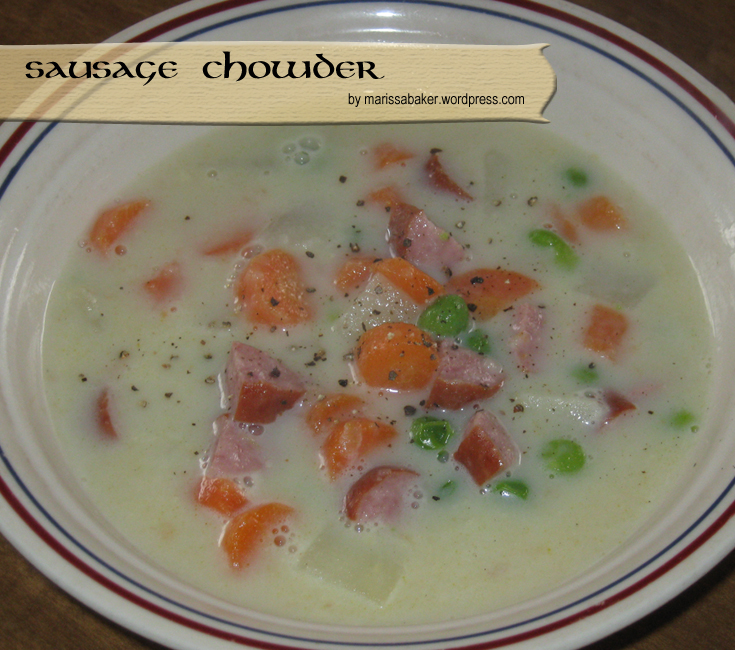
Here in Ohio, we’re back to weather that would make a penguin shiver. The only decent thing to do is make pots of creamy soup for lunch and then curl up with a warm blanket, a book, and a cat. Or you could share the soup with the cat, which Tiger seems to think is a good idea. He’s taken to begging whenever I sit down to eat anything, even if he knows he doesn’t like it (such as scrambled eggs).
I’m not sure if there ever was an original recipe for this soup — I wrote it down while watching my mother throw ingredients in a pot. It’s tasty and easy to make, which is why it and Cheese Burger Soup figure so prominently in our eating habits this time of year.
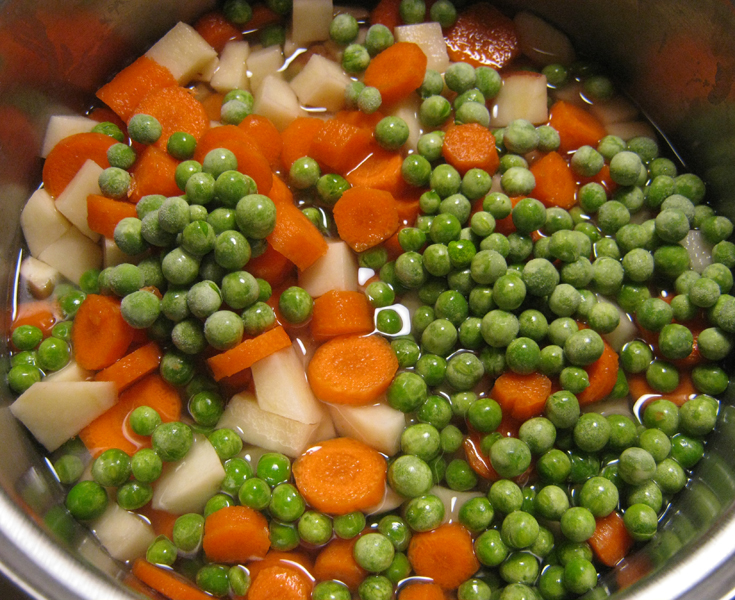
Place chopped potatoes, carrots, and peas in a large sauce pan. Add 2 cups water and bring to a boil.
Meanwhile, cut turkey sausage into cubes. Add sausage, chicken base, and onion powder when mixture in pot boils. Reduce heat and simmer till carrots and potatoes are done.
While vegetables are cooking, place flour in a small bowl or measuring cup and gradually whisk in milk until smooth. Once the vegetables are tender, add milk and flour to cooked mixture.
Add black pepper and salt to taste and a pinch of cayenne pepper. Turn up temperature to medium-high and stir regularly until the soup bubbles and thickens. Serve warm.
I was talking with a friend some weekends ago about items we have on our “future husband” and “potential boyfriend” lists. We were saying how it would be nice if we could find out more easily whether or not a guy was someone we would like to date before we agreed to go out with him, and I suggested (half-jokingly) “I say we prepare a detailed questionnaire for potential boyfriends and ask for at least 3 character references.” The more we talked about it, the better the idea sounded. After all, when you apply for a job, you have to answer a whole series of questions and you’re expected to provide references that can attest to your good character. Relationships are more important, and hopefully more permanent, so why wouldn’t we give as much consideration to finding out whether or not someone is right for you and you are right for them?
On the other hand, I’ve talked to more than one girl who was approached by a guy who was clearly working his way through a list of questions as they talked. They felt like they could see him putting mental check-marks down as he covered each topic. Ew … that’s creepy! We certainly don’t want to end up like that.
Non-creepy Questions
As I continued to think about this idea, I realized it would be less helpful to run people through a “prefect person checklist” than to have some kind of guideline for clarifying what we need in a relationship. There are certain things I think of as non-negotiable, such as a having a relationship with God. If I don’t clarify what that means to me before I meet someone, though, I might find myself making excuses for a guy because I like him, even if his beliefs differ from mine on significant points.
Before our conversation about surveying boyfriends, I came across something titled “My Little Book of Whether Or Not He’s Worth It” by Brittany Baily. There is much to like about her points, particularly her emphasis on not settling for a guy who treats you with disrespect. But I feel this kind of guide misses two very important things: 1) it ignores the importance faith plays in a relationship, and 2) it focuses entirely on what I need/want in a relationship. For my list, I wanted to address the need to have God as the center of your relationship, as well as the fact that a relationship can’t be all about what you want — you also have to think of the other person’s needs and be the kind of person they are looking for.
I’ve presented my list in a questionnaire form, mostly because of the conversation which prompted this post. I would advise against actually passing them out to potential boyfriends or girlfriends (but if you do, be sure to let me know how it goes!). Think of it as a guide to learning important things about the person you are considering, or in, a relationship with. You might want to fill one out with the answers you think you would like a potential dating partner to fill-in, and then answer one for yourself. Would your ideal match like the way you filled out your survey? If you meet someone who would answer one of these questions differently than you think you would like, will you be irritated by that or learn to live with it?
Relationship Questionnaire
Spiritual
How would you describe your relationship with God? (you can’t expect someone to love you the way you deserve/need/want to be loved if they do not love God even more than they love you)
What do you consider a good amount of time to spend in prayer and study on a daily basis? (how much time they give to God is an indication of whether or not they are worth your time)
How important is fellowship with other believers to you? What influences your decisions about which church group(s) to attend?
Relational
What kind of boundaries (physical and emotional) would you want to set in a dating relationship?
How much time do you envision spending together in person, online, or on the phone while dating? Will you write letters and/or emails?
What would make you mistrust someone you were dating?
Why didn’t your previous relationships work out?
How do you handle money? Are you a spender? a saver? some other money personality?
Personal
Are you typically introverted or extroverted? would you be comfortable spending time with someone who is more introverted/extroverted than you are?
How do you express anger?
How do you handle conflict?
Do you know what your primary love language is?
Is there anything in your past that you wouldn’t want to tell someone you just started dating, but probably should before you get married?
What do you consider your positive characteristics?
What do you consider your negative characteristics?
Family
Do you want kids? How many? Would you consider adoption, and if so under what circumstances?
If you want kids, how would you like to educate them? Home school? Public school? Private school?
Would kids be encouraged to pursue higher education, if that’s what they want?
What do you consider appropriate discipline for young children? for teenagers?
Is it important to live near the extended family? Why or why not?
What kind of influence, if any, should our parents and family have over our relationship?
Are you closer to your mother or to your father? Why?
One Last Note
I hope you find these helpful. Feel free to add suggestions — I can continue to edit this based on feedback.
I also want to add that I talked about these questions with the friend who first gave me the idea, and requested feedback from a couple who has been happily married for almost 27 years — my parents. I’ve also been reading about psychology, love, and relationships for years, and drew upon that information for some of these points.
I’ve finished making my way through a study of Proverbs, in preparation for my church’s women’s group discussion about favorite proverbs that is taking place this afternoon. My first post covered five proverbs from chapters 1-10, the second covered five from chapters 11-20, and this last post is for chapters 21-31. I still haven’t decided which of these 15 is my favorite, but at least I’ve narrowed it down to 15.
11: Reputation
A good name is to be chosen rather than great riches, loving favor rather than silver and gold. (Prov. 22:1)
I just heard a sermonette last week about God giving people names with meanings that fit the roles He designated them for — Jesus = savior; Paul = small; Peter = a little stone; Abraham = father of a multitude. From what I understand, names in Hebrew thought are inseparable from the essence, character, and reputation of a person. Therefore, it is better to have a good reputation, a name worthy of respect, than to have great riches. The word for “favor,” which is described as better than silver and gold, is from the word chen (H2580), and it means “favor, kindness, grace, loveliness, charm, preciousness.”
12: Deliverance
For a righteous man may fall seven times and rise again, but the wicked shall fall by calamity. (Prov. 24:16)
It doesn’t promise that if you are a just person you will never fall — it says you will be able to get back up rather than fall deeper into mischief. “Many are the afflictions of the righteous,” David said, “but the Lord delivers him out of them all” (Ps. 34:19). If — when — we fall, we can be assured that God is holding our hand and will help pick us back up (Ps. 37:24).
13: Friends
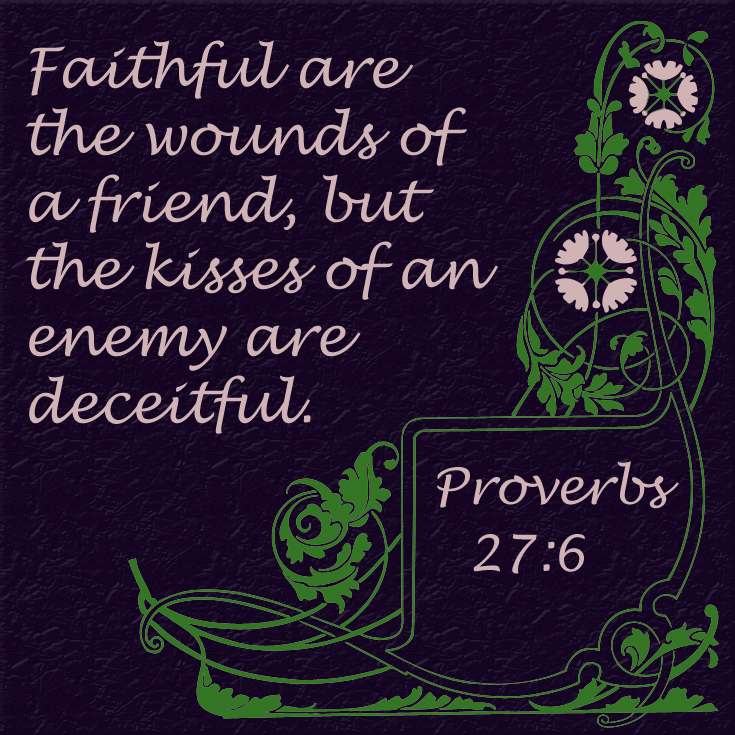
Faithful are the wounds of a friend, but the kisses of an enemy are deceitful. (Prov. 27:6)
King Lear would have been a very different play had the titular character been heeding this advice. When a friend wounds you, it is generally 1) an accident, or 2) with a view to your good. David wrote, “Let the righteous strike me; it shall be a kindness. And let him rebuke me; it shall be as excellent oil; let my head not refuse it” (Ps. 141.5). It might make us angry at first, but if we are honest with ourselves, we can often see that we were reproved out of love, and that we become better people with a stronger friendship as a result. In contrast, listening to the flattering words of those who secretly seek our hurt can only lead to grief.
14: Guardrail
Every word of God is pure; He is a shield to those who put their trust in Him. (Prov. 30:5)
Here we leave Solomon’s proverbs and read “the words of Agur the son of Jakeh” (Prov. 30:1). This is a two-fold promise. Firstly, that God’s words are free of imperfections. As such, it is all profitable and no part should be ignored or neglected (2 Tim. 3:16). Secondly, that the Lord shields those who trust in Him. This was a frequent subject in Psalms, such as “For the Lord God is a sun and shield; the Lord will give grace and glory; no good thing will He withhold from those who walk uprightly” (Ps. 84:11). Connecting these two points is the fact that God’s commands are designed to protect us, as illustrated by this comic I saw on Facebook the other day.
15: Beauty
Charm is deceitful and beauty is passing, but a woman who fears the Lord, she shall be praised. (Prov. 31:30)
This is from the end of the virtuous woman passage contained in “words of King Lemuel, the utterance which his mother taught him” (Prov. 31:1). When I was younger, I latched on to this verse as a substitute for my perceived lack of beauty — if I couldn’t be pretty, I could at least fear God and earn praise that way. As I’ve become more comfortable with myself and more mature as a Christian, my views on this verse have changed. I concentrate more on the last half of the verse, asking “How can I be a woman who fears the Lord?”
Do not let your adornment be merely outward—arranging the hair, wearing gold, or putting on fine apparel — rather let it be the hidden person of the heart, with the incorruptible beauty of a gentle and quiet spirit, which is very precious in the sight of God. (! Pet. 3:3-4)
I found this recipe on Pinterest, and it’s the only cinnamon roll recipe I make now. It’s originally from a blog called pReCiouS MoMentS. I’ve changed measurements that were in grams to cups or tablespoons, to make it easier to American cooks to follow. I also changed the scalding instructions — I wanted an exact temperature to aim for so I didn’t scorch the milk or kill the yeast, and it takes much less than an hour for my milk to cool to the right temperature. My rolls also have less filling, and I’ve added a glaze.
Mix milk, sugar and vegetable oil in a pan. Scald by heating to 150°F. Leave to cool for about 20 minutes, or until the temperatures is between 105°F and 115°F. Sprinkle yeast over the scaled mixture and let sit for about 5 minutes.
Place 2 cups flour in a mixing bowl. Make a well in the center and add scalded mixture. Stir with a spatula until it comes together to form a thick batter. Cover and let the batter sit for at least 1 hour.
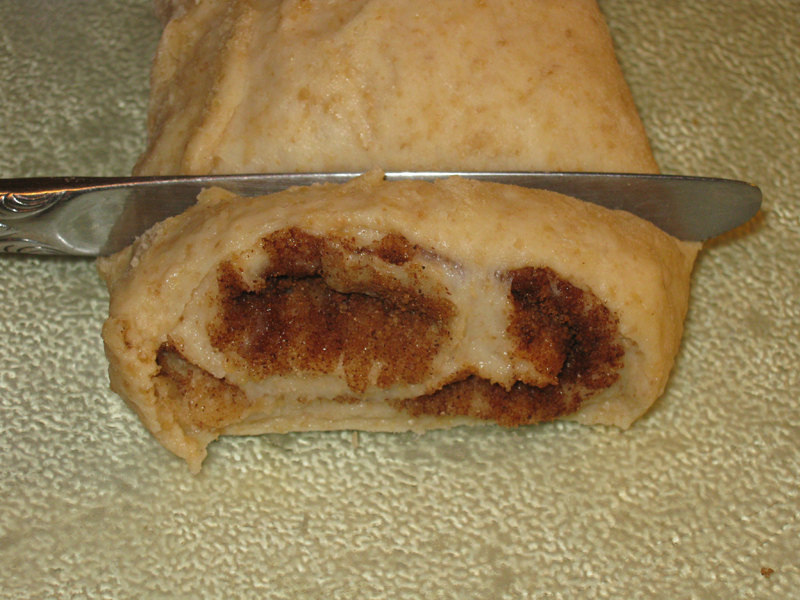
I was probably cutting them a little less than 1-inch thick. You could also just cut it into 20 equal size slices.
Add the remaining 1/4 cup flour, baking powder, baking soda, and salt. Stir until the mixture comes together. Rolls can be made now, or covered and chilled until needed. Dough will be easier to work with if chilled.
When ready to make the rolls, mix ground cinnamon and sugar in a small bowl. Dust the work surface and the top and bottom of dough freely with flour. Roll out the dough into a thin, rectangular shape. Dust the dough and work surface with flour when necessary.
Brush the rolled out dough with melted butter. Sprinkle the cinnamon sugar mixture evenly over the surface. Roll the dough neatly in a line towards you, rolling as tightly as possible. Pinch the seams to seal.
Top image: rolls before rising. Bottom image: rolls after rising. The size change isn’t really noticeable until after baking
Cut into 1-inch thick slices and arrange in a baking pan greased with butter. Use one 9×13-inch baking pan, or two 8×8-inch baking pans. Place the rolls close together so that they are almost touching.
Cover and leave to rise for 30 to 60 minutes, or until the rolls double in size. Rolls can be left to chill in the fridge over night and baked the next morning. If rolls have doubled in size in the refrigerator, bake right away. Otherwise leave to sit on counter until they double. Bake in preheated oven at 375°F for 12-16 minutes, or until golden brown.
Let rolls cool on the counter. Mix glaze ingredients and drizzle over cooled rolls.
I recently set up an account with my favorite name website, NameBerry. For me, it’s almost as potentially addictive as Pinterest — I could spend hours browsing names, interacting with other writers, and discussing the best names for other people’s children. One of the forum topics I stumbled across last week was about favorite names from each letter of the alphabet.
When I tried to fill out the alphabet chart, there were some letters (A, C, and S) that were hard to narrow down to just one name each for boys and girls. Other letters (O and U), I had hard time finding anything I liked or would actually use even on a fictional person. It was fun, though, and I decided to share it here as well as on that site.
I’ve mentioned my name obsession before, along with a few of my favorite names. This list is longer, and includes a few that I like the sound of more than the meaning. The two that aren’t linked to NameBerry or another website are from fantasy stories. Brigan is my favorite character from Kristian Cashore’s bookFire, and while it is used as a last name there doesn’t appear to be a distinct meaning. Faramir is from Tolkein’s Lord of the Rings and means “sufficient jewel” or “jeweled hunter” in Elvish.
As I continue my study of Proverbs, I keep finding more and more to put on my favorites list. Last week, I shared five favorites from the first 10 chapters of Proverbs. Here are my top five from chapters 11 through 20.
I’m having a hard enough time narrowing it down to five verses for every 10 chapters — I’m not sure how I’ll settle on just one favorite for our study discussion next month. Perhaps I’ll bring a list roughly organized by which one I want to talk about most, and then cross-off any that someone mentions before I do.
6: Graciousness
A gracious woman retains honor, but ruthless men retain riches. (Prov. 11:16)
It is for the first half of this verse that I have included it here. Ever since my career adviser at OSU told me I was very gracious in the way I responded when she had to take a phone call while we were meeting, I’ve paid extra attention to verses like this. I liked how it felt to be considered gracious — it was a description I’ve always thought held value, but this was the first time someone applied it to me. I want to be a grace-filled woman, and I hope to give people that impression of me.
7: Desire
Hope deferred makes the heart sick, but when the desire comes, it is a tree of life. (Prov. 13:12)
There are many hopes I have that have been deferred (marriage and a family of my own, to name one). I have to believe, though, that God does not want to make our hearts sick. Therefore, when our hopes are deferred, it must be for a good reason. Perhaps it is to teach us to trust Him long-term — if all our hopes were fulfilled instantly I doubt we would appreciate His gifts very much. Psalm 37 says if we delight in the Lord, “He shall give you the desires of your heart.” If we trust in Him and commit lives to following Him, He will bring about our desires (Ps. 37:4-5). God wants to give us good things. He wants us to be delighted.
8: Peace
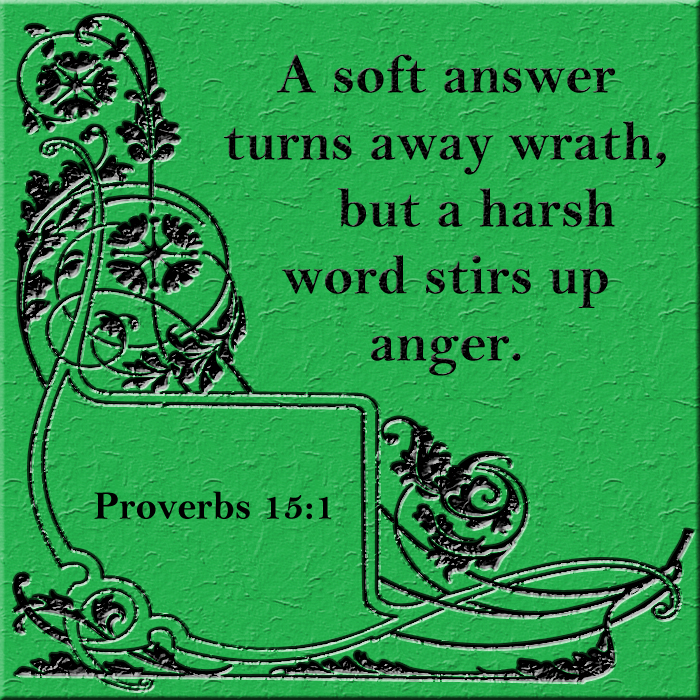
A soft answer turns away wrath, but a harsh word stirs up anger. (Prov. 15:1)
A cross reference in my study Bible gives an example of this in Judges 8:1-3. The men of Ephraim were chiding Gideon sharply for not calling them to fight with him against Midian. Instead of answering them in kind, he diplomatically diffused the situation and “their anger toward him subsided.” The flip side of this principle, of course, is that being snappish and peevish stirs up an angry response in others and leads to escalating arguments. We need to be moving toward peace instead of anger. “Blessed are the peacemakers,” Christ said, “for they shall be called sons of God” (Matt. 5:9).
9: Thoughts
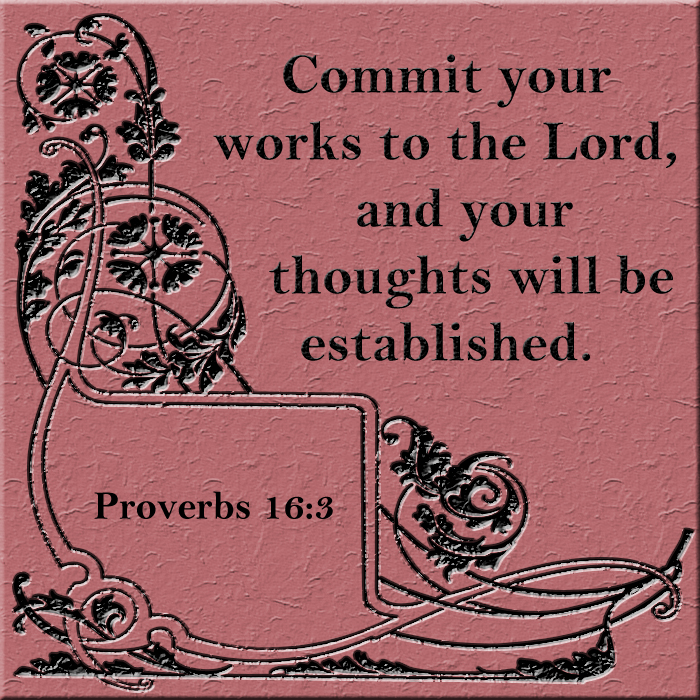
Commit your works to the Lord, and your thoughts will be established. (Prov. 16:3)
I find it interesting that in this verse, it says your “thoughts will be established.” Related verses talk about God establishing our ways and caring for our wants, but this one focuses on the state of our minds. It is like Philippians 4:6-9 in a single verse.
10: Quiet
He that hath knowledge spareth his words: and a man of understanding is of an excellent spirit. Even a fool, when he holdeth his peace, is counted wise: and he that shutteth his lips is esteemed a man of understanding. (Prov. 17:27-28)
How little we value the skill and gift of quietness in today’s society. Words fitly spoken are beautiful (Prov. 25:11), but there are also many times when it is more beautiful to be “swift to hear, slow to speak” (James 1:19).
 3 to 4 potatoes, peeled and cubed (about 3 cups)
 1 1/2 cups milk
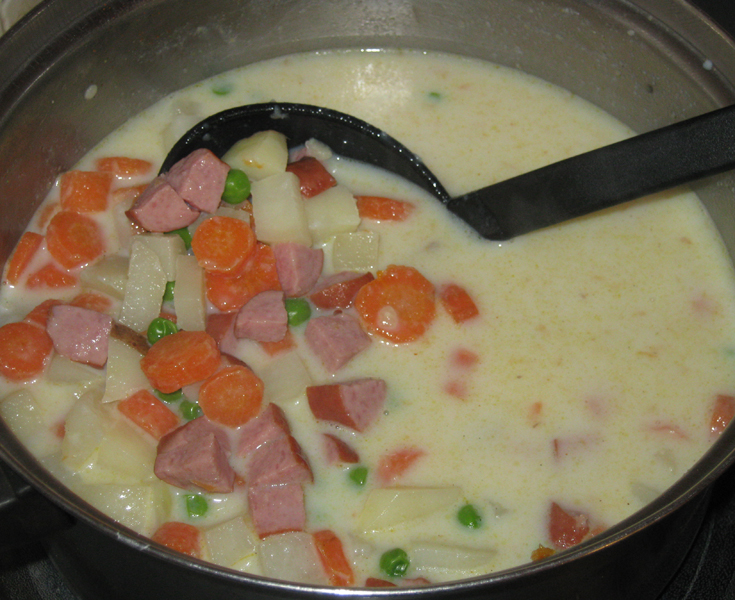 While vegetables are cooking, place flour in a small bowl or measuring cup and gradually whisk in milk until smooth. Once the vegetables are tender, add milk and flour to cooked mixture.





 Like An Anchor