Lessons From My Nervous Cat

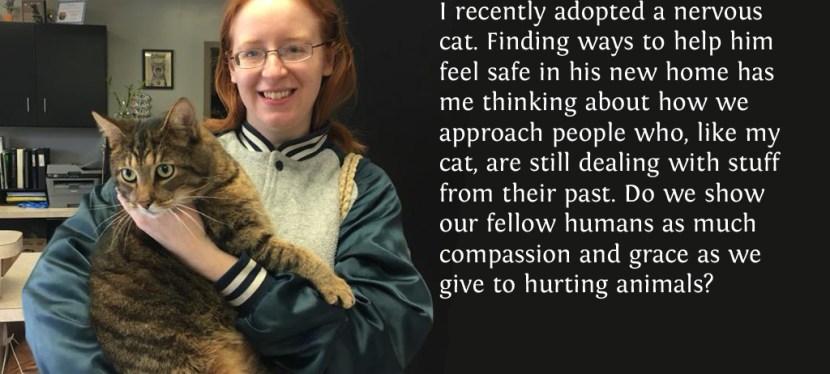
Meet Flynn. He’s 2 years old, weighs 15 pounds, and lost his previous home (not sure of the exact circumstances). I brought him home from a local humane society a couple weeks ago. I’d asked them if they had a sweet, cuddly cat that would do well in a single-cat home. They recommended Dorito (I’d originally planned to keep his name, but he doesn’t respond to it at all and it just didn’t “feel right” to me. Hence the name change, after Flynn Carsen from The Librarians).

Lessons From My Nervous Cat | marissabaker.wordpress.com
Flynn Carsen and Flynn the Cat

My new kitty cried for the entire car ride home. Once I released him from the cat carrier he promptly hid under the couch for the next six hours. Poor little thing’s been through a lot. But we’re starting to settle in and get used to each other. And after two weeks together I’ve learned that

  • He loves meat and will beg in the kitchen for beef, poultry, and fish
  • Catnip mice are his favorite thing. He just lays on the floor while hugging and chewing on them
  • My fleece mermaid blanket must have a texture he likes, since he danced around with a look of wonder on his face the first time he touched it. It’s our favorite blanket
  • His purr is furniture-rattling in volume and intensity
  • He likes sleeping with people. Usually he picks my bed and spends the night curled up near my feet or legs

But I’ve also learned some other things:

  • He’s terrified of people in motion. If you stand up or walk into a room his eyes get big and he runs away
  • If you reach out toward him he flinches, like he expects you to hit him. But he’s sweet and affectionate if you’re sitting down and he comes up to you
  • He doesn’t like being picked up
  • The slightest noise is enough to make him startle awake, leap in the air, and/or flee the room
  • He spends most of the day hiding, only coming out to spend time with us in the morning and evenings

Lessons From My Nervous Cat | marissabaker.wordpress.com
hiding under the bed

I don’t know what happened in Flynn’s past as Dorito. Being a storyteller, I have a completely theoretical narrative that goes like this: Dorito’s owner was a sweet, elderly person who was confined to a wheelchair. They fed Dorito in the kitchen, invited him to sleep in the bed, and showered him with love. But this person had a caretaker that came in during the days and wasn’t kind to the cat. So Dorito learned that people walking toward him meant he’d be kicked or grabbed or chased out of the room. And then when their elderly person passed away, Dorito was dumped off at the Humane Society.

Of course I have no idea if that’s anywhere near the truth. What I do know is that I’ve adopted a very nervous cat. He startles at the slightest noise. He flinches if you touch him. He doesn’t do “normal cat” things like lay around all day and nap (at least not out in the open). And he’s taking a very long time to relax around us, especially my 6′ 3″ younger brother.

After a few days of this, someone in my family described Flynn as a “useless cat” because he won’t cuddle. And then someone asked if I could return a defective cat. I was behind the couch at this point trying to convince Flynn to come out and raised my voice just enough to say, “He’s scared and he needs our love and understanding!” After that the (mostly) joking suggestions that Flynn wasn’t the cat we were looking for stopped. He also started becoming more friendly, which helped with that.

Lessons From My Nervous Cat | marissabaker.wordpress.com
Flynn’s favorite blanket

I don’t know what in Flynn’s past made him so scared. But I know that right now he’s easily startled, worried, and only wants touched on his terms. So I decided to love him where he’s at and work with him. It’s not going to help if I lecture him, saying he’s got it so good now that he should just suck it up and move forward with his life. He needs patience. He needs someone not to push his boundaries because that will only prove we can’t be trusted not to go too far. He needs someone there for him when he does want held and petted.

And then I started thinking, isn’t that what hurting people need too? Love, understanding, acceptance, and someone to be there for them on their terms. But how many times do we meet someone who’s going through something we don’t understand and yet we treat them as if they’re “lesser than” because they’re still showing signs of their past trauma? Why are we so much more willing to extend grace and compassion to a nervous cat than to an anxious, depressed, or hurting human?

Then I had another realization. The way I’m treating my cat is the way I want to be treated when I’m anxious, nervous, or on the edge of panic. I want patience, understanding, and someone who will ask what I need instead of pushing me to just get over it. And it’s also the way I should treat myself (I’ve recently started seeing a counselor to get help working through my anxiety and she was delighted with this realization). We must give ourselves the same compassion, love, and permission to be ourselves that we long for from other people and should extend to others who are going through similar things.

So that’s what I’ve been learning from my nervous cat. I think he’s turning out to be a pretty good teacher.

Lessons From My Nervous Cat | marissabaker.wordpress.com

Make Pleasing God Your Lifestyle By Desiring What He Requires

Last Sabbath, I was at a young adult weekend centered on the theme “Desire What The Lord Requires.” All the seminars focused on Michah 6:8, which reads:

He has shown you, O man, what is good. What does Yahweh require of you, but to act justly, to love mercy, and to walk humbly with your God? (WEB)

One speaker mentioned something that really stuck in my mind. In this passage, God doesn’t tell His people to be just, merciful, and humble. He uses specific verbs instructing us to act, love, and walk in certain ways. This passage is focused on actions that come from developing God’s character. It goes beyond being like God to actively walking with Him. And though it doesn’t say so here, this should be something that we want to do rather than something we do just because it’s a requirement. God has always been concerned with the state of our hearts and the motives behind why we follow Him. We please Him when we do what He requires willingly and desire the same things He does.Make Pleasing God Your Lifestyle By Desiring What He Requires | marissabaker.wordpress.com

Act Justly

Matthew Henry’s and Adam Clarke’s commentaries says that to do or act justly means “to give to all their due.” Giving everyone what they are “due” from us includes giving God all our hearts, minds, souls, and strength, treating our neighbors as we would like to be treated, and also treating ourselves the way God intends.

Basically, acting justly is summed up in the two greatest commands (Matt. 22:36-40). That’s because the concept of justice is tied to God’s law, and the entire law hangs on the commands Jesus shared about how to love God and our neighbors. Read more

Be Of The Same Mind: God’s Intention For Peace In His Church

If God says He hates something, is it a thing we should be doing in the church? Of course not! Those who love God do things that are pleasing in His sight (1 John 3:22). We don’t always do that perfectly, but it’s supposed to be our goal. And when we miss the mark, we repent and change and try again.

One of the things the Lord hates and considers an abomination is “he who sows discord among brothers” (Prov. 6:19, all scriptures in this post are WEB version). In Hebrew, “sow” is shalach (H7971), and it means to send out or shoot forth, as in a growing plant putting out leaves. God hates it when someone plants and spreads strife or contention (medan, H4090) among those who are metaphorical or literal family (ach, H251).

So what does it say about us as a church body when there are divisions, disagreements, and rifts in our relationships and beliefs? In some cases, we can disagree on things that are open to interpretation and still fellowship peaceably, which is the right thing to do (Rom. 14). But all too often, when people in the churches disagree they start attacking or ignoring each other rather than working through their issues, resolving doctrinal conflicts, and seeking peace and unity as God intends.

Be Of The Same Mind: God's Intention For Peace In His Church | marissabaker.wordpress.com
Photo credit: Shaun

Menary via Lightstock

Strife Does Not Come From God

The greatest commandments are to love God with all your heart, mind, soul, and strength and to love your neighbor as yourself. In contrast, strife is stirred up by hatred, not love (Prov. 10:12). And the people who spread strife are called perverse, lovers of disobedience, greedy, and angry (Prov. 16:28; 17:19; 28:25; 29:22). Those aren’t the sort of things God wants to see when He looks at the people in His chruch.

Now the deeds of the flesh are obvious, which are … hatred, strife, jealousies, outbursts of anger, rivalries, divisions, heresies, envy … of which I forewarn you, even as I also forewarned you, that those who practice such things will not inherit God’s Kingdom. (Gal. 5:19-21)

More than half the things in this “works of the flesh” list have to do with discord and disunity. In contrast, the fruit of the Spirit is things like “love, joy, peace, patience, kindness, goodness, faith, gentleness, and self-control” (Gal. 5:22-23). Those are the things that stop arguments before they even start.

This Goes Beyond Not Fighting

Scriptures make it quite clear that God puts a high value on peace. Though He warns us that following Him will set people against you (Matt. 10:34-36; John 15:18-21), that sort of strife should only happen between you and the world. There’s supposed to be peace in the church among God’s people.

So then, let us follow after things which make for peace, and things by which we may build one another up. (Rom. 14:19)

On your part, you’re supposed to do what you can to live peacefully with everyone you meet (Rom. 12:18; Heb. 12:14). This is especially important in the church, where it’s an attainable goal because all the believers are supposed to be working toward peace (1 Thes. 5;13). God intends for there to be unity in His church. Read more

In The Age of Piracy: Reading and Watching Captain Blood

As I’ve mentioned once or twice before, I have something of an obsession with tall ships. This is probably a result of my love for stories set during the Age of Sail. One such story is Captain Blood by Rafael Sabatini, first published in 1922.

This book wasn’t on my original Classics Club list. I’d already read it and hadn’t intended a reread, especially after being disappointed by Sabatini’s Bardelys the Magnificent. But I ended up with a digital copy on my phone a year or so ago and started reading it while in a waiting room. So of course I had to finish it — one simply doesn’t abandon an adventure novel in the middle of the story.In The Age of Piracy: Reading and Watching Captain Blood | marissabaker.wordpress.com

I’m (once again) in the midst of a pirate obsession, for which we can thank the recent release of Daughter of the Siren Queen (sequel to my 2nd favorite novel of 2017, Daughter of the Pirate King). So I started reading a book on the history of pirates in reality and fiction, which prompted me to watch the 1935 version of Captain Blood. And that brings me to my decision to write a post for the classic novel.

But first, a brief digression about the film, which is really quite impressive. $1 million went into its production (to put this in perspective, online estimates tell me that $1 in 1935 has the same buying power as $17-18 today). It launched Errol Flynn’s and Olivia de Havilland’s careers and made an overall profit of $1.5 million. And it was scandalously realistic for a 1930s audience. In fact, a screenwriter named Robert Lord wrote to the producer, Hal Wallis, asking “Why do you have so much flogging, torturing, and physical cruelty in Captain Blood? … Women and children will be warned to stay away from the picture — and rightly so” (quoted in Under The Black Flag by David Cordingly, p.174). Read more

How Much Have You Grown In A Year?

As we approach the Passover season, it’s traditionally a time of reflection and self-examination. It’s good to have moments like that where we consider what God has to say about our lives, the areas where we need to repent, and different ways we can continue to grow and change.

At my Messianic congregation, they’ve shared that certain rabbis teach that if you are still in the same place you were a year ago you have backslid. We can’t maintain a sort of “status quo” in our walk of faith. Either we’re moving toward God or we’re moving away. There’s no place for complacency in a Christian life.

God expects growth. That doesn’t mean we need to be constantly on-edge and second guessing if we’re “good enough,” though. He doesn’t expect us to already be perfect, but He does expect us to keep going that direction. Such growth involves becoming more like God in every aspect of our lives. The more we grow, the more His character, desires, priorities, etc. are reflected in our own lives.

How Much Have You Grown In A Year? | marissabaker.wordpress.com
Photo credit: Pearl via Lightstock

In Touch With The Great  Commandments

What are the most important things to focus on as we try to grow as Christians and learn more about God? You’ll hear various answers. Some say preach the gospel, citing the great commission as our primary goal. Others devote themselves to good works. Some study prophecy. I like to point to the passage where Jesus identified the greatest commandments.

Jesus answered, “The greatest is, ‘Hear, Israel, the Lord our God, the Lord is one: you shall love the Lord your God with all your heart, and with all your soul, and with all your mind, and with all your strength.’ This is the first commandment. The second is like this, ‘You shall love your neighbor as yourself.’ There is no other commandment greater than these.” (Mark 12:29-31, WEB)

We can all tell how important these commands are from the way Jesus describes them. But I think we too often see them just as a starting place when they should be a continuing focus. We should never stop learning how to love God and our neighbors.

In Jesus’ letter to the Ephesian church, He said, “I have this against you, that you left your first love” (Rev. 2:4, WEB). We’re not told exactly what that first love is, but since the first commandment is to love the Lord your God I don’t think it’s too much of a stretch to say the Ephesians’ problem was related to losing touch with the greatest commandments. Read more

Who Was “God” In The Old Testament?

Almost four years ago, I wrote a post addressing the phrase “the God of the Old Testament.” Little did I know then that it was going to explode from being an interesting point of doctrinal dispute into a contention that could split churches. I know of at least one group that has already divided over the question, “Who was the God of the Old Testament?” And now the related issue of whether Jesus was created by the Father or existed before His human birth is starting to tear apart one of my local churches.

In the post from four years ago, I described the phrase “God of the Old Testament” as coming under the category of “stupid things we say in the church.” I still believe that. The wording is misleading and confusing, often causing inaccurate statements and doctrinal fallacies. In reality, the God we worship today is the exact same God (two beings in one) that has always existed. Scripture is quite clear on this point. And trying to argue that either the Word who became Jesus OR the Being we now know as the Father was the only “God of the Old Testament” is an exercise in futility (and quite possibly blasphemy as well).

The arguments on both sides are no longer just an intriguing discussion about scripture. They’re becoming a stumbling block . I’ve heard that some people in the group I mentioned which has already split are so confused they don’t even know who to pray to anymore. And studies into this topic, which may have started out with good-hearted Christians seeking to understand the word of God more fully, are turning into schisms, contentions, and heresies that cannot be pleasing to God. He does not look kindly on those who generate endless debates (Tit. 3:9), fracture His body (1 Cor. 1:10; 12:25), or lead His little ones into error (Matt. 18:6). This has to stop.Who Was "God" In The Old Testament? | marissabaker.wordpress.com

Why Is This So Contentious?

I think part of the issue with resolving questions like this is that we often fail to look at the Bible as a whole. We get so focused on digging out the slightest variations in meaning for a specific scripture that we don’t look up from analyzing a single sentence long enough to see there’s a whole narrative that clears things up. That’s something I talked about in my post titled, “Why Does It Matter If Jesus Existed Before He Was Human?

Another way we fall prey to deception in this area is what I call the two ditches problem. Human beings aren’t good at finding balance in our ideas. We tend to avoid the middle of the road. So if we discover that we’ve been taught an extreme view in one direction (for example, that Jesus is the only “God of the Old Testament”), there’s a temptation to head straight for the opposite ditch (e.g. that Jesus wasn’t around at all in the Old Testament). In trying to avoid one error we come up with a new one.

Something else that might be playing a role for certain people is the temptation to come up with their own doctrine. If you’ve been lied to by church leaders in the past (and far too many of us have), we might want to question everything we’ve been taught. There’s nothing wrong with that in and of itself. In fact, following blindly is a great way to end up in errors that could be avoided if we were studying the Bible for ourselves. But if you start feeling like you have to come up with a new or alternative way of seeing scripture that is “your own,” then you can run into problems. Chances are, you’re not the only person God is revealing “new truth” to. And if you have to argue your point out of obscure commentaries or a possible mistranslation when the people who believe something else have myriads of clear scriptures and the bulk of Biblical scholarship to back them up, then there’s a good chance you’re the one who’s wrong.

“God” Has Always Been Two

Let’s dive into the scriptures now. Some of this is going to be a repeat of the post I wrote four years ago, but I doubt most of you have read that and it’s good for context. We’ll begin in Genesis. Read more