The Classics Club

In my never-ending search for new things to write about, I stumbled upon The Classics Club by way of Carissa’s post at Musings of an Introvert. I love classic literature (not really a surprise to most of you — if someone doesn’t like at least some classic literature they probably shouldn’t major in English), so why not come up with a reading list and blog about each title? That will give me topics for 10 of Mondays blog posts for the next five years.

The Classics Club | marissabaker.wordpress.com

The challenge for those who join The Classics Club is to make a list of at least 50 books and read through it in no more than 5 years. I thought 10 books a year would be thoroughly doable (to put this in perspective, I’ve read 45 books so far this year), and so I posted my list and I’m signing up today. Some of them are re-reads, but most of the ones on the list are new to me. The titles on the list may change as I read, but here are the one I’m starting out with (*indicates a re-read):

  1. Adams, Richard: Watership Down*
  2. Anonymous: The Arabian Nights
  3. Austen, Jane: Lady Susan
  4. Beagle, Peter S: The Last Unicorn
  5. Bradbury, Ray: The Martian Chronicles
  6. Bronte, Anne: The Tenant of Wildfell Hall
  7. Bronte, Charlotte: Villette
  8. Burke, Edmund Burke: Reflections on the Revolution in France
  9. Burnett, Frances Hodgson: A Little Princess*
  10. Burnett, Frances Hodgson: The Secret Garden*
  11. Burney, Frances: Evelina*
  12. Burney, Frances: The Wanderer
  13. Burroughs, Edgar Rice: Tarzan of the Apes*
  14. Cooper, James Fenimore: The Red Rover*
  15. Cooper, James Fenimore: The Water-Witch
  16. Dickens, Charles: Bleak House
  17. Dickens, Charles: Oliver Twist
  18. Dickens, Charles: The Mystery of Edwin Drood
  19. Dostoevsky, Fyodor: The Brothers Karamazov
  20. Doyle, Sir Arthur Conan: The Hounds of the Baskervilles
  21. Doyle, Sir Arthur Conan: The Memoirs of Sherlock Holmes
  22. Doyle, Sir Arthur Conan: The Sign of Four
  23. Dumas, Alexandre: The Count of Monte Cristo
  24. Eliot, George: Adam Bede
  25. Eliot, George: Middlemarch
  26. Gaskell, Elizabeth: North and South*
  27. Gaskell, Elizabeth: Wives and Daughters
  28. Hardy, Thomas: Far From the Madding Crowd
  29. Hawthorne, Nathaniel: The House of the Seven Gables
  30. Hawthorne, Nathaniel: The Scarlet Letter
  31. Homer: The Iliad
  32. Homer: The Odyssey
  33. Keats, John: Poems
  34. Leroux, Gaston: The Phantom of Opera
  35. Malory, Sir Thomas: Le Morte d’Arthur
  36. Montgomery, L.M.: Emily of New Moon
  37. Poe, Edgar Allen: Collected Stories and Poems
  38. Radcliffe, Ann: The Mysteries of Udolpho
  39. Rousseau, Jean-Jaques: Emile
  40. Scott, Sir Walter: Waverly
  41. Shakespeare, William: Henry IV, part 1
  42. Shakespeare, William: Henry IV, part 2
  43. Shakespeare, William: Measure for Measure
  44. Shakespeare, William: Othello
  45. Shelley, Mary: Frankenstein
  46. Stevenson, Robert Louis: The Black Arrow*
  47. Swift, Jonathon: Gulliver’s Travels
  48. Tolstoy, Leo: Anna Karenina
  49. Twain, Mark: The Adventures of Tom Sawyer*
  50. Wells, H.G.: The Invisible Man

INFJs — please share your stories

Update: The book is finished, and you can download the final version here. Thank you so much for your interest!

I’ve started work on an INFJ e-book, and would like to ask you – my fellow INFJs – to share some of your personal experiences. I don’t want this to just be another description of the INFJ personality type. I want real stories that INFJ readers can relate to, and which will give non-INFJ readers insight into how we think. Specifically, I’m looking for short first-hand accounts of what life is like as an INFJ. You can share anything you like, but here are a few prompts:

  • How did you first discover your type, and what was your reaction?
  • In what ways do you feel different from non-INFJs?
  • What role does intuition play in your life?
  • How would you describe the way you feel emotions as an INFJ?
  • Are there any areas of your life or specific situation where you rely on thinking more than feeling?
  • How does an INFJ’s inferior function (Extroverted Sensing) show up for you when you’re stressed?
  • What do you wish other people knew about INFJs?

You would be credited by first-name only to protect your privacy, or I can give you a pseudonym if you prefer to remain completely anonymous. Alternately, if you want your full name used or me to direct readers to your blog I could do that as well. Everyone whose stories are used in the book will receive a free copy once it is finished. If you want to contribute, you can post responses as comments here, or get in touch through my contact form.

Kate Morton’s novels

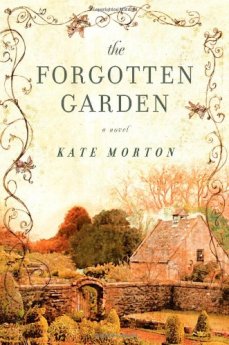
I love Kate Morton’s books. The first one I read, about 2 years ago now, was The Forgotten Garden. It was her second novel, and spans several time periods to discover the history of a girl abandoned on a ship sailing for Australia in 1913. It is not told in chronological order, and moves between the little girl, Nell, and her granddaughter Cassandra as they both travel to England and investigate Nell’s past as tied to the Blackhurst Manor on the Cornish coast.

One of the things I enjoyed most about this novel was the way it wove two different time periods together. If told in chronological order, the story may have been interesting but there would have been no mystery. This way of telling the story does not feel contrived, however, or as if the writer is telling the story out of order simply to confuse the reader with an elaborate plot.

The same is true of Morton’s third book, The Distant Hours, which I read last year.This one has more of a Gothic element. Though the story takes place in both present-day and the relatively modern World War II era, it still has clear ties to the more distant and mysterious past.

It was not until I read Daphne du Maurier’s book Rebecca for the first time a couple weeks ago that I realized what a great influence her writing style had been on Kate Morton (the inside cover of the dust jacket on one of Morton’s books even references du Maurier). A mystery uncovered through flash-backs. A young woman who discovers the past is even darker and more convoluted than she imagined. An ancestral home filled with secrets.

And that brings us to Kate Morton’s first novel, The House At Riverton, which I finally started reading. I’m about 2/3 of the way through now. This most likely means that I’m at the point in the book where I think I have everything pretty much figured out, and all my suppositions are about to be turned upside down. As I read this book, I realize another reason I love Morton’s writing style — there isn’t an extraneous scene in the book. Everything that happens builds the plot or contributes to essential character development. In novels this size (the shortest is 480 pages), that is an achievement.
I’m enjoying this novel quite a lot, partly for the reason that Morton’s writing style is just as enjoyable in her first novel as in later works, and partly because of the many parallels with Dowton Abbey (Morton’s book was published 3 years before the first season aired, so any similarities are coincidence or the script-writer pilfering from her). Unlike the other two novels, where one character in the present is investigating another in the past, the 98-year-old narrator of this book is looking back on her own life and telling her secrets to her grandson and a film maker.

There is one more novel to read once I finish this one, Morton’s latest book The Secret Keeper. I think I will wait a little while before reading it, though, perhaps a whole year like I did in between her other books. I don’t like the thought of not having another one waiting for me when that one is over.

TheGeekSpa.com
don’t forget to check out new Sherlock and Doctor Who themed items in my Etsy store


Clearing Out Books

Clearning Out Books marissabaker.wordpress.com
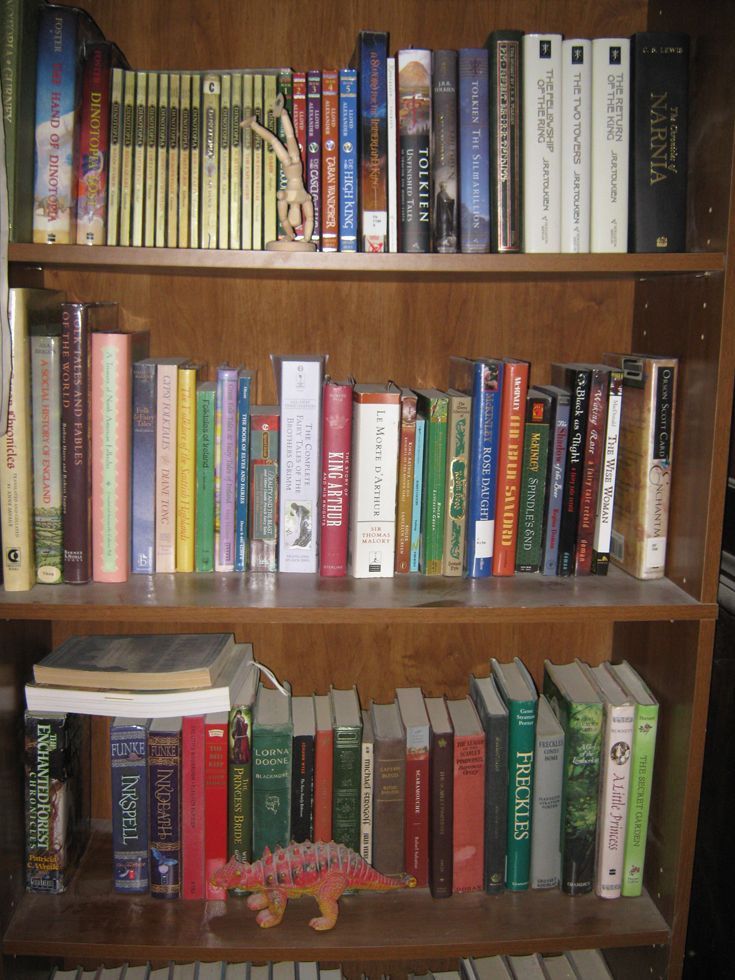
one of my bookshelves, complete with a dusty dinosaur

Our local library system has a book sale once a month, where they sell books, CDs, and other items pulled from the library collection or donated to the Friends of the Library. When I was there last Thursday, the room normally filled with VHS tapes and a couple DVDs had been taken over by history books. Not only that, but the shelves regularly allotted to history books were full, as was a shelf near the front of the building for new 900s books. It was as if they had gutted their history collection.

I managed to restrain myself and only brought home a few Medieval books that will be useful for research, but even through they are sitting on the floor for lack of shelf space I don’t feel good about that decision. I wish I could have given more of them a home. I’m not a bibliophile who refuses to destroy an old moldy paperback because it deserves respect as a book, but I don’t like to see perfectly good history books sitting unwanted on the shelves.

At least our library can sell them. Other libraries are chucking books in the trash when they pull them off the shelves. Not just the old moldy books either, these include new hardcovers. It makes me sad, and I want to bring them home and give them a nice comfortable spot on my shelves. The irony is, to make room for all these books I want to “rescue,” I’ll have to get rid of some books currently in my home library. Maybe I’ll donate them to the library book sale.

Empathic Feeling

I realized Tuesday night when I was reading Fire by Kristin Cashore and crying into the bath water that I wasn’t crying because I felt sad a character had died. I was crying because someone in the book felt sad that this character had died. Once I thought about it, I realized that at least half of the times when fiction moves me to tears, it is in empathy with the characters rather than my own feelings being affected. In other words, I’m crying because the character is crying, not because of what moved the character to tears. Sometimes it is both (Ender’s Game, for example).

This feeling other people’s feelings (fictional and real) is something I didn’t have much of a grasp on until I discovered my Myers-Briggs type and started reading what other INFJs wrote about being overwhelmed with the emotions of others. Adding high sensitivity to the mix only heightens this (here is a wonderful article about Elaine Aaron’s research on the Highly Sensitive Person).

A Range of Empathy

The extent to which INFJs report feeling other people’s emotions range from an awareness of how others are reacting, to not being able to remember the last time you experienced a feeling that belonged only to you. “You feel it, I feel it,” an anonymous INFJ wrote. I may not be quite ready to claim my feeling of and for others reaches that extent, but I share her decision to try and avoid encountering strong negative emotions (e.g. a news story about child molestation, a film where a family is torn apart, real-life conflict) because of how overwhelming it is — emotionally as well as physically in terms of headaches and stomach pain.

Managing Feelings

In INFJ Coach’s series of blog posts on “10 Steps to an Amazing INFJ Life,” part two is “Manage Those Pesky Emotions.” Her article is mainly about dealing with our own emotions when they surface, but the comments point out that this is only part of the problem. One commenter named Jennie wrote that she asks herself,

“Is this my emotion that I’m feeling, or is it someone else’s emotion?’ Many of us INFJs are emotional sponges for the emotions that other people are feeling. Our NF gives us a very high degree of empathy, but sometimes taking on other people’s emotions can be too much to handle.

The other side to this is what INFJ writer Cheryl Florus points out in Personality Junkie’s INFJ Strategies for Dealing with Emotions: Part I. Because an INFJ’s feeling is extroverted, we often have an easier time understanding the emotions of other people than our own emotions (for more on function stacks, see this post). We feel emotions strongly, but need to make an effort to learn how to experience and express them in a way that doesn’t seem overwhelming or uncontrolled. Often, writing down or talking about our emotions is a way to get them outside us so we can look at them more objectively (I keep a journal and talk to my closest family members). Sometimes, until I’ve done this, I’m not exactly sure what it is I’m feeling, let alone how it should be expressed and dealt with.

What about you? Are you an INFJ with experience feeling other people’s feelings (or a non-INFJ who does the same thing, because I’d love to hear from you)? Or are you someone who has never had this happen and thinks we’re crazy?

More Favorite Quotes

More Favorite Quotes from marissabaker.wordpress.comI was hoping to write a somewhat lengthy post today, but found I ran out of time to finish it. I didn’t want to just skip posting today, though, so I thought I’d share a few of my favorite quotes which were not yet listed on my Quotes page. These are all one’s I came across for the first time on Pinterest. I’d read several of Hans Christian Anderson’s writings before, however, and he is an author I like.

“Every person’s life is a fairy tale written by God’s fingers” — Hans Christian Anderson

This next quote is by Kurt Vonnegut, and I’m afraid I must confess I’ve never read any of his books. I like this quote, though, so I’ve included it here.

“Be soft. Do not let the world make you hard. Do not let pain make you hate. Do not let the bitterness steal your sweetness. Take pride that even though the rest of the world may disagree, you still believe it to be a beautiful place.” — Kurt Vonnegut

I was determined not to become a Tom Hiddleston fan and join the ranks of the crazy Loki fangirls. Then I started reading quotes from him (like these two), seeing interviews, and learning about his work helping children. I can admire a guy who likes kids, respects women, values humility, and describes his apartment as wall-to-wall bookshelves.

More Favorite Quotes from marissabaker.wordpress.com

“Stay hungry; stay young; stay foolish; stay curious. And, above all, stay humble because just when you think you’ve got all the answers, is the moment when some bitter twist of fate in the universe will remind you that you very much don’t” — Tom Hiddleston.

“This generation has lost the true meaning of romance. There are so many songs that disrespect women. You can’t treat the woman you love as a piece of meat. You should treat your love like a princess. Give her love songs, something with real meaning. Maybe I’m old fashioned but to respect the woman you love should be a priority” — Tom Hiddleston