Anxiety Kitty: The Not-So-Surprising Way Pets Improve Mental Health

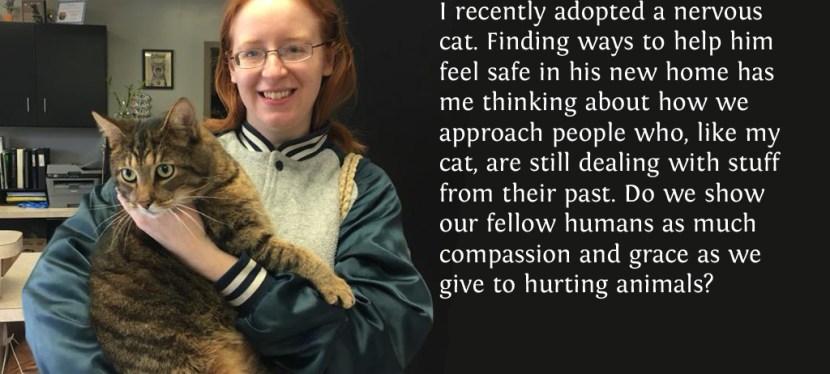
Remember that nervous cat I adopted a few months ago who spent all his time hiding under couches and beds or in closets? (click here to read “Lessons From My Nervous Cat”). My plan was to pour as much patience, love, and understanding into his life as I want people to show me when I’m scared. I wanted to show him that he had a safe home now.

Well, it’s working. Flynn is turning into quite the friendly cat, especially with me but also with the rest of the people he sees every day. And he’s even getting better around non-family members. We had several people over for dinner last night for a total of 14 humans around. Flynn hid when they were all in the house together, but after we sat down to dinner (some outside and some in the dining room) he actually wandered around out in the open and let people he didn’t know pet him.

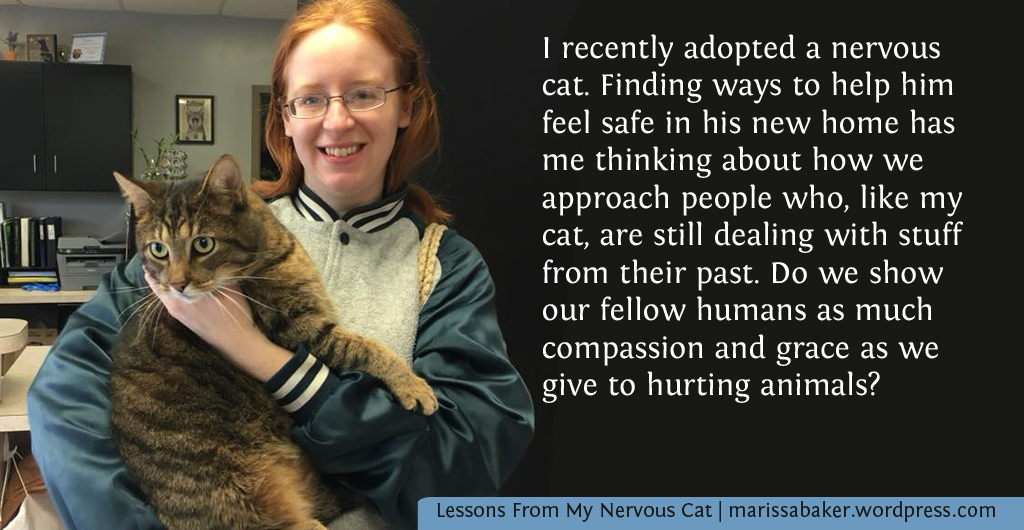
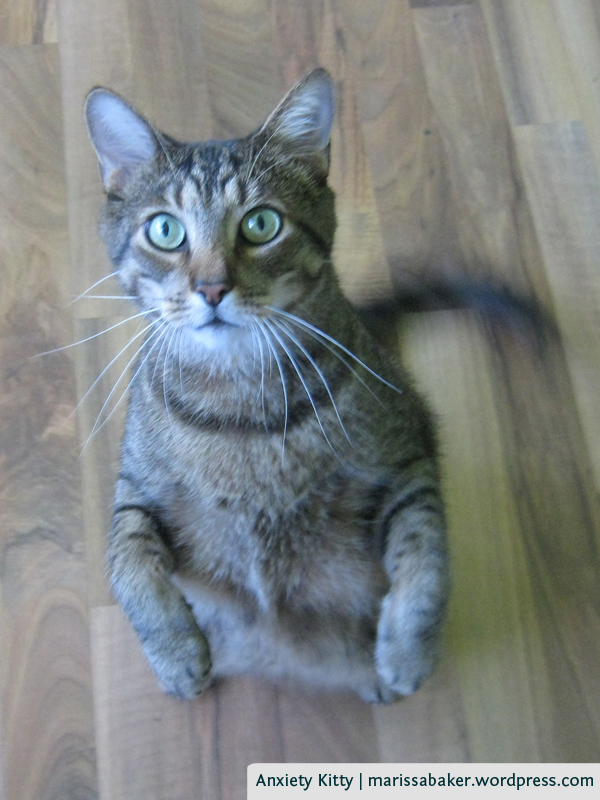
After doing some research, I learned that clicker training is the one thing people have found that helps anxious cats settle down and feel safe. No one knows why teaching a cat to do simple tricks on command combats anxiety, but it does. My theory is that when the cat gets positive reinforcement for certain actions the additional structure helps make them feel secure. Whatever the reason, it’s adorable. It’s mostly about teaching him to do things he was already doing on command (touch my fingers, come when called, jump on and off chairs, and stand on his hind legs). The “stand” command is everyone’s favorite. He’s just so cute!
Anxiety Kitty | marissabaker.wordpress.com

As I’ve helped Flynn with his anxiety, he’s been helping me with mine. Before a lunch date a few weeks ago (the first since my breakup), he spent the whole morning following me around and checking in on me. Every few minutes while I was working at my desk he’d hop out of the window and walk over to “talk” with me and have his head rubbed. And when I walked into a different room he followed. Since then, he’s kept that pattern up most of the days my anxiety has spiked.

I’m honestly shocked how in-tune he is with my emotional state. A few days ago I was working on a guest post sharing my testimony about anxiety (I’ll share a link here when it goes live) and I hit a point in my writings where I just burst into tears sitting at my desk. I went for a walk outside and when I came back Flynn walked around my feet crying until I responded to him. He actually let me pick him up and hold him for a good 30 seconds (he hates being cuddled and usually wiggles as soon as you pick him up). Then a little while later when I was journaling and crying he spotted me, ran into the room, jumped up on the bed with me and stayed there purring until someone else came home. The only other times he sits on my bed with me is late at night, so this was really outside his normal behavior.

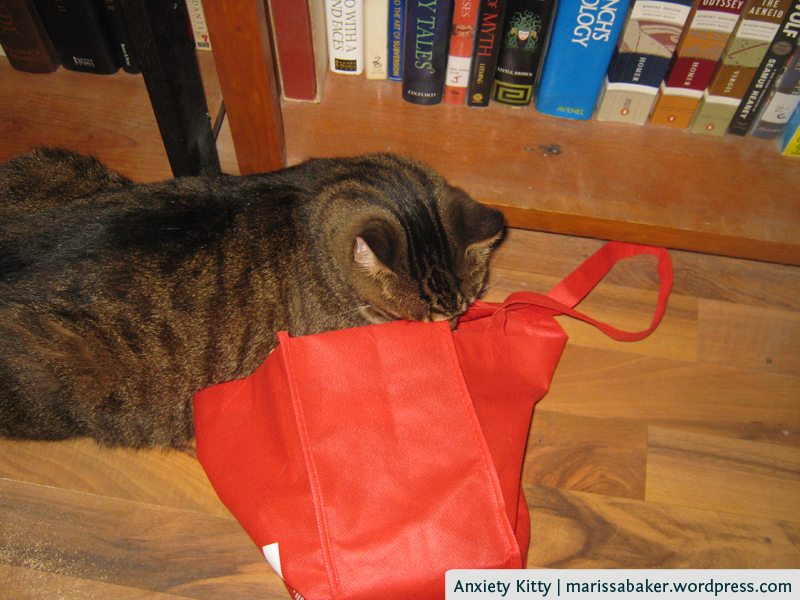
We’ve also discovered another shared love: old books. I collect Grosset & Dunlap series books (like Hardy Boys, Nancy Drew, Tom Swift, Rick Brant, and others). I found two bags full of books I needed for my collection at a book sale on Friday and they’re in really good shape. Flynn acted like the bags were full of catnip. He dove into the Hardy Boys bag head first and rolled around on the books until I pulled him out and tied the bag shut so he wouldn’t damage them. Then he climbed into the bag that I’d had Rick Brant books in earlier. He looked almost as happy with the books as I am.
Anxiety Kitty | marissabaker.wordpress.com

There’s just something comforting about sharing my home with a fluffy critter. Cats are my choice, but I’m sure other pet owners can relate whether they love dogs, rabbits, gerbils, or even non-fluffy pets. People are happier and healthier around animals. In fact, one survey found that 74% of pet owners reported mental health improvements from pet ownership.

The Anxiety and Depression Association of America says, “pets and therapy animals can help alleviate stress, anxiety, depression, and feelings of loneliness and social isolation.” That’s so true for me. Adopting Flynn and starting counseling are the two biggest things that have helped me deal with my anxiety this year, as well as my post-breakup grief. I know pet ownership isn’t for everyone, and would never tell you to get a pet if you’re not sure you could take care of it. But for those of us who can have pets, they can be a huge help when you’re going through something.

You don’t need to have a mental health issue to benefit from caring for an animal. For example, I suggested in my post on developing Sensing as an INFJ or INTJ that pets can help ground these personality types in the real world. INxJ types are normally a bit out-of-touch with the physical world and there’s nothing like knowing some other life form needs you in order to stay alive and happy to get you out of your own head for a while. Whatever your personality type, pets can be a huge blessing.
What about you? Do you have an animal friend who helps you when you’re struggling with something?

Making Some New Paths In Our Minds

One of the more helpful (for me, at least) analogies that my counselor has used as we work on my anxiety is that we can think of our minds as a big open field. As we live and grow, our thoughts travel over this field and we start to wear-down paths as we think along the same lines over and over.

For example, little Marissa grew up in a safe, cozy home with parents who told her she was loved. So the “I am loved” thought-path got a lot of travel. It became an easy path to go down. But at some point, a conflicting message came in and it shifted the path. No longer “I am loved” without qualifiers, but now “I am loved by my family and God” because those are the ones who haven’t let me down or rejected me. And even though there’s evidence to the contrary coming from many friends, anxiety adds the idea “and no one else” to that thought-path.

Your Brain Can Lie

Your brain can be a dirty, rotten liar (to quote my counselor again). And while anxiety doesn’t look the same for everyone who deals with it, one of the common things it does is push your brain toward overestimating worst-case scenarios. You wear deep paths in your mental field that reinforce all the negative things and push positive ones off somewhere in the tall grass.

And so my mind likes to wander down the “no one will accept you as your full, authentic self” path even though I have plenty of evidence to the contrary. For example, all the comments on the post where I told you about my breakup and anxiety are evidence that my brain is lying when it wants to head down that road. But that’s still what the brain wants to do. And this is also how you can end up thinking things like, “no one appreciates my contributions” when there are dozens of people who love what you’re doing but those one or two people who criticize you become the only voices you can hear. Read more

Lessons From My Nervous Cat

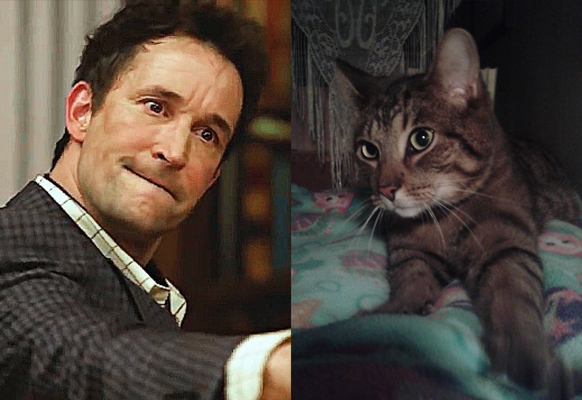
Meet Flynn. He’s 2 years old, weighs 15 pounds, and lost his previous home (not sure of the exact circumstances). I brought him home from a local humane society a couple weeks ago. I’d asked them if they had a sweet, cuddly cat that would do well in a single-cat home. They recommended Dorito (I’d originally planned to keep his name, but he doesn’t respond to it at all and it just didn’t “feel right” to me. Hence the name change, after Flynn Carsen from The Librarians).

Lessons From My Nervous Cat | marissabaker.wordpress.com
Flynn Carsen and Flynn the Cat

My new kitty cried for the entire car ride home. Once I released him from the cat carrier he promptly hid under the couch for the next six hours. Poor little thing’s been through a lot. But we’re starting to settle in and get used to each other. And after two weeks together I’ve learned that

  • He loves meat and will beg in the kitchen for beef, poultry, and fish
  • Catnip mice are his favorite thing. He just lays on the floor while hugging and chewing on them
  • My fleece mermaid blanket must have a texture he likes, since he danced around with a look of wonder on his face the first time he touched it. It’s our favorite blanket
  • His purr is furniture-rattling in volume and intensity
  • He likes sleeping with people. Usually he picks my bed and spends the night curled up near my feet or legs

But I’ve also learned some other things:

  • He’s terrified of people in motion. If you stand up or walk into a room his eyes get big and he runs away
  • If you reach out toward him he flinches, like he expects you to hit him. But he’s sweet and affectionate if you’re sitting down and he comes up to you
  • He doesn’t like being picked up
  • The slightest noise is enough to make him startle awake, leap in the air, and/or flee the room
  • He spends most of the day hiding, only coming out to spend time with us in the morning and evenings
Lessons From My Nervous Cat | marissabaker.wordpress.com
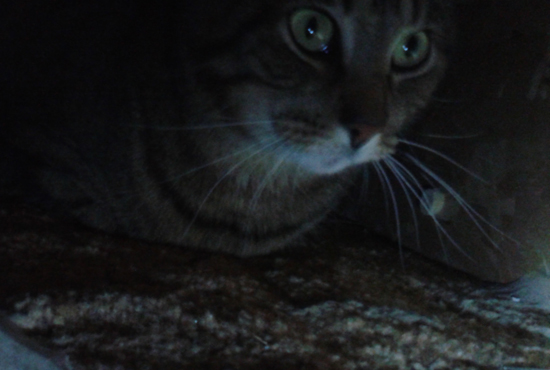
hiding under the bed

I don’t know what happened in Flynn’s past as Dorito. Being a storyteller, I have a completely theoretical narrative that goes like this: Dorito’s owner was a sweet, elderly person who was confined to a wheelchair. They fed Dorito in the kitchen, invited him to sleep in the bed, and showered him with love. But this person had a caretaker that came in during the days and wasn’t kind to the cat. So Dorito learned that people walking toward him meant he’d be kicked or grabbed or chased out of the room. And then when their elderly person passed away, Dorito was dumped off at the Humane Society.

Of course I have no idea if that’s anywhere near the truth. What I do know is that I’ve adopted a very nervous cat. He startles at the slightest noise. He flinches if you touch him. He doesn’t do “normal cat” things like lay around all day and nap (at least not out in the open). And he’s taking a very long time to relax around us, especially my 6′ 3″ younger brother.

After a few days of this, someone in my family described Flynn as a “useless cat” because he won’t cuddle. And then someone asked if I could return a defective cat. I was behind the couch at this point trying to convince Flynn to come out and raised my voice just enough to say, “He’s scared and he needs our love and understanding!” After that the (mostly) joking suggestions that Flynn wasn’t the cat we were looking for stopped. He also started becoming more friendly, which helped with that.

Lessons From My Nervous Cat | marissabaker.wordpress.com
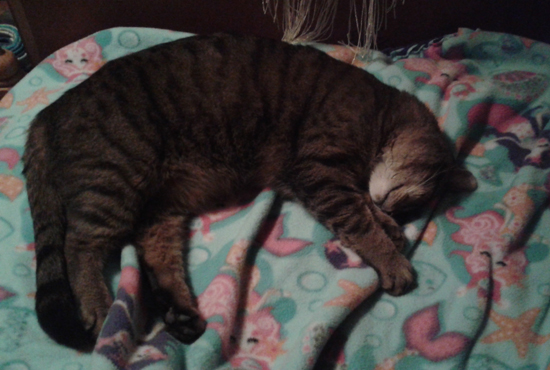
Flynn’s favorite blanket

I don’t know what in Flynn’s past made him so scared. But I know that right now he’s easily startled, worried, and only wants touched on his terms. So I decided to love him where he’s at and work with him. It’s not going to help if I lecture him, saying he’s got it so good now that he should just suck it up and move forward with his life. He needs patience. He needs someone not to push his boundaries because that will only prove we can’t be trusted not to go too far. He needs someone there for him when he does want held and petted.

And then I started thinking, isn’t that what hurting people need too? Love, understanding, acceptance, and someone to be there for them on their terms. But how many times do we meet someone who’s going through something we don’t understand and yet we treat them as if they’re “lesser than” because they’re still showing signs of their past trauma? Why are we so much more willing to extend grace and compassion to a nervous cat than to an anxious, depressed, or hurting human?

Then I had another realization. The way I’m treating my cat is the way I want to be treated when I’m anxious, nervous, or on the edge of panic. I want patience, understanding, and someone who will ask what I need instead of pushing me to just get over it. And it’s also the way I should treat myself (I’ve recently started seeing a counselor to get help working through my anxiety and she was delighted with this realization). We must give ourselves the same compassion, love, and permission to be ourselves that we long for from other people and should extend to others who are going through similar things.

So that’s what I’ve been learning from my nervous cat. I think he’s turning out to be a pretty good teacher.

Lessons From My Nervous Cat | marissabaker.wordpress.com

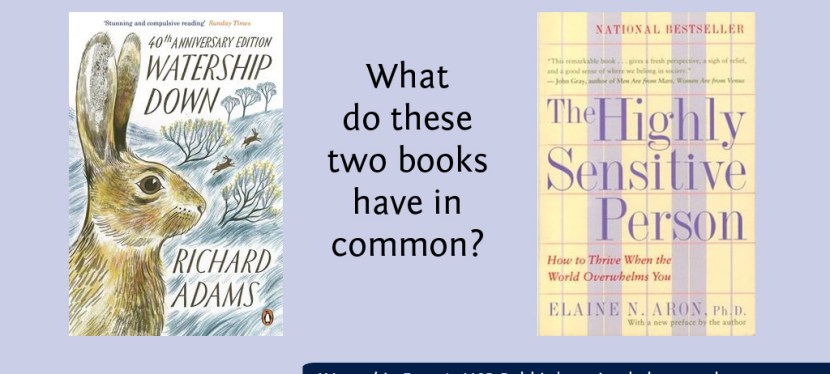
Watership Down’s HSP Rabbit

I just started rereading Watership Down by Richard Adams last night. Normally I wait to write about the books on my Classics Club list until after I’ve finished them, but I’m also rereading Elain Aron’s The Highly Sensitive Person In Love and I was struck by a connection between the two books.

In her research on high sensitivity (also known as Sensory Processing Sensitivity), Aron discovered that it’s found in 15 to 20% of the population. And it’s not just humans. The trait “can be observed in all higher animals — mice, cats, dogs, horses, [and] monkeys” at about the same percentage. I’m going to add rabbits to the list as well.

Research on HSPs had barely started by the 1970s, so I doubt Richard Adams would have been familiar with it as a scientifically validated trait when he published Watership Down in 1972. I think he was writing about it anyway, though, with his character Fiver.Watership Down's HSP Rabbit | marissabaker.wordpress.com

When publisher Rex Collins acquired the book, he wrote to a friend saying, “I’ve just taken on a novel about rabbits, one of them with extra-sensory perception. Do you think I’m mad?” Fiver’s insights do go beyond simply being a highly sensitive rabbit, but it’s also true that Fiver would pass the HSP test. Easily overwhelmed by strong sensory input? Check. Aware of subtleties in the environment? Double check. Made uncomfortable by loud noises, startles easily, has a nervous system that feels frazzled, and so on down the list.

He was small, with side, staring eyes and a way of raising and turning his head which suggested not so much caution as a kind of ceaseless, nervous tension. His nose moved continually, and when a bumblebee flew humming to a thistle boom behind him he jumped and spun round with a start that sent two nearby rabbits scurrying for holes (Fiver’s introduction, Watership Down)

As a Highly Sensitive Person myself, I know that feeling all too well. The heightened awareness of the smallest noise. The tension so familiar you barely notice it until an unexpected sound startles you out of your chair (in fact, right after writing this sentence I jumped at a Facebook notification on my phone). And it’s kind of nice to see a character like that in a book, especially one with friends who don’t tell him he needs to change. They accept him for who he is, work with his weaknesses, and appreciate his unique strengths.

Can you think of any other HSP characters in fiction?


Click here to get a copy of Watership Down. Please note that this is an affiliate link. This means that, at no additional cost to you, I will receive a commission if you click on the link and make a purchase.

How Full Is Your Marble Jar?

I have issues with trust. I knew this to a certain extent, but being in a relationship has brought it to the forefront of my attention. My boyfriend wants to build the kind of trust that I’ve always wanted in a relationship, which is fantastic. But it’s harder to get there than I was expecting and that’s frustrating for both of us. I probably feel safer with him than anyone else who I haven’t known a minimum of 10 years and yet I still feel nervous opening up to him and being “me” around him.

As I mentioned a few weeks ago, I love Brené Brown’s TED talks. Since writing that post, I’ve read her book The Gifts of Imperfection and I’m halfway through Daring Greatly. Since I’ve been confronting some deep-seated fear issues as well as this trust thing, they’ve been really good books for me. They’re tough, though. For example, she has a list of 10 things that “Wholehearted” people who believe in their worthiness do. I’ve only got one down pretty good and maybe half of two others. And that’s even though all 10 points on the list are things that, in theory, I agree are good and which I’ve considered worth pursuing for quite some time.

How Full Is Your Marble Jar? | marissabaker.wordpress.com
Photo credit: timlewisnm CC BY-SA via Flickr

The Anatomy Of Trust

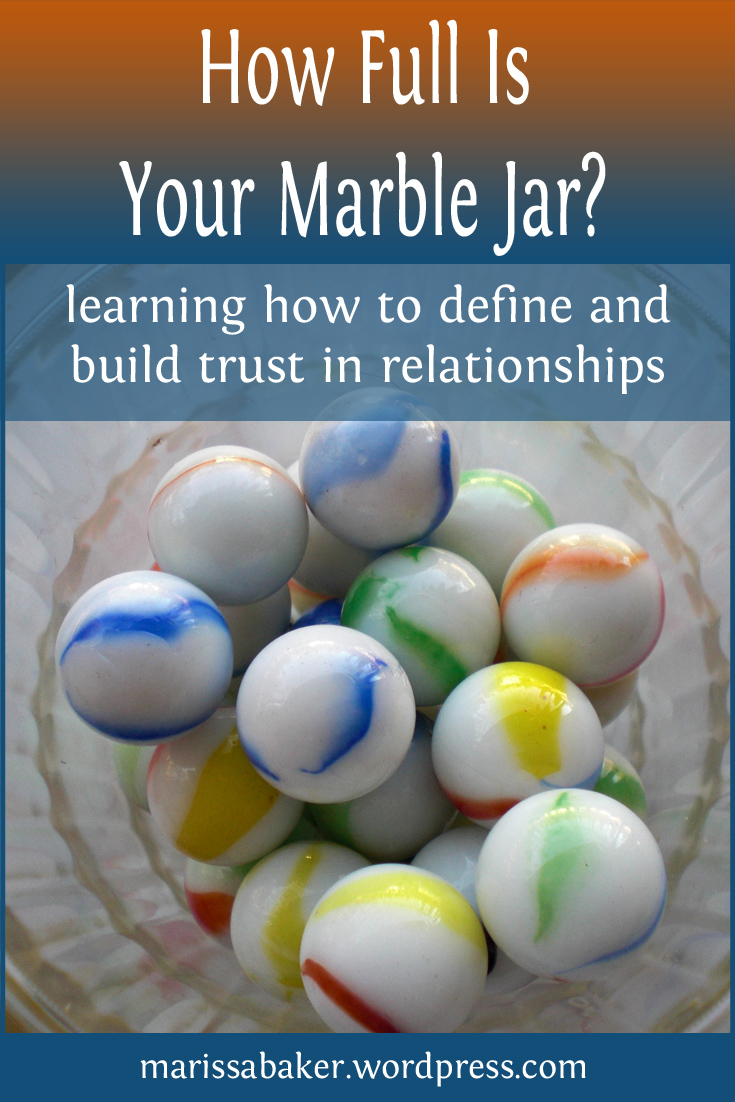
Earlier this year, Brené Brown gave a talk called “The Anatomy of Trust.” In this talk, she tells a story that she also relates in Daring Greatly about her daughter experiencing a betrayal of trust at school. You can click here to read the full story or just watch the video below, but in short summary the situation got so bad that the teacher took marbles out of the Marble Jar (marbles go in when the kids are making good choices and come out if they’re breaking rules, acting out, etc.). Read more

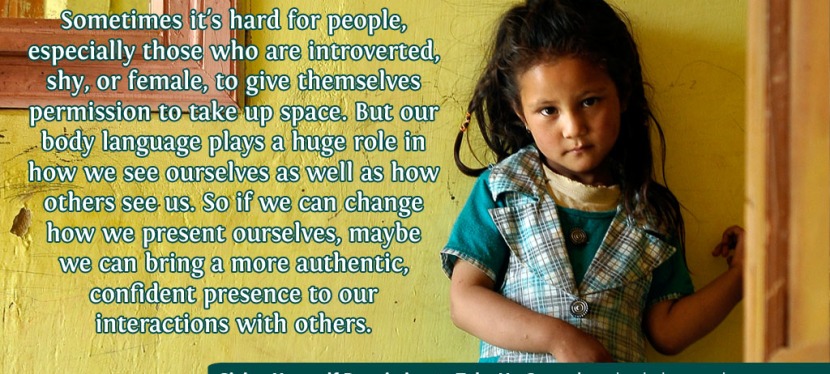
Giving Yourself Permission to Take Up Space

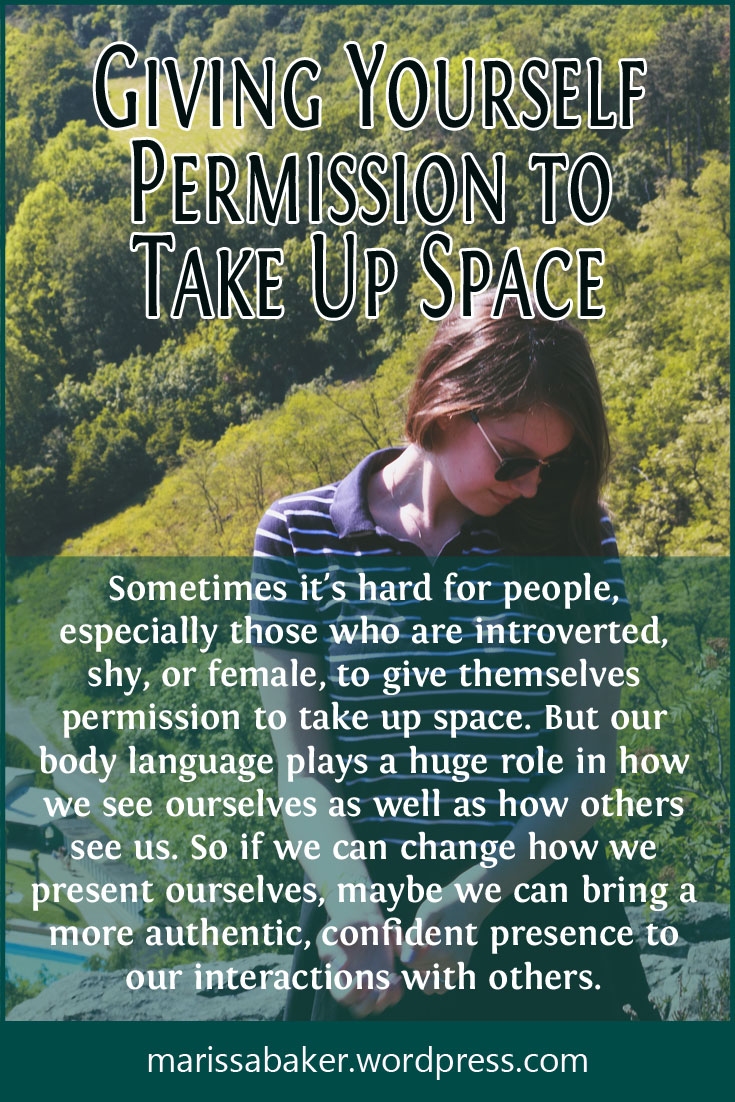
I’m 5 feet 6 inches tall (about 168 cm for my readers on the metric system). When I was a teenager I decided that was about 3 inches too tall for some reason ostensibly connected with Joe Hardy (yes, the fictional character. I know — I needed more real friends). That’s not the only reason I do things to make myself look smaller, but it’s one of the stranger ones. In general, though, being taller than other people simply makes me feel awkward. And even though I’ve explored that feeling before in a creative non-fiction class in college, I really wasn’t sure why.

Recently, I’ve been asked why I use body language that makes me look small. That question made me  take another look at why I’m doing what I do. I hunch my shoulders. I sit in corners of sofas. I cross my arms and legs or ankles. Or I have my hands together nervously fiddling with my fingers. Part of this is unconscious but I’m often aware of it as well. I know I make myself smaller and sometimes I do it on purpose, especially if I feel nervous or threatened. I suppose I’m saying with my body language, “Don’t notice me. Don’t hurt me.” And this sort of thing has become instinctive for me.

Giving Yourself Permission to Take Up Space | marissabaker.wordpress.com
Photo credit: “Shy” by Karel Macalik, CC BY via Flickr

One of my more vivid childhood memories is of being enrolled in a summer school program and hiding under the playground equipment from the other kids. My experiences there played a large role in why my parents chose to homeschool. In some ways, that scared little girl is still part of me and hiding is still my default move. But, as someone recently reminded me, fear isn’t a good way to live your life. I feel like it’s time for a change. Read more