

In Defense of Frozen’s Queen

In Defense of Frozen's Queen | marissabaker.wordpress.comIt’s been more than 7 months since Disney’s Frozen hit theaters, but the conversation about it shows little signs of dying down. There are still people on my Facebook feed warning about how the insidious messages of “Let It Go” are damaging our little girls, as well as people finally giving into peer-pressure to see the film and subsequently describing “Let It Go” as the most empowering song ever. I’ve seen articles calling Frozen “the most Christian movie that I have seen this year,” and articles describing “Let It Go” as an occult anthem. What is it about this film that catches people’s attention so strongly, and results in such polarized viewpoints?

Contextualizing “Let It Go”

There are plenty of articles talking about how “Let It Go” fits into the context of the film Frozen. I particularly like NaClhv’s articles An analysis of “Let It Go” in Disney’s “Frozen” and Elsa’s facial expressions during “Let It Go”, in Disney’s “Frozen”, which talk about how “Let It Go” is more of a running-away song than an empowerment song. In this analysis, Elsa’s song represents a turning point for her character. We see her both depressed and happy, with the potential to grow and become a good ruler or to become an evil Ice Queen. It is a dangerous moment for her, but she is also a deeply sympathetic character. Who hasn’t wished that running away could make things all better?

Even people who hate “Let It Go” will sometimes admit there’s no problem with the song in the context of the film. But they then argue that the context doesn’t matter because it is being sung and played out of context. Joseph Clarkson writes that “when removed from the context of the movie, the song concludes that rebellion and relativism lead to freedom.” And I will admit that I can see how people think that, particularly in connection to the “no right, no wrong, no rules for me” line. Still, several people who are advocating examining this song out of context are also speculating about the motives of the writers. Remember that article I mentioned about the occult in my intro? That blogger states, “This is hardcore occultism. But we didn’t catch it did we. The language does appeal to those who are familiar with the terms though, and if you don’t know the jargon it goes over your head.” The implication is that the writers of Frozen know the jargon and are purposefully slipping these occult references in. In Defense of Frozen's Queen | marissabaker.wordpress.com

Now, I don’t know anything about the writers of Frozen. That may have been their intent. (For an argument from that point of view, I do encourage you to read the article I’ve been quoting. The writer is very sincere, and reading this will give you context for her statements as well.) But when we’re talking about a writer’s intention, we can’t take the song out of context because it was written to fit within the film’s entire plot. And the overall film shows that “Let It Go” isn’t Elsa’s end point. The very next scene Elsa appears in shows that she hasn’t actually been freed from her fears, and that running away hasn’t protected people from the powers she started embracing in “Let It Go.” The blogger I’ve been referencing connects the phrase “let it go” with the fact that “the greatest command of occult is ‘Do what thou wilt shall be the whole of the law’ (The Law of Thelema, Crowley).” What the writers connect “Let It Go” to is the fact that Elsa needs to find a way to fit who she is into the larger context of society. “Let it go” isn’t a cure-all or the intended message of the film. Elsa tried making her will the only law, and discovered it didn’t work. The real answer was love, which is actually more of a Christian message.

There is no fear in love; but perfect love casts out fear, because fear involves torment. But he who fears has not been made perfect in love. (1 John 4:18)

Christian Themes?

I do not consider Frozen a Chrisian film. I wouldn’t even go so far as to say there are overtly Christian overtones. I do, however, think it’s a decent film which contains good messages that can be associated with Christianity because of their positivity. The film also has some less-positive content which can send a wrong message, like That Weird Sexy-Makeover Moment at the Heart of Frozen’s “Let It Go” or possibly the homosexual overtones that a few people who haven’t even seen the movie are talking about. Still, overall, I agree with Plugged-In reviewer Paul Asay’s response that Frozen “actually offers a ‘responsible and family friendly’ message.” One other thing I take issue with is that so many writers who are talking about the potential Christian themes in this film hate Elsa and love Anna. Why does a 21-year-old expressing some independence for the first time in her life mean she should be compared to Satan, but an 18-year-old who becomes engaged to a man she just met and irresponsibly leaves the kingdom in his hands gets labeled as a Christ-figure? In this view, Elsa’s the sinner and Anna’s the redeeming saint, never mind that Anna’s act of love thaws her own frozen heart (thus saving herself more than her sister, who could have easily stopped Hans) and Elsa independently chooses to use an act of love to save her kingdom.

Elsa’s Rare Personality

click to read article "In Defense of Frozen's Queen" by marissabaker.wordpress.comI think one of the reasons Elsa is misread by so many people is because she is an INFJ. Hovering around 1% of the population, the INFJ is the rarest Myers-Briggs type. On top of that, the effects of her childhood stress means Elsa’s type isn’t immediately recognizable even to other INFJs.

Even stable INFJs with a normal childhood report feelings of alienation that comes from being different than the rest of the world (Read my post “Things You Should Know About INFJs” for more on that). The thing about Elsa is that she didn’t have a normal childhood. She learned to use her introverted side — intuition — but was told to”conceal, don’t feel,” which made her try to suppress her feeling side. INFJs use “their second function, Extraverted Feeling (Fe), which can serve as a useful extroverted tool for navigating the outside world” (from Personality Junkie’s INFJ profile). This effectively crippled her for dealing with other people in a healthy way (it would have been much better to send her to Xavier’s School For Gifted Youngsters, but sadly that isn’t an option outside of HISHE). Elsa’s Fe is why you might see her mistyped as an ISFJ duty-fulfiller, since young Fe types try to fit in with the expectations of people they look up to (in this case, Elsa’s parents) and typically try their best not to hurt anyone. But once you see Elsa run away and reveal the introverted side she’s been nurturing in her prison, you see Introverted Intuition (Ni) surface rather than Introverted Sensing (Si). Si is experiential and fact based, and enjoys rhythm and reliability. Ni is more like this description from Personality Pathways.

Introverted Intuition reflects on patterns, relationships, symbols, meanings, and perspectives on matters from complex phenomena to magical connections to practical problems. The Introverted Intuitive mind typically creates a unique vision and arrives at unique insights about things, phenomena, or people. It strives to discover the essence of things and fill in the missing pieces of a puzzle. Introverted Intuitive types frequently will have complex visions or perspectives that they are unable to explain with clarity to others.

The sentiments expressed in “Let It Go” are typical for INFJs as they mature and learn to embrace the aspects of their Ni that sets them apart from other people. From that perspective, Elsa progresses from a “kingdom of isolation” in the first verse, to breaking free of social rules (INFJs will stay within rules that make sense, but don’t want confined by ones that do not), and finally rising like the break of dawn to become who she is inside rather than the “perfect girl” image that other people have in their minds. It’s not really all that dissimilar to the songs “The Orphan” and “Sweet Liberty” from the musical Jane Eyre, which was written for another fictional INFJ. Elsa’s problems aren’t just specific to INFJs, though, as pointed out by One Dad’s Thoughts on Frozen’s Smash Hit “Let it Go.” Elsa’s song and character arc resonate with girls, particularly teen girls, who are struggling with swirling storms of emotions and feelings of alienation.

Frozen is a typical Disney children’s movie in as much as Anna’s story line is concerned, but Elsa’s storyline explores Young Adult novel themes like coming-of-age, self-discovery, and yes even that sexualized transformation at the end of “Let It Go” (which, seriously, isn’t that bad. She’s 21 years old for crying out loud and it’s a cute dress. I’d wear it).

 

Click here to check out my e-book, The INFJ Handbook, for more information and insight into the INFJ personality type
Available in the Amazon Kindle Store

Save

Save

Fictional MBTI – Steve Rogers (ISFJ)

This was requested in the comments on Fictional MBTI – Loki, and since I went to see Captain America: The Winter Soldier on Friday it seemed a good time to write a post about Steve Rogers/Captain America. Incidentally, I will reference Winter Soldier in this post but will try to keep it spoiler-free. If you don’t want to know anything about the plot, though, go watch the film and then come back 🙂

In support of typing Steve as an ISFJ, I’ll be citing quotes from Captain America, The Winter Soldier, Gifts Differing* by Isabel Myers, and Was That Really Me?* by Naomi L. Quenk.

  • Disclaimer: links marked with an * are affiliate links. This means that, at no additional cost to you, I will receive a commission if you click on the link and make a purchase on that website.

Introverted Sensing

Isabel Myers describes the Introverted Sensing (Si) types – both ISFJ and ISTJ — as “remarkably dependable … they base their ideas on a deep, solid accumulation of stored impressions, which gives them some almost unshakable ideas” (102). For Steve Rogers, this resulted in the attitude that earned him consideration in Dr. Abraham Erskine’s experiment — “I don’t want to kill anyone. I don’t like bullies; I don’t care where they’re from” (Captain America). The same deeply rooted ideas that form his character also gave Steve the conviction to stand-up to Nick Fury when asked to compromise his values to create a “safe” world — “This isn’t freedom; it’s fear” (Winter Soldier).

In the right person, the traits of Si are perfect for military command. Si types are extremely stable, not entering “into things impulsively” and, “once in, they are very hard to distract, discourage, or stop” (Myers 102). When convinced he is in the right, Captain America is an unstoppable force, whether he is performing a one-man rescue mission in WWII or leading a team against Hydra.

Since Si is an introverted function, there are aspects of their private reactions that ISFJs usually keep to themselves. Only when they feel “off duty” and are around people they trust will they share insights into their unique way of viewing the world. These impressions “may be absurd, irreverent, touching, or hilarious, but never predictable, because their way of sensing life is intensely individual” (Myers 103). Steve tends to joke before going on missions, such as his dialog with Peggy Carter before he parachutes behind enemy lines in Captain America, and that scene from the beginning of Winter Soldier (which is also in the trailer) when he says he doesn’t anything to do on Saturday night because his barbershop quartet is dead.

Extroverted Feeling

Fictional MBTI - Steve Rogers. Captain America is an ISFJ. marissabaker.wordpress.com

Though an auxilary function, Extroverted Feeling (Fe) is the most easily visible aspect of an ISFJ. Heavily informed by dominant Si, this manifests in ISFJs as an emphasis on “loyalty, consideration, and the common welfare” (Myers 104). Myers also says that a well-balanced ISFJ will be very hard working and more practical than a typical introvert. They also “carry responsibility well,” though they do not necessarily enjoy leadership (102).

Fe is a social function, to the point that some introverts who use Fe may be mistaken for extroverts (this explains why you’ll sometimes see Steve typed as an ESFJ). It adapts to situations and strives to act in a way that is acceptable to as many people as possible. An ISTJ probably wouldn’t have agreed to become the “star-spangled man with a plan,” but ISFJ Steve was convinced that was how he could best serve his country. He stuck with that role up until it conflicted with his deeply held Si convictions. In this aspect, ISFJs resemble INFJS, in that both will try to please others for as long as possible without compromising their ideas.

Thinking

Psychologists disagree about whether or not the tertiary function should be described as “introverted” or “extroverted” (so it’s opposite of the auxiliary function), or simply listed by itself. Whichever the case, Jung says that this third function is under conscious control to some degree as it supports the auxiliary function (Quenk 33, 51). For an ISFJ, tertiary thinking helps with clarity in crisis situations, strategy and logic, and suspending feeling to evaluate other people’s actions. We can see this any time Captain America is planning something strategic, as he sorts through sensing data and comes up with a plan.

Extroverted Intuition

Fictional MBTI - Steve Rogers. Captain America is an ISFJ. marissabaker.wordpress.com

All dominant sensing type are uncomfortable with intuition, and highly skeptical of unverified facts. They can’t consciously access their inferior, or shadow, function of Extroverted Intuition (Ne) and are made uneasy by it. In every day life, this comes out as a general sense of worry and a skepticism about new ideas. This can be useful for detecting flaws in new proposals and warning about negative possibilities, which Steve does quite often in The Avengers. For ISFJs to become comfortable with something new and unexpected, they need time alone to process, such as Steve hiding from the world in The Avengers until he feel needed again and has had time to come to terms with his time displacement.

Anger is a typical response for ISFJs, particularly ISFJ men, when stressed. Stress can also cause ISFJs to become more outspoken, “irritable, and pessimistic” (Quenk 220). They are likely to feel a “loss of control over facts and data,” become more impulsive, and focus on worst-case scenarios (Quenk 221).

Stress triggers for inferior Ne include people whose types use intuition as a dominant function (such as Tony Stark/Iron Man), noisy and disorganized environments, unsubstantiated statements from authority figures, “not having sufficient information to do a good job,” and delays in goal achievement (Quenk 219). These last three triggers play a major role in the opening events of Winter Soldier, when Steve becomes angry that Nick Fury didn’t give him all the information about a rescue mission.


If you enjoyed this post, check out my other MCU typings:

Bucky Barns – ESTP

Loki – INFJ

Scott Lang -ISFP

T’Challa – ISFP

Thor – ESTP

Tony Stark – ENTP

Save

Save

Save

Save

Sir Percival Blakeney. Baronet.

A blog I follow is participating in the Anthony Andrew’s Blog Hop this month, and after reading her post I decided to give it a go. The Scarlet Pimpernel (1982) has long been one of my favorite films, ever since my mother shared it with my sister and I as children. As a reader, of course the next thing I did was look up the books, which are just as enjoyable as the film.

Sir Percy’s Background

The 1982 film is based on two books by Baroness Emmuska Orczy: The Scarlet Pimpernel and Eldorado. According the extremely reliable site that is Wikipedia, Orczy may or may not have been the first to write a “hero with a secret identity.” It is quite likely that she influenced, if not inspired, the creation of later nobleman-hero characters like Zorro and Batman. She released 16 books related to the Scarlet Pimpernel, including novels and two short story collections directly related to Sir Percy’s exploits as well as a few novels about his relatives.

“We seek him here, we seek him there. Those Frenchies seek him everywhere! Is he in heaven? Or is he in hell? That demmed Elusive Pimpernel?”

The first book was published in 1905. It is set in 1792 in the midst of the French Revolution. Sir Percival Blakeney is one of the wealthiest and laziest men in England (he does, in fact, bear more than a passing resemblance to Johnston McCulley’s Don Diego Vega [aka Zorro], who debuted in 1919). The most ambitious thing he does is write poetry (see photo caption for a sample). At least, that’s what he wants people to think.

Behind this carefully cultivated facade, Sir Percival Blakeney is The Scarlet Pimpernel, a daring Englishman who leads a band of adventurers into France to rescue people from Madam la Guillotine’s blade. He usually meets with success, which earns him a dedicated adversary named Chauvelin (played by Ian McKellen).

Anthony Andrew’s Percy

Sine 1917, there have been several film and television adaptations of The Scarlet Pimpernel. I’ve not watched them all, or even most of them, but I doubt any of the actors could rival Anthony Andrew’s portrayal of Sir Percival Blakeney. He is the Scarlet Pimpernel — even when I read the books I can hear his voice in my head every time Percy has written dialogue. I hardly ever refer to the character without saying “Sir Percival Blakeney. Baronet” with the same affected pause that Anthony Andrew’s Sir Percy speaks with when introducing himself.

For my readers who are Myers-Briggs fans, one of the other writers participating in this blog hop typed Sir Percy as an ENFP. It makes sense — he is a visionary, a crusader, an idealistic champion who lives to right wrongs. The traits that are common to Champion/ENFP types serve him well as a hero with a secret identity. David Keirsey says people of this type

have outstanding intuitive powers and can tell what is going on inside of others, reading hidden emotions and giving special significance to words or actions. In fact, Champions are constantly scanning the social environment, and no intriguing character or silent motive is likely to escape their attention. Far more than the other Idealists, Champions are keen and probing observers of the people around them, and are capable of intense concentration on another individual. Their attention is rarely passive or casual. On the contrary, Champions tend to be extra sensitive and alert, always ready for emergencies, always on the lookout for what’s possible.

Sounds like the Scarlet Pimpernel to me, and Anthony Andrew’s portrays him perfectly. I’ve seen analysis written about certain actors’ eyebrows (yes, I have too much time on my hands for looking up weird things on the Internet), and we could certainly add the way Anthony Andrew’s raises his eyebrow when Percy is scanning a room to the list of analysis-worthy eyebrow-acting. You can tell in an instant, just by his posture and the look in his eyes, when he shifts from lazy Sir Percy to alert Scarlet Pimpernel.

Bog Hopping

I hope you’ll check out some of the other blogs in this blog hop. Anthony Andrews is not an incredibly prolific actor, but he is in several good films which are being covered by other bloggers this month. I’m looking forward to reading more of them myself. Since I’m on WordPress (which doesn’t support Javascript), you’ll have to click the link below to see other posts in the blog hop:

Powered by Linky Tools

Click here to enter your link and view this Linky Tools list…

Caramel Popcorn and Doctor Who

Caramel Corn and Doctor Who. marissabaker.wordpress.comI found this amazing Homemade Caramel Corn recipe a couple weeks ago on a blog called Gimme Some Oven. The first recipe I had tried was too sticky and burnt easily, but this one is just right. The only alterations I made to the ingredients was less salt in the caramel. I also had to use two roasting pans to bake the corn — it just wouldn’t fit in one. I had them on two different racks in the oven, and switched the pans back and forth when I stirred them so the corn would be heated evenly. The recipe says it will keep for up to a week, but we’ve never had it last much more than 24 hours. If there’s any left, it will be something to munch on while watching Doctor Who.

Caramel Corn and Doctor Who. marissabaker.wordpress.com
I have no idea who the artist is, but this is a great painting. Here’s where I found it: doctorwhotv.co.uk

Since I became a Whovian, I’ve actually been looking forward to Christmas. As someone who does not observe the holiday, my previous feelings around this time of year mainly consisted of frustration with the endless barrage of Christmas music on the radio. Now, I look forward to “Whomas.” This year, however, I dread the Christmas special more than I anticipate it. I’m interested to see what kind of Doctor Peter Capaldi will be, but I don’t want to see Matt Smith leave. With his impending regeneration, I’ll have to make sure there’s a box of tissues on hand as well as the caramel corn.

Homemade Caramel Corn

Caramel Corn and Doctor Who. marissabaker.wordpress.com
don’t be afraid to let it cook on low for 5 minutes without stirring – it won’t burn

print this recipe

12 cups freshly popped popcorn (about 1 cup kernels before popped)

1/2 cup unsalted butter

1 cup light brown sugar, packed

1/4 cup light or dark corn syrup

1 teaspoon salt

1/4 teaspoon baking soda

Caramel Corn and Doctor Who. marissabaker.wordpress.com
the finished caramel

1/2 teaspoon vanilla extract

Preheat oven to 300 degrees F. Line two rimmed baking sheets or roasting pans with aluminum foil, and grease with cooking spray. Begin popping popcorn.

Melt butter in a large pot over medium-high heat. Add brown sugar and corn syrup, stir to combine. Bring to a rolling boil, then reduce the heat to low and let simmer undisturbed for 5 minutes. Stir, then continue to cook for an additional 4 to 6 minutes, stirring every 30 seconds, until the mixture is a deep golden color. Turn off the heat and slowly whisk in salt, baking soda and vanilla.

Pour caramel over the popcorn and toss until it is evenly coated with the caramel, being sure to scrape the caramel off the bottom of the pot. Spread the mixture onto the prepared baking sheets or pans in an even layer.

Caramel Corn and Doctor Who. marissabaker.wordpress.com
baking in the oven

Bake for 15 to 20 minutes, stirring every 5 minutes, until the caramel corn has turned a deep amber color. Remove the caramel corn from the oven and transfer to a surface covered with parchment or wax paper to cool (or lift the foil out of the pans and place it on the counter). Once it reaches room temperature, use your hands or a spoon to break up the caramel corn, then store in an airtight container for up to a week.

print this recipe

Optional: you can melt about 1/3 cup of milk chocolate and drizzle it over half the popcorn. It’s pretty tasty, but I didn’t do that this time because it takes so much longer to set-up and it’s messy to eat when still melted.Caramel Corn and Doctor Who. marissabaker.wordpress.com

Watching Cinderella

Having watched Frozen last Tuesday (I shoveled the driveway so I could get to the theater) I’ve been in a Disney watching mood. Since my sister and I had been discussing Lucifer the cat’s role in Cinderella recently, I decided to start with that film.

Is this really the story of poor, misunderstood cat?

"Watching Cinderella" by marissabaker.wordpress.com. Is this really the story of a poor, misunderstod cat?The mice describe Lucify as “meany, sneaky, jump at you.” But if Lucifer the cat could talk, what would his version of this film look like? Cinderella wakes him up early every morning, orders him to “come,” and then shuts the door on his rump. Next, she takes Lucify down to a kitchen inhabited by a dog – a dog that mocks him and dreams of chasing and eating him. If he tries to defend himself by getting that horrible dog thrown out of the house, Cinderella berates him.
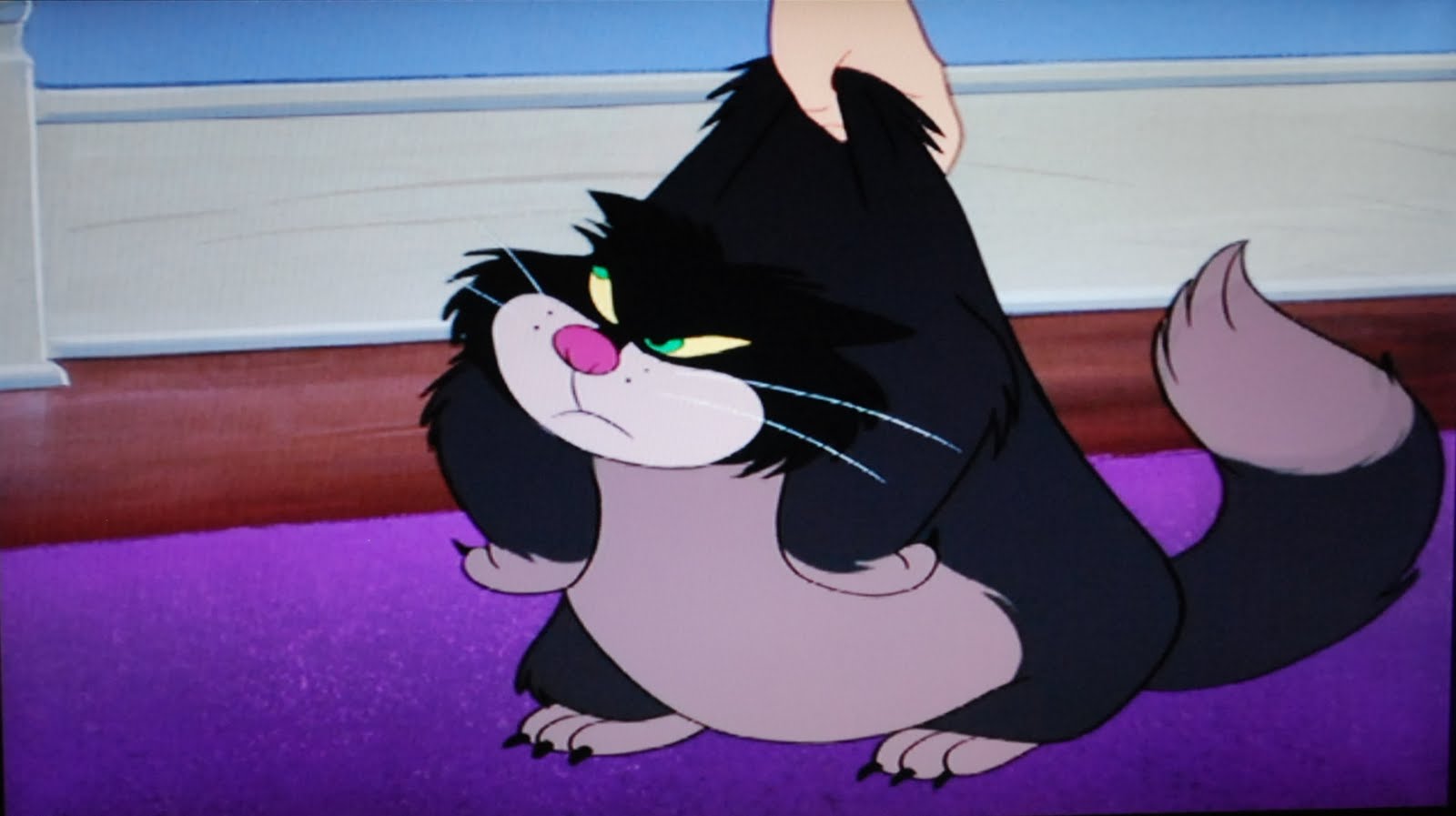
But Cinderella isn’t the only person in this house who torments the cat. Cinderella says, “It’s certainly not my idea to feed you first,” which shows that it’s his owner’s idea to wake him up early. She also decrees that “Lucifer gets his bath,” a bath clearly meant to punish Cinderella at the cat’s expense. And then the stepmother leads a music lesson for her off-tune daughters in the room Lucify has chosen for his nap. It would make anyone grumpy.

"Watching Cinderella" by marissabaker.wordpress.com. Is this really the story of a poor, misunderstod cat?On top of this, he is surrounded by a mouse infestation encouraged by the woman who drags him out of bed every morning. These mice must be gotten rid of – they are on the tables, in the serving trays, stealing trim from the sewing room, and have the entire house honeycombed with tunnels and secret doors — but when he catches one Cinderella takes his prize away and shakes him. These aren’t just any mice either – they attack him unprovoked in the middle of breakfast! They pluck out his whiskers, pull his tail, topple a broom on his head, trick him and snap a button in his face, pull on his eyelids, then one turns into a horse and attacks him. Finally the mice come after him with forks and fire, the birds gang up on him to drop pots and pans on his head, and they set the dog on him and he falls out of the tower (in the original uncut version, it is clear that this fall was fatal).

Not A Grimm Tale

Contrary to what you might read when people are contrasting Disney fairy tales with the “original Grimm version,” Disney’s Cinderella is not based on the version told by the Brothers Grimm, but rather on Charles Perrault’s “Cinderella, or The Little Glass Slipper” (as stated in the opening credits). This is the story where Cinderella sleeps in “the garret at the top of the house,” the one with a fairy godmother and magic pumpkin, and where the stepsisters’ feet don’t fit the glass slipper. It does depart from Perrault’s tale in a few aspects. For one thing, Cinderella’s father is absent from the story, but not necessarily dead, nor is Cinderella included in the invitation to the ball. She does not even ask to go, and says “That would not befit me at all” when her stepsisters teasingly ask if she would like to go to the ball. The ball lasts two days, and she leaves her slipper the second night. Her sister’s beg her forgiveness at the end, and she arranges marriages for them with “two great noblemen of the court.”

Grimm’s “Cinderella” is like Perrault’s concerning the main story (a girl is mistreated by her step-family, goes to a ball magically, leaves her shoe, and marries a prince), but there are significant differences. In this story, there is no fairy godmother – Cinderella’s father brings her a twig which she plants on her mother’s grave and it grows into a magical tree with a bird that lives in its branches and throws her “whatever she had requested.” That is where she gets the clothes for all three days of the ball. She does not loose her slipper because she is fleeing before the magic disappears – the prince coated the castle steps with pitch so she couldn’t run away so fast. The slipper that he gets as a result of this trick is made of gold. Both step sisters cut off parts of their feet to fit in the shoe, and the prince only notices the blood oozing out when they are halfway back to the castle. The Prince asks Cinderella’s father is he has any other daughters (he’s clearly alive in this version), and the man says, “No. There’s only little Cinderella, my dead wife’s daughter, who’s deformed, but she can’t possibly be the bride.” The prince demands to see her and marries her when the shoe fits. At the wedding, the stepsisters eyes get pecked out by birds.

Would the prince have married Cinderella if he didn’t have to chase her?

This isn’t so much a question inspired by re-watching Cinderella as it is something I’ve been wondering for a while now. Why does the prince pick Cinderella? Yes, I know it’s a fairy tale and he has to marry her for the happy ending, but it becomes an important question if you want to tell a story that fleshes out the prince’s character (my retelling makes them childhood friends to get around this problem). There’s even an entire song devoted to this question in the Rodgers and Hammerstein version: “Do I Love You Because You’re Beautiful?

In this Disney film, the prince appears for the first time 48 minutes into the story. We don’t hear their meeting – we just see him bow and kiss her hand (it evidently wasn’t much of an introduction. She doesn’t realize he’s the prince, and he doesn’t know her name). He doesn’t even have a line until singing “So This Is Love.” Between the palace, and the waltzing, and the walk in the garden it’s a pretty impressive first date. It doesn’t seem like quite enough to lead to matrimony, yet the Grand Duke says, “He won’t rest until he finds her. He’s determined to marry her.” Not that the Prince actually does any searching himself – the Grand Duke is the one who travels around trying on slippers.

In the written version they spend a little more time together and there’s a reason for the secrecy about her name. Perrault’s version has a two-day ball, and Cinderella talks with her stepsisters in her princess guise. She has to keep her name a secret so they won’t know her. In Grimm’s version, the ball lasts three days and she hides her identity because the prince is actually following her far enough each night to question her father about the elusive princess.

While they do spend a little more time together in the written stories, it still doesn’t seem like enough to base a marriage on. The prince can choose any woman in the kingdom to marry, but the one he goes after is the mysterious princess who presents an intriguing challenge. Would she have held his attention if it had been easy to win her hand? I doubt it.

Fictional MBTI — Neal Caffrey (ESTP)

Season 4 of White Collar is now on DVD, which means it’s on Netflix, which means I’m finally catching up on episodes. White Collar is probably my favorite crime drama (the only other candidates are NCIS: LA and Castle, and I haven’t liked them as well lately), and I’m fascinated by the characters.

When I first read David Keirsey’s Please Understand Me II chapter on Artisans, I was thinking of Neal Caffrey from White Collar even before Keirsey mentioned that most con-men were extroverted SP types (though of course most SP types [about 30-35% of the population] are not con-men). A hunch like that isn’t enough to type a fictional character, but it’s a good place to start.

Why SP?

Like Loki, typing Neal is complicated by his criminal behavior and possible psychopathy. I have not seen his Myers-Briggs type discussed often, and most of the ones I have seen type him an ENTJ or an ENFP. Since my decision to place him as a sensor instead of intuitive is apparently unpopular, I’d like to address why. While he does go with his “gut feeling” sometimes and rely on intuition, he does not display classic NF qualities like valuing personal authenticity, a focus on lasting emotional connections, and preoccupation with personal journeys. I could almost see him as an NT, but his problem solving abilities seem more focused on real-world results (a Sensing attribute) than on the abstract ideas behind the problems (an Intuitive trait).

The core characteristics Keirsey uses to describe Artisans are these (quoted from his website):

  • Artisans tend to be fun-loving, optimistic, realistic, and focused on the here and now.
  • Artisans pride themselves on being unconventional, bold, and spontaneous.
  • Artisans make playful mates, creative parents, and troubleshooting leaders.
  • Artisans are excitable, trust their impulses, want to make a splash, seek stimulation, prize freedom, and dream of mastering action skills.

Extroverted Sensing

Fictional MBTI: Neal Caffrey -- marissabaker.wordpress.comNow that I’ve narrowed Neal down to one of four types (ESFP, ISFP, ESTP, or ISTP), I want to switch from Keirsey’s approach to cognitive functions (which is too elaborate a subject to go into here. If you want background info, see this article).  I’ve settled on ESTP for Neal, which gives him this function stack:

  • Dominant: Extraverted Sensing (Se)
  • Auxiliary: Introverted Thinking (Ti)
  • Tertiary: Extraverted Feeling (Fe)
  • Inferior: Introverted Intuition (Ni)

Note: For the remainder of this post, I rely heavily on Keirsey’s Portrait of The Promoter, and Dr. A.J. Drenth’s ESTP Personality Profile.

Extroverted Sensing types (ESxPs) are life-of-the-party people. They enjoy presenting themselves well (for example, Neal’s expensive taste in clothing), and are generally seen as charming (that Neal fits this description goes without saying if you’ve watched the show). Se types are easily bored by routine, and actively seek out new sensory experiences (such as fine dining, romance, and [in Neal’s case] running a con). They like to take action, accomplish tasks, and experience the world. Keirsey describes them as a risk-taking type.

Introverted Thinking

Fictional MBTI: Neal Caffrey -- marissabaker.wordpress.comI’ve settled on Introverted Thinking instead of Feeling for Neal’s auxiliary function because of his gift for planning and how serious he becomes when he has to stop and think instead of just being free to act. It is one reason he is such a successful criminal, and why he is so valuable to the FBI. Dr. Drenth phrases it this way:

The fluid nature of their Ti, combined with the keen observational powers of their Se, contributes to ESTPs’ acumen as practical problem solvers. ESTPs can analyze a situation, diagnose the problem, and then determine how to fix it.

You can see examples of Neal’s thinking function in most episodes, as he responds to problems that arise by thinking and planning. Primarily, he approaches problem-solving from a perspective of getting things done efficiently (as opposed to worrying about how each option will affect people involved).

Relationships

Farther down the function stack, and less conciously available, is Extroverted Feeling. The typical ESTP does not like to share their judgments or true feelings. Keirsey says, “While they live in the moment and lend excitement – and unpredictability – to all their relationships, they rarely let anyone get really close to them.” Even when Neal does open up to people and form bonds with them (like his friendship with Peter), he is still able to run off to a tropical island and smoothly settle into a new life (though it only lasted for one episode in the fourth season).

So, what do you think? Does Neal fit the profile of an ESTP? Is there another type you think fits him better (maybe you have an argument for him as an iNtuitive)?