What if the Proverbs 31 Woman Was Less Intimidating?

When I’m in a group of church ladies and someone mentions the Proverbs 31 woman, there’s often a collective groan. She’s such a high standard of Biblical womanhood that she seems intimidating–like we’ll never measure up to something like her and even suggesting we should is a scary thought. But is that really why she’s here at the end of Proverbs? To make us feel bad about ourselves or to show us exactly what a godly woman looks like? Maybe there’s a way that we can find her encouraging rather than threatening.

I will be addressing this post mostly to the women reading, and using words like “we” throughout. I apologize to the guys this leaves out. I hope you might still find some value in reading this, though. Perhaps you’ll think of it next time you read Proverbs, or the Proverbs 31 woman comes up in conversation, or one of the women in your life is feeling discouraged.

Translating Chayil

When we first start reading about the Proverbs 31 woman, we see a question. In the familiar King James it reads, “Who can find a virtuous woman?” (Prov. 31:10, KJV). I wrote about the translation choice here years ago in a post called “Mighty Women.” The Hebrew word translated “virtuous” is chayil (Strongs H2428). According to the Theological Wordbook of the Old Testament, this word basically means “strength,” which leads to translations like “power,” “might,” “valiant,” “army,” and “wealth” depending on how the word is used in context. Chayil is used of God’s power about 20 times, and of “valiant men,” “able men,” or “mighty men of valor” about 85 times (TWOT, 624a). Now look at how the word is translated in the KJV when used of women:

And now, my daughter, fear not; I will do to thee all that thou requirest: for all the city of my people doth know that thou art a virtuous woman. 

Ruth 3:11, KJV

A virtuous woman is a crown to her husband: but she that maketh ashamed is as rottenness in his bones. 

Proverbs 12:4, KJV

Who can find a virtuous woman? for her price is far above rubies … Many daughters have done virtuously, but thou excellest them all. 

Proverbs 31:10, 29, KJV

Now, to be fair, “virtue” originally meant “force; strength; vigor; moral strength” (Online Etymology Dictionary). However, by the 1590s (before the 1611 release of the KJV), it had taken on the meaning of “especially (in women) ‘chastity, sexual purity.'” The KJV translators only used “virtue” for chayil when it’s used for women. Modern translations often opt to soften the sex-based translation choice by using “worthy,” “noble,” and occasionally “valiant” in these verses (see Ruth 3:11; Prov. 12:4; 31:10, 29 in WEB and NET).

Fixing the translation probably doesn’t make her any less intimidating of a role model, though. “Virtuous” carries some historical baggage, but noble, worthy, and valiant are still high standards to live up to. I find the more accurate translation a little more inspiring, though. And maybe clarifying how to translate chayil is a good starting point for approaching the whole Proverbs 31 passage differently than we may have in the past.

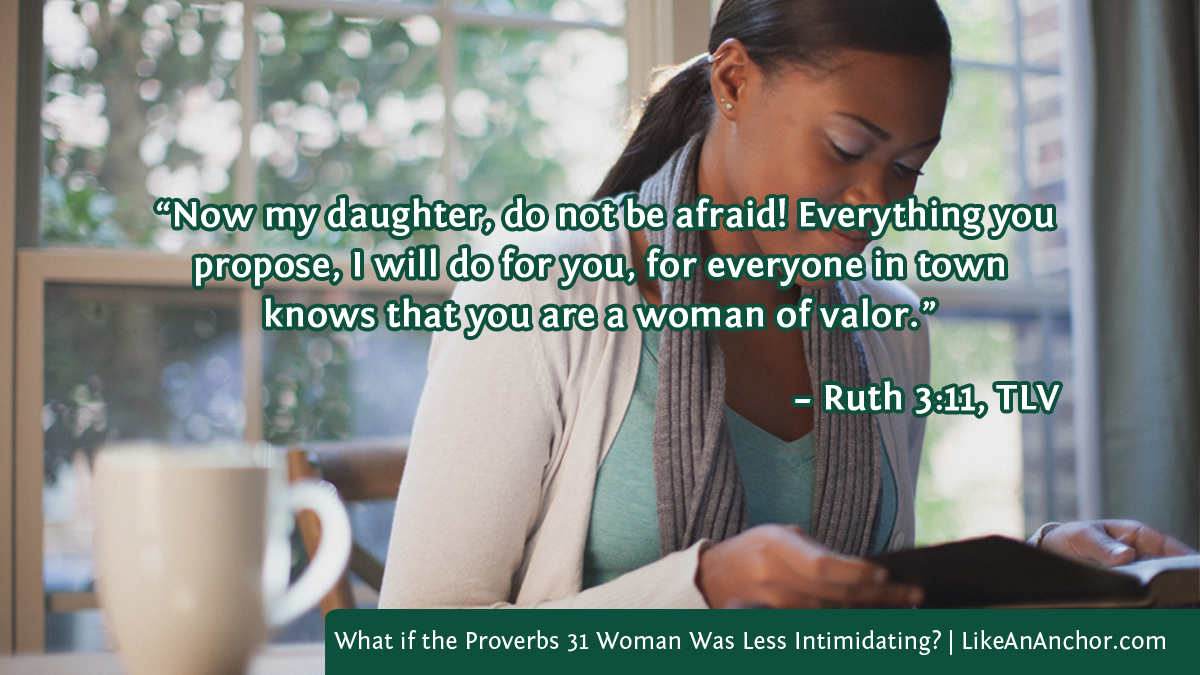
Image of a woman reading a Bible overlaid with text from Ruth 3:11, TLV version: "Now my daughter, do not be afraid! Everything you propose, I will do for you, for everyone in town knows that you are a woman of valor.”
Image by Pearl from Lightstock

A Mother’s Advice

It had been a while since I’d read through Proverbs, but not long ago I found myself back there reading Proverbs 31. (I think it was for one of the scripture writing studies our ladies’ group is doing at church.) This was the first time I’d read it since I’d started thinking about planning a wedding. I was also reading it, I think for the first time, in the NET translation. I’ll just quote the whole passage here so we can look at it together:

1 The words of King Lemuel, an oracle that his mother taught him: …

10 Who can find a wife of noble character?
For her value is far more than rubies.
11 Her husband’s heart has trusted her,
and he does not lack the dividends.
12 She has rewarded him with good and not harm
all the days of her life.
13 She sought out wool and flax,
then worked happily with her hands.
14 She was like the merchant ships;
she would bring in her food from afar.
15 Then she rose while it was still night,
and provided food for her household and a portion to her female servants.
16 She considered a field and bought it;
from her own income she planted a vineyard.
17 She clothed herself in might,
and she strengthened her arms.
18 She perceived that her merchandise was good.
Her lamp would not go out in the night.
19 She extended her hands to the spool,
and her hands grasped the spindle.
20 She opened her hand to the poor,
and extended her hands to the needy.
21 She would not fear for her household in winter,
because all her household were clothed with scarlet,
22 because she had made coverings for herself;
and because her clothing was fine linen and purple.
23 Her husband is well-known in the city gate
when he sits with the elders of the land.
24 She made linen garments then sold them,
and traded belts to the merchants;
25 her clothing was strong and splendid;
and she laughed at the time to come.
26 She has opened her mouth with wisdom,
with loving instruction on her tongue.
27 Watching over the ways of her household,
she would not eat the bread of idleness.
28 Her children have risen and called her blessed;
her husband also has praised her:
29 “Many daughters have done valiantly,
but you have surpassed them all!”
30 Charm is deceitful and beauty is fleeting.
A woman who fears the Lord—she makes herself praiseworthy.
31 Give her credit for what she has accomplished,
and let her works praise her in the city gates.

Proverbs 31:1, 10-31, NET

I like starting with the beginning of chapter 31 because that clarifies the context for this passage. This whole chapter is advice from a mother to her son. It’s about the type of woman he should want to marry and how highly he ought to value that woman.

That’s an important piece of information. It clarifies that the stated purpose of this passage is not to say, “Here’s the type of woman that all women should be.” We can use Proverbs 31:10-31 as an example of a good woman who follows the Lord, but it’s not a prescriptive list for everyone. It’s also specifically about married women; there are aspects which can relate to singles but not the whole thing.

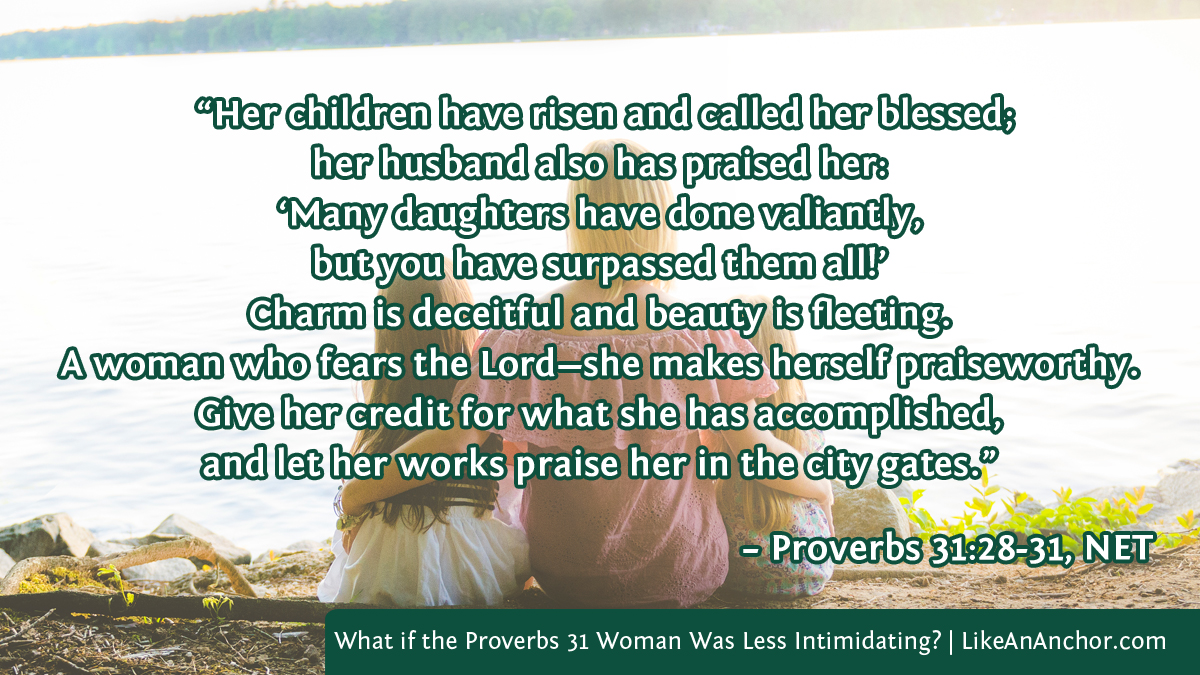
Image of a woman with her arms around two little girls overlaid with text from Proverbs 31:28-31, NET version: “Her children have risen and called her blessed; her husband also has praised her: ‘Many daughters have done valiantly,
but you have surpassed them all!’
Charm is deceitful and beauty is fleeting. A woman who fears the Lord—she makes herself praiseworthy. Give her credit for what she has  accomplished, and let her works praise her in the city gates.”
Image by David Clark Photography from Lightstock

Qualities of the Proverbs 31 Wife

As I read through the description of the Proverbs 31 wife, it seems like many of the specific descriptions could be summed up in general character traits. For example, “She perceived that her merchandise was good … She made linen garments then sold them, and traded belts to the merchants” shows us that she makes quality things and sells them. If we’re going to model her behavior, we don’t need to craft clothing; we need to do something productive with our time and make sure the things we’re producing are good quality. Here are the other qualities that stand out to me while reading:

  • Chayil–noble, strong, valiant
  • Trustworthy
  • Industrious and hardworking
  • A provider for her family and those working for her
  • Creator of quality goods, which she sells
  • Generous to the poor and needy
  • Fearless because she’s prepared
  • Wise and able to instruct
  • God-fearing
  • Accomplished, and given credit and praise for those accomplishments

Depending on when and where you grew up, you might have been told women shouldn’t work a job or get an education. You might have felt like your accomplishments should be hidden lest you appear too intelligent, too proud, or too intimidating. But the exact opposite is happening here.

King Lemuel’s mother supports the idea of a wife who works a job (specifically, her own business that she runs from her house while also caring for her family), manages and invests her own money, has wisdom and knowledge that she teaches to others, and who is publicly praised for her accomplishments. And that’s the kind of woman that she tells her son he should hope to find in a wife. (Perhaps the person who said no Christian guy would marry me after I got my bachelor’s degree should reread this chapter.)

We’re All Still Growing

Image of three women holding Bibles and talking with the blog's title text and the words "Becoming a valiant woman of strength, virtue, and courage is a process. The Proverbs 31 woman isn’t a standard to judge you against, but a friend you can imitate as you grow."
Image by Shaun Menary from Lightstock

When I read the Proverbs 31 woman passage most recently, I realized I didn’t find her all that intimidating. I wanted to mimic her, but in a good way rather than like I was under a weight of pressure. I want to be a wife for my soon-to-be husband who improves his life by being with him. And this passage reassures me I can do that with my talents, gifts, accomplishments, and knowledge.

Also, as I read this passage, I remember that God calls people “perfect” as long as they’re following Him and working toward perfection. Maybe the same is true here. If you’re working on following the Lord and growing as a woman of noble character, then perhaps you too can be described in the glowing terms of praise used here. I know many women–my mother, ladies at church, friends–who I’d say line up with this description of the Proverbs 31 woman pretty much exactly even though I know they’d say they’re far from perfect.

Reading passages like this, where we’re given an ideal to strive toward, should inspire us to keep doing our best and keep growing. Remember, our goal is “to build up the body of Christ, until we all attain to the unity of the faith and of the knowledge of the Son of God—a mature person, attaining to the measure of Christ’s full stature.” (Eph. 4:12-13, NET). That doesn’t all happen at once, and that’s okay. There’s a reason the Christian life is described as one of growing and building. It’s a process, and becoming a valiant woman of strength, virtue, and courage is no exception to that rule. So maybe next time you read Proverbs 31, think of her not as a standard to judge you against, but as a friend you can imitate as you grow.


Featured image by Shaun Menary from Lightstock

Song Recommendation: “Overcomer” by Mandisa

The Most Important Thing

I think God’s trying to give me a gentle reminder about what’s most important. This past Sabbath, the minister spoke about developing a Biblical worldview that begins with recognizing God is the highest authority in your life. Then the very next morning, the devotional I’m reading this year focused on making God “our primary passion” (Daily Moments of Peace: Inspiration for Women, p. 36). Together, those also make me think back to a video I watched on modern idolatry not that long ago. And thinking about this prompted a question.

What’s the most important thing in your life? And does what you just answered line up with how you prioritize your time?

I would answer God, of course. We know that’s what we’re supposed to say. And I could pat myself on the back if I liked since I read a devotional page and a few scriptures every morning, a chapter of the Bible every night, and I spend time studying and working on these blog posts almost every day. But right now, I’m spending more time thinking about and planning my upcoming wedding or fretting about trying to teach math to high schoolers.

Now, that doesn’t necessarily mean my priorities are out of whack. Pretty much all of us have to spend more time at work, for example, than in the Bible each day. Spending a quality half-hour in Bible study and eight hours on your workday doesn’t mean you don’t put God first; it’s just a necessity of how modern life is structured. But if you’re trying to Bible study or pray and you want to think about your to-do list, or your wedding, or whatever else (good or bad, happy or stressful) that you have going on instead, then maybe you’re not really putting God first.

Part of this I think just has to do with modern attention spans. We have more trouble focusing on one thing than we used to. It takes discipline and help from God’s holy spirit to focus and spend quality time with Him. But I think we’re also way too easily distracted from that one thing which is most important. And it’s a struggle people in the Bible had as well, even without smartphones to get in the way.

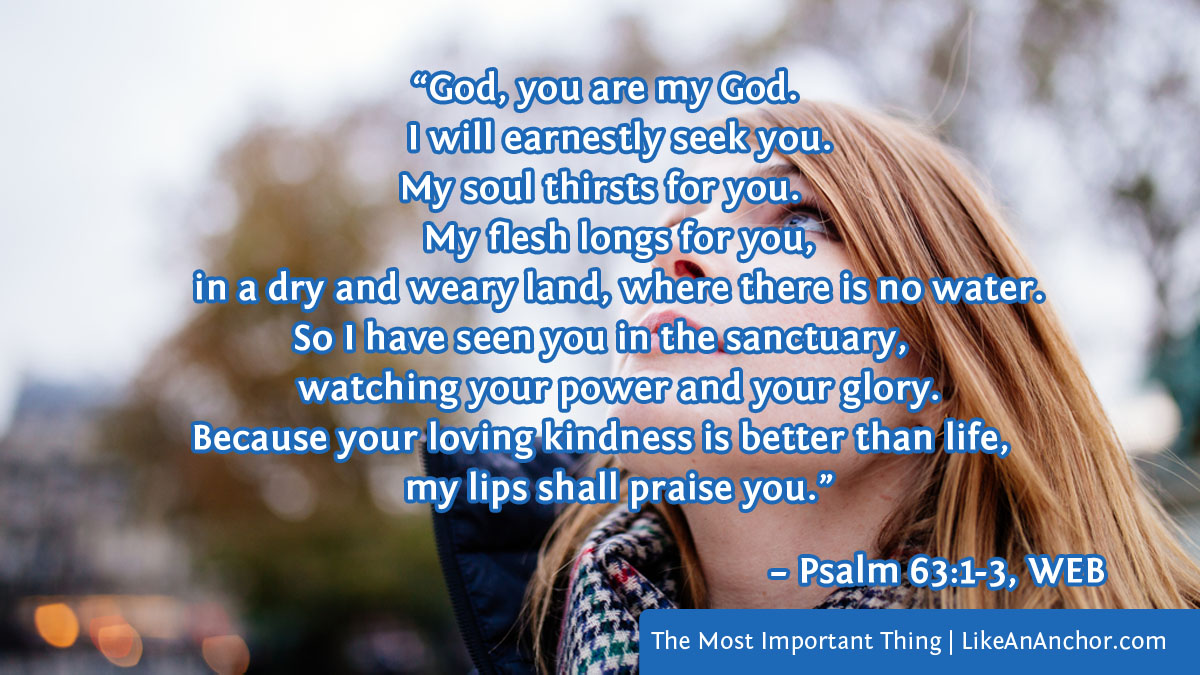
Image of a woman looking up at the sky overlaid with text from Psalm 63:1-3, WEB version:   “God, you are my God. I will earnestly seek you. My soul thirsts for you. My flesh longs for you, in a dry and weary land, where there is no water. So I have seen you in the sanctuary, watching your power and your glory. Because your loving kindness is better than life, my lips shall praise you.”
Image by Brightside Creative from Lightstock

Choose the Best Part

Now as they went on their way, Jesus entered a certain village where a woman named Martha welcomed him as a guest. She had a sister named Mary, who sat at the Lord’s feet and listened to what he said. But Martha was distracted with all the preparations she had to make, so she came up to him and said, “Lord, don’t you care that my sister has left me to do all the work alone? Tell her to help me.” But the Lord answered her, “Martha, Martha, you are worried and troubled about many things, but one thing is needed. Mary has chosen the best part; it will not be taken away from her.

Luke 10:38-42, NET

This is probably the best known example of someone in the Bible being distracted from spending time with God. I never actually read Joanna Weaver’s book Having a Mary Heart in a Martha World, but I remember it coming up at young adult retreats I went to years ago. Women broke down crying, torn by desires and pressures to stay busy serving and the call to spend time with Jesus. No one wanted to be like Martha, who was so gently rebuked by Jesus, but someone has to make sure the food’s made and served, and the church hall is clean, and the kids aren’t getting into too much mischief.

Notice, though, that Jesus didn’t say it was wrong to do the work Martha was doing. It was wrong to be worried and troubled about things, resent that her sister chose to focus on something else, and let her work become a source of bitterness and a distraction. Serving is a good thing; “service” is itself a spiritual gift and even if our gift is something else we’re supposed to use it in serving others (Rom. 12:6-8; 1 Pet. 4:9-10). But unless we have the right priorities and keep our service in perspective, we can start to resent the time we’re spending on it.

This can extend to other situations too. For example, someone came to Jesus and said, “Teacher, tell my brother to divide the inheritance with me.” If you had one question you could ask Jesus in person, I dare say you wouldn’t pick that, but we can see where this man’s focus and priorities were. Jesus told him arbitrating disputes like that isn’t His job, then said, “Watch out and guard yourself from all types of greed, because one’s life does not consist in the abundance of his possessions.” It’s far better to focus on being “rich toward God” than on anything we could own in this human life (Luke 12:13-21, NET). In other words, focus on the more important things. When we remember what’s most important, then the rest of it will fall into its proper place.

Image of a man reading a Bible overlaid with text from Luke 12:32-34, NET version:  " “Do not be afraid, little flock, for your Father is well pleased to give you the kingdom. Sell your possessions and give to the poor. Provide yourselves purses that do not wear out—a treasure in heaven that never decreases, where no thief approaches and no moth destroys. For where your treasure is, there your heart will be also.”
Image by Anggie from Lightstock

The Danger of Forgetting

It might seem well-nigh impossible to forget about God, but we know from the Bible (and sometimes from personal experience) that people have done that many times. In 1 Corinthians, Paul says that Israel’s history is recorded in the Bible “as examples and were written for our instruction” (1 Cor. 10:11, NET). One of the things we can learn from is how quickly they forgot about God’s importance. Even the ones who literally saw the plagues of Egypt and the parting of the Red Sea were worshipping a golden calf only a couple months later. If they could do that having seen so much evidence of God’s involvement and reality, then we’re in danger of doing the same and the warnings to Israel’s descendants apply to us as well (Deut. 4:8-10; 23-24; 6:10-13; 8:10-20; 9:6-8).

Beware lest you forget Yahweh your God, in not keeping his commandments, his ordinances, and his statutes, which I command you today; lest, when you have eaten and are full, and have built fine houses and lived in them; and when your herds and your flocks multiply, and your silver and your gold is multiplied, and all that you have is multiplied; then your heart might be lifted up, and you forget Yahweh your God, who brought you out of the land of Egypt, out of the house of bondage … and lest you say in your heart, “My power and the might of my hand has gotten me this wealth.” …

It shall be, if you shall forget Yahweh your God, and walk after other gods, and serve them and worship them, I testify against you today that you shall surely perish. As the nations that Yahweh makes to perish before you, so you shall perish, because you wouldn’t listen to Yahweh your God’s voice.

Deuteronomy 8:11-14, 17, 19-20, NET

I know this doesn’t describe all of us, but based on what I know about the countries where most of my readers live (U.S., U.K, and Canada, among others) I’m guessing most of you can eat enough to be full, live in some type of house, and have money enough at least for necessities. Many of us are in a position where we could say, “My power and the might of my hand has gotten me to the place where I am today.” But if we did say that, it wouldn’t be any more true than when ancient Israel said it. We’re where we are by the grace of God and every good thing in our lives comes from Him (James 1:17). We must guard ourselves against forgetting that.

“Can a virgin forget her ornaments,
    or a bride her attire?
    Yet my people have forgotten me for days without number.”

Jeremiah 2:32, WEB

Forgetting God is as insane as me forgetting to put on my pretty wedding dress when I get married in June. Yet people did forget Him and it broke God’s heart, as He said over and over to prophets like Jeremiah and Hosea. We also looked at this in our in-depth study of Isaiah 40-66 last year. In particular, I’m thinking of the first post, “God is Incomparable and Irreplaceable.” There, we studied passages where God addresses the insanity of Israel’s idolatry in the light of His incomparableness (Isaiah 40:12-31; 43:10-13; 44:6-20; 46:5-11; 57:3-11; 63:7-14; 64:4). The Creator of the Universe wanted to claim them as His people, yet they bowed down to carved wood or stone instead? It just doesn’t make sense.

For he said, “Surely, they are my people,
    children who will not deal falsely;”
    so he became their Savior. …
But they rebelled
    and grieved his Holy Spirit.

Isaiah 63:8, 10, WEB

Way Too Important To Forget

Image of two women reading a Bible with the blog's title text and the words  "With God as the true center of our lives, many of the things that could become distractions turn into reasons to remember His presence as we pray about the hard stuff and give thanks for the good things."
Image by Ryan Klintworth from Lightstock

We’re not likely to toss out our Bibles and pick up some statue to worship instead. But we might not spend as much time in God’s word as we ought. In the U.S., only about 50% of adults are “Bible Users—defined as individuals who read, listen to, or pray with the Bible on their own at least three or four times a year” (Barna, 2021). Three or four times a year isn’t that much–you’d lose your job real quick if that’s how often you bothered showing up for work, and we ought to honor God a lot more than we do our bosses (Mal. 1:6-8).

According to the same Barna report, the number of near-daily Bible readers is increasing–“one in six U.S. adults (16%) reads the Bible most days during the week, up from 12 percent in 2020.” That’s the group we ought to be in. You can’t have a close relationship with someone unless you spend time with them, and prayer and Bible study are two of the primary ways we can spend time with God. We also need to spend time in the Bible to understand how we ought to live and deepen our understanding of God’s way of life.

But be doers of the word, and not only hearers, deluding your own selves. For if anyone is a hearer of the word and not a doer, he is like a man looking at his natural face in a mirror; for he sees himself, and goes away, and immediately forgets what kind of man he was. But he who looks into the perfect law of freedom and continues, not being a hearer who forgets, but a doer of the work, this man will be blessed in what he does.

James 1:22-25, WEB

We need to do something with the knowledge God gives us about Him and His way of life. We need to be actively involved in our relationship with Him. Forgetting to put our faith into action means we’re forgetting the whole basis of our faith.

For this very reason, make every effort to add to your faith excellence, to excellence, knowledge; to knowledge, self-control; to self-control, perseverance; to perseverance, godliness; to godliness, brotherly affection; to brotherly affection, unselfish love. For if these things are really yours and are continually increasing, they will keep you from becoming ineffective and unproductive in your pursuit of knowing our Lord Jesus Christ more intimately. But concerning the one who lacks such things—he is blind. That is to say, he is nearsighted, since he has forgotten about the cleansing of his past sins. Therefore, brothers and sisters, make every effort to be sure of your calling and election. For by doing this you will never stumble into sin.

2 Peter 1:5-10, NET

The Christian life is a growth process. Without that growth, Peter says it’s like you forgot Jesus died for your sins. People who remember what is most important spend time cultivating their relationship with God and becoming more and more like Him. That’s not the only thing they do, but it is their top priority. When God is truly the most important thing in our lives, His supremacy contextualizes everything else. With this perspective, when I think about the difficult things, I also remember to pray about them. When I think about the good things, I thank God for them. Instead of distractions, they can become reasons to remember God’s presence.

God is way too important for us to forget. At the end of our lives, it’s not going to matter what color the tulle was at the wedding, whether Mary helped in the kitchen, if you get an A or a C on that test, that your brother divided the inheritance with you, how many followers you had online, or if your wealth multiplied. It matters far more that the marriage grows from your relationship with God, that you treated the people you interact with well, and that you used your possessions in a godly way. And all of those things happen when we properly prioritize God as the most important and respect Him as the one who’s in charge.


Featured image by Shaun Menary from Lightstock

Song Recommendation: “Lifesong” by Casting Crowns

The Glory, Importance, and Victory of Other People

While I was writing last week’s post, I noticed I’d come back yet again to the idea of other people’s importance to our lives with God. I feel like I’ve been writing about that a lot lately, starting with “The Glorious Weights We Carry” over a month ago, then in “Building People Up in Christ,” “The Reason For Relationship,” and most recently “The Crown of Victory.”

It’s clear that God cares deeply for people. We all benefit from His love immensely as recipients of grace, mercy, salvation, and ongoing relationship. Yet as human beings, we have a tendency to think about how much God cares for me and how His love changes my life. We think less often about what His care for all people means for how we should interact with others. But we’re supposed to become like God, and that means learning to see other people the way He does.

As I’ve studied the Bible over the past month, it struck me that the glory we anticipated is connected to other people. When Jesus builds us up, He expects us to respond by building others up. The type of relational oneness that Jesus and the Father want with us is the same type of oneness we should want to have with others in God’s family. Even the crown of victory we’re promised after faithfully completing our mortal lives is linked with other people who are also living lives of faith. Our individual lives with God are inescapably contextualized by our relationships within His church.

Carrying Others’ Glory

If we’re going to follow Jesus’s example, then we need to spend a lot of time focused on helping other people toward a good outcome. Paul says, “Carry one another’s burdens, and in this way you will fulfill the law of Christ” (Gal. 6:2, NET). The word translated “burdens” here is baros (βάρος), the same Greek word that’s translated “weight” in this verse: “For our momentary, light suffering is producing for us an eternal weight of glory far beyond all comparison” (2 Cor. 4:17, NET). I suspect C.S. Lewis was connecting these two scriptures when he spoke of our neighbor’s glory in a sermon from 1941.

It may be possible for each to think too much of his own potential glory hereafter; it is hardly possible for him to think too often or too deeply about that of his neighbour. The load, or weight, or burden of my neighbour’s glory should be laid daily on my back, a load so heavy that only humility can carry it, and the backs of the proud will be broken. It is a serious thing to live in a society of possible gods and goddesses, to remember that the dullest and most uninteresting person you talk to may one day be a creature which, if you saw it now, you would be strongly tempted to worship, or else a horror and a corruption such as you now meet, if at all, only in a nightmare. All day long we are, in some degree, helping each other to one or other of these destinations.

C.S. Lewis, The Weight of Glory, p. 8

I often think about this sermon, and this passage in particular. We know that “Christ Jesus came into the world to save sinners” and as a result “whoever believes in him should not perish, but have eternal life” (1 Tim. 1:15; John 3:16). God deeply desires for all people to know the truth, repent, follow Him, and receive salvation (1 Tim. 3:4; 2 Peter 3:9). If we want to be like God, then we should deeply desire that as well. We need to remember that the people all around us have the same glorious potential that God grants to us.

So we must not grow weary in doing good, for in due time we will reap, if we do not give up. So then, whenever we have an opportunity, let us do good to all people, and especially to those who belong to the family of faith.

Galatians 6:9-10, NET

We’re supposed to be doing good to other people. God never intended for there to be quarreling, backbiting, pettiness, and rivalries among His people. We’re supposed to care so much about other people, especially those in “the family of faith,” that we’ll carry their burdens and shoulder the weight of their glory along with our own.

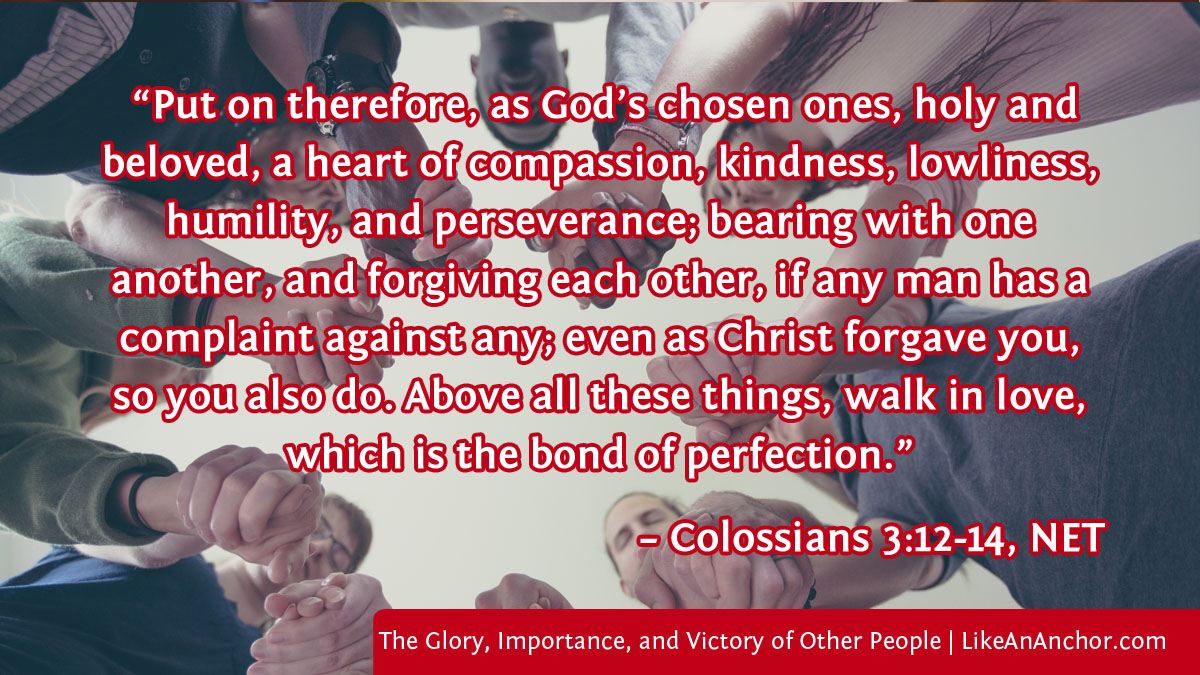
Image of people in a circle holding hands overlaid with text from Colossians 3:12-14, NET version:   “Put on therefore, as God’s chosen ones, holy and beloved, a heart of compassion, kindness, lowliness, humility, and perseverance; bearing with one another, and forgiving each other, if any man has a complaint against any; even as Christ forgave you, so you also do. Above all these things, walk in love, which is the bond of perfection.”
Image by Claudine Chaussé from Lightstock

Build Others Up First

In 1 Corinthians, Paul counsels his readers to “flee from idolatry” in the context of whether or not they should eat meat sacrificed to idols. Paul answers that specific question like this: you’re free to eat the meat as long as you’re not participating in idol worship and thereby having dinner with demons (1 Cor. 8:1-13; 10:14-33). But Paul also points out there’s a much deeper issue here. The question is about an individual choice, but that doesn’t matter nearly as much as the question of how the choice to eat this meat affects other people.

With regard to food sacrificed to idols, we know that “we all have knowledge.” Knowledge puffs up, but love builds up. … With regard then to eating food sacrificed to idols, we know that “an idol in this world is nothing,” and that “there is no God but one.”  …

But this knowledge is not shared by all. … be careful that this liberty of yours does not become a hindrance to the weak. For if someone weak sees you who possess knowledge dining in an idol’s temple, will not his conscience be “strengthened” to eat food offered to idols? So by your knowledge the weak brother or sister, for whom Christ died, is destroyed. If you sin against your brothers or sisters in this way and wound their weak conscience, you sin against Christ. 

1 Corinthians 8:1-2, 4, 7, 9-12, NET

Paul shifts the conversation. The most important thing here isn’t whether you have the freedom to eat the meat sold in the market place without asking about its backstory. The thing you need to worry about it how your choice affects other people in the family of faith.

“Everything is lawful,” but not everything is beneficial. “Everything is lawful,” but not everything builds others up. Do not seek your own good, but the good of the other person.  … So whether you eat or drink, or whatever you do, do everything for the glory of God. Do not give offense to Jews or Greeks or to the church of God, just as I also try to please everyone in all things. I do not seek my own benefit, but the benefit of many, so that they may be saved.

1 Corinthians 10:23-24, 31-33, NET

I’m a Star Trek fan, so this makes me think of Spock’s statement that “The good of the many outweighs the good of the one.” That’s the attitude Paul is describing here. What does it matter whether you get to eat meat in the grand scheme of other people’s salvation? If you decide to do something because it’s technically allowed, even though you know it’s going to hurt someone else who might be “weaker” in the faith, then you’re sinning against Jesus Christ Himself. When we love as God loves, we’ll focus on the things that build other’s up before we focus on our own desires. In fact, just a little later in this same letter, Paul says, “Let all things be done to build each other up ” (1 Cor. 14:26, WEB). We need to make doing good to others the main goal of our actions and interactions, particularly in the church.

Copying Christ’s Attitude

Last week when we were studying the crowns of victory that God promises us for living faithfully, we looked at two verses where Paul describes other people as our glory, joy, and crown (Phil. 4:1; 1 Thes. 2:19-20). This description emphasizes that there’s no competition among believers. Even though our Christian lives are described like an athletic game that we need to strive to win, we’re not competing against other believers but alongside them.

Therefore, if there is any encouragement in Christ, any comfort provided by love, any fellowship in the Spirit, any affection or mercy, complete my joy and be of the same mind, by having the same love, being united in spirit, and having one purpose. Instead of being motivated by selfish ambition or vanity, each of you should, in humility, be moved to treat one another as more important than yourself. Each of you should be concerned not only about your own interests, but about the interests of others as well. You should have the same attitude toward one another that Christ Jesus had

Philippians 2:1-5, NET
Image of two people holding hands with the blog's title text and the words "If everything goes according to plan, we'll be spending eternity with other people in God’s family of faith. We can't wait until then to care about them, though. We need to be loving, encouraging, prioritizing, and building each other up now."
Image by Jantanee from Lightstock

Paul goes on to describe Jesus’s attitude as humble, service-oriented, sacrificial, and obedient (Phil. 2:6-11). Just like He and His servants admonish us to do, Jesus built other people up. He put their needs first, whether that meant correcting them sternly or showing unexpectedly generous mercy (Matt 16:22-23; Luke 7:36-48). He even died for all of us. And He expects those who follow Him to be similarly humble, forgiving, service-oriented, and sacrificial (Eph. 4:31-32; Col. 3:12-13; 1 John 3:16).

He died for us so that whether we are alert or asleep we will come to life together with him. Therefore encourage one another and build up each other, just as you are in fact doing.

1 Thessalonians 5:10-11, NET

Notice that while Paul charges his readers to encourage and build each other up, he also points out they’re already doing this. We might already be doing this as well, but a reminder is always good to help us continue doing the right thing. Supporting others in God’s family is important enough that even if we’re already doing it, we need reminders of it’s importance.

If we’ve stopped encouraging and building each other up–for example, started avoiding some people at church because we don’t like them–then we can take Paul’s words here as a nudge to get back on track. There will be people in God’s family and our local church groups we don’t get along with very well. There may even be some that, in extreme cases, we need to stop associating with for our mental or spiritual health (Rom. 16:17-18; 1 Cor. 5:11; 2 Thes. 3:6-14). However, that’s the exception rather than the rule. God’s intention and command is for us to live in peace with others in the church and invest in good relationships with them.

 Let’s consider how to provoke one another to love and good works, not forsaking our own assembling together, as the custom of some is, but exhorting one another, and so much the more as you see the Day approaching.

Hebrews 10:24-25, WEB

Nearly two thousand years ago, the apostle John wrote, “Little children, these are the end times” (1 John 2:18, WEB). That was true then, and we’re even closer now. This makes the admonition in Hebrews to assemble together and encourage each other as the Day of the Lord approaches even more urgent. (Of course, this includes the caveat, “if it’s possible to assemble;” health problems, location, and persecution can make assembly in person very difficult or impossible for some of us.)

If we can get together with other believers and participate in a church group, though, we should. We simply don’t have time to waste bickering, competing, or holding petty things against each other. We need to forgive, to encourage, to show love when we speak truth, and build each other up. And we ought to enjoy spending time together. If everything goes according to plan, we’ll be spending eternity with these people. That thought should make us excited–it’s what Jesus and the Father want, and it’s what we should want as well.


Featured image by Ben White from Lightstock

New Scripture Writing Topic: Inspiring Music

As you may know, a group of ladies at my church group started a scripture writing group a few years ago. One of us studies a topic and shares a list of scriptures with the other ladies, then we all write those scriptures over the course of a month, and finally we meet again to discuss the topic. It’s been such a good way to connect with each other and dig deeper into God’s word.

Whenever I make the list for the month, I share it here on my blog as one of the free resources available to all my readers. For February, I have the topic “Inspiring Music.” Here it is if you’d like to follow along with us. The version I’m sharing here has 30 days instead of 28, so you can use it any other month as well.


The Crown of Victory

What do you think of when you think “crown”?

Probably a gold circlet that rulers wear on top of their heads, possibly very elaborate and adored with gemstones. Or maybe you think of the crown, or top, of your head. You might think of it as a verb, too, in the sense of crowning someone when they ascend to a throne.

I’m guessing a victory laurel wasn’t the first thing you thought of. We don’t give winners in the Olympic games laurel crowns any more; we give them gold, silver, and bronze medals. Back in New Testament Bible times, though, when someone read the Greek word typically translated as “crown” they were just as likely to think of victory as authority.

That changes things a little, doesn’t it? When Paul talks about us earning a crown, he’s likely talking about victory rather than ruling power. When Jesus warns in Revelation, “Let no one take your crown,” He’s not talking about them stealing the crown jewels but robbing us of victory. When the soldiers put a crown of thorns on Jesus, it’s a mockery of the authority and victory that He claimed, which ironically turned into a symbol for both.

What actually is a crown?

The word translated “crown” throughout the New Testament “refers to a wreath … worn as a symbol of honor, victory, or as a badge of high office” (NET footnote on Rev. 3:11). This word stephanos (στέφανος) is both “a mark of royal or (in general) exalted rank” and “the wreath or garland which was given as a prize to victors in public games” (Thayer’s dictionary, G4735). While the royal imagery is included as part of the definition, in Classical Greek it was “not used of the kingly crown but of the crown of victory in games, of civic worth, military valor, nuptial joy, [and] festival gladness” (Zodhiates’s dictionary, G4735).

There were a few other words that Greek writers could have used for a similar idea. Stemma (στέμμα) comes from the same root as stephanos and means pretty much the same thing, but it only shows up once in the Bible (Acts 14:13, “garlands”). Diadema (διάδημα) is “a symbol of royal dignity,” but was more of a headband than a crown (Zodhiates, G1238). That word, diadema, appears in the Bible, but only in Revelation to refer to crowns worn by the dragon, the beast, and the triumphantly returning Jesus (Rev. 12:3; 13:1; 19:12). Korona (κορώνη) is where we get the modern word “crown,” but it doesn’t appear in the Bible. In contrast, stephanos appears 18 times in the New Testament, making it by far the most common word for “crown.” Here’s one of the passages where it’s used:

For he did not put the world to come, about which we are speaking, under the control of angels. Instead someone testified somewhere:

What is man that you think of him or the son of man that you care for him?
You made him lower than the angels for a little while.
You crowned him with glory and honor.
You put all things under his control.”

For when he put all things under his control, he left nothing outside of his control. At present we do not yet see all things under his control, but we see Jesus, who was made lower than the angels for a little while, now crowned with glory and honor because he suffered death, so that by God’s grace he would experience death on behalf of everyone.

Hebrews 2:5-9, NET, bold italics a quotation from Psalm 8

Here, we see both the authority and victory meanings of stephanos. God granted to human beings a certain amount of authority at creation, but the one with all authority is Jesus Christ. He is also the one who gained victory by His suffering, earning a crown of glory and honor. And because He earned that crown, there’s an assurance that we can follow right along after Him and get a crown for ourselves.

Image of a leafy crown hanging from a fence post overlaid with text from Rev. 3:11-12, NET version:  “I am coming soon. Hold on to what you have so that no one can take away your crown. The one who conquers I will make a pillar in the temple of my God, and he will never depart from it.”
Featured image by Pexels from Pixabay

Competition and Reward

Because crowns were awarded to victors in athletic games, Paul uses the word “crown” when talking about our Christian life as a competition. We’re “competitors” who “strive in the games” like athletes (1 Cor. 9:25; 2 Tim. 2:5). It’s not a competition where there’s only one winner, though–it’s more like the sort of thing where all who reach the goal are counted winners. We’re not “in competition” with other people, especially not other believers. But we are striving toward a victory.

Do you not know that all the runners in a stadium compete, but only one receives the prize? So run to win. Each competitor must exercise self-control in everything. They do it to receive a perishable crown, but we an imperishable one.

So I do not run uncertainly or box like one who hits only air. Instead I subdue my body and make it my slave, so that after preaching to others I myself will not be disqualified.

1 Corinthians 9:24-27, NET

The word translated “competitor” here is agonizomai (ἀγωνίζομαι). It literally means “to contend for victory in the public games,” but it also took on a more figurative meaning: “straining every nerve to the uttermost towards the goal” (Zodhiates, G75). That’s the level of commitment we’re all supposed to have to following Jesus. And, as James points out, when we strive faithfully there is certainty of a reward at the end.

Happy is the one who endures testing, because when he has proven to be genuine, he will receive the crown of life that God promised to those who love him.

James 1:12, NET

This is a promise. If you compete well–in other words, strive faithfully to follow God–He will be faithful to give you the victor’s reward. Similarly, Peter tells leaders in the church that if they’re faithful and humble, “when the Chief Shepherd appears, you will receive the crown of glory that never fades away” (1 Pet. 5:1-6, NET). In the letter to the church in Smyrna, Jesus promises, “Remain faithful even to the point of death, and I will give you the crown that is life itself” (Rev. 4:10, NET). By the end of his life even Paul, who wrote about exercising rigorous self-discipline lest he be “disqualified,” knew for certain that the Lord would give him (and others) a crown of victory.

Finally the crown of righteousness is reserved for me. The Lord, the righteous Judge, will award it to me in that day—and not to me only, but also to all who have set their affection on his appearing.

2 Timothy 4:8, NET

You Are Our Crown

There’s one more way that Paul uses the word “crown” in his New Testament writings.

So then, my brothers and sisters, dear friends whom I long to see, my joy and crown, stand in the Lord in this way, my dear friends!

Philippians 4:1, NET

For who is our hope or joy or crown to boast of before our Lord Jesus at his coming? Is it not of course you? For you are our glory and joy!

1 Thessalonians 2:19-20, NET

If we still thought competing for the victory might imply some competition between believers, this should put that idea to rest. Paul calls his brothers and sisters in Christ his joy, crown, and glory! We’re not all Paul, of course, but I think we can relate to this statement as well (particularly since he says “our” in Thessalonians). This isn’t a statement only Paul can make; our fellow believers can (and should!) be a source of joy, victory, and glory to all of us.

I’ve thought about our Christian life as a battle before (I am, after all, working on final edits for my next study guide, The Armor of God). But I’d never thought about our relationships with other believers being connected with the crown of victory promised to those following Jesus Christ and God the Father. It’s a fascinating thought, and it ties us right back again to the post I wrote a couple weeks ago about the weight of glory and the connection C.S. Lewis drew between our glory and our neighbors. If we’re carrying each other’s burdens (Gal. 6:2) and shouldering the weight of our neighbors’ glory (Lewis), then it makes sense we’d celebrate them as part of the anticipated victory.

Our future in God’s kingdom will involve a certain amount of authority, under the Lordship of Jesus Christ and the ultimate authority of the Father. We will, after all, judge angels and serve as priests (1 Cor. 6:2-4; Rev. 1: 6). But the focus now and in the future isn’t on our authority; it’s on service (Matt. 20:25-28; 23:10-12). Even the crowns we’re promised are symbols of victory and gladness more than symbols pointing out we’re in charge. It’s a humbling thing to think about, and also a joyful one. I imagine Jesus and the Father eagerly awaiting a celebration, wanting to welcome us into the family and crown us as victors who followed in Jesus’s footsteps to overcome the world. And I pray we’ll all be there together in glory and joy. Keep striving for victory! Let no one take your crown.


Featured image by James Chan from Pixabay

Grace To Build An Ark: Take Two

About six years ago (at the end of 2016), I wrote a blog post called “Grace to Build An Ark.” As I’ve studied grace more over the years, I keep coming back to this idea. When Noah found grace in the Lord’s eyes, God didn’t drop a ready-made ark from the sky. He gave Noah the plans to build an ark for himself.

We rightly think of grace as an “unmerited favor” or a “free gift” from God. But we often wrongly think that because the gift is given freely there are no accompanying expectations. I write about this error in posts like “Learning More About Covenant Grace” and you can learn even more about it by reading the book that inspired that post, Relational Grace: The Reciprocal and Binding Covenant of Charis (2015). Here’s one quote from the author, Brent Schmidt:

Jews knew about covenantal relationships from the Bible. Every commandment was a covenant with God. Several stories, including Joseph, Moses, and David, associate the concepts of grace and mercy with covenants. Greek-speaking Jews lived in a culture that depended heavily on reciprocal relationships and understood what charis meant. When Paul taught them using the word charis, they would have understood that by accepting God’s grace they were making covenantal obligations.

BRENT SCHMIDT, RELATIONAL GRACE, P. 64

Noah’s story is the very first time we see the word “grace” in the Bible (Hebrew chen, also “kindness” or “favor”). God looked down on earth and “saw that the wickedness of man was great in the earth.” Grieving, God decided to destroy His creation, except “Noah found favor in Yahweh’s eyes” (Gen. 6:5-8, WEB). Once God chose to extend grace to Noah, He warned Him about the world-destroying flood, saying, “Make a ship of gopher wood,” gave him building instructions, and promised, “I will establish my covenant with you” (Gen. 6:13-21, WEB).

Noah and his family didn’t earn the right to be in the ark or to have a covenant-relationship with God. Their salvation was a gracious choice God made. But Noah still had to obey the command to build. Likewise, salvation is offered freely to us by God’s grace as He welcomes us into a covenant with Him. And we also have an obligation to obey God and to build something.

Building By Grace

Giving Noah the time and ability to build an ark so he and his family would live and the world would continue was a free gift of God’s grace. But Noah wouldn’t have been saved if he’d refused to build the ark. Peter and the author of Hebrews both talk about how important this building step was, and what it means for us today.

By faith Noah, when he was warned about things not yet seen, with reverent regard constructed an ark for the deliverance of his family. Through faith he condemned the world and became an heir of the righteousness that comes by faith.

Hebrews 11:7, NET

God patiently waited in the days of Noah as an ark was being constructed. In the ark a few, that is eight souls, were delivered through water. And this prefigured baptism, which now saves you—not the washing off of physical dirt but the pledge of a good conscience to God—through the resurrection of Jesus Christ, who went into heaven and is at the right hand of God with angels and authorities and powers subject to him.

1 Pet. 3:20-22, NET

Hebrews talks about the righteousness by faith that Noah inherited. Peter says Noah’s salvation prefigured baptism and our salvation. We live in times very similar to those Noah faced, and we’re also fast approaching the end of this world (1 John 2:18; Matt. 24:37-39; 2 Pet. 3:1-10). Like Noah, God has extended a lifeline to us–salvation by His grace. Also like Noah, we need to respond by taking action based on faith. Twice in Genesis, we’re told “Noah did everything that Yahweh commanded him” (Gen. 6:22; 7:5). If someone wrote the stories of our lives, could they say that about you and me?

Faith is an active thing. As we studied earlier this month, God seems to like building things, particularly when it involves building people up. He talks about building us into His temple, a dwelling place for Him here on earth as He lives inside the people of His church. He also talks about us participating in the building process.

We are coworkers belonging to God. You are God’s field, God’s building. According to the grace of God given to me, like a skilled master-builder I laid a foundation, but someone else builds on it. And each one must be careful how he builds. For no one can lay any foundation other than what is being laid, which is Jesus Christ. If anyone builds on the foundation with gold, silver, precious stones, wood, hay, or straw, each builder’s work will be plainly seen, for the Day will make it clear, because it will be revealed by fire. And the fire will test what kind of work each has done. If what someone has built survives, he will receive a reward. If someone’s work is burned up, he will suffer loss. He himself will be saved, but only as through fire.

Do you not know that you are God’s temple and that God’s Spirit lives in you? If someone destroys God’s temple, God will destroy him. For God’s temple is holy, which is what you are.

1 Corinthians 3:9-17, NET

Just like Noah so long ago, God expects us to act on the gift of grace that He gives us. God’s grace brings us into salvation and then we start building and working. We step out in obedience with faith, trusting the guides God gives us for how to build. We “work out our own salvation” while God “works in us both to will and to work, for his good pleasure” (Phil. 2:12-13, WEB).

Continuing to Walk With God

Our walk with God doesn’t end when we receive His grace. That’s when it starts. Once we’ve covenanted with Him–in other words, entered a relationship with Him–we’re expected to “walk worthy of the calling with which you were called” (Eph. 4:1; Col. 1:10). The gift should change us. How could it not? What human being could encounter God in a meaningful, ongoing way and stay the same?

For by grace you are saved through faith, and this is not from yourselves, it is the gift of God; it is not from works, so that no one can boast. For we are his creative work, having been created in Christ Jesus for good works that God prepared beforehand so we can do them.

Ephesians 2:8-10, NET

Before we’re told that Noah found favor in the eyes of Yahweh, we’re given a description of his character. “Noah was a righteous man, blameless among the people of his time. Noah walked with God” (Gen 6:9, WEB). That’s what we’re supposed to do as well. Noah stood out from the wicked world around him because he followed God, and God noticed. When He spoke to Noah, Yahweh said, “Come with all of your household into the ship, for I have seen your righteousness before me in this generation” (Gen 7:1, WEB).

God loves and longs to save the whole world (John 3:16; 2 Pet. 3:9; 1 Tim. 2:3-4). But He won’t force people to follow Him and He won’t bring people into His kingdom who refuse the gift of salvation in word or action. That’s a choice we’re given to make. As He has always done, God sets before us life or death, blessings or cursing. We can either live in His grace or refuse to walk with Him. There’s no third option.

Behold, I have set before you today life and prosperity, and death and evil. For I command you today to love Yahweh your God, to walk in his ways and to keep his commandments, his statutes, and his ordinances, that you may live and multiply, and that Yahweh your God may bless you in the land where you go in to possess it. … I call heaven and earth to witness against you today that I have set before you life and death, the blessing and the curse. Therefore choose life, that you may live, you and your descendants, to love Yahweh your God, to obey his voice, and to cling to him; for he is your life, and the length of your days.

Deuteronomy 30:15-6, 19-20, WEB

Salvation isn’t about going on with your old life after you’ve received grace. It’s about a life-changing relationship with the One who continually gives grace (John 1:17; 1 Cor. 1:4; Eph. 4:7; 2 Thes. 2:16-17; 2 Tim. 1:9). And we have help in our quest to keep living by obedience as we build up ourselves and others in the church. God’s not going to call us into something without equipping us to finish it.

Building our arks has nothing to do with what we can accomplish on our own. Rather, it’s about believing Jesus when He said, “My grace is enough for you, for my power is made perfect in weakness.” (2 Cor. 12:9, NET). By God’s grace we are saved, we’re equipped to walk by faith, and we’re told to build, just like Noah. Our building project isn’t a giant boat, but the very church of God. Jesus said, “I will build my church” (Matt. 16:18, NET), but He graciously invites us to have a role in that. We get to build each other up and we get to build up our own faith.

But you, dear friends, by building yourselves up in your most holy faith, by praying in the Holy Spirit, maintain yourselves in the love of God, while anticipating the mercy of our Lord Jesus Christ that brings eternal life. 

Jude 1:20-21, NET

Featured image by Greg Reese from Pixabay

Song Recommendation: “Build a Boat” by Colton Dixon

Save

Save

Save