Lessons from The Kings of Judah

One thing I find fascinating when reading the Old Testament is thinking about how the ancient kings of Israel and Judah did at childrearing. I’m guessing they weren’t all that involved with raising their children given their other kingly responsibilities (and perhaps cultural expectations as well). Still, if we didn’t know the story we probably wouldn’t expect David, the “man after God’s own heart” to have children who end up in a situation where one rapes his half-sister, gets murdered by her brother, and then that brother rebels against David and sleeps with his concubines (2 Sam. 13-18). David’s son Solomon was a great king, but then Solomon’s son Rehoboam listens to bad advisors, messes everything up, and the kingdom splits into Israel and Judah (2 Chr. 10).

Reading the books of Kings and Chronicles, it often seems like the kings of Judah bounce back and forth from good, to bad, to okay, to really bad, to almost righteous with no real pattern. It just seems random, or perhaps it would be more accurate to say it’s deeply individual. We just don’t know that much about the kings and what influenced them to act the way they did. I suspect a closer look, though, will reveal some interesting things we can learn. This is going to be a pretty long post, mapping out the kings of Judah after Rehoboam through the fall of Judah. The first three sections of this post walk through the kings in order, then in the last section of the post I’ll share my thoughts looking back on this study (you can skim until then if you’re short on time).

Abijam to Athaliah

The scripture helpfully records summaries for each of the kings, giving us an overview of their deeds and character before (sometimes) filling in extra details. Before we dive into those summaries, here’s a link to a timeline of all the kings that should help with keeping all these names straight. Let’s start with Rehoboam’s son, along with the two kings after him.

Abijam began to reign over Judah. He reigned three years in Jerusalem. His mother’s name was Maacah the daughter of Abishalom. He walked in all the sins of his father, which he had done before him; and his heart was not perfect with Yahweh his God, as the heart of David his father. …

Abijam slept with his fathers, and they buried him in David’s city; and Asa his son reigned in his place. … He reigned forty-one years in Jerusalem. … Asa did that which was right in Yahweh’s eyes, as David his father did. He put away the sodomites out of the land, and removed all the idols that his fathers had made. … But the high places were not taken away. Nevertheless the heart of Asa was perfect with Yahweh all his days. …

Asa slept with his fathers, and was buried with his fathers in his father David’s city; and Jehoshaphat his son reigned in his place. … Jehoshaphat was thirty-five years old when he began to reign; and he reigned twenty-five years in Jerusalem. His mother’s name was Azubah the daughter of Shilhi. He walked in all the way of Asa his father. He didn’t turn away from it, doing that which was right in Yahweh’s eyes. However the high places were not taken away. The people still sacrificed and burned incense on the high places. 

1 Kings 15:1-3, 8-12, 4, 24; 22:42-43, WEB
  • note: bold words added throughout to help keep track of names when a new ruler takes over.

Here, we have a son (Abijam) who walked in all the sins of his father (Rehoboam), followed by a king (Asa) who refused to follow his father’s bad example. Then, that king’s son (Jehoshaphat) followed his father’s example of righteousness. The scriptures actually say their hearts were “perfect with Yahweh” (in Asa’s case) and they did “what was right in Yahweh’s eyes” (in Jehoshaphat’s case)–high praise indeed. Then the next king went back the other direction.

Jehoram the son of Jehoshaphat king of Judah began to reign. He was thirty-two years old when he began to reign. He reigned eight years in Jerusalem. He walked in the way of the kings of Israel, as did Ahab’s house; for he married Ahab’s daughter. He did that which was evil in Yahweh’s sight. However Yahweh would not destroy Judah, for David his servant’s sake, as he promised him to give to him a lamp for his children always. …

Jehoram slept with his fathers, and was buried with his fathers in David’s city; and Ahaziah his son reigned in his place. … Ahaziah was twenty-two years old when he began to reign; and he reigned one year in Jerusalem. His mother’s name was Athaliah the daughter of Omri king of Israel. He walked in the way of Ahab’s house, and did that which was evil in Yahweh’s sight, as did Ahab’s house; for he was the son-in-law of Ahab’s house.

2 Kings 8:16-19, 24, 26-27, WEB

In case you’re getting a bit lost with all the names, this is talking about the daughter of King Ahab of Israel whose wife was the infamous Queen Jezebel. They were so bad that scripture says, “there was no one like Ahab, who sold himself to do that which was evil in Yahweh’s sight, whom Jezebel his wife stirred up” (1 Kings 21:25, WEB). Here, scripture does give us hints as to why this king went bad–he brought evil influences into his life.

Ahaziah dies in the same uprising that takes out Jezebel and her son Jehu. When his mother Athaliah heard it, she slaughtered all but one of her grandchildren and took Judah’s throne for herself (2 Kings 9-11). Out of the six rulers of Judah from Abijam to Athaliah, only two made an effort to walk with God.
Image of a woman reading a Bible, overlaid with Jer. 21:11-12, WEB version: “Concerning the house of the king of Judah, hear Yahweh’s word: 12 House of David, Yahweh says,

‘Execute justice in the morning,
    and deliver him who is robbed out of the hand of the oppressor,
lest my wrath go out like fire,
    and burn so that no one can quench it,
    because of the evil of your doings.
Image by Pearl from Lightstock

Joash to Ahaz

Athaliah only ruled for six years before the people who’d rescued her one surviving grandson put him on the throne. This new child-king is called Joash or  Jehoash. He spent his childhood living in Yahweh’s temple, presumably raised by his uncle, Jehoiada the priest, and the aunt Jehoshabeath who’d saved his life (2 Chr. 22:11-12).

Jehoash was seven years old when he began to reign.

Jehoash … reigned forty years in Jerusalem. His mother’s name was Zibiah of Beersheba. Jehoash did that which was right in Yahweh’s eyes all his days in which Jehoiada the priest instructed him. However the high places were not taken away. The people still sacrificed and burned incense in the high places.

2 Kings 11:27-12:3, WEB

There’s an interesting qualifier here. Jehoash did what “was right in Yahweh’s eyes,” but only in the days when “Jehoiada the priest instructed him.” After that, things go terribly wrong. We learn the details about that by moving from 2 Kings to 2 Chronicles, where he’s called King Joash.

Now after the death of Jehoiada, the princes of Judah came, and bowed down to the king. Then the king listened to them. They abandoned the house of Yahweh, the God of their fathers, and served the Asherah poles and the idols …

The Spirit of God came on Zechariah the son of Jehoiada the priest; and he stood above the people, and said to them, “God says, ‘Why do you disobey Yahweh’s commandments, so that you can’t prosper? Because you have forsaken Yahweh, he has also forsaken you.’”

They conspired against him, and stoned him with stones at the commandment of the king in the court of Yahweh’s house. …

[Joash’s] own servants conspired against him for the blood of the sons of Jehoiada the priest, and killed him on his bed, and he died. They buried him in David’s city, but they didn’t bury him in the tombs of the kings.

2 Chronicles 24:17-18, 20-21, 25, WEB

Joash, who started out so well, wasn’t even buried with the kings of Judah. He’s one of the few kings whose childhood we know about; he was raised by a God-fearing uncle and most likely aunt as well. Then the moment the people influencing him change, Joash’s character changed as well. It’s a sobering lesson in being careful about those you trust as influences, as well as a lesson in having your own convictions and sticking to them. It makes you wonder how much of Joash’s flip-flopping between good and bad examples influenced the kings after him.

Amaziah was twenty-five years old when he began to reign, and he reigned twenty-nine years in Jerusalem. His mother’s name was Jehoaddan, of Jerusalem. He did that which was right in Yahweh’s eyes, but not with a perfect heart. Now when the kingdom was established to him, he killed his servants who had killed his father the king. But he didn’t put their children to death, but did according to that which is written in the law in the book of Moses …

Now from the time that Amaziah turned away from following Yahweh, they made a conspiracy against him in Jerusalem. He fled to Lachish, but they sent after him to Lachish, and killed him there. They brought him on horses, and buried him with his fathers in the City of Judah.

2 Chr. 25:1-4, 27-28 WEB

Amaziah did a little better than his father, but he didn’t say “perfect” with God. His son follows the same pattern once he brings ruling Judah. He starts out okay, but then he goes kind a crazy.

All the people of Judah took Uzziah, who was sixteen years old, and made him king in the place of his father Amaziah. … he reigned fifty-two years in Jerusalem. His mother’s name was Jechiliah, of Jerusalem. He did that which was right in Yahweh’s eyes, according to all that his father Amaziah had done. He set himself to seek God in the days of Zechariah, who had understanding in the vision of God; and as long as he sought Yahweh, God made him prosper. …

But when he was strong, his heart was lifted up, so that he did corruptly, and he trespassed against Yahweh his God; for he went into Yahweh’s temple to burn incense on the altar of incense. … He had a censer in his hand to burn incense, and while he was angry with the priests, the leprosy broke out on his forehead before the priests in Yahweh’s house, beside the altar of incense. … Uzziah the king was a leper to the day of his death, and lived in a separate house, being a leper; for he was cut off from Yahweh’s house. Jotham his son was over the king’s house, judging the people of the land.

2 Chr. 26: 1, 3-5, 16, 19, 21, WEB

Uzziah does not have other people to blame for influencing him in the wrong direction (though he does go off the right path after “the days of Zechariah,” so it seems he was better when he had a strong, positive influence in his life). He just let his success get the better of him, gave into pride, and thought he needed to act as a priest as well as a king. For his corruption, Uzziah becomes a leper and his son rules in his place (that’s why you’ll see them overlapping in a timeline of all the kings).

Jotham was twenty-five years old when he began to reign, and he reigned sixteen years in Jerusalem. His mother’s name was Jerushah the daughter of Zadok. He did that which was right in Yahweh’s eyes, according to all that his father Uzziah had done. However he didn’t enter into Yahweh’s temple. The people still acted corruptly. … Jotham became mighty, because he ordered his ways before Yahweh his God. … Jotham slept with his fathers, and they buried him in David’s city; and Ahaz his son reigned in his place.

Ahaz was twenty years old when he began to reign, and he reigned sixteen years in Jerusalem. He didn’t do that which was right in Yahweh’s eyes, like David his father, but he walked in the ways of the kings of Israel, and also made molten images for the Baals. Moreover he burned incense in the valley of the son of Hinnom, and burned his children in the fire, according to the abominations of the nations whom Yahweh cast out before the children of Israel. He sacrificed and burned incense in the high places, and on the hills, and under every green tree.

2 Chr. 27:1-2, 6, 9; 28:1-4, WEB

It seemed for a while that the kings were getting better. Uzziah was impious, but he didn’t forsake Yahweh like his father Amaziah. Then Jotham stayed with doing what “was right in Yahweh’s eyes,” even though the people he ruled over were corrupt. Then all of the sudden, his son Ahaz starts putting up idols and sacrificing children (a sin that so horrified God He hadn’t even imagined people should do it).
Image of five Bibles on a table with hands pointing to scriptures, overlaid with Isaiah 7:10:13, NET version: The Lord again spoke to Ahaz: “Ask for a confirming sign from the Lord your God. You can even ask for something miraculous.”
But Ahaz responded, “I don’t want to ask; 
I don’t want to put the Lord to a test.”
So Isaiah replied, “Pay attention, family of David. Do you consider it too insignificant to try the patience of men? Is that why you are also trying the patience of my God?”
Image by Inbetween from Lightstock

Hezekiah to Zedekiah

I told you this would be a long post 🙂 We’re now at one of the greatest kings of Judah, famous for his religious reforms and the detail the Bible gives us about events during his reign.

Hezekiah began to reign when he was twenty-five years old, and he reigned twenty-nine years in Jerusalem. His mother’s name was Abijah, the daughter of Zechariah. He did that which was right in Yahweh’s eyes, according to all that David his father had done. In the first year of his reign, in the first month, he opened the doors of Yahweh’s house, and repaired them. He brought in the priests and the Levites, and gathered them together into the wide place on the east, and said to them … “Now it is in my heart to make a covenant with Yahweh, the God of Israel, that his fierce anger may turn away from us.”

2 Chronicles 29:1-5, 10, WEB

We have a lot of details about Hezekiah’s reign; probably more than any other king besides David and Solomon (2 Kin. 18-20; 2 Chr. 29-32; Is. 36-39). None of those details tell us about his life before he was king, but by the age of 25 when he assumed the throne he was passionate about following God faithfully and he stayed that way until his death. He also surrounded himself with good influences, including the prophet Isaiah. Unfortunately, it seems he didn’t have much influence on his own 12-year-old son.

Manasseh was twelve years old when he began to reign, and he reigned fifty-five years in Jerusalem. He did that which was evil in Yahweh’s sight, after the abominations of the nations whom Yahweh cast out before the children of Israel. For he built again the high places which Hezekiah his father had broken down; and he raised up altars for the Baals, made Asheroth, and worshiped all the army of the sky, and served them. …  He also made his children to pass through the fire in the valley of the son of Hinnom. He practiced sorcery, divination, and witchcraft, and dealt with those who had familiar spirits and with wizards. He did much evil in Yahweh’s sight, to provoke him to anger. … Manasseh seduced the inhabitants of Jerusalem, so that they did more evil than did the nations whom Yahweh destroyed before the children of Israel. …

Therefore Yahweh brought on them the captains of the army of the king of Assyria, who took Manasseh in chains, bound him with fetters, and carried him to Babylon. When he was in distress, he begged Yahweh his God, and humbled himself greatly before the God of his fathers. He prayed to him; and he was entreated by him, and heard his supplication, and brought him again to Jerusalem into his kingdom. Then Manasseh knew that Yahweh was God.

2 Chronicles 33:1-3, 6, 9, 11-13, WEB

It’s a rollercoaster now. From one of the most righteous kings (Hezekiah), to a wicked child-sacrificing king who then did a 180° turn of repentance (Manasseh), to a brief yet very wicked king (Amon), then back to a righteous king (Josiah).

So Manasseh slept with his fathers, and they buried him in his own house; and Amon his son reigned in his place.

Amon was twenty-two years old when he began to reign; and he reigned two years in Jerusalem. He did that which was evil in Yahweh’s sight, as did Manasseh his father; and Amon sacrificed to all the engraved images which Manasseh his father had made, and served them. He didn’t humble himself before Yahweh, as Manasseh his father had humbled himself; but this same Amon trespassed more and more. His servants conspired against him, and put him to death in his own house. But the people of the land killed all those who had conspired against king Amon; and the people of the land made Josiah his son king in his place.

Josiah was eight years old when he began to reign, and he reigned thirty-one years in Jerusalem. He did that which was right in Yahweh’s eyes, and walked in the ways of David his father, and didn’t turn away to the right hand or to the left. For in the eighth year of his reign, while he was yet young, he began to seek after the God of David his father; and in the twelfth year he began to purge Judah and Jerusalem from the high places, the Asherah poles, the engraved images, and the molten images. …  All his days they didn’t depart from following Yahweh, the God of their fathers.

2 Chronicles 33:20-25; 34:1-3, 33 WEB

Josiah was the last really good king of Judah. Joahaz his son only reigned three months before he’s taken captive to Egypt and his evil brother Jehoiakim takes over. He reigned 11 years before being taken captive into Babylon. Jehoiachin his son reigned wickedly for just three months before the Babylonians took him as well and set up his brother Zedekiah. Zedekiah did evil, refused to “humble himself before Jeremiah the prophet speaking from Yahweh’s mouth,” rebelled against Babylon, and Jerusalem was destroyed (2 Chr. 36). Thus ends the reign of the Judean kings.
Image of a man reading a Bible overlaid with 1 Cor. 10:11-12, NET Version: “These things happened to them as examples and were written for our instruction, on whom the ends of the ages have come. So let the one who thinks he is standing be careful that he does not fall.”
Image by Matt Vasquez from Lightstock

Summary of Judah’s Kings

  • David—righteous with a perfect heart
  • Solomon—righteous, but not perfect with God in the end
  • Rehoboam—evil
    • Listened to bad advisors
  • Asa—righteous with a perfect heart
  • Jehoshaphat—righteous with a perfect heart
  • Jehoram—evil
  • Ahaziah—evil
    • Welcomed evil influences into his life
  • Athaliah—evil
  • Jehoash—righteous for a while, then turned wicked
    • Faithful only while he had good influences
  • Amaziah—righteous, but not perfect hearted
  • Uzziah—righteous at first, but disobeyed God later
    • Faithful only while he had good influences
  • Jotham—righteous
  • Ahaz—evil
  • Hezekiah—righteous with a perfect heart
    • surrounded himself with good influences
  • Manasseh—evil, but repented and changed
  • Amon—evil
  • Josiah—righteous
    • surrounded himself with good influences
  • Joahaz—evil
  • Jehoiakim—evil
  • Jehoiachin—evil
  • Zedekiah–evil

Lessons from the Kings

Image of a scroll written in Hebrew overlaid with the blog post's title and the words, "Looking back at ancient Israel and Judah’s history can give us perspective on our own walks with God, warnings to keep in mind, and encouragement that we can count on God’s unchanging character."

Alright, now that we’ve gone through a 3,000-word history lesson, what next? (I honestly didn’t intend for it to be that long; it just happened :lol:) One of the few patterns I did notice is probably obvious to you too based on how I’ve written about the kings–some of the really bad ones had evil influences, several that went from good to bad changed after a good influence died, and the good ones surrounded themselves with positive influences. It’s not all that shocking–we’ve all heard adages like “evil company corrupts good behavior.” We know the people around us influence how we live and act.

And yet, the influences don’t tell the whole story. Manasseh did some of the most horrible things any king of Judah ever tried, and yet he sincerely repented based not on the influence of another person but on a distress-prompted, character-redefining revelation that Yahweh is God. We see Asa, Jehoshapat, and Jotham all described as righteous with God and we’re not told anything about their influences. Some of the perfect-hearted kings came to power right after a father who was thoroughly wicked in God’s eyes, and some of the most evil kings rule right after seeing their righteous father lead the country.

It feels almost anti-climactic to go through that whole study and say it comes down to an individual issue of the heart. And yet, I also find this encouraging. The most famous kings are the ones that reformed all of Judah and brought the nation back into covenant with God, but Jehoshaphat and Jotham are still commended for doing what “was right in Yahweh’s eyes” even though they didn’t reform the entire country. Their individual faithfulness mattered a great deal to God, and it’s the same for us as well.

We also see real-life examples of the point God makes about himself in Ezekiel 18 and 33–He interacts with people according to the way their actions reveal their character. God says He delights when the wicked “return from his way, and live” (Ezk. 18:21, WEB), and we see that when He accepts Manasseh’s repentance even after he commits abominable sins like child sacrifice. God also says, “The righteousness of the righteous will not deliver him in the day of his disobedience” (Ezk. 33:12,WEB), and we see this as well when kings who started out doing well are labeled as unrighteous because they did not stay faithful to God all their lives.

Looking back at ancient Israel’s history can give us perspective on our own walks with God (1 Cor. 10:1-13). We learn from the examples of the past how to follow God with perfect hearts. We also see warnings about how not to live, and learn we need to avoid evil influences and take personal responsibility for obeying and following God. We can also take encouragement seeing that God’s character is unchanging–He still interacts with us in both righteousness and mercy.


Featured scroll images are photos taken by me.

Inspiring Music: The Connection Between Song and Prophecy

Years ago when I was studying the topic of prophecy in the Bible, I noticed a link between prophecy and music that I thought seemed strange at the time. When we think of prophecy, we typically think of foretelling future events. We might also think of “inspired speaking,” which is the more general sense of both the Hebrew naba (H5012 “prophecy”) and the Greek propheteia (G4394 “prophecy”). Thus, a prophet (nabiy [masculine] or nebiyah [feminine] in Hebrew and prophetes in Greek) is someone who shares a message inspired by God; they’re a spokesperson for Him.

It’s likely impossible to read the Bible without noticing the importance of music, especially in the Psalms. People of God sing a lot, often accompanied by lively music and dancing. With this in mind, perhaps the link between music and prophecy shouldn’t surprise me, but it did. I hear this much less often now, but when I was a teen I was warned repeatedly against the dangers of getting too caught up in the emotions of worship music. Those emotions could stir you up to ignore theologically questionable lyrics or make a fool out of yourself swaying and back and forth in church (or so the argument went). And yet, people in the Bible deliberately sought out music as part of not only their praise but also to help them hear God’s voice.

Prophets as Singers

Revisiting this study started with my mom suggesting that someone should put together a study on music for our monthly scripture writing group. So far, I’ve come up with 20 scriptures for the topic “Inspiring Music.” They’re not all direct links between prophecy and music, but they all have to do with inspiration and singing or playing musical instruments. Several of these verses have to do with prophets and prophetesses who used music when sharing inspired words.

Miriam the prophetess, the sister of Aaron, took a tambourine in her hand; and all the women went out after her with tambourines and with dances. Miriam answered them,

“Sing to Yahweh, for he has triumphed gloriously.
He has thrown the horse and his rider into the sea.”

Exodus 15:20-21, WEB

Now Deborah, a prophetess, the wife of Lappidoth, judged Israel at that time. …

Then Deborah and Barak the son of Abinoam sang on that day, saying,

“Because the leaders took the lead in Israel,
    because the people offered themselves willingly,
be blessed, Yahweh!

Judges 4:4; 5:1-2, WEB

With two of the Old Testament prophetesses singing like this, Brown-Driver-Briggs dictionary even includes “gift of song” as part of their definition for nebiyah. The Theological Wordbook of the Old Testament notes that it’s rare, but musicians are “designated nebi’im” (entry 1277). We see another example of this when David appointed “some of the sons of Asaph, Heman, and Jeduthun to prophesy as they played stringed instruments and cymbals” (1 Chr. 25:1-3, NET). It shouldn’t come as any surprise to us that music can be divinely inspired, but seeing it linked with prophecy underscores the importance God places on musical praise, worship, and teaching.

Inspired By Music

In addition to these examples of prophets and prophetesses as musicians, we also have an example of a prophet who listened to music.

Elisha said, “As Yahweh of Armies lives, before whom I stand, surely, were it not that I respect the presence of Jehoshaphat the king of Judah, I would not look toward you, nor see you. But now bring me a musician.” When the musician played, Yahweh’s hand came on him. 

2 Kings 3:14-15, WEB

Here, three kings came to Elisha asking him to talk with God for them. Though he wouldn’t have responded to the kings of Israel and Edom, Elisha said he would seek God’s guidance out of respect for the king of Judah. In order to do that, he asked for a musician and it was while he listened to music that “Yahweh’s hand came on him.” It’s a fascinating precedent for someone using music to help them communicate and connect with God.

Music was a key part of worship in God’s temple, particularly after King David appointed singers and musicians for worship in the tabernacle. That type of ministry through music continued into Solomon’s day and beyond whenever kings and righteous leaders reinstituted true worship (1 Chr. 6:31-32; 2 Chr. 23:18; Neh. 12:44-46).

He [Hezekiah] set the Levites in Yahweh’s house with cymbals, with stringed instruments, and with harps, according to the commandment of David, of Gad the king’s seer, and Nathan the prophet; for the commandment was from Yahweh by his prophets.  The Levites stood with David’s instruments, and the priests with the trumpets. Hezekiah commanded them to offer the burnt offering on the altar. When the burnt offering began, Yahweh’s song also began, along with the trumpets and instruments of David king of Israel. All the assembly worshiped, the singers sang, and the trumpeters sounded. All this continued until the burnt offering was finished.

2 Chronicles 29:25-28, WEB

Share Your Song

The emphasis on music isn’t just an Old Testament thing. Much as there was music in the physical tabernacles and temples of old, God expects to see music in His spiritual temple that’s made up of all faithful believers.

 Let the peace of Christ be in control in your heart (for you were in fact called as one body to this peace), and be thankful. Let the word of Christ dwell in you richly, teaching and exhorting one another with all wisdom, singing psalms, hymns, and spiritual songs, all with grace in your hearts to God.

Colossians 3:15-16, NET

When God looks at His church, there are some specific things He expects to see. He wants us to be at peace with each other and have peace inside us. He wants to see Jesus’s words in us “richly,” overflowing in “teaching and exhorting with wisdom.” And He wants to see us “singing psalms, hymns, and spiritual songs.” The context indicates that singing is part of our teaching and exhortation (our inspired and inspiring words); a conclusion reinforced by another letter Paul wrote.

And do not get drunk with wine, which is debauchery, but be filled by the Spirit, speaking to one another in psalms, hymns, and spiritual songs, singing and making music in your hearts to the Lord, always giving thanks to God the Father for all things in the name of our Lord Jesus Christ,

Ephesians 5:18-20, NET

When we’re filled with the Spirit, that’s going to inspire music both aloud and in our hearts. I know it can be hard sometimes to get excited about singing. Maybe you don’t like the way your voice sounds or you’re turned-off by the style of music at your church. I like singing, but there are some hymns that sound an awful lot like a funeral dirge to me and I just can’t work up much involvement singing those. But there are other hymns that I love, and when I’m at home I’m free to pick a style of Christian music I like and dance around singing them all I want. If we want to make music part of our worship, surely we can all find songs that match our tastes well enough that we can sincerely use them to glorify God. At the very least, we can appreciate the words of the music we sing at church and recognize the value God places on music.

In addition to the encouraging and exhorting aspect of “speaking to one another in psalms, hymns, and spiritual songs,” there’s also a link to thankfulness. Thanksgiving is a key aspect of praise and of song, and it should accompany our teaching, exhorting, and singing. (2 Sam. 22:50, Ps. 33:2, and others). In this as in so many other things, it comes down to the state of your heart. When we have God’s spirit inside us, want to encourage others, and have a thankful attitude, then godly music is one of the ways for us to both express our appreciation for the Lord and strengthen our relationship with Him.

Featured image by Wolfgang Heubeck from Pixabay

How I Bible Study: Tips, Recommendations, and Resources

I’ve been going back and forth on making a post like this for quite some time now. There isn’t one right formula for studying your Bible, and I’m not saying there is. As long as you’re reading God’s word, praying for His guidance, and working to know Him better then you can have a productive study. I don’t want to imply the way I study is the “right” or “best” way. But a few people have asked me to recommend Bible study resources, and I also realized that some of the study tools I use to help me understand the Greek and Hebrew behind our English translations aren’t familiar to everyone.

In this post, I’ll go through resources I use frequently and highly recommend. If you have other resources that you like to use, I’d love to learn about them. Please leave a comment so everyone reading can benefit from the recommendations 🙂

Disclaimer: Some of the links on this page are affiliate links (marked with an *). This means that if the resource I mention is available for purchase on Amazon, I provide a link and if you use that link to make a purchase I will receive a commission (at no additional cost to you).

Background Reading

Whenever I’m reading a text, I like to ask myself contextual questions. When was this written? Who was it written for? What culture(s) influenced the writer? When reading the Bible, the ultimate author behind the text is God, but He used human beings who were influenced by the world they lived in. Modern, Western Christians often think of Christianity as a Western/European religion and either don’t think about or misunderstand the ancient Eastern cultural context. This can lead to misinterpretations of the Bible and misunderstandings about underlying concepts such as how language works.

Misreading Scriptures with Western Eyes (coupled with attending a Messianic congregation for several years) fundamentally changed how I read the Bible, I think very much for the better. The modern world, particularly modern Western culture, is not very similar to the Biblical world. While God’s message is simple enough for a child to understand and His word can speak to everyone where they are, it’s also full of riches so deep we’ll never reach the bottom. Familiarizing yourself with the cultural context is key to understanding the Bible on a deeper level. These are my two favorite books I’ve found so far on that topic:

Digital Tools

There are three free digital resources that I use to support a deeper study of God’s word. These tools provide a variety of Bible translations, the ability to compare those translations, resources for studying the Greek and Hebrew behind our English translations, and a variety of commentaries. I use all of these tools to varying degrees, depending on exactly what I’m trying to study.

  • MySword app–this is a free-to-download Android app. I use this app on my phone as my Bible when at church, traveling, and often when studying at home. It makes it easy to compare translations, look up words in a dictionary, and do pretty robust word studies all in the palm of your hand. It’s also a great supplement to the language tools I’ll talk about in the next section.
    • The search tool for MySword is pretty good, and you can search for Greek and Hebrew words by searching for the Strong’s number in translations that include those. However, the free version of MySword doesn’t include all the search tools that eSword has and it limits you to 100 results.
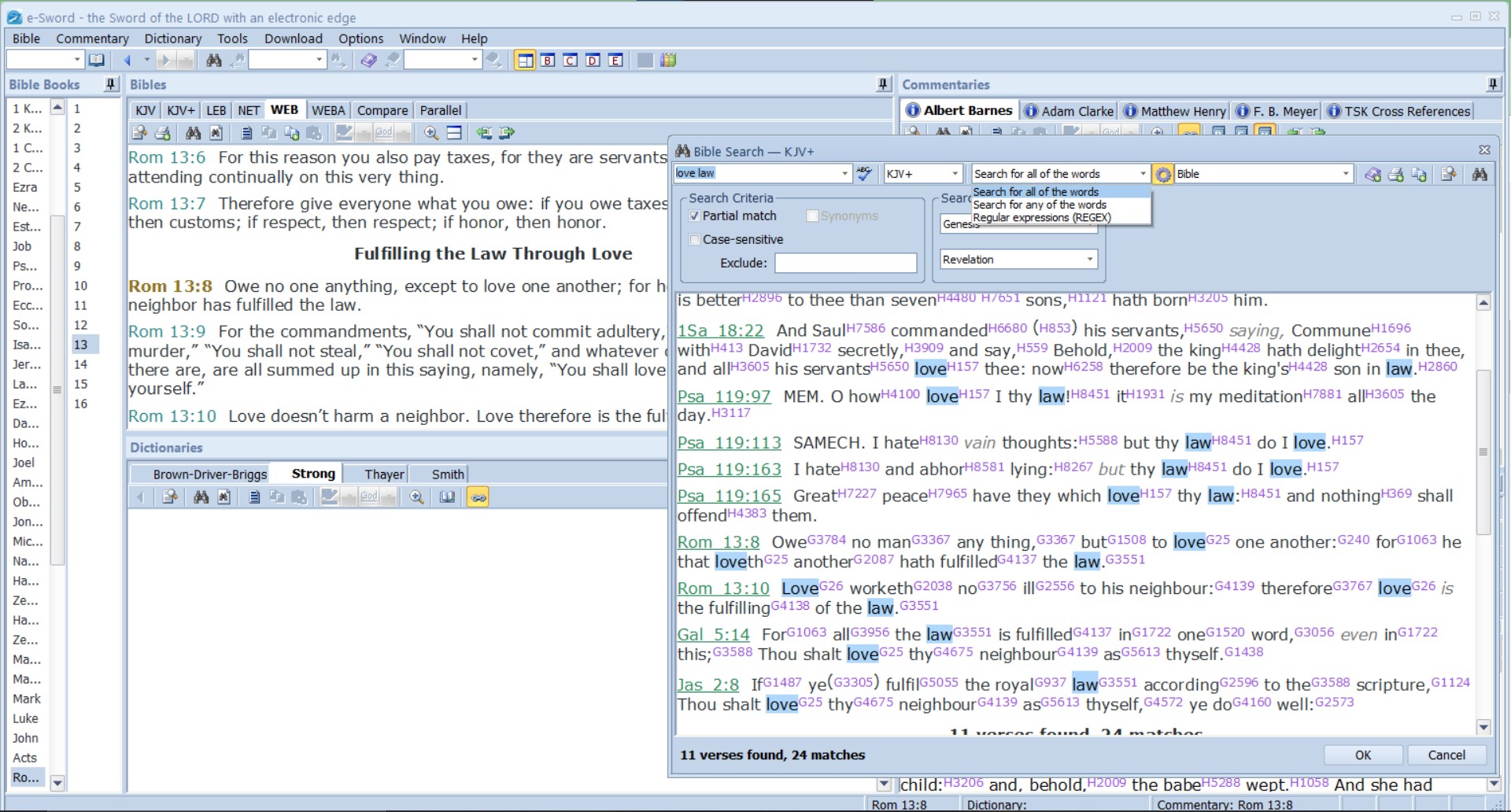
  • eSword for PC–a free-to-download Bible study program. I mostly use this one if I want to search for specific words or topics in the Bible. The search tools are robust (even more so than MySword) and make it easy to search for parts of words, whole words, and Greek and Hebrew words (by searching for the Strong’s number). You can also have a Bible, dictionary, commentary, and your own notes all open on the same screen.
  • BibleGateway–an online resource that makes comparing Bible translations very simple. It’s the easiest tool I’ve found for looking at multiple translations side-by-side and doing full text searches of more than one translation at the same time. I use it all the time when writing my blog posts for this site. One thing I like about this website compared to MySword or eSword is that it includes full footnotes (very handy with translations like NET).
screenshot of eSword Bible program showing search tools using the example  of searching for partial matches to the words "love law"
Screenshot showing eSword search tool

Language Tools

I’ve done some formal study of Greek–enough to recognize words, understand basic grammar, and read it a little–but not much for Hebrew. The tools I use to study the Bible’s original languages aren’t a perfect substitute for really learning the languages, but I think they do make it easier for someone with a basic understanding of how language works (something any of us can learn relatively easily) to get a deeper look into the nuances of the Bible without devoting their lives to a study of ancient languages.

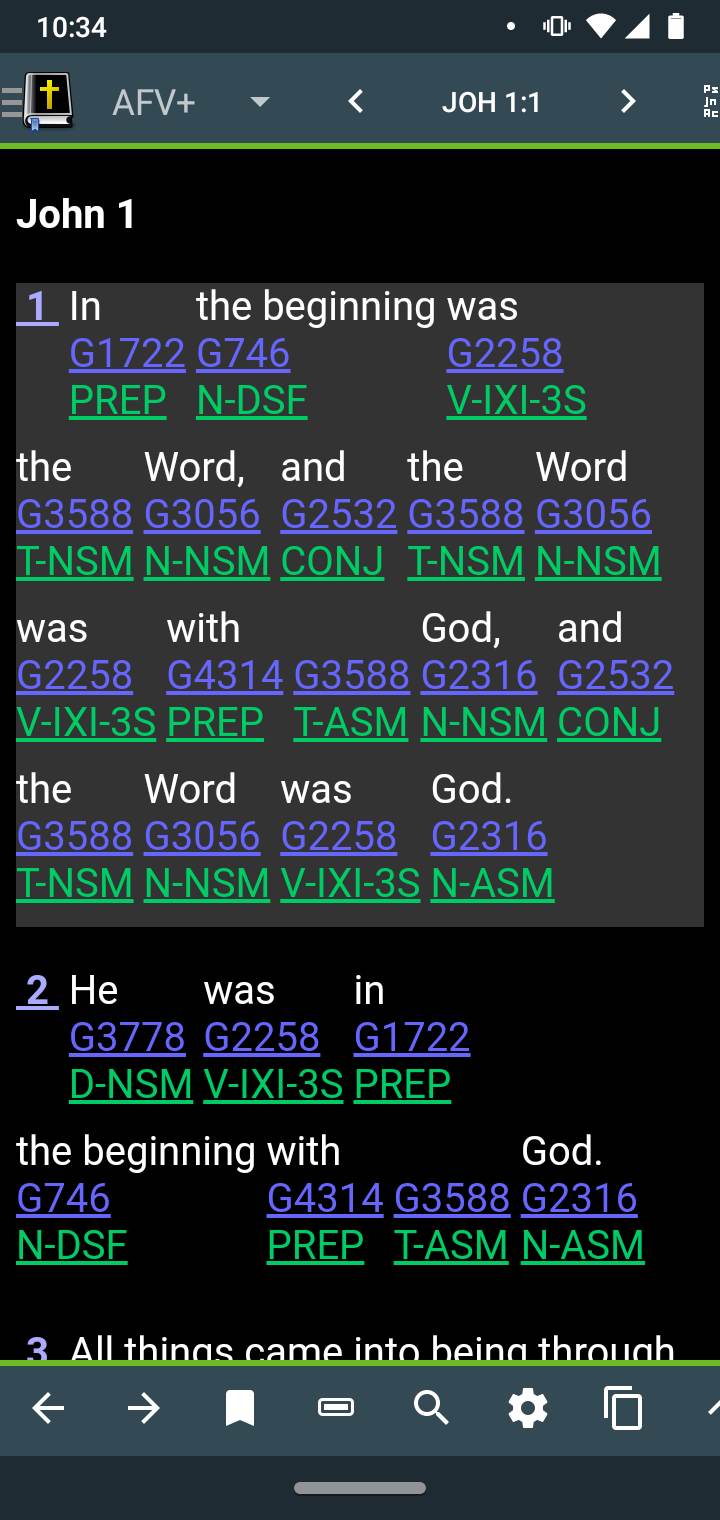
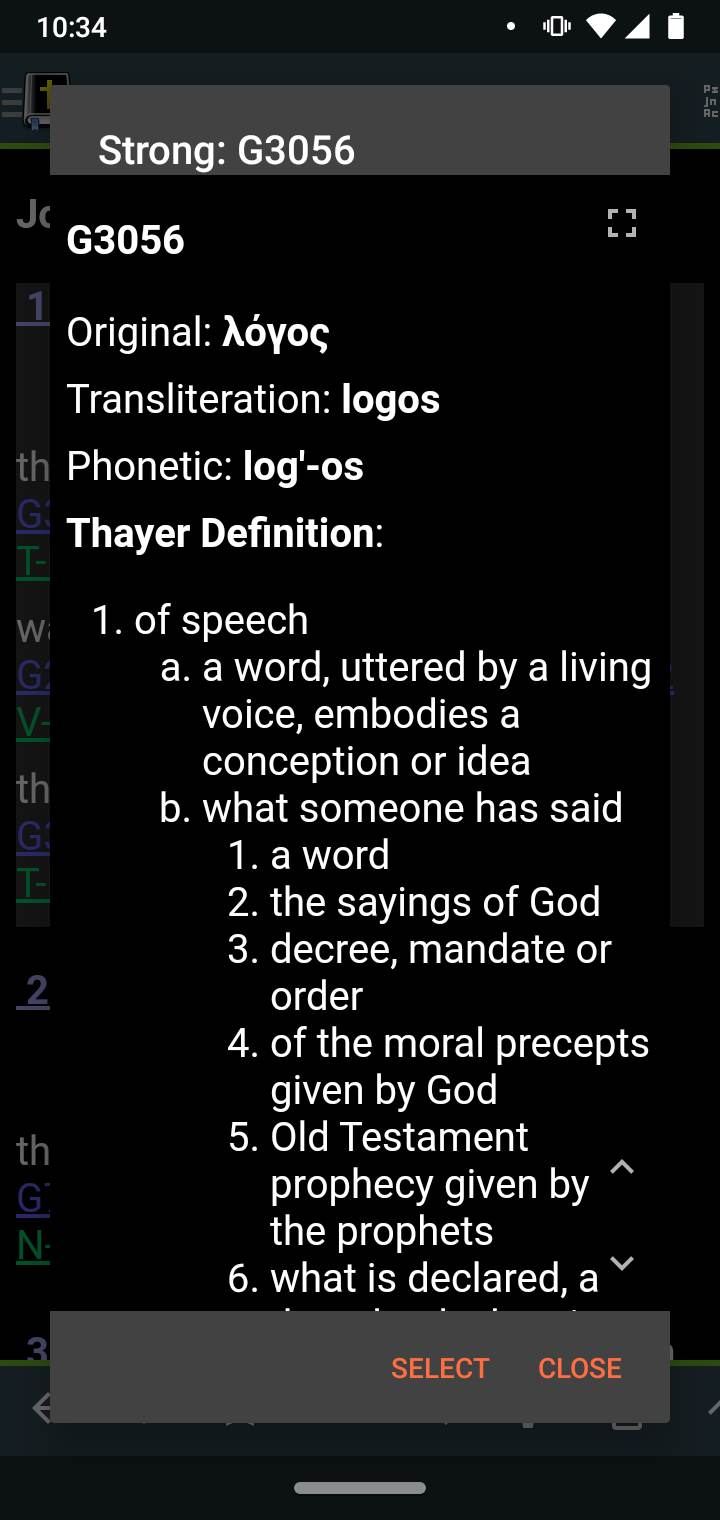
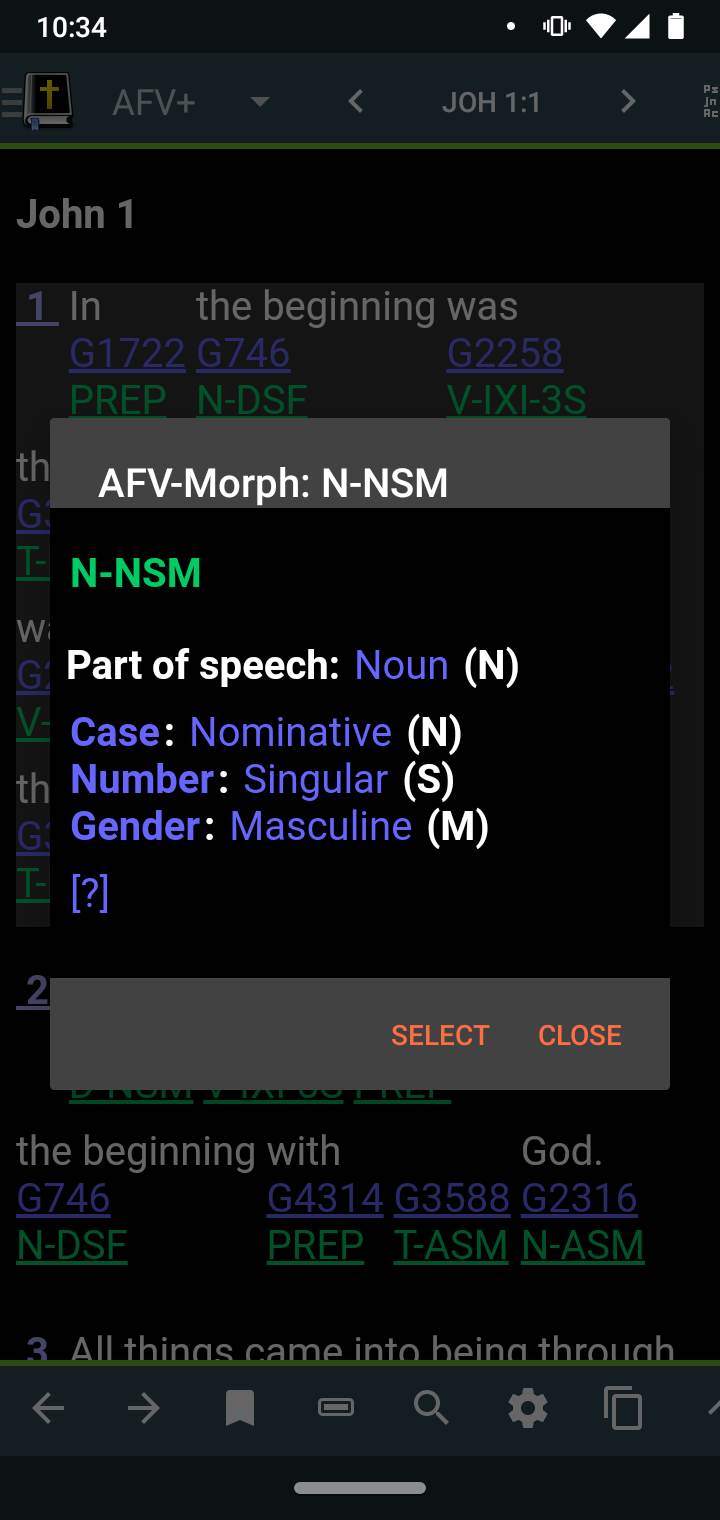
In both eSword and MySword, I recommend Thayer’s Dictionary for Greek and Brown-Driver-Briggs (BDB) for Hebrew. Both of these digital tools offer downloadable modules that link those dictionaries to Strong’s numbers. For any Bible translation that includes Strong’s numbers, you can click on that number and go right to the dictionary. Some of the translations also offer codes that give you more insight into how the word is used. For example, here’s what John 1:1 looks like in the MySword module for A Faithful Version with Strong’s numbers and Morphology (AFV+) if you click on more detail for the word translated “Word.”

I don’t read AFV+ much just because all those codes can get confusing to look at, but it is great for looking up the nuances behind a translation. If you click on the Strong’s number (G3056), it takes you to Thayer’s dictionary. I don’t have this in the screenshot, but if you scrolled down it would also provide Strong’s definition and a list of all the places this word is used in the New Testament (you could also search for G3056 in the AFV+ or other Strong’s coded translation to see all the places its used).

If you click on the morphology link (N-NSM) this translation shows you linguistic information for the word. Logos is a noun, and here it’s in the nominative case (identifying logos as the subject of the sentence), singular in number, and masculine gender (Greek has gendered nouns much like French or German). I use this tool most often to look up whether a word is singular or plural since you can’t always tell in English (e.g. when Paul says “you are the temple of God,” “you” is plural in the Greek but ambiguous in English).

Hebrew and Greek Dictionaries

In addition to these digital language tools, I also have two print dictionaries that I really like. These provide more complete definitions than the tools in eSword or MySword and also help you understand how different words relate to each other.

  • The Complete WordStudy Dictionary: New Testament* by Spiros Zodhiates—my favorite Greek dictionary. It uses Strong’s numbering system and is simple to use.
  • Theological Wordbook of the Old Testament* (TWOT) by Laird R. Hariss, Gleason L. Archer, Jr., and Bruce K. Waltke — my favorite Hebrew dictionary. Rather than being tied to Strong’s numbers, this dictionary groups Hebrew words by their root, which provides a much deeper look at the nuances of the Hebrew language. The different numbering system can make this one a bit more challenging to use, but in MySword the BDB dictionary module makes things easy by telling you where to look up the word in TWOT.

Google Is Your Friend

Another general tool that I use a lot is a simple Google search. Don’t know what the Genitive Case is in Greek? There are language-learning tools to help you understand Greek grammar. Partly remember a verse but can’t find it in eSword, MySword, or BibleGateway? Try Googling the words you remember with the word “Bible” and it’ll help you figure out if it’s in a translation you hadn’t thought of or if it’s a quote from something else. Suddenly need an interlinear version of the Septuagint? I recently found one on StudyLight.org. We’re fortunate to live in a time when we have access to Bible Study tools people even just a few decades before could only dream about or could only access in specialized print books.

Finding Study Topics

Most of my Bible studies end up on this blog. That means I’m usually looking at specific topics when I study, so being able to search the Bible effectively, look up Hebrew and Greek words, and compare translations is super helpful. It’s also helpful to be listening to and reading things that prompt Bible-related ideas that can turn into studies which then show up here on my blog. Here are some of my favorite Christian resources for inspiring new studies:

Final Thoughts

As I mentioned before, not everyone Bible studies the same way, and that’s okay. We have different spiritual temperaments and different ways we most easily connect with God and His word. Some might spend more time reading whole books rather than focusing on topics. Some might find the most value in picking one verse and meditating on it for their whole study time. Others could read, then search for ways to put those lessons into real-world action. And I’m sure there are way more study styles than I could list here.

I like Gary Thomas’s book Sacred Pathways* as a tool to describe those temperaments (you can read my full review by clicking here). I most closely align with what he calls the “Contemplative” and “Intellectual” temperaments, and I suspect others with similar ways of relating to God will be the ones that find this post most useful (if they haven’t already tracked down similar resources of their own). Still, I hope some of these tools and resources will be helpful for you whatever your spiritual temperament. And I hope you’ll share some of your own favorite resources in the comments.

Featured image by StartupStockPhotos from Pixabay

Don’t Despise Your Role

I caught myself doing something I’m not proud of a few weeks ago. I was talking with someone about why I’d been traveling last month for the Feast of Tabernacles (Sukkot) and made a comment about the “weird religious things” I do. I felt bad about it immediately, repented and asked God’s forgiveness, but it still kept bugging me. Why was my first reaction to downplay rather than to explain my faith?

Just a few weeks later in a sermon, I heard a speaker at church using a similar phrase in the context of explaining our “weird religious stuff” to people who have no background with our faith. I’m not the only one doing this, and I think I know why. We recognize that our faith is very different than what the world thinks is “normal” and that’s becoming increasingly apparent. Religious people are no longer the majority in the United States. According to Gallup, “In 2020, 47% of U.S. adults belonged to a church, synagogue or mosque,” which is 20 points lower than it was in 2000 (“U.S. Church Membership Falls Below Majority for First Time“).

When you’re going to church on Saturday and keeping God’s holy days (as I do), then you have some very visible differences from other Christians as well. We laugh self-consciously at the King James Version of 1 Peter 2:9, which says “ye are a chosen generation, a royal priesthood, an holy nation, a peculiar people,” and agree that we’re certainly peculiar. We know we’re odd, and so we laugh at ourselves before someone else can.

The thing is, “peculiar” comes from the Latin word peculiaris, which relates to private property (Oxford Languages via Google). That’s why modern translations say things like, “you are … a people for God’s own possession” (1 Pet. 2:9, WEB). Our peculiarity isn’t because we’re strange and odd; it’s because we belong to God. That will make us look strange to the world that we’re living in without being a part of it (John 17:14-16), but that doesn’t mean we should think of ourselves as weird.

Being self-effacing and deflecting conversations about your faith in certain situations isn’t necessarily a sin. You don’t always have to engage with people who are actively hostile or have zero interest in learning about God. But evading or downplaying is not the best thing to do. Especially if it might come across as you being embarrassed about your faith or unwilling to confess that you follow Jesus Christ, because then we are getting into sin territory. God wants us to be lights in a dark world, not cover up the light He’s shining through us. He wants us to speak about Him boldly because we love Him too much to stay silent and we respect Him too much to downplay His importance.

Image of a woman studying a Bible overlaid with text from 1 Peter 1:14-16, NET version: “Like obedient children, do not comply with the evil urges you used to follow in your ignorance, but, like the Holy One who called you, become holy yourselves in all of your conduct, for it is written, ‘You shall be holy, because I am holy.’”
Image by MarrCreative from Lightstock

Esau’s Problem

There’s a story in the Old Testament that comes to mind when I think about the value we place on God’s gifts. Part of God’s law includes a special place for the firstborn. He told Moses to write, “Sanctify to me all the firstborn, whatever opens the womb among the children of Israel, both of man and of animal. It is mine” (Ex. 13:2, WEB). Culturally and theologically, the firstborn had a special role in the ancient Biblical world. They were set apart for God’s own use, and they inherited a more significant blessing from their father. Even before Exodus, we see this pattern in the stories of the patriarchs. There were rights and privileges that should belong to the firstborn. We also see this disrupted several times–Isaac was the son of the promise, but not Abraham’s firstborn, and Joseph was chosen for special blessings over his older brothers. That disruption also happens for Isaac’s sons Jacob and Esau.

Jacob boiled stew. Esau came in from the field, and he was famished. Esau said to Jacob, “Please feed me with some of that red stew, for I am famished.” Therefore his name was called Edom.

Jacob said, “First, sell me your birthright.”

Esau said, “Behold, I am about to die. What good is the birthright to me?”

Jacob said, “Swear to me first.”

He swore to him. He sold his birthright to Jacob. Jacob gave Esau bread and lentil stew. He ate and drank, rose up, and went his way. So Esau despised his birthright.

Genesis 25:30-34, WEB

This didn’t turn out so well for Esau. He lost the firstborn blessing and it was his younger twin Jacob who became the patriarch of Israel and is part of the lineage of Jesus Christ. But what does that have to do with us?

Pursue peace with everyone, and holiness, for without it no one will see the Lord. See to it that no one comes short of the grace of God, that no one be like a bitter root springing up and causing trouble, and through it many become defiled. And see to it that no one becomes an immoral or godless person like Esau, who sold his own birthright for a single meal.

Hebrews 12:14-16, NET (italics mark allusions to Deut 29:18 and Gen 27:34-41)

There’s a danger that we could also become like Esau. The writer of Hebrews warned about it strongly. We’re to diligently follow peace, holiness, and grace, avoiding things like bitterness, immorality, and godlessness that’s here exemplified by Esau selling and despising his birthright. He didn’t value that gift and so he let it go in exchange for something relatively worthless. There’s little chance Esau was actually “about to die” after a day of hunting in the field, especially when he had a tent to go back to where his whole family lived. They likely had a whole household and if there wasn’t other food available right that moment there would be later. But he didn’t consider consequences or think through his options. He wanted immediate gratification of his hunger more than he wanted significant, long-term blessings.

Image of a man reading a Bible overlaid with text from Luke 9:25-26, NET version: “For what does it benefit a person if he gains the whole world but loses or forfeits himself? For whoever is ashamed of me and my words, the Son of Man will be ashamed of that person when he comes in his glory and in the glory of the Father and of the holy angels.”
Image by Creative Clicks Photography from Lightstock

Firstborn Inheritance with Jesus

There’s another question earlier in Hebrews that also seems relevant to this conversation. Near the beginning of this book, the writer reminds us of God’s revelation through Jesus Christ and of how important it is to properly reverence and appreciate Him. Then, he says this:

Therefore we must pay closer attention to what we have heard, so that we do not drift away. For if the message spoken through angels proved to be so firm that every violation or disobedience received its just penalty, how will we escape if we neglect such a great salvation? It was first communicated through the Lord and was confirmed to us by those who heard him, while God confirmed their witness with signs and wonders and various miracles and gifts of the Holy Spirit distributed according to his will.

Hebrews 2:1-4, NET

For Esau, the problem was that he despised his birthright. Here, the danger is that we might neglect the great salvation offered through our elder brother Jesus Christ, who is sharing His firstborn inheritance with us. In both situations, improperly valuing the gifts, inheritance, and roles that God gives you leads to a poor outcome.

And see to it that no one becomes an immoral or godless person like Esau, who sold his own birthright for a single meal. For you know that later when he wanted to inherit the blessing, he was rejected, for he found no opportunity for repentance, although he sought the blessing with tears.

Hebrews 12:16-17, NET

God offers abundant forgiveness for sins, but sometimes you still have to deal with the consequences. In Esau’s case, he couldn’t get his birthright back. In our case, continual and deliberate neglect of God’s word and despising His gifts can have eternal consequences.

Image of a woman reading a Bible overlaid with text from Phil. 3:13-15, NET version: “Brothers and sisters, I do not consider myself to have attained this. Instead I am single-minded: Forgetting the things that are behind and reaching out for the things that are ahead, with this goal in mind, I strive toward the prize of the upward call of God in Christ Jesus. Therefore let those of us who are ‘perfect’ embrace this point of view.”
Image by Pearl via Lightstock

Living With Joyful Integrity

The question of whether or not you can “lose” salvation is hotly debated in Christian circles. At one extreme, some say that anyone who confesses Jesus is permanently saved regardless of how they live after. At the other extreme, some say you can’t have any certainty that you’re saved until the very end and live in fear that they won’t measure up.

Bible writers strike an interesting balance between the two–teaching and displaying both a sense of urgency and a sense of confidence. Paul, for example, said in Philippians that he was still striving “to attain to the resurrection from the dead” (Phil. 3:8-16). He hadn’t been perfected yet, but he was confident God could get him there and by the time he wrote 2 Timothy he was sure that God would reward him for his faithfulness (2 Tim. 4:6-8). Similarly, Jesus promises that His father wants to give His children the kingdom and that no one will ever take them out of His hand (Luke 12:32; John 10:28-29) while also warning that people who claim to follow Jesus without sincerely doing God’s will won’t inherit the kingdom (Matt. 7:21-23; 25:1-13; 31-46).

Image of a man sitting on a beach with the blog's title text and the words "God has blessed us with incredible gifts and roles. When we see Him and His work in us as precious, we’ll align the way we talk about our faith and live our lives with the value we place on following Jesus."
Image by Aaron Kitzo via Lighstock

Basically, if we do our best to follow God, obey Him, honor Him, and keep growing closer to Him then He’ll make sure we succeed. He even calls us perfect so long as we’re heading that direction. On the other hand, if we “deliberately keep on sinning after receiving the knowledge of the truth” and show “contempt for the Son of God” then we’re not on a path toward eternal life in His kingdom (Heb. 10:19-39).

This might have taken too harsh a turn from our starting point of referring to some aspect of your faith as a “weird religious thing.” However, if we’re downplaying the importance of our faith in a little thing like that, will we be faithful when we’re confronted with choosing between our faith and fitting in with the world for a larger thing? It’s a question I ask myself, especially when I read stories of people being persecuted and killed for their faith. If someone put a gun to my head and told me to deny Jesus or die, I intend to stay faithful. But what if the compromise is easier to justify, such as staying quiet about a moral issue so you can get a promotion? Can I really expect to respond with faith then if I’m reluctant to express how important He is to me now when there aren’t even any negative consequences?

We need to live with integrity, aligning the way we talk about our faith and live our lives with the value that we say we place on following Jesus. In writing this, I’m speaking to myself as much as (and perhaps more than) anyone else. I pray this study helps keep me on-track. I pray the next time I could describe my faith as weird, I instead let others see how much joy following Jesus brings me. And I hope this gives you something to think about as well, even if you are always honest and joyful about your faith when talking with other people.

Featured image by Matt Vasquez via Lightstock

Anger, Perspective, and Character: The Questions Between Jonah and God

Have you ever been angry?

Everyone can say “yes” to that. What about being deeply, exceedingly angry? So angry it burns you up?

That’s how angry Jonah was after God chose to spare the people of Nineveh. We know this story–God told Jonah to go preach against Nineveh because of its wickedness. Jonah didn’t like that and fled on a ship. God sent a great storm, so great the ship could have sank, but Jonah confessed what he’d done and told the sailors to throw him overboard. They did, the storm stopped, and “The Lord sent a huge fish to swallow Jonah” (Jon. 1:17, NET).

After three days and three nights in the whale, Jonah was ready to do what God told him to and the fish spit him out on land. Jonah went to Nineveh and warned the whole city that it would be overthrown in 40 days. Remarkably, the people listened. They repented with fasting, cries for mercy, and a change in their behavior. God saw this, and responded by not destroying the city.

That’s when Jonah got angry. He went through a huge storm, the whole belly of the fish thing, and shouting a message of destruction only for God not to follow-through? If nothing was going to happen, why bother sending Jonah at all? He certainly hadn’t wanted to come!

In today’s study, we’ll dig into the questions Jonah and God ask each other. I also want us to think about how we might have responded in this situation, and how we respond to other things in our own lives that don’t go as we expect. Do we get angry? And if so, are we right to be so very angry?

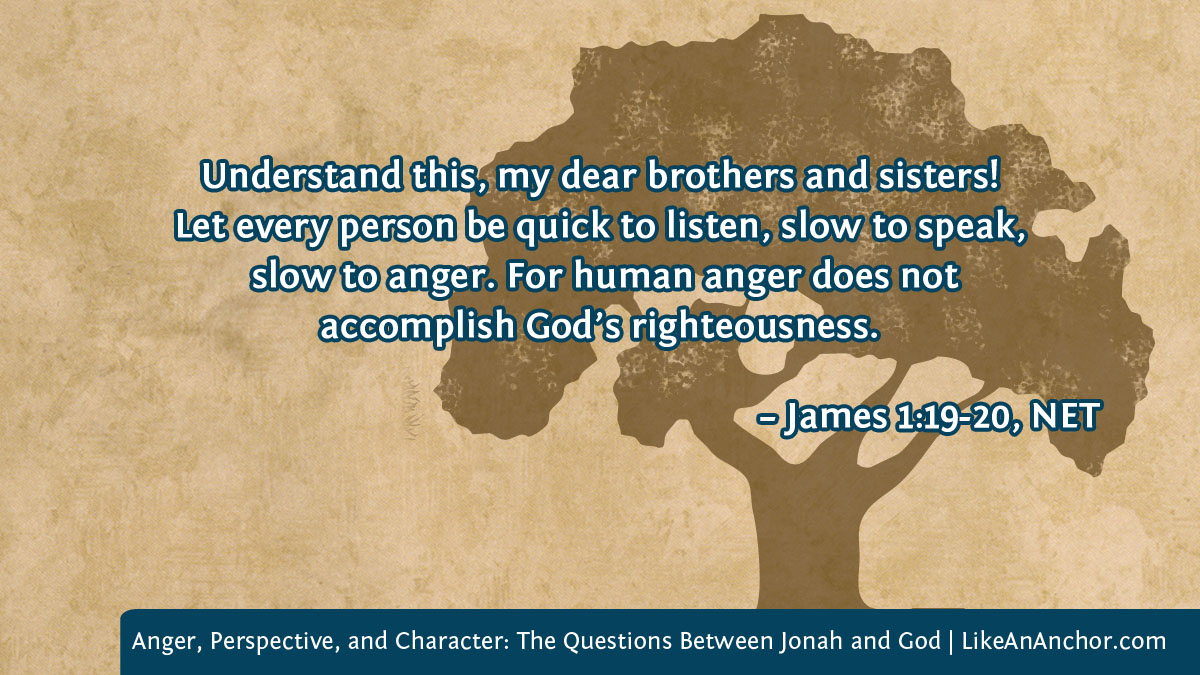
Background image of parchment paper with a tree, overlaid with text from James 1:19-20, NET version: "Understand this, my dear brothers and sisters! Let every person be quick to listen, slow to speak, slow to anger. For human anger does not accomplish God’s righteousness."

So Very Angry

As Jonah looked at Nineveh after the people in the city repent, he noticed God didn’t destroy everyone. “This displeased Jonah terribly and he became very angry” (Jon. 4:1, NET). In Hebrew, it’s literally saying God’s choice to show mercy “was evil to Jonah, a great evil” (NET footnote).  He’s actually so angry that he tells God, “take, I beg you, my life from me; for it is better for me to die than to live” (Jon. 4:3, WEB). God asks a question in return, and there are two possible ways to translate it:

Yahweh said, “Is it right for you to be angry?”

Jonah 4:4, WEB

The Lord said, “Are you really so very angry?”

Jonah 4:4, NET

“Angry” comes from the Hebrew kharah (H2734 “to burn”). The word before it is yatav (H3190), which either refers to ethical right and wrong or “it may mean ‘well, utterly, thoroughly,’ as an adverb” (NET footnote). Depending how you translate it, God is either asking if Jonah is correct to be so exceedingly angry or He’s questioning Jonah about the depth of his anger. Either way, I think God seems a bit surprised here. Jonah isn’t being reasonable, and God tries to show him that with an illustration.

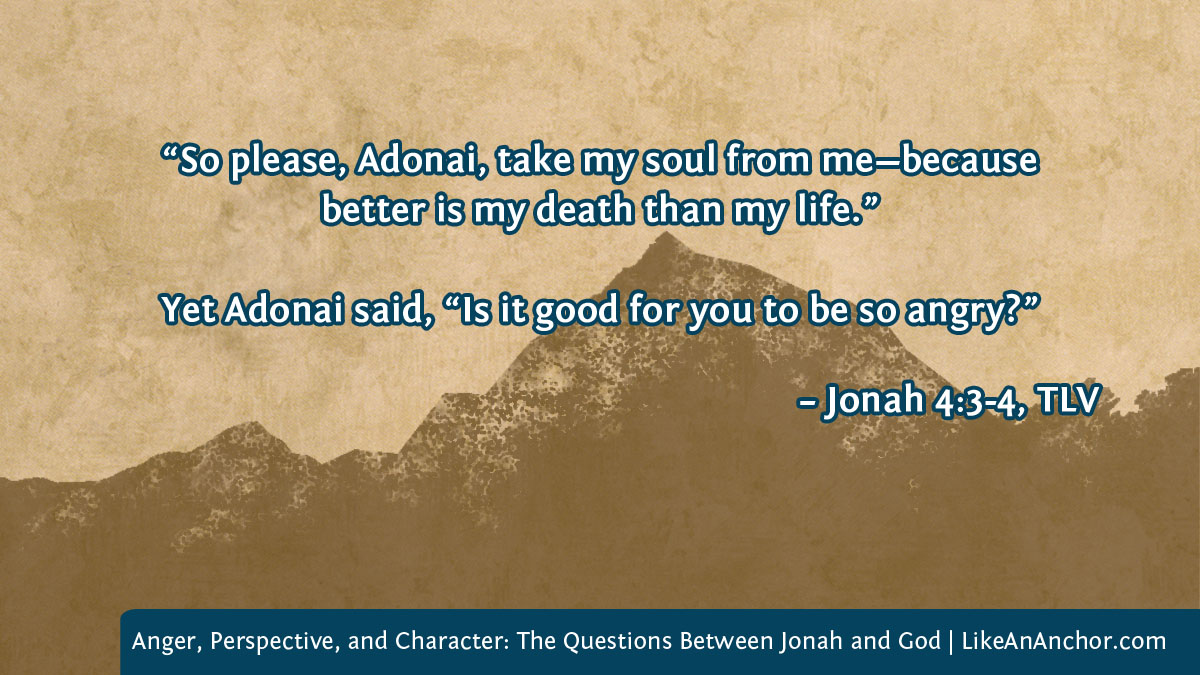
Background image of parchment paper with mountain image, overlaid with text from Jonah 4:3-4, TLV version: “So please, Adonai, take my soul from me—because better is my death than my life.” Yet Adonai said, “Is it good for you to be so angry?”

The Little Plant

While Jonah was pouting on a hill and watching Nineveh, God made a little plant grow up and provide shade. “Now Jonah was very delighted about the little plant”–a phrase which “ironically mirrors the identical syntax of v. 1: ‘he was angry with great anger'” (NET footnote on Jon. 4:6). When God strikes down the plant the next day, Jonah cries out in renewed rage. Again, we’ll look at this in two translations:

the sun beat on Jonah’s head, so that he fainted, and requested for himself that he might die, and said, “It is better for me to die than to live.”

God said to Jonah, “Is it right for you to be angry about the vine?”

He said, “I am right to be angry, even to death.”

Jonah 4:8-9, WEB

So the sun beat down on Jonah’s head, and he grew faint. So he despaired of life and said, “I would rather die than live!”

God said to Jonah, “Are you really so very angry about the little plant?” And he said, “I am as angry as I could possibly be!”

Jonah 4:8-9, NET

That’s a lot of anger. It makes me think of a child throwing a temper tantrum while a bemused parent tries to ask them why they’re so upset. Jonah is just as angry about God not striking down a whole city as he is about losing a little plant that shaded him from the hot sun. He doesn’t even see how comically absurd this is, particularly in light of Jonah’s earlier claim that he knows Yahweh is “a gracious God, and merciful, slow to anger, and abundant in loving kindness”, and you relent of doing harm.” (Jon. 4:3, WEB).

I wonder how often I’m just as blind as Jonah was? Probably more often than I realize. I’m so thankful for God’s patience. Not only did He spare Nineveh when they repented, but He’s also patient with Jonah. Instead of striking him down for questioning God (again) and throwing a tantrum, God just asks him questions and gives him a concrete illustration to try and guide him toward understanding.

Background image of parchment paper with leaves, overlaid with text from Jonah 4:10-11, TLV version: Adonai said, “You have pity on the plant for which you did no labor or make it grow, that appeared overnight and perished overnight. So shouldn’t I have pity on Nineveh—the great city that has in it more than 120,000 people who don’t know their right hand from their left—as well as many animals?”

God’s Final Question

The book of Jonah ends with a question. The verses we’re about to look at are the last ones in the book. God asks a question, and there’s no record of Jonah’s answer. Leaving off his response makes it feel less like a question to Jonah and more like a question to us, the readers.

 Yahweh said, “You have been concerned for the vine, for which you have not labored, neither made it grow; which came up in a night, and perished in a night. Shouldn’t I be concerned for Nineveh, that great city, in which are more than one hundred twenty thousand persons who can’t discern between their right hand and their left hand; and also much livestock?”

Jonah 4:10-11, WEB

How many times have you heard someone complain about how “it’s not fair” that God would let people get away with doing terrible things ? Or how many times have we said that ourselves? How often have we gotten irritable and even exceedingly angry about something that should have woken us up to a more accurate perspective on life?

There’s a lot we can sympathize with in Jonah’s story. We live in a world that is not Godly, and it often seems like our preaching to it doesn’t do any good. Jonah felt that way even when the people he delivered God’s message to repented! There’s also a lot we can learn from. We shouldn’t respond to the darkness of our world with Jonah’s first response (running away) or his second (anger and condemnation). We should be like God, who takes a firm stance against sin but also hopes for repentance and is eager to show mercy.

God’s True Character

In the ending dialog for the book of Jonah, Jonah seems so concerned about how God inconvenienced him that He doesn’t even notice God is doing something wonderful. God was showing His true character, much as He did to Moses when He proclaimed His own name (remember: names in Hebrew thought are linked with someone’s reputation and character).

Yahweh descended in the cloud, and stood with him there, and proclaimed Yahweh’s name. Yahweh passed by before him, and proclaimed, “Yahweh! Yahweh, a merciful and gracious God, slow to anger, and abundant in loving kindness and truth, keeping loving kindness for thousands, forgiving iniquity and disobedience and sin; and who will by no means clear the guilty, visiting the iniquity of the fathers on the children, and on the children’s children, on the third and on the fourth generation.”

Exodus 34:5-7, WEB

Jonah actually references this verse at the beginning of his conversation with God (Jon. 4:3), but doesn’t connect the dots as far as we can see. God does eventually take down Nineveh around 612 BC, that’s at least a century after Jonah’s message (Amazing Bible Timeline: “Nineveh Destroyed” and “Jonah and the Whale”). With that longer perspective on history, we can better see how God showed His character in His dealings with Nineveh. He is slow to anger and quick to forgive, but He also won’t leave the guilty unpunished (you can read Nahum to learn more about why Nineveh was eventually destroyed).

Jonah didn’t have that longer-term perspective, but his reaction still wasn’t what it should have been. He knew God’s character; he should have trusted that He was working things out the right way. Perhaps he did learn that in the end. And hopefully, we can read his story and also learn to trust God more fully.

Featured image by Jeff Jacobs from Pixabay

Song Recommendation: “Alive” by Big Daddy Weave

Giving to God the Things Made in His Image

 Last week when I was studying one way women reflect God’s image, a familiar verse caught my eye in a new way. It’s a verse we usually quote when talking about why you need to pay your taxes. A group of people came to Jesus asking, “Should we pay taxes?” hoping to trick Him into saying something that would get Him into trouble (Matt. 22:15-22). Jesus does answer that question, but it’s not the only thing He talks about in this verse. He uses their wicked attempt to entrap Him to teach a valuable spiritual lesson.

“Show me the coin used for the tax.” So they brought him a denarius.  Jesus said to them, “Whose image is this, and whose inscription?”  They replied, “Caesar’s.” He said to them, “Then give to Caesar the things that are Caesar’s, and to God the things that are God’s.”

Matthew 22:18-21, NET

Jesus answered a question they thought would back Him into a corner in a way that left them marveling (v.22). Then on top of that, He gave them–and us–a deep lesson to ponder. The thing stamped with Caesar’s image belonged to Caesar. The things stamped in God’s image belong to God.

Made In His Image

When Jesus pointed out that we should give “to God the things that are God’s,” He isn’t just talking about paying God our tithes or owing Him things like worship, praise, and thankful offerings. We do owe Him those things (Mal. 1:6-8; 3:6-18), but the context here has to do with giving someone the things which bear their image.

Then God said, “Let us make humankind in our image, after our likeness, so they may rule over the fish of the sea and the birds of the air, over the cattle, and over all the earth, and over all the creatures that move on the earth.”

God created humankind in his own image,
in the image of God he created them,
male and female he created them.

Genesis 1:26-27, NET

We are made in God’s image. We are what we’re supposed to be giving to God. Just as the coins stamped with Caesar’s face showed that the money circulating came from and ultimately belonged to Caesar, we’re “stamped” with God’s image. We come from Him and belong to Him.

Image of a man reading the Bible, with text from Malachi 1:6, WEB version: "A son honors his father, and a servant his master. If I am a father, then where is my honor? And if I am a master, where is the respect due me?"
Image by Matt Vasquez from Lightstock

Owe Him Our Lives

Paul also teaches about the idea that we owe all of ourselves to God. “You are not your own,” he writes, “for you were bought with a price. Therefore glorify God in your body and in your spirit, which are God’s” (1 Cor. 6:19-20, WEB). Here, the focus is on the service we owe Jesus as our redeemer–the one who saved us from death and now has a claim on our lives. We also owe Him and the Father service as our creator. We’re loyal to God and serve Him because “our citizenship is in heaven” (Phil. 3:20, NET). We belong to God and, following Him, our lives are on a path toward spending eternity in His kingdom.

 Therefore I exhort you, brothers and sisters, by the mercies of God, to present your bodies as a sacrifice—alive, holy, and pleasing to God—which is your reasonable service. Do not be conformed to this present world, but be transformed by the renewing of your mind, so that you may test and approve what is the will of God—what is good and well-pleasing and perfect.

Romans 1:1-2, NET

We would be dead–or we wouldn’t even exist–if it wasn’t for God. It’s reasonable and logical (G3050 logikos) to present ourselves to God as a sacrifice. Not a dead sacrifice laid once on an altar, but an ongoing, holy life devoted to following the good, pleasing, and perfect will of God. That’s how we give ourselves–the things made in God’s image–back to God: by serving Him faithfully.

Image of a young woman reading the Bible, with text from Titus 2:14, NET version: "He gave himself for us to set us free from every kind of lawlessness and to purify for himself a people who are truly his, who are eager to do good."
Image by José Roberto Roquel from Lightstock

Everything is Already His

God has the right to demand anything He wants of us. And yet all He asks is that we give Him things that are already His. It is–as Paul said of us being living sacrifices–a reasonable request.

“The God who made the world and everything in it, who is Lord of heaven and earth, does not live in temples made by human hands, nor is he served by human hands, as if he needed anything, because he himself gives life and breath and everything to everyone. From one man he made every nation of the human race to inhabit the entire earth, determining their set times and the fixed limits of the places where they would live, so that they would search for God and perhaps grope around for him and find him, though he is not far from each one of us. For in him we live and move about and exist, as even some of your own poets have said, ‘For we too are his offspring.’ So since we are God’s offspring, we should not think the deity is like gold or silver or stone, an image made by human skill and imagination. Therefore, although God has overlooked such times of ignorance, he now commands all people everywhere to repent”

Acts 17:24-30, NET

Here, Paul presents a reasonable case to the Athenians. They already worshiped an “unknown god,” so he uses that to introduce the one true God (Acts 17:16-23). They already know the writings of Cretan philosopher Epimenides and Cilician Stoic philosopher Aratus, so the idea of being God’s created children ought to be familiar (NIV footnotes on v. 28). The big, stunning new idea here is that the “Lord of heaven and earth” is the only real God. He can’t be represented by “an image made by human skill” or contained “in temples made by human hands.”

People like to make gods in their own image. Much like the Greeks and Romans, we often imagine a God who’s flawed like us, or who needs something from us, or who does chaotic things without reason, or who could be swayed to do things our way if we could just find the right bribe. But that’s a backwards idea. God is the one who makes us in His image. We belong to Him and we need to do things His way, not the other way around.

Courage in Knowing

Sometimes, the idea that we belong to God and owe Him everything rankles us. Humanity’s independent spirit often rebels against the idea that we have a Creator to whom we owe our existence. It’s easier in some ways to believe that we just happened; the product of lucky chaos and millennia of evolution. But God reveals that He created us in His own image. We’re precious and we’re made for a purpose.

We can see owing all of ourselves to God as stifling, or as encouraging. Jesus modeled the latter response. In John’s gospel, we learn this about Jesus’s mindset going into the Passover right before His crucifixion.

Just before the Passover Feast, Jesus knew that his time had come to depart from this world to the Father. Having loved his own who were in the world, he now loved them to the very end. The evening meal was in progress, and the devil had already put into the heart of Judas Iscariot, Simon’s son, that he should betray Jesus. Because Jesus knew that the Father had handed all things over to him, and that he had come from God and was going back to God, he got up from the meal, removed his outer clothes, took a towel and tied it around himself. He poured water into the washbasin and began to wash the disciples’ feet.

John 13:1-5, NET

Jesus knew He was facing a horrible death. He also knew “he had come from God and was going back to God.” Though it’s different for us, we also know we’ve “come from God.” For Jesus, He was God already and had been with the Father forever before coming into this world as human. For us, we came into existence through the creative work of both Father and Son. We’re also heading toward God, though for Jesus He was “going back” and for us we’re looking forward to being there for the first time. Despite the differences in why we can say we’ve come from God and are going toward God, we can have the same focus Jesus did here.

Knowing we’re made in God’s image opens our eyes to marvelous truths and gives us courage for whatever we face in this life. We can love “to the very end” and keep following God’s will, knowing that we belong to Him and He cares for us. We know we are special to Him. We know He made us for a purpose, which involves looking fully like Him in the future if we follow Him faithfully now (1 John 3:1-3). We also know that we owe Him all of ourselves. We’re stamped with His image, marking us as belonging to Him and (if our lives are oriented properly) we’ll be giving ourselves to Him as well.

Featured image by Med Ahabchane from Pixabay

Song Recommendation: “In His Eyes” by 1 Girl Nation