God’s Parental Compassion

I started studying compassion this week and discovered something that seemed a bit odd at first. There are two main Hebrew words translated “compassion” in the Bible, and one of them is also translated “womb.” For example, these two verses use the exact same word:

even by the God of your father, who will help you,
by the Almighty, who will bless you,
with blessings of heaven above,
blessings of the deep that lies below,
blessings of the breasts, and of the womb (rachum).

Genesis 49:25, WEB

Yahweh, remember your tender mercies (rachum) and your loving kindness,
for they are from old times.

Psalm 25:6, WEB

To English speakers, “womb” and “compassion” are entirely different words. We might associate compassion with feminine traits, but other than that there’s not much connection. In Hebrew, though, this word describes love you feel deep in your guts. Racham (H7356), along with closely related words like raham (H7355) and rachum (H7349), are all part of the same word-family (Theological Wordbook of the Old Testament [TWOT] 2146). They refer “to deep love (usually of a ‘superior’ for and ‘inferior’).” It’s the sort of love/mercy/pity/compassion that people feel for each other because “they are human beings (Jer 50:42) and which is most easily prompted by small babies (Isa 13:18) or other helpless people” (TWOT).

Love for the Little Ones

Racham and related words are only rarely used “of men” (TWOT), though it does describe the type of love that a mother has for her children (1 Kings 3:26). Far more often, this word is used to describe how God feels, particularly as a parent toward people who owe their birth to Him (Is. 46:3-4). That’s all of humanity, really–He’s our Creator even if we’re not yet in a parent-child relationship with Him. He sees us as children who belong to Him.

“Can a woman forget her nursing child,
that she should not have compassion on the son of her womb?
Yes, these may forget,
yet I will not forget you!

Isaiah 49:15, WEB

God feels towards us the way a good mother feels towards her children. Even though God always presents Himself as male, women are also made in His image and many traits that we think of as “feminine” are traits of God. His love is perfect and far surpasses even the best parents.

Like a father has compassion on his children,
so Yahweh has compassion on those who fear him.

Psalm 103:13, WEB

Note that in this verse, the Psalmist specifies that “Yahweh has compassion on those who fear him.” It’s similar to how we’ve talked in the past about different types of love that God has for people. Though He has agape for everyone–benevolent love that always seeks good things/outcomes for the people loved– He only has phileo–familial affection based on shared interests–with those who’ve responded to His invitation to enter a relationship with Him (see “Not All God’s Love Is Unconditional: How To Become A Friend Of God”). We’re all little children in God’s eyes and, for those of us in relationship with Him, we’re recipients of a special, familial love that invovles reliable compassion and mercy.

Love that We Can Count On

One of the things that makes God’s love so precious is that we can count on it never to fail. His compassion and mercy aren’t going anywhere and we have abundant evidence in the Bible (and often from our own lives as well) that this is true. He even considers this character trait part of His name (Ex. 33:19; 34:6; Deut 4:31). One example of His rachum can be found in God holding Himself back from destroying ancient Israel no matter how many times they betrayed and forsook Him (Neh. 9:17-19, 27-31). There’s even more evidence in the Psalms, where the writers speak of God’s mercy, recall times when He had compassion on them, and ask for more mercy when they miss the mark (here’s a link to Psalms with rachem words).

It is because of Yahweh’s loving kindnesses that we are not consumed,
because his compassion doesn’t fail.
They are new every morning.
Great is your faithfulness.

Lamentations 3:22-23, WEB

This is still true for us today. Already, we’re the people Hosea prophesied of “who had not obtained mercy, but now have obtained mercy” (Hos. 2:23; 1 Pet. 2:9-10). And if we’re in distress, even if we’ve done something He tells us is wrong, we can count on Yahweh’s great mercies (2 Sam. 24:13-14; Ps. 51:1). That’s a promise backed-up by the sacrifice of Jesus Christ, who came to earth bringing the most incredible proof of our Father’s deep mercy and compassion (Luke 1.76-79; Eph. 2:4-6; Tit 3.4-7).

Just like a little child can trust in a good, responsible mother or father, so we can trust in God. In fact, we must be like little children if we want to inherit the Kingdom of Heaven (Matt. 8:2-4). The more we grow to see Him as our Father and ourselves as completely dependent on Him, the more easily His compassion and mercy flows toward us.

Featured image by Shaun Menary from Lightstock

Paul on the Topic of Self-Judgement

 I was chatting with some friends at church last week, and we started trying to figure out what Paul meant when he said he didn’t judge himself. Bible-readers know a lot about Paul’s history, and we can come up with plenty of reasons why he might have judgmental, condemning thoughts about himself and his past actions. He persecuted the church of God! Shouldn’t he judge himself for that? And yet it seems that he didn’t.

What did Paul mean when he said “I do not even judge myself”? And what might that mean for us as we look back on our own past sins and failures?

Judicial Investigation of the Self

Paul spends quite a bit of time in his epistles talking about judgement–judgements we’re supposed to make as we exercise discernment, judgements we shouldn’t make since we’re not permitted to condemn others, and judgements that God will make of us at the end times. There are only three passages that I’ve found where Paul specifically addresses self-judgement. We could perhaps include passages about self-examination, but that seems to be a separate concept.

The three passages we’ll look at all use the Greek word krino or one of its derivatives. This word means “to judge, to form an opinion after separating and considering the particulars of a case,” and it can include the passing of judgment as well (Zodhiates’ Word Study Dictionary, entry G2919). A related word, which Paul uses in the passage where he says he doesn’t judge himself, is anakrino. This word means “to judicially investigate,” “examine accurately and carefully,” and “to question in order to pass a judicial sentence” (Zodhiates, G350).

So for me, it is a minor matter that I am judged (anakrino) by you or by any human court. In fact, I do not even judge (anakrino) myself. For I am not aware of anything against myself, but I am not acquitted because of this. The one who judges (anakrino) me is the Lord. So then, do not judge (krino)anything before the time. Wait until the Lord comes. He will bring to light the hidden things of darkness and reveal the motives of hearts. Then each will receive recognition from God.

1 Corinthians 4:3-5, NET

For context, Paul has been talking about divisions in the church (1 Cor. 1:10-17; 2:1-5; 3:1-9) and the need for individuals to take responsibility for their own spiritual journeys (1 Cor. 2:6-16; 3:10-23). We belong to God and ought to follow Him, not some human no matter how impressive his qualifications. So now here in 1 Corinthians 4:1-21, Paul is talking about the apostles’ ministry using a courtroom analogy. He doesn’t care if others presume to “judicially investigate him,” and he doesn’t do that to himself either–that’s something he leaves to God because He’s the one with the perspective needed to pass an accurate and righteous judgment. Finally, Paul gives us warning not to judge (krino) anything before the Lord comes and reveals “the motives of hearts.” 

Image of scales, with text from 1 Cor. 4:3-4, CJB version: "And it matters very little to me how I am evaluated by you or by any human court; in fact, I don’t even evaluate myself. 4 I am not aware of anything against me, but this does not make me innocent. The one who is evaluating me is the Lord."
Image by OpenClipart-Vectors from Pixabay

Taking a Proper View of Ourselves

Later in this same letter, Paul returns to the idea of judging ourselves when he’s talking about Passover. This is one of the self-examination passages I mentioned earlier (1 Cor. 11:26-30), but it also talks about self-judgement. Paul starts wrapping that discussion up with these lines:

But if we examined ourselves, we would not be judged. But when we are judged by the Lord, we are disciplined so that we may not be condemned with the world.

1 Corinthians 11:31-32, NET

“Examined” here is diakrino, and Zodhiates says that in this verse it could be translated “if we took a proper view” or “formed a just estimate of ourselves” (G1253). More generally, it means “to separate thoroughly, discriminate, make to differ, judge thoroughly.” It seems from these verses that there is a certain type of self-judgment Paul encourages, but it’s one that involves seeing ourselves accurately rather than seeking to condemn. It works alongside God’s accurate judgement (krino) to make us more and more like Him.

When Paul says he doesn’t judge himself, it doesn’t mean he ignores who he is. He knows he persecuted the church and is only an apostle by God’s grace (1 Cor. 15:9-10; Eph. 3:8). He realizes that he needs to keep moving forward in faith with Jesus’s righteousness applied to him, not become complacent (Phil. 3:8-14). But he doesn’t let a realistic look at himself lead to getting stuck in self-condemnation. Paul knows he has received God’s grace. He knows he has righteousness that comes from Jesus. That’s what lets him say he doesn’t judge himself and isn’t aware of any charge against him. 

For us, this seems to indicate that we shouldn’t beat ourselves up over past mistakes. When God says He has removed our sins and forgiven us, He really means it (Ps. 103:12; Rom. 3:25). He’s not going to say our sins are gone, covered and paid in full by Jesus’s blood and then hold those over us in a judicial examination of our character. We need to have a realistic view of ourselves and not forget the things that we once did (so that we can learn from them, not do them again, and appreciate the magnitude of God’s forgiveness), but we’re not to keep judging ourselves for things in our pasts. 

Avoiding Judgmental Doubt

The final passage where Paul talks about self-judgement is found in Romans. For context, this is the section in chapter 14 where Paul is discussing mutual respect in the church. He exhorts readers not to judge others, but rather to take a close look at their own lives. “Each of us will give an account of himself to God,” and we ought to care more about that than pointing condemning fingers at God’s other servants. It’s our responsibility to “be fully convinced in” our own minds about the choices we make and act in a way guided by faith. (Rom. 14:1-12). We’re also to respect when people make other choices in matters where God hasn’t given clear guidelines one way or the other (the example Paul uses here is eating meat vs. eating only vegetables). Whichever choice we make, though, we need to be careful we don’t act in a way that causes others to stumble. Indeed, we ought to refrain from doing anything that would harm other believers (Rom. 14:13-21).

The faith you have, keep to yourself before God. Blessed is the one who does not judge (krino) himself by what he approves. But the man who doubts is condemned (katakrinio) if he eats, because he does not do so from faith, and whatever is not from faith is sin.

Romans 14:22-23, NET

Since it’s linked to doubt, it seems here that not judging yourself is basically the same thing as not letting doubt take you to the point where you aren’t even walking in faith anymore. If we take self-judgement to an unhealthy extreme, then we could be so caught-up in it that we can’t live the vibrant lives of faith that God has planned for us. That leads to being “condemned;” another derivative of krino. It means “to pronounce sentence against, condemn, adjudge guilty” (Zodhiates G2632) and “to judge worthy of punishment” (Thayer).

It’s not easy to live a life of faith if we’re constantly second-guessing and beating ourselves up. Self-examination is vital, and when we discover something in ourselves that isn’t in line with God’s righteousness a certain amount of self-judgment can be productive if it brings us to repentance. But constant self-judgment–condemning ourselves for sins Jesus has already removed or questioning every choice over and over–is not productive. We don’t need to keep tormenting ourselves with past mistakes. Focus on actively engaging in your relationship with God, striving to follow Jesus’s example, and faithfully repenting when you miss the mark. Then, as Paul did, leave the judgement on your life in God’s hands.

Featured image by OpenClipart-Vectors from Pixabay

Living With Jesus’s Righteousness

I wasn’t planning to write another whole blog post about Paul’s letter to Rome. But I started studying “righteousness,” and didn’t make it out of Romans so here we are.

There’s a lot of talk in the Bible about righteousness. Scripture is full of how we ought to behave righteously, what happens to those who aren’t righteous, and the righteousness of God. Today’s world doesn’t spend much time thinking or talking about righteousness, but when we turn to God’s word the pages are filled with this topic. It can be overwhelming to try and understand it all, and it would take a far longer article than this one to cover the whole topic in depth. But we can get a good understanding of God’s take on righteousness just from this one letter by the apostle Paul.

God’s Righteousness Comes First

The first time Paul brings up righteousness in this letter, it’s in relation to the gospel revelation of God’s righteousness in contrast to humanity’s unrighteousness. This lays groundwork for an analogy he’ll use later to explain the relationship between righteousness, law, and grace.

For the righteousness of God is revealed in the gospel from faith to faith, just as it is written, “The righteous by faith will live.” For the wrath of God is revealed from heaven against all ungodliness and unrighteousness of people who suppress the truth by their unrighteousness

Romans 1:17-18, NET

Immediately, Paul sets up a stark contrast between the righteous God and those who practice unrighteousness (particularly the ones who ought to know better [Rom. 1:32]). He makes some strong accusations against the readers, too, challenging them to check if they’re following righteousness or unrighteousness using this test: “it is not those who hear the law who are righteous before God, but those who do the law will be declared righteous” (Rom. 2:13, NET). Paul is laying an expectation on us that results from God’s righteous character. Listening to God’s words doesn’t do much for us, but putting them into action can. That’s not enough on it’s own, though.

Image of a man reading the Bible, with text from Romans 3:9-11, NET version: "we have already charged that Jews and Greeks alike are all under sin, just as it is written: There is no one righteous, not even one, there is no one who understands,
there is no one who seeks God."
Image by Anggie via Lightstock

The Pivotal Righteousness of Jesus

One reason it’s so important to read scripture in-context is because there’s often more said on the subject in the nearby chapters and verses. Nowhere is that more true than in Romans, where Paul continues adding on to his teachings about righteousness. If we stopped at 2:13, we might think that doing the law is enough to make us righteous. But Paul goes on to say “there is no one righteous, not even one,” and “no one is declared righteous before him by the works of the law” (Rom. 3:10, 20, NET). God’s law is a good thing, but it can’t make us righteous; it can only tell us where we don’t measure-up to God’s standard of righteousness. And transgressing the law even once means we justly fall under condemnation from the perfectly righteous God. We’ve all sinned, we’re all unrighteous, and we can’t fix that problem by our own power (Rom. 3:4-20). God would be well within His rights to condemn us, but He very much wants us to accept the alternative He offers.

But now apart from the law the righteousness of God (although it is attested by the law and the prophets) has been disclosed— namely, the righteousness of God through the faithfulness of Jesus Christ for all who believe. For there is no distinction, for all have sinned and fall short of the glory of God. But they are justified freely by his grace through the redemption that is in Christ Jesus. God publicly displayed him at his death as the mercy seat accessible through faith. This was to demonstrate his righteousness, because God in his forbearance had passed over the sins previously committed. This was also to demonstrate his righteousness in the present time, so that he would be just and the justifier of the one who lives because of Jesus’ faithfulness.

Romans 3:21-26, NET

We can be righteous because God chooses to apply Jesus’s righteousness to those who believe in Him. Jesus’s faithfulness and righteousness meant He could be–and was–the sacrifice needed to fulfill the righteous requirements of God’s law and redeem us from the consequences of sin (Rom. 6:23).

Before moving on to the next part of Paul’s argument we must, as Paul did, take the time to clarify a potential misunderstanding. Paul makes clear that “we uphold the law” by teaching righteousness through Jesus rather than (as some wrongly suppose) nullify the law through faith and grace (Rom. 3:31). We need to look at Paul’s whole teaching on this subject, and make sure we don’t jump to conclusions about his overall theology based on a single part of one verse like “you are not under law but under grace” (Rom. 6:14-15).

Image of a man reading the Bible, with text from Romans 10:9-10, NET version: " if you confess with your mouth that Jesus is Lord and believe in your heart that God raised him from the dead, you will be saved. For with the heart one believes and thus has righteousness and with the mouth one confesses and thus has salvation."
Image by Matt Vasquez via Lightstock

Compensation, Reward, and Credit

Paul continues to build on his explanation for how righteousness works by bringing in a money analogy. Chapter 4 breaks down the example of Abraham, to whom faith was “credited” as righteousness even before the law was given at Sinai. This shows righteousness was never about trying to keep the law perfectly; as if God would then “owe” you righteousness as wages for your works. Righteousness is something God “credits” to believers in response to their faith (Rom. 4:1-12, 20-25; the Greek word logizomai can “refer to deliberations of some sort” or “charging up a debt” [NET footnotes]). By sinning, we earned death because “the compensation due sin is death” (Rom. 6:23, LEB). However, Jesus’s actions on the cross credit us with righteousness that cancels out that debt.

Therefore, since we have been declared righteous by faith, we have peace with God through our Lord Jesus Christ, through whom we have also obtained access into this grace in which we stand, and we rejoice in the hope of God’s glory. …

God demonstrates his own love for us, in that while we were still sinners, Christ died for us. Much more then, because we have now been declared righteous by his blood, we will be saved through him from God’s wrath.

Romans 5:1-2, 8-9, NET

Righteousness by faith isn’t incompatible with law keeping (it would be strange if it was, considering how often scripture links obedience, love, and faith). Rather, Paul is showing that righteousness comes from God, not our own efforts. If we’re trying to make ourselves righteous–even by doing a good thing like obeying God–then our “zeal is not in line with the truth.” Righteousness only comes through God in response to our belief (Rom. 10:1-13).

Obligated to Walk in Righteousness

Image of a woman looking up at the sky with the blog's title text and the words "we can't make ourselves righteous on our own. Rather, righteousness is credited to our accounts through Jesus's sacrifice, as Paul explains in his letter to the Romans."
Image by Brightside Creative via Lightstock

After explaining the method by which we can be credited with Jesus’s righteousness, Paul then explains what a life of righteousness looks like for someone justified by faith. Because we’re under grace, we must not permit sin to take mastery over us again by presenting ourselves as “instruments to be used for unrighteousness” (Rom. 6:12-14, NET).

Do you not know that if you present yourselves as obedient slaves, you are slaves of the one you obey, either of sin resulting in death, or obedience resulting in righteousness? But thanks be to God that though you were slaves to sin, you obeyed from the heart that pattern of teaching you were entrusted to, and having been freed from sin, you became enslaved to righteousness. (I am speaking in human terms because of the weakness of your flesh.) For just as you once presented your members as slaves to impurity and lawlessness leading to more lawlessness, so now present your members as slaves to righteousness leading to sanctification.

Romans 6:16-19, NET

Having established that we’re credited with righteousness as a result of Jesus’s life and death–not our own efforts–Paul now highlights that we still have a choice to make. Jesus’s righteousness applied to us covers over our sins, but it does not give us license to keep sinning (though if we do sin, He covers those sins as well after we repent and turn back to Him). Jesus’s righteousness frees us from being slaves of sin to become slaves of God, following His holy, righteous commandments (Rom. 7:12).

There is therefore now no condemnation for those who are in Christ Jesus. For the law of the life-giving Spirit in Christ Jesus has set you free from the law of sin and death. For God achieved what the law could not do because it was weakened through the flesh. By sending his own Son in the likeness of sinful flesh and concerning sin, he condemned sin in the flesh, so that the righteous requirement of the law may be fulfilled in us, who do not walk according to the flesh but according to the Spirit.

Romans 8:1-4, NET

As children of God, “we are under obligation” to live in the spirit rather than in the flesh (Rom. 8:12-14). It’s the same kind of obligation that’s inherent in covenant grace, which early Christians like Paul teach is both relational and reciprocal. We don’t follow the law in order to become righteous, but once God applies Jesus’s righteousness to us we keep the law as a result of aligning our lives spiritually with God’s righteousness. Now, we get to live with Jesus’s righteousness as a part of us, covering over the parts of us that don’t yet look like Him and enabling us to grow more and more like Him the longer we walk in His spirit.

Featured image by Pearl via Lightstock

Song Recommendation: “Your Great Name” by Krissy Nordhoff and Michael Neale

Overcome Evil With Go(o)d

There are a lot of terrible things in this world. If your phone isn’t letting you know about them in news story notifications or you don’t find out when watching TV, a quick Google search or a trip to a news website is all you need to realize the world’s not in a great place right now. As I write this, the homepage for BBC world news has stories telling us the UK and France are fighting over fishing rights, it’s impossible to estimate the death count in Sudan following a coup, global “battles” over climate change continue, and (earlier this week) China forced Amnesty International out of Hong Kong.

When we see stories like this we often feel overwhelmed–overwhelmed by a desire to help, or by the problem being so big it seems impossible to help, or by the sheer number of terrible things. We may think of the verse that tells us to “overcome evil with good” (Rom. 12:21), but wonder how we could possibly do enough good to overcome the evils of oppression, wars, persecution, slavery, famine, disease, and more.

Fighting the Evil One

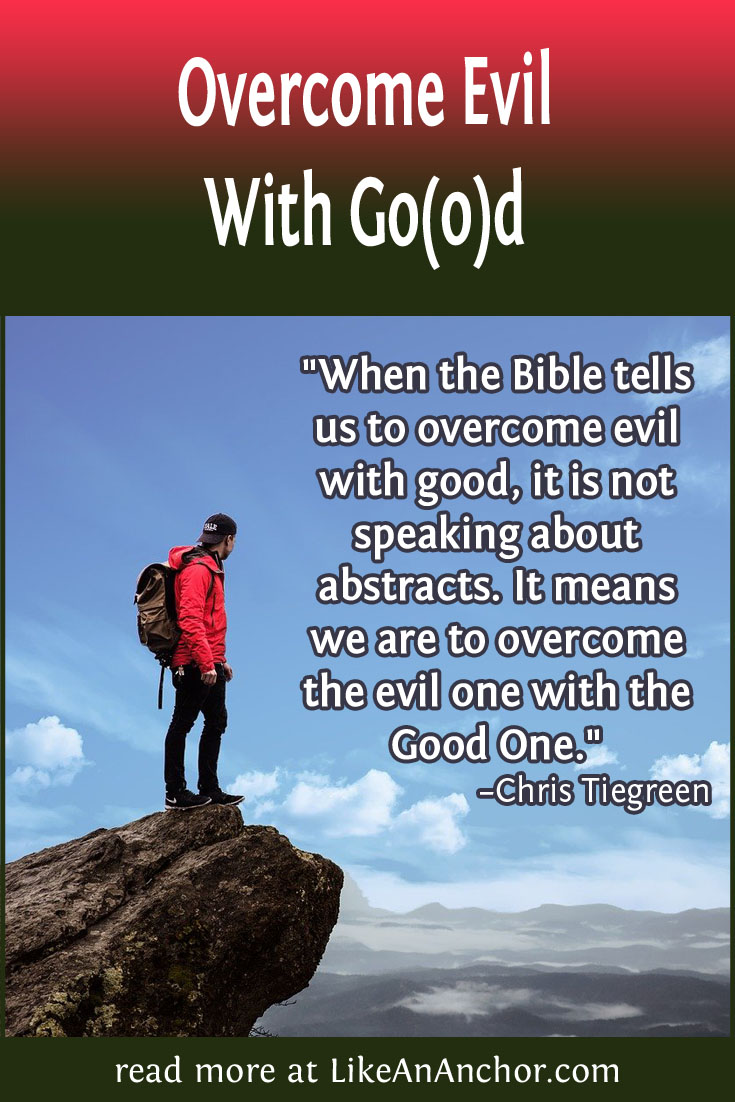
I’ve written before about a little pocket devotional by Chris Tiegreen that I really like. On Day 232, he points out that evil is the result of “a relentless, malicious intelligence,” not simply an “abstract principle” or a “force in this world.” This observation comes straight out of scripture, and it’s accompanied by an interesting implication.

“When the Bible tells us to overcome evil with good, it is not speaking about abstracts. It means we are to overcome the evil one with the Good One.”

Tiegreen, p. 199

If we’re trying to overcome this world’s evil simply by doing good things in hope of tipping the scales so good outweighs bad, then it’s no wonder we feel overwhelmed and burned out. We’d be trying to fight an enemy that’s out of our league without armor or backup. In order to be part of overcoming evil with good, we need to understand that overcoming doesn’t happen on our own. It means combatting an evil one with the power and support of the Good One.

You Have Overcome

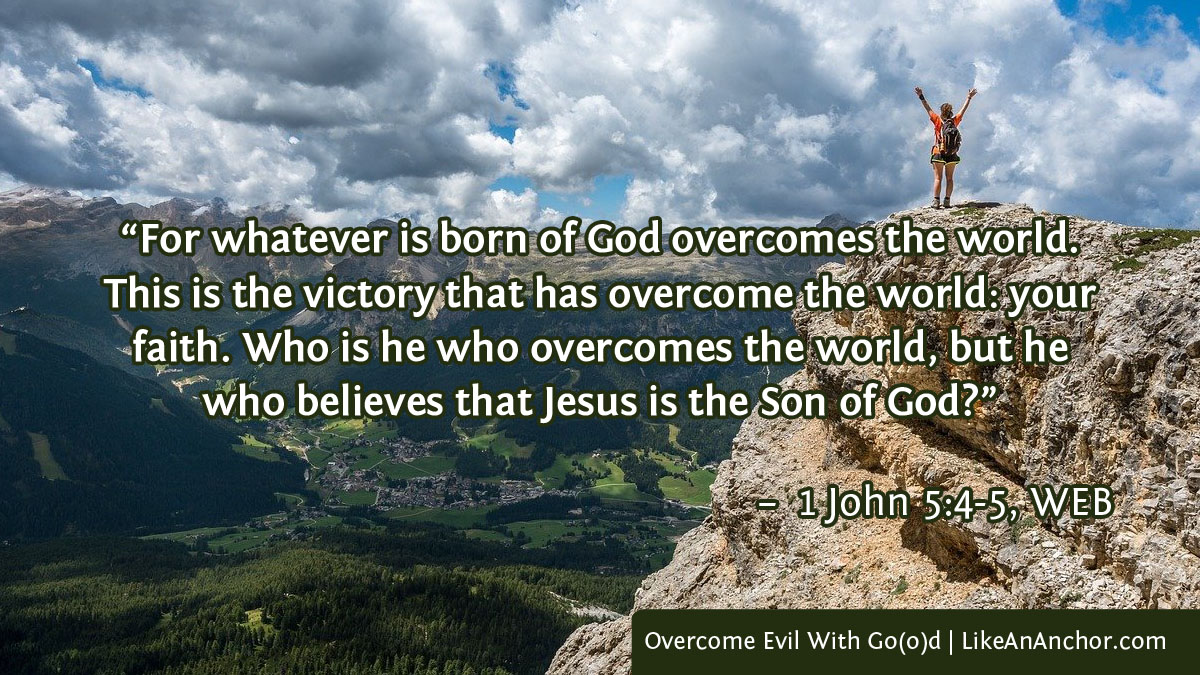
When John writes to believers, he encourages them by saying, “you have overcome the evil one” (1 John 2:13-14, WEB). This is made possible by us staying in close relationship with Jesus, “For whatever is born of God overcomes the world” by faith “that Jesus is the Son of God” (1 John 5:4-5). This same Jesus told His followers, “In the world you have trouble; but cheer up! I have overcome the world” (John 16:33, WEB). He has already proved He can overcome the evil in this world.

You are of God, little children, and have overcome them; because greater is he who is in you than he who is in the world.

1 John 4:4, WEB

With God on our side, no power in the universe can stand against us (Rom. 8:31-39). That fact ought to humble us while also giving us confidence. Without God we have no hope of overcoming, but so long as we stay with Him there’s no risk of us failing. All that “extraordinary power belongs to God and does not come from us” (2 Cor. 4:6-10, NET). The only possible outcome in the battle between good and evil is that, ultimately, the Good One will overcome the evil one. When the Father and Jesus dwell in us and we’re staying faithful to them, we can be overcomers as well. As Paul says, “I can do all things through Christ who strengthens me” (Phil. 4:13, WEB).

Continue Overcoming with God

Paul reminds us several times that we’re part of a battle between good and evil. It’s not a battle we can–or should–try to fight alone. To do so would be foolish, especially when God is eager to fight alongside us and equip us for battle.

For our struggle is not against flesh and blood, but against the rulers, against the powers, against the world rulers of this darkness, against the spiritual forces of evil in the heavens. For this reason, take up the full armor of God so that you may be able to stand your ground on the evil day, and having done everything, to stand.

Ephesians 6:12-13, NET

The evil forces at work in this world are powerful and can seem overwhelming, but only when compared to us human beings on our own. God’s power totally eclipses anything the evil one can do and He is already giving us victory through Jesus (Rom. 8:37; 1 Cor. 15:57). It is His power and His love for us which enables us to overcome the forces of evil during spiritual battles. It is also His power which enables us to combat evils we deal with on a personal, day-to-day level.

If possible, so far as it depends on you, live peaceably with all people. Do not avenge yourselves, dear friends, but give place to God’s wrath, for it is written, “Vengeance is mine, I will repay,” says the Lord. Rather, if your enemy is hungry, feed him; if he is thirsty, give him a drink; for in doing this you will be heaping burning coals on his head. Do not be overcome by evil, but overcome evil with good.

Romans 12:18-21, NET

Though we’re part of a large, cosmic-scale fight against evil, we also deal with it on a personal level as well. Part of overcoming the evil one with the Good One involves choosing peace and goodness in our actions. We might not be able to stop others from doing evil, but we can choose not to contribute to the wickedness of the world. By aligning ourselves with God and choosing to act according to His goodness, we fight against evil getting a foothold in our lives. And we do make the world a little bit brighter by shining Jesus’s light into dark situations.

Featured image by Sasin Tipchai from Pixabay

Song Recommendation: “I just need U” by TobyMac

Let Jesus Navigate

I love reading about the history of sail and immersing myself in fiction set aboard tall ships. One of the things you notice reading books like that is it takes a lot of skilled people to handle a ship. You need someone to captain, someone to chart the course, someone to manage upkeep tasks, people to hoist the sails, and a whole host of other jobs. In addition to having a navigator on board, ships would also hire local pilots when going through unfamiliar waters to make sure they didn’t run aground or go off course.

As we’ve talked about before, the Bible uses analogies of storms at sea to show us how invested Jesus is in keeping us afloat. But storms aren’t the only time we need Him. We also need Him to help navigate our lives. Even in situations that seem familiar and easy to handle there’s a chance of something unexpected showing up that we’ll need help navigating. And in situations where we have no idea what to do, we need to make extra sure we bring Him on as our pilot.

Jeremiah said, “I know, Adonai, that a man’s way is not his own, nor does man, as he walks, direct his steps” (Jer. 10:23, TLV). We don’t have complete power over our destinations or the course we take. We can influence them, we can plan our course and work hard to achieve our goals, but ultimately God is the one in control (Prov. 16:9). That’s why we’re better off if we trust Him from the get-go.

Then you will take delight in the Lord,
and he will answer your prayers.
Commit your future to the Lord.
Trust in him, and he will act on your behalf.

Psalm 37:4-5, NET

Without God, we’re like ships that haven’t got a stabilizing anchor or a navigator to steer them. In one evocative passage, Isaiah speaks to some of Israel’s and God’s enemies saying, “Your rigging is untied. They couldn’t strengthen the foot of their mast. They couldn’t spread the sail” (Is. 33:23, WEB). We don’t want to end up like that. We want to be like “Those who go down to the sea in ships” and “see Yahweh’s deeds and his wonders in the deep” as He “he brings them to their desired haven” (Ps. 107:23-30, WEB). We want to be like the psalmist who asked, “Guide me in the path of your commands, for I delight to walk in it (Ps. 119:35, NET).

We live in uncertain times. It’s easy to be afraid as we face unknowns, but that’s not how God means for us to live. He means for us to live boldly, trusting that He knows what He’s doing as He guides our course. When we trust Him to navigate and use His word as the guidebook for our lives, He will bring us to a good destination.

May the Lord direct your hearts into God’s love, and into the perseverance of Christ.

2 Thessalonians 3:5, WEB

Featured image by David Mark from Pixabay

Song Recommendation: “They Word” by Amy Grant

Our God Delights In Helping Us Succeed

There can be great peace and security in having a relationship with God. That’s something He wants us to enjoy. But if you’re struggling, feeling as if you may never measure up to God’s standards, serenity is likely the last thing you feel. It might even be discouraging to see other Christians seem so confident when you’re secretly unsure if you’ll make it through the week as a good and godly person.

One of the most comforting truths revealed in the Bible is that God wants us to succeed. His “mercy triumphs over judgement,” which in Greek means that mercy “boasts against, exalts over” judgement “in victory” (Jas 2:13, NET). When He looks at us, He hopes to see us doing well and He wants to support our growth far more than He wants to pass judgement on us. And when we slip-up or stray off the “straight and narrow” path, He’s eagerly looking for us to come back. God wants as many people as possible to be in His family, and He’s deeply committed to making that happen.

The Compassionate Father

You’re likely familiar with the parable of the prodigal son. In some translations, it’s labeled The Parable of the Compassionate, or Forgiving, Father. This name shifts our focus as we read this parable to notice the father’s role. In this parable, a man’s younger son demanded his share of the inheritance, then went off and “squandered his wealth with a wild lifestyle” (Luke 15:13, NET). Once he’d lost everything and was living destitute, barely scraping by feeding pigs, he realized he’d be better off going home even if his father only let him be a servant rather than acknowledged again as a son.

So he got up and went to his father. But while he was still a long way from home his father saw him, and his heart went out to him; he ran and hugged his son and kissed him. … the father said to his slaves, ‘Hurry! Bring the best robe, and put it on him! Put a ring on his finger and sandals on his feet! Bring the fattened calf and kill it! Let us eat and celebrate, because this son of mine was dead, and is alive again—he was lost and is found!’ So they began to celebrate.

Luke 15: 20, 22-24, NET

This father’s joy is the same joy God and all the hosts of heaven feel when a sinner repents (Luke 15:7, 10). God has felt this joy over us; we’ve all sinned (Rom. 3:23) and we’ve all had to repent many times. We count on God’s mercy to say, “Yes, I forgive you” every time we come to Him repentant and committed to doing better.

Image by Free-Photos from Pixabay

Wanting Us To Choose Life

God sincerely “desires all people to be saved and come to full knowledge of the truth” (1 Tim. 2:4, WEB). He does not wish “that any should perish, but that all should come to repentance” (2 Pet. 3:9, WEB). His goal is salvation and truth for, and repentance from, everyone (with that last one connected to our acceptance of the first two). We need to opt-in to grace; God doesn’t give people eternal life unless we take Him up on His offer. But He very much wants us to accept His gift and He’s invested in our success.

“But if the wicked person turns from all the sin he has committed and observes all my statutes and does what is just and right, he will surely live; he will not die. None of the sins he has committed will be held against him; because of the righteousness he has done, he will live. Do I actually delight in the death of the wicked,” declares the Sovereign Lord? “Do I not prefer that he turn from his wicked conduct and live?”

Ezekiel 18:21-23, NET

We might sometimes think God seems strict or unfair, but the reality is that His whole focus is on making things turn out well for His people (Rom. 8:28). He says to people He’s working with, “I have plans to prosper you, not to harm you. I have plans to give you a future filled with hope” (Jer. 29:11, NET). That group He’s working with can include any of us; people from all sorts of backgrounds, personalities, and experiences. Through Jesus’s sacrifice, God has opened up the opportunity to live in covenant with Him to anyone who hears His voice and responds.

Invested In and Delighted With Us

God delights in people who do their best to follow Him, not in people who are already “perfect.” Which is good for us, since we’re all still quite a ways off from attaining perfection even though we’re headed that direction. What’s important to God is that we stay on the journey toward being more and more like Him.

So then, my dear friends, just as you have always obeyed, not only in my presence but even more in my absence, continue working out your salvation with awe and reverence, for the one bringing forth in you both the desire and the effort—for the sake of his good pleasure—is God.

Philippians 2:12-13, NET

There are so many verses saying God delights in His people. Ps. 149:4; Prov. 11:20; 12:22; Is. 62:4-5; Jer. 32:40-41; Zeph. 3:17 are just a sample that point out He specifically delights in those who keep covenant with Him; who love and obey Him. Doing these things leads to delight for us as well (Ps. 16:11; 21:1; 37:4; 112:1; 119:16, 24, 35, 47, 77, 143, 174; 149:2; Is. 29:19). The more we delight in God and His laws, the more He delights in us. And when we do sin–since, as Paul said, it’s a struggle to do good all the time even when you delight in God’s law (Rom. 7:14-25)–then God delights in our repentance; our choice to run home to our compassionate Father.

Featured image by SnapwireSnaps from Pixabay