Rethinking Heaven: Capturing A Vision Of The Resurrection

Christians and non-Christians alike typically assume that our religion teaches good Christians go to heaven when they die and bad people, or those who’ve never given their lives to Jesus, go to hell. As more and more Biblical scholars, Christian churches, and individual believers are realizing, though, this isn’t the most accurate picture of what the Bible teaches regarding life after death.

I grew up in churches that taught the resurrection. It’s straight out of the scriptures, but I hadn’t come across other churches teaching something similar until reading a book called Desiring the Kingdom by Catholic theologian James K.A. Smith. In this book, Smith made a comment about Christians not really going to heaven when they die and footnoted it with three book suggestions for further reading. I could only locate one book from that list in the library: Surprised by Hope by New Testament scholar and Anglican bishop N.T. Wright.

Wright’s powerful exegesis on the meaning of the resurrection is inspiring and some of the thoughtful, well-researched ways he diverged from my church’s traditional teachings made me realize there are alternative explanations for a few difficult scriptures that deserve a second look. I also admire his style. Instead of telling people “You’re wrong,” he says, “We’ve been misinformed, and here’s the more wonderful plan God has for us.” That’s what I want to focus on today. The deeper our understanding of what God is actually planning for us, the firmer our hope and faith becomes.

What Happens When We Die?

The idea that human beings have immortal souls does not come from the Bible, It traveled into Christian theology from Greek philosophy, specifically Plato (see “Plato’s Shadow” by Gary Petty for more details). The Bible teaches that God “alone possesses immortality” (1 Tim. 6:16, NET). Immortality is not something inherent to humans. We didn’t even have a chance at eternal life until Jesus Christ broke “the power of death and brought life and immortality to light through the gospel!” (2 Tim. 1:10, NET).

In Hebrew thought and New Testament theology, the soul refers “not to a disembodied entity hidden within the outer shell of a disposable body, but rather to what we would call the whole person or personality” (Wright, p. 28). In Hebrew, the word translated “soul” is nephesh (H5315). It refers to a living thing with breath (Thayer’s Dictionary).

 Yahweh God formed man from the dust of the ground, and breathed (naphach) into his nostrils the breath (neshamah) of life; and man became a living soul (nephesh).

Genesis 2:7, WEB

The New Testament does talk about different parts of a human. We have a body  — the soma , which is fleshy, physical, and “that which casts a shadow” (Thayer G4983). We have a soul — psuche , the vital force of life and personality (G5590). And we have a spirit — pneuma , the “rational spirit, the power by which the human being feels, thinks, decides” (Thayer G4151). The three can’t really be separated in any useful way, though; they all go together to make us human beings in the image of God.

Now may the God of peace himself make you completely holy and may your spirit (pneuma) and soul (psuche) and body (soma) be kept entirely blameless at the coming of our Lord Jesus Christ.

1 Thessalonians 5:23, NET

So, we are human bodies that God created from dust and breathed into, making us living beings with spirits that can communicate with His Spirit. Ecclesiastes says that, at death, “the dust returns to the earth as it was, and the spirit returns to God who gave it” (Ecc. 12:7, WEB). Wright believes that this spirit is conscious while awaiting the bodily resurrection, but I lean more toward my church’s traditional teaching that this isn’t the case.

While there are a couple verses hinting at the possibility of consciousness after death (Luke 16:19-31; Rev. 6:9-10), the bulk of scripture compares death to sleep (John 11:11-13; 1 Cor. 15:6, 18, 31; 1 Thes. 4:13-15; 5:10; 2 Pet. 3:4; Dan. 12:2; and many others). Furthermore, “in death there is no memory of you” (Ps. 6:5, WEB), “the dead don’t praise Yah” (Ps. 115:17, WEB), and ” the dead don’t know anything” (Ecc. 9:5, WEB). Two scriptures–one in a parable and one in Revelation– that aren’t necessarily clear/straightforward do not seem to be enough evidence to counter the many, many other scriptures describing the dead as unconscious and sleeping.
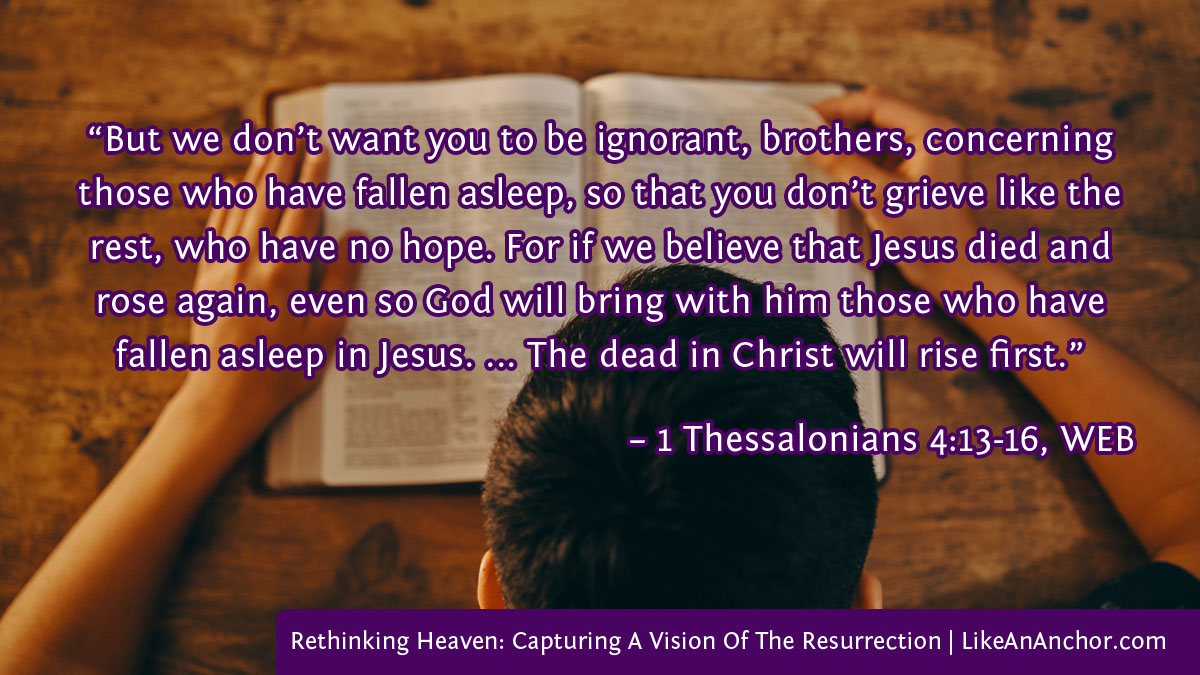
Image of a man reading the Bible overlaid with text from 1 Thes. 4:13-16, WEB version:  “But we don’t want you to be ignorant, brothers, concerning those who have fallen asleep, so that you don’t grieve like the rest, who have no hope. For if we believe that Jesus died and rose again, even so God will bring with him those who have fallen asleep in Jesus. ... The dead in Christ will rise first.”
Image by Matt Vasquez from Lightstock

For The Firstfruits

Eternal life is a gift God promises to those who follow Him now, in this life (we’ll save those who don’t for a follow-up post next week). The promises to believers are spelled out clearly in scripture, and nowhere more clearly than in 1 Corinthians 15. Here in the resurrection chapter, Paul reminded the Corinthians that he declared to them the gospel: “that Christ died for our sins according to the scriptures, and that he was buried, and that he was raised on the third day according to the scriptures, and that he appeared to” the apostles and hundreds of other believers (1 Cor. 15:3-5, NET). Jesus’s resurrection is central to the gospel message.

Paul then addressed a group of people who didn’t believe in the resurrection of the dead. He stated in no uncertain terms that if there is no resurrection the gospel is empty, and “if Christ has not been raised, your faith is useless; you are still in your sins. Furthermore, those who have fallen asleep in Christ have also perished” (1 Cor. 15:17-19, NET). There is no alternative. Either there’s a resurrection of the dead or we have no hope at all; physical death would be permanent.

Paul spent the next few verses talking about how and when we’ll be raised. N.T. Wright summed up the “how” by saying, “the risen Jesus is both the model for the Christian’ future body and the means by which it comes about” (p. 149). The “when” for the resurrection of faithful believers is Jesus Christ’s second coming (1 Thes. 4:13-18; 1 Cor. 15:23). This resurrection is for “the firstfruits”–a select group of people who actively, faithfully followed God during their physical lives. It’s not enough to verbally accept Jesus as your savior; we also have to live like Christians. And so the resurrection chapter also includes the injunction not to be deceived or corrupted, but rather “Sober up as you should, and stop sinning!” (1 Cor. 15:34. NET).
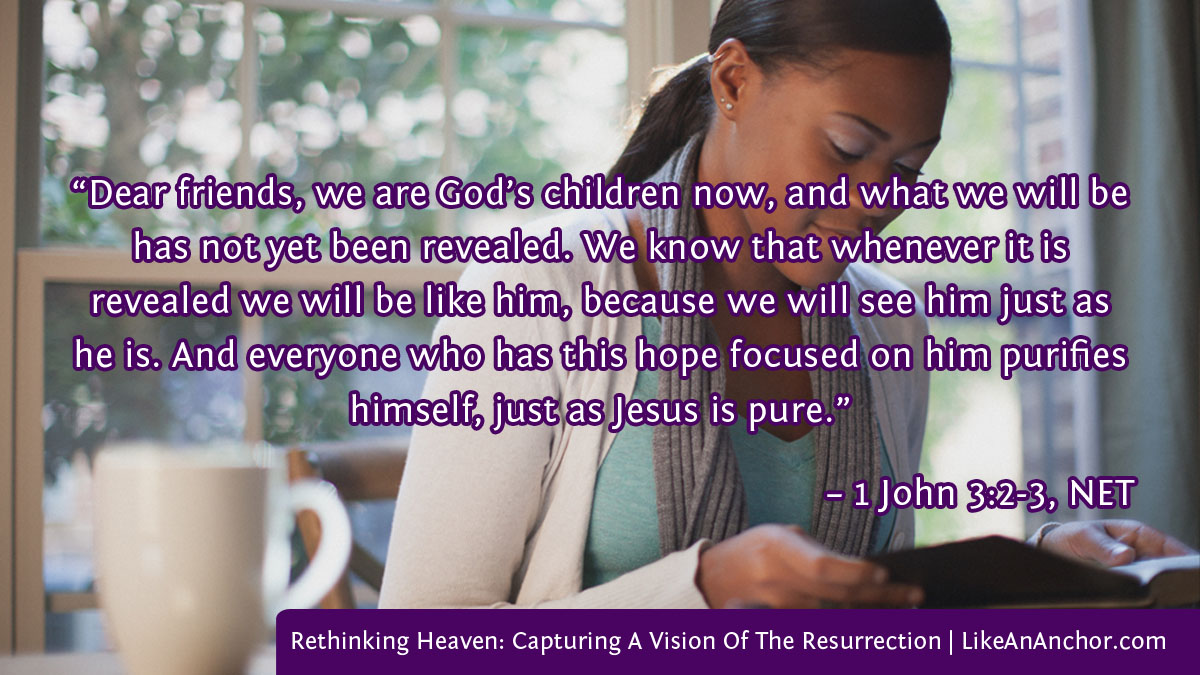
Image of a woman reading the Bible overlaid with text from 1 John 3:2-3, NET version:  “Dear friends, we are God’s children now, and what we will be has not yet been revealed. We know that whenever it is 
revealed we will be like him, because we will see him just as he is. And everyone who has this hope focused on him purifies himself, just as Jesus is pure.”
Image by Pearl from Lightstock

A Bodily Resurrection

Paul anticipated one question that many will have about the resurrection when he said, “But someone will say, ‘How are the dead raised? With what kind of body will they come?'” (1 Cor. 15:35, NET). It’s an understandable question, especially today given the confusion about what “soul” actually means. The short answer is given by John: “we will be like him, because we will see him just as he is.” (1 John 3:2, NET). When we’re resurrected, it will be to an existence like God’s.

Paul addresses this question in more depth. He likens our bodies now to “a bare seed” sown in a field with the expectation that it will grow into a mature, flourishing plant (1 Cor. 15:37, NET).We currently have a “natural body” that bears the image of the first human being that God breathed into and made a living being. Those who rise from the dead in the first resurrection will have a “spiritual body” that bears the image of Jesus Christ (1 Cor. 15:42-49).

 It is the same with the resurrection of the dead. What is sown is perishable, what is raised is imperishable. It is sown in dishonor, it is raised in glory; it is sown in weakness, it is raised in power; it is sown a natural body, it is raised a spiritual body. If there is a natural body, there is also a spiritual body.

1 Corinthians 15:42-44, NET
In Greek, the words “natural” and “spiritual” are psychikos and pneumatikos. Wright points out that “Greek adjectives ending in -ikos describe not the material out of which things are made but the power or energy that animates them” (p. 155, emphasis in original). We currently have a body animated by the human soul. We will have a body “animated by God’s pneuma, God’s breath of new life, the energizing power of God’s new creation” (p. 156).

When Jesus rose from the dead, people could touch Him (John 20:27) and eat with Him (John 21:9-13). He told them, “Look at my hands and my feet; it’s me! Touch me and see; a ghost does not have flesh and bones like you see I have” (Luke 24:39, NET). Though He could appear in the middle of a locked room or vanish from sight (Luke 24:30-31, 36), Jesus wasn’t a ghost or a disembodied spirit. His spiritual body was something more than His physical one.

We’re not waiting for an escape from the body, but rather “the redemption of our bodies” (Rom. 8:23, NET). We long “to put on our heavenly dwelling … because we do not want to be unclothed, but clothed, so that what is mortal may be swallowed up by life” (2 Cor. 5:1-5, NET). We’re not waiting to go to heaven when we die — we’re waiting for Christ to come down from heaven to raise His people from their sleep of death and transform us all to have a spiritual life and body like His (1 Cor. 15:51-58). And it doesn’t end there!

Blessed and holy is the one who takes part in the first resurrection. The second death has no power over them, but they will be priests of God and of Christ, and they will reign with him for a thousand years.

Revelation 20:6, NET

We don’t have a ton of information about what happens after the first resurrection, but God does sketch out the final stages of His plan for us. We know that for 1,000 years, those firstfruits who were resurrected from the dead or who were alive and transformed at Jesus’s second coming reign alongside Him in what we call the Millennium (most details about this come from the prophets and Revelation). After that, there will be a resurrection of the remaining dead, a final judgment, Satan’s total defeat, a new heaven and new earth, and God will come to dwell with humanity on earth (Rev. 20-22). It’s an incredible future that God has planned for His creation! Let’s not settle for any teaching that offers less than His glorious plan that He has revealed to us in scripture.


Featured image by Ruby-Rose from Lightstock

Song Recommendation: “With The Sound of Trumpets

Walking Through Philippians 3: Paul’s Thoughts on Following Jesus

In 1 Corinthians 11:1, Paul said, “Be ye followers of me, even as I also am of Christ” (KJV). If we want a how-to guide for the way Paul follows Jesus, we can find a succinct version in the 3rd chapter of Philippians. This chapter is a bit unusual. Rather than speaking generally to his fellow believers or addressing a specific issue in the church, Paul gets real about his own walk of faith.

click to read article, Walking Through Philippians 3: Paul's Thoughts on Following Jesus | marissabaker.wordpress.com
photo credit: Samuel Zeller via StockSnap.io

Paul’s Zeal

We break into the middle of the letter to the church in Philippi. Paul has been warning against “dogs, “evil workers,” and “the mutilation.” He gives a general principle that physical things like circumcision aren’t what determines whether or not you’re part of God’s chosen people. “We are the circumcision,” he writes, “who worship God in the Spirit, rejoice in Christ Jesus, and have no confidence in the flesh” (Phil. 3:2-3). He then shifts to using himself as an example.

Though I also might have confidence in the flesh. If anyone else thinks he may have confidence in the flesh, I more so: circumcised the eighth day, of the stock of Israel, of the tribe of Benjamin, a Hebrew of the Hebrews; concerning the law, a Pharisee; concerning zeal, persecuting the church; concerning the righteousness which is in the law, blameless. (Phil 3:4-6)

What a pedigree! Under the Old Covenant, Paul was as perfect as you could get. There was no stain on his Israelitish lineage. His parents kept the Law and had him circumcised. He became an elite leader in the Jewish community and an expert in the Law, which he kept to the letter. He even actively persecuted heretics.

Then, suddenly, Jesus Himself showed up and told Paul those weren’t heretics. The Messiah had come and Paul was fighting the next step in God’s plan. In response, Paul gave up power, prestige, and (parts of) the belief system he’d poured his entire life into to follow Jesus. And that’s an aspect of Paul’s life that we’re supposed to imitate. Read more

The Role of Works

We are not saved by works. We all know this — Jesus Christ is the only path to salvation and we are saved as a gift of God. We can’t earn it. We agree on that, but not every Christian agrees on what our role is in this process. Are you saved when you accept Christ? When you covenant with Him at baptism? some other time? Is salvation a permanent state or can it be withdrawn? Does salvation require good works, result in good works, or have nothing to do with works at all?The Role of Works | marissabaker.wordpress.com

God offers salvation freely as a gift, but we aren’t forced to accept the gift. It’s a choice that’s part of Him giving us free will. Choosing salvation involves more than a verbal acknowledgement of Christ as savior. God doesn’t just care about what we say. He cares about the state of our hearts and how that translates into the way we live our lives. The Bible is very clear that there will be people who think they’re following God, but who won’t be in His kingdom because they’re not following Him in the way He commanded.

The Gift of God

The key passages discussing grace and freely given salvation also have quite a bit to say about works. In Romans, for example, we’re told “the grace of God and the gift by the grace of the one Man, Jesus Christ, abounded to many” (Rom. 5:15). It doesn’t stop there, though. Paul anticipates his readers’ questions, asking, “Shall we continue in sin that grace may abound?” and “Shall we sin because we are not under law but under grace?” Both are answered with an emphatic “Certainly not!” (Rom. 6:1-2, 15). This phrase is also translated “God forbid!” (KJV), “By no means!” (NIV), and “May it never be!” (NASB). When the gift of God frees us from servitude to sin we become servants of God, and servants are expected to work (Rom. 6:15-23). Freedom from sin gives us the ability to obey God, not license to disobey Him. Read more

I got a “What if …”

Almost 80 degrees and Tiger wants to snuggle with me and a blanket.
Almost 80 degrees and Tiger wants to snuggle with me in a blanket.

Today’s post is a bit different than usual. During my Tuesday morning Bible study, my cat looked so comfortable snuggled up on my lap that I spent some extra time meditating on the Word. I’d been in Genesis writing about our Creator, and a thought popped into my head. I want to share this idea with you today and ask for feedback. Please comment! Diving deeper into God’s mysteries shouldn’t be done in a void — I believe God wants us to grow together and “sharpen” each other (and also to call each other out if we notice someone studying something that’s not in line with scripture).

Okay, so we know that God has had a plan in mind since before creation and that plan involves building a family (Eph.1:3-6). We also know that the church is described as the bride of Jesus Christ (2 Cor. 11:2; Rev. 19:6-9) and we’re told that human marriage is a “great mystery” that points to the relationships between Christ and His church (Eph. 5:22-33).

What if God began revealing these aspects of His plan from the very beginning in the way He chose to create man and woman? or, to put it another way, what if the way God created man and woman teaches us that He didn’t want to be alone and that He’s fashioning a helper comparable to Him? Read more

Rhythms of Worship: God’s Plan and the Sacred Calendar

The people of God are set apart, with different priorities, habits, and festivals than the rest of the world. We may celebrate national holidays of our homelands, such as July 4th for Americans, but those are not the observances that shape our identities as God’s people. The kingdom we belong to under Christ’s authority has a different calendar.

A couple months ago, I read Desiring the Kingdom by James K.A. Smith. In “Chapter 5: Practicing (for) the Kingdom,” he discusses “rhythms and cadences of hope” that Christians observe in weekly and annual practices. For him, this means Sunday, Easter, Lent, Advent, Christmas and others. He connects the observances to a rich history of “a people gathered to worship the Messiah, who does not float in some esoteric, ahistorical heaven, but who made a dent in the calendar — and will again” (p. 157).

However, when you read the Bible, you won’t find the days Smith talks about on God’s calendar. Even the one mention of Easter in the KJV is a mistranslation of pascha, or Passover (Acts 12:4, Strong’s G3957). Rather, we find the church from the Torah to Revelation on a calendar even more unique than the one Smith claims for Christians. I know it puzzles many Christians that I would keep the “Jewish holidays,” but I find it equally puzzling that they would continue a tradition of co-opting pagan holidays and attaching them to Biblical events God gave no instructions to observe. When we search the scriptures looking for God’s version of liturgical rhythms, we find a worship pattern far more richly layered and deeply rooted in God’s plan than what man has invented.

Photo by Megs Harrison on Unsplash

Weeks and Months

The observance of time in the Bible begins at Creation. On the fourth day, God said, ““Let there be lights in the expanse of the sky to divide the day from the night; and let them be for signs to mark seasons, days, and years” (Gen 1:14, WEB). On the seventh day God rested “from all his work which he had done. God blessed the seventh day, and made it holy, because he rested in it from all his work of creation which he had done” (Gen. 2:2-3, WEB; see also Ex. 20:11; 31:17).

From the very beginning, God set up a world that allowed for marking time in weekly, monthly, and yearly rhythms. The Sabbath was established from the foundation of the world, and there’s no scriptural evidence that it was ever moved from the seventh to the first day (click here for my Sabbath post). The other holy days were set in place as God revealed His plan and established His covenants, but the Sabbath was there since the beginning and will be with us forever (Is. 56:2-7; 66:22-23; Mark 2:27-28; Heb. 4:9).

The months were marked by new moons, making the Hebrew calendar lunar (which is why the holy days “move around” on the Gregorian calendar). Exodus establishes which month begins the year (Ex. 12:2) and calls it Abib (Ex. 13:4). The new moons aren’t counted as Sabbaths and we know very little about how they were observed. We’re told there was trumpet blowing and offerings (Num. 10:10; 28:11-15), we read about people gathering together (1 Sam. 20:5, 18, 24, 27; 2 King. 4:22-23), observance is mentioned in a  Millennial setting (Is. 66:23), and once they’re mentioned in the New Testament alongside holy days and Sabbaths (Col. 2:16-17). Most of us aren’t sure what to do with them today and ignore them, and I confess I’m guilty of that as well.

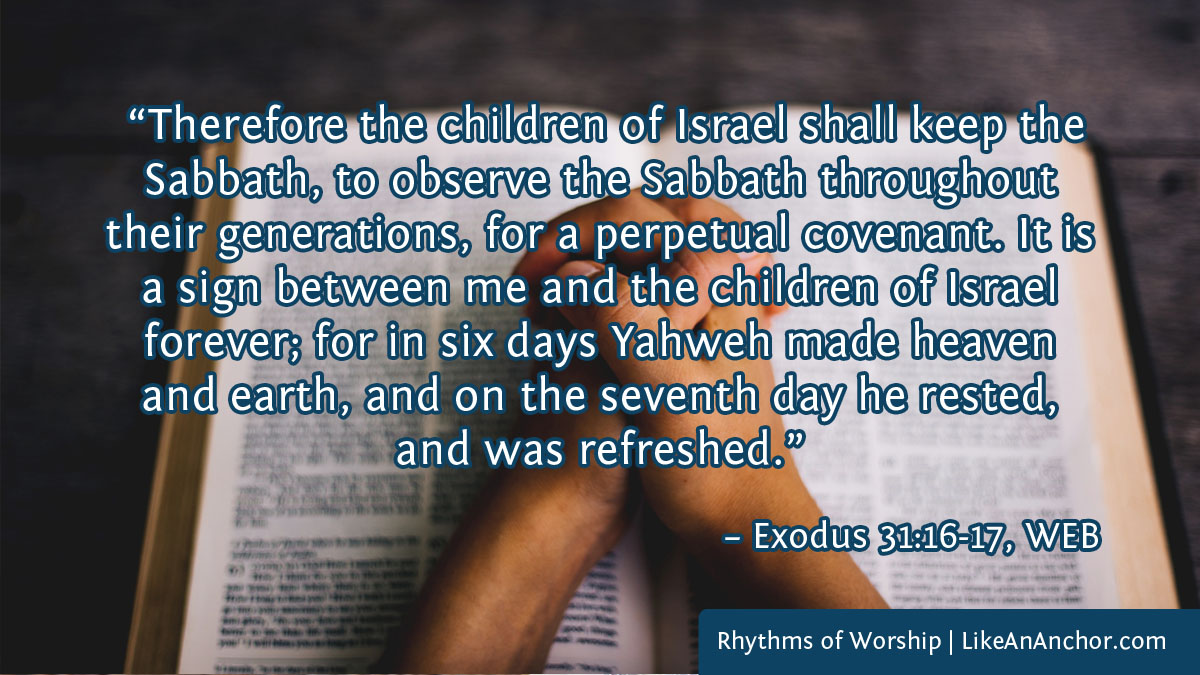
Image of hands folded on a Bible, overlaid with text from Exodus 31:16-17, WEB version: "Therefore the children of Israel shall keep the Sabbath, to observe the Sabbath throughout their generations, for a perpetual covenant. It is a sign between me and the children of Israel forever; for in six days Yahweh made heaven and earth, and on the seventh day he rested, and was refreshed.”
Image by Jantanee from Lightstock

Remembering Our Savior

The first month, Abib, begins the holy day cycle with Passover on the 14th. Originally, the Passover (Pesach in Hebrew) was kept as a memorial of God rescuing Israel from Egypt and sparing their firstborn by passing His vengeance over the houses covered by the blood of a lamb. Jesus Christ fulfilled what was pictured here when He died as our Passover lamb, and He up-dated Passover observance for His new church.

Many churches today keep the Passover, but in many Christian denominations it has been replaced with Easter and the ceremony Jesus instituted on His last Passover is done regularly as Communion. However, Jesus never tells us to mark His resurrection day with a yearly observance. Rather, He says during the Passover ceremony, “Do this in remembrance of me” (Luke 22:19, NET). Even if we did remember Him in communion throughout the year (there are some scriptures you could use to support that practice), it would not eliminate the need to observe Passover the way that Christ did. The resurrection was incredibly important, but Jesus didn’t want us to stop keeping Passover and replace it with Easter.

In his book Surprised by Hope, N.T. Wright laments how little time is spent in celebrating Easter and argues “it ought to be an eight day festival” (p. 256). If he were to step back from Easter and take another look at Passover, he would see God did indeed set up eight days of observance. Passover starts things off, then the following day begins the seven-day festival of Unleavened Bread (Chag HaMatzot). If we look at a timeline of Jesus’ death and resurrection, we find that He rose from the dead when the sun set on Saturday, ending the weekly Sabbath and starting the first day of the week. He ascended to His father the following Sunday morning (John 20:1-17), which corresponds to a special ceremony outlined in Leviticus 23:9-15 called the Wave Sheaf or First Fruits. This ceremony marked the beginning of a 50-day count to Pentecost.

Set back in the context of the Biblical holy days, our remembrance of Christ’s Passover sacrifice kicks-off a week long festival where we remember that because “Christ, our Passover, has been sacrificed in our place” we are being made into a people untainted by the yeast of sin (1 Cor. 5:6-8). It should be a time of rejoicing and appreciation for all that’s pictured in His sacrifice and in His resurrection. When we mark the Wave Sheaf as the day He ascended to His Father following His resurrection and start counting to Pentecost (Shavuot), we have a reminder built into God’s holy calendar that without the resurrection of Jesus the church wouldn’t have the holy spirit. And so we celebrate Pentecost, the day God poured His spirit out on the New Testament church (Acts 2:1-4) as a direct result of the resurrection of Jesus Christ and the work He’s currently doing in and with His church to make us firstfruits.

Image of unleavened bread and wine on a table, overlaid with text from 1 Corinthians 11:23-25, WEB version:  “the Lord Jesus on the night in which he was betrayed took bread. When he had given thanks, he broke it and said, ‘Take, eat. This is my body, which is broken for you. Do this in memory of me.’ In the same way he also took the cup, after supper, saying, ‘This cup is the new covenant in my blood. Do this, as often as you drink, in memory of me.’”
Image by Jeff Jacobs from Pixabay

Looking To The Future

On the first day of the seventh Hebrew month, the Lord commanded Israel, “you must have a complete rest, a memorial announced by loud horn blasts, a holy assembly” (Lev. 23:24, NET). Many interpret this day as picturing the return of Jesus Christ because “the Lord himself will descend from heaven with a shout, with the voice of the archangel and with God’s trumpet” (1 Thes. 4:16, NET). In Jewish tradition, trumpets were blown the entire month leading up to the Feast of Trumpets (Yom Teruah). Messianic rabbis teach the trumpet calls proclaim, “The Bridegroom is coming! get ready to meet Him.” What could be more relevant for the church today as we draw ever closer to Jesus’ second coming?

Ten days after Trumpets, we cycle through to a solemn, serious holy day called the Day of Atonement (Yom Kippur). This day is marked by fasting, prayer, and a complete Sabbath rest from all work. Judging by the amount of scripture space devoted to its observance (Lev. 16:1-34; 23:26-32, and others), this day was very important to God, and it still is. Atonement was called an “everlasting statute” and Paul was still marking it in the New Testament (Acts 27:9). Unfortunately, it’s been so stereotyped as a Jewish holiday that most Christians don’t even consider the depth and meaning this day takes on following Christ’s atoning sacrifice, His resurrection, and His exaltation to the role of High Priest. Instead, they’re distracted during the fall season of the year by thoroughly pagan Halloween and non-scriptural All Saints and All Souls days.

The holy day cycle, like the plan of God, culminates in a celebration. Every weekly Sabbath looks forward to the time when Christ will reign on this earth as present, powerful, King of kings and Lord of lords, but the Feast of Tabernacles (Sukkot) takes the picture further. We dwell in temporary shelters as a reminder that we are sojourners here on this earth awaiting the return of our Lord and looking forward to a time when His kingdom will be here on earth. Sukkot also looks back, at the children of Israel who God made to live in tabernacles, or “temporary shelters,” when He “brought them out of the land of Egypt” (Lev. 23:42-43, WEB). Jesus kept this Feast (John 7:2-10, 14, 37) and it will be kept in God’s future kingdom (Zech. 14:16). We can’t argue it’s irrelevant to the church today; it hasn’t even been fulfilled yet by God’s Millennial Kingdom. Wrapping up the holy day cycle, the Feast ends with an eighth day, the Last Great Day, pointing to the final judgement day and the New Jerusalem (Revelation chapters 20-22).

Image of a young woman sitting by a tiger, overlaid with text from Isaiah 11:6 and 9, WEB version: “The wolf will live with the lamb, and the leopard will lie down with the young goat, the calf, the young lion, and the fattened calf together; and a little child will lead them. ... They will not hurt nor destroy in all my holy mountain; for the earth will be full of the knowledge of Yahweh, as the waters cover the sea.”

Aligned With The Lord

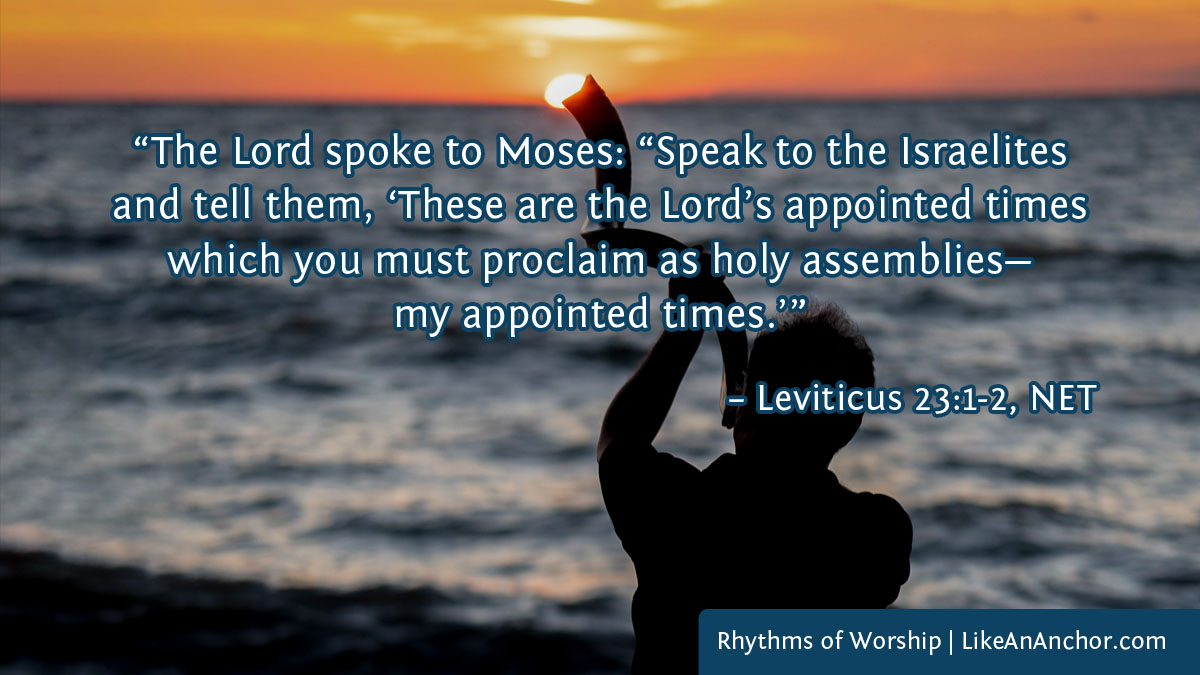
So why aren’t all the Christian churches on God’s calendar? I’ll be honest, this is something I really don’t understand. To be clear, I under stand why people who never learned about God’s holy days and who are members of churches that dismiss these days don’t keep them. Unless you study God’s holy days for yourself, you’re unlikely to hear about them in most churches. But I don’t understand how Bible teachers justify the omission. Why distance yourself from the rhythms of worship God says belong to Him? In Leviticus, before outlining all the holy days, God says, “These are the Lord’s appointed times which you must proclaim as holy assemblies—my appointed times” (Lev. 23:1-2, NET). They are days Holy to our great God, not something just for a specific group or time. So why abandon them for days with observances rooted in pagan holidays like the worship of Ishtar/Astarte (for Easter) and mid-winter Saturnalia (for Christmas)?

Images from OpenClipArt

I’m not just talking about Christian leaders today. This substitution of man’s days for God’s days goes back centuries–so far that Easter and Christmas are called “Christian” traditions and the days Christ Himself kept are a distant memory. It’s time for the church to ask itself some tough questions. Is God pleased when we use pagan holidays to “worship” Him, even after we pretty them up and associate them with events in the Bible? Or would God be more pleased if we value the holy days He set aside for His people from the establishment of His covenants? The way we live our lives matters to God, and He’s watching to see whether we’ll cling to traditions of men or whether we’ll cling to His word, His kingdom, and His plan.

I hope no one feels like I’m attacking them or their beliefs. I’ve thought long over how to phrase this post, and even debated whether or not to share it. I truly feel, though, that the closer we align ourselves with God’s word, the more He will reveal of His plan and the closer our relationships will be with Him. May God’s blessing rest on you all, my friends.


Featured image by José Roberto Roquel from Lightstock

The Meaning of the Resurrection

My churches have always taught the importance of Jesus Christ’s resurrection. I’ve even written about resurrection before, as part of the Foundations series. But I only focused on what the resurrection meant for individuals — that Christ’s resurrection makes our resurrections possible. I hadn’t really considered the implication of Christ’s sacrifice and resurrection on the entire world today.

The Meaning of the Resurrection | marissabaker.wordpress.com
Image credit: “Sunrise Point” by Justin Fincher, CC BY via Flickr

Reading N.T. Wright’s book Surprised by Hope: Rethinking Heaven, the Resurrection, and the Mission of the Church has been eye-opening. He’s not really talking about things I’ve never heard before, but the way he frames his exegesis is making me think about Christ’s resurrection and the church’s mission at a depth I hadn’t pondered until now.

Wright places the resurrection in its historic context to show that what happened when Jesus rose from the grave three days after His Passover sacrifice was truly revolutionary. The Greek and Roman cultures believed in an immortal soul and the Jews believed in a resurrection, but no one was expecting Jesus (or anyone else) to rise from the dead in a renewed spiritual body. The risen Jesus was far too tangible and real to fit Greco-Roman ideas of afterlife and it was unexpected timing-wise from the Jewish perspective. This resurrection was sealed proof that Jesus was indeed the Messiah and that things on earth would never be the same again. Read more