Free In Christ

I didn’t realize until I saw this post still in drafts that there wasn’t a Saturday post last week. Oops. Well, here it is now.

Then Jesus said to those Jews who believed Him, “If you abide in My word, you are My disciples indeed. And you shall know the truth, and the truth shall make you free …

“Most assuredly, I say to you, whoever commits sin is a slave of sin. And a slave does not abide in the house forever, but a son abides forever. Therefore if the Son makes you free, you shall be free indeed.” (John 8:31-32, 34-36)

What happens once we are made free from sin? Some people (especially those in Western cultures, I suspect) tend to think of freedom as license to do whatever they want. This is not what is meant by the freedom that we are given in Christ.

And having been set free from sin, you became slaves of righteousness. (Rom. 6:18)

The Bible reveals that we have only two options: service to sin or service to God. Though we are “not under law but under grace,” that does not give us license to disobey. Under the New Covenant, God’s commandments are still in effect, and He requires obedience from those who love Him (John 14:15, 21).

What then? Shall we sin because we are not under law but under grace? Certainly not! Do you not know that to whom you present yourselves slaves to obey, you are that one’s slaves whom you obey, whether of sin leading to death, or of obedience leading to righteousness? (Rom. 6:15-17)

"Free In Christ" marissabaker.wordpress.comThis does not mean we can earn eternal life by obedience — it is a free gift from God (Rom. 6:23). However, we can show by disobedient actions that we refuse to accept His gift. When we do that, it’s as if someone pulled us from a burning building and said, “Don’t go back in there,” and instead of obeying we marched right back inside because we thought the heat felt good.

Once we have been redeemed by Jesus Christ, we have to respond by walking not “according to the flesh, but according to the Spirit” (Rom. 8:1). We will surely slip and fall, but we have to stop willfully sinning and make a genuine effort to change and obey. The habit of our life has to become Christ-imitating instead of sinful.

For this is the will of God, that by doing good you may put to silence the ignorance of foolish men — as free, yet not using liberty as a cloak for vice, but as bondservants of God. (1 Pet. 2:15-16)

The Subject of Kneecaps

I’m a little fuzzy on the subject of violence in the Bible, and talking with or reading the opinions of other Christians doesn’t make it any less confusing. We can all agree murder is wrong. After that, there doesn’t seem to be much agreement at all. Should a Christian use violence, sometimes even deadly violence, to save someone’s life or defend themselves?

Zoë: “Preacher, don’t the Bible have some pretty specific things to say about killin’?”

Book: “Quite specific. It is, however, somewhat fuzzier on the subject of kneecaps.”

— Firefly, episode 9 “War Stories”

In this situation in Firefly, Shepherd Book armed himself and joined his shipmates to rescue Malcolm Reynolds from torture and death. He did not violate the commandment “You shalt not murder,” or even the King James’ rendering “Though shalt not kill” (Ex. 20:13). But does this kind of violence violate the spirit, if not the letter, of such commandments? If he had killed in self-defense, would it have been wrong?

Murder vs. Killing

I don’t think there is any question about murder being wrong. Even in societies without the Bible as a guide, laws against murder are usually part of the culture. It’s on the subject of “killing” where things get sticky for Christians. If someone is attacking your family, is it permitted to use violence to stop them? Does unintentionally killing someone who is trying to harm you make guilty of murder in God’s eyes?

The Hebrew word translated “kill” or “murder” in Exodus 20 is râtsach (H7523). Strong’s defines it as, “to dash in pieces, that is, kill (a human being), especially to murder.” Like many Hebrew words, the exact meaning is dependent on the context, and The Complete WordStudy Dictionary: Old Testament points out that the word is used “to indicate premeditated murder” as well as “an accidental killing,” slaying someone as an “act of revenge,” and “death by means of an animal attack.” Other scriptures help narrow down the definition, as C.S. Lewis points out in this quote from Mere Christianity.

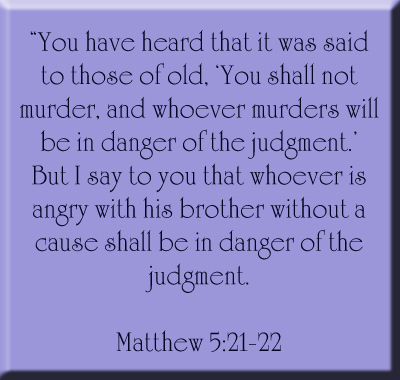
It is no good quoting “Thou shalt not kill.” There are two Greek words: the ordinary word to kill and the word to murder. And when Christ quotes the commandment He uses the murder in all three accounts. … All killing is not murder any more than all sexual intercourse is adultery.

The Issue of Hate

Should Christians defend themselves? "The Subject of Kneecaps" marissabaker.wordpress.comC.S. Lewis was not a pacifist (he wrote a whole article on the “why” of this viewpoint, but I have yet to find a copy). I admire his writings, but there are other people whose opinions I admire who are adamant that it is wrong for a Christian to serve as a soldier and wrong for a person to kill someone in self-defense.

For some people, I think the distinction between murder and killing comes down to the idea of a death being accidental and/or premeditated. We know from the instructions God gives for cities of refuge (Joshua 20) that accidental killings  do not come under the death-penalty ascribed to murder. The reasons given for not condemning a man who accidentally caused his neighbor’s death are these: “he struck his neighbor unintentionally, but did not hate him beforehand” (Josh. 20:5).

People seem to go two ways on interpreting this verse. One: killing someone in self defense does not constitute murder because you “did not hate him before hand.” It was not a premeditated, vengeful killing, therefore it is considered an accident. C.S. Lewis seems to come down on this side when he says, “We may kill if necessary, but we must not hate and enjoy hating.”

Whoever hates his brother is a murderer, and you know that no murderer has eternal life abiding in him. (1 John 3:15)

Deliberate Self-Defense

The second argument I’ve heard goes something like this: planning to defend yourself makes the death premeditated. You might not be deliberately trying to kill a specific person, but if you intend to kill whoever attacks you and your family, the killing was planned. This also means you don’t fulfill the requirement “he struck his neighbor unintentionally.”

Something doesn’t sit well with me about this last viewpoint. Perhaps it’s partly the implication that most people who intend to defend themselves if attacked also have a desire to kill (which I don’t see in the people I know who are prepared to defend themselves). There are also elements of hypocrisy. The person who thinks self-defense is wrong will probably not hesitate to call 911, and if the person attacking them is killed by police officers I’m not sure they’d feel terribly guilty.

I don’t have much of a conclusion for this post. In theory, I tend to lean more towards C.S. Lewis’s views. In practice, though, one of the reasons I quit Tae Kwon Do is because I hated even practicing how to hurt people. What are your thoughts on this subject?

Reasons for Suffering

"Reasons for Suffering" marissabaker.wordpress.com
image from Stock.xchng

One of the best sermons we heard during the Feast of Tabernacles was titled “Why Will God Release Satan to Deceive the World Again?” (Sept. 24 sermon, link in Pacific COG archives). I could probably write half a dozen blog posts on different points he brought up, but for now I want to focus on just one. In the context of trying to see things from God’s point of view (such as understanding His decision to release Satan after the Millennium [Rev. 20:1-10]), the speaker brought up the subject of suffering. When we’re suffering, our automatic response is to want the suffering to end because we view it in a negative light, but God’s perspective can be very different.

Blessed Persecution

If we start reading the beatitudes, those who Christ calls blessed are not always in a condition we would consider a blessing. They are “poor in spirit” (Matt. 5:3), they mourn and weep (Matt. 5:4; Luke 6:21), they are hungry (Luke 6:21), they are hated (Luke 6: 22), and they are persecuted.

Blessed are those who are persecuted for righteousness’ sake, for theirs is the kingdom of heaven. Blessed are you when they revile and persecute you, and say all kinds of evil against you falsely for My sake. Rejoice and be exceedingly glad, for great is your reward in heaven, for so they persecuted the prophets who were before you. (Matt. 5:10-12)

I don’t know about you, but my first reaction when I’m feeling persecuted is not to “rejoice and be exceedingly glad” or to “leap for joy” (Luke 6:23). Yet we should be more like the apostles who, after they were beaten and commanded not to preach Jesus any more, “departed from the presence of the council, rejoicing that they were counted worthy to suffer shame for His name” and made themselves the target of more persecution by continuing to preach (Acts 5:40-42).

If we suffer with Him

The question, “Why would God allow suffering?” is frequently asked by those in the church and by those who have rejected belief in God. If He’s all powerful, we wonder, why would He allow such terrible things to happen? One answer, as pointed out in the sermon I’ve been referring to, is that God sees suffering in a different light than we do. Often, what we see as negative in this moment will ultimately be for our good. For example, in Romans 8, Paul writes that we will be glorified with Christ on the condition that we suffer as He suffered.

The Spirit itself beareth witness with our spirit, that we are the children of God: and if children, then heirs; heirs of God, and joint-heirs with Christ; if so be that we suffer with him, that we may be also glorified together. For I reckon that the sufferings of this present time are not worthy to be compared with the glory which shall be revealed in us. (Rom. 8:16-18, KJV)

This is certainly not the only scripture that talks of our glorious future as being conditional on present suffering. Here are a few more:

our light affliction, which is but for a moment, is working for us a far more exceeding and eternal weight of glory (2 Cor. 4:17)

if you should suffer for righteousness’ sake, you are blessed (1 Pet. 3:14)

But when you do good and suffer, if you take it patiently, this is commendable before God. For to this you were called, because Christ also suffered for us, leaving us an example, that you should follow His steps (1 Pet. 2:20-21)

Why is suffering so important?

Finding these scriptures and understanding that suffering is part of being a Christian is not hard. Accepting that there is a good reason for suffering in your life or in the lives of those you love is the hard part. And this is why I really appreciated this sermon message, because the speaker didn’t just tell people “suffering is good for you, be happy.” He pulled together an easy-to-understand analysis that moved logically from the proper reaction to suffering, to the reward for suffering, to the reason for suffering.

My brethren, count it all joy when you fall into various trials, knowing that the testing of your faith produces patience. But let patience have its perfect work, that you may be perfect and complete, lacking nothing. (James 1:2-4)

The reason for trials and testings and suffering is that it helps us learn to be like God. If we were dancing through life without a care in the world, we would forget how much we depend on God. If we never suffered for following Christ, we would have no sense of how much we owe Him for dying in our place. If we did not suffer the consequences of sin, we would never learn to hate sin as much as God does.

God of Love, Old Testament

Love has always been an integral part of God’s relationship with His people. The commandments Christ called greatest (Mat. 22:37-39; Mar. 12:29-31) are contained in the the law delivered to Moses: “thou shalt love the LORD thy God with all thine heart, and with all thy soul, and with all thy might” and “thou shalt love thy neighbor as thyself” (Deu. 6:5; Lev. 19:5). In addition, the Old Testament conversation about love was not limited to instructions. God also declared His great love for His people.

For thou art an holy people unto the LORD thy God: the LORD thy God hath chosen thee to be a special people unto Himself, above all people that are upon the face of the earth. The LORD did not set His love upon you, nor choose you, because ye were more in number than any people; for ye were the fewest of all people: but because the LORD loved you, and because He would keep the oath which He had sworn unto your fathers, hath the LORD brought you out with a mighty hand, and redeemed you out of the house of bondmen, from the hand of Pharaoh king of Egypt. (Deut. 7:6-8)

In the Old Testament, God’s love is revealed in many ways. He shows His love by rescuing Israel from Egypt and defeating her enemies. His love is contained in the law, given to protect His people from the consequences of sin. Love is shown every time He chastises Israel for forsaking Him and in the way He offers forgiveness and welcomes them back when they repent. He also tells His people He loves them.

“I Love You,” says God

When I first started studying this subject, I was amazed to read how many declarations of love God makes for His chosen people. He calls Himself Israel’s husband, and even after they were unfaithful to Him, He promised to redeem His people from their sins and marry them again — a promise fulfilled when Jesus Christ established the New Covenant. He says, “I will allure her, and bring her into the wilderness, and speak comfortably unto her. … And it shall be at that day, saith the LORD, that thou shalt call Me Ishi [husband]; and shalt call Me no more Baali [master]” (Hos. 2:14,16).

And I will betroth thee unto Me for ever; yea, I will betroth thee unto Me in righteousness, and in judgment, and in loving kindness, and in mercies. I will even betroth thee unto Me in faithfulness: and thou shalt know the LORD. And it shall come to pass in that day, I will hear, saith the LORD, … and I will have mercy upon her that had not obtained mercy; and I will say to them which were not my people, Thou art my people; and they shall say, Thou art my God. (Hos 2:19-21, 23 KJV)

Can there be anything more beautiful than these promises? God is often accused of being unfairly harsh in His judgments, but how many human beings whose spouse was unfaithful would be as merciful towards them as the Lord is toward His unfaithful people?God of Love, Old Testament. marissabaker.wordpress.com

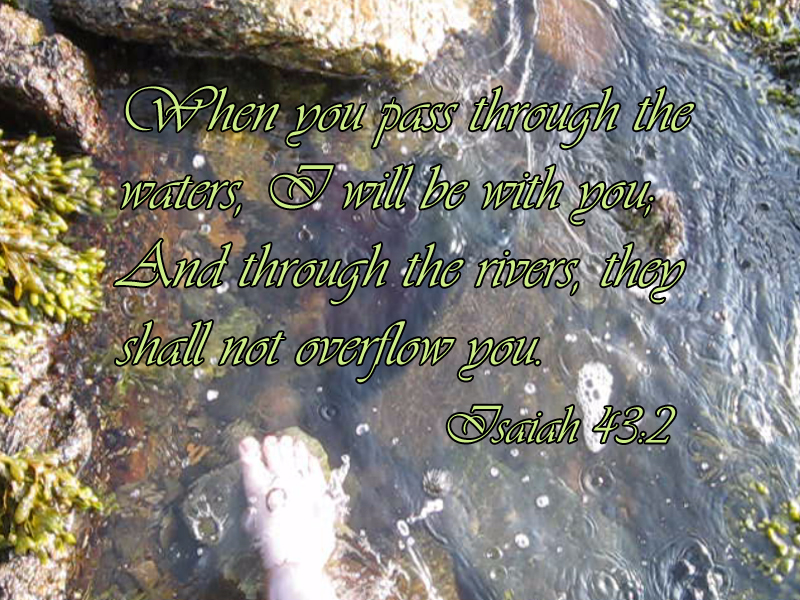
But now, thus says the Lord, who created you, O Jacob, and He who formed you, O Israel: “Fear not, for I have redeemed you; I have called you by your name; You are Mine. When you pass through the waters, I will be with you; and through the rivers, they shall not overflow you. When you walk through the fire, you shall not be burned, nor shall the flame scorch you. For I am the Lord your God, the Holy One of Israel, your Savior; I gave Egypt for your ransom, Ethiopia and Seba in your place. Since you were precious in My sight, You have been honored, and I have loved you; therefore I will give men for you, and people for your life. (Is. 43:1-4 NKJV)

This is one of my favorite passages from the Old Testament. It is so full of reassurance and love.

I was going to write a more complete concluding paragraph, but we have morning services today and I’m running out of time to get to choir practice. Happy Sabbath!

Righteousness by Faith

When I started writing blog posts based on my study of Romans, I had intended each post to stand on its own. But this time, to avoid recapping half of last week’s post, I’m going to refer back to “Purpose of the Law.” As background for what I am about to write, the most important concept in that post is that keeping the letter of the law is not enough to earn eternal life. Obedience must be accompanied by faith.

But before faith came, we were kept under guard by the law, kept for the faith which would afterward be revealed. Therefore the law was our tutor to bring us to Christ, that we might be justified by faith. (Gal. 3:23-24)

Abraham’s Righteousness

In both Romans and Galatians, the life of Abraham serves as a case study to illustrate justification by faith instead of by works.

What then shall we say that Abraham our father has found according to the flesh? For if Abraham was justified by works, he has something to boast about, but not before God. For what does the Scripture say? “Abraham believed God, and it was accounted to him for righteousness.” Now to him who works, the wages are not counted as grace but as debt. But to him who does not work but believes on Him who justifies the ungodly, his faith is accounted for righteousness (Romans 4:1-5)

It is worth mentioning that true faith cannot exist without works. In Romans and Galatians, the point is that we are made righteous as a result of Jesus Christ’s sacrifice and our faith in Him. We cannot earn salvation by works, but works are a necessary part of faith. In the book of James, it is clarified that good works are an outward result of true faith, and that “faith without works is dead” (James 2:26).

Spiritual Children of Abraham

The importance of this concept is made clear in the following verses. The promises God made to Abraham and to his descendants had to be “through the righteousness of faith,” because “if those who are of the law are heirs, faith is made void and the promise made of no effect” (Rom. 4:13-14). This expands the promises to include those who follow in Abraham’s righteous footsteps, not just his physical descendants. It also shows that being a physical descendant of Abraham is not enough to give you a place in God’s family, a fact Jesus Christ pointed out to the Pharisees (John 8:31-40). Each individual must demonstrate a righteous heart and be faithful to God if they expect to inherit eternal life.

Therefore know that only those who are of faith are sons of Abraham. And the Scripture, foreseeing that God would justify the Gentiles by faith, preached the gospel to Abraham beforehand, saying, “In you all the nations shall be blessed.” So then those who are of faith are blessed with believing Abraham. (Gal. 3:7-9)

An Attitude of Faith

The people who stood out as examples of godly conduct in the Old Testament are not commended because they kept the letter of the law perfectly, but because they were faithful. Just look at David. He is described as a man after God’s own heart, yet his sins included adultery and conspiracy to commit murder. The point is that he did not continue in those sins, he repented and was forgiven, and moved forward in righteousness.

David also describes the blessedness of the man to whom God imputes righteousness apart from works: “Blessed are those whose lawless deeds are forgiven, and whose sins are covered; blessed is the man to whom the Lord shall not impute sin.” (Rom. 4:6-8)

For us, as with David, righteousness “shall be imputed to us who believe in Him who raised up Jesus our Lord from the dead” (Rom. 4:24). Jesus Christ’s sacrifice makes it possible for us to “have peace with God” and gives us “access by faith into this grace in which we stand, and rejoice in hope of the glory of God” (Rom. 5:1, 2). We are given a chance at eternal life, not because of anything we did, but because Jesus Christ’s sacrifice gives us the opportunity to be made righteous and live a life of faith and obedience.

Purpose of the Law

Once again, I’m going to pull a topic from my Bible study on covenants. In the first chapter of Romans, Paul begins by commending his readers for their faith, which is “spoken of throughout the whole world” (Rom. 1:8). He goes on to talk about the importance of belief. Lest any think he is going to present a “one saved, always saved” doctrine, they are immediately refuted.

For I am not ashamed of the gospel of Christ, for it is the power of God to salvation for everyone who believes, for the Jew first and also for the Greek. For in it the righteousness of God is revealed from faith to faith; as it is written, “The just shall live by faith.” For the wrath of God is revealed from heaven against all ungodliness and unrighteousness of men, who suppress the truth in unrighteousness (Rom. 1:16-18)

He goes on to list a number of sins and concludes “those who practice such things are deserving of death” (Rom. 1:32). Obviously, the emphasis on faith does not exclude commandment keeping. With this foundation, we move into the second chapter.

Judged According To Our Deeds

God expects us to live by faith, keeping the law and worshiping Him in spirit and in truth (John 4:23). “Do not think that I came to destroy the Law or the Prophets,” Jesus said. “I did not come to destroy but to fulfill,” or fill to the fullest extent (Matt. 5:17). Under the New Covenant, we are still expected to keep the commandments and will be judged by a righteous God,

who will render to each one according to his deeds: eternal life to those who by patient continuance in doing good seek for glory, honor, and immortality; but to those who are self-seeking and do not obey the truth, but obey unrighteousness—indignation and wrath, tribulation and anguish, on every soul of man who does evil (Rom. 2:6-9)

How we conduct ourselves in obedience to God is the basis for how we will be judged. However, this does not simply refer to a rigid obedience to the letter of the law. Physical adherence to the law means nothing if you are not keeping the law from the heart (Rom. 2:25-29). To illustrate this point, Paul writes,

(for not the hearers of the law are just in the sight of God, but the doers of the law will be justified; for when Gentiles, who do not have the law, by nature do the things in the law, these, although not having the law, are a law to themselves, who show the work of the law written in their hearts, their conscience also bearing witness, and between themselves their thoughts accusing or else excusing them) in the day when God will judge the secrets of men by Jesus Christ, according to my gospel. (Rom 2:13-16).

In essence, this is repeating a statement made in 1 Samuel: “the LORD seeth not as man seeth; for man looketh on the outward appearance, but the LORD looketh on the heart (1 Sam. 16:7). Outward appearance means nothing if our hearts are not right with God.

Knowledge of Sin

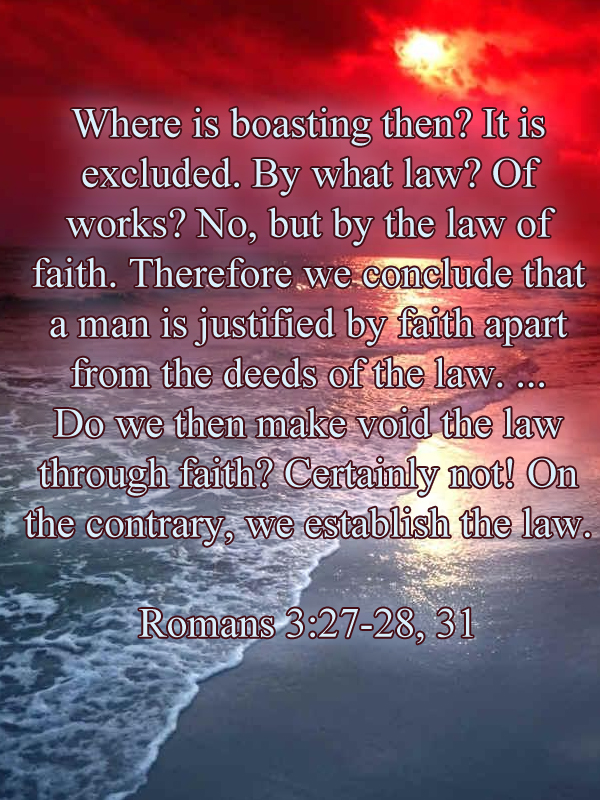
Romans 3:27-28, 31In chapter 3, we read that human beings “are all under sin” (Rom. 3:9). No one is inherently righteousness, not matter how closely they have adhered to the letter of the law. The law lets us know that we have sinned, but does not give justification from that sin.

Now we know that whatever the law says, it says to those who are under the law, that every mouth may be stopped, and all the world may become guilty before God. Therefore by the deeds of the law no flesh will be justified in His sight, for by the law is the knowledge of sin. (Rom. 3:19-20).

It is only through Christ’s sacrifice that we can be cleansed of our sins. Human being cannot earn eternal life by keeping the law because the law was missing a vital aspect. Rather than replacing the law, Jesus Christ’s sacrifice supplied that missing piece.

What purpose then does the law serve? It was added because of transgressions, till the Seed should come to whom the promise was made; and it was appointed through angels by the hand of a mediator. Now a mediator does not mediate for one only, but God is one. Is the law then against the promises of God? Certainly not! For if there had been a law given which could have given life, truly righteousness would have been by the law. But the Scripture has confined all under sin, that the promise by faith in Jesus Christ might be given to those who believe. But before faith came, we were kept under guard by the law, kept for the faith which would afterward be revealed. Therefore the law was our tutor to bring us to Christ, that we might be justified by faith. (Gal. 3:19-24)

Faith does not negate the importance of the law. It adds to the law, giving it new meaning and layers. Because we have been redeemed from sin by Jesus Christ’s sacrifice (1 Cor. 6:19-20), we have an obligation to obey His commandments. These commandments include the updated law, followed in spirit and in truth. Distilled to it’s most basic level, this means we must love God and love our neighbor as ourselves.

Owe no one anything except to love one another, for he who loves another has fulfilled the law. For the commandments, “You shall not commit adultery,” “You shall not murder,” “You shall not steal,” “You shall not bear false witness,” “You shall not covet,” and if there is any other commandment, are all summed up in this saying, namely, “You shall love your neighbor as yourself.” Love does no harm to a neighbor; therefore love is the fulfillment of the law. (Rom. 13:8-10)