The Gift of Recognizing Blessings

Our God is so generous with His blessings, and not only with those following Him. As Jesus points out, the Father “causes His sun to rise on the evil and the good, and sends rain on the righteous and the unrighteous” (Matt. 5:45, NET). It’s part of Him being perfect (Matt. 5:48). There are a lot of people who enjoy those sorts of universal blessings and don’t recognize where they come from. Even more heartbreaking, there are people who follow God, receive extra blessings, and still don’t recognize it.

As part of God’s church, we’re called out of the world and told to live like resident aliens in the countries where we reside. We’re now citizens of God’s heavenly kingdom. But the influences of the world and culture we grew up in still affect us, often in unconscious ways. One of those ways involves the idea that real things should be observable, testable, and explainable. We assume things have a natural, rational explanation behind them. Even as Christians, we’re often quick to see something good or even wonderful happen and say, “well that was lucky” or “what a coincidence” or “I’m sure there’s reasonable explanation.”

Recognizing God’s blessings in our lives requires a mindset shift. It also involves accepting and applying some of those blessings. For example, the blessings of internal peace and getting to see things from God’s perspective make it much easier for us to recognize all His blessings in our lives. It’s heartbreaking to see someone who is richly blessed, yet thinks that God doesn’t care about them because they either can’t see the good things happening in their lives or assumes the good is a result of their own hard work, luck, or some natural quirk of the universe.

Image of two people sitting across from each other with books on the table between them, overlaid with text from James 1:17, WEB version: "Every good gift and every perfect gift is from above, coming down from the Father of lights, with whom can be no variation, nor turning shadow."
Image by Claudine Chaussé from Lightstock

Seeing the Source of Good

Think about the good things in your life. Some of them might be obvious blessings from God. For me, that’s my husband and baby–a blessing that I prayed for for many years before I married and got pregnant. Some might be less obvious, like living in a home you payed for with your own money, having pets that you went out and adopted, or the garden growing outside because the weather’s been good for vegetables this year. For those things, it might be easier to think your actions resulted in the good things or that it was just something that happened.

 It shall be, when Yahweh your God brings you into the land which he swore to your fathers, to Abraham, to Isaac, and to Jacob, to give you, great and goodly cities which you didn’t build, and houses full of all good things which you didn’t fill, and cisterns dug out which you didn’t dig, vineyards and olive trees which you didn’t plant, and you shall eat and be full; then beware lest you forget Yahweh, who brought you out of the land of Egypt, out of the house of bondage. You shall fear Yahweh your God; and you shall serve him, and shall swear by his name. 

Deuteronomy 6:10-13, WEB

When ancient Israel was about to enter the promised land, Moses warned them about complacency and forgetfulness. When things are going well and God delivers on the promised blessings, human beings tend to forget where those blessings came from. We think we made them happen, or we deserve them, or that this is just the way life is supposed to be.

Do not be led astray, my dear brothers and sisters. All generous giving and every perfect gift is from above, coming down from the Father of lights, with whom there is no variation or the slightest hint of change.

James 1:16-17, NET

Both the act of generous giving and the gifts we receive have their source in the Father. And lest we think that good things in our lives aren’t gifts–that they were earned by us rather than given by God–Paul asks us along with the puffed-up church in Corinth, “What do you have that you did not receive? And if you received it, why do you boast as though you did not?” (1 Cor. 4:7, NET). We need to set-aside our pride, resist our forgetfulness, and realize/remember that God is the source of good things in our lives. They are blessings from Him.

Image of a smiling man playing piano overlaid with text from Psalm 34:8, WEB version: "Oh taste and see that Yahweh is good. Blessed is the man who takes refuge in him."
Image by Ben White from Lightstock

Gifted With Open Eyes

Several months ago, we studied how God cures spiritual blindness. Some are spiritually blind because of Satan’s influence (2 Cor. 4:4) and others because they’ve closed their own eyes to God’s truth (Matt. 13:13-15). In contrast, Jesus told His followers, “your eyes are blessed because they see, and your ears because they hear” (Matt. 13:16, NET).

 We know that we are from God, and the whole world lies in the power of the evil one. And we know that the Son of God has come and has given us insight to know him who is true, and we are in him who is true, in his Son Jesus Christ. This one is the true God and eternal life.

1 John 5:19-20, NET

One of the many amazing gifts Jesus gave to people is the “insight to know him who is true.” When God opens someone’s eyes to recognize Him as the one true God and Jesus as the only way to eternal life, that’s an incredible blessing. It’s not a realization that we can get to all on our own. Even the most foundational, beginning steps of faith are a gift from God.

God has revealed these to us by the Spirit. For the Spirit searches all things, even the deep things of God. For who among men knows the things of a man except the man’s spirit within him? So too, no one knows the things of God except the Spirit of God. Now we have not received the spirit of the world, but the Spirit who is from God, so that we may know the things that are freely given to us by God. … The one who is spiritual discerns all things, yet he himself is understood by no one. For who has known the mind of the Lord, so as to advise him? But we have the mind of Christ.

1 Corinthians 2:10-2, 15-16, NET (bold italics mark a quotation from Isa 40:13)

Revelation, discernment, clear spiritual eyesight–all of those are gifts from God, and they enable us to “know the things that are freely given to us by God.” He’s working on transforming our perspective so we can see things the way He does. Eventually, the way our minds work should be indistinguishable from Jesus’s mind.

Image of a woman sitting at a table with a Bible overlaid with text from Psalm 111:1-2, WEB version: "Praise Yah! I will give thanks to Yahweh with my whole heart, in the council of the upright, and in the congregation. Yahweh’s works are great, pondered by all those who delight in them."
Image by Prixel Creative from Lightstock

Praise and Thanksgiving

Earlier this year, I wrote about the vital concept of “praise” in the Bible. I didn’t bring it up in that post, but after doing that study I started to think that we should see praise as one of the essential spiritual disciplines (like prayer, study, and fasting). Praise–which includes glorifying, thanking, and blessing God as well as recognizing and confessing His deeds–is the proper response to God’s involvement in our lives.

 Praise Yahweh, my soul!
    All that is within me, praise his holy name!
Praise Yahweh, my soul,
    and don’t forget all his benefits,

Psalm 103:1-2, WEB

Cultivating a habit of praise can help us remember all the wonderful things God does for us and recognize His benefits in our lives. It might seem like thankfulness is just something we can do when we feel like it, but Paul instructed his readers to give thanks in everything because that’s God’s will (1 Thes. 5:18). We need to be thankful people.

There’s actually a danger in neglecting to give God thanks. In the opening part of his letter to Roman believers, Paul spoke of a group of people that, “although they knew God, they did not glorify him as God or give him thanks, but they became futile in their thoughts and their senseless hearts were darkened” (Rom. 1:21, NET). If we know about God, but don’t recognize Him for who He is and what He does, we run the risk of having our foolish, senseless hearts go dark.

It is a good thing to give thanks to Yahweh,
    to sing praises to your name, Most High,
to proclaim your loving kindness in the morning,
    and your faithfulness every night …
How great are your works, Yahweh!
    Your thoughts are very deep.
A senseless man doesn’t know,
    neither does a fool understand this:
though the wicked spring up as the grass,
    and all the evildoers flourish,
    they will be destroyed forever.
But you, Yahweh, are on high forever more

Psalm 92:1-2, 5-8, WEB
Image by Anggie from Lightstock

Senseless and foolish people don’t recognize who God is and what He’s doing. The opposite, then, would be that sensible and wise people can see the good that God does, and then respond properly with praise and thanksgiving. God is full of loving kindness and faithfulness. He wants to pour out blessings on people. Many of those blessings involve opening our eyes, hearts, and minds to be able to understand how deeply involved He is. As we receive those blessings, he enables us to see other blessings as well because our spiritual vision becomes clearer the closer our relationships with Him become.

If we ever feel like we’re not blessed or wonder if God’s actually involved in our lives, we can take heart remembering that the Bible will bless His people. If there’s anything good in our lives, we have Him to thank for that. I dare say most of us can come up with something good if we really think about it (and probably quite a few somethings). It’s not just about the stuff in our lives, though. Often, psalms of praise and thanksgiving spend as much (or more) time focused on who God is and on what He does on a cosmic scale as they do on what He’s doing for the individual psalmist (Psalm 30; 111; 136; 138 are a few examples of praise psalms). The psalmists do give thanks for individual blessings–which often arrive after times of trials–but they also talk as if God’s character and His relationship with His people (including them) is the more amazing blessing.

I think that shift in thinking is how we get to the point where we can constantly give thanks, praise God, and experience joy even in the midst of trials (Heb. 12:28; Eph. 1:11-12; Gal. 5:22-23; Jam. 1:2-4). When we recognize that God’s involvement in our lives and our relationship with Him are great and wonderful blessings, it puts other things in perspective. We can praise and have joy no matter what our external circumstances. We can also develop the spiritual eyesight to see the good things God is doing in our lives, even things that wouldn’t be apparent to people watching from the outside. God blesses us richly, and with His help we can learn to recognize just how blessed we are.


Featured image by Pearl from Lightstock

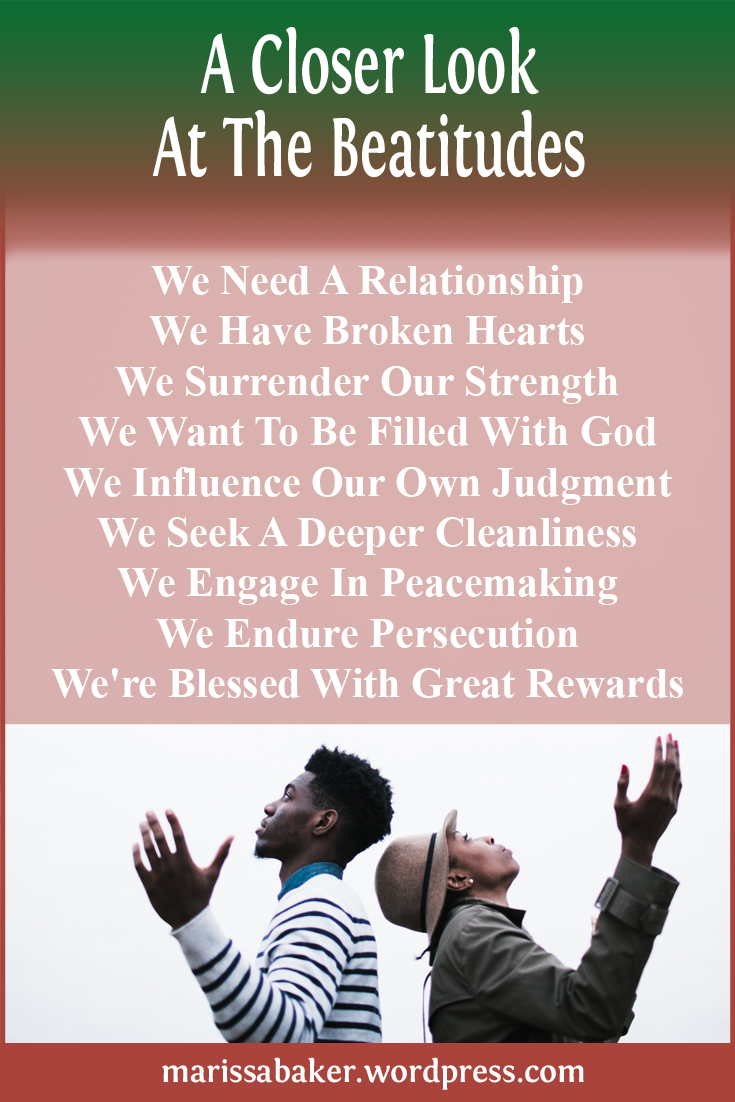
A Closer Look At The Beatitudes

When Jesus delivered the Sermon on the Mount, He began at what we now call the Beatitudes. He says, “Blessed are” the sort of people who probably don’t feel all that blessed — those who are poor, mourning, meek, hungry and thirsty for righteousness, merciful, pure in heart, peacemakers, persecuted, and reviled. We don’t like being poor, or in grief, or humble enough to put others first, or attacked by the people around us. It’s hard work being a peacemaker, or showing mercy, or staying pure of heart, or constantly yearning to get closer to God’s righteousness.

It’s interesting that two of the beatitudes mention righteousness: “Blessed are they which do hunger and thirst after righteousness” and “Blessed are they which are persecuted for righteousness’ sake” (Matt. 5:6, 10, KJV). This word refers to “the condition acceptable to God” and/or “the doctrine concerning the way which man may attain a state of approval by God” (Thayer’s G1343, dikaiosune). It relates to our state of being and the way we live. In fact, when you think about it, all the beatitudes relate to something we do and/or become as we follow God.

A Closer Look At The Beatitudes | marissabaker.wordpress.com
Photo credit: Temi Coker via Lightstock

We Need A Relationship

Blessed are the poor in spirit: for theirs is the kingdom of heaven. (Matt. 5:3, KJV)

There’s more than one word that could be translated from Greek as “poor.” This one means “reduced to beggary” and “lacking anything” (Thayer’s G4434, ptochos). When we’re like that in our spirits, we’re really in a place to recognize how much we need a relationship with the Father and Jesus. We become the sort of person the Lord is talking about when He says, “to this man will I look, even to he who is poor and of a contrite spirit, and who trembles at my word” (Is. 66:2, WEB).

We Have Broken Hearts

Blessed are they that mourn: for they shall be comforted. (Matt. 5:4, KJV)

We all experience grief. The death of a parent, child, or dear friend. The loss of a hope held close to our hearts. The decay of a relationship. Betrayal from a friend. And even in the midst of that mourning, we’re blessed because God promises comfort (John 14:16-18; 2 Cor. 1:3-7). He can respond to our tears as powerfully as He did for David in the situation recorded in Psalm 6. Read more

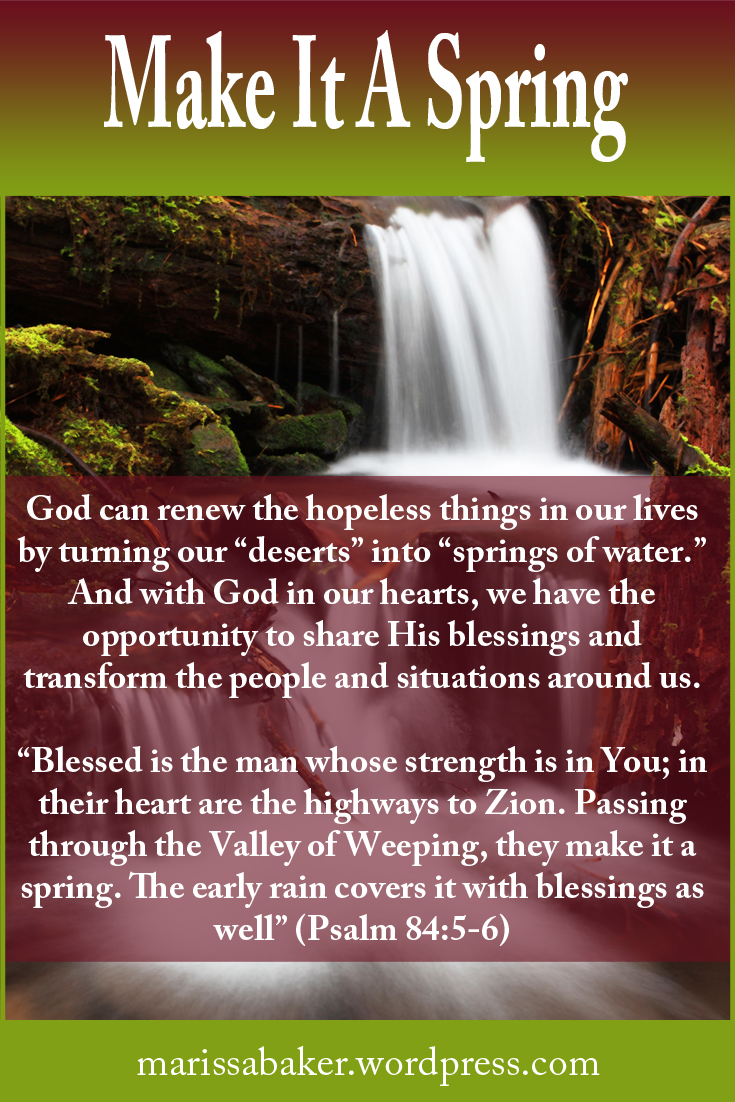
Make It A Spring

Sometimes we walk through a season of life that feels like a wilderness. Barren, lonely, forsaken. We might even feel like this is the end. That things are hopeless.

That’s where Elijah was when he fled Jezebel. He went out in the wilderness, sat by a tree, and asked God to let him die. Instead, God gave him food and water and sent him to Mount Horeb (1 Kings 19:1-8). There, Elijah made his complaint. “Then he said, ‘I have been very zealous for Yahweh the God of hosts, for the Israelites have forsaken your covenant. They have demolished your altars, and they have killed your prophets with the sword. I alone am left over, and they seek to take my life'” (1 Kings 19:10, LEB).

Yahweh responds by showing His power, reassuring Elijah that he was not the only believer left, and giving him a job to do (1 Kings 19:11-18). Elijah thought things were hopeless but God had other ideas. He had a plan for Elijah and an even larger plan Elijah didn’t know about.

click to read article, "Make It A Spring" | marissabaker.wordpress.com
Photo Credit: “Spring Runoff” by Ian Sane, CC BY via Flickr

Transforming Your Wilderness

For all of us, it’s easy to feel like we’re insignificant to God’s plan. But no one is too small for God to do marvelous things with. In fact, God often chooses the poor, weak, and little because those are the ones easiest for Him to work powerfully in (1 Cor. 1:26-31; 2 Cor. 12:9-10)

When the poor and needy seek water, and there is none, and their tongue faileth for thirst, I the Lord will hear them, I the God of Israel will not forsake them. (Is 41:17, KJV)

Read more

God’s Message Through the Aaronic Blessing

At a conference this past December, I attended an excellent seminar by a gentleman named Hal exploring the depth of the Hebrew words used in the Aaronic blessing (I want to credit him, but not sure if he’d want his full name used here, so we’ll just stick with first names). This blessing goes like this in the New King James Version: “The Lord bless you and keep you; the Lord make His face shine upon you, and be gracious to you; the Lord lift up His countenance upon you, and give you peace” (Num. 6:24-26).

God's Message Through the Aaronic Blessing | marissabaker.wordpress.com

These words are lovely in English, but I was awed by how much more incredible they are when you start digging deep into the Hebrew meanings. In this article, we’re going to take a deep-dive into the words originally used to record this blessing. These words illuminate an encouraging, hopeful message that God continues to share with us today.

Read more

Cycles of Judgement, Repentance, and Blessing (Lessons from Joel)

I recently heard that pastors tend to use the same set of scriptures over and over when speaking. It’s probably not even on purpose — you just naturally go to the verses you know well and are comfortable with when writing about a given topic. I wondered if I do that in this blog, and started trying to think of scriptures that I don’t regularly quote. The minor prophets came to mind. I spend time in Hosea, but not really any of the others. And so I though, why not start a study on these 12 books and see what the Lord might have to teach me.

Repent From the Heart …

Joel begins with prophecies of destruction. First, he warns Israel that locusts will sweep through and destroy the food crops. There wouldn’t even be enough harvest to supply the offerings in the temple (Joel 1:9).

Consecrate a fast, call a sacred assembly; gather the elders and all the inhabitants of the land into the house of the Lord your God, and cry out to the Lord. Alas for the day! For the day of the Lord is at hand; it shall come as destruction from the Almighty. (Joel 1:14-15)

Mercy triumphs over judgement (James 2:13), but that doesn’t mean God won’t punish sin. Sometimes, that’s the only way to get our attention and save us by turning us back to Him.

In chapter 2, the prophecy shifts to what is still for us future events (at least, that’s what it looks like to me. Zodhiates’ study Bible says there is some disagreement among scholars). It sounds a lot more like Revelation, though, than a famine caused by locusts. Regardless of the timing, the conclusion of both prophesies is the same — an immediate call to repentance.

“Now, therefore,” says the Lord, “Turn to Me with all your heart, with fasting, with weeping, and with mourning.” So rend your heart, and not your garments; return to the Lord your God, for He is gracious and merciful, slow to anger, and of great kindness; and He relents from doing harm. Who knows if He will turn and relent, and leave a blessing behind Him — a grain offering and a drink offering for the Lord your God? (Joel 2:12-14)

We should stay close to God through both good times and bad, but if we have drifted away He is still ready to hear us as individuals and as a nation. Genuine repentance from the heart will always get God’s attention.

… And There Will Be Blessings

Joel tells us that when all the people — including the elders, youth and ministry (Joel 2:16-17) —  come to God with tears and a request for mercy, He will hear.

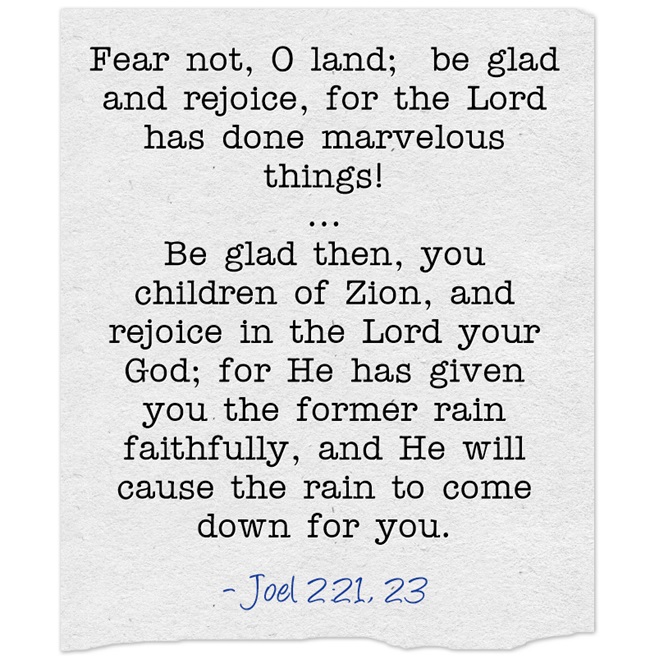
Then the Lord will be zealous for His land, and pity His people. The Lord will answer and say to His people, “Behold, I will send you grain and new wine and oil, and you will be satisfied by them; I will no longer make you a reproach among the nations.” … Fear not, O land; be glad and rejoice, for the Lord has done marvelous things! (Joel 2:18-19, 21)

Lessons From Joel | marissabaker.wordpress.comGod promises to send so many blessings that they will make up for everything that was lost in the plagues described earlier (Joel 2:25). This makes me think of  a passage in Romans, where Paul writes, “I consider that the sufferings of this present time are not worthy to be compared with the glory which shall be revealed in us” (Rom. 8:18). There’s certainly no reason Christians can’t be happy and joyful in their lives today, but often our walks are marked by trials and touched by sorrow. Either way, we have a magnificent future to look forward to, and focusing on that can help us endure as we follow in Christ’s footsteps (Heb. 12:1-3).

Then you shall know that I am in the midst of Israel: I am the Lord your God and there is no other. My people shall never be put to shame. And it shall come to pass afterward that I will pour out My Spirit on all flesh; your sons and your daughters shall prophesy, your old men shall dream dreams, your young men shall see visions. And also on My menservants and on My maidservants I will pour out My Spirit in those days. (Joel 2:27-29)

Fulfillment of this prophecy began on the Pentecost where the disciples were given the Holy Spirit, which Peter points out as he quotes Joel 2:28-32 when he explains what’s going on (Acts 2:14-21). The remainder of the prophecy, and Joel chapter 3, relate to future judgement.

In Joel, we’ve already seen cycles of judgement, repentance, and blessing. Now, the subject turns back to the tribulation and wars before the coming of Jesus Christ. Though things look extremely bleak, once again it will ultimately result in blessing for the people who stay faithful to God (Joel 3:16-21)

The Lord also will roar from Zion, and utter His voice from Jerusalem; the heavens and earth will shake; but the Lord will be a shelter for His people, and the strength of the children of Israel. (Joel 3:16)

There is hope and help for us now, and in the future if we whole-heartedly draw near to God. That’s a main message of the book of Joel — bad things are going to happen because of sin, and therefore we need to draw near to God and repent so good things can happen to us in the end.

Choose God (Lessons from Hosea, part two)

Last week, we began a study of Hosea, and covered the first three chapters. We looked at how Hosea’s marriage to a prostitute pictured God’s covenant with unfaithful Israel in the Old Testament, and how that serves as a warning to us. We need to learn from Israel’s example and not follow their pattern of repeatedly rejecting God, but rather hold fast to Him as He fulfills His promises to reestablish a marriage covenant with His people.

As we continue in Hosea, we see God addressing the reasons for Israel’s unfaithfulness. Everything that separated Israel from God was Israel’s fault.  God never let down His side of the bargain — Israel got into trouble because they walked away from Him. This holds true for the New Testament as well.

If we endure, we shall also reign with Him. If we deny Him, He also will deny us. If we are faithless, He remains faithful; He cannot deny Himself. (2 Tim 2:12-13)

God is always faithful to His promises, including His promise that sin will be punished. Like with Israel, it is still up to us to choose between life and death, blessings and cursing (Deut. 30:9).

Lack of Knowledge

Hear the word of the Lord, you children of Israel, for the Lord brings a charge against the inhabitants of the land: “There is no truth or mercy or knowledge of God in the land.” (Hos 4:1)

God gives three reasons for His “controversy” with Israel. They lacked truth, did not show mercy, and had no knowledge of Him. This resulted in “swearing and lying, killing and stealing and committing adultery” (Hos. 4:2). The farther they strayed from God, the more corrupt and destructive they became.

My people are destroyed for lack of knowledge. Because you have rejected knowledge, I also will reject you from being priest for Me; because you have forgotten the law of your God, I also will forget your children. (Hos 4:6)

This verse specifically refers to knowledge about God and His ways. The New Testament tells us that “the wisdom of this age” — knowledge that the world esteems — is coming to nothing (1 Cor. 2:6), but that “all the treasures of wisdom and knowledge” are hidden for us to find in the Father and Christ (Co. 2:2-3).

Chapters 4 and 5 cover punishments for Israel, and deal with prophecies of an Assyrian invasion and Judah’s alliances with Egypt and Syria. In chapter 6, the people say, “Come, and let us return to the Lord,” but they are not sincere (Hos. 6:1, 4).  Their sham repentance is not what God was looking for.

For I desire mercy and not sacrifice, and the knowledge of God more than burnt offerings. But like men they transgressed the covenant; there they dealt treacherously with Me. (Hos. 6:6-7)

God is all about relationship. He wants to know the people we’ll become when we learn to know Him. All the religious services and laws given to Israel weren’t the “point” of the Old Covenant. They were supposed to be an outward sign of an inward condition — a heart full of truth, mercy, and the knowledge of God.

Because of Unbelief

Israel’s lack of relationship with God was a result of choices they make to walk away from Him.

When I would have healed Israel, then the iniquity of Ephraim was uncovered, and the wickedness of Samaria. For they have committed fraud; a thief comes in; a band of robbers takes spoil outside. They do not consider in their hearts that I remember all their wickedness; now their own deeds have surrounded them; they are before My face. (Hos. 7:1-2)

Wickedness, lies, adulteries (Hos. 7:3-4) — their sins kept piling up until God could say of the people that “none among them calls upon Me” (Hos 7:7). The entire nation rejected the One who they had entered into a covenant with.

Woe to them, for they have fled from Me! Destruction to them, because they have transgressed against Me! Though I redeemed them, yet they have spoken lies against Me. They did not cry out to Me with their heart when they wailed upon their beds.
They assemble together for grain and new wine, they rebel against Me; though I disciplined and strengthened their arms, yet they devise evil against Me; they return, but not to the Most High; they are like a treacherous bow. Their princes shall fall by the sword for the cursings of their tongue.  (Hos. 7:13-16)

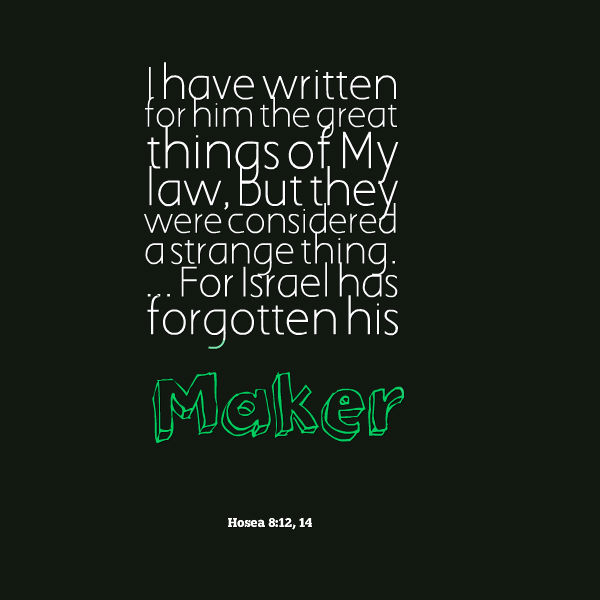
quotescover-JPG-96Israel did this continually in the Old Testament. Psalm 78 records that even though “their heart was not steadfast with Him, nor were they faithful in His covenant” that God was “full of compassion” and held back His anger many times (Ps. 78:37-38). He was grieved by their sins, because they would not let Him be their God. Though He acted as their Redeemer, Deliverer, and Rock, “again and again they tempted God, and limited the Holy One of Israel” (Ps. 78:35, 41-42). By not believing in Him, they rejected His good works in their lives.

This rejection of God continued into the New Testament as well. Matthew 13:58 records that Jesus “did not do many mighty works” in His hometown “because of their unbelief.” Mark’s account of this incident phrases it, “He could do no mighty work there, except that He laid His hands on a few sick people and healed them” (Mark 6:4-6). Where there was belief, simply touching the edge of Christ’s garments brought healing (Mark 5:27-29, 34). Where there was no faith, He was actually limited in how many miracles He could perform.

Make A Choice

Israel was given a choice whether or not to follow God and welcome His involvement in their lives. Many of them made the wrong choice, as Paul describes in Romans 11 when comparing God’s people to an olive tree where some of the natural branches were removed. In this analogy, Gentile New Testament Christians are wild olive branches grafted into the Rootstock. Once there, we also have a choice to make.

You will say then, “Branches were broken off that I might be grafted in.” Well said. Because of unbelief they were broken off, and you stand by faith. Do not be haughty, but fear. For if God did not spare the natural branches, He may not spare you either. Therefore consider the goodness and severity of God: on those who fell, severity; but toward you, goodness, if you continue in His goodness. Otherwise you also will be cut off.  And they also, if they do not continue in unbelief, will be grafted in, for God is able to graft them in again. (Rom. 11:19-23)

Like so many serious warnings in the Bible, this contains hope as well as caution. The Bible provides us with records of Israel rejecting God, being punished, and returning to Him again and again. God leaves as many doors open as possible for people to come back to Him, and He’s eager to “graft them in again” if they repent. These doors are open to us as well. But God still wants us to learn from Israel’s mistakes and choose not to leave Him at all, because even though He is a God of enormous mercy there is a point where we can go too far away to get back to Him.

For if we sin willfully after we have received the knowledge of the truth, there no longer remains a sacrifice for sins, but a certain fearful expectation of judgment, and fiery indignation which will devour the adversaries. Anyone who has rejected Moses’ law dies without mercy on the testimony of two or three witnesses. Of how much worse punishment, do you suppose, will he be thought worthy who has trampled the Son of God underfoot, counted the blood of the covenant by which he was sanctified a common thing, and insulted the Spirit of grace? (Heb. 10:26-29)

Like He did in Deuteronomy 30 with Israel, today God sets before His people a choice between life or death, blessings or cursing, and good or evil. He wants us — pleads with us — to choose life, blessings, and good, but the choice is still ours to make.