I don’t talk much about my fiction writing on this blog. In fact, I don’t even write fiction under my own name — I use the pen name Maris McKay to keep my non-fiction and fiction separate. But this blog is partly about me sharing major things going on in my life with all of you, and so I’ve decided to let you all know about something exciting that happened in the fiction-writing part of my life.
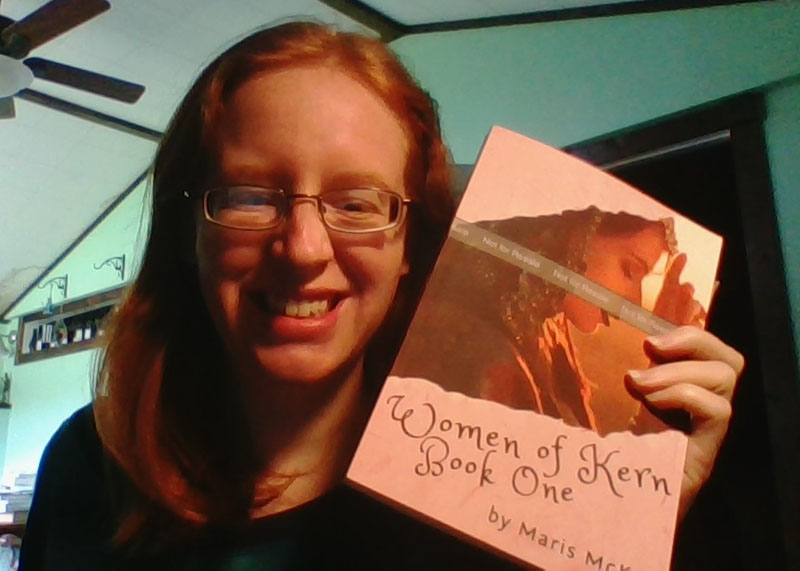
I published my first book!!!
Technically this isn’t really my first book since The INFJ Handbook and God’s Love Story have been available for quite some time now, but it’s my first fiction book and it’s the first of my books available in paperback as well as ebook. Getting the proof copy was ridiculously exciting.
What It’s About
Most of my fiction is fantasy, and this new short story collection is no exception. All the stories are set in the fantasy world of Kern, which you can learn more about on my other website (click here). Here’s the description printed on the back cover:
A negotiator who uses herself as a bargaining chip.
An adventurous spirit trapped by her culture and family.
A resistance fighter leading her captors into a trap.
A reclusive horse trainer swept into a quest for treasure.
An elderly, overlooked servant smuggling slaves out of her country.
A woman with a gift that seems like far more trouble than it’s worth.
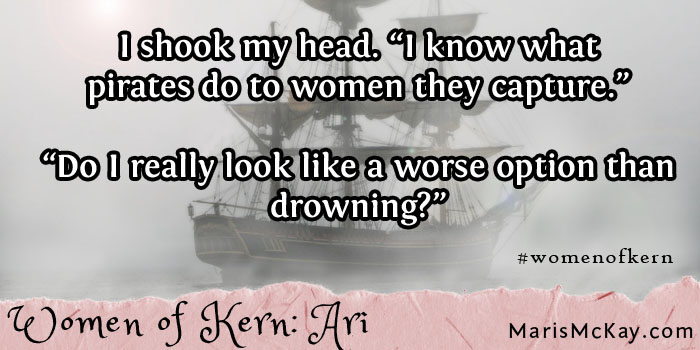
A princess whose arranged marriage puts her in the hands of pirates.
A shepherdess fighting to save her sister.
A belly-dancing assassin who fakes her targets’ deaths.
These are the women of Kern — the sort of women who in our own world are all too often ignored, overlooked, forgotten, and silenced by history. Enter their world of magic, adventure, and romance through nine short stories and novellas driven by women with the strength and courage to shape their own destinies.
FAQs
I’m anticipating a few questions about this book, so I want to answer them here (feel free to ask others in the comments):
Q: Is this Christian fiction?
A: No. It is fiction written by a Christian and certain stories have Christian themes, but it is not “Christian fiction.”
Q: Is this book clean?
A: Mostly? I’d describe it as PG-13 for violence and sex. My target audience is adults and older teens, not children.
Q: Why the pen name?
A: Several reasons:
The website “marissabaker.com” was taken.
I didn’t want people searching for this blog finding my fiction page instead, or those looking for my fiction to find articles I’d written about gardening (less of a problem now than it was a few years ago when I was writing for eHow).
Since I write such a wide variety of things (non-fiction about personality types, Christian non-fiction, and fantasy/sci-fi) I thought it would be easier to write non-fiction and fiction under separate names.
Giveaway
Update: the giveaway is now closed. If you would still like to get a copy of Women of Kern either as an ebook or in paperback, click here to visit my Amazon page.
I realized after my last Classics Club post that I’m bad at writing book reviews. I’d intended to just write a short “this is what the books are like, this is what I thought” post for Elizabeth Gaskell’s novels but it turned into an essay on what makes a strong female character and the state of modern feminism. I think I’ll give up on book reviews. Apparently I can only write thoughtful, rambling essays.
That’s not a bad thing though, right? These are classics, after all. People have been writing reviews of them for decades or centuries. If you want to find out about the plot you can go on Goodreads. I’d much rather talk about the ideas prompted by these great books. And I think you might rather read about that, too.
NOTE: this post contains spoilers but not enough, I think, to ruin the book for you
Disclaimer: some of the links in this post are affiliate links. This means that, at no additional cost to you, I will receive a commission if you click on the link and make a purchase on that website. Affiliate links are marked with *
A Perfect Fantasy Book
I feel like The Last Unicorn by Peter S. Beagle* should have been a re-read for me, but this was the first time I’d read it. You’d think as much as I love unicorns and fantasy novels I’d have picked this one up earlier. Especially considering how much everyone loves it. Even the guy who wrote the best fantasy book I’ve ever read says, “The Last Unicorn is the best book I have ever read. You need to read it. If you’ve already read it, you need to read it again” (Patrick Rothfuss, author of The Name of the Wind*).
On the surface, The Last Unicorn seems like a pretty simple book. A unicorn overhears two men say there aren’t any unicorns left in the world. Worried that she might be the last one, she goes out searching for other unicorns and meets with the sort of adventures you’d expect in a fantasy novel. There’s a wizard, a merry band of outlaws, a wise woman, a curse, a wicked king, and heroic prince, a talking cat, and a beautiful princess. But there’s so much more than that, too.
How People See You
There’s a lot going on in this relatively short book, so I’m just going to focus on one theme that I found particularly interesting. When the unicorn first sets out on her search, I expected that problems would arise when people spotted a unicorn walking down the road. But all they see is a white mare. The unicorn is puzzled.
“I suppose I could understand if men had simply forgotten unicorns, or if they had changed so that they hated unicorns and tried to kill them when they saw them. But not to see them at all, to look at them and see something else — what do they look like to one another, then? What do trees look like to them, or houses, or real horses, or their own children?”(p. 11).
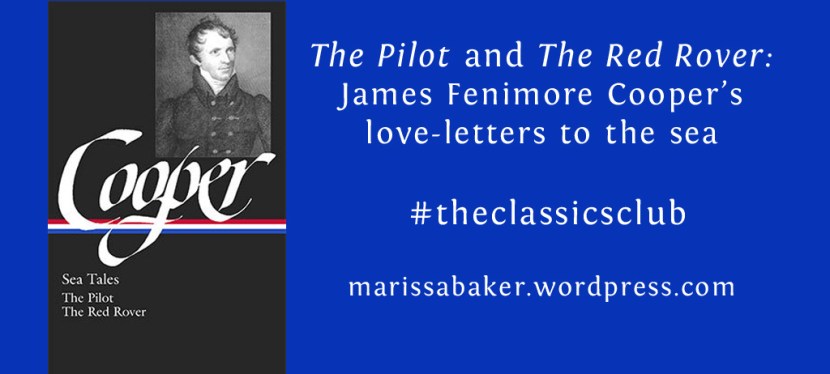
I’m going to knock two books off my Classics’s Club List in this post. They’re both written by James Fenimore Cooper (best known for The Last of the Mohicans) and both take place on and near the sea, so grouping them together makes sense. In fact, the library book I read has both in a single volume. The Red Rover (1827) is a re-read for me, but The Pilot (1824) was new.
I really wanted to like these books. They’re the sort of stories that I usually love. But I just wasn’t really liking them and found myself skimming large chunks. It wasn’t until halfway through The Red Rover (which I read second) that I finally figured out why. My favorite books are usually character-driven, but Cooper isn’t really writing to tell his characters’ stories. He’s writing love-letters to the sea and the men who sail her waves.
Scarcely A Favorite With Females
In a preface to the 1849 edition of The Pilot, it says that this book “could scarcely be a favorite with females. The story has little interest for them, nor was it much heeded by the author of the book in the progress of his labors. His aim was to illustrate vessels and the ocean rather than to draw any pictures of sentiment and love.”
At first, I felt compelled to prove him wrong. I like books about vessels and the ocean. And the story’s plot centers around two young American naval officers (Griffin and Barnstable) who risk their real mission in trying to rescue the women they love. There’s also a mysterious Pilot, who has an equally mysterious connection with another woman at the house. It’s a perfect recipe for a romantic adventure.
But Cooper doesn’t take full advantage of the compelling plot he’s crafted. Oh, he keeps with that story line but the characterization starts falling apart. Cooper will spend several chapters describing in loving, minute detail how a ship’s crew navigates away from a particularly dangerous piece of coastline during a storm. But if you’re expecting such care taken with the characters you’re in for a disappointment. Read more →
We’ve probably all heard that Christianity is about your individual relationship with Jesus. I’ve said that myself. But while God is very much concerned with the state of every individual heart and wants a relationship with you, Christianity is not an individualistic religion. We get that idea from Western culture, not from scripture.
The Bible is written for all peoples and all cultures. But it was also written by people living in a Middle Eastern society, and those of us in the Western world can miss some things Biblical writers took for granted. It rarely occurs to us that Americanized Christianity might not be the same thing as Biblical Christianity, but our culture does color how we read the Bible and in some cases it leads to inaccurate assumptions.
When I was reading Misreading Scripture With Western Eyes by E. Randolph Richards and Brandon J. O’Brien, one of the misconceptions that really stuck with me had to do with the verses about spiritual temples. We tend to read the verses that say “you are a temple of God” and think the “you” is singular” and treat “temple” as plural, assuming that we are each one of God’s temples. But we’re wrong.
There are three passages where Paul talks with the Corinthians about them being God’s temple. They’re 1 Cor. 3:16, 6:19; and 2 Cor. 6:16. Richards and O’Brian only talk about one of these, but I checked the others in the Greek and their point holds true for all three. They write,
Biblical Greek could differentiate between you singular and you plural, but we miss this in our English translations. … We typically understand the singulars and plurals in this verse backwards. In the original Greek, the you is plural and temple is singular. Paul is saying, “All of you together are a singular temple for the Holy spirit. God doesn’t have millions of little temples scattered around. Together we make the dwelling for the spirit (p. 108)
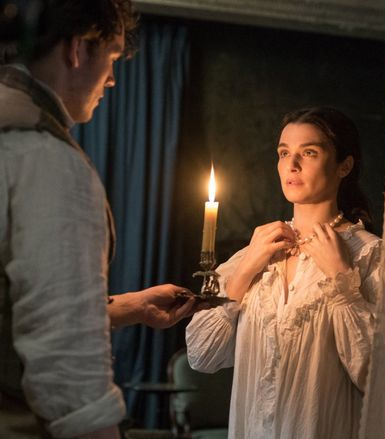
I should never have stayed here. Nay, I should never have left Italy.
If my cousin Philip had not been so like Ambros perhaps I could have left. To see his face — that beloved, tormenting face — staring into my eyes once more was more than I could leave. More than I could resist when he asked me to stay. Or I should say ordered me. They were orders, though I turned a blind eye to it then because I wanted him. Or perhaps not him, but Ambros back in my life. I know not.
My Cousin Rachel (2017)
I’m in such fear. It was a foolish thing on both our parts, the midnight of his birthday. He knows too little of the world to realize what I gave him was nothing more than a thank you. A birthday gift that would mean more than that stupid little pearl cravat pin. And yes, I wanted it too. A younger, more devoted Ambros to worship me once again if only for a moment.
And how could I have known that he meant marriage by his comment about lacking warmth and comfort? Or that he thought I’d agreed to be his when he took me into those primroses? Or that he would get so drunk he’d announce our engagement to his godfather and poor Louise at dinner?
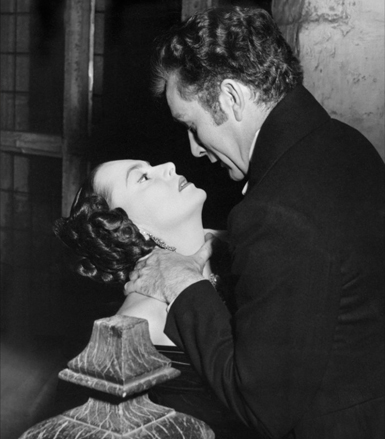
I still feel the pressure of his hands at my throat. Those big, powerful hands of a man who works on his farm every day and stands a head taller than me. Stronger than the ones Ambros once put around my neck. My cousin Philip could have snapped my neck, though he wouldn’t have had to. The slightest squeeze more and I’d not have been able to draw the thinnest breath.
My Cousin Rachel (1952)
Should I feel guilty for bringing Mary Pascoe into this house? Surely his fury won’t touch her, too. The worst he’d do is throw her out of the house. While me … I know not what he’d do were we alone now. Would he wrap his hands around my throat again and expect me to make myself his? Would he force me and afterward tell me I liked it and must marry him?
His fantasy is as complete as the paranoia that claimed Ambrose. I half-believe in his mind we’re already married. That he thinks I’m so sure to agree it’s as if I’ve done so already. That his ridiculous present of his entire fortune will surely convince me to stay.
I must get away. I have the means to do so now, though God knows it’s not why I came here. I simply wanted to see the home Ambros talked about. The symbol of what could have been before he turned on me. The idea of our marriage rather than the reality of it. The allowance my cousin Philip gave me was more than enough. More than I expected or even hoped. To have him honor the will Ambros never signed …
Did he think he’d bought me?
Will he let me leave?
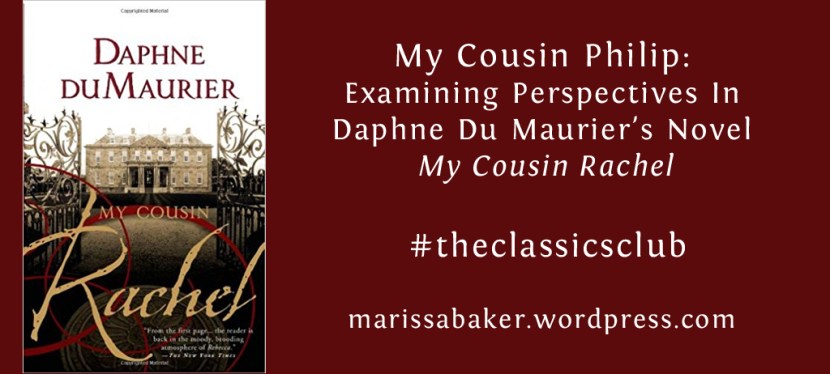
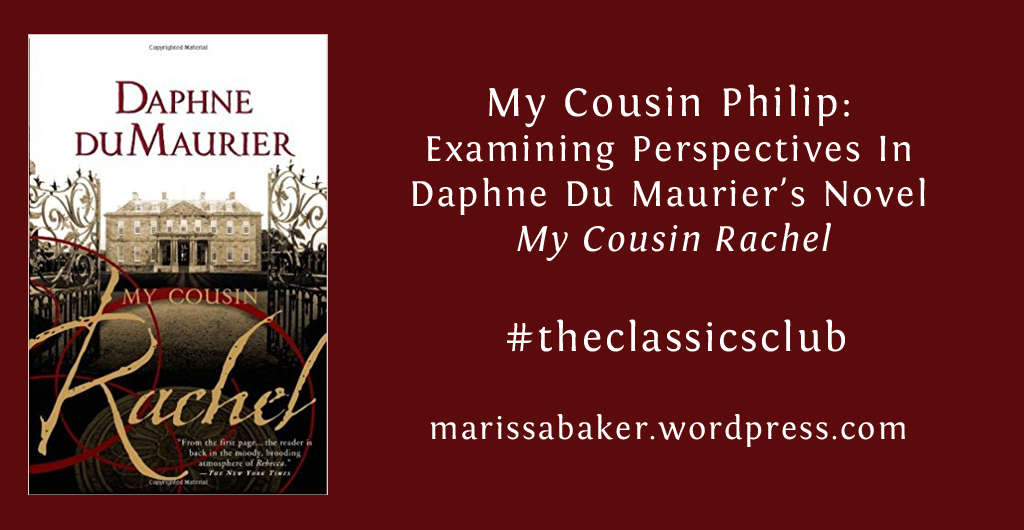
This is quite a bit different than my usual review for books I’m reading on my Classics Club Book list. But I think Daphne Du Maurier’s My Cousin Rachel (1951) is the sort of novel that invites you to look at it from different perspectives. The fact that you’re trapped inside Philip Ashley’s mind for the entire novel leaves you guessing at what the other characters are really thinking. He’s an unreliable narrator and he’s hopelessly naive, especially when it come to women, so the motives he assigns to Rachel are likely untrue. But if he’s wrong about her, then what is right? Everything we know of her is filtered through Philip. We don’t know her true motive or any of her thoughts. We can only guess, as I’m doing in my little retelling from Rachel’s point of view (which overlaps Chapter 23 of the original novel).
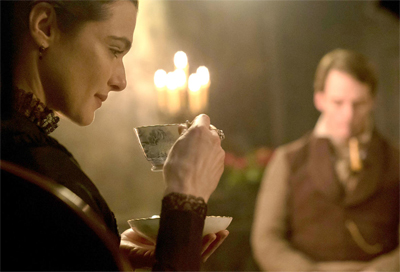
My Cousin Rachel (2017)
I watched the 2017 film adaptation of My Cousin Rachel before reading the book. I suspected I would still enjoy the book after seeing the movie, but knew if I read the book first there was a good chance I’d spend the film grumpy about how they’d adapted it. It turned out to be a very faithful adaptation, though.
*Spoiler Warning* The only major changes were made at the end. The film provides less evidence of Rachel’s alleged guilt, pointing viewers towards the idea that she was not poisoning Philip. And it also has Philip sending her to ride along a dangerous path rather than choosing not to warn her about a dangerous bridge in the garden. The film pushes you toward believing he intended her to die where the book leaves it a little more ambiguous. But then again, Philip’s the one telling the story. Of course he’d make himself look as good as possible.
Philip wants us second-guessing his cousin Rachel. But I suspect Du Maurier wants us to look at Philip just as closely. Because even though we’re getting his perspective on things and he’s certainly not putting any blame on himself, there are things about being in his mind that make me as scared of him as I think Rachel is.
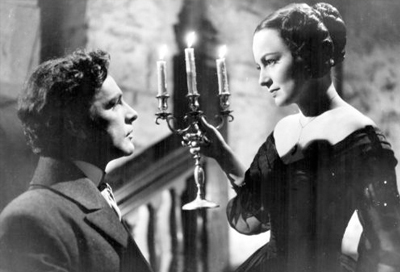
My Cousin Rachel (1952)
Repeatedly, Philip says he wants to isolate Rachel from everyone but him. And that’s before he starts becoming overtly controlling. And when he puts his hands around her throat, it’s not in the heat of anger. He presents it as a calculated decision to add fear to the list of reasons she should marry him. Later, he barely contains his fury and indignation when (after he’s given her all his property and she still hasn’t married him) she states that she can and will invite whoever she likes to stay with them because the house belongs to her and she doesn’t feel safe alone with him.
So instead of just asking, “Did Rachel poison Ambros and/or Philip?” I think we need to ask whether such an act could be considered self-defense. Abuse does not justify murder, but even if Rachel killed someone she may not be the evil and/or misguided character that Philip (who describes himself as feeling a strange compassion for her once he makes up his mind about her guilt) makes her out to be. It might have been more of an act of desperation and fear than calculating malice.
But that’s assuming she’s guilty at all. And there’s no clear evidence that she is. Laburnum (the plant Philip settles on as the murder weapon) isn’t even all that poisonous. The most common symptoms are nausea and vomiting, and that’s after eating several seeds. “Higher doses can produce intense sleepiness, convulsive possibly tetanic movements, coma, slight frothing at the mouth and unequally dilated pupils. … [However] the MAFF publication ‘Poisonous Plants in Britain and their Effects on Animals and Man’, says that all stories about laburnum causing serious poisoning and death are untraceable” (The Poison Garden).
Perhaps Du Maurier believed her chosen poison really was deadly based on the rumors that have made it one of the most feared garden plants. But perhaps she did her research and knew that Philip was jumping to unjustifiable conclusions. Maybe she would have known, as Rachel surly did with her expertise in herb lore and gardening, that most gardens are home to far more reliably deadly plants (like foxglove and oleander). Perhaps Du Maurier meant for her readers to realize that a brain tumor (for Ambros) and a relapse of meningitis (for Philip) are the most logical explanations for symptoms both men attribute to “Rachel, my torment.”
There’s an argument to be made that Philip isn’t really concerned about whether or not Rachel poisoned Ambros at all. He decides her guilt based on whether or not she “conforms to his desires and whims” (from “My Cousin Rachel (2017) and Male Entitlement“). After all, he already possesses everything else that belonged to Ambros. Why not Rachel as well?
The question of whether or not Rachel poisoned Ambros consumes Philip only until their first meeting. After that he’s quite certain she’s innocent until she makes it clear she won’t marry him. All his worry about whether or not she’s guilty of murder covers the fact that his inability to deal with rejection brings out a desire to posses and control her. He and Ambros call Rachel “my torment” because she brings out the ugliest side of their natures and they blame her for their darkness rather than looking to the true culprits. Themselves.
As I’ve mentioned once or twice before, I have something of an obsession with tall ships. This is probably a result of my love for stories set during the Age of Sail. One such story is Captain Blood by Rafael Sabatini, first published in 1922.
This book wasn’t on my original Classics Club list. I’d already read it and hadn’t intended a reread, especially after being disappointed by Sabatini’s Bardelys the Magnificent. But I ended up with a digital copy on my phone a year or so ago and started reading it while in a waiting room. So of course I had to finish it — one simply doesn’t abandon an adventure novel in the middle of the story.
I’m (once again) in the midst of a pirate obsession, for which we can thank the recent release of Daughter of the Siren Queen (sequel to my 2nd favorite novel of 2017, Daughter of the Pirate King). So I started reading a book on the history of pirates in reality and fiction, which prompted me to watch the 1935 version of Captain Blood. And that brings me to my decision to write a post for the classic novel.
But first, a brief digression about the film, which is really quite impressive. $1 million went into its production (to put this in perspective, online estimates tell me that $1 in 1935 has the same buying power as $17-18 today). It launched Errol Flynn’s and Olivia de Havilland’s careers and made an overall profit of $1.5 million. And it was scandalously realistic for a 1930s audience. In fact, a screenwriter named Robert Lord wrote to the producer, Hal Wallis, asking “Why do you have so much flogging, torturing, and physical cruelty in Captain Blood? … Women and children will be warned to stay away from the picture — and rightly so” (quoted in Under The Black Flag by David Cordingly, p.174).Read more →



 * should have been a re-read for me, but this was the first time I’d read it. You’d think as much as I love unicorns and fantasy novels I’d have picked this one up earlier. Especially considering how much everyone loves it. Even the guy who wrote the best fantasy book I’ve ever read says, “The Last Unicorn is the best book I have ever read. You need to read it. If you’ve already read it, you need to read it again” (Patrick Rothfuss, author of
  *).
*).


 , and
, and  . Please note that these are affiliate links. This means that, at no additional cost to you, I will receive a commission if you click on the link and make a purchase.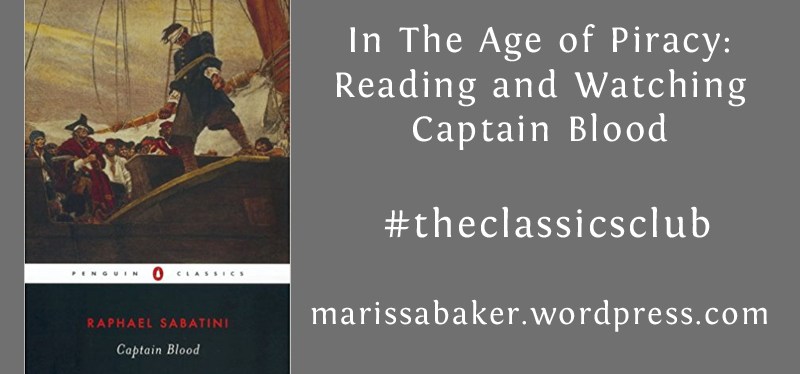
 Like An Anchor