As you may know, a group of ladies at my church group started a scripture writing group a few years ago. One of us studies a topic and shares a list of scriptures with the other ladies, then we all write those scriptures over the course of a month, and finally we meet again to discuss the topic. It’s been such a good way to connect with each other and dig deeper into God’s word.
Whenever I make the list for the month, I share it here on my blog as one of the free resources available to all my readers. For February, I have the topic “Inspiring Music.” Here it is if you’d like to follow along with us. The version I’m sharing here has 30 days instead of 28, so you can use it any other month as well.
Probably a gold circlet that rulers wear on top of their heads, possibly very elaborate and adored with gemstones. Or maybe you think of the crown, or top, of your head. You might think of it as a verb, too, in the sense of crowning someone when they ascend to a throne.
I’m guessing a victory laurel wasn’t the first thing you thought of. We don’t give winners in the Olympic games laurel crowns any more; we give them gold, silver, and bronze medals. Back in New Testament Bible times, though, when someone read the Greek word typically translated as “crown” they were just as likely to think of victory as authority.
That changes things a little, doesn’t it? When Paul talks about us earning a crown, he’s likely talking about victory rather than ruling power. When Jesus warns in Revelation, “Let no one take your crown,” He’s not talking about them stealing the crown jewels but robbing us of victory. When the soldiers put a crown of thorns on Jesus, it’s a mockery of the authority and victory that He claimed, which ironically turned into a symbol for both.
What actually is a crown?
The word translated “crown” throughout the New Testament “refers to a wreath … worn as a symbol of honor, victory, or as a badge of high office” (NET footnote on Rev. 3:11). This word stephanos (στέφανος) is both “a mark of royal or (in general) exalted rank” and “the wreath or garland which was given as a prize to victors in public games” (Thayer’s dictionary, G4735). While the royal imagery is included as part of the definition, in Classical Greek it was “not used of the kingly crown but of the crown of victory in games, of civic worth, military valor, nuptial joy, [and] festival gladness” (Zodhiates’s dictionary, G4735).
There were a few other words that Greek writers could have used for a similar idea. Stemma (στέμμα) comes from the same root as stephanos and means pretty much the same thing, but it only shows up once in the Bible (Acts 14:13, “garlands”). Diadema (διάδημα) is “a symbol of royal dignity,” but was more of a headband than a crown (Zodhiates, G1238). That word, diadema, appears in the Bible, but only in Revelation to refer to crowns worn by the dragon, the beast, and the triumphantly returning Jesus (Rev. 12:3; 13:1; 19:12). Korona (κορώνη) is where we get the modern word “crown,” but it doesn’t appear in the Bible. In contrast, stephanos appears 18 times in the New Testament, making it by far the most common word for “crown.” Here’s one of the passages where it’s used:
For he did not put the world to come, about which we are speaking, under the control of angels. Instead someone testified somewhere:
“What is man that you think of himorthe son of man that you care for him? You made him lower than the angels for a little while. You crowned him with glory and honor. You put all things under his control.”
For when he putall things under his control, he left nothing outside of his control. At present we do not yet see all things under his control,but we see Jesus, who was made lower than the angels for a little while, now crowned with glory and honor because he suffered death, so that by God’s grace he would experience death on behalf of everyone.
Hebrews 2:5-9, NET, bold italics a quotation from Psalm 8
Here, we see both the authority and victory meanings of stephanos. God granted to human beings a certain amount of authority at creation, but the one with all authority is Jesus Christ. He is also the one who gained victory by His suffering, earning a crown of glory and honor. And because He earned that crown, there’s an assurance that we can follow right along after Him and get a crown for ourselves.
Because crowns were awarded to victors in athletic games, Paul uses the word “crown” when talking about our Christian life as a competition. We’re “competitors” who “strive in the games” like athletes (1 Cor. 9:25; 2 Tim. 2:5). It’s not a competition where there’s only one winner, though–it’s more like the sort of thing where all who reach the goal are counted winners. We’re not “in competition” with other people, especially not other believers. But we are striving toward a victory.
Do you not know that all the runners in a stadium compete, but only one receives the prize? So run to win. Each competitor must exercise self-control in everything. They do it to receive a perishable crown, but we an imperishable one.
So I do not run uncertainly or box like one who hits only air. Instead I subdue my body and make it my slave, so that after preaching to others I myself will not be disqualified.
1 Corinthians 9:24-27, NET
The word translated “competitor” here is agonizomai (ἀγωνίζομαι). It literally means “to contend for victory in the public games,” but it also took on a more figurative meaning: “straining every nerve to the uttermost towards the goal” (Zodhiates, G75). That’s the level of commitment we’re all supposed to have to following Jesus. And, as James points out, when we strive faithfully there is certainty of a reward at the end.
Happy is the one who endures testing, because when he has proven to be genuine, he will receive the crown of life that God promised to those who love him.
James 1:12, NET
This is a promise. If you compete well–in other words, strive faithfully to follow God–He will be faithful to give you the victor’s reward. Similarly, Peter tells leaders in the church that if they’re faithful and humble, “when the Chief Shepherd appears, you will receive the crown of glory that never fades away” (1 Pet. 5:1-6, NET). In the letter to the church in Smyrna, Jesus promises, “Remain faithful even to the point of death, and I will give you the crown that is life itself” (Rev. 4:10, NET). By the end of his life even Paul, who wrote about exercising rigorous self-discipline lest he be “disqualified,” knew for certain that the Lord would give him (and others) a crown of victory.
Finally the crown of righteousness is reserved for me. The Lord, the righteous Judge, will award it to me in that day—and not to me only, but also to all who have set their affection on his appearing.
There’s one more way that Paul uses the word “crown” in his New Testament writings.
So then, my brothers and sisters, dear friends whom I long to see, my joy and crown, stand in the Lord in this way, my dear friends!
Philippians 4:1, NET
For who is our hope or joy or crown to boast of before our Lord Jesus at his coming? Is it not of course you? For you are our glory and joy!
1 Thessalonians 2:19-20, NET
If we still thought competing for the victory might imply some competition between believers, this should put that idea to rest. Paul calls his brothers and sisters in Christ his joy, crown, and glory! We’re not all Paul, of course, but I think we can relate to this statement as well (particularly since he says “our” in Thessalonians). This isn’t a statement only Paul can make; our fellow believers can (and should!) be a source of joy, victory, and glory to all of us.
I’ve thought about our Christian life as a battle before (I am, after all, working on final edits for my next study guide, The Armor of God). But I’d never thought about our relationships with other believers being connected with the crown of victory promised to those following Jesus Christ and God the Father. It’s a fascinating thought, and it ties us right back again to the post I wrote a couple weeks ago about the weight of glory and the connection C.S. Lewis drew between our glory and our neighbors. If we’re carrying each other’s burdens (Gal. 6:2) and shouldering the weight of our neighbors’ glory (Lewis), then it makes sense we’d celebrate them as part of the anticipated victory.
Our future in God’s kingdom will involve a certain amount of authority, under the Lordship of Jesus Christ and the ultimate authority of the Father. We will, after all, judge angels and serve as priests (1 Cor. 6:2-4; Rev. 1: 6). But the focus now and in the future isn’t on our authority; it’s on service (Matt. 20:25-28; 23:10-12). Even the crowns we’re promised are symbols of victory and gladness more than symbols pointing out we’re in charge. It’s a humbling thing to think about, and also a joyful one. I imagine Jesus and the Father eagerly awaiting a celebration, wanting to welcome us into the family and crown us as victors who followed in Jesus’s footsteps to overcome the world. And I pray we’ll all be there together in glory and joy. Keep striving for victory! Let no one take your crown.
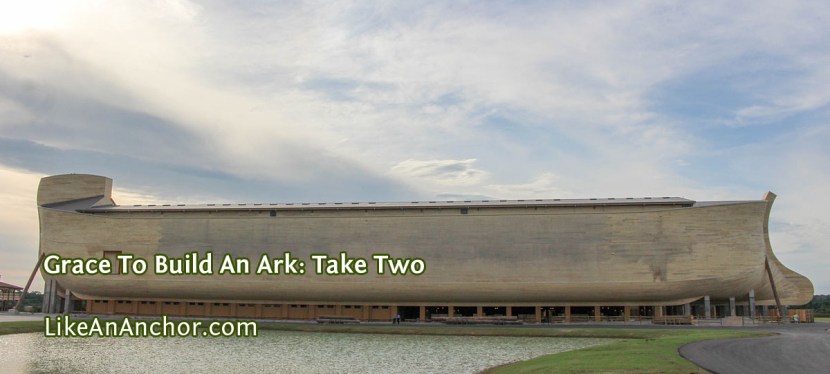
About six years ago (at the end of 2016), I wrote a blog post called “Grace to Build An Ark.” As I’ve studied grace more over the years, I keep coming back to this idea. When Noah found grace in the Lord’s eyes, God didn’t drop a ready-made ark from the sky. He gave Noah the plans to build an ark for himself.
We rightly think of grace as an “unmerited favor” or a “free gift” from God. But we often wrongly think that because the gift is given freely there are no accompanying expectations. I write about this error in posts like “Learning More About Covenant Grace” and you can learn even more about it by reading the book that inspired that post, Relational Grace: The Reciprocal and Binding Covenant of Charis(2015). Here’s one quote from the author, Brent Schmidt:
Jews knew about covenantal relationships from the Bible. Every commandment was a covenant with God. Several stories, including Joseph, Moses, and David, associate the concepts of grace and mercy with covenants. Greek-speaking Jews lived in a culture that depended heavily on reciprocal relationships and understood what charis meant. When Paul taught them using the word charis, they would have understood that by accepting God’s grace they were making covenantal obligations.
BRENT SCHMIDT, RELATIONAL GRACE, P. 64
Noah’s story is the very first time we see the word “grace” in the Bible (Hebrew chen, also “kindness” or “favor”). God looked down on earth and “saw that the wickedness of man was great in the earth.” Grieving, God decided to destroy His creation, except “Noah found favor in Yahweh’s eyes” (Gen. 6:5-8, WEB). Once God chose to extend grace to Noah, He warned Him about the world-destroying flood, saying, “Make a ship of gopher wood,” gave him building instructions, and promised, “I will establish my covenant with you” (Gen. 6:13-21, WEB).
Noah and his family didn’t earn the right to be in the ark or to have a covenant-relationship with God. Their salvation was a gracious choice God made. But Noah still had to obey the command to build. Likewise, salvation is offered freely to us by God’s grace as He welcomes us into a covenant with Him. And we also have an obligation to obey God and to build something.
Giving Noah the time and ability to build an ark so he and his family would live and the world would continue was a free gift of God’s grace. But Noah wouldn’t have been saved if he’d refused to build the ark. Peter and the author of Hebrews both talk about how important this building step was, and what it means for us today.
By faith Noah, when he was warned about things not yet seen, with reverent regard constructed an ark for the deliverance of his family. Through faith he condemned the world and became an heir of the righteousness that comes by faith.
Hebrews 11:7, NET
God patiently waited in the days of Noah as an ark was being constructed. In the ark a few, that is eight souls, were delivered through water. And this prefigured baptism, which now saves you—not the washing off of physical dirt but the pledge of a good conscience to God—through the resurrection of Jesus Christ, who went into heaven and is at the right hand of God with angels and authorities and powers subject to him.
1 Pet. 3:20-22, NET
Hebrews talks about the righteousness by faith that Noah inherited. Peter says Noah’s salvation prefigured baptism and our salvation. We live in times very similar to those Noah faced, and we’re also fast approaching the end of this world (1 John 2:18; Matt. 24:37-39; 2 Pet. 3:1-10). Like Noah, God has extended a lifeline to us–salvation by His grace. Also like Noah, we need to respond by taking action based on faith. Twice in Genesis, we’re told “Noah did everything that Yahweh commanded him” (Gen. 6:22; 7:5). If someone wrote the stories of our lives, could they say that about you and me?
Faith is an active thing. As we studied earlier this month, God seems to like building things, particularly when it involves building people up. He talks about building us into His temple, a dwelling place for Him here on earth as He lives inside the people of His church. He also talks about us participating in the building process.
We are coworkers belonging to God. You are God’s field, God’s building. According to the grace of God given to me, like a skilled master-builder I laid a foundation, but someone else builds on it. And each one must be careful how he builds. For no one can lay any foundation other than what is being laid, which is Jesus Christ. If anyone builds on the foundation with gold, silver, precious stones, wood, hay, or straw, each builder’s work will be plainly seen, for the Day will make it clear, because it will be revealed by fire. And the fire will test what kind of work each has done. If what someone has built survives, he will receive a reward. If someone’s work is burned up, he will suffer loss. He himself will be saved, but only as through fire.
Do you not know that you are God’s temple and that God’s Spirit lives in you?If someone destroys God’s temple, God will destroy him. For God’s temple is holy, which is what you are.
1 Corinthians 3:9-17, NET
Just like Noah so long ago, God expects us to act on the gift of grace that He gives us. God’s grace brings us into salvation and then we start building and working. We step out in obedience with faith, trusting the guides God gives us for how to build. We “work out our own salvation” while God “works in us both to will and to work, for his good pleasure” (Phil. 2:12-13, WEB).
Our walk with God doesn’t end when we receive His grace. That’s when it starts. Once we’ve covenanted with Him–in other words, entered a relationship with Him–we’re expected to “walk worthy of the calling with which you were called” (Eph. 4:1; Col. 1:10). The gift should change us. How could it not? What human being could encounter God in a meaningful, ongoing way and stay the same?
For by grace you are saved through faith, and this is not from yourselves, it is the gift of God; it is not from works, so that no one can boast.For we are his creative work, having been created in Christ Jesus for good works that God prepared beforehand so we can do them.
Ephesians 2:8-10, NET
Before we’re told that Noah found favor in the eyes of Yahweh, we’re given a description of his character. “Noah was a righteous man, blameless among the people of his time. Noah walked with God” (Gen 6:9, WEB). That’s what we’re supposed to do as well. Noah stood out from the wicked world around him because he followed God, and God noticed. When He spoke to Noah, Yahweh said, “Come with all of your household into the ship, for I have seen your righteousness before me in this generation” (Gen 7:1, WEB).
God loves and longs to save the whole world (John 3:16; 2 Pet. 3:9; 1 Tim. 2:3-4). But He won’t force people to follow Him and He won’t bring people into His kingdom who refuse the gift of salvation in word or action. That’s a choice we’re given to make. As He has always done, God sets before us life or death, blessings or cursing. We can either live in His grace or refuse to walk with Him. There’s no third option.
Behold, I have set before you today life and prosperity, and death and evil. For I command you today to love Yahweh your God, to walk in his ways and to keep his commandments, his statutes, and his ordinances, that you may live and multiply, and that Yahweh your God may bless you in the land where you go in to possess it. … I call heaven and earth to witness against you today that I have set before you life and death, the blessing and the curse. Therefore choose life, that you may live, you and your descendants, to love Yahweh your God, to obey his voice, and to cling to him; for he is your life, and the length of your days.
Deuteronomy 30:15-6, 19-20, WEB
Salvation isn’t about going on with your old life after you’ve received grace. It’s about a life-changing relationship with the One who continually gives grace (John 1:17; 1 Cor. 1:4; Eph. 4:7; 2 Thes. 2:16-17; 2 Tim. 1:9). And we have help in our quest to keep living by obedience as we build up ourselves and others in the church. God’s not going to call us into something without equipping us to finish it.
Building our arks has nothing to do with what we can accomplish on our own. Rather, it’s about believing Jesus when He said, “My grace is enough for you, for my power is made perfect in weakness.” (2 Cor. 12:9, NET). By God’s grace we are saved, we’re equipped to walk by faith, and we’re told to build, just like Noah. Our building project isn’t a giant boat, but the very church of God. Jesus said, “I will build my church” (Matt. 16:18, NET), but He graciously invites us to have a role in that. We get to build each other up and we get to build up our own faith.
But you, dear friends, by building yourselves up in your most holy faith, by praying in the Holy Spirit, maintain yourselves in the love of God, while anticipating the mercy of our Lord Jesus Christ that brings eternal life.
The New English Translation is one of my favorite Bible versions to use for study. I’ve been reading it for a couple years now, but there are still times when a particular translation choice catches my eye. It’s just different enough from some of the other translations I’m more familiar with (like KJV and WEB) that it makes me think more deeply about a verse. For example, look at these translations for a verse from 1 Corinthians:
But of Him you are in Christ Jesus, who became for us wisdom from God—and righteousness and sanctification and redemption
1 Corinthians 1:30, NKJV
Because of him, you are in Christ Jesus, who was made to us wisdom from God, and righteousness and sanctification, and redemption
1 Corinthians 1:30, WEB
He is the reason you have a relationship with Christ Jesus, who became for us wisdom from God, and righteousness and sanctification and redemption
1 Corinthians 1:30, NET
The “of Him you are in Christ Jesus” version doesn’t match sentence patterns we use in modern English, and so the meaning is a little fuzzy. “Because of him, you are in Christ Jesus” strikes a good balance between literally translating the Greek and getting the point across in English. The NET is less literal, but really makes the main point clear to English readers: you have a relationship with Jesus Christ–you’re in Him–because of what God does.
Think about the circumstances of your call, brothers and sisters. Not many were wise by human standards, not many were powerful, not many were born to a privileged position.But God chose what the world thinks foolish to shame the wise, and God chose what the world thinks weak to shame the strong. God chose what is low and despised in the world, what is regarded as nothing, to set aside what is regarded as something, so that no one can boast in his presence. He is the reason you have a relationship with Christ Jesus, who became for us wisdom from God, and righteousness and sanctification and redemption, so that, as it is written, “Let the one who boasts, boast in the Lord.”
1 Corinthians 1:26-31, NET. Bold italics in original; quote from Jer 9:24.
God Himself chose each of us. He’s the reason we can have a relationship with Jesus. We know that, of course, but it’s still good to meditate on “the circumstances of your call.” We owe Him everything.
Image by Matt Vasquez from Lightstock
The Closeness of God
It’s vital that we value our relationship with both God the Father and God the Son. They’re a family and They call Themselves “one.” While studying things like the question of which God-being talked with people in the Old Testament helps us understand God’s nature and plan, in many cases it’s not useful to try separating Father and Son. The Hebrew word for “God,” elohim, is plural and the Greek theos is used much the same way. Even when they make distinctions between their roles, it’s usually to show how closely They’re working together (John’s gospel is full of these).
So Jesus answered them, “I tell you the solemn truth, the Son can do nothing on his own initiative, but only what he sees the Father doing. For whatever the Father does, the Son does likewise.For the Father loves the Son and shows him everything he does, and will show him greater deeds than these, so that you will be amazed. For just as the Father raises the dead and gives them life, so also the Son gives life to whomever he wishes.Furthermore, the Father does not judge anyone, but has assigned all judgment to the Son, so that all people will honor the Son just as they honor the Father. The one who does not honor the Son does not honor the Father who sent him.
“I tell you the solemn truth, the one who hears my message and believes the one who sent me has eternal life and will not be condemned, but has crossed over from death to life. I tell you the solemn truth, a time is coming—and is now here—when the dead will hear the voice of the Son of God, and those who hear will live. For just as the Father has life in himself, thus he has granted the Son to have life in himself, and he has granted the Son authority to execute judgment, because he is the Son of Man.”
John 5:19-27, NET
Look how closely they work together. No rivalry, no concern over who does what or who gets credit. There’s closeness; oneness between them. They fill some different roles and relate to us in different ways, but they’re so close that Jesus said the most important commandment is, “Listen, Israel, the Lord our God, the Lord is one. Love the Lord your God with all your heart, with all your soul, with all your mind, and with all your strength” (Mark 12:29, NET).
Image by Pearl from Lightstock
Can’t Have One Without the Other
There aren’t many Christians who completely deny either the Father or the Son. However, there are some who question Jesus’s divinity, or who try to avoid the Father because they think He’s the scary God from the Old Testament. Both of those views are dangerous, and so are any others that deny or devalue either member of the God-family.
Who is the liar but the person who denies that Jesus is the Christ? This one is the antichrist: the person who denies the Father and the Son. Everyone who denies the Son does not have the Father either. The person who confesses the Son has the Father also. As for you, what you have heard from the beginning must remain in you. If what you heard from the beginning remains in you, you also will remain in the Son and in the Father.
1 John 2:22-24, NET
We need to stay close to the Son and the Father, recognizing both are God and working to build a relationship with them. We need to understand that the Father enables our relationship with the Son, and no one gets to the Father except through Jesus (John 6:44; 14:6).
Watch out, so that you do not lose the things we have worked for, but receive a full reward. Everyone who goes on ahead and does not remain in the teaching of Christ does not have God. The one who remains in this teaching has both the Father and the Son. If anyone comes to you and does not bring this teaching, do not receive him into your house and do not give him any greeting
2 John 1:8-10, NET
We might think there’s no danger of losing Jesus or the Father, but John gives his readers a serious warning. He tells us to “watch out” so that we don’t lose the things we’ve worked so hard to learn and the relationships God is building with us. Denying God or walking away from Him disrupts relationship. He can forgive us and welcome us back, but He doesn’t force us to stay with Him if we decide to walk away. So we need to be on guard against our own boredom, discontent, doubt, and anything else that might tug us away from God.
Pursue Oneness
Image by Jantanee from Lightstock
Understanding God helps us draw closer to Him. We’re supposed to imitate the sort of oneness the Father and Son share, and we can’t do our best to be like them unless we know what they are like. Our participation in their oneness–in other words, becoming part of their family–is so important that Jesus made it a central part of His prayer in the garden before His crucifixion.
“I am not praying only on their behalf, but also on behalf of those who believe in me through their testimony, that they will all be one, just as you, Father, are in me and I am in you. I pray that they will be in us, so that the world will believe that you sent me. The glory you gave to me I have given to them, that they may be one just as we are one—I in them and you in me—that they may be completely one, so that the world will know that you sent me, and you have loved them just as you have loved me.”
John 17: 20-23, NET
The idea of us all being one in Christ is one that Paul expresses using a metaphor. We’re all parts of Jesus’s body, and He is the head (1 Cor 12:12-27; Eph. 1:22-23; Col. 1:15-20). If you’re an ear or a pinky finger you don’t just go running off; you stay as part of the body. If not, well, body parts that get cut off just rot into a pile of flesh; they’re not alive on their own. And I think we can stretch the metaphor far enough to say something similar happens to us if we’re not connected to the Head and to Our Father.
The sort of oneness that Jesus says He longs to have with us is the sort that we should want to pursue as well, with God the Father, Jesus Christ, and with all the people in their church. “All” is a pretty tall order (and also impossible to do in our physical lives), but we can start with our local congregations. We likely have some people in our church groups that we get along with better than others, but we also get to have a deeper-than-blood relationship with them because we’re all part of Jesus’s body. The value that God the Father and Jesus place on relationships with us and between us is extremely high, and that shows us how much we ought to value the relationships we have with them and with each other. With God as the central point of our relationships, we can deepen the level of relationships we have and our appreciation for how precious those relationships are.
Featured image by Claudine Chaussé from Lightstock
I like building things. I built a small table for my houseplants last year, and I enjoy the times I’ve bought furniture from somewhere like Ikea where it comes in a box and I have to put it all together. There’s something satisfying about taking a bunch of pieces that don’t seem like much on their own and putting them together into something useful and attractive.
God likes building things too. At least, I assume He does based on the satisfaction He expressed after creating the universe and the ongoing pleasure He takes in creation. He also talks about His work with His people as a type of building, and He invites us to join Him in building each other up.
Building Words
I started thinking about this topic while looking up some of the Greek words Peter uses when talking about what “the God of all grace” will personally do for us. Here’s that verse:
And, after you have suffered for a little while, the God of all grace who called you to his eternal glory in Christ will himself restore, confirm, strengthen, and establish you
1 Peter 5:10, NET
As I looked up the Greek words translated here as “restore, confirm, strengthen, and establish,” it seemed like they could all be used when building something. I wanted to dig into this a little more and see if my hunch was correct.
Restore–G2675, kataritizo. This word means to make something “sound” or “complete,” often in the sense of “repair” or “frame for one’s self” (Thayer). It’s not specifically used for building a structure, but “the fundamental meaning is to put a thing in its appropriate condition, to establish, set up, equip, arrange, prepare, mend” (Zodhiates). It’s used for things like mending nets (Matt. 4:21) and God “framing” the world (Heb. 11:3). Paul also uses this word when talking about church unity (1 Cor. 1:10; 2 Cor. 13:11).
Confirm–G4741, sterizo. This word means “to make stable, place firmly … strengthen” (Thayer) and to permanently fix something in place (Zodhiates). Some translations equate it to the English word “establish” (Rom. 1:11; 1 Thes. 3:2, 13). Reading the dictionary definitions and how it’s used in scripture makes me think “stabilize” could also be a reasonable translation as well.
Strengthen–G4599, sthenoo. This word means “to make strong, strengthen” (Thayer) and it is only used in 1 Peter 5:10 (Zodhiates). The opposite, asthenes, means “weak” or “sick” (Mark 14:38; Luke 10:9; Rom 5:6).
Establish–G2311, themelioo. This word does have to do with building things. It means “to lay the foundation … to make stable” (Thayer). It can be a foundation for anything from a house in Christ’s parables (Luke 6:48), to the earth itself (Heb. 1:10), to our lives being grounded in faith and love (Eph. 3:17; Col. 1:23).
So my hunch was partly correct. One of the words has to do with laying a foundation for something you’re going to build and another involves “framing” something appropriately and/or “perfecting” a project. The foundation-laying word’s close relative themelios is also used in this famous building passage:
So then you are no longer strangers and foreigners, but you are fellow citizens with the saints and of the household of God, being built on the foundation of the apostles and prophets, Christ Jesus himself being the chief cornerstone; in whom the whole building, fitted together, grows into a holy temple in the Lord; in whom you also are built together for a habitation of God in the Spirit.
Ephesians 2:19-22, WEB
This verse has the Greek words usually used to talk about building houses. Words with oikodomeo as the root word (including epoikodemeo, “being built,” and sunoikodomeo “built together”) all have to do with building and constructing (G3618, Zodhiates). This word is most often used for building houses, but it can also mean to rebuild and metaphorically refers to building people up in much the same way we use that English phrase today.
I like looking into Greek word definitions like this because I think it’s important to understand how the New Testament writers talked about the way God interacts with us. By looking at these words that have to do with building, we deepen our understanding of the constructive work God is doing with His church as a whole and as individuals. He starts from the ground up, laying a sure foundation as He builds His temple. He also makes sure He’s constructing things properly, keeping us stabilized as He works.
If you read last week’s post, you might remember I quoted C. S. Lewis about the future potential of human beings. He said that we’re all destined either to be glorious children of God or “a horror of corruption” without God. Then he added, “All day long we are, in some degree, helping each other to one or other of these destinations” (Lewis,“The Weight of Glory”). In other words, we’re always choosing whether we participate in God’s constructive work and build other people up, or if we’re a destructive force in their lives. Additionally, we make the same choice in relation to our own lives.
We are coworkers belonging to God. You are God’s field, God’s building. According to the grace of God given to me, like a skilled master-builder I laid a foundation, but someone else builds on it. And each one must be careful how he builds. For no one can lay any foundation other than what is being laid, which is Jesus Christ. If anyone builds on the foundation with gold, silver, precious stones, wood, hay, or straw, each builder’s work will be plainly seen, for the Day will make it clear, because it will be revealed by fire. And the fire will test what kind of work each has done. If what someone has built survives, he will receive a reward. If someone’s work is burned up, he will suffer loss. He himself will be saved, but only as through fire.
Do you not know that you are God’s temple and that God’s Spirit lives in you?If someone destroys God’s temple, God will destroy him. For God’s temple is holy, which is what you are.
1 Corinthians 3:9-17, NET
In this lead-up to one of the famous “you are God’s temple” passages, Paul emphasizes the roles people play in building. A teacher like Paul can lay a foundation, but must always remember that they’re really just helping Jesus Christ who is the only real Foundation. And then we all get to build on that foundation, being careful how we build on it for ourselves and when teaching and helping other people to build.
Paul continues using the building analogy later in 1 Corinthians. He tells us to remember, “Knowledge puffs up, but love builds up” (1 Cor. 8:1, NET). He cautions that even if something is lawful, that doesn’t give us license to go and do it because “not everything builds others up” and building others up should be a priority (1 Cor. 10:23, NET). Even if we’re doing something well, like giving a great prayer in church, it’s useless unless other people understand the language we’re using so the prayer can build them up (1 Cor. 14:4, 17).
For God did not destine us for wrath but for gaining salvation through our Lord Jesus Christ.He died for us so that whether we are alert or asleep we will come to life together with him. Therefore encourage one another and build up each other, just as you are in fact doing.
One of the inescapable truths of Christianity is that we can’t do anything on our own. That most definitely includes participating in building God’s temple. Jesus is the foundation for all good efforts to build ourselves or others up. And we don’t just build on Him; we build in Him.
For I want you to know how great a struggle I have for you, and for those in Laodicea, and for those who have not met me face to face. My goal is that their hearts, having been knit together in love, may be encouraged, and that they may have all the riches that assurance brings in their understanding of the knowledge of the mystery of God, namely, Christ, in whom are hidden all the treasures of wisdom and knowledge. I say this so that no one will deceive you through arguments that sound reasonable. For though I am absent from you in body, I am present with you in spirit, rejoicing to see your morale and the firmness of your faith in Christ.
Therefore, just as you received Christ Jesus as Lord, continue to live your lives in him, rooted and built up in him and firm in your faith just as you were taught, and overflowing with thankfulness.
Colossians 2:1-6, NET
Remember what Paul said in Ephesians: “you have been built on the foundation of the apostles and prophets, with Christ Jesus himself as the cornerstone.In him the whole building, being joined together, grows into a holy temple in the Lord” (Eph. 2:20-21, NET). We don’t just start with Jesus and then keep going on our own–the whole building project happens in God, “for in him we live and move about and exist” (Acts 17:28, NET). This goes beyond asking, “What would Jesus do?” or thinking about Him walking alongside us. Our whole lives ought to be totally immersed in Him. And when we think about other people in His church, we should think of them as likewise being part of His body (1 Cor. 12:12-14).
For this reason I kneel before the Father,from whom every family in heaven and on earth is named. I pray that according to the wealth of his glory he will grant you to be strengthened with power through his Spirit in the inner person, that Christ will dwell in your hearts through faith, so that, because you have been rooted and grounded in love, you will be able to comprehend with all the saints what is the breadth and length and height and depth,and thus to know the love of Christ that surpasses knowledge, so that you will be filled up to all the fullness of God.
Now to him who by the power that is working within us is able to do far beyond all that we ask or think,to him be the glory in the church and in Christ Jesus to all generations, forever and ever. Amen.
Ephesians 3:14-21, NET
God has a constructive plan for us. He invites us to be living, breathing, actively involved parts of the building project that He holds dearest–the construction of a family. We’re blessed to be involved in this building, both for ourselves and for our fellow believers. I like reading Paul’s prayers as models for how we ought to pray for others in God’s church. (Also notice that this verse brings us right back to thinking of glory in the people of God’s church, just like we were focused on last week.) Since God cares about building up every part of His church, we ought to care about that as well and focus at least as much on other people’s growth as we do our own.
There’s a C.S. Lewis sermon that I think about on a near-weekly basis. It’s called “The Weight of Glory.” He originally preached it on June 8, 1941 in the Church of St Mary the Virgin, Oxford. It was then published in Theology for the first time in November, 1941, and has been in print ever since. You can also read it for free online. Usually when I quote this sermon, I reference Lewis’s discussion of how we ought to view others, knowing that every human being has the potential to become fully part of God’s own family. Today, though, I want to start by looking at the message as a whole.
Lewis opens by speaking of the rewards offered a Christian and pointing out that wanting these rewards while living a godly life is not “mercenary.” He spins out Paul’s analogy of the law as our schoolteacher (from Galatians) in more modern terms. He also speaks of our eternal reward and the longing for God in each human heart as a Romantic idea that proves there is something wonderful and heavenly in our future (much like being hungry for food proves that food must exist in some form or another).
The promises of Scripture may very roughly be reduced to five heads. It is promised, firstly, that we shall be with Christ; secondly, that we shall be like Him; thirdly, with an enormous wealth of imagery, that we shall have “glory”; fourthly, that we shall, in some sense, be fed or feasted or entertained; and, finally, that we shall have some sort of official position in the universe—ruling cities, judging angels, being pillars of God’s temple. The first question I ask about these promises is: “Why any of them except the first?”
C.S. Lewis, The Weight of Glory, p. 4
Even just one of God’s promises are overwhelmingly amazing, yet he offers us even more, including “glory.” Lewis links glory with “what may happen when the redeemed soul, beyond all hope and nearly beyond belief, learns at last that she has pleased Him whom she was created to please” (Lewis, p. 5). We might not describe ourselves as desiring glory, but that’s what we seek when we want “good report with God, acceptance by God, response, acknowledgment, and welcome into the heart of things” (Lewis, p. 6). Basically, glory is “being ‘noticed’ by God” or “known by God” (Lewis, p. 6; 1 Cor. 8:3). Plus, of course, there’s the other sense of glory as well–“glory as brightness, splendour, luminosity” (Lewis, p. 7). Then, we get to the part of this sermon that I think about and quote most frequently:
It may be possible for each to think too much of his own potential glory hereafter; it is hardly possible for him to think too often or too deeply about that of his neighbour. The load, or weight, or burden of my neighbour’s glory should be laid daily on my back, a load so heavy that only humility can carry it, and the backs of the proud will be broken. It is a serious thing to live in a society of possible gods and goddesses, to remember that the dullest and most uninteresting person you talk to may one day be a creature which, if you saw it now, you would be strongly tempted to worship, or else a horror and a corruption such as you now meet, if at all, only in a nightmare. All day long we are, in some degree, helping each other to one or other of these destinations.
C.S. Lewis, The Weight of Glory, p. 8
It’s this idea of weightiness that I want to focus in on today. When we think of glory, I suspect we think of God Himself being glorious. We might think of shining like lights in the world now, and shining even more when we’re spirit beings in God’s family. But I don’t think we often think of glory as a “load, weight, or burden” that is “heavy” to carry.
Image by Lamppost Collective
Weight of Glory
For our momentary, light suffering is producing for us an eternal weight of glory far beyond all comparison
2 Corinthians 4:17, NET
Lewis doesn’t reference 2 Corinthians 4:17 directly in his sermon, but it’s alluded to throughout and explicitly referenced in the title. The Greek word for “weight” is baros. It means “weight in reference to its pressure, burden, load” (G922 Zodhiates). You could also translate it “heaviness, burden, trouble” (Thayer). It’s the same word Jesus uses in His parable of the workers in the vineyard where the first workers complain, “These last have spent one hour, and you have made them equal to us who have borne the burden of the day and the scorching heat!”’” (Matt. 20:12, WEB). It’s something that’s heavy, often burdensome, and it’s carried like a load.
This burdensome heaviness is contrasted with “light suffering.” Here, light is elaphros and it means “light in weight, quick, agile” (G1645 Thayer). It means something that’s “not heavy, easy to bear” (Zodhiates). It’s such an interesting word picture. Paul describes our suffering as light and easy to carry, and eternal glory as something heavy and burdensome. Why not the other way around? Suffering seems like a heavy thing to drag around and glory like something shining and light and wonderful. What’s going on here?
There aren’t a whole lot of other verses using baros that we can look at for more information on how it’s used in the Bible. One stands out, though. Paul uses this word in Galatians when he says, “Carry one another’s burdens, and in this way you will fulfill the law of Christ” (Gal. 6:2, NET). That one seems fairly straightforward–we all have metaphorical burdens we carry, so we should help each other out with that–but thinking of “glory” as being included in our burdens adds an interesting additional layer to this verse. It brings us back to Lewis’s point about taking the burden of our neighbors’ glory seriously (and I’m sure he knew about the connection between these two verses since he could read Greek).
And what about “light suffering”? The only other time this word translated “light” appears in scripture is when Jesus says, “Take my yoke upon you and learn from me, for I am gentle and humble in heart; and you will find rest for your souls. For my yoke is easy, and my burden is light” (Matt. 11:29-30, WEB). The word for “burden” here isn’t baros but phortion; a word that’s also related to freight loads, but is metaphorically connected to “rites” and “obligations” (G5413 Thayer). The burdens that Jesus asks us to carry (including, though not limited to, suffering in this life) are not unreasonably heavy. He’s yoked to us, carrying the burdens alongside us.
Worthy and Weighty
Now we come to the verses that started me off on today’s whole study. I was sitting in church listening to a sermon and I don’t remember if the speaker read the definition for a Greek word used in these verses or if I looked it up myself, but I was intrigued by the idea of “worthily” and “weighty” being connected.
I, therefore, the prisoner for the Lord, urge you to live worthily of the calling with which you have been called
Ephesians 4:1, NET
so that you may live worthily of the Lord and please him in all respects—bearing fruit in every good deed, growing in the knowledge of God,
Colossians 1:10, NET
Worthily is from the adverb form of axios, which (not surprisingly) means “worthily, suitably, properly” (G516 Zodhiates). But if you start looking at the related words like the adjective axios, you learn that it has to do with weight. The root is ago (G71), which means “to weigh.” Axios describes something that has inherent, weighty value (G514 Zodhiates; Thayer). It may mean something of equal value like items in a market balancing a scale. It can also mean “worthy or deserving” and “suitable, congruent, corresponding to” (G514 Zodhiates).
Now, I read this and the first thing I thought of was the phrase “weight of glory,” though I now know Paul uses a different word for the “eternal weight of glory far beyond all comparison” (2 Cor. 4:17, NET). Even so, both have to do with the idea of weight as something to carry (just like the English words weight, burden, and heavy are all related). It’s not too much of a stretch to connect the idea of “the weight of glory” to living a worthy or “weighty” life.
Sufferings and Glory
Image by Lamppost Collective
There’s something deeply valuable about the glory that God offers us. It’s weighty. It has meaning. It’s worth far outweighs the inconvenience of suffering, which is light in comparison. Understanding the weight of glory has a profound impact on how we live our lives now.
So then, brothers and sisters, we are under obligation, not to the flesh, to live according to the flesh (for if you live according to the flesh, you will die), but if by the Spirit you put to death the deeds of the body you will live. For all who are led by the Spirit of God are the sons of God. For you did not receive the spirit of slavery leading again to fear, but you received the Spirit of adoption, by whom we cry, “Abba, Father.” The Spirit himself bears witness to our spirit that we are God’s children. And if children, then heirs (namely, heirs of God and also fellow heirs with Christ)—if indeed we suffer with him so we may also be glorified with him. For I consider that our present sufferings cannot even be compared to the coming glory that will be revealed to us.
Romans 8:12-18, NET
Over and over in the New Testament, suffering is linked with glory. Jesus said He had to suffer before entering His glory (Luke 24:26). The writer of Hebrews goes so far as to say Jesus was “crowned with glory and honor because he suffered death” (Heb. 2:9, NET, emphasis added). Peter also talks about the connection between Christ’s suffering and His glory, then links it to our suffering and glory as well (1 Peter 1:8-11; 4:12-13; 5:1-3, 10).
Dear friends, do not be astonished that a trial by fire is occurring among you, as though something strange were happening to you. But rejoice in the degree that you have shared in the sufferings of Christ, so that when his glory is revealed you may also rejoice and be glad. …
And, after you have suffered for a little while, the God of all grace who called you to his eternal glory in Christ will himself restore, confirm, strengthen, and establish you.
1 Peter 4:12-13; 5:10 NET
It makes more sense, now, why glory is a weighty burden and our sufferings so light we may hardly notice carrying them. I’m sure we’ve all met someone who is always smiling, positive, and talking about how good Jesus is to them while they’re going through things that you’d expect would drive someone to despair, or at least dampen their spirits. One of the people who comes to mind for me is Tamie Haupricht, a woman who became my friend while we were dancing together at a Messianic congregation. She asked me to work with her as an editor when she published her story two years ago, and you can click here to get a copy of Always Smiling: A Journey From Abuse To A Life of Faith and Joy (I don’t make anything from sharing this book; I just started writing this paragraph and then felt I should share her story with you).
The more we learn about the gifts God shares with us, the more we ought to feel the weightiness of carrying His name, nature, and future plans for us. Incredibly, these gifts include and are not limited to glory so momentous that it outweighs sufferings by so much that they can seem light in comparison. We’re offered glory along with Jesus; a share in the glory He received after suffering in our place. And, as Lewis reminds us, we’re not the only ones offered this. “Christ Jesus came into the world to save sinners” and as a result “whoever believes in him should not perish, but have eternal life” (1 Tim. 1:15; John 3:16). Everyone we meet has the same glorious potential that God is giving us. I wonder how much it would change my life if I really, truly remembered this. I’m carrying the weight of the glory God offers me. God loves every person I interact with or even hear about enough to die for them and He’d be overjoyed if none of them perished (1 Tim. 3:4; 2 Peter 3:9). Those truths should impact my every choice and interaction.












 Like An Anchor