One phrase I frequently pray is, “Thank you for bringing us from darkness into light.” It’s an incredible blessing that each believer partakes of. Without God the Father drawing us to His Son, the Light of the world, we wouldn’t even know the world around us is in darkness.
Do we really understand and value this light, though? And, equally important, do we live in the light now that we’ve been called to follow the Light?
It’s not a popular thing in today’s society to make distinctions between right and wrong, holy and profane, light and darkness. But that’s something we must do because it is something God does. We have to know the difference between light and darkness so that we can choose the light and live in relationship with God.
Confusing Light and Dark Hurts God
When we read the phrase “woe to those who ___” it seems like a scary, sobering pronouncement. It means great sorrow or distress, which is what comes on those who forsake God. Hebrew carries another shade of meaning as well. “Woe” is hoy (H1945), which is an exclamation like ah! alas! ha! O! In the sort of context we’re looking at today, we can read this word as a cry of grief and despair from God at seeing the evil His people are doing that’s leading them away from the light.
Woe to those who call evil good, and good evil; who put darkness for light, and light for darkness; who put bitter for sweet, and sweet for bitter! Woe to those who are wise in their own eyes, and prudent in their own sight! (Is. 5:20-21, WEB)
God has good reason to exclaim hoy! over these people, for He knows what happens to those who “have rejected the law of Yahweh of Armies, and despised the word of the Holy One of Israel” (Is. 5:24). Spoilers: it’s not pretty. Read more →
A second princess, another key to the treasure, and a cruel king desperate to squelch the growing rebellion.
If you’re looking for a wholesome and sweetly romantic series for your teens and young adults (or yourself — there’s no age limit!) then you’ll want to check out Jody Hedlund’s new Lost Princesses fairy tale series. The series started with prequel novella Always and novel Evermore, and now it continues with Foremost.
Mild spoiler warning: I’m not going to disclose any major plot points but if you don’t want to know anything about the plot and character relationships before reading this book then you’ll want to skip my post for now.
The story of Foremost
Raised in an isolated abbey, Lady Maribel desires nothing more than to become a nun and continue practicing her healing arts. She knows nothing outside her cloistered world but that doesn’t bother her much. She has all the friends she needs in the nuns, their protector Wade, and her fellow orphans Edmund and Collette. Sure she feels trapped sometimes and longs for a little adventure before settling down, but she does intend to take her vows and settle into life as a nun.
Adventure finds her with the arrival of an unexpected visitor who reveals Maribel’s true identity as one of the three lost princesses. With wicked King Ethelwulf’s soldiers hunting her, Maribel must leave the abbey and travel to join her sister, Queen Adelaide Constance. Edmund goes with her as her protector, hoping and praying she won’t discover that he loves her as far more than an adopted sister. He will not stand in the way of her dreams to become a nun and a healer, no matter what it costs him. Read more →
How many versions of you are there? Are you a different person behind the wheel of your car than you are when speaking to your grandmother? Do you play one part at work and another part with friends on the weekend? Do you hide parts of yourself or change the way you present yourself based on circumstances?
We all do this. To a certain extent, it’s useful to make your behavior fit the context. You don’t want to wear the same clothes, for example, to grub out a stump in the backyard as to attend a wedding. But when the change is more extreme — polite to a date but angry and vindictive when driving in traffic — it can be a problem.
Integrity comes form the Latin word integer, meaning something whole and complete in itself. If you are a person with integrity then there is only one version of you (“The True Meaning of Integrity” by So-Young Kang). You act with honesty and live by strong moral principles whether or not someone is watching. People with integrity apologize when they are wrong or cause inconvenience, they refuse to act viciously even when fighting, and they give others the benefit of the doubt (“7 Signs of People With Integrity” by Seth Meyers).
It’s very difficult to live with complete wholeness and consistency. And it’s well-nigh impossible to do so if you don’t know who you are and what you believe. As the Biblical writer James said, “he who doubts is like a wave of the sea, driven by the wind and tossed” (James 1:6, WEB). We need an anchor for our identity if we’re to live with integrity. Read more →
Do you ever feel like God doesn’t really know what you’re going through? That He doesn’t get how hard it is to be human or that He expects too much of us?
I think this is an easy thought pattern to fall into. “My problem is something different,” we think. “Other people don’t understand, and maybe God doesn’t either. Sure Jesus was human but that was 2,000 years ago. Things have changed.”
Truth is, though, things haven’t changed that much. “There is no new thing under the sun” because human nature stays the same (Ecc. 1:9). And even if things have changed so much that being human is fundamentally different than it once was, God has still taken steps to make sure He understands us. Evidently connecting with us is very important to Him, because He’s done some pretty incredible things in order to get inside our perspectives and also to share His mind with us. Firstly, He made us. Secondly, He experienced human life by Jesus living as a human. Finally, He indwells His people today through His spirit.
Made
If you make something you understand it. You know all the ingredients in the cookies, you know the hours put into shaping clay into an urn, you know the measurements and materials required to machine that part. God understands us even better than that, for He created all the materials we’re formed from and then fashioned us in His own image.
Like a father has compassion on his children, so Yahweh has compassion on those who fear him. For he knows how we are made. He remembers that we are dust. (Psalm 103:13-14, WEB)
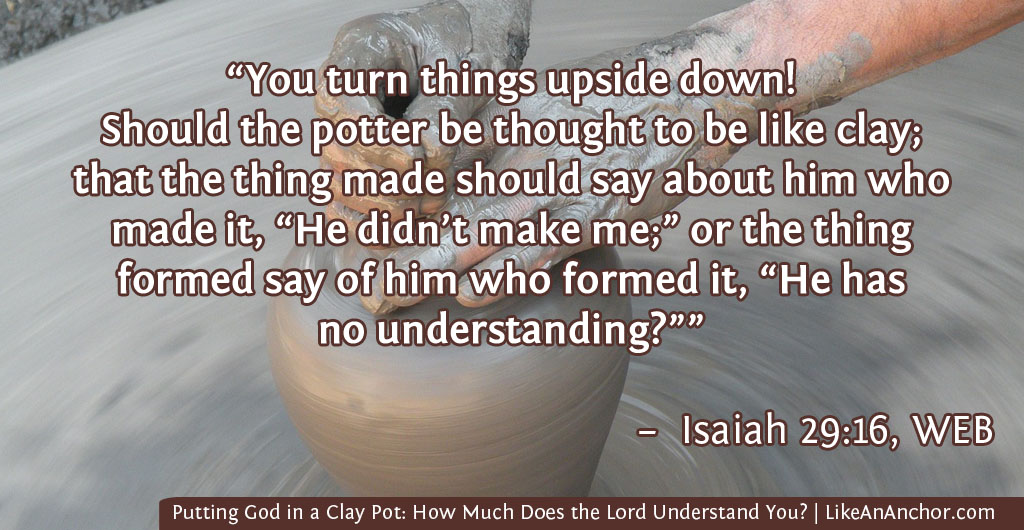
Other translations use the phrase “He knows our frame” (Hebrew word yetser, meaning form, framing, or purpose). God made us and knows all about us. We are something formed by him as if we were clay in the hands of a master potter (Is. 29:16 also uses the word yetser).
However, knowing how to make a clay pot isn’t the same as knowing what it’s like to be a clay pot. He could search us and know us more intimately than anyone else (see my favorite Psalm, number 139 for an example), but God in the Old Testament hadn’t yet lived as one of us.
They say if you want to understand someone you should walk a mile in their shoes. God did much more than that when the Son came to this earth as a man. He walked 33 years in our human form.
Who, existing in the form of God, didn’t consider equality with God a thing to be grasped, but emptied himself, taking the form of a servant, being made in the likeness of men. And being found in human form, he humbled himself, becoming obedient to the point of death, yes, the death of the cross. (Phil. 2:6-8, WEB)
Having created the form of man, God now inhabited it as the Word who took on the same form He created (John 1:1-4, 14). Both Father and Son were involved in creation (Eph. 3:9) and both were involved in the decision to send Jesus as the Messiah (John 5:36-37; 10:17-18). The God-family was in perfect agreement about how important it was for one of them to live and die as a human.
Since then the children have shared in flesh and blood, he also himself in the same way partook of the same, that through death he might bring to nothing him who had the power of death, that is, the devil … Therefore he was obligated in all things to be made like his brothers, that he might become a merciful and faithful high priest in things pertaining to God, to make atonement for the sins of the people. For in that he himself has suffered being tempted, he is able to help those who are tempted. (Heb. 2:14, 17-18, WEB)
This tells us that one of Jesus’ reasons for coming to this earth was to experience human life and so know first-hand what we are going through. This is an incredible sacrifice for God to make in order to understand you! It’s mind-boggling that one of the two all-powerful beings in the universe would choose to live like one of the clay pots He made all so He could save our lives and understand how to help each of us.
What Jesus did in coming to earth, living as human, and dying for us is amazing in itself. But He doesn’t stop there. He made us, then He lived like us, and now He lives inside us.
For we don’t preach ourselves, but Christ Jesus as Lord, and ourselves as your servants for Jesus’ sake, seeing it is God who said, “Light will shine out of darkness,” who has shone in our hearts to give the light of the knowledge of the glory of God in the face of Jesus Christ. But we have this treasure in clay vessels, that the exceeding greatness of the power may be of God, and not from ourselves. (2 Cor. 4:5-7, WEB)
Today, God is still putting His presence in clay pots (us) through His spirit. He has said, “I will dwell in them and walk in them. I will be their God and they will be my people” (2 Cor. 6:16, WEB). This is an intimate level of knowing that goes beyond how we are made or even what it’s like to be human (John 15:4; 17:22-23). Through the indwelling of His spirit, He knows what it is like to be us in the fullest way we could ever imagine.
So if you ever feel like maybe God doesn’t understand you, remember all the ways that He knows you. He made human kind, lived as a human, and now lives in each of us. No one (including yourself) will ever understand you as well as God does. And there’s a great comfort in that, “for we don’t have a high priest who can’t be touched with the feeling of our infirmities.” Our Lord and Savior knows what it’s like to be human and has deep sympathy for all of us (Heb. 4:14-16). Beyond that, He deeply sympathizes with each individual He’s in a relationship with because we dwell in Him and He in us through His spirit.
I know how hard it is when you’re struggling with loneliness, but when we have a relationship with God we never have to feel fundamentally alone or misunderstood. He’s gone to incredible lengths to have a deep, personal relationship with us. All we have to do is recognize that He’s there.
Those words, or a variation, come up again and again when I talk with people about what they need when they’re hurting. You’ll also find this advice in books, articles, and interviews talking about how to interact with grieving people. Don’t try to compare your pain to theirs, or explain it away, or slap verbal band aids on the wound. Just be there for them.
Whenever we think about suffering in the Bible, Job is one of the first stories that comes to mind. This man lost seven sons and three daughters all in one day, along with all his wealth. Shortly after that, Satan struck him “with painful sores from the soul of his foot to his head” (Job 1:13-22; 2:7-8, all quotes from WEB). Family, wealth, and health all gone in a moment. Job was about as low as you can humanly get. And so his three best friends came to comfort him and to teach us important lessons about how to interact with hurting people.
Comfort, Sympathy, and Silence
Now when Job’s three friends heard of all this evil that had come on him, they each came from his own place: Eliphaz the Temanite, Bildad the Shuhite, and Zophar the Naamathite; and they made an appointment together to come to sympathize with him and to comfort him. When they lifted up their eyes from a distance, and didn’t recognize him, they raised their voices, and wept; and they each tore his robe, and sprinkled dust on their heads toward the sky. So they sat down with him on the ground seven days and seven nights, and no one spoke a word to him, for they saw that his grief was very great. (Job 2:11-13)
Things started out well. 1) they cared about Job enough to keep track of what was going on with him and know he needed support. 2) they came to him for the purpose of comfort and sympathy. 3) they shared in his grief, weeping with him. 4) they didn’t talk; they just sat with him and waited to see what he’d need. Read more →
During His ministry on earth, Jesus said He was not here to destroy the law. Yet we also have record of the Jews saying He “broke the Sabbath” (Matt. 5:17; John 5:18). Do those two statements contradict?
Similarly, Paul said his own writings “establish the law,” but he also asked his readers why they would be “subject to ordinances” now that they live by faith (Rom. 3:31; Col. 2:20). Aren’t those statements contradictory as well?
These statements actually don’t contradict each other, but to understand why you have to know something about the Jewish world at the time. On one hand, you have God’s law that He delivered to His people through Moses (the Torah). On the other hand, you have additional rules, regulations, and traditions that were put in place by human beings.
So if we look more closely, we see Christ was not here to destroy God’s law, but He did loose the Sabbath from restrictions added by human teachers. Similarly, in Romans Paul is talking about establishing the law of God, but in Colossians he is talking about walking away from “the commandments and doctrines of men” (Col. 2:20-23).
So what does all this have to do with modern Christians? We’ll take a close look at this question in today’s post, and I think we’ll find that these statement that at first appear contradictory actually teach us about how we are supposed to relate to God’s law. They also teach us how to respond when other people (including teachers and leaders) start to change or add to God’s word.
Torah Teachers and Lawbreakers
For a long time, I’ve been confused about the opening verses for Matthew 23. They read like this:
Then Jesus spoke to the multitudes and to his disciples, saying, “The scribes and the Pharisees sit on Moses’ seat. All things therefore whatever they tell you to observe, observe and do, but don’t do their works; for they say, and don’t do.”
Matthew 23:1-3, WEB
I used to think Jesus was telling people to follow the extra traditions because we should respect authority even if it’s corrupt. That didn’t seem quite right, but it was the best I could figure out. Then a heard a sermon about the true meaning of legalism that explained things differently and (I think) more accurately.
Sitting in Moses’ seat refers to the scribes and Pharisees teaching the Torah that Moses taught. The Apostles make a similar observation later, saying they don’t need to focus their efforts on teaching Torah because the synagogues are already reading Moses every sabbath (Acts 15:21). Torah is important, but it was already being taught. That is why Jesus said to “observe and do” what the Jewish leaders said to do — because they were teaching God’s law.
These leaders were not, however, doing the law themselves and that’s why we’re told not to imitate their works. In fact, by saying “they say and don’t do” Christ is identifying them as lawbreakers (Matt. 23:4-36, particularly verse 23). They legalistically followed doctrines of men but broke the laws of God.
Jesus tells us to do what the scribes and Pharisees said inasmuch as they were faithfully teaching God’s words, but not to follow their example because they weren’t really keeping God’s law. This connects to an earlier point He made in the Sermon on the Mount.
Do not think that I have come to destroy the law or the prophets. I have not come to destroy them but to fulfill them. For truly I say to you, until heaven and earth pass away, not one tiny letter or one stroke of a letter will pass away from the law until all takes place. Therefore whoever abolishes one of the least of these commandments and teaches people to do so will be called least in the kingdom of heaven, but whoever keeps them and teaches them, this person will be called great in the kingdom of heaven. For I say to you that unless your righteousness greatly surpasses that of the scribes and Pharisees, you will never enter into the kingdom of heaven.
Matthew 5:17-20, LEB
I imagine it shook some of Jesus’ hearers to learn He expected them to follow God’s word with more righteousness than the scribes and Pharisees. That group was the most righteous that Jews could get, following every little ordinance to the letter. But as Jesus teaches in Matthew 23, their “righteousness” was not the type of righteousness that God seeks. Jesus wants His people to follow His words faithfully from the heart, not to put on a more righteous show. Aligning ourselves with Jesus is how we become truly righteous.
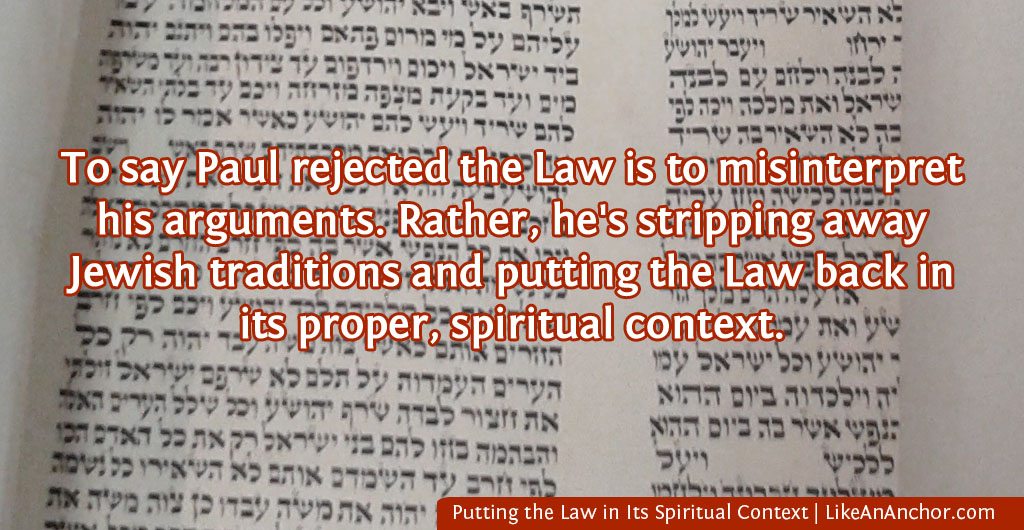
These passages of Jesus’ teachings are key to understanding Paul’s writings. As a faithful apostle he would not have contradicted Jesus by abolishing God’s commands or teaching people to break the law. Rather, Paul’s writings expand on how we relate to God’s laws as spirit-led Christians.
Photo credit: me
Inward Judaism
In the Old Testament, God promised a new kind of covenant relationship with His people, one where the Law would be written in their minds and hearts instead of imposed from the outside (Jer. 31:33). That happened when Jesus came as the Messiah (Heb. 8). So now we come to Paul — a rabbi who was once a Pharisee and became a faithful follower of Jesus (Phil. 3:4-6). Paul teaches how we should relate to God’s law under the New Covenant. He teaches that it’s not so much about “do”s and “don’t”s, but about inward transformation that makes us spiritual like God instead of fleshy.
For he is not a Jew who is one outwardly, neither is that circumcision which is outward in the flesh; but he is a Jew who is one inwardly, and circumcision is that of the heart, in the spirit not in the letter; whose praise is not from men, but from God.
Romans 2:28-29, WEB)
In this chapter of Romans, Paul tells his readers God cares more about how you live than your pedigree or your professions of lawfulness. “It isn’t the hearers of the law who are righteous before God, but the doers of the law will be justified” (Rom. 2:13, WEB). We need to keep the Law because we have a relationship with the Lawgiver which changes our character, not because we think the law will save us on its own. New Covenant believers still keep God’s law, but our relationship with it is different.
As Romans progresses, Paul builds an explanation for how post-Crucifixion believers relate to God’s law. We’ve all sinned and stand condemned under the law of God, which is incapable on its own of making anyone righteous. We can only be saved by Christ’s atoning sacrifice (Rom. 3:20-27). This doesn’t get rid of God’s law, though. “May it never be! No, we establish the law” (Rom. 3:31, WEB). Paul himself (perhaps anticipating how his words might be misread) makes sure that we understand his arguments establish God’s law rather than say it doesn’t matter.
Our walks as Christians should be closely identified with Jesus and affected by our participation in Him. We are buried into His death, raised to new life with Him, and now walk in Him freed from sin (Rom. 6:1-11). Because of this, we must not let sin rule over us. Instead of serving sin, we are now servants of righteousness (Rom. 6:12-23).
In dying with Christ, we also died to the condemnation from sinning/breaking the law and we are now joined to the Lawgiver in a New Covenant marriage “so that we serve in newness of the spirit, and not in oldness of the letter” (Rom. 7:1-6). There’s a struggle inside us about how we relate to the law that only Jesus can reconcile. “The law indeed is holy, and the commandment holy, and righteous, and good” (Rom. 7:12). It is also “spiritual, but I am fleshly, sold under sin” (Rom. 7:14). We want to do what God says but wrestle with human inability to be good.
For I joyfully agree with the law of God in my inner person, but I observe another law in my members, at war with the law of my mind and making me captive to the law of sin that exists in my members. Wretched man that I am! Who will rescue me from this body of death? Thanks be to God through Jesus Christ our Lord! So then, I myself with my mind am enslaved to the law of God, but with my flesh I am enslaved to the law of sin.
Romans 7:22-25, LEB
Jesus makes it possible for our inner man, which hopefully agrees with God’s law as Paul did, to live in alignment with Him even though we fall short of God’s perfect standard. We rejoice with God’s law and walk in the spirit, free from the fear that came with not measuring up under the old covenant. There’s no condemnation now because in Christ, we walk not after the flesh but in the spirit (Rom. 8:1-14).
We learn more about this flesh vs. spirit distinction in Paul’s other writings, notably Galatians 5:13-26. Instead of following our fleshly desires into sin or being preoccupied by trying to make ourselves perfect by our own power, we focus on walking in the spirit. This process necessarily results in change. Paul makes it clear that if we aren’t changing from flesh to spirit then we’re not in Christ. It’s as simple as that. Following Jesus and truly modeling His love results in us fulfilling the law in its proper, spiritual context as God always desired. Righteousness happens as a sort of side-effect when we’re following Christ and living a life that is truly spirit-led.







![Image of a Bible open on a table overlaid with Matt. 23:24, TLV version: “Woe to you, Torah scholars and Pharisees, hypocrites! You tithe[a] mint and dill and cumin, yet you have neglected the weightier matters of Torah—justice and mercy and faithfulness. It is necessary to do these things without neglecting the others. O blind guides, straining out a gnat while swallowing a camel!](https://likeananchor.com/wp-content/uploads/2019/08/law-spirit-3.jpg)

 Like An Anchor