Putting the Law in Its Spiritual Context: What Did Paul and Jesus Teach about the Law of God?

During His ministry on earth, Jesus said He was not here to destroy the law. Yet we also have record of the Jews saying He “broke the Sabbath” (Matt. 5:17; John 5:18). Do those two statements contradict?

Similarly, Paul said his own writings “establish the law,” but he also asked his readers why they would be “subject to ordinances” now that they live by faith (Rom. 3:31; Col. 2:20). Aren’t those statements contradictory as well?

These statements actually don’t contradict each other, but to understand why you have to know something about the Jewish world at the time. On one hand, you have God’s law that He delivered to His people through Moses (the Torah). On the other hand, you have additional rules, regulations, and traditions that were put in place by human beings.

So if we look more closely, we see Christ was not here to destroy God’s law, but He did loose the Sabbath from restrictions added by human teachers. Similarly, in Romans Paul is talking about establishing the law of God, but in Colossians he is talking about walking away from “the commandments and doctrines of men” (Col. 2:20-23).

So what does all this have to do with modern Christians? We’ll take a close look at this question in today’s post, and I think we’ll find that these statement that at first appear contradictory actually teach us about how we are supposed to relate to God’s law. They also teach us how to respond when other people (including teachers and leaders) start to change or add to God’s word.

Torah Teachers and Lawbreakers

For a long time, I’ve been confused about the opening verses for Matthew 23. They read like this:

Then Jesus spoke to the multitudes and to his disciples, saying, “The scribes and the Pharisees sit on Moses’ seat. All things therefore whatever they tell you to observe, observe and do, but don’t do their works; for they say, and don’t do.”

Matthew 23:1-3, WEB

I used to think Jesus was telling people to follow the extra traditions because we should respect authority even if it’s corrupt. That didn’t seem quite right, but it was the best I could figure out. Then a heard a sermon about the true meaning of legalism that explained things differently and (I think) more accurately.

Sitting in Moses’ seat refers to the scribes and Pharisees teaching the Torah that Moses taught. The Apostles make a similar observation later, saying they don’t need to focus their efforts on teaching Torah because the synagogues are already reading Moses every sabbath (Acts 15:21). Torah is important, but it was already being taught. That is why Jesus said to “observe and do” what the Jewish leaders said to do — because they were teaching God’s law.

These leaders were not, however, doing the law themselves and that’s why we’re told not to imitate their works. In fact, by saying “they say and don’t do” Christ is identifying them as lawbreakers (Matt. 23:4-36, particularly verse 23). They legalistically followed doctrines of men but broke the laws of God.

Image of a Bible open on a table overlaid with Matt. 23:24, TLV version: “Woe to you, Torah scholars and Pharisees, hypocrites! You tithe[a] mint and dill and cumin, yet you have neglected the weightier matters of Torah—justice and mercy and faithfulness. It is necessary to do these things without neglecting the others. O blind guides, straining out a gnat while swallowing a camel!
Photo credit: Anggie via Lightstock

More Righteous Than The Pharisees

Jesus tells us to do what the scribes and Pharisees said inasmuch as they were faithfully teaching God’s words, but not to follow their example because they weren’t really keeping God’s law. This connects to an earlier point He made in the Sermon on the Mount.

Do not think that I have come to destroy the law or the prophets. I have not come to destroy them but to fulfill them. For truly I say to you, until heaven and earth pass away, not one tiny letter or one stroke of a letter will pass away from the law until all takes place. Therefore whoever abolishes one of the least of these commandments and teaches people to do so will be called least in the kingdom of heaven, but whoever keeps them and teaches them, this person will be called great in the kingdom of heaven. For I say to you that unless your righteousness greatly surpasses that of the scribes and Pharisees, you will never enter into the kingdom of heaven.

Matthew 5:17-20, LEB

I imagine it shook some of Jesus’ hearers to learn He expected them to follow God’s word with more righteousness than the scribes and Pharisees. That group was the most righteous that Jews could get, following every little ordinance to the letter. But as Jesus teaches in Matthew 23, their “righteousness” was not the type of righteousness that God seeks. Jesus wants His people to follow His words faithfully from the heart, not to put on a more righteous show. Aligning ourselves with Jesus is how we become truly righteous.

These passages of Jesus’ teachings are key to understanding Paul’s writings. As a faithful apostle he would not have contradicted Jesus by abolishing God’s commands or teaching people to break the law. Rather, Paul’s writings expand on how we relate to God’s laws as spirit-led Christians.
Image of a scroll written in Hebrew, overlaid with the text "To say Paul rejected the Law is to misinterpret his arguments. Rather, he's stripping away Jewish tradition and putting the Law back in its proper, spiritual context."
Photo credit: me

Inward Judaism

In the Old Testament, God promised a new kind of covenant relationship with His people, one where the Law would be written in their minds and hearts instead of imposed from the outside (Jer. 31:33). That happened when Jesus came as the Messiah (Heb. 8). So now we come to Paul — a rabbi who was once a Pharisee and became a faithful follower of Jesus (Phil. 3:4-6). Paul teaches how we should relate to God’s law under the New Covenant. He teaches that it’s not so much about “do”s and “don’t”s, but about inward transformation that makes us spiritual like God instead of fleshy.

For he is not a Jew who is one outwardly, neither is that circumcision which is outward in the flesh; but he is a Jew who is one inwardly, and circumcision is that of the heart, in the spirit not in the letter; whose praise is not from men, but from God.

Romans 2:28-29, WEB)

In this chapter of Romans, Paul tells his readers God cares more about how you live than your pedigree or your professions of lawfulness. “It isn’t the hearers of the law who are righteous before God, but the doers of the law will be justified” (Rom. 2:13, WEB). We need to keep the Law because we have a relationship with the Lawgiver which changes our character, not because we think the law will save us on its own. New Covenant believers still keep God’s law, but our relationship with it is different.

As Romans progresses, Paul builds an explanation for how post-Crucifixion believers relate to God’s law. We’ve all sinned and stand condemned under the law of God, which is incapable on its own of making anyone righteous. We can only be saved by Christ’s atoning sacrifice (Rom. 3:20-27). This doesn’t get rid of God’s law, though. “May it never be! No, we establish the law” (Rom. 3:31, WEB). Paul himself (perhaps anticipating how his words might be misread) makes sure that we understand his arguments establish God’s law rather than say it doesn’t matter.

Aligning The Inner Man With Christ
Putting the Law in Its Spiritual Context: What Did Paul and Jesus Teach about the Law of God? | LikeAnAnchor.com
Photo credit: Anggie via Lightstock

Our walks as Christians should be closely identified with Jesus and affected by our participation in Him. We are buried into His death, raised to new life with Him, and now walk in Him freed from sin (Rom. 6:1-11). Because of this, we must not let sin rule over us. Instead of serving sin, we are now servants of righteousness (Rom. 6:12-23).

In dying with Christ, we also died to the condemnation from sinning/breaking the law and we are now joined to the Lawgiver in a New Covenant marriage “so that we serve in newness of the spirit, and not in oldness of the letter” (Rom. 7:1-6). There’s a struggle inside us about how we relate to the law that only Jesus can reconcile. “The law indeed is holy, and the commandment holy, and righteous, and good” (Rom. 7:12). It is also “spiritual, but I am fleshly, sold under sin” (Rom. 7:14). We want to do what God says but wrestle with human inability to be good.

For I joyfully agree with the law of God in my inner person, but I observe another law in my members, at war with the law of my mind and making me captive to the law of sin that exists in my members. Wretched man that I am! Who will rescue me from this body of death? Thanks be to God through Jesus Christ our Lord! So then, I myself with my mind am enslaved to the law of God, but with my flesh I am enslaved to the law of sin.

Romans 7:22-25, LEB

Jesus makes it possible for our inner man, which hopefully agrees with God’s law as Paul did, to live in alignment with Him even though we fall short of God’s perfect standard. We rejoice with God’s law and walk in the spirit, free from the fear that came with not measuring up under the old covenant. There’s no condemnation now because in Christ, we walk not after the flesh but in the spirit (Rom. 8:1-14).

We learn more about this flesh vs. spirit distinction in Paul’s other writings, notably Galatians 5:13-26. Instead of following our fleshly desires into sin or being preoccupied by trying to make ourselves perfect by our own power, we focus on walking in the spirit. This process necessarily results in change. Paul makes it clear that if we aren’t changing from flesh to spirit then we’re not in Christ. It’s as simple as that. Following Jesus and truly modeling His love results in us fulfilling the law in its proper, spiritual context as God always desired. Righteousness happens as a sort of side-effect when we’re following Christ and living a life that is truly spirit-led.


Featured image credit: zofiaEliyahu via Pixabay

How Paul Approached the Commandments of Men

When we start talking about the relationship between God’s law and New Testament Christians, everyone wants to jump right into Paul’s writings. It’s easy to pluck verses from his epistles out of context and use them to argue that God’s law went away along with the Old Covenant and that you don’t have to keep the commandments. But is that really the best explanation for passages like Romans 7 and Colossians 2 in light of the rest of the Bible?

I’ve written quite a bit about Romans but never Colossians, even though some commenters have asked. But a short time ago I was re-reading Paul’s letter to Colossae and felt a nudge in my spirit to “study this” as I read chapter two.

 I say this so that no one will deceive you through arguments that sound reasonable. …

Therefore, just as you received Christ Jesus as Lord, continue to live your lives in him, rooted and built up in him and firm in your faith just as you were taught, and overflowing with thankfulness. Be careful not to allow anyone to captivate you through an empty, deceitful philosophy that is according to human traditions and the elemental spirits of the world, and not according to Christ.

Colossians 2:4, 6-8, NET

This verse provides context for what’s to follow. Paul is going to discuss the difference between following traditions invented by men and following Christ. The following scriptures won’t be about whether or not the Old Testament law matters since Jesus came in the flesh. It’s about following Jesus the way Jesus and His Father want us to rather than the way humans come up with.

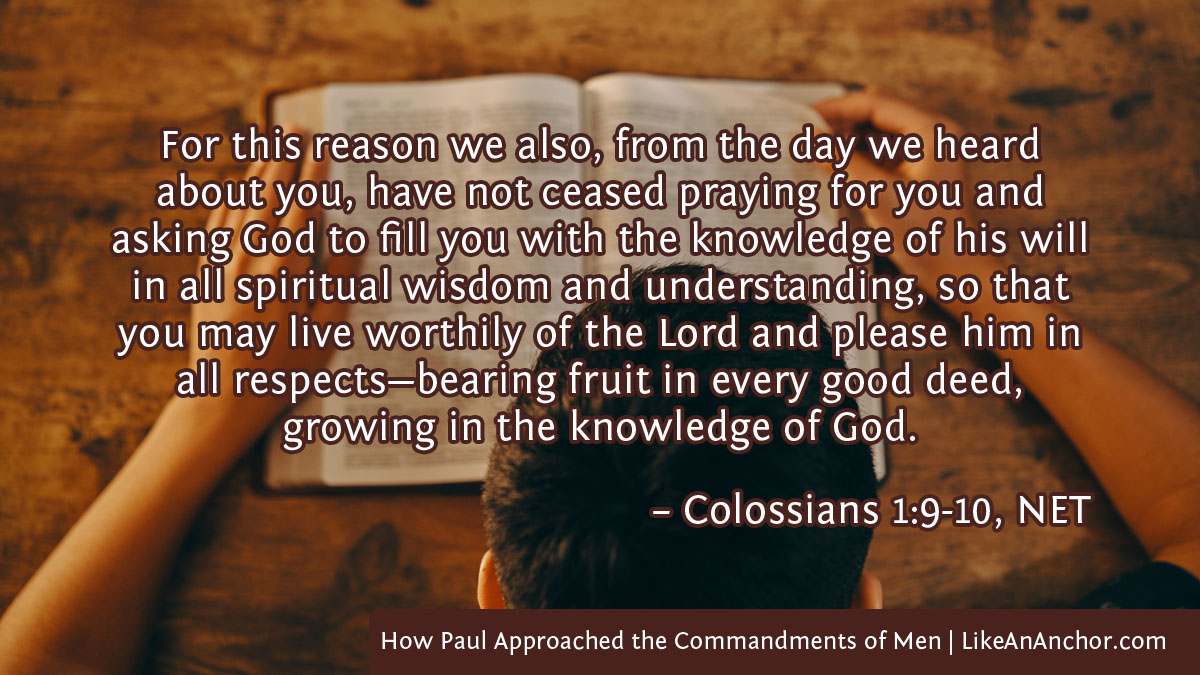
Image of a man reading the Bible overlaid with text from Colossians 1:9-10, NET version: "For this reason we also, from the day we heard about you, have not ceased praying for you and asking God to fill you with the knowledge of his will in all spiritual wisdom and understanding, so that you may live worthily of the Lord and please him in all respects—bearing fruit in every good deed, growing in the knowledge of God."
Image by Matt Vasquez from Lightstock

Jesus’s Take On God’s Law

Before going any farther in Paul’s writings, let’s look at what Jesus says. During His ministry, Jesus and His disciples were accused of things like Sabbath breaking, defiling themselves with sinners’ company, and unclean hygienic practices. We know that Jesus lived a sinless life and never broke His Father’s commands. But He did reject the additions humans made.

He said to them, “Isaiah prophesied correctly about you hypocrites, as it is written:

This people honors me with their lips,
but their heart is far from me.
They worship me in vain,
teaching as doctrine the commandments of men.’

Having no regard for the command of God, you hold fast to human tradition.”

Mark 7:6-8, NET (bold italics mark a quotation from Isa 29:13)

He’s not saying to stop following God’s commandments. He’s berating them for elevating their traditions to the same level as God’s law. The leading Jews of the time had things really mixed up. Even when they followed God’s law, they focused on the wrong things, emphasizing minute details and neglecting the “weightier matters.” That’s something Jesus criticized, but He speaks very differently about the law that came directly from God.

 “Do not think that I have come to abolish the law or the prophets. I have not come to abolish these things but to fulfill them. I tell you the truth, until heaven and earth pass away not the smallest letter or stroke of a letter will pass from the law until everything takes place. So anyone who breaks one of the least of these commands and teaches others to do so will be called least in the kingdom of heaven, but whoever obeys them and teaches others to do so will be called great in the kingdom of heaven. For I tell you, unless your righteousness goes beyond that of the experts in the law and the Pharisees, you will never enter the kingdom of heaven!”

Matthew 5:17-20, NET

Jesus clearly stated He had no intention of doing away with God’s law. Rather, He was there to fill it to the fullest extent. He also upheld God’s commands when giving practical advice to individuals. When a rich young man came to Jesus and asked, “What shall I do that I may inherit eternal life?” Jesus responded, “keep the commandments.” After the young man said he was already doing that, Jesus told him the only thing still lacking was a commitment to follow Jesus unconditionally (Matt. 19:16-21; Mark 10:17-21; Luke 18:18-22). Keeping God’s commands and following Jesus go hand-in-hand.

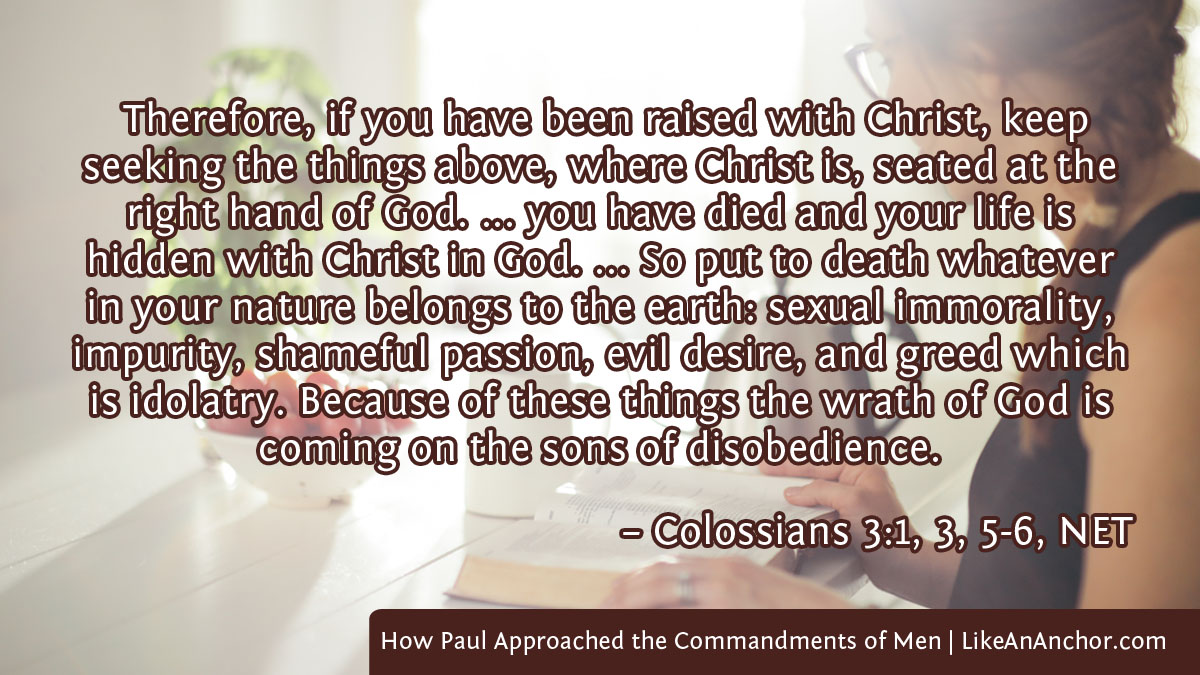
Image of a woman studying the Bible overlaid with text from Colossians 3:1, 3, 5-6, NET version: "Therefore, if you have been raised with Christ, keep seeking the things above, where Christ is, seated at the right hand of God. ... you have died and your life is hidden with Christ in God. ... So put to death whatever in your nature belongs to the earth: sexual immorality, impurity, shameful passion, evil desire, and greed which is idolatry. Because of these things the wrath of God is coming on the sons of disobedience."
Image by MarrCreative from Lightstock

Not Judged For Following Jesus

With that understanding, we can go back to Paul’s writings. Knowing he would never contradict Jesus’s teachings gives us framework for understanding difficult passages like Colossians 2. Here, his focus is on following Jesus rather than human beings. One example Paul uses is the issue of circumcision. There was a faction in the early church that believed new male converts had to be circumcised according to the Abrahamic covenant before they could receive salvation. But that was an aspect of the Old Covenants that pertained to the flesh and didn’t carry over. Rather, the emphasis is now on “circumcision not made with hands” on a spiritual level (Col. 2:11-12, WEB).

Interestingly, the focus on spiritual circumcision was already part of the Old Testament (Deut. 10:16; 30:6; Jer. 4:4). It’s just now brought to the forefront as Jesus fills the law to its fullest. We’re to “serve in newness of the spirit, and not in oldness of the letter” (Rom. 7:6, WEB) now that Christ has taken away our condemnation for breaking the law (Col. 2:14-15).

Therefore do not let anyone judge you with reference to eating or drinking or participation in a feast or a new moon or a Sabbath, which are a shadow of what is to come, but the reality is Christ.

Colossians 2:16-17, LEB

Some take this to mean no one should judge you for rejecting God’s dietary laws and holy day commands. But the focus in this chapter isn’t on moving away from keeping God’s commandments. It’s about following Jesus instead of human beings, and we have direct evidence of Jesus keeping Passover, the Feast of Unleavened Bread, and the Feast of Tabernacles. Also, the holy days weren’t something man came up with; they belong to God. If God tells His people to observe days that belong to Him, Jesus Himself observed them as holy, and His followers continued to do that (see, for example, 1 Cor. 5:6-8; 11:23-26), then one verse in a chapter that talks about rejecting human regulations doesn’t change that.

Follow Jesus. That’s It.

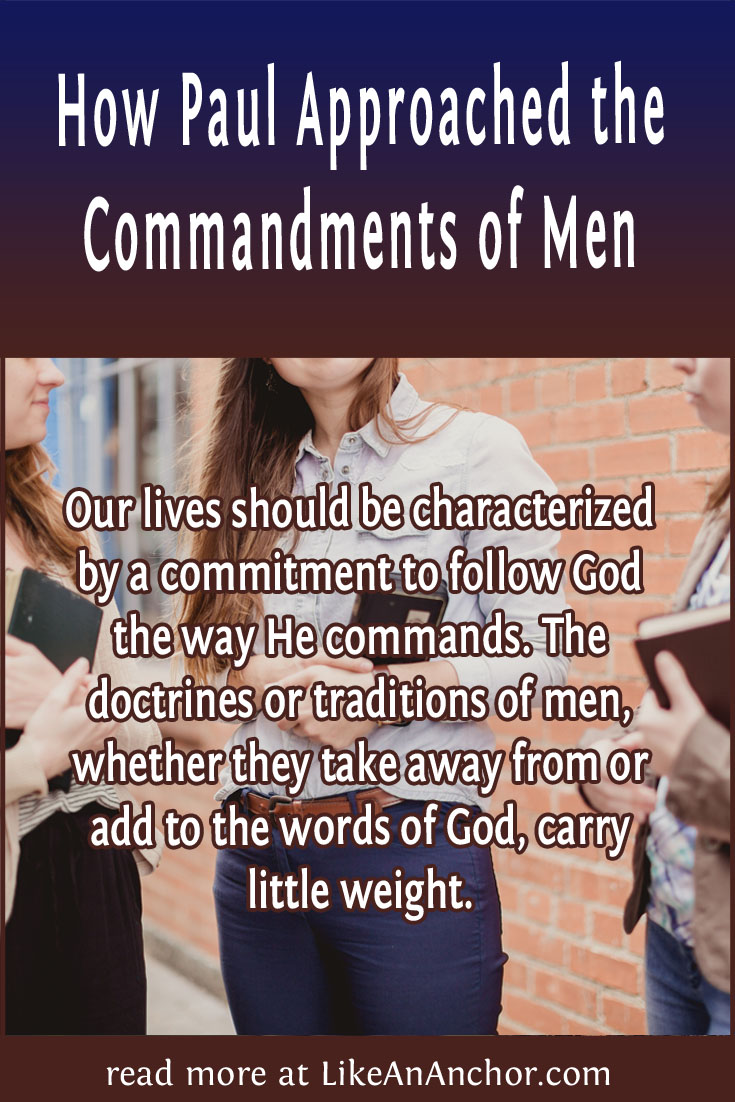
Image of three women holding Bibles, overlaid with blog's title text and the words, "Our lives should be characterized by a commitment to follow God the way He commands. The doctrines or traditions of men, whether they take away from or add to the words of God, carry little weight."
Image by Shaun Menary from Lightstock

We can learn even more about Paul’s intention when writing about feasts and sabbaths by continuing to read his letter. This part comes right after the verse we just looked at that mentions a feast, new moon, or Sabbath.

Let no one who delights in false humility and the worship of angels pass judgment on you. That person goes on at great lengths about what he has supposedly seen, but he is puffed up with empty notions by his fleshly mind. He has not held fast to the head from whom the whole body, supported and knit together through its ligaments and sinews, grows with a growth that is from God.

If you have died with Christ to the elemental spirits of the world, why do you submit to them as though you lived in the world? “Do not handle! Do not taste! Do not touch!” These are all destined to perish with use, founded as they are on human commands and teachings. Even though they have the appearance of wisdom with their self-imposed worship and humility achieved by an unsparing treatment of the body—a wisdom with no true value—they in reality result in fleshly indulgence.

Colossians 2:18-23, NET

Paul states that he’s talking about ordinances that are “human commands and teachings.” He’s not telling us to reject God’s commands! Rather, he’s saying to follow God the way God tells us to follow Him instead of the legalistic worship practices piled on by human beings.

Similarly, when writing to Titus, Paul warned not to pay “attention to Jewish myths and commandments of people who turn away from the truth” (Tit. 1:14, LEB). Instead, Titus was to “say the things which fit sound doctrine” (Tit. 2:1, WEB). The standard for “sound doctrine” is the entirety of scripture, not just the New Testament and cherry-picked parts of the Old (2 Tim. 3:16; Rom. 15:4). Our lives should be characterized by a commitment to follow God the way He commands. The doctrines or traditions of men, whether they take away from or add to the words of God, carry little weight.

There are physical parts of the Old Covenant law (e.g. hygienic practices for an encampment) that don’t apply to us today. There are parts that have been updated under the renewed covenant (e.g. we don’t stone people for death-penalty sins; they can be forgiven in Jesus Christ). But God never changes and the commandments He gave are still guides for helping us understand and develop His character. Obedience matters to God. Just look at how many times in John’s writings that loving and knowing God is linked to keeping His commandments (John 14:21;  15:10; 1 John 2:3-4; 5:2-3; 2 John 1:4-6).

God has never done away with His law or commandments and there’s no indication He’ll do so in the future (note: law is linked with covenants, but it’s not exactly the same thing as the Old Covenant). In fact, the closing parts of Revelation say, “Blessed are those who do his commandments, that they may have the right to the tree of life, and may enter in by the gates into the city” (Rev. 22:14, WEB). The city spoken of in this passage is new Jerusalem, which comes down to earth after the resurrections, Millennium, and final defeat of Satan. If God only intents to fellowship with those who keep His commandments at that point, why would we think He doesn’t want that now?


Save