Why Does 1 Corinthians 11 Matter Today?

In the first letter we have that Paul sent to the Corinthians, he wrote to address some specific things. Firstly, there were serious issues in this church. They were divided, arguing, and following different human teachers. They also had a big issue with tolerating sin, even priding themselves on how forbearing they were toward a man in their congregation living and sleeping with his stepmother. Paul had to set them right, and he did so by comparing them to ancient Israel and explaining how the Passover and Festival of Unleavened Bread apply to the New Covenant church.

In the midst of all this, Paul also talked about proper conduct within a church community. One of those passages is labeled in the chapter and verse model of our modern Bibles as 1 Corinthians 11:1-16. It’s a passage most people skip over because it has to do with headcoverings and hair length for men and women. It’s the only place in the New Testament where this topic comes up, and it’s one that generates a lot of debate, offense, and division so we tend to ignore it completely. But we miss something important if we skip this passage, even if we don’t agree on how to interpret it.

The Headcovering Passage

People often approach this passage as just being about women’s headcoverings, but it’s addressed just as much to men. Paul opened this discussion by saying, “Be imitators of me, just as I also am of Christ” and praising the Corinthians for maintaining “the traditions just as I passed them on to you” (1 Cor. 11:1, 2, NET). He then made a statement about authority in the churches (the ecclesia, or called-out ones) of God.

But I want you to know that Christ is the head of every man, and the man is the head of a woman, and God is the head of Christ. Any man who prays or prophesies with his head covered disgraces his head. But any woman who prays or prophesies with her head uncovered disgraces her head, for it is one and the same thing as having a shaved head. 

1 Corinthians 11:3-5, NET

In my studies on this topic, I learned that culturally, Jewish men and women covered their heads with scarves or prayer shawls while Greek/Gentile men and women tended not to cover (though they could, mostly as a fashion choice). This passage would have involved a change for Jewish men as well as Gentile women. Men who covered their heads while praying needed to stop, and women who didn’t cover their heads while praying needed to start. Full disclosure, I do cover my head when at a church gathering or praying and studying at home. You can click here to learn more about why and the research I did into the topic.

Context For Paul’s Next Commands About Women

So why can’t we just skip over this divisive passage? For one thing, it’s part of the Bible and if we admit the Bible is the inspired word of God, then there is value in every part of it even if we’re not yet sure what to make of it. This is a significant reason to pay attention to 1 Corinthians 11:1-16, but it’s not the one that we’re going to focus on today. In this post, I want to focus on the important context clues this passage provides for interpreting other parts of the letter.

As the letter continued, Paul covered instructions for keeping Passover correctly (1 Cor. 11:17-34), spiritual gifts and unity in the body (1 Cor. 12), the “more excellent way” of agape love (1 Cor. 13), the use of prophecy or “inspired speaking” in the church (1 Cor. 14:1-25), and proper, orderly conduct during a church meeting (1 Cor. 14:26-40). Paul didn’t address the topic of women again directly until chapter 14, but since he started out this part of the letter by addressing how men and women properly pray and prophecy in the church (men with their heads uncovered, women with their heads covered), we can assume the discussions about keeping Passover, having spiritual gifts and using them properly, and love are addressed equally to men and women in the church. The NET even uses the phrase “brothers and sisters” when Paul addresses believers, because the whole church group is included when Paul uses the word “brethren” (adelphoi in Greek). We all have key roles to play, and very similar responsibilities and gifts.

Then, we come to a place where Paul again addressed women and men separately, with different instructions for each. It’s one of the infamous passages about women being silent in church.

What should you do then, brothers and sisters? When you come together, each one has a song, has a lesson, has a revelation, has a tongue, has an interpretation. Let all these things be done for the strengthening of the church. … Two or three prophets should speak and the others should evaluate what is said. … For you can all prophesy one after another, so all can learn and be encouraged. Indeed, the spirits of the prophets are subject to the prophets, for God is not characterized by disorder but by peace.

As in all the churches of the saints, the women should be silent in the churches, for they are not permitted to speak. Rather, let them be in submission, as in fact the law says. If they want to find out about something, they should ask their husbands at home, because it is disgraceful for a woman to speak in church.

1 Corinthians 14:26, 29, 31-35, NET

If you read Paul’s statement about women being silent by itself, it sounds like women shouldn’t say a word the whole time they’re at a gathering of believers. This doesn’t make sense in the context of other scriptures, which show women were deeply involved in the churches. This is where 1 Corinthians 11 can provide much-needed context to help us figure out what Paul is likely saying in this passage.

“In light of 11:2-16, which gives permission for women to pray or prophesy in the church meetings, the silence commanded here seems not to involve the absolute prohibition of a woman addressing the assembly. Therefore (1) some take be silent to mean not taking an authoritative teaching role as 1 Tim 2 indicates, but (2) the better suggestion is to relate it to the preceding regulations about evaluating the prophets (v. 29). Here Paul would be indicating that the women should not speak up during such an evaluation, since such questioning would be in violation of the submission to male leadership that the OT calls for (the law, e.g., Gen 2:18).”

NET study note on 1 Cor. 14:34

Whether you think women should cover their heads today or not, the fact is that 1 Corinthians 11 addresses the proper way for women to pray and/or prophecy. Obviously women can, and frequently do throughout the scriptures, pray and prophecy outside of church meetings. But the context of this section of scripture is how to do things in the churches, when believers are gathered together, as for a formal church service. It follows, then, that Paul talks about how women can properly pray and prophecy in church in 1 Corinthians 11, then addresses a time when silence is more appropriate in 1 Corinthians 14.

Culture Adds More Context

It also helps to take the cultural context into account when looking at Paul’s writings. Now, there are right and wrong ways to do this. Sometimes, people say that Paul just had a backwards view of women because he was influenced by his culture and so we don’t need to listen to him anymore. But in reality, some of his writings indicate he was pretty radical compared to the culture of his day.

Likewise the women are to dress in suitable apparel, with modesty and self-control. Their adornment must not be with braided hair and gold or pearls or expensive clothing, but with good deeds, as is proper for women who profess reverence for God. A woman must learn quietly with all submissiveness. But I do not allow a woman to teach or exercise authority over a man. She must remain quiet.

1 Timothy 2:9-12, NET

We read this today and we might feel offended that he’d say women have to be quiet and submissive and can’t teach. People of Paul’s day, though, would have read “a woman must learn” and been shocked by that. This statement “was a radical and liberating departure from the Jewish view that women were not to learn the law” (NET footnote on 1 Tim. 2:12). Some Jewish girls received Torah instruction while they were young and if they had a good family they might have learned a little more, but women weren’t generally taught very much and they certainly weren’t selected for advanced study with respected rabbis.

Jesus’s interactions with women as spiritual equals was unusual, and Paul continued His practice. He also assured his readers, though, that women serving in the church, preaching the gospel, and learning God’s words did not mean that women were suddenly going to start taking over roles that God entrusted to men. Women are to learn, yes, but they will also be submissive in the sense that God expects. Women can pray and prophecy, but they won’t (or shouldn’t) be disrupting church meetings or usurping male roles.

We often miss it today with our modern perspectives, but Paul isn’t advocating for either the subjugation of women or for doing away with gender roles in 1 Corinthians and 1 Timothy. It’s actually a more balanced view than we often find in churches today, which in many cases either try to follow society in doing away with different roles for men and women entirely, or follow traditional (mis)interpretations of Paul that bar women from being involved. However you interpret the passage on hair length and headcoverings, it provides much-needed context assuring us that women were deeply involved in the New Testament church and they still can be in the churches today.


Featured image by StockSnap from Pixabay

Song Recommendation: “This Girl” by Lauren Daigle

Am I Really In the Faith? (Crash-Course in 2 Corinthians)

What do you think of if I bring up the idea of self-examination?

When I talk about self-examination, it’s often in the context of Passover preparation and we usually turn to 1 Corinthians. But there’s another instruction about self-examination in Paul’s second letter to the church at Corinth. That’s what I want to look at today as we move from Passover to Pentecost (May 28 this year).

Put yourselves to the test to see if you are in the faith; examine yourselves! Or do you not recognize regarding yourselves that Jesus Christ is in you—unless, indeed, you fail the test!

2 Corinthians 13:5, NET

My dad read this verse a couple weeks ago in his sermon, and it jumped out at me because of how Paul uses the word “faith.” As you might imagine if you read my book review of Relational Faith, faith in scripture has been on my mind a lot lately. I wanted to take a closer look at this verse with Brent Schmidt’s study on the original first-century context for the Greek word pistis fresh in my mind.

As you’ve no doubt noted in the title, I might have started by looking at the end of 2 Corinthians, but we’re going to look at the entire letter. One of the key principles I follow when interpreting Paul’s writings is that he must be read in context. This includes looking at the parts of the letter around the verse(s) you want to look at as well as keeping historical context in mind. As I started looking at the context, I realized the whole letter is important to understanding the self-examination point near the end.

Image of a woman reading a Bible overlaid with text from 2 Corinthians 1:1-2, NET version:  “From Paul, an apostle of Christ Jesus by the will of God, and Timothy our brother, to the church of God that is in Corinth, with all the saints who are in all Achaia. Grace and peace to you from God our Father and the Lord Jesus Christ!”
Image by MarrCreative from Lightstock

Faithful New Covenant Ministry (2 Corinthians 1-5)

Paul opens this second canonized letter to the Corinthians with a message of comfort and hope. He then goes on to explain why he didn’t visit the Corinthian church earlier, saying, “Now I appeal to God as my witness, that to spare you I did not come again to Corinth. I do not mean that we rule over your faith, but we are workers with you for your joy, because by faith you stand firm. So I made up my own mind not to pay you another painful visit” (2 Cor. 1:23-2:1, NET). It seems that the “painful visit” he alludes to might have been connected with the issues he wrote about in 1 Corinthians, for he now counsels them to welcome back a man he’d previously told them to put out of the church because of sinful behavior now that he has sincerely repented.

This is also the first time Paul brings up “faith” in this letter. A note in the NET says that “because by faith you stand firm” could be translated “because you stand firm in the faith.” As we know from our discussion of Schmidt’s book a couple weeks ago, “faith” in the first century wasn’t simply a set of beliefs or a feeling. Rather, “in the first century, pistis implied active loyalty, trust, hope, knowledge, and persuasion” as part of a covenant relationship (p. 11). Here in 2 Corinthians, Paul is telling his readers that he and other ministers don’t rule over their faithful covenant relationship with Jesus; ministers are there to help you stand firm in the covenant that you entered into with God when you were baptized.

Paul then goes on to talk about his role as a person sent by God for ministry work, referring to himself and his fellow ministers as “servants of a new covenant” (2 Cor 3:6, NET). He then compares the new covenant with the old, speaking of the letter of the law written in stone and the spirit of the law that’s associated with an even more glorious ministry. It’s in the context of ministers’ roles in the New Covenant that he begins talking about faith again. He says, “we have the same spirit of faith as that shown in what has been written, ‘I believed; therefore I spoke,’ we also believe, therefore we also speak” (2 Cor. 4:13, NET, quoting Ps. 116:10). Just a little farther down the page, Paul makes the famous statement, ” we live by faith, not by sight” (2 Cor. 5:7, NET). We don’t yet see all the glorious promises of the covenant, but we trust that God will deliver them when we are faithful to Him.

Living in Holiness and Faith (2 Corinthians 6-10)

Paul goes on to talk about reconciliation, Christ’s sacrifice, and true teachings. He also continues his discussion of ministry in the New Covenant, describing himself and other “ambassadors for Christ” as “fellow workers” with his readers (2 Cor. 5:20; 6:1, NET). He also talks about the things that responsible Christians need to do, urging us “not to receive the grace of God in vain” (2 Cor. 6:1, NET) or associate too closely with unbelievers.

For we are the temple of the living God, just as God said, “I will live in them and will walk among them, and I will be their God, and they will be my people.” Therefore “come out from their midst, and be separate,” says the Lord, “and touch no unclean thing, and I will welcome you, and I will be a father to you, and you will be my sons and daughters,” says the All-Powerful Lord.

Therefore, since we have these promises, dear friends, let us cleanse ourselves from everything that could defile the body and the spirit, and thus accomplish holiness out of reverence for God.

2 Corinthians 6:16-7:1, NET

Paul returns to the topic of his previous letters again after this point, reinforcing that “sadness as intended by God produces a repentance that leads to salvation, leaving no regret” (2 Cor. 7:10, NET). He doesn’t regret writing a letter that made them sad because it bore such good fruits and led to rejoicing, encouragement, and more fervent faith.

The next two times “faith” shows up in 2 Corinthians, it’s in the context of faithful action. Paul tells them “you excel in everything,” including “in faith,” when writing about generous giving to other saints in need (2 Cor 8:7, NET). He then goes back to talking about his ministry work and says, “we hope that as your faith continues to grow, our work may be greatly expanded among you” (2 Cor. 10:15, NET). For Paul, faith always went along with doing something.

Image of four people studying the Bible togather overlaid with text from 2 Corinthians 13:5-6, WEB version:  “Examine your own selves, whether you are in the faith. Test your own selves. Or don’t you know about your own selves, that Jesus Christ is in you?—unless indeed you are disqualified. But I hope that you will know that we aren’t disqualified.”
Image by Ben White from Lightstock

2 Corinthians 10-12

One of my favorite passages from 2 Corinthians comes at the beginning of chapter 10 (of course, there weren’t chapter breaks originally; it’s just a convenient way of navigating scripture). I usually think of this as a section about spiritual warfare and mental health. It is those things, but it’s also part of Paul’s discussion of his ministry and his hopes for the people he writes to.

Now I, Paul, appeal to you personally by the meekness and gentleness of Christ (I who am meek when present among you, but am full of courage toward you when away!)—now I ask that when I am present I may not have to be bold with the confidence that (I expect) I will dare to use against some who consider us to be behaving according to human standards. For though we live as human beings, we do not wage war according to human standards, for the weapons of our warfare are not human weapons, but are made powerful by God for tearing down strongholds. We tear down arguments and every arrogant obstacle that is raised up against the knowledge of God, and we take every thought captive to make it obey Christ. We are also ready to punish every act of disobedience, whenever your obedience is complete. You are looking at outward appearances. If anyone is confident that he belongs to Christ, he should reflect on this again: Just as he himself belongs to Christ, so too do we. For if I boast somewhat more about our authority that the Lord gave us for building you up and not for tearing you down, I will not be ashamed of doing so.

2 Corinthians 10:1-8, NET

As Paul goes on, he continues describing his ministry work. With the topic of faith in mind as I read this, I’m struck by how all-in Paul was to his faith commitments. He endured terrible suffering to keep preaching the gospel. He passionately defends the ministry work that God gave him, and condemns those who claim to be apostles but don’t have the same commission from God and commitment to teaching His word faithfully. He even shares his story of glorious revelations and a humbling thorn in the flesh to show “I lack nothing in comparison to those “’super-apostles,’ even though I am nothing” (2 Cor. 12:11, NET). Yet this defense isn’t for his own benefit; he’s writing to build his readers up before his third visit because he’s afraid he’ll find that some of them still aren’t living in the faith.

Have you been thinking all this time that we have been defending ourselves to you? We are speaking in Christ before God, and everything we do, dear friends, is to build you up. For I am afraid that somehow when I come I will not find you what I wish, and you will find me not what you wish. I am afraid that somehow there may be quarreling, jealousy, intense anger, selfish ambition, slander, gossip, arrogance, and disorder. I am afraid that when I come again, my God may humiliate me before you, and I will grieve for many of those who previously sinned and have not repented of the impurity, sexual immorality, and licentiousness that they have practiced.

2 Corinthians 12:9-21, NET

Now Paul reveals the point of the whole letter. He’s been writing to build people up and encourage them to make necessary changes before he comes. “Quarreling, jealousy, intense anger, selfish ambition, slander, gossip, arrogance, and disorder” are not things that he ought to see in a faithful church, nor is “impurity, sexual immorality, and licentiousness.” Those things have to go. Which brings us to the instruction to test ourselves.

Putting Yourselves to the Test (2 Corinthians 13)

Image of a man walking in the woods holding a Bible with the blog's title text and the words "In 2 Corinthians, Paul tells his readers, “Put yourselves to the test to see if you are in the faith.” Why does he issue this warning, and how does it fit with the rest of the letter?"
Image by HarveyMade from Lightstock

This is the third time I am coming to visit you. By the testimony of two or three witnesses every matter will be established. I said before when I was present the second time and now, though absent, I say again to those who sinned previously and to all the rest, that if I come again, I will not spare anyone, since you are demanding proof that Christ is speaking through me. He is not weak toward you but is powerful among you. For indeed he was crucified by reason of weakness, but he lives because of God’s power. For we also are weak in him, but we will live together with him, because of God’s power toward you. Put yourselves to the test to see if you are in the faith; examine yourselves! Or do you not recognize regarding yourselves that Jesus Christ is in you—unless, indeed, you fail the test! And I hope that you will realize that we have not failed the test! Now we pray to God that you may not do anything wrong, not so that we may appear to have passed the test, but so that you may do what is right even if we may appear to have failed the test. For we cannot do anything against the truth, but only for the sake of the truth. For we rejoice whenever we are weak, but you are strong. And we pray for this: that you may become fully qualified. Because of this I am writing these things while absent, so that when I arrive I may not have to deal harshly with you by using my authority—the Lord gave it to me for building up, not for tearing down!

2 Corinthians 13:1-10, NET (bold italics mark a  quotation from Deut 19:15)

Notice the intensity of Paul’s instruction here. “Put yourselves to the test to see if you are in the faith; examine yourselves!” This is important. He’s been building up to this for the entire letter. Paul didn’t just tell the Corinthians they needed to repent, stop sinning, and live obediently with God because he wanted to. He taught this because it’s necessary for faithful living.

“Or do you not recognize regarding yourselves that Jesus Christ is in you,” Paul asks, “unless, indeed, you fail the test!” Either Jesus is in you and you’ll be living in the faith, or He’s not. There are no two ways about it. You can’t live sinfully and still say you have a relationship with Jesus. If the Lord is living inside you, then you’ll be acting like Him and when you mess up you’ll repent and change.

 Finally, brothers and sisters, rejoice, set things right, be encouraged, agree with one another, live in peace, and the God of love and peace will be with you. Greet one another with a holy kiss. All the saints greet you. The grace of the Lord Jesus Christ and the love of God and the fellowship of the Holy Spirit be with you all.

2 Corinthians 3:11-13, NET

This is how Paul ends the letter. He wants his readers to “set things right,” but he also wants them to rejoice, be encouraged, and live in peace. As Proverbs says, “the wise in heart accept commandments” (Prov. 10:8, WEB). For those who love God, correction like Paul gives here motivates change and also brings joy because it helps us live in a closer relationship with God.


Featured image by Aaron Kitzo from Lightstock

Exodus To Corinthians: A Passover Message For The New Testament Church

In 1 Corinthians, Paul makes several references to leavening and to Passover. For many readers today, these references mean very little because so many Christian churches have left the roots of their faith, which Paul was referencing here. In order to really understand key passages of 1 Corinthians, we need to understand Passover and the Feast of Unleavened Bread.

I know some (perhaps quite a few) of you are Christians who don’t keep Passover, but I hope you’ll still keep reading today’s post. I think you’ll find it interesting and maybe it’ll give you something new to think about and study.

Passover Background

The Passover story begins in Exodus 12. We’re nearing the end of the plagues of Egypt, and the Lord is telling Moses what the Israelite must do to avoid the final plague — the death of the first born. In the first month of the year, on the evening that begins the 14th day (Hebrew days begin at sunset), Israel was to kill a young male lamb, paint the door posts of their houses with its blood, then roast the lamb whole and eat it with unleavened bread and bitter herbs (Ex. 12:1-13).

This day shall be to you for a memorial, and you shall keep it a feast to Yahweh: throughout your generations you shall keep it a feast by an ordinance forever. (Ex. 12:14, WEB)

The Lord goes on to describe a festival of unleavened bread (matzah) that follows the Passover. For seven days, no leavening (hametz) is permitted in anyone’s house and whoever eats leavened food will be cut off from God’s people (Ex. 12:15-20). Later instructions in Leviticus clarify the timing of all this, stating that Passover is on the 14th and Unleavened Bread begins with a holy convocation on the 15th, then ends with another holy convocation on the seventh day (Lev. 23:4-8). The two holy days are Sabbaths of rest where you are not to work, much like the weekly Sabbath.

The New Covenant Passover

Moving into the New Testament, the gospels make careful note of Passovers that Jesus kept during his ministry. The first is recorded in John 2:13-23. The second is skimmed over, though Luke 6:1 probably references the last day of Unleavened Bread. John 6:4 mentions the third Passover, and Christ’s final Passover is recorded in detail by all four gospels because that was the day He died.

He said to them, “I have earnestly desired to eat this Passover with you before I suffer, for I tell you, I will no longer by any means eat of it until it is fulfilled in God’s Kingdom.” (Luke 22:15-16, WEB)

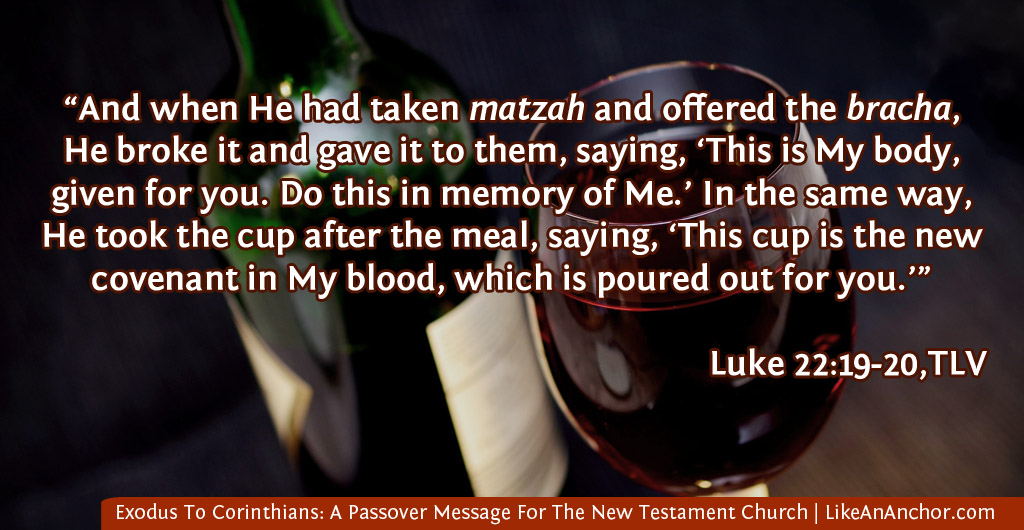
He then proceeded to institute new Passover symbols for New Covenant believers. Jesus will not partake of the Passover again until the kingdom of God comes in the future, but He tells us to do so in memory of Him (Luke 22:17-20).

For I received from the Lord that which also I delivered to you, that the Lord Jesus on the night in which he was betrayed took bread. When he had given thanks, he broke it, and said, “Take, eat. This is my body, which is broken for you. Do this in memory of me.” In the same way he also took the cup, after supper, saying, “This cup is the new covenant in my blood. Do this, as often as you drink, in memory of me.” (1 Cor. 11:23-25, WEB)

Exodus To Corinthians: A Passover Message For The New Testament Church | LikeAnAnchor.com
Photo credit: congerdesign via Pixabay

Honoring Jesus By Keeping The Passover

The passage we just read from 1 Corinthians 11 is part of the most obvious Passover reference in this letter. Paul goes on to share instructions on how we’re supposed to prepare for Passover, as well as warnings about the dangers of not keeping Passover the correct way. Read more