A New Crash Course in Galatians

When I was writing last week’s post about inheriting covenants, I found myself writing a lot about Galatians. At one point while drafting, more than half that post was just about chapters 2 and 3. I decided to copy all that I’d written into a new post, condense the Galatians section, and focus entirely on Galatians this week.

I don’t usually spend much time in Galatians, at least not writing about it here on the blog (though I did previously write another “crash course” post on it 4 years ago). I’ve more than made up for that in today’s post, though, which is quite long (apologies for the 4,000 word article).

My reason for avoiding Galatians is it’s very easy to misinterpret, and I usually don’t want to take the time to contextualize verses from it and/or I’m not quite sure how to explicate them correctly. It’s easier to quote from other books, at least when we’re talking about a subject like covenants or a Christian’s relationship to God’s law. The “I am crucified with Christ,” fruit of the spirit, and “sowing and reaping” sections are the easiest to understand, so that’s where I (and most people I know of) spend most of their time if they go to Galatians. Today, though, we’ll do our best to study the whole thing.

Context and Background

Galatians is one of the letters that Paul likely wrote with co-authors. He began the letter, “Paul … and all the brothers with me, to the churches of Galatia” (Gal. 1:1-2. NET). Though Paul wrote this letter with his own hands (Gal. 6:11), it seems that he collaborated, at least to some extent, with other believers. That would make sense considering the subject matter; Paul’s main focus is on correcting errors in the Galatian’s theology. Bringing in others to consult on and probably proofread the letter makes it less about Paul and more about the truth held by trusted, established followers of Jesus.

Paul also takes great care to outline his qualifications as an authority on the subject of the true gospel. He can write to correct distorted gospels because he is “an apostle (not from men, nor by human agency, but by Jesus Christ and God the Father who raised him from the dead)” (Gal. 1:1, NET). He also reminds his readers “that the gospel I preached is not of human origin. For I did not receive it or learn it from any human source; instead I received it by a revelation of Jesus Christ” (Gal. 1:11-12, NET). Right off the bat, Paul wants to be very clear that the gospel Galatian believers originally received came straight from Jesus and was verified by the apostles who’d been personally taught by Jesus (Gal. 1:13-2:10). That understanding helps contextualize Paul’s shock that he would even need to write this letter.

 I am astonished that you are so quickly deserting the one who called you by the grace of Christ and are following a different gospel—not that there really is another gospel, but there are some who are disturbing you and wanting to distort the gospel of Christ. But even if we (or an angel from heaven) should preach a gospel contrary to the one we preached to you, let him be condemned to hell! As we have said before, and now I say again, if any one is preaching to you a gospel contrary to what you received, let him be condemned to hell! Am I now trying to gain the approval of people, or of God? Or am I trying to please people? If I were still trying to please people, I would not be a slave of Christ!

Galatians 1:6-10, NET

We’re not sure exactly when Galatians was written, but it was at some point after Paul had preached the gospel to churches in this region. Like most of his letters, he’s writing to a group that he already has a relationship with and addresses something specific that’s going on in the church.

One exception to this pattern is the letter to Rome; Paul hadn’t been there before, and Romans is an introduction of sorts (Rom. 1:8-15; 15:22-24). That makes Romans very helpful in understanding Galatians; we can assume that the foundational theology Paul outlines in Romans is pretty much what he would have preached to the Galatians. Since the gospel he preached came straight from Jesus, it wouldn’t have been changing from church-to-church or over the course of Paul’s ministry.

Likewise, we can use the gospels as guides to interpret Galatians (as well as Paul’s other writings). As a faithful apostle, Paul would not have contradicted any of Jesus’s teachings. If there’s ever a case where we’re not sure what Paul meant (and he can be tricky to interpret, as even Peter points out [2 Pet. 3:15-16]), we need to compare what he’s saying to Jesus’s teachings. Whatever interpretation we go with must agree with Jesus. We won’t talk about the General Epistles much in today’s post, but those are also helpful pre-reqs for understanding Paul.

Image of ___ overlaid with text from Romans 3:28-31, NET version:  “For we consider that a person is declared righteous by faith apart from the works of the law. Or is God the God of the Jews only? Is he not the God of the Gentiles too? Yes, of the Gentiles too! Since God is one, he will justify the circumcised by faith and the uncircumcised through faith. Do we then nullify the law through faith? Absolutely not! Instead we uphold the law.”
Image by Shaun Menary from Lightstock

Paul Setting The Stage

Paul does not outline the specifics of the heresy in Galatia. He assumes his readers already know what’s going on. Those of us divorced from this context have to read closely and draw conclusions from the letter and what Acts tells us about similar questions. It appears that the Galatian believers had been deceived by someone who came in and told them they needed to keep the whole Jewish law in order to be saved. The Galatians were worried that male believers needed to be circumcised, that they all had to keep the whole Old Covenant law, and that they additionally had to keep Jewish additions to God’s law.

A large section of the letter’s introduction is devoted to Paul explaining his ministry and pointing out that the true Christian apostles never compelled new Gentile converts to be circumcised (see Acts. 11 and 15). Male circumcision was a key part of the Abrahamic Covenant, which continued for ancient Israel into the Sinai Covenant and up to the time of Jesus. Paul addressed the question of whether new converts to following Jesus the Messiah should be circumcised in several letters. Taken together, his basic explanation was that New Covenant circumcision happens in the heart rather than as a physical sign (which aligns perfectly with God’s Old Testament intention as well [Deut. 10:16; 30:6; Jer. 4:4; 9:26; Rom. 2:29; Phil. 3:3; Col. 2:11-12]).

But when Cephas [Peter] came to Antioch, I opposed him to his face, because he had clearly done wrong. Until certain people came from James, he had been eating with the Gentiles. But when they arrived, he stopped doing this and separated himself because he was afraid of those who were pro-circumcision. …

We are Jews by birth and not Gentile sinners, yet we know that no one is justified by the works of the law but by the faithfulness of Jesus Christ. And we have come to believe in Christ Jesus, so that we may be justified by the faithfulness of Christ and not by the works of the law, because by the works of the law no one will be justified. But if while seeking to be justified in Christ we ourselves have also been found to be sinners, is Christ then one who encourages sin? Absolutely not! But if I build up again those things I once destroyed, I demonstrate that I am one who breaks God’s law. For through the law I died to the law so that I may live to God.

I have been crucified with Christ, and it is no longer I who live, but Christ lives in me. So the life I now live in the body, I live because of the faithfulness of the Son of God, who loved me and gave himself for me. I do not set aside God’s grace, because if righteousness could come through the law, then Christ died for nothing!

Galatians 2:11-12, 15-21, NET

In other words, the Old Covenant ended with Jesus’s death and a New Covenant took its place. We certainly don’t live lawlessly now, but we live with the knowledge that we can’t make ourselves righteous. Jesus’s faithfulness brings us righteousness and justification. The moment we think we’re saved by our own efforts rather than Christ’s sacrifice, we’ve set aside God’s grace. That doesn’t mean we break God’s law now; Christ in us does not encourage sin nor did He do away with God’s law (Matt. 5:17-20; Rom. 3:28-31). But He also didn’t redeem us and give us the Spirit so that we could then try to save ourselves by our own efforts.

You foolish Galatians! Who has cast a spell on you? Before your eyes Jesus Christ was vividly portrayed as crucified! The only thing I want to learn from you is this: Did you receive the Spirit by doing the works of the law or by believing what you heard? Are you so foolish? Although you began with the Spirit, are you now trying to finish by human effort? Have you suffered so many things for nothing?—if indeed it was for nothing. Does God then give you the Spirit and work miracles among you by your doing the works of the law or by your believing what you heard?

Galatians 3:1-5, NET

These questions prime the Galatians for the next parts of Paul’s argument. He defends the gospel he preached previously, then asks questions to wake them up to ways they’d distorted the gospel. From the way Paul speaks, I assume the Galatians made one of two errors very common to people trying to follow Jesus.

Sometimes, we err by becoming too permissive and thinking that God’s grace means we have no responsibilities and that law doesn’t exist anymore (Paul addressed this with the Corinthians, who prided themselves on allowing sin in the congregation). Other times, we’re more like the Galatians and error by thinking that if we do every command written in the Bible just right and maybe add some Jewish tradition on top of that, then we’ll make ourselves good enough to deserve salvation. Neither is correct.

Image of a man walking with his daughter overlaid with text from Genesis 18:18-19, NET version:  “Abraham will surely become a great and powerful nation, and all the nations on the earth may receive blessing through him. I have chosen him so that he may command his children and his household after him to keep the way of the Lord by doing what is right and just. Then the Lord will give to Abraham what he promised him.”
Image by Matt Vasquez from Lightstock

Faith Like Abraham

Rather than present again the nuanced rhetorical argument of Romans, where Paul explains that the New Covenant replaces the Old Covenant entirely and elevates the Law of God to a higher, spiritual, internalized level, in Galatians Paul goes back even farther to the covenant God made with Abraham. For this letter, he needs to show that the Galatians are not saved by doing the works commanded in the law and counter the claim that new believers should be circumcised. To do that, he argues that New Covenant believers follow the same pattern that Abraham did even though they’re not doing the physical sign of that covenant.

Just as Abraham believed God, and it was credited to him as righteousness, so then, understand that those who believe are the sons of Abraham. And the scripture, foreseeing that God would justify the Gentiles by faith, proclaimed the gospel to Abraham ahead of time, saying, “All the nations will be blessed in you.” So then those who believe are blessed along with Abraham the believer. 

Galatians 3:6-9, NET (bolt italics mark quotes from the Old Testament)

Here, Paul quotes from the record in Genesis of God cutting a covenant with Abraham (Gen. 15). This covenant is one of inheritance and blessing. We learn more about this in Genesis 17 and 18, which Paul also quotes. Back in Genesis, God said He would bless Abraham and that “I have chosen him so that he may command his children and his household after him to keep the way of the Lord by doing what is right and just. Then the Lord will give to Abraham what he promised him” (Gen. 18:19, NET). Notice that God’s covenant with Abraham included following the Lord’s way and doing what is right. But, as Paul emphasized, the promises come to Abraham and his descendants because God is faithful, not because they kept the Law that God later shared as part of the Sinai Covenant or because they observed Jewish traditions added later.

For all who rely on doing the works of the law are under a curse, because it is written, “Cursed is everyone who does not keep on doing everything written in the book of the law.” Now it is clear no one is justified before God by the law, because the righteous one will live by faith. But the law is not based on faith, but the one who does the works of the law will live by them. Christ redeemed us from the curse of the law by becoming a curse for us (because it is written, “Cursed is everyone who hangs on a tree”) in order that in Christ Jesus the blessing of Abraham would come to the Gentiles, so that we could receive the promise of the Spirit by faith.

Galatians 3:10-14, NET (bolt italics mark quotes from the Old Testament)

God does want people to follow His law (it defines sin, and since sin is not consistent with God’s character it damages relationships between us and Him). But God also knows that all people sin and we can’t keep His law perfectly. It is very, very good for us that He upholds His parts of covenants even when people aren’t faithful, because one of those covenant promises was that God would send Jesus as the Messiah. That’s how we inherit the Abrahamic Covenant promises: through Jesus Christ.

 Brothers and sisters, I offer an example from everyday life: When a covenant has been ratified, even though it is only a human contract, no one can set it aside or add anything to it. Now the promises were spoken to Abraham and to his descendant. Scripture does not say, “and to the descendants,” referring to many, but “and to your descendant,” referring to one, who is Christ. What I am saying is this: The law that came 430 years later does not cancel a covenant previously ratified by God, so as to invalidate the promise. For if the inheritance is based on the law, it is no longer based on the promise, but God graciously gave it to Abraham through the promise.

Galatians 3:15-18, NET (bolt italics mark quotes from the Old Testament)

A few verses later, Paul says that the Law was “added because of transgressions, until the arrival of the descendant to whom the promise had been made” (Gal. 3:19, NET). He also says the law was a guard to keep us safe and a “guardian” or “tutor to bring us to Christ, that we might be justified by faith” (Gal. 3:24, WEB). The law defines sin for us and reveals the penalties for breaking God’s covenant law. As transgressors of the covenant, we deserved to inherit the curses contained in the covenanting words (Deut. 11:26-32; 27:1-28:68).

The only one who perfectly kept God’s covenant was Jesus Christ, and so He’s the only one who truly deserved to inherit all the promises. Once Christ inherited, He died and “willed” those promises to us. Now, “if you belong to Christ, then you are Abraham’s descendants, heirs according to the promise” (Gal. 3:29, NET). Moving from the Old to the New Covenant is like going from being slaves to being “sons with full rights” (Gal. 3:23-4:7).

Image of a woman reading the Bible overlaid with text from Heb. 10:14-17, NET version:  “For by one offering he has perfected for all time those who are made holy. And the Holy Spirit also witnesses to us, for after saying, ‘This is the covenant that I will establish with them after those days, says the Lord. I will put my laws on their hearts and I will inscribe them on their minds,’ then he says, ‘Their sins and their lawless deeds I will remember no longer.’”
Image by Pearl from Lightstock

No Going Back To the Old

Now we get to the passages of Galatians that I struggle with, because I understand that the Old Covenant is over and we’re under the New Covenant, but I also know from Jesus Himself and from other apostolic writings that God’s law still exists. The confusing part is that most of God’s law that we have recorded in scripture was given as part of the Old Covenant. So I struggle sometimes with figuring out what in the Torah is God’s timeless, enduring Law and what is part of the Old Covenant that ended with Jesus’s sacrifice.

Formerly when you did not know God, you were enslaved to beings that by nature are not gods at all. But now that you have come to know God (or rather to be known by God), how can you turn back again to the weak and worthless basic forces? Do you want to be enslaved to them all over again? You are observing religious days and months and seasons and years. I fear for you that my work for you may have been in vain. I beg you, brothers and sisters, become like me, because I have become like you. You have done me no wrong!

Galatians 4:8-12, NET

Remember that he’s talking with Gentile converts, so the “beings that by nature are not gods at all” are most likely references to false gods worshiped by people in the Galatian region. But Paul is also talking about not being enslaved to the Old Covenant, so we read this part about “observing religious days and months and seasons and years” and readers wonder if Paul means something pagan, something added by the Jews, or the sabbaths outlined in Leviticus 23. Many commentators say it’s the Sabbaths, but Jesus kept the Sabbath and the author of Hebrews (very likely Paul) concludes, “a Sabbath rest remains for the people of God” (Heb. 4:9). Additionally, Paul clearly instructed the Corinthians to keep the Feast of Unleavened Bread (1 Cor. 5:8). Whatever he’s talking about here in Galatians, it isn’t getting rid of God’s holy days.

Contextually, since Paul was talking about the time before they knew God at all, it seems most likely that he’s referring to something other than the Biblical holy days. It may be that the Galatians practiced some kind of religious syncretism and continued keeping their pagan festivals. Or perhaps he’s rebuking the Galatians for keeping the holy days wrongly (perhaps transactionally, as if by keeping these days God will “owe” them something), as ancient Israel did when God told them, “I cannot tolerate sin-stained celebrations!” (Is. 1:13, NET).

Paul then made a personal appeal to the Galatians to hear him and come back to the truth. He accuses those who’ve been preaching a distorted gospel of trying to isolate the Galatians for their own gain (Gal. 4:13-20). Then, he returns to the topic of being under the law and this time uses Abraham’s children as an allegory. It roughly parallels Romans 11, in that Paul is contrasting the Jews who didn’t follow the Messiah with the Jews and Gentiles who accept Jesus and inherit the promises of God (Gal. 4:21-31; Rom. 11).

Image of a man reading the Bible overlaid with text from 1 Cor. 9:20-21, NET version:  “To those under the law I became like one under the law (though I myself am not under the law) to gain those under the law. To those free from the law I became like one free from the law (though I am not free from God’s law but under the law of Christ) to gain those free from the law."
Image by Matt Vasquez from Lightstock

A Christian’s Freedom

As Paul begins to wrap up this letter (ch. 5-6), he moves to talking about the freedom of New Covenant believers to put God’s way of life into practice by living in faith and love. Essentially, the second half of Galatians is an expanded version of a statement he makes in his first letter to Corinth: “Circumcision is nothing and uncircumcision is nothing. Instead, keeping God’s commandments is what counts” (1 Cor. 7:19, NET).

You who are trying to be declared righteous by the law have been alienated from Christ; you have fallen away from grace! For through the Spirit, by faith, we wait expectantly for the hope of righteousness. For in Christ Jesus neither circumcision nor uncircumcision carries any weight—the only thing that matters is faith working through love.  You were running well; who prevented you from obeying the truth? This persuasion does not come from the one who calls you! …

For you were called to freedom, brothers and sisters; only do not use your freedom as an opportunity to indulge your flesh, but through love serve one another. For the whole law can be summed up in a single commandment, namely, “You must love your neighbor as yourself.”

Galatians 5:4-8, 13-14 NET

As we’ve been talking about for a good part of this past year, faith involves active, relational loyalty. It’s part of keeping covenant with God that we appreciate His gift of grace by honoring Him, patterning our lives after Him, and obeying His commands. At the same time, we must never think that the actions we take in response to God saving us are a way for us to save ourselves. Jesus is the one who saved us. He even frees us from being under the law in the sense “that law is not intended for a righteous person, but for lawless and rebellious people, for the ungodly and sinners, for the unholy and profane” (1 Tim. 1:9, NET). If we aren’t any of those things (i.e. we’ve repented of sin, believe in Jesus who cleanses us from sin, and follow Him faithfully, repenting if we miss the mark), then we aren’t under any penalty from breaking the law.

But I say, live by the Spirit and you will not carry out the desires of the flesh. For the flesh has desires that are opposed to the Spirit, and the Spirit has desires that are opposed to the flesh, for these are in opposition to each other, so that you cannot do what you want. But if you are led by the Spirit, you are not under the law. Now the works of the flesh are obvious: sexual immorality, impurity, depravity,  idolatry, sorcery, hostilities, strife, jealousy, outbursts of anger, selfish rivalries, dissensions, factions, envying, murder, drunkenness, carousing, and similar things. I am warning you, as I had warned you before: Those who practice such things will not inherit the kingdom of God!

But the fruit of the Spirit is love, joy, peace, patience, kindness, goodness, faithfulness, gentleness, and self-control. Against such things there is no law. Now those who belong to Christ have crucified the flesh with its passions and desires. If we live by the Spirit, let us also behave in accordance with the Spirit. 

Brothers and sisters, if a person is discovered in some sin, you who are spiritual restore such a person in a spirit of gentleness. Pay close attention to yourselves, so that you are not tempted too. Carry one another’s burdens, and in this way you will fulfill the law of Christ. For if anyone thinks he is something when he is nothing, he deceives himself. Let each one examine his own work. Then he can take pride in himself and not compare himself with someone else

Galatians 5:16-6:4, NET
Image of a man and woman reading the Bible together, overlaid with blog's title text and the words, "Why did Paul write this letter and what can we learn from it today?"
Image by Anggie from Lightstock

That’s a long quote, but I think it’s key to understanding Paul’s take-away points from this letter. His insistence that the Galatian believers don’t need to be circumcised or keep the law does not exempt them from following God’s commandments. In fact, he issues the strict warning that those who sin will not inherit God’s kingdom! Living in the Spirit and walking by faith (as is expected of New Covenant Christians) means behaving in accordance with the spirit and therefore fulfilling the law of Christ (see also 1 Cor. 9.21). It’s a higher, better level of commandment keeping than the Galatians were trying to do by focusing only on the physical sign of an old covenant and not on the heart-level transformation that God looks for in His people.

Paul wraps up this letter with an admonition to teach truth, encouragement to keep doing good, and another reminder that the people who’d deceived the Galatians just wanted to avoid persecution and make themselves look righteous (Gal. 6:6-18). In conclusion, Galatians was written to address a specific problem in a specific church region at a specific time. But it still has a lot to teach us today when we take the time to put Paul’s words in context and understand his argument. Like the Galatians, we must be wary of letting ourselves get entangled in ideas or practices that sound righteous, but really distract us from faithfully following Christ and fulfilling the law of God by truly practicing love for Him and our neighbors.


Featured image by Marissa Martin

Am I Really In the Faith? (Crash-Course in 2 Corinthians)

What do you think of if I bring up the idea of self-examination?

When I talk about self-examination, it’s often in the context of Passover preparation and we usually turn to 1 Corinthians. But there’s another instruction about self-examination in Paul’s second letter to the church at Corinth. That’s what I want to look at today as we move from Passover to Pentecost (May 28 this year).

Put yourselves to the test to see if you are in the faith; examine yourselves! Or do you not recognize regarding yourselves that Jesus Christ is in you—unless, indeed, you fail the test!

2 Corinthians 13:5, NET

My dad read this verse a couple weeks ago in his sermon, and it jumped out at me because of how Paul uses the word “faith.” As you might imagine if you read my book review of Relational Faith, faith in scripture has been on my mind a lot lately. I wanted to take a closer look at this verse with Brent Schmidt’s study on the original first-century context for the Greek word pistis fresh in my mind.

As you’ve no doubt noted in the title, I might have started by looking at the end of 2 Corinthians, but we’re going to look at the entire letter. One of the key principles I follow when interpreting Paul’s writings is that he must be read in context. This includes looking at the parts of the letter around the verse(s) you want to look at as well as keeping historical context in mind. As I started looking at the context, I realized the whole letter is important to understanding the self-examination point near the end.

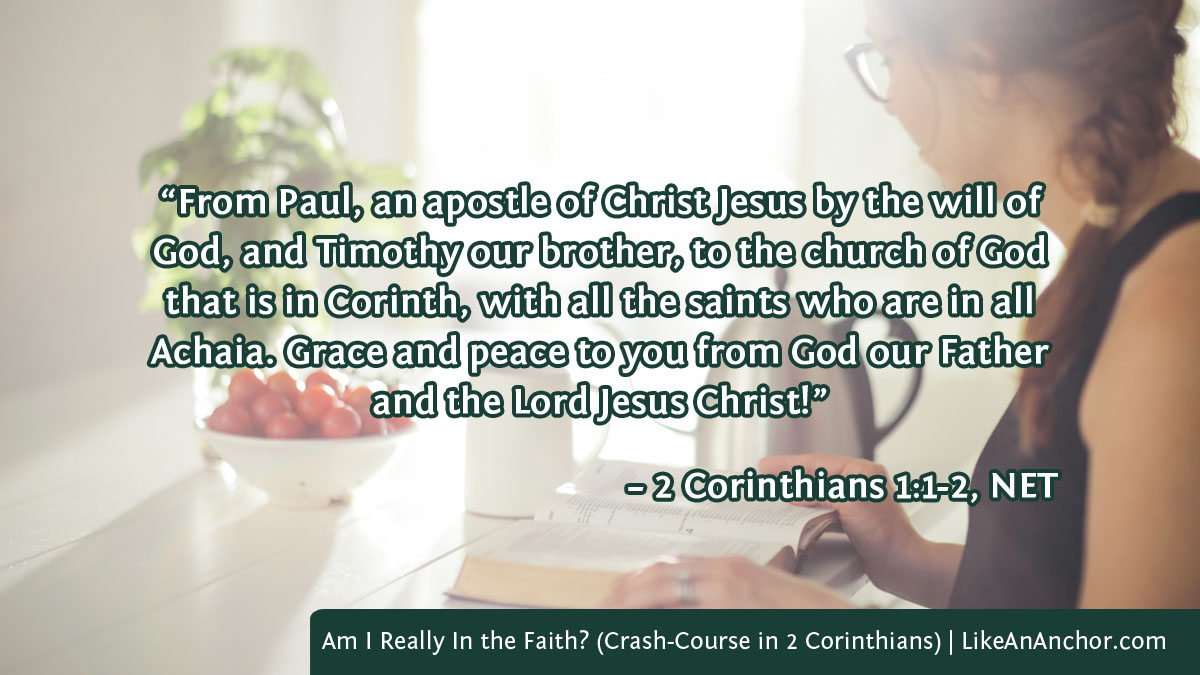
Image of a woman reading a Bible overlaid with text from 2 Corinthians 1:1-2, NET version:  “From Paul, an apostle of Christ Jesus by the will of God, and Timothy our brother, to the church of God that is in Corinth, with all the saints who are in all Achaia. Grace and peace to you from God our Father and the Lord Jesus Christ!”
Image by MarrCreative from Lightstock

Faithful New Covenant Ministry (2 Corinthians 1-5)

Paul opens this second canonized letter to the Corinthians with a message of comfort and hope. He then goes on to explain why he didn’t visit the Corinthian church earlier, saying, “Now I appeal to God as my witness, that to spare you I did not come again to Corinth. I do not mean that we rule over your faith, but we are workers with you for your joy, because by faith you stand firm. So I made up my own mind not to pay you another painful visit” (2 Cor. 1:23-2:1, NET). It seems that the “painful visit” he alludes to might have been connected with the issues he wrote about in 1 Corinthians, for he now counsels them to welcome back a man he’d previously told them to put out of the church because of sinful behavior now that he has sincerely repented.

This is also the first time Paul brings up “faith” in this letter. A note in the NET says that “because by faith you stand firm” could be translated “because you stand firm in the faith.” As we know from our discussion of Schmidt’s book a couple weeks ago, “faith” in the first century wasn’t simply a set of beliefs or a feeling. Rather, “in the first century, pistis implied active loyalty, trust, hope, knowledge, and persuasion” as part of a covenant relationship (p. 11). Here in 2 Corinthians, Paul is telling his readers that he and other ministers don’t rule over their faithful covenant relationship with Jesus; ministers are there to help you stand firm in the covenant that you entered into with God when you were baptized.

Paul then goes on to talk about his role as a person sent by God for ministry work, referring to himself and his fellow ministers as “servants of a new covenant” (2 Cor 3:6, NET). He then compares the new covenant with the old, speaking of the letter of the law written in stone and the spirit of the law that’s associated with an even more glorious ministry. It’s in the context of ministers’ roles in the New Covenant that he begins talking about faith again. He says, “we have the same spirit of faith as that shown in what has been written, ‘I believed; therefore I spoke,’ we also believe, therefore we also speak” (2 Cor. 4:13, NET, quoting Ps. 116:10). Just a little farther down the page, Paul makes the famous statement, ” we live by faith, not by sight” (2 Cor. 5:7, NET). We don’t yet see all the glorious promises of the covenant, but we trust that God will deliver them when we are faithful to Him.

Living in Holiness and Faith (2 Corinthians 6-10)

Paul goes on to talk about reconciliation, Christ’s sacrifice, and true teachings. He also continues his discussion of ministry in the New Covenant, describing himself and other “ambassadors for Christ” as “fellow workers” with his readers (2 Cor. 5:20; 6:1, NET). He also talks about the things that responsible Christians need to do, urging us “not to receive the grace of God in vain” (2 Cor. 6:1, NET) or associate too closely with unbelievers.

For we are the temple of the living God, just as God said, “I will live in them and will walk among them, and I will be their God, and they will be my people.” Therefore “come out from their midst, and be separate,” says the Lord, “and touch no unclean thing, and I will welcome you, and I will be a father to you, and you will be my sons and daughters,” says the All-Powerful Lord.

Therefore, since we have these promises, dear friends, let us cleanse ourselves from everything that could defile the body and the spirit, and thus accomplish holiness out of reverence for God.

2 Corinthians 6:16-7:1, NET

Paul returns to the topic of his previous letters again after this point, reinforcing that “sadness as intended by God produces a repentance that leads to salvation, leaving no regret” (2 Cor. 7:10, NET). He doesn’t regret writing a letter that made them sad because it bore such good fruits and led to rejoicing, encouragement, and more fervent faith.

The next two times “faith” shows up in 2 Corinthians, it’s in the context of faithful action. Paul tells them “you excel in everything,” including “in faith,” when writing about generous giving to other saints in need (2 Cor 8:7, NET). He then goes back to talking about his ministry work and says, “we hope that as your faith continues to grow, our work may be greatly expanded among you” (2 Cor. 10:15, NET). For Paul, faith always went along with doing something.

Image of four people studying the Bible togather overlaid with text from 2 Corinthians 13:5-6, WEB version:  “Examine your own selves, whether you are in the faith. Test your own selves. Or don’t you know about your own selves, that Jesus Christ is in you?—unless indeed you are disqualified. But I hope that you will know that we aren’t disqualified.”
Image by Ben White from Lightstock

2 Corinthians 10-12

One of my favorite passages from 2 Corinthians comes at the beginning of chapter 10 (of course, there weren’t chapter breaks originally; it’s just a convenient way of navigating scripture). I usually think of this as a section about spiritual warfare and mental health. It is those things, but it’s also part of Paul’s discussion of his ministry and his hopes for the people he writes to.

Now I, Paul, appeal to you personally by the meekness and gentleness of Christ (I who am meek when present among you, but am full of courage toward you when away!)—now I ask that when I am present I may not have to be bold with the confidence that (I expect) I will dare to use against some who consider us to be behaving according to human standards. For though we live as human beings, we do not wage war according to human standards, for the weapons of our warfare are not human weapons, but are made powerful by God for tearing down strongholds. We tear down arguments and every arrogant obstacle that is raised up against the knowledge of God, and we take every thought captive to make it obey Christ. We are also ready to punish every act of disobedience, whenever your obedience is complete. You are looking at outward appearances. If anyone is confident that he belongs to Christ, he should reflect on this again: Just as he himself belongs to Christ, so too do we. For if I boast somewhat more about our authority that the Lord gave us for building you up and not for tearing you down, I will not be ashamed of doing so.

2 Corinthians 10:1-8, NET

As Paul goes on, he continues describing his ministry work. With the topic of faith in mind as I read this, I’m struck by how all-in Paul was to his faith commitments. He endured terrible suffering to keep preaching the gospel. He passionately defends the ministry work that God gave him, and condemns those who claim to be apostles but don’t have the same commission from God and commitment to teaching His word faithfully. He even shares his story of glorious revelations and a humbling thorn in the flesh to show “I lack nothing in comparison to those “’super-apostles,’ even though I am nothing” (2 Cor. 12:11, NET). Yet this defense isn’t for his own benefit; he’s writing to build his readers up before his third visit because he’s afraid he’ll find that some of them still aren’t living in the faith.

Have you been thinking all this time that we have been defending ourselves to you? We are speaking in Christ before God, and everything we do, dear friends, is to build you up. For I am afraid that somehow when I come I will not find you what I wish, and you will find me not what you wish. I am afraid that somehow there may be quarreling, jealousy, intense anger, selfish ambition, slander, gossip, arrogance, and disorder. I am afraid that when I come again, my God may humiliate me before you, and I will grieve for many of those who previously sinned and have not repented of the impurity, sexual immorality, and licentiousness that they have practiced.

2 Corinthians 12:9-21, NET

Now Paul reveals the point of the whole letter. He’s been writing to build people up and encourage them to make necessary changes before he comes. “Quarreling, jealousy, intense anger, selfish ambition, slander, gossip, arrogance, and disorder” are not things that he ought to see in a faithful church, nor is “impurity, sexual immorality, and licentiousness.” Those things have to go. Which brings us to the instruction to test ourselves.

Putting Yourselves to the Test (2 Corinthians 13)

Image of a man walking in the woods holding a Bible with the blog's title text and the words "In 2 Corinthians, Paul tells his readers, “Put yourselves to the test to see if you are in the faith.” Why does he issue this warning, and how does it fit with the rest of the letter?"
Image by HarveyMade from Lightstock

This is the third time I am coming to visit you. By the testimony of two or three witnesses every matter will be established. I said before when I was present the second time and now, though absent, I say again to those who sinned previously and to all the rest, that if I come again, I will not spare anyone, since you are demanding proof that Christ is speaking through me. He is not weak toward you but is powerful among you. For indeed he was crucified by reason of weakness, but he lives because of God’s power. For we also are weak in him, but we will live together with him, because of God’s power toward you. Put yourselves to the test to see if you are in the faith; examine yourselves! Or do you not recognize regarding yourselves that Jesus Christ is in you—unless, indeed, you fail the test! And I hope that you will realize that we have not failed the test! Now we pray to God that you may not do anything wrong, not so that we may appear to have passed the test, but so that you may do what is right even if we may appear to have failed the test. For we cannot do anything against the truth, but only for the sake of the truth. For we rejoice whenever we are weak, but you are strong. And we pray for this: that you may become fully qualified. Because of this I am writing these things while absent, so that when I arrive I may not have to deal harshly with you by using my authority—the Lord gave it to me for building up, not for tearing down!

2 Corinthians 13:1-10, NET (bold italics mark a  quotation from Deut 19:15)

Notice the intensity of Paul’s instruction here. “Put yourselves to the test to see if you are in the faith; examine yourselves!” This is important. He’s been building up to this for the entire letter. Paul didn’t just tell the Corinthians they needed to repent, stop sinning, and live obediently with God because he wanted to. He taught this because it’s necessary for faithful living.

“Or do you not recognize regarding yourselves that Jesus Christ is in you,” Paul asks, “unless, indeed, you fail the test!” Either Jesus is in you and you’ll be living in the faith, or He’s not. There are no two ways about it. You can’t live sinfully and still say you have a relationship with Jesus. If the Lord is living inside you, then you’ll be acting like Him and when you mess up you’ll repent and change.

 Finally, brothers and sisters, rejoice, set things right, be encouraged, agree with one another, live in peace, and the God of love and peace will be with you. Greet one another with a holy kiss. All the saints greet you. The grace of the Lord Jesus Christ and the love of God and the fellowship of the Holy Spirit be with you all.

2 Corinthians 3:11-13, NET

This is how Paul ends the letter. He wants his readers to “set things right,” but he also wants them to rejoice, be encouraged, and live in peace. As Proverbs says, “the wise in heart accept commandments” (Prov. 10:8, WEB). For those who love God, correction like Paul gives here motivates change and also brings joy because it helps us live in a closer relationship with God.


Featured image by Aaron Kitzo from Lightstock

Crash Course In Ecclesiastes

It’s always puzzled me why so many people think of Ecclesiastes as depressing. For me as a teenager, it provided a map for navigating my way out of depression. Of course, I’m not saying it’s a magic cure for mental illness, but if you’re struggling with questions about the meaning of life or frustrated with how pointless it all seems, this book can provide a great deal of hope.

The book of Ecclesiastes contains the reflections of a deep thinker who works through an existential crisis. This sort of crisis happens when an individual starts to question whether their life (or life in general) has any purpose, meaning, or value. Solomon wrestled with these questions and records his thoughts for us to learn, as he did, that true meaning and purpose can only be found in God.

Ecclesiastes is one of those books that it’s not a good idea to read isolated pieces from. That’s one way you end up thinking there are few spiritual lessons in this book or misinterpreting its message. The whole thing is interconnected, with layers of thoughts building on each other as Solomon goes back and forth asking questions and contemplating possible answers. It’s vital that we look at this piece of writing as a whole before we start to dive deep into individual passages.

Cycles of Futility …

“Vanity of vanities,” says the Preacher; “Vanity of vanities, all is vanity” (Ecc. 1:2 , unless otherwise noted, all quotes are from the WEB version). Thus the book of Ecclesiastes opens, and Solomon will repeat this phrase throughout and in the conclusion (Ecc. 12:8). He presents everything in life as vanity, or hebel (H1892) — a vapor/breath; a transitory or unsatisfactory thing. That might seem like a depressing outlook, but can you really look at the world and say he’s wrong? Do things of this life last? Do they make sense? Is this world satisfying? Not on its own.

All things are full of weariness beyond uttering. The eye is not satisfied with seeing, nor the ear filled with hearing. That which has been is that which shall be; and that which has been done is that which shall be done: and there is no new thing under the sun.

Ecclesiastes 1:8-9, WEB

With a few thousand more years of history to look back on than Solomon had, we can see the truth of these statements. Nothing really changes. We’re not advancing toward a utopia. People just keep making the same mistakes over and over again, which looks to Solomon like cycles of futility and meaninglessness. Oh, there are technology advances and improvements in our lives, but people stay the same.

… Become Cycles of Hope

Having come to this conclusion about life, Solomon tries to resolve his existential crisis by looking for some kind of meaning. He says, “I applied my heart to seek and to search out by wisdom concerning all that is done under the sky” (Ecc. 1:13). He indulged in all sorts of sensory pleasures, amassed wealth, and created created great things but it was also vanity.

Next, he tried out wisdom and folly to compare the two, and found “that wisdom excels folly as far as light excels darkness” (Ecc. 2:13). But the wise and foolish both die. They can’t keep what they worked for or guarantee what they leave behind will have any effect. At this point, Solomon “hated life” and says, “I began to cause my heart to despair concerning all the labor which I had labored” (Ecc. 2:17, 20). Even realizing that you can have wisdom, knowledge, and joy in your life if you please God seems to him like “vanity and chasing after wind” (Ecc. 2:26). But now we come to the first part of Solomon’s ruminations where he glimpses hope.

For everything there is a season, and a time for every purpose under heaven … He has made everything beautiful in its time. He has also set eternity in their hearts, yet so that man can’t find out the work that God has done from the beginning even to the end.

Ecclesiastes 3: 1, 11, WEB

Solomon realizes that God is the one who made the cycles of time. What Solomon initially saw as hopeless repetition he now recognizes as beautiful (Ecc. 3:1-11). Solomon sees that it is a gift from God that we can do good and enjoy this life. He knows that God has a plan in place and that the righteous and wicked will be judged (Ecc. 3:12-17).

But What About Death?

Existential crises aren’t that easy to resolve, though, and Solomon still has questions. He’s accepted that God has a purpose for how the world keeps on turning. He knows that this life can be seen as a gift. but what about after you die? In Ecc. 3:18-22, Solomon concludes that humans die just like animals, and who knows whether their spirits really go to different places? Maybe this life is all we have and we should just make the most of it.

But that’s not a satisfactory answer either, since not everyone gets to enjoy this life. People oppress each other, and the oppressed have no comfort. People envy each other, live lonely lives, and there’s no end to the people who keep being born and dying in this fallen world. Solomon even suggests it would be better to never be born than to live and see all the evil that fills this world (Ecc. 4:1-16).

Immediately, the conversation turns. Solomon says, “Don’t be rash with your mouth and don’t let you heart be hasty to utter anything before God” (Ecc. 5:2). Perhaps he knows that’s what he’d been doing, as his thoughts ran away with fears and questions.

Don’t allow your mouth to lead you into sin. … For in the multitude of dreams there are vanities, as well as in many words: but you must fear God.

Ecclesiastes 5:6-7, WEB

Solomon knows God has a plan and the times are in His hands — he just needs to find a way to trust Him. He desperately wants to make sense of what’s going on in his life, in the world, and in the afterlife (if there is one).

Letting Death Give Us Perspective

Even with this reminder not to jump to hasty conclusions, Solomon continues to struggle. Everything people strive for in this life still seems futile to him. Sure you can enjoy it in this life, but you can’t take it with you when you go. Then we come to another major turning point in Solomon’s thought process. Instead of seeing death as the thing which robs life of meaning, he proposes that we use death to give us perspective on life. There truly is value in a good life well-lived and there is a future worth striving for. I talked about this section of Ecclesiastes in-depth last week, so if you haven’t read it yet here’s a link: “Letting Death Give Us Perspective On Life.”

As we continue in chapter 7, Solomon counsels to avoid extremes. Even a good thing like wisdom can drive you crazy if you “make yourself overly wise” (Ecc. 7:11-2, 16). We can’t make sense of everything or know the future (7:23-25). “There is no man who has power over the spirit to contain the spirit; neither does he have power over the day of death” (Ecc. 8:8). Because this is true we need to beware of hasty judgements, offenses, and conclusions. Rather, focus on fearing God (Ecc. 7:18).

Though a sinner commits crimes a hundred times, and lives long, yet surely I know that it will be better with those who fear God, who are reverent before him. But it shall not be well with the wicked, neither shall he lengthen days like a shadow; because he doesn’t fear God.

Ecclesiastes 8:12-13, WEB

More Questions

The latter part of chapter 8 and into chapter 9 seems like a step backward. Solomon was talking about it being “better with those that fear God” but then he remembers “that there are righteous men to whom it happens according to the work of the wicked. Again, there are wicked men to whom it happens according to the work of the righteous” (Ecc. 8:14). This frustrating situation sends Solomon right back to commending mirth, then reapplying his heart to wisdom trying to figure things out (8:15-16).

He concludes that “man can’t find out” the work of God no matter how much he seeks it, nor comprehend God’s plan and thoughts even if he is wise (Ecc. 8:17-9:1). Solomon even starts to question whether there’s purpose in death or not because he’s still wrestling with the fact that the same things happen to both righteous and wicked people (9:2-6).

I think most (if not all) of us can relate to this. Just because we think we’ve figured something out doesn’t mean nothing will shake our faith. Gross injustice, friends who die too young, tragic health trials — they can all make us question the frame through which we see the world. The fact that Solomon keeps going back and forth, asking the same questions and wrestling with the answers makes him very relatable.

Life’s Absurd, Enjoy It Anyway

We’re approaching the end of the book now and Solomon presents a revised conclusion: that we should live life to the fullest even though it’s absurd. We can’t predict the future, we can’t control anything, and we’ll be better off if we just live well and try not to overthink things (Ecc. 9:7-12).

Of course, overthinking things is something we humans are very good at. Solomon continues comparing wisdom and folly, and continues coming up against the conclusion that wisdom is far better. Chapter 10 reads much like part of Proverbs, and it leads into the final conclusions of Ecclesiastes.

Practice wisdom. Remember “you don’t know the words of God who does all.” Don’t get distracted or complacent. Keep working and living (Ecc. 11:5-6). Balance is key — rejoice in all your years but also “remember the days of darkness” that help give perspective. Remember that “God will bring you into judgement” for all you do, so put off both sorrow and evil (Ecc. 11:8-10).  He’s now speaking most pointedly to young people, urging them to “remember your Creator” today, before life gets harder or trials come or you grow old and full of regrets (Ecc. 12:1-6).

Now Let Us Hear The Conclusion

Crash Course In Ecclesiastes | LikeAnAnchor.com
Photo credit: Pearl via Lightstock

Here at the end is where Solomon finally answers his earlier question, “Who know the spirit of man, whether it goes upward?” (Ecc. 3:21).

Remember also your Creator in the days of your youth … before the silver cord is severed, or the golden bowl is broken, or the pitcher is broken at the spring, or the wheel broken at the cistern, and the dust returns to the earth as it was, and the spirit returns to God who gave it.

Ecclesiastes 12:1, 6-7, WEB

Solomon has reached the point where he has a confident assurance that there is life after death and God will sort-out everything that doesn’t make sense now. I suspect, and Matthew Henry’s commentary agrees, that Solomon wrote this in old age, hoping that his young audience would heed his wisdom without feeling the need to themselves experiment with life as he did.

Solomon shared what he learned from wresting with questions and doubts so others wouldn’t have to. This also seems to be when he put together the book of Proverbs (Ecc. 12:9-10). As Ecclesiastes wraps up, he admonishes young people not to study too widely, for not all the information out there is good (12:11-12). Better to stick with “the words of the wise” which “have been given by one Shepherd” (Ecc. 12:11, TLV).

This is the end of the matter. All has been heard. Fear God, and keep his commandments; for this is the whole duty of man. For God will bring every work into judgment, with every hidden thing, whether it is good, or whether it is evil.

Ecclesiastes 12:13-14, WEB

It’s so nice to have such a straight-forward conclusion at the end of such a deep, complex book. Here, Solomon tells us in no uncertain terms what the point of Ecclesiastes is. From it, we’re to learn that fearing God and keeping his commandments is man’s whole duty and that God will judge all our works.