Intuitives Abroad

I’ve safely returned from my trip to France, though not without a few complications. Flying with a nasty headcold scores a 0 out of 10 and I would not recommend it. Thankfully my brother and sister were healthy and navigated the airports for me so I could just follow them around in a congestion-induced stupor and focus on breathing.

That was only a shadow over the last couple days of trip, though. Most of the experience was fantastic. Before this, I’d never been any farther outside the United States than the Canadian side of Niagara Falls. Then all the sudden I’m getting on a plane in Detroit, waking up the next morning in Paris, and walking down streets older than the country I live in. We had one day in Paris, then flew to Nice and took a bus to Saint-Raphaël. We were there on the Mediterranean coast for about a week, during which we also visited Saint Paul de Vance (pictured in the featured image for this post), Monaco, and Cannes.

Visiting Paris with Mark Twain
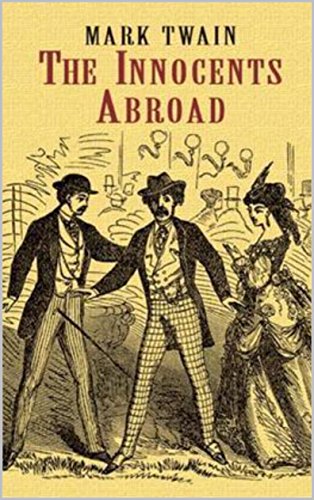
I took this trip with my siblings, so our little group consisted of an INFJ, INTJ, and ENFJ (hence the title of this post, which I’ve been planing on using for a while now and am still endlessly pleased with). I started reading Mark Twain’s Innocents Abroad while on the trip, mostly because I wanted to nod to it in a blog post title once we got home. I love the books by Twain that I’ve read, but even though this was the one that sold best during his lifetime I hadn’t read it before.

It’s interesting to read Twain’s record of his visit to Paris in 1867 with our own visit 152 years later. Our experience with French food was similar, with unfamiliar dishes accompanied by “wine with every course, of course, being in France.” Like Twain, on visiting Notre Dame “we recognized the brown old Gothic pile in a moment” even with the recent fire damage making it impossible for us to go inside. We also visited the Louvre like Twain and his companions, though we seem to have been more impressed by “its miles of paintings by the old maters” than he was. Read more

How Do I Know If I’m an INFJ or an ENFJ?

One of the questions that often comes up after someone learns about Myers-Briggs® types is how to tell which of two similar types they are. Maybe you took a few different online tests and they gave you a couple different results. Or maybe you started reading about the types and discovered more than one that sounds a lot like you.

If you’re trying to decide whether you’re more of an INFJ or an ENFJ type, I hope this article will help. Just looking at the names of these personality types, we might think that the only difference between them is that one is more extroverted than the other. This is only party true. When we dive deeper into the cognitive functions that describe the mental processes each Myers-Briggs® type uses, it become easier to see the differences and similarities between these two types more clearly.

If you’re not familiar with cognitive functions, click here to read “The Simplest Guide to Myers-Briggs® Functions Ever.” INFJ and ENFJs both use the same cognitive functions. They just use them in a different order of preference, as shown in this graphic:How Do I Know If I'm an INFJ or an ENFJ? | LikeAnAnchor.com

The way these cognitive functions work together makes ENFJs and INFJs very different in certain ways and very similar in others. The two types can often find lots of common ground and make great friends. But there are also several key differences in how they learn information and approach the world that makes it possible for us to tell these two types apart. Read more

How Do INFJs, ISFJs, ENFJs, and ESFJs Read People So Well?

Every personality type has unique, powerful gifts. For the FJ types, one of those gifts involves an ability to read people well. Exactly how this skill shows up varies from person to person.

  • You might meet an INFJ who picks up on so much about you that it seems like they’re reading your mind.
  • Or perhaps you know an ESFJ so in-tune with how people work in groups that every event they plan is an unqualified success.
  • You might find yourself in a group lead by an ENFJ who manages to make every single person there feel included.
  • Maybe you meet an ISFJ who knows exactly how to act in dozens of different social situations and always makes the people they interact with feel valued.

The FJ types all use a mental process called Extroverted Feeling, or “Harmony” (to use Personality Hacker’s nickname). ENFJs and ESFJs use it as their favorite (or primary) mental function. INFJs and ISFJs use it as their co-pilot (or auxiliary) function. Today, we’re going to take a closer look at how this cognitive function helps INFJs, ISFJs, ENFJs, and ESFJs read other people. Read more

I Have Become All Things To All People: ENFJ Christians

Today’s post about ENFJ Christians is the sixth in a series talking with Christians of different personality types. I started this series because discussing faith with with different personality types revealed that they don’t all feel equally valued and understood in Christian churches. This is particularly true, in my experience, for Intuitive types (which make up about 30% of the population as a whole). If Christianity is a faith meant for all people (and I believe it is), then why aren’t we doing a better job of connecting with all personality types?

Our walks with God don’t all look the same. We’re influenced by our backgrounds, variations in beliefs, and individual personalities. And even though the goal is for us all to become “like God,” that doesn’t mean we become indistinguishable from each other. God created great variety in people and I believe He did that for a reason. So let’s spend today’s post hearing from and talking about the unique perspectives of ENFJ Christians.

Identifying With Bible Characters

Three of the six ENFJs I talked with for this post identified David as a Bible character they relate to, at least in part. They identify with his heart, his struggles, his expressive worship, and his depth of feeling. One ENFJ named Nathan qualified this choice by saying, “I relate to the fact that David gets incredibly emotional about relational issues in his life, but not so much his impulsive daring.”

Other characters ENFJs mentioned relating to include the Apostle Paul, who Heather described as “a man of great conviction, and grace and grit” with the ability to adapt his leadership style to meet others’ needs (e.g. “I have become all things to all men, that I might save some,” 1 Cor. 9:22). Gwyneth chose Jesus as the most relatable Bible person for her because “His peaceful ways were misunderstood as rebellious” and “He had empathy for every person.” Nathan mentioned, “Daniel in that he’s kind of an academic/thinker type who is trying to find his way in relation to the society around him.” Kait identified her favorite book of the Bible as Ecclesiastes and said the stories of “Ruth and Joseph mean a lot to me, and Peter/Thomas are the disciples I feel I can understand where they are coming from.” Read more

Here’s How Each Personality Type Can Change The World

Every personality type has something incredibly valuable to offer the world. Each comes with a slightly different way of learning new information, seeing the world, making decisions, and interacting with others. And that means that we each have the potential to positively impact the world in different ways.

A person’s Myers-Briggs® type doesn’t explain everything about them. But it does describe how our minds work, and that can give us an idea of how each type can use their strengths to make the world a better place.

For this list, I’ve paired the types that use the same primary and co-pilot functions together. For example, both ESFJ and ISFJ use Extroverted Feeling and Introverted Sensing as their preferred functions, just in a different order. If you’re new to Myers-Briggs® theory or want a quick refresher, you can click here for a quick intro to how functions work.

ESFJ and ISFJ

ESFJs and ISFJs change the world by connecting with and supporting other people, as well as preserving and passing on valuable lessons of the past. 

Having Extroverted Feeling as either their primary or co-pilot function gives SFJ types a strong desire to help and support other people. They tend to personalize everything they do and care so deeply about others that they may forget their own needs while selflessly serving those around them. They’re also really good at picking up on what other people are feeling.

With Introverted Sensing as either their primary or co-pilot function, SFJs have a strong desire to learn from the past. It’s the function that helps us make sure we remember what was learned in our personal and collective histories so we don’t keep repeating failures as we go forward.

ENFJ and INFJ

ENFJs and INFJs change the world by bridging gaps between people who have different perspectives and offering a vision for what the future could look like on both personal and societal levels. Read more

ENFJs, the Dead Poet Society, and Ways To Change the World

When I wrote my list of 7 Fictional Characters That You’ll Relate To If You’re An ENFJ, I rewatched the movie Dead Poet Society. I think both John Keating and Neil Perry are ENFJs, but they’re often typed as ENFPs and that got me thinking about some of the main differences between these types. And that led me to pondering the ways that NF types, and ENFJs in particular, work to change the world.

Most people don’t think of ENFJs as a type that would buck the status quo. We see them as harmony creators, best friends, and mentors but not necessarily as someone who swims against the flow of culture. I think that’s the main reason people type Mr. Keating and Neil as ENFPs, who we more often think of as the outspoken champions of causes. But ENFJs do have a rebellious streak. In fact, all NF types are idealists who typically find some way to seek a better world. Though the ways they work toward this change (and what a better world means to them) differ depending on their individual personalities, interests, and experiences most of them do want to change the world in some way.

Just to be clear, NF types aren’t the only ones who care about social change or want to see improvements in the world. Every one of the 16 types does that in their own way, and I’ll be working on a post that covers all of them in the near future. But just for today, I want to focus on ENFJs, ENFPs, and Dead Poet Society.

The Teacher

I’m not a huge fan of giving the Myers-Briggs types nicknames because there’s so much more to each type than can be neatly packaged into a single description. But we can look at the different nicknames as roles that each type fills often enough for it to stick as a label. Teacher, Mentor, Giver, and Charismatic Leader are all descriptions that are used to try and sum-up the key traits of ENFJs. Interestingly, all those labels could be applied to John Keating from Dead Poet Society. Read more