Hidden Figures and NT-type Women

Contrary to popular belief, INTJs have emotions. They also express them, though not always to the person they’re having feelings about (for example, an INTJ might tell his best friend he likes a girl, but not tell the girl. Or an INTJ might tell her husband she hates a coworker, but never give the coworker a hint). INTJs tend to compartmentalize their feelings and process them internally, and they hate expressing deep emotions casually or to people they don’t know well.
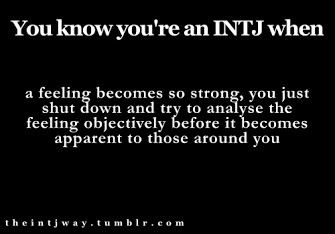
hidden_ntIf you’re very observant, though, and get to know the INTJs in your life, you’ll start to realize there’s a remarkable depth to their feelings. They’ll even do things, like cry at movies, that are typically associated with Feeling personality types. They might scorn the things that are “supposed” to make you cry (e.g. I’m sniffling at a Pixar film and my INTJ sister laughs out loud in the theater). But then I’ll look over and notice moisture leaking from the corners of her eyes at the end of Hidden Figures (I’ve been informed it was not crying).

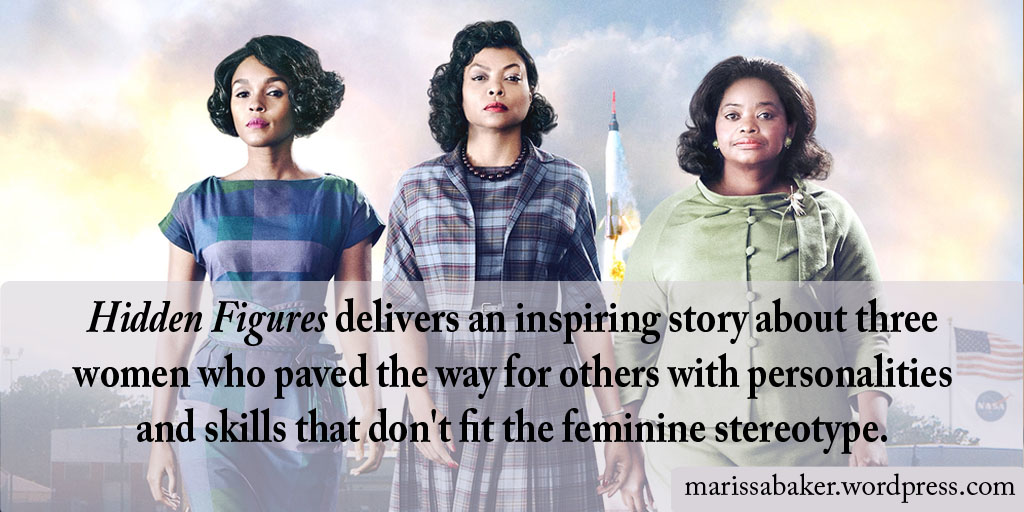
Hidden Figures (2016) is a fantastic film about “a team of African-American women mathematicians who served a vital role in NASA during the early years of the US space program. ” They were among the first African-Americans and the first women to work in such prestigious technical roles. My sister, about to graduate with a degree in Chemical Engineering, gave me one explanation for her emotional response to the film: “these women and others like them made it possible for me to be an engineer.”

As the character Mary Jackson tells a judge, someone always has to be first. These women proved it’s possible for women to be taken seriously and make important contributions as mathematicians and engineers. But I suspect my sister’s words go deeper than referring to breaking down gender stereotypes about the kind of work women can do. It also has to do with people’s expectations for what women should be like.
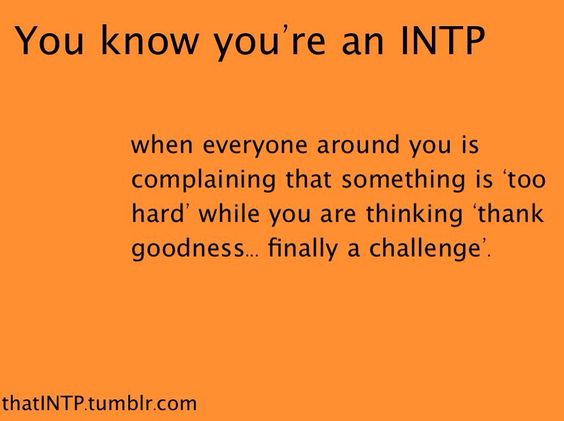
hidden_nt_2Only 24-35% of women have a personality type that relies on Thinking as their primary or secondary mental process (according to the Center for Applications of Psychological Type). INTJ and INTP women are tied for rarest at 1-3% of the female population. ENTJs come in a close third at 1-4%. ENTPs tie with ESTPs with 2-4%, just slightly more common than ISTPs at 2-3%. The STJ types aren’t nearly as rare, with ESTJs making up 6-8% and ISTJs 7-10% of the female population.

I’m not going to type the women in Hidden Figures, but having seen the film I think it’s safe to say Katherine G. Johnson, Dorothy Vaughan, and Mary Jackson are Thinking types. Their minds are naturally wired to excel at processing facts, figures, and data — a hall-mark of the fact-checking, analytical Thinking functions that use “impersonal criteria to make decisions.” I’d say Katherine at least is probably an Intuitive type as well, pairing pattern-recognition and possibility-seeking with her Thinking side.

That means she wasn’t just a rarity at NASA (an African-American woman working in a highly technical position). She’s also a rarity in society (a woman using both Intuition and Thinking as her most comfortable mental processes). Thinking traits are so strongly stereotyped as masculine that NT women often don’t fit cultural expectations for femininity. One of the many things I loved about Hidden Figures is that these three women seemed to have figured out a way to balance being wives and mothers with working as groundbreakingly successful mathematicians. They’re also portrayed as real people who are admired and respected for who they are instead of as the bitchy, controlling, or cold stereotype we often get when presented with Thinking female characters (take Sandra Bullock’s character in The Proposal as an example). And the men they’re in relationships with aren’t scared of them or trying to fit them back in boxes.

It was really wonderful to see characters that embraced femininity on their own terms. While I do believe God created the two genders to be different and complementary in the roles we fill, I also think there are stereotypes in our culture that do both genders a disservice. One of those is that women are or “should” be more emotion-driven than analytically-minded. There’s room for both. And, as Hidden Figures reminds us, we would do ourselves a terrible disservice if we tried to keep these women hidden.click to read article, "Hidden Figures and NT-type Women" | marissabaker.wordpress.com
Save

Save

Save

Save

Save

Personality Types in Star Wars Rebels

Note: an updated version of this chart and expanded discussions about Star Wars characters’ Myers-Briggs types can now be found on my other blog Star Wars Personalities.

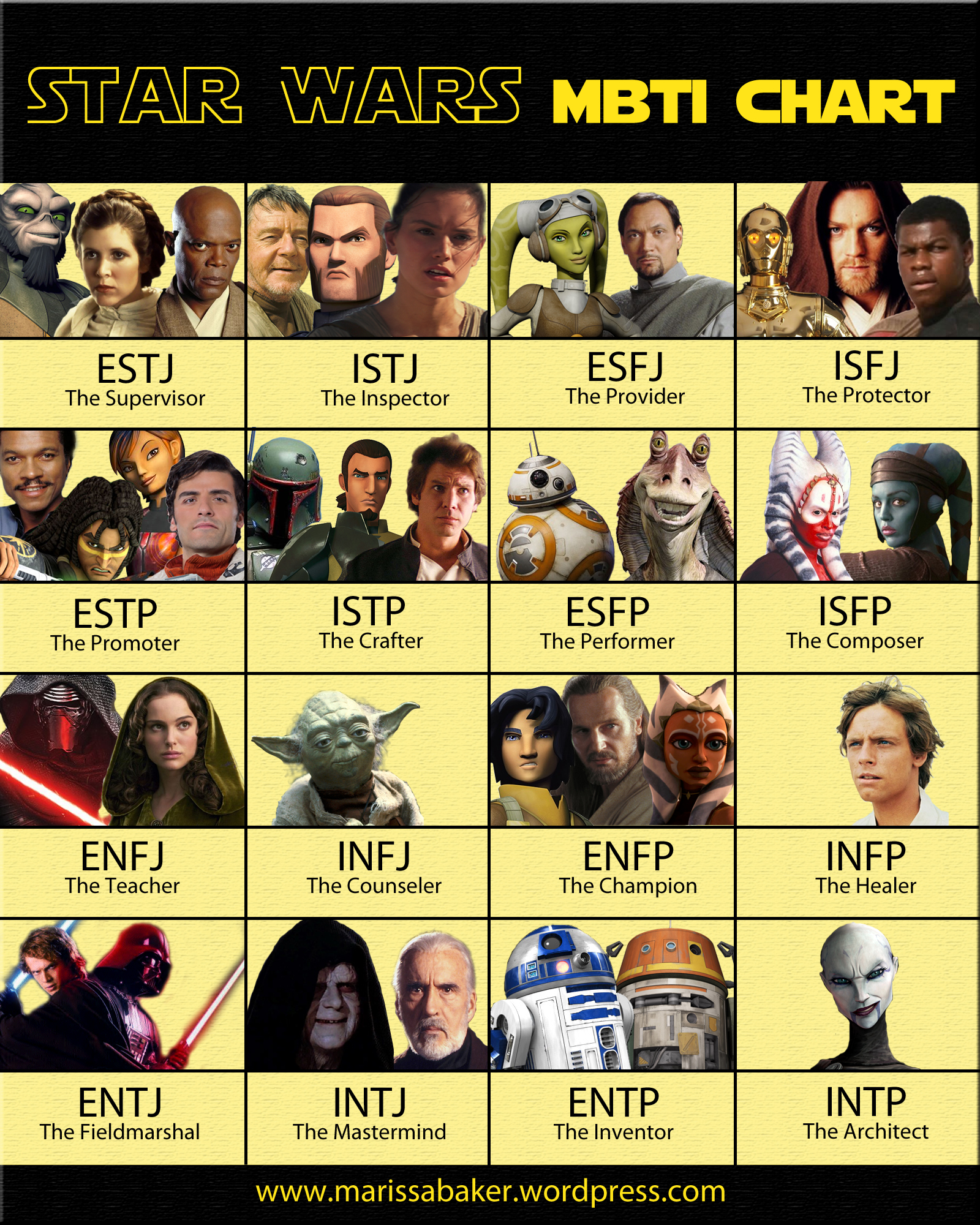
Star Wars Rebels is my new favorite TV show. It’s been around since 2014, but I just started watching it last month. Now I’m caught up and eagerly awaiting the rest of season 3. Being an Myers-Briggs enthusiast as well as a Star Wars fan, my thoughts naturally turned toward analyzing the main characters’ personality types and updating my Star Wars MBTI chart.

Like The Clone Wars, Rebels is an animated series set in the Star Wars universe. While I enjoyed The Clone Wars (especially Ahsoka’s story line and Anakin’s character development), there are plenty of filler episodes, most of the humor is aimed at a young audience, and it’s a bit daunting at 121 episodes. Rebels, on the other hand, has a much tighter story arc and it’s aimed at a more mature audience (still a kids show, but fewer things that will have adults wincing or rolling their eyes).

click to read article, "Personality Types in Star Wars Rebels" | marissabaker.wordpress.com

After The Force Awakens came out last year I published a Star Wars MBTI Chart, which I present again here with Rebels characters added. For this post, I’m focusing on the Ghost‘s crew with one recurring character thrown in (Ahsoka also appears in Rebels, but she’s already been typed). I’d love to include Grand Admiral Thrawn, but I think I’ll wait until his new in-canon novel is released later this year.

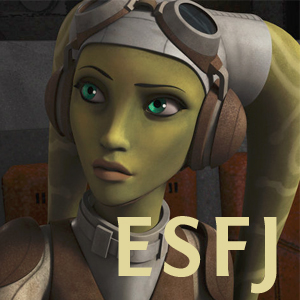
Hera Syndulla – ESFJ

Hera Syndulla - ESFJ. Visit marissabaker.wordpress.com for more Star Wars Rebels personality typesHera is a fantastic example of an SFJ type. She has that Si-Fe blend of prioritizing other people’s good while working to maintain social order. As an extrovert, she’s a talkative, people-focused character who teaches Ezra “if all you do is fight for your own life then your life is worth nothing.” It’s a belief she lives by as well.

SFJ characters are stereotyped at the “mother” figure and we get to see why in the way Hera leads and cares for her crew, especially in the first two seasons. As is typical of a dominant Extroverted Feeling type, she puts extra effort into maintaining harmony among her crew (such as sending Zeb and Ezra on a wild meiloorun chase so they can bond in S1E2).

After Hera’s rebels become more involved with the rebellion, we see that she’s the only one who’s really concerned with working in a larger movement. If you read A New Dawn, you see her focus from the very beginning has been on working to save the entire galaxy. This is partly an SJ’s commitment to order, partly an Fe type’s concern for people. But I think it’s also a little bit of her tertiary Extroverted Intuition looking at the larger picture and future implications of their actions. Read more

Part Two: “Unofficial” Disney Princesses MBTI Chart

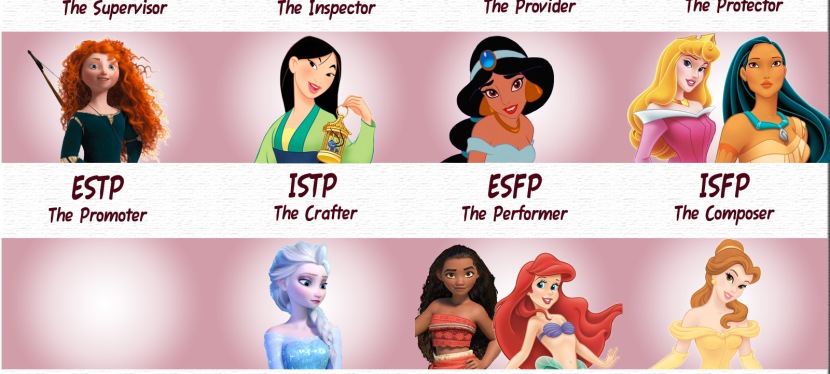
Last week, I updated an old post called The Missing Disney Princesses with a brand new MBTI Chart featuring the 14 official princesses (well, technically there are 11 official princesses, plus Anna and Elsa who have their own line, and Moana who hasn’t been crowned yet. So it was more like the “Official + New/Popular Princesses Chart”).

There are other Disney women, though, who’ve been completely snubbed by the Disney princess line-up and I wanted to include those as well. I had them on a separate chart in my previous post and I wanted to follow that pattern this time as well. Eilonwy and Alice were the most requested characters I left out last time, so I’m adding them. And I’ve also added a character no one asked about from my favorite underappreciated Disney films — Maid Marion from Robin Hood.Updated Disney Princesses MBTI Chart, Part Two | marissabaker.wordpress.com

Note: I’m not using anything from sequel films (just to help narrow-down the typing choices), so that’s why you won’t see Ariel’s daughter Melody (for example). I also type using cogitative functions. If you’re not familiar with that aspect of Myers-Briggs theory, click here and here for a two-part introduction. Read on for detailed explanations for why I chose these types for the unofficial princesses, and click here for the post about the other princesses.

Read more

Updated Disney Princesses MBTI Chart

A couple years ago, I made a Myers-Briggs chart called The Missing Disney Princesses that quickly became one of the more popular posts on my blog. Now (finally!!!) I get to update it to include our new princess, Moana.

But I’m not just adding Moana to my chart. I’m also moving around a few of the other princesses. Last time, my focus was on showing that we don’t see all the personality types represented by the Disney princesses. Both Intuitive and Thinking types are under represented among Disney’s ladies. That’s still the case, but this time my focus is on explaining why I typed each princess the way I did.

In the two years since publishing the last chart, I’ve learned more about Myers-Briggs typing. I’ve also re-watched several of these movies, considered comments from readers on the previous post, and asked advice from fellow personality type and Disney enthusiasts. In response, I’ve re-typed several characters (which is noted and explained in the individual character discussions).Updated Disney Princesses MBTI Chart | marissabaker.wordpress.com

Note: I type using cogitative functions. If you’re not familiar with that aspect of Myers-Briggs theory, click here and here for a two-part introduction. Read on for detailed explanations for why I chose these types for each character. Read more

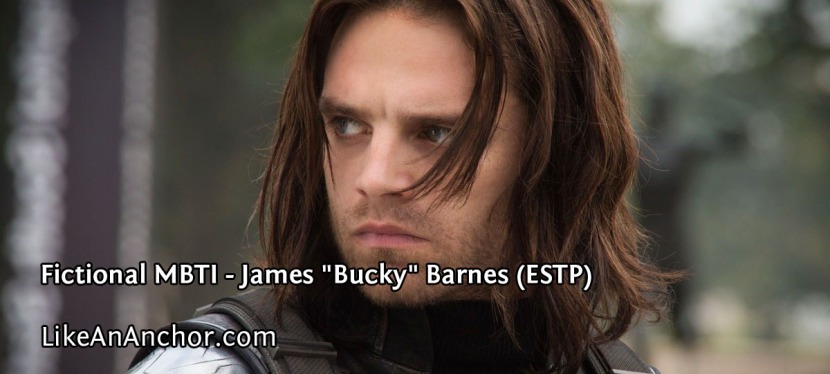
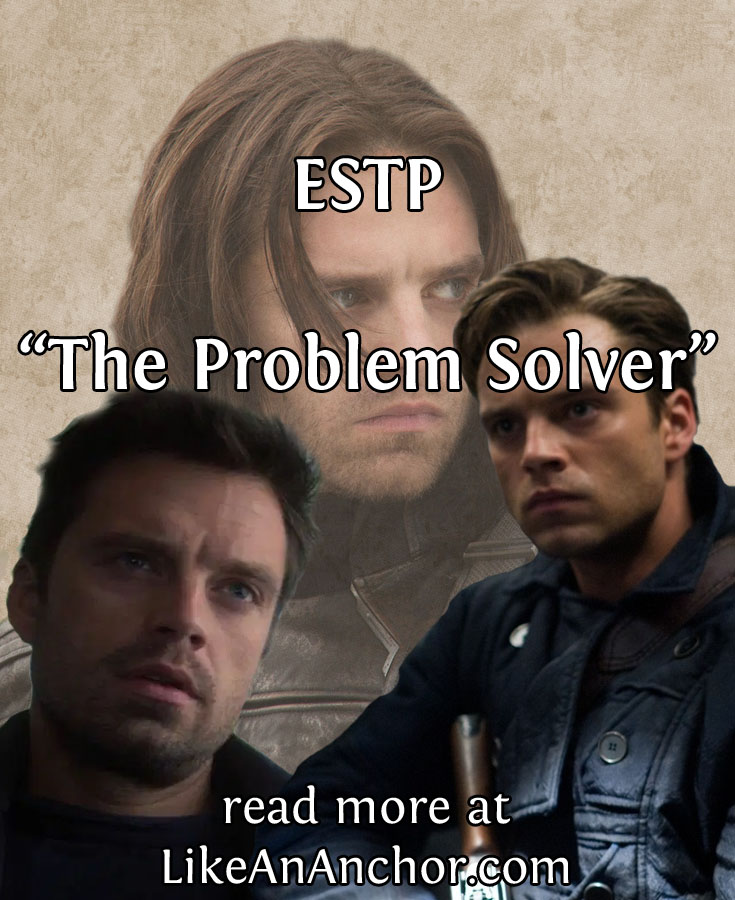
Fictional MBTI – James “Bucky” Barnes (ESTP)

It always intrigues me how certain characters attract so much investment from viewers. Browsing Pinterest lately, it seems like Bucky is the new Loki — the Marvel fandom’s dark, mistreated character who just needs a hug because we love him soooooo much. In Bucky’s case, the reasons why we find his character compelling aren’t too hard to find. He’s a good man who was forced to do terrible things and is now constantly fighting a battle to be himself. Sebastian Stan’s portrayal allows audiences to glimpse Bucky’s human side under the soldier persona he wears and the assassin role he’s forced to adopt, and audiences are drawn in by a realistic, sensitive portrayal of a compelling character.

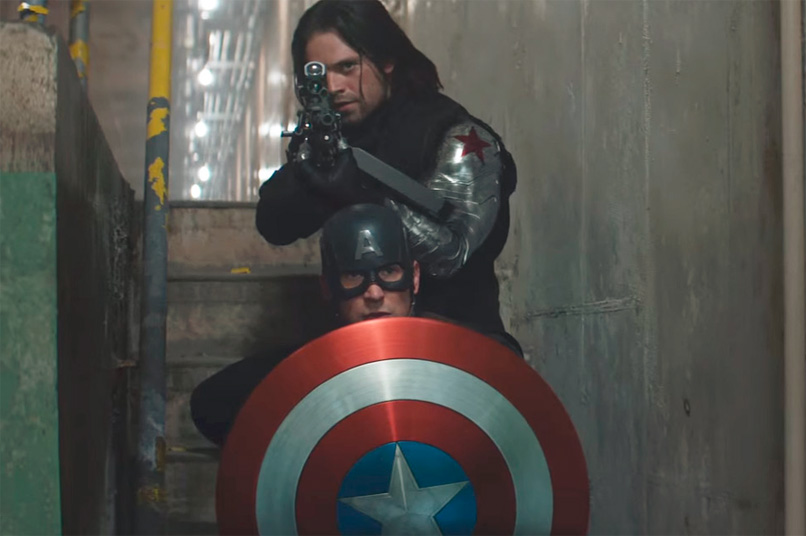
Most people type James “Bucky” Buchanan Barnes as an ESTP, and I’m inclined to agree with them. Operating under the assumption that MBTI type doesn’t change, when we see him as Bucky in Captain America: First Avenger he’s a healthy, stable version of his MBTI type. The version of Bucky we see later in Captain America: The Winter Soldier is a severely stressed and traumatized man of the same MBTI type. Bucky in Captain America: Civil War is still dealing with the fall-out of all he went through, but he’s more recognizable as an ESTP.

Typing Bucky Barnes

We only get about 13 minutes of footage with Bucky in the first Captain America film, but those scenes reveal a character in line with type descriptions of ESTPs as people characterized by decisive action, contagious energy, and enjoyment of being in the moment. They are “thrillseekers who are at their best when putting out fires, whether literal or metaphorical. … They assess situations quickly and move adeptly to respond to immediate problems with practical solutions” (Truity.com description). David Keirsey writes that ESTPs (whom he nick-names Promoters) “live with a theatrical flourish which makes even the most routine events seem exciting. … Promoters demand new activities and new challenges. Bold and daring at heart, and ever-optimistic that things will go their way, Promoters will take tremendous risks to get what they want, and seem exhilarated by walking close to the edge of disaster.” Other nicknames for ESTPs include “problem solver” and “realist.”

ESTPs lead with a mental process called Extroverted Sensing, or “Sensation.” This process “can get into the action in the moment. Think of it as ‘real-time kinetic’” (from Personality Hacker). It’s a fun-loving function that delights in sensory experiences, such as Bucky spending his last night in New York dancing with girls he probably doesn’t care whether or not he ever sees again. On that same night, he and Steve are talking about Steve’s inability to enlist and he says, “I don’t see what the problem is. You’re about to be the last eligible man in New York.” He’s trying to make Steve feel better with joking and doesn’t really ‘get’ the duty-fulfilling and self-sacrificing aspect of Steve’s character. It’s not a deeply ingrained aspect of his personality type (like it is for ISFJ Steve), though in practice he still does his duty and sacrifices himself because he’s a loyal friend and a good man.

We also see Bucky demonstrate sensory skills in more serious situations. Even post-experimentation and groggy when escaping Redscull’s prison, Bucky could walk across that metal girder with coordination, balance, and no hints of fear other than a healthy caution. As a Howling Commando, we see him as a sniper (which requires skills that come naturally to SP types) and making split-second sensory decisions with ease in the final train fight.

ESTP types support their Sensation function secondary with Introverted Thinking (or “Accuracy”) and then tertiary Extroverted Feeling (or “Harmony”). These mental processes describe how ESTPs, like Bucky, make decisions. First he’s using impersonal criteria to evaluate information and make decisions that are motivated by his own understanding of how the world works. Extroverted Feeling gives ESTPs an insight into other people that they stereotypicaly use to be charming and get people to do what they want. When he tries to ask Peggy to dance, he’s clearly not used to being ignored in favor of his friend (or any other guy). ESTPs are not primarily an emotional sort of people, though. In an early scene, Bucky had just had an argument with his best friend and turns that emotionally invested side of himself ‘off’ to take the girls dancing and enjoy himself.

The Winter Soldier

Once Hydra turns Bucky into the Winter Soldier, it’s difficult to use any scenes to get a clear picture of his personality type. In Captain America: The Winter Soldier we see a few glimpses of the real Bucky trying to get out, but not really anything to help with typing him. In Civil War, however, his own mind is starting to reassert itself and we can talk about his personality type in that film.

When ESTPs are stressed, one of the most common things they experience is internal confusion. They feel out of control, forget details, and become paranoid. Their inferior, or 3-year-old, function is Introverted Intuition (also called “Perspectives”). It’s a mental process that speculates on things that cannot be known, which is great for creativity and insight if you’re using it as a driver process but not so good if it’s an underdeveloped function that comes out when you’re stressed. Most ESTPs snap out of what Naomi Quenk calls a “Grip experience” (where stress causes your inferior function to assert itself) fairly quickly, but “Chronic grip behavior can lead the individual and others to believe that he or she is typically negative, pessimistic, and worried about both the present and the future” (Was That Really Me? p.180). Add to that all the torture and brainwashing used to turn Bucky into the Winter Soldier, and you have the Bucky who’s fighting alongside Cap in Civil War.

Here, we see a man who is not only fighting physical battles (and with extraordinary skill now that super-soldier enhancements have been added to his natural sensory abilities), but who is also fighting a mental battle. As extroverts, ESTPs tend to focus more on the external. Bucky’s experiences have turned him inward, making him more serious and forcing him to develop his Introverted Thinking side. Though type theory holds that your base personality doesn’t change, Bucky is in many ways a different person than the one we see in The First Avenger. He’s burdened with the weight of what he’s done and his friend Steve is now his only real connection with another human being.

In some ways, Bucky’s joking remark from the first Captain America movie “I’m turning into you” has come true. He’s become much more introspective and aware of the weight of his actions. Yet he’s also still thoroughly himself. We have a scene where he and Cap are reminiscing about fun times they had and a girl Bucky tried to impress, and he’s really Bucky against instead of the Winter Soldier. The fun-loving young ESTP is still in there, just buried deeply under the weight of all he’s been though.

In The First Avenger, we see Bucky fighting to protect his best friend and giving his life for his country. Now in Civil War, he trusts his best friend to help him through and gives up his freedom by going into cryostasis so he’s can’t be used to hurt others. Bucky’s decision to enter cryostasis at the end of the movie is also an intensely individualistic move that’s characteristic of SP types. If he can’t guarantee he can control himself, then at least he can make sure no one else can take control of him either.

bucky

If you enjoyed this post, check out my other MCU typings:

Loki – INFJ

Scott Lang -ISFP

Steve Rogers – ISFJ

T’Challa – ISFP

Thor – ESTP

Tony Stark – ENTP

SaveSave

Save

Save

Myers-Briggs: Fad or Science?

Friends who know I blog about Myers Briggs types sometimes send me links to people critiquing the MBTI and ask what I think. The arguments in videos like “Why the Myers-Briggs test is totally meaningless” and articles such as “Goodbye to MBTI, the Fad That Won’t Die” tend to follow a similar pattern and hit the same points:

  • Kathryn Brigs and Isabel Briggs Myers had no formal training.
  • The test doesn’t allow for complex personalities or that someone can be a little bit of an extrovert and a little bit of an introvert at the same time.
  • Similarly, the judging-perceiving, thinking-feeling, and sensing-intuition “scales” don’t allow for people who use both.
  • About 50% of people who take the test twice within 5 weeks get different results.
  • Test fails to predict success in various jobs and doesn’t provide meaningful data.
  • The test remains popular because it only gives positive results. These results are vague and hard to argue with, much like astrology and pseudoscience.

Disclaimer: some of the links in this post are affiliate links. This means that, at no additional cost to you, I will receive a commission if you click on the link and make a purchase on that website.

Setting aside the first arguments for now, I think these points are a good criticism of some of the free tests going around which make people pick just between the four letter groups. None of this, however, takes into account the science behind Myers-Briggs. In fact, if the critics would bother reading Isabel Myers’ book Gifts Differing,* they would find most of their points have nothing to do with actual Myers-Briggs theory.Myers-Briggs: Fad or Science? | marissabaker.wordpress.com

The Truth About Extroverts and Introverts

The video I linked above correctly states that Jung’s theory allowed for people who didn’t fit neatly into a single category. But then they say Kathryn Briggs and Isabel Myers “took Jung’s types but slightly altered the terminology and changed it so every single person was assigned only one possibility or another. You couldn’t be a little bit of an extrovert or a little bit of an introvert.”

In fact, this a complete misrepresentation of Myers-Briggs theory. Read more