
Thoughts on Sharing the Gospel

As I mentioned in my email newsletter that went out this past Wednesday, I’ve been reading quite a bit of New Testament historical fiction. One of the series–Angela Hunt’s “Jerusalem Road”— made me think about is how weird it would have been to live at the time of Jesus. We look back from our modern perspective and think it would have been amazing to be alive at that time and have the chance to actually meet and talk with Jesus. But I wonder if it’s more likely we’d have been confused and perplexed by this seemingly ordinary man who suddenly started performing miracles and who claimed to be the literal Son of God.

It’s hard for me to imagine not knowing Jesus is the Messiah (the Hebrew word for “Christ,” which means “anointed”). I grew up going to church. Not only that, I grew up in a culture that was shaped by Christianity and where most people I met had at least a basic understanding of who Jesus is and what Christians believe. It’s so natural for me to think of Him as the Son of God and accept that He lived, died, and rose from the dead. But that all would have been brand-new to early 1st century people.

As our modern culture moves farther and farther away from Christianity, more and more people don’t have much–if any–Christian cultural background or Bible knowledge. Those of us in the U.S. and similar countries can’t really assume anymore that if we talk with someone about our faith they’ll have any foundational Biblical knowledge to build on. It’ll be more like Paul preaching to Gentiles who’d never heard of Jesus and thought Yahweh was only a God for the Jews than it is like Peter preaching to Jewish people who already had a faith background but needed to hear how Jesus is relevant to them.
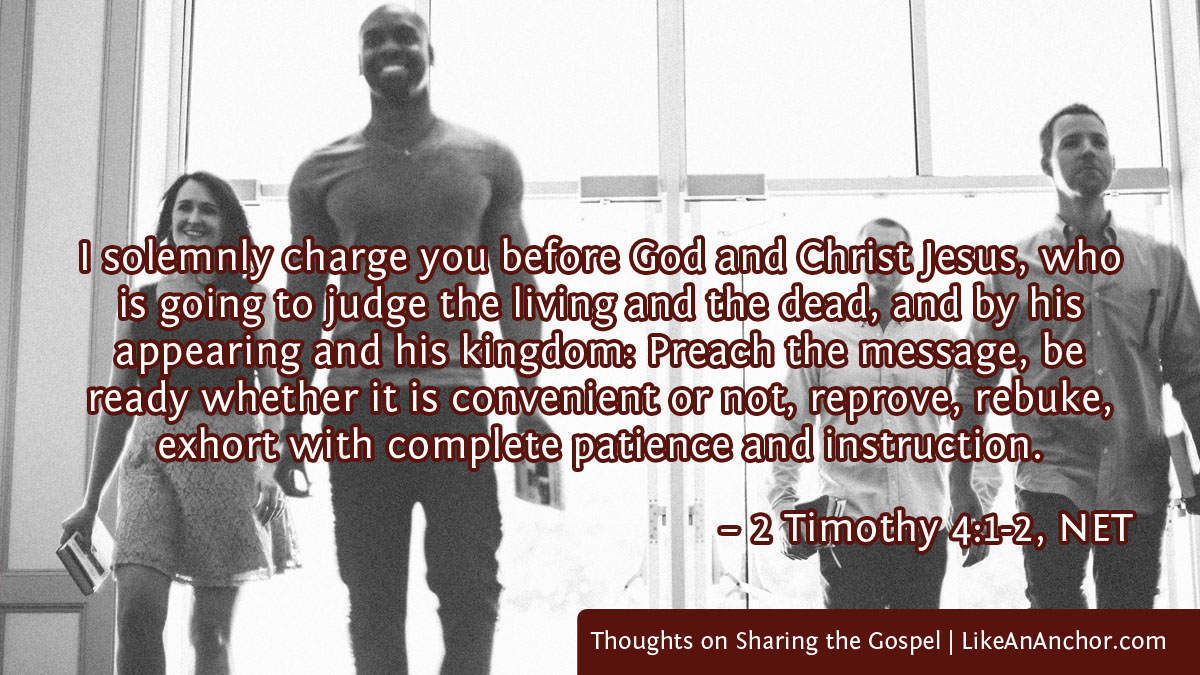
Image of four smiling people walking toward the camera overlaid with text from  2 Tim. 4:1-2, NET version: "I solemnly charge you before God and Christ Jesus, who is going to judge the living and the dead, and by his 
appearing and his kingdom: Preach the message, be ready whether it is convenient or not, reprove, rebuke, exhort with complete patience and instruction."
Image by Matt Vasquez from Lightstock

What Are the Gospels Doing?

I’ve also been pondering a related thought, this time about sharing Jesus with someone rejecting Him rather than someone who never knew about Him. I know of someone who was Christian but is now adopting Jewish beliefs, and I’ve heard that this person challenged someone to prove that Jesus is the Messiah and the Son of God using only the Old Testament. In many ways, that’s a ridiculous thing to ask. You can prove just from the Old Testament that there is a promised Messiah coming, but if you’re going to prove that it’s Jesus you need to cite evidence that His life lines up with those prophecies. As I thought about this topic more, I realized this is exactly the point of the gospels. They’re there to convince readers of who Jesus is.

Now Jesus performed many other miraculous signs in the presence of the disciples, which are not recorded in this book. But these are recorded so that you may believe that Jesus is the Christ, the Son of God, and that by believing you may have life in his name.

John 2o:30-31, NET

Have you ever noticed how many times the gospel writers (especially Matthew) say things like, “it is written” or “that it might be fulfilled”? They’re constantly referencing back to the Old Testament writings and linking them to Jesus, showing that He fulfilled prophecies. Just like Jesus came to fill the law and the prophets to the fullest and just like He had to open His disciples eyes to understand the scriptures about Himself (Matt. 5:17-20; Luke 24:25-48), so are the gospel accounts there to open up the scriptures for us and show that Jesus is the Messiah. Of course, God the Father is the one who opens minds to comprehend these truths (John 6:44), but He also responds to those who diligently seek Him (Matt. 7:7-11) and expects His people to help share His truths with the world (Matt. 28:18-20; 2 Tim. 4:1-2).

Preaching the Word of Christ
Image of two people studying a Bible together, overlaid with blog's title text and the words, "Pondering ways that talking about God today is similar to the first century."
Image by Anggie from Lightstock

I feel like a lot of times when we talk about our faith, we want to jump right into the details. We like to explain what makes our church’s Christianity different from other churches. We want to make sure people know God has expectations for them and their conduct if they commit to following Him. But that only matters to people if they already know about Christianity and they already care what God thinks about them. If they don’t have that already, they need to hear the gospel–the good news about who Jesus is and what He taught–before all the details about how to follow Him.

 For with the heart one believes and thus has righteousness and with the mouth one confesses and thus has salvation. For the scripture says, “Everyone who believes in him will not be put to shame.” For there is no distinction between the Jew and the Greek, for the same Lord is Lord of all, who richly blesses all who call on him. For everyone who calls on the name of the Lord will be saved.

How are they to call on one they have not believed in? And how are they to believe in one they have not heard of? And how are they to hear without someone preaching to them? And how are they to preach unless they are sent? As it is written, “How timely is the arrival of those who proclaim the good news.” But not all have obeyed the good news, for Isaiah says, “Lord, who has believed our report?” Consequently faith comes from what is heard, and what is heard comes through the preached word of Christ.

Romans 10:10-17, NET (bold italics mark quotations from Isa 28:16; Joel 2:32; Isa 52:7; Nah 1:15; Isa 53:1)

The details about how to follow Jesus are important–He included many of those “how-to” details in His message, and His followers filled in more information in their letters that make up the rest of the New Testament. But at it’s core, the gospel is very simple. People hear the preached word of Christ, they respond in faith and obey the good news, and their belief results in righteous living. Remember, God’s sincere desire is that everyone turn away from wickedness, turn to Him, and choose life (1 Tim. 2:1-4; 2 Peter 3:9; Eze. 18:21-32). That should be our desire as well, and the ways we talk about Him should reflect that.

I know this wasn’t really my typical blog post format this week. It was more musings and reflections than a topical Bible study. I just really struggled coming up with a topic this week, and so I wrote about the ideas my thoughts kept coming back to pondering.


Featured image by Ben White from Lightstock

Song Recommendation: “The Basics of Life” by 4HIM (a song I haven’t thought about in probably 10 years, but which popped into my head while writing this post)


Why Are So Many INFJs Obsessed With Fictional Characters?

Every once in a while, I go through the list of search terms that WordPress says leads people to my blog looking to see if there are any topics I haven’t covered. This is one of them. It’s no surprise that search term led to this blog, though, since I’m an INFJ bloggers and the number of posts I’ve written about typing fictional characters (both here and on my Star Wars Personalities blog) shows that at least this INFJ is obsessed with fictional characters.

That doesn’t answer the question of “why” though. Nor does it explain why my posts about fictional character types were the most popular posts on my blog last year. It’s not just the posts about INFJ characters that are popular, either. All of my “7 Fictional Characters You’ll Relate To If You’re An ___” posts get a lot of views. We might not all be obsessed with fictional characters for the same reasons, but it seems that at least some people from every personality type feels an interest in and an attachment to fictional characters.

For INFJs (and perhaps other types as well), I suspect this obsession with fictional characters comes from a few different sources. Part of it is likely because INFJs so often feel alone and misunderstood in our real lives. We struggle to find belonging and acceptance, and so we search the stories that we love for people who seem to be like us. Many INFJs feel as if they find themselves in their favorite stories, and they may feel that the characters they find within fiction could understand them better than the people in real-life do.

This last part leads to another possible reason why INFJs are obsessed with fiction and fictional characters. We have very active imaginations and often talk about our “rich inner world.” Our minds are peopled with interesting places, people, ideas, and storylines that we encounter in fiction and real-life alongside all the imaginings we come up with on our own. Fictional characters give us fuel for the imaginative lives we lead inside our thoughts.

INFJs are also a type that loves people, but often finds interacting with other people in real-life challenging. It’s not that we avoid spending time with people, but we’re selective about who we spend time with and for how long because we have a limited amount of social energy. Reading well-written fiction or watching a well-acted film gives us the opportunity to “interact” in a non-social way with a wider number and variety of people than we’d typically get to see in real life. Fictional characters are not by any means a substitute for real friends, but they can help fill an INFJ’s hunger to learn about as many different people and perspectives as possible without wearing themselves out.

So there are the three reasons why I think INFJs are so often obsessed with fictional characters. We find connection with characters, we enjoy the way fiction fuels our imaginations, and we learn about people from stories.

Do you have any other explanations you’d add to this list for why we’re obsessed with fictional characters? And if you’re not an INFJ, do these reasons resonate with you as well or are there other reasons that you enjoy engaging with fiction?

“Almost A Bride” Book Review

I’m always excited to receive a new Jody Hedlund book to read and review before its release. I’ve read and enjoyed the first three books in her Bride Ships series: A Reluctant Bride, The Runaway Bride, and A Bride of Convenience. This final book, Almost A Bride, was a disappointment for me. There’s some really good character growth, but overall I didn’t enjoy this story nearly as much as I did the first books in the series or her other novels I’ve read. This might have something to do with my own personal experiences, and I’ll be sure to talk about that in this review so you can decide for yourself if I’ve judged the book too harshly.

Kate Millington has no trouble finding potential husbands. Staying engaged, however, is a problem. She arrives in the frontier mining town of Williamsville intending to marry her latest fiancé, only to panic and back out of their deal. He’s the fourth man she’s failed to marry — two back home, and now two more since she arrived in British Columbia on a bride ship. She longs for true love, but she’s also frightened of trusting any man with her heart.

Zeke Hart barely remembers Kate from their childhood. Back then, she was just the little sister of his best friend. He’s sure she couldn’t have good memories of him, considering how he left things back home. Falsely accused of a crime, he ran away to the new world and turned his back on God. Now a prosperous owner of a gold mine and one of the most powerful men in the area, he doesn’t see a need for faith. But meeting Kate again convinces him he has a powerful need for a wife. If only she wasn’t so hung-up on that whole issue of him not being a Christian.

In the background of Kate and Zeke’s personal struggles and ill-advised romance, there’s another threat building. A jealous ex-fiancé stabs Zeke. Someone sets an explosive charge in his mine, nearly killing him. He receives anonymous threats. Perhaps the question of whether or not they should be together isn’t the only thing these two need to worry about.

Read more

Myers-Briggs Types of the Characters in Avatar: The Last Airbender — Azula, Iroh, Mai, Ty Lee, and Zuko

Since Avatar: The Last Airbender is now on Netflix, I was able to watch it for the first time. We didn’t have TV growing up so it wasn’t part of my childhood, but now I understand what the hype was all about. And with people who loved the series when it first came out re-watching it as well, this seems a perfect time to take a look at the personality types of the characters in this series.

This was turning into an enormous blog post, so I decided to split it in two. In this post, I’m talking about the Fire Nation characters — Azula, Iroh, Mai, Ty Lee, and Zuko. Part One post was about the Team Avatar characters, and you can click here to read that (yes, I know Zuko could go in both posts, but I put him here so there’d be five characters for each).

You’ll notice as I talk about each type that I reference functions. In Myers-Briggs® theory, functions refer to the mental processes that each type prefers to use. If you’re not familiar with functions or want a refresher,  you can check out my post “The Simplest Guide to Myers-Briggs® Functions Ever” and Susan Storm’s post “The Cognitive Functions – What Are They?” Usually when I type fictional characters I research other people’s typings as well, but for this post I chose to approach the characters with fresh eyes. I haven’t read any other articles about the Myers-Briggs® types of Avatar characters.

Myers-Briggs Types of the Characters in Avatar: The Last Airbender | LikeAnAnchor.com
Image credit: Bryan Konietzko

Azula — ENTJ

Typing insane, villainous characters might not be the best idea since at some point it tends to degenerate into stereotypes about the worst aspects of a certain type. I’m hoping, though, that there are enough clues about Azula’s type in the episodes before she looses it to come up with a pretty good guess at her personality type. I also relied heavily on Susan Storm’s article “The Evil Versions of Every Myers-Briggs® Personality Type,” which was very helpful in coming up with this typing. Read more

Myers-Briggs Types of the Characters in Avatar: The Last Airbender — Aang, Katara, Sokka, Suki, and Toph

Many of my friends my age and a bit younger watched Avatar: The Last Airbender when they were kids. We didn’t have TV growing up so I missed that, but now Netflix has made it possible for me to find out what the hype was all about. And with people who loved the series when it first came out re-watching it as well, this seems a perfect time to take a look at the personality types of the characters in this series.

This was turning into an enormous blog post, so I decided to split it in two. In today’s post, I’m talking about the “Team Avatar” characters — Aang, Katara, Sokka, Suki, and Toph. In the next post, I’ll be talking about the Fire Nation characters (yes, I know Zuko could go on both posts, but if I put him in part two there’ll be five characters for each post so that’s why he’s in the Fire Nation group).

You’ll notice as I talk about each type that I reference functions. In Myers-Briggs® theory, functions refer to the mental processes that each type prefers to use. If you’re not familiar with functions or want a refresher,  you can check out my post “The Simplest Guide to Myers-Briggs® Functions Ever” and Susan Storm’s post “The Cognitive Functions – What Are They?

One more note: usually when I type fictional characters I research other people’s typings as well, but for this post I chose to approach the characters with fresh eyes. I haven’t read any other articles about the Myers-Briggs® types of Avatar characters. This is all just my perspective on the characters after binge-watching the series on Netflix for the first time.

Myers-Briggs Types of the Characters in Avatar: The Last Airbender | LikeAnAnchor.com
Image credit: Bryan Konietzko

Aang — ENFP

Aang is a character who loves life and sees endless possibilities in the world. He thrives when at peace with people, but also believes in staying true to his personal convictions even when that puts him at odds with those he cares about or with every Avatar who has come before him. He’s not tied to just one way of seeing the world and can see possibility for change even in the most unlikely people. Read more

“A Bride of Conveience” Book Review

As a Jody Hedlund fan, I was thrilled to receive a copy of her newest book A Bride of Convenience to read and review before its release. This is the third book in her Bride Ships series. I’ve also reviewed the other two: A Reluctant Bride and The Runaway Bride.

Pastor Abe Merivale has no intentions of getting married during his five-year mission to spread the gospel in British Columbia. Not even to beautiful Zoe Hart, a former mill-worker among the women to arrive on the latest bride ship. But shortly after their meeting in a hospital, one of Abe’s parishioners shows up and extracts a promise that they’ll find a good home for the infant daughter he hasn’t been able to take care of since his native wife died. Zoe takes to the baby immediately, and Abe finds himself taken with Zoe almost as quickly.

After a series of impulsive decisions, the two find themselves agreeing to a marriage of convenience. Marrying Zoe gives Abe a way to sooth his recent heartache and fulfill his promise to care for the baby, and marrying Abe protects Zoe from a less-desirable match while making it possible for her to keep baby Violet. Abe’s Bishop doesn’t approve of the hasty marriage, though, nor of the half-breed child. Tension and attraction in Abe and Zoe’s relationship rise as they discover this marriage might not be so convenient after all. Read more