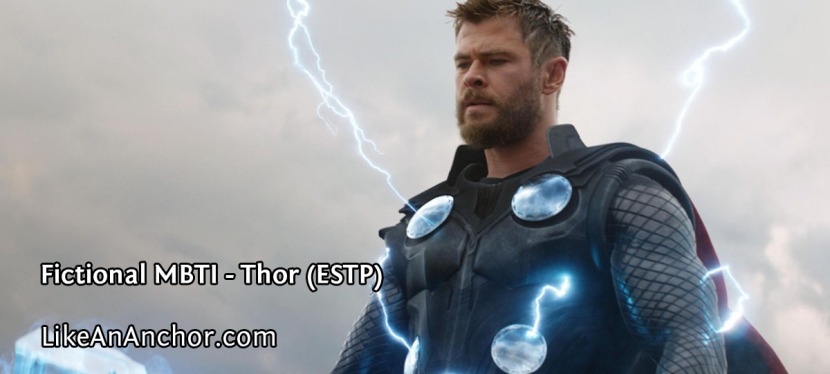
Fictional MBTI – Thor (ESTP)

With Thor: Ragnarok now out, it seemed like a good time for another Fictional MBTI post, especially since Ragnarok is so good. Who would have thought a film about the destruction of Asgard and fall of the gods (that’s not a spoiler — it’s Norse mythology) could be so light-hearted and fun?

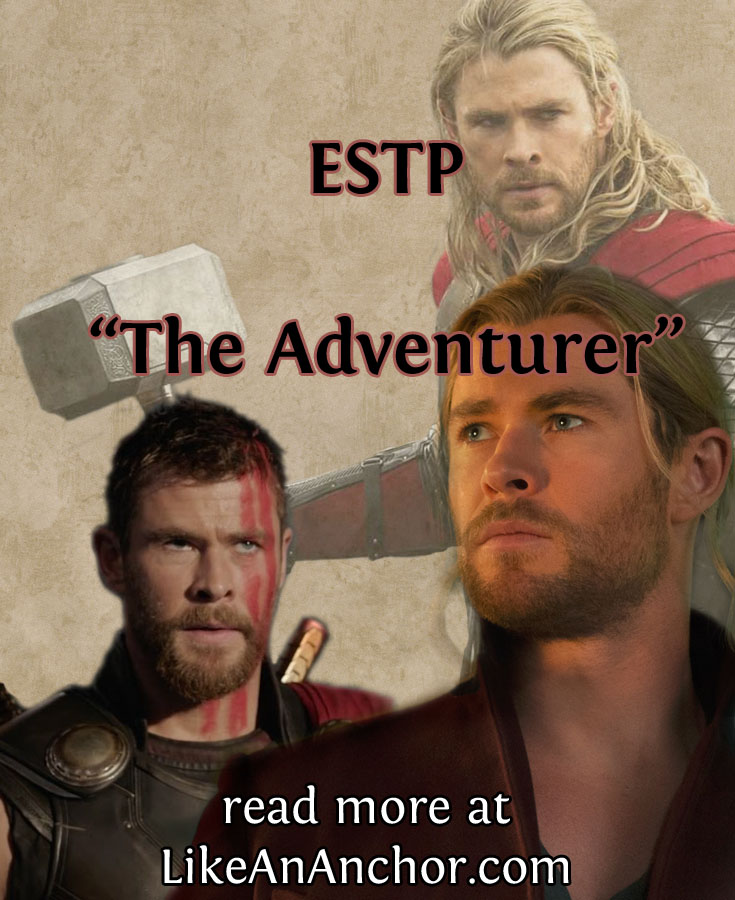
I’ve been typing Thor as an ESTP since the first film came out, which I think is pretty much the standard typing for him (please note: I’m only typing the MCU version of Thor, not his character in the comics or mythology). Still, just because there’s not much debate about his type doesn’t mean we can’t give him his own post. There are several different nicknames for this type, and for Thor I decided to go with “Adventurer” rather than the more commonly used David Keirsey nickname “Promoter.”
A Man of Action
Fictional MBTI - Thor (ESTP) | marissabaker.wordpress.com

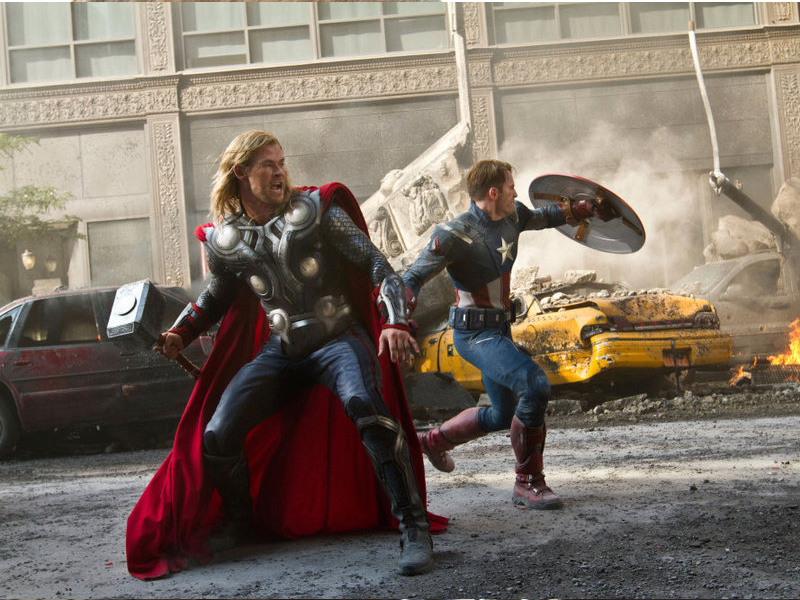
ESTP types lead with a mental process called Extroverted Sensing (Se). Fittingly, this is the most visible aspect of Thor’s character in the films. SP types are doers. They thrive on taking action in the real world and they’re good at it. Really good. In fact, I’d venture a guess that most action heroes in fiction are SP types, especially STP types. It’s not that they can’t pause for reflection or plan ahead. It’s that they don’t really see the need since things usually work out so well for them.

ESTPs have a reputation for being thrill-seekers, and it’s not hard to see why. Their dominant Se seeks variety and physical stimulation. They like to take risks, yet they are so aware of their physical surroundings and their limits that they are probably the smartest physical risk-takers around. They have a natural awareness for what their body can or can’t do, paired with quick reflexes, and an ability to keep their wits in a crisis.” — Susan Storm, Understanding ESTP Sensing

This side of Thor’s character is at the forefront in the new film as well as his past appearances. In Ragnarok’s opening scene, he even comments that fighting against overwhelming odds without a real plan seems to always work out for him. And not only does it work out, he’s clearly enjoying himself. He thrives on challenge and risk-taking.

Thoughtlessly Charming
Fictional MBTI - Thor (ESTP) | marissabaker.wordpress.com

I’m going to skip over an ESTP’s co-pilot process for now and talk about their tertiary side. It’s tempting for any type to bypass their secondary function and spend more time in their less-developed tertiary side because that lets them stay in their preference for introversion or extroversion. For example, an ESTP’s primary and tertiary functions are both extroverted, while their secondary one is introverted.

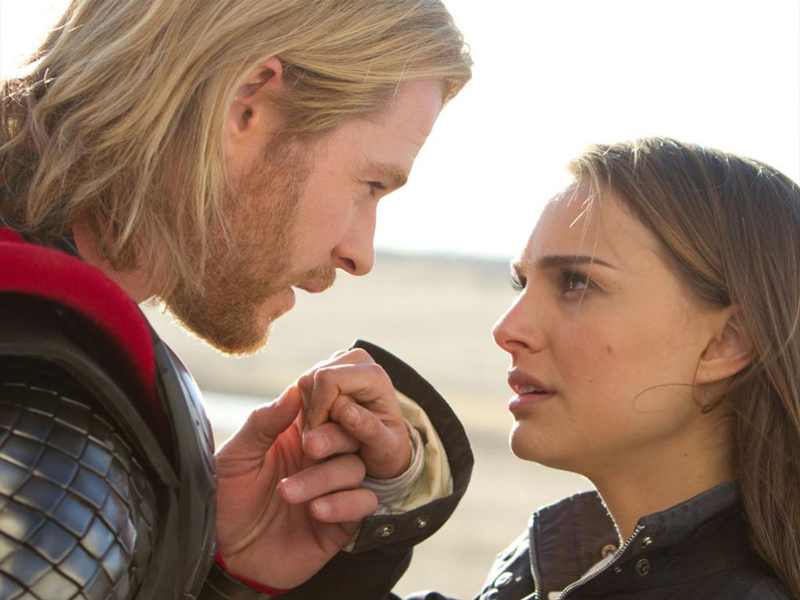
Extroverted Feeling (Fe) isn’t all that well-developed or reliable for ESTPs. It can lead to bad decisions based on doing things that will make them look good to or fit in with the people around them (Fe is a process focused on harmony in relationships). Thor is clearly enjoying his social position in the opening scenes of the first film and I suspect that a large part of how he acts is because “reckless military leader” is the persona people expect (though I doubt he’s analyzed it that much). We also see him using his Fe to connect with people on earth as the charming gentleman Jane Foster falls in love with.

Learning After Doing
Fictional MBTI - Thor (ESTP) | marissabaker.wordpress.com

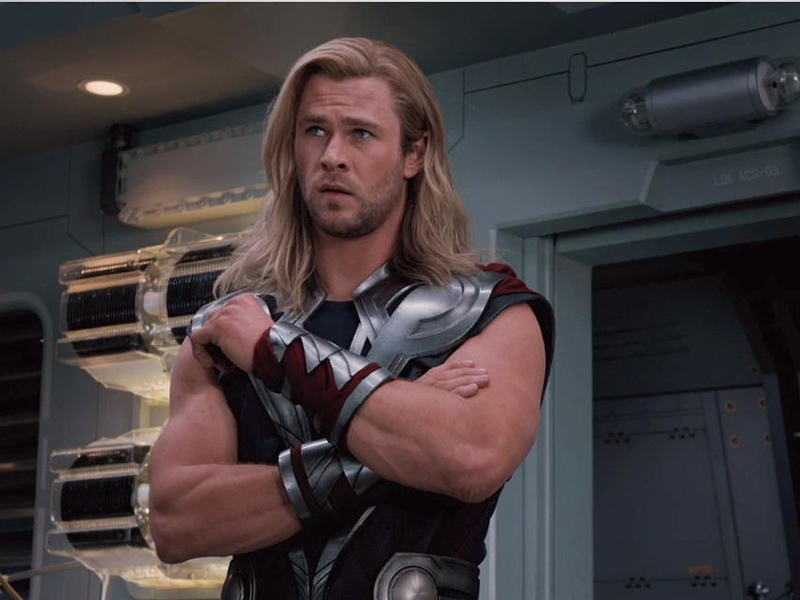
ESTPs learn best by doing. They’re not the sort to listen to lectures or spend a lot of time planing. They’d rather do something and see how it works out, then adjust future actions accordingly. Until something doesn’t work out there’s not much of a reason for them to spend time figuring out why. Which leads us to a discussion of an ESTP’s secondary function, Introverted Thinking (Ti).

Most people start to develop their secondary function in their teens, but it’s not a comfortable process for people to be in so we don’t always focus on growing it until we have to. For ESTPs, this “co-pilot” is a judging function that they use when making decisions. Ti is concerned with figuring out what makes sense, aligning to personal convictions, and impartially looking at facts. Thor starts doing this when his exile from Asgard in his first film forces him to look at the sort of decisions he’s been making and re-think his actions.

We do also get glimpses of an ESTP’s healthy thinking side in Thor’s character. People of this type can be incredibly clever and intelligent, though they’re often underestimated because so many outsiders just see their action-oriented side. An example from the first film is when he’s explaining the science behind Bifrost travel to Jane. He makes it look easy, but he’s managing to translate two completely different cultural way to framing the world (science and magic) in a way that makes perfect sense to an earth scientist. And in Ragnarok, we get a conversation between him and Bruce Banner where Thor effortlessly keeps up with and understands the scientific terminology used by a man with multiple PhDs.

Stress And The ESTP

Fictional MBTI - Thor (ESTP) | marissabaker.wordpress.com

Being cast out of Asgard in the first film, and especially learning that Mjölnir doesn’t see him as worthy anymore, pushes Thor into his least developed function. For ESTPs, that’s Introverted Intuition (Ni). When intuition is a type’s stress function, stressful situations tends to confuse their normally clear thought process and they may become angry, paranoid, or feel hopeless. It typically doesn’t take ESTPs long to bounce back, though, which helps explain why Thor’s despondency only lasts until he’s given a chance to take action and fight back.

What’s really interesting about Thor of the MCU films is that this version of his brother Loki is an INFJ type. Making Loki and Thor complete opposites in their personalities means they use the exact same mental functions in the opposite order. Thor’s weakest mental process is Loki’s strongest (INFJs lead with Ni), and vice-versa. No wonder they’re constantly butting heads and struggling to understand each other.


If you enjoyed this post, check out my other MCU typings:

Bucky Barns – ESTP

Loki – INFJ

Scott Lang -ISFP

Steve Rodgers – ISFJ

T’Challa – ISFP

Tony Stark – ENTP

Save

Save

Save

Save

Save

Save

Save

Disney Villains Myers-Briggs Chart – Part Two

Last week I posted my chart with Disney villains Myers-Briggs types. It turned into such a big post that I finally split it in half — Sensing types in Part One and Intuitive types today in part two (some of you probably saw the whole post last week. It was live for a few hours before I decided splitting it up would be more manageable). To re-cap, here’s my criteria for which villains are included in this chart:

  • All Primary Members of the Disney Villains franchise show up here, except Chernabog.
  • I then added a few other popular villains, paying special attention to the villains from films where I’ve already typed a Disney heroine.
  • To keep the number of villains manageable, I decided not to type any of their side-kicks or secondary villains.
  • I’m only typing the animated versions. This is mostly to maintain consistency, since sometimes the type changes in live-action reboots (such as Maleficent becoming more INFJ when she got her own film).

Disney Villains Myers-Briggs Chart | marissabaker.wordpress.com

As I mentioned last week, if you compare this chart to the ones I made for Disney Princesses, you’ll see they’re almost opposite each other. The spots on the chart that stood empty for the Princesses (ENFJ, INTJ, INTP) now have at least one occupant and some of the spots bursting with princesses don’t have any villains at all. The biggest trend seems to be Feeling types equal “good” and Thinking types equal “evil” (which really bugs me, but that’s a rant for another time).

There’s not much to go on for typing some of the villains. They’re often caricatures of personality types rather than fully-fleshed out characters. By necessity, associating a villain with a certain types means looking at the most negative stereotypes of that type. But Disney typing is fun, so even when we don’t have much to work, I’m going to take a guess at the character. You’re welcome to shout-out in the comments about what you do and don’t like! Have fun 🙂

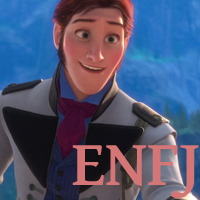
Hans — ENFJ

Hans - ENFJ. Visit marissabaker.wordpress.com for more Disney villain typesI love NF type villains. They’re not the typical choice for a fictional bad guy and their motives aren’t always immediately understandable, which is part of makes them an unexpected and unpredictable character.

  • Fe: Types that lead with Fe often have the easiest time connecting with people. Which means they can be the most charming, manipulative villains you’ll ever see. Hans’ entire plan is based on charming one of the sisters into marrying him (which he does easily by creating an instant connection with Anna). He’s also writing a narrative that makes him “the hero that’s going to save Arandel” as he manipulates all Elsa’s advisors until they’re begging him to be king.
  • Ni: This shows up in his long-term thinking. As the youngest of 13 brothers, he decided that taking over a different kingdom was better than the life he could see continuing on in the future at home.
  • Se: Typically a fun-loving and risk-taking aspect of personality, which helps him charm Anna initially and also shows up in his physical skills like dancing and swordfighting.
  • Ti: Logic is not an ENFJ’s strongest suit. Hans’ entire plan rests on getting people to feel the way he wants them to rather than not on something concrete and he doesn’t have a backup plan.

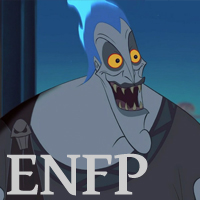
Hades — ENFP

Hades - ENFP. Visit marissabaker.wordpress.com for more Disney villain typesThere’s little disagreement that Disney’s Hades is an NP type and none at all that he’s an extrovert. People just can’t agree on Thinking or Feeling. Both ENxP types lead with Ne, so it comes down to whether he uses Fi/Te (ENFP) or Ti/Fe (ENTP) to make decisions. Read more

Disney Villains Myers-Briggs Chart – Part One

It’s finally here! The baddest evildoers to ever oppose animated Disney heroism — now with Myers-Briggs types. There are a lot of villains that show up in Disney stories so I had to whittle it down to a fairly short list. Here’s my criteria:

  • All Primary Members of the Disney Villains franchise show up here, except Chernabog.
  • I then added a few other popular villains, paying special attention to the villains from films where I’ve already typed a Disney heroine.
  • To keep the number of villains manageable, I decided not to type any of their side-kicks or secondary villains.
  • I’m only typing the animated versions. This is mostly to maintain consistency, since sometimes the type changes in live-action reboots (such as Maleficent becoming more INFJ when she got her own film).

Disney Villains Myers-Briggs Chart | marissabaker.wordpress.com

If you compare this chart to the ones I made for Disney Princesses, you’ll see they’re almost opposite each other. The spots on the chart that stood empty for the Princesses (ENFJ, INTJ, INTP) now have at least one occupant and some of the spots bursting with princesses don’t have any villains at all. The biggest trend seems to be Feeling types equal “good” and Thinking types equal “evil” (which really bugs me, but that’s a rant for another time).

There’s not much to go on for typing some of the villains. They’re often caricatures of personality types rather than fully-fleshed out characters. By necessity, associating a villain with a certain types means looking at the most negative stereotypes of that type. But Disney typing is fun, so even when we don’t have much to work, I’m going to take a guess at the character. You’re welcome to shout-out in the comments about what you do and don’t like! Have fun 🙂

  • Please note: there were so many villains to type that I split them up into two blog posts. Part One covers the Sensing Type villains and Part Two will cover the Intuitive types.
  • One more note: I mostly type by function stacks, so if you’re not familiar with that part of Myers-Briggs theory you can click here to read The Simplest Guide To Myers-Briggs Functions Ever.

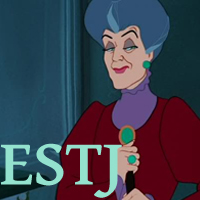
Lady Tremaine — ESTJ

Lady Tremaine - ESTJ. Visit marissabaker.wordpress.com for more Disney villain typesMost people type her as a TJ type (at least in the animated version), but beyond that there isn’t any agreement about her I/E or S/N preference. I’m pretty sure she’s a Sensor, but I’ve gone back and forth between introvert and extrovert. I’ve gone with extrovert because she’s very inclined to take-charge in the outer world and we don’t really see her spending any time alone.

  • Te: The opening narration describes her as “cold, cruel, and bitterly jealous of Cinderella’s charm and beauty.” While not a fair representation of TJ types, “heartless” is an accusation stereotypically leveled against them, especially women. She’s very outwardly judgemental and her communication consists of authoritative orders.
  • Si: My guess is that Lady Tremaine married Cinderella’s father for security. She already had a “good family” so she wasn’t social climbing. While we do see her trying to forward her daughters’ interests, it’s not really as part of a N-type’s long-term planning. She’s working within traditional roles to control and manipulate people.
  • Ne: A pattern-recognition function, Extroverted Intuition helps Lady Tremain put the pieces together and realize Cinderella was the mystery woman at the ball.
  • Fi: As an inferior function, Introverted Feeling can show up as outbursts of emotion and a fear of feeling. Lady Tremain is a very detached character, never showing her feelings for the people around her unless it’s in an angry outburst.

Queen of Hearts — ESTJ

Queen of Hearts - ESTJ. Visit marissabaker.wordpress.com for more Disney villain typesThe Queen of Hearts is one of the more exaggerated Disney villains. ESTJ nicknames include Supervisor, Executive, Overseer, and Enforcer. Take that to a villainous extreme and you just might get someone who lops off subordinates’ heads when things don’t go as they ordered. Read more

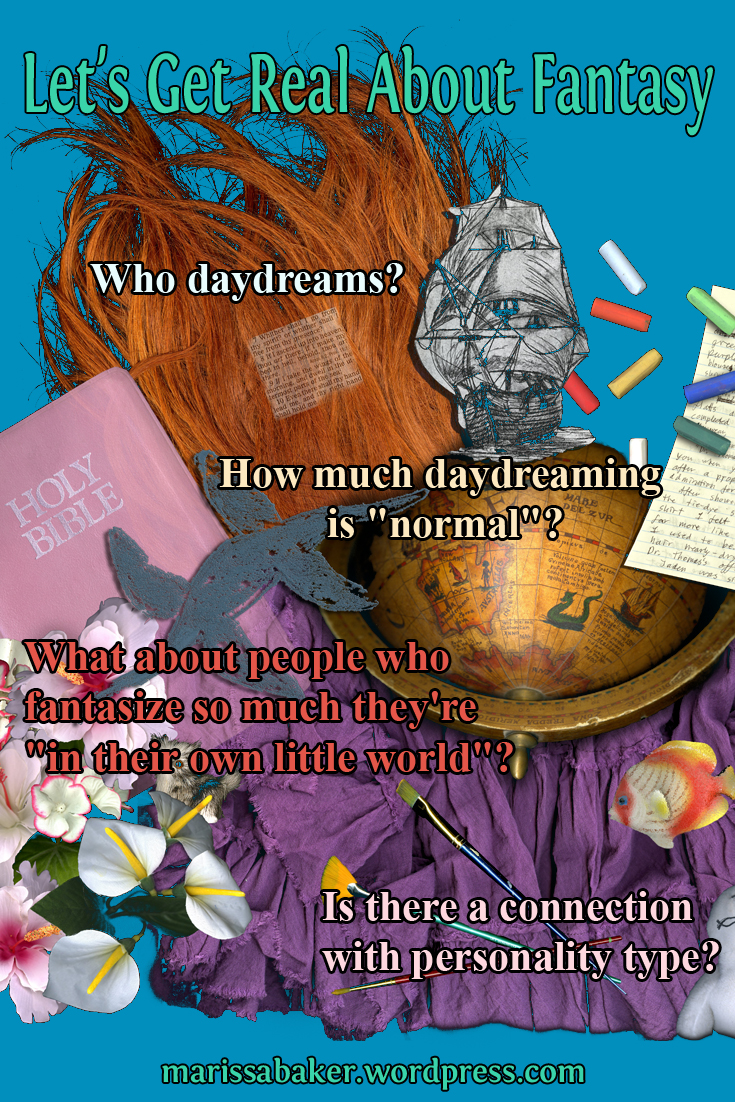
Let’s Get Real About Fantasy

Daydreaming is often considered a childish activity. So it might come as a surprise that studies indicate at least 96% of adults engage in daydreams and/or fantasizing on a daily basis. These daydreams typically last for just a few minutes while the mind wanders, but they can also be more involved, frequent, and lengthy. And getting caught up in daydreams is not, as previously thought, as sign of tending toward mental illness.

According to an article in the Dartmouth Undergraduate Journal of Science, we’re learning that daydreaming is “a normal part of our cognitive processes.” In fact, it’s pretty normal to “spend one-third to one-half of our waking hours daydreaming, although that amount can vary significantly from person to person.” I was honestly pretty surprised to learn this. I mean, I know I do that, but I wasn’t expecting such a large percentage of the population to also daydream so much.

But while reading different articles about daydreams, I realized something else. They’re talking about people’s minds drifting into fantasies about their real lives. For example, it’s considered healthy for someone approaching a job interview to daydream about getting the job or for someone in a high-stress job to spend time fantasizing about how all their conversations for the upcoming day could go well. Other studies asked people to daydream about taking vacations or their childhood home. These daydreams are about things that could happen or have happened. I have those types of daydreams, too, but that’s not what most of mine are.

Let's Get Real About Fantasy | marissabaker.wordpress.com
this picture is part of a psychological self-portrait I made in a college art class

Extreme Fantasizers

While studying hypnotic suggestibility in 1981, psychologists Theodore X. Barber and Sheryl Wilson discovered that the 27 women they identified “as extremely good hypnotic subjects … all had a fantasy life so intense that it seemed ‘as real as real.'”‘ After more research, people in this group are now described as having a “fantasy prone personality” (FPP). On the more extreme side, where fantasies start to take over reality, it’s called “maladaptive daydreaming” (click here to read an interview with a maladaptive daydreamer).

According to researchers, about 4 percent of people spend half or more of their waking hours absorbed in reverie. The fantasies are not mere fleeting daydreams but something of a cross between a dream and a movie, where an elaborate scenario unfolds once a theme is set. (from a New York Times article)

Reading about this group is where I start to recognize myself. Read more

Part Two: “Unofficial” Disney Princesses MBTI Chart

Last week, I updated an old post called The Missing Disney Princesses with a brand new MBTI Chart featuring the 14 official princesses (well, technically there are 11 official princesses, plus Anna and Elsa who have their own line, and Moana who hasn’t been crowned yet. So it was more like the “Official + New/Popular Princesses Chart”).

There are other Disney women, though, who’ve been completely snubbed by the Disney princess line-up and I wanted to include those as well. I had them on a separate chart in my previous post and I wanted to follow that pattern this time as well. Eilonwy and Alice were the most requested characters I left out last time, so I’m adding them. And I’ve also added a character no one asked about from my favorite underappreciated Disney films — Maid Marion from Robin Hood.Updated Disney Princesses MBTI Chart, Part Two | marissabaker.wordpress.com

Note: I’m not using anything from sequel films (just to help narrow-down the typing choices), so that’s why you won’t see Ariel’s daughter Melody (for example). I also type using cogitative functions. If you’re not familiar with that aspect of Myers-Briggs theory, click here and here for a two-part introduction. Read on for detailed explanations for why I chose these types for the unofficial princesses, and click here for the post about the other princesses.

Read more

Updated Disney Princesses MBTI Chart

A couple years ago, I made a Myers-Briggs chart called The Missing Disney Princesses that quickly became one of the more popular posts on my blog. Now (finally!!!) I get to update it to include our new princess, Moana.

But I’m not just adding Moana to my chart. I’m also moving around a few of the other princesses. Last time, my focus was on showing that we don’t see all the personality types represented by the Disney princesses. Both Intuitive and Thinking types are under represented among Disney’s ladies. That’s still the case, but this time my focus is on explaining why I typed each princess the way I did.

In the two years since publishing the last chart, I’ve learned more about Myers-Briggs typing. I’ve also re-watched several of these movies, considered comments from readers on the previous post, and asked advice from fellow personality type and Disney enthusiasts. In response, I’ve re-typed several characters (which is noted and explained in the individual character discussions).Updated Disney Princesses MBTI Chart | marissabaker.wordpress.com

Note: I type using cogitative functions. If you’re not familiar with that aspect of Myers-Briggs theory, click here and here for a two-part introduction. Read on for detailed explanations for why I chose these types for each character. Read more