Female Difficulties

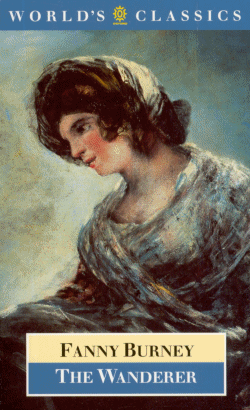
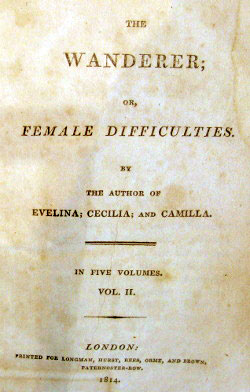
The Wanderer; or, Female Difficulties #ccwomensclassics post | marissabaker.wordpress.comMy title for this post is the subtitle for Frances Burney’s final novel, The Wanderer. It was one of the first books I put down when compiling my Classics Club Book List, and I’m reading it this year for the Women’s Classic Literature Event. Finishing this book means I’ve now read all Burney’s major fiction works (that is a grand total of 3,133 pages of text, so it’s a pretty big deal). I am Reader, hear me roar.

Note: spoilers follow for this 202 year old book.

The Wanderer, or Female Difficulties is the tale of a penniless emigree from revolutionary France trying to earn her living in England while guarding her own secrets. Combining the best elements of the gothic and historical novels, this newly appreciated work is an extraordinary piece of Romantic fiction. Burney’s tough comedy offers a satiric view of complacent middle-class insularity that echoes Godwin and Wollstonecraft’s attacks on the English social structure. The problems of the new feminism and of the old anti-feminism are explored in the relationship between the heroine and her English patroness and rival, the Wollstonecraftian Elinor Joddrel, and the racism inherent within both the French and British empires is exposed when the emigree disguises herself as a black woman. (Goodreads summary)

This is probably the Burney novel that I found most frustrating. Evelina, her first novel, is the easiest to read, though it still engages with the darker side of 18th century romance. Her next two, Cecelia and Camilla, are more difficult (especially if you’re expecting an Austen-style romance). The heroines are persecuted relentlessly, in grave danger several times, and the heroes fail to live up to the name.  The Wanderer takes these themes a step further. Instead of giving her characters ineffective guardians, Burney doesn’t leave the Wanderer, who goes by the name “Ellis” for much of the book, anyone to turn to at all. Instead of revealing the plight of a young woman having difficulty navigating the marriage market, Burney shows the struggles of a woman completely alone without name or resources to protect and support her.
The Wanderer; or, Female Difficulties #ccwomensclassics post | marissabaker.wordpress.comThe Wanderer is a scathing rebuke of society on many different levels. Burney takes full advantage of her lengthy text to discuss the French Revolution, snobbery in the upper classes, gender inequalities, racial stereotypes, modern suspicion of an afterlife, suicide, social perceptions and stereotypes, abusive/coercive relationships, and duty to family (just to name the ones that come to mind within a minute). The amount of ground she covers is really quite impressive. Even more impressive is that she manages to show both sides of most issues. Sometimes you can easily tell where Burney stands, but not always. For several of the ideas discussed, it seems she just wants readers to open their eyes and see that things aren’t always black and white.

What frustrated me when reading The Wanderer wasn’t the issues being discussed or even so much the drawn-out plot line. It was Ellis’ character. The narrative stays with Ellis but maintains a distance that makes it very difficult to sympathize or identify with her. For the better part of the book, we don’t know any more than the other characters about who she is and what her motivations are. We rarely even know what she’s thinking. What’s worse, we seldom hear her say anything. There are a few scenes where Ellis speaks clearly and decisively, but mostly she stands mute. She is silent while other characters misconstrue her motivations, put words into her mouth, accuse her unjustly, and even propose romantic connections. A few words pass her lips, but mostly she stands in acute emotional agony hoping the other characters will understand her inarticulate protests. Even Mr. Harleigh, the heroic figure in this story, becomes so frustrated by this that there are times he is almost violent in his insistence that she give him a straight answer.

Silencing the main character frustrated me, but it also draws attention to the difficulties Burney is discussing. It might be tempting to read the subtitle “Female Difficulties” simply as a critique of the challenges women faced in 18th century society. We could say that it is the other characters who make life difficult for Ellis because society is set-up to be suspicious of a woman alone and to limit her options. But it goes even deeper than that. The type of femininity ingrained the naturally elegant and lady-like Ellis make her situation even more difficult. She is one of her own worst enemies because of her limiting view of her own role as a woman. It’s not seemly for a lady to perform in public, so she refuses to give a concert until she’s shamed into it by a need to pay her debts. It’s not ladylike to accept pecuniary aid from a man, so she becomes entangled in a host of embarrassing situations trying to return gifts that were made anonymously to spare her delicacy. It’s a shame for a woman to run away from her husband, so she conceals the fact that she was forced into a marriage that’s barely recognizable under the law even when it means leading on another man who’s falling in love with her.

Like today, 18th Century culture was struggling with ideas surrounding gender definitions, roles, and expectations. Burney recognized that the problems regarding inequalities between men and women weren’t just external, but also ingrained in prevailing ideas about what constitutes masculinity and femininity. I argued when writing my undergrad thesis about her other novels that Burney countered the gender crisis of her day by advocating for a return to Biblical gender ideals where men and women are recognized as having unique strengths and roles yet also viewed as equally important. In this book, published 18 years after Camilla, there’s little evidence of that hope. Burney seems more cynical about society’s ability to change and points out problems without offering a way to fix things. It’s up to us, the readers, to try and find a solution or to live with the consequences of inaction.wanderer
Click here to get a copy of The Wanderer. Please note that this is an affiliate link. This means that, at no additional cost to you, I will receive a commission if you click on the link and make a purchase.

Save

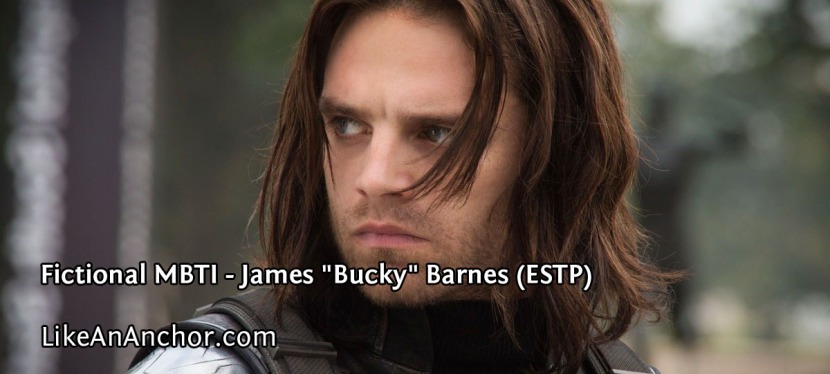
Fictional MBTI – James “Bucky” Barnes (ESTP)

It always intrigues me how certain characters attract so much investment from viewers. Browsing Pinterest lately, it seems like Bucky is the new Loki — the Marvel fandom’s dark, mistreated character who just needs a hug because we love him soooooo much. In Bucky’s case, the reasons why we find his character compelling aren’t too hard to find. He’s a good man who was forced to do terrible things and is now constantly fighting a battle to be himself. Sebastian Stan’s portrayal allows audiences to glimpse Bucky’s human side under the soldier persona he wears and the assassin role he’s forced to adopt, and audiences are drawn in by a realistic, sensitive portrayal of a compelling character.

Most people type James “Bucky” Buchanan Barnes as an ESTP, and I’m inclined to agree with them. Operating under the assumption that MBTI type doesn’t change, when we see him as Bucky in Captain America: First Avenger he’s a healthy, stable version of his MBTI type. The version of Bucky we see later in Captain America: The Winter Soldier is a severely stressed and traumatized man of the same MBTI type. Bucky in Captain America: Civil War is still dealing with the fall-out of all he went through, but he’s more recognizable as an ESTP.

Typing Bucky Barnes

We only get about 13 minutes of footage with Bucky in the first Captain America film, but those scenes reveal a character in line with type descriptions of ESTPs as people characterized by decisive action, contagious energy, and enjoyment of being in the moment. They are “thrillseekers who are at their best when putting out fires, whether literal or metaphorical. … They assess situations quickly and move adeptly to respond to immediate problems with practical solutions” (Truity.com description). David Keirsey writes that ESTPs (whom he nick-names Promoters) “live with a theatrical flourish which makes even the most routine events seem exciting. … Promoters demand new activities and new challenges. Bold and daring at heart, and ever-optimistic that things will go their way, Promoters will take tremendous risks to get what they want, and seem exhilarated by walking close to the edge of disaster.” Other nicknames for ESTPs include “problem solver” and “realist.”

ESTPs lead with a mental process called Extroverted Sensing, or “Sensation.” This process “can get into the action in the moment. Think of it as ‘real-time kinetic’” (from Personality Hacker). It’s a fun-loving function that delights in sensory experiences, such as Bucky spending his last night in New York dancing with girls he probably doesn’t care whether or not he ever sees again. On that same night, he and Steve are talking about Steve’s inability to enlist and he says, “I don’t see what the problem is. You’re about to be the last eligible man in New York.” He’s trying to make Steve feel better with joking and doesn’t really ‘get’ the duty-fulfilling and self-sacrificing aspect of Steve’s character. It’s not a deeply ingrained aspect of his personality type (like it is for ISFJ Steve), though in practice he still does his duty and sacrifices himself because he’s a loyal friend and a good man.

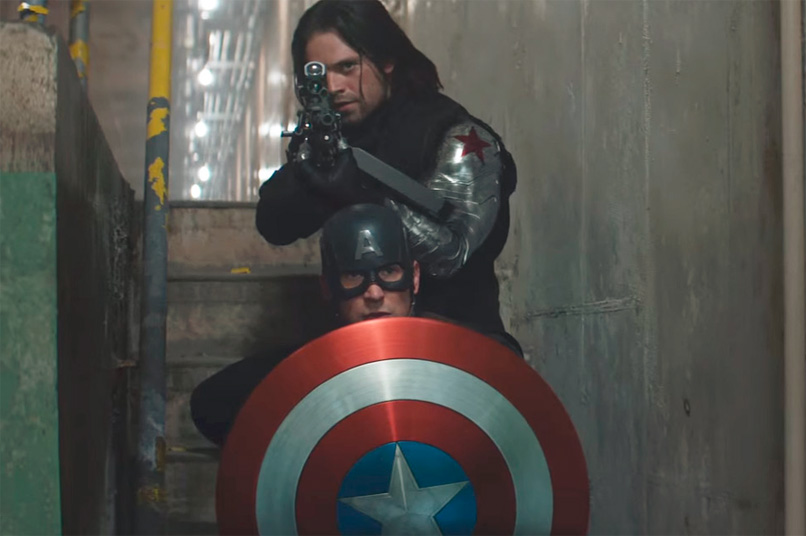
We also see Bucky demonstrate sensory skills in more serious situations. Even post-experimentation and groggy when escaping Redscull’s prison, Bucky could walk across that metal girder with coordination, balance, and no hints of fear other than a healthy caution. As a Howling Commando, we see him as a sniper (which requires skills that come naturally to SP types) and making split-second sensory decisions with ease in the final train fight.

ESTP types support their Sensation function secondary with Introverted Thinking (or “Accuracy”) and then tertiary Extroverted Feeling (or “Harmony”). These mental processes describe how ESTPs, like Bucky, make decisions. First he’s using impersonal criteria to evaluate information and make decisions that are motivated by his own understanding of how the world works. Extroverted Feeling gives ESTPs an insight into other people that they stereotypicaly use to be charming and get people to do what they want. When he tries to ask Peggy to dance, he’s clearly not used to being ignored in favor of his friend (or any other guy). ESTPs are not primarily an emotional sort of people, though. In an early scene, Bucky had just had an argument with his best friend and turns that emotionally invested side of himself ‘off’ to take the girls dancing and enjoy himself.

The Winter Soldier

Once Hydra turns Bucky into the Winter Soldier, it’s difficult to use any scenes to get a clear picture of his personality type. In Captain America: The Winter Soldier we see a few glimpses of the real Bucky trying to get out, but not really anything to help with typing him. In Civil War, however, his own mind is starting to reassert itself and we can talk about his personality type in that film.

When ESTPs are stressed, one of the most common things they experience is internal confusion. They feel out of control, forget details, and become paranoid. Their inferior, or 3-year-old, function is Introverted Intuition (also called “Perspectives”). It’s a mental process that speculates on things that cannot be known, which is great for creativity and insight if you’re using it as a driver process but not so good if it’s an underdeveloped function that comes out when you’re stressed. Most ESTPs snap out of what Naomi Quenk calls a “Grip experience” (where stress causes your inferior function to assert itself) fairly quickly, but “Chronic grip behavior can lead the individual and others to believe that he or she is typically negative, pessimistic, and worried about both the present and the future” (Was That Really Me? p.180). Add to that all the torture and brainwashing used to turn Bucky into the Winter Soldier, and you have the Bucky who’s fighting alongside Cap in Civil War.

Here, we see a man who is not only fighting physical battles (and with extraordinary skill now that super-soldier enhancements have been added to his natural sensory abilities), but who is also fighting a mental battle. As extroverts, ESTPs tend to focus more on the external. Bucky’s experiences have turned him inward, making him more serious and forcing him to develop his Introverted Thinking side. Though type theory holds that your base personality doesn’t change, Bucky is in many ways a different person than the one we see in The First Avenger. He’s burdened with the weight of what he’s done and his friend Steve is now his only real connection with another human being.

In some ways, Bucky’s joking remark from the first Captain America movie “I’m turning into you” has come true. He’s become much more introspective and aware of the weight of his actions. Yet he’s also still thoroughly himself. We have a scene where he and Cap are reminiscing about fun times they had and a girl Bucky tried to impress, and he’s really Bucky against instead of the Winter Soldier. The fun-loving young ESTP is still in there, just buried deeply under the weight of all he’s been though.

In The First Avenger, we see Bucky fighting to protect his best friend and giving his life for his country. Now in Civil War, he trusts his best friend to help him through and gives up his freedom by going into cryostasis so he’s can’t be used to hurt others. Bucky’s decision to enter cryostasis at the end of the movie is also an intensely individualistic move that’s characteristic of SP types. If he can’t guarantee he can control himself, then at least he can make sure no one else can take control of him either.

bucky

If you enjoyed this post, check out my other MCU typings:

Loki – INFJ

Scott Lang -ISFP

Steve Rogers – ISFJ

T’Challa – ISFP

Thor – ESTP

Tony Stark – ENTP

SaveSave

Save

Save

Books That Tell Truth Through Lies

As I was going through blog posts in my inbox yesterday,  I noticed two of my fellow bloggers were writing about reading recommendations and lists. Juni Desireé was posting about the top 10 books on her reading list for this year, and Socratic MBTI offered three quick recommendations for “enriching” books to read. In the past, I’ve shared a couple lists of my own, including my favorite fantasy books, but that was way back in 2013 (I’ve been blogging that long!?!). Sounds like it’s time for another recommended books post! Fiction That Tells The Truth

Books That Tell A Truth Through Lies | marissabaker.wordpress.com

I’m taking the title of this post from one of my favorite ideas — that even though “fiction” is defined as imaginary or untrue it is, in fact, a vehicle for telling the truth.

“That’s what fiction is for. It’s for getting at the truth when the truth isn’t sufficient for the truth.” ― Tim O’Brien

“Fiction reveals truth that reality obscures.” ― Ralph Waldo Emerson

“Fiction is the lie through which we tell the truth.” ― Albert Camus

“A fiction writer weaves a fabric of lies in hopes of revealing deeper human truths.” ― Wally Lamb

That’s my favorite kind of fiction. Any good story can teach you something true about yourself or other people, but truly great stories are going to get at a “deeper human truth” than is often isn’t possible in any other form. Child-labor laws would have passed in Britain without Dickens, but would it have happened as quickly if people hadn’t read Oliver Twist? Would the phrase “Catch-22” have entered our vocabulary if Joseph Heller wrote an essay instead of a novel?

Many books exist to share truths or make us think about something we’d otherwise overlook. One of the more famous is 1984 by George Orwell, which I’ve never actually finished reading (I know, I know — I’ll go hide in the corner now). Many others teach us truths seemingly by accident while telling a story. Here are just a few examples :

*note: there will be spoilers for all these books.

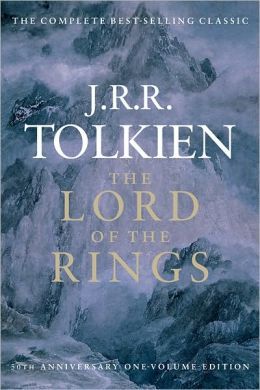
The Lord of the Rings

Tolkien insisted his The Lord of the Rings trilogy was not allegorical or inspired by his personal life, but I think we can at least say that his faith (Catholic) and his history (serving in both World Wars) influenced his writings. It’s a classic battle of good verses evil that set the stage for every epic fantasy adventure written since.

Just in case you’ve escaped reading or watching LOTR, the formerly-vanquished dark lord Sauron has come back into power in Middle Earth and is attempting to regain control of a magic ring that will let him subdue all lands and people under his power.  Though there are great warriors involved in the fight, the final victory hinges on two little hobbits from the middle of nowhere who hiked a very, very long way to destroy the ring.

By taking us outside of our own world, Tolkien shares universal truths about what makes a real friendship, the sacrifices required to do the right thing, and the importance of resisting evil even when it seems hopeless. One of the truths that hits me the hardest when reading or watching Lord of the Rings is how helpless we are to resist evil on our own. Frodo was incredibly strong on an emotional and psychological level and he carried the ring longer than any other character could have, but he still couldn’t make it up to Mount Doom by himself. Sam carried him the rest of the way and Frodo still wouldn’t have destroyed the ring if Gollum hadn’t fought him for it and carried it into the fires when he fell. Even heroes are susceptible to evil’s pull and they can’t overcome alone.

Mockingjay

I’ve read the whole Hunger Games book series and just watched Mockingjay Part II this past weekend. Suzanne Collins grew up learning about military history from her father — a Vietnam veteran and history professor. She didn’t go the history professor route herself, though, instead majoring in theater and telecommunications, then earning a master’s degree in dramatic writing.

The Hunger Games, Catching Fire, and Mockingjay all take a good, hard look at what the article linked above describes as “necessary and unnecessary wars.” They quote Collins saying, “If we introduce kids to these ideas earlier, we could get a dialogue about war going earlier and possibly it would lead to more solutions.” In this case, the writer approached her storytelling hoping to convey truths about and get a dialogue started on ideas relate to war.

My mother, brother and I were talking yesterday about how Mockingjay is a story that sticks with you. It’s not something you can just read/watch and move on from. This is largely owing to what is probably Collins’ least popular authorial choice — killing Finnick Odair. In the book I actually read right over his death the first time and then had to go back and figure out what happens to him. His death isn’t the driving force in a major plot point (like Prim’s death) and he doesn’t have a dying scene all of his own (like Rue does in the first book). He just dies senselessly and tragically while the action moves on without him. And that’s the point. In real life, death doesn’t always make sense or serve a specific purpose.

Ender’s Game

This book could have so easily been nothing more than a story about a futuristic society that trains children to kill aliens. But Ender’s Game was written by Orson Scott Card (one of my all-time favorite writers) and there’s much more to it than that. The real story isn’t about the alien threat — it’s about human nature.

Ender’s Game wrestles with the question of how far it’s “okay” to go when you’re at war, and it does so from the perspective of a child who’s been immersed in a militaristic system for the bulk of his formative years. Just in case the military training isn’t enough to make him comfortable with genocide, though, he’s taught the entire thing is a game — that none of the aliens will actually die if he wins.

As the story unwinds, we’re forced to confront ideas that can spill over into our own world. How violent can games become before they start affecting reality? When, if ever, are large-scale preemptive strikes an acceptable form of self-defense? What is an adult’s responsibility toward children?

Somewhat less obvious is the question of an individual’s responsibility within society. Ender was raised from a young age to think of the Buggers (this name was changed to Formics in later Enderverse writings) as enemies you must destroy at all costs. He should have been thoroughly brainwashed into believing this, and yet learning he’d succeeded in wiping out his enemy in real life rather than just in-game nearly destroyed him. He devoted the rest of his life to making others understand the Hive Queen’s perspective and trying to set things right by bringing back the Formics species. Perhaps that’s the real take-away truth from Ender’s Game — there are at least two sides (and often more) to every story and it’s not always easy to see who’s right.

Your Turn: What are some of the truths you’ve discovered in and through fiction?

Fictional MBTI – Scott Lang (ISFP)

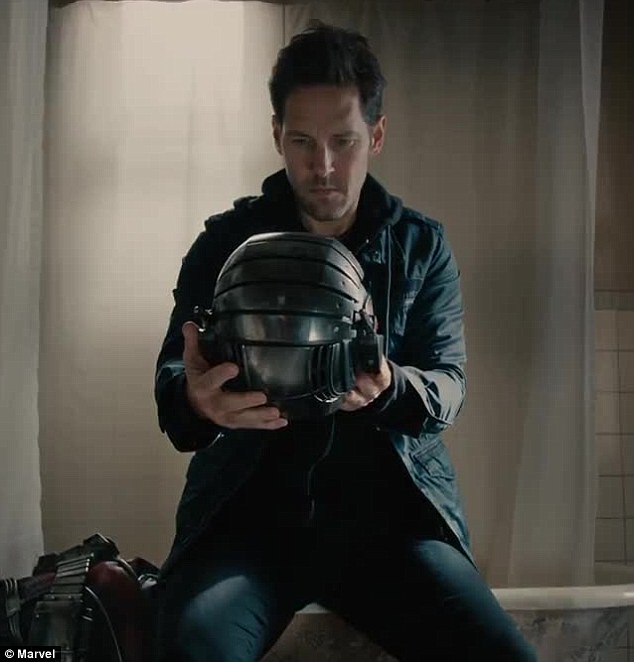
With Captain America: Civil War coming out in just seven weeks, I thought I’d add a post on Scott Lang to my collection of fictional MBTI types. It’s also a pretty good excuse to buy and re-watch Ant-Man.

If you do a quick Google search to see how others on the interwebs are typing Scott Lang, you’ll mostly find ESTP, with a few ISTP, ISFP and one INTP guesses thrown in. One thing all these types have in common is that they’re extroverting their Perceiving process, so that’s where we’re going to start (the P/J preference in an MBTI type refers to how we interact with the outer world).

Sensing vs. Intuition

The S/N preference describes our perceiving function, which is the mental process we use to learn new information. Isabel Meyers wrote that Sensing types “depend on their five senses for perception.” They want to see, touch, and test the information they’re taking in. Subjective or indirect information is less trustworthy, and less interesting, than their own direct experiences. Intuitives, on the other hand, “are comparatively uninterested in sensory reports of things as they are” (Gifts Differing, 57). Intuition is an innovative process that resembles advanced pattern recognition (in Personality Hacker’s words) and focuses on exploring possibilities.

Types that have a “P” in their four-letter name extrovert this mental process. Personality Hacker describes Extroverted Sensing (Se) as a “real-time kinetic” function that’s very in-tune with verifiable details of the outer world. Types with Se high in their function stack are typically very comfortable in their bodies and have a natural talent working with their hands.

Extroverted Intuition (Ne) is the function that ENTP Iron Man leads with. It’s very much about exploring the outer world and trying things just to see what will happen. It actively searches for patterns that haven’t been found and understood yet.

Looking at Scott Lang in Ant-Man (we’re not covering the comics here, just the film), I don’t really see much evidence of him using Intuition. He’ll still have intuition in his function stack (Introverted Intuition is the opposite of Se, so in an SP type that will be either his tertiary or inferior function) but it’s not what he leads with. Just a few examples:

  • Se types are typically very good working with their hands and coordinating their bodies. Scott possesses the skills to burgle houses (quite impressively) even before having the suit. He is also trained as an electrical engineer and we see him doing skilled hands-on work throughout the film.
  • When Scott encounters a challenging safe to crack, he doesn’t explore possibilities or try different things. He relies on what he knows will work from past experience and quickly implements it to bypass the fingerprint scanner and freeze the door. He also doesn’t forget any Sensing details (blows up air mattress for the door to land on, hangs comforter in the door to catch the flying hardware).
  • The “Whose pajamas are these?” question would be irrelevant to Ne, but it’s a detail Se would notice.
  • Scott learns to control the suit and fight fairly quickly by testing it out actively. It become natural to him and he’s soon effortlessly coordinating sensory details (like timing his jump off the servers at Pym Tech to coincide with bringing Antony into position to catch him).

Feeling vs. Thinking

The F/T preference describes how we make decisions about our behavior and what we think the world should look like. Feeling types typically prioritize how a decision lines up with their values and those of society. Feeling is concerned with the emotional impact of a decision. Thinking, on the other hand, “is essentially impersonal” (Gifts Differing, 65). This process seeks objective truth that doesn’t depend on the perspectives of other people

For “P” types, the judging process is internally focused. Introverted Feeling (Fi) types tend to check-in with the emotional impact of a decision by looking inward. They want to “determine what feels the most in alignment with oneself” (Personality Hacker). For them, decisions have to “feel right” and authentic.

Introverted Thinking (Ti) also checks in with the inner reality, but doesn’t focus on authentic feeling. Instead, it prizes things that “make sense.” Whether or not Ti types can objectively explain a decision, it has to line-up with the theory they’ve formulated about how the world works. They are interested in facts, but “chiefly as illustrative proofs” of their ideas (Gifts Differing, 78).

This one was harder for me to pin-down in Scott. The difference between Fi and Ti confuses me, but a couple articles from Personality Junkie helped clear things up (click to read “Introverted Feeling (Fi) vs. Introverted Thinking (Ti)” and “The Laws of P-Types: Fi & Ti Laws“). Prelude Character Analysis’ ISFP vs. ISTP article was also useful.

  • Scott’s infamous VistaCorp burglary was based on what he felt was right, not on logic. There’s an interesting interview on YouTube where Scott talks about this incident. He says he’s tired of having his “name dragged through the mud” by media who don’t recognize why he did what he did. He’s willing to pay the price for his choices, but he wants the world to respond according to his internal value system and recognize VistaCorp was morally culpable.
  • In the film itself, Scott is very careful about how he’s defined. He insists he’s a cat-burglar because “robbery involves threat” and he detests violence. This is not just about specificity and getting facts right — it’s about how he’s seen by others in society and how he feels about himself.
  • When Scott talks about how he sees himself and his subjective view of the world, he defines himself in relation to the kind of man his daughter wants him to be. This is also why he chooses to help Hank Pym. It isn’t about logic — it’s about a “chance to earn that look in your daughter’s eyes, to become the hero that she already thinks you are.”
  • Scott is certainly not suspicious of emotions or hesitant to share and talk about feelings, unlike the typical ISTP (such as Black Widow and Hawkeye, who I’ll eventually write posts about). He’s not very well in-tune with how others will respond, though (unlike an Extroverted Feeling type, such as ISFJ Steve Rogers). For example, when Pym and his daughter are reconciling Scott expresses his appreciation of their feelings, but in doing so ruins the moment.

Extrovert vs. Introvert

The question now becomes what order Scott uses these functions in. Does he lead with his Extroverted Sensing process (ESFP) or with his Introverted Feeling process (ISFP)? There are very few scenes where we see Scott seeking out people so he can re-charge or where he seems focused on the outer world. His internal ides, cares, and identity are what’s important. Those are all marks of an Introvert. For a character whose entire motivation is based on doing what lines up with his internal locus of control, it makes sense for that introverted decision-making function to take center stage. This makes his ISFP function stack:

  • Primary: Introverted Feeling
  • Secondary: Extroverted Sensing
  • Tertiary: Introverted Intuition
  • Inferior: Extroverted Thinking

You can learn a lot about people by how they respond under stress, and in Scott we do see a stress-reaction consistent with Inferior Thinking rather than Inferior Intuition (as would be the case for an ESFP). When stressed out, he doesn’t lose control over sensory details or withdraw and get angry. Instead, he starts asking questions and trying to get back on familiar footing (“Who are you, who is she, what the hell is going on here, and can I go back to jail now?”). Stressed Feeling types also tend to act rather than shut-down, which is what Scott does whenever there are obstacles to his plan or when something traumatic happens (like Antony’s death).

One reason people might not like an ISFP typing for Scott is that this type is consistently stereotyped as too “artsy” to go into a field like engineering or implement logical plans. Yet, Dr. A. J. Drenth notes that SFP types “may find themselves curiously drawn to Investigative subjects like math, science, computer science, engineering, etc.” though it’s not necessarily a good fit for their type. They can do it, like Scott, but they may struggle to fit into the system, become frustrated, and even act out in some way (though not necessarily as illegally as Scott did). You can also find personal accounts from ISFPs who work as chemists, geologists, computer programmers, doctors, and engineers. Personality type describes how someone’s mind works — it doesn’t limit what they can and cannot do with those mental processes.


If you enjoyed this post, check out my other MCU typings:

Bucky Barns – ESTP

Loki – INFJ

Steve Rodgers – ISFJ

T’Challa – ISFP

Thor – ESTP

Tony Stark – ENTP

Save

Evelina: A Darker Look At Courtship

When I first read Evelina, my observation was that Frances Burney’s style “represents a shift nearing the latter part of the 18th century from fiction as a didactic tool to fiction as a pleasurable reading experience.” While I’m good as saving my literary observations (I have copies of everything I wrote in college), I’m apparently not very good at taking my own advice. This is the first time I’ve read Evelina for pleasure rather than analysis

I chose Evelina for a reread on my Classics Club Book List, and it also fits neatly into the Classics Club’s year-long Women’s Classic Literature Event (Tweet about it with #ccwomenclassics). The first time I read Evelina was in Spring 2010 for an upper-level course on The Early British Novel. Though I didn’t hate any of the other 4 books in this course, Burney’s little epistolary novel from 1778 was by far my favorite.

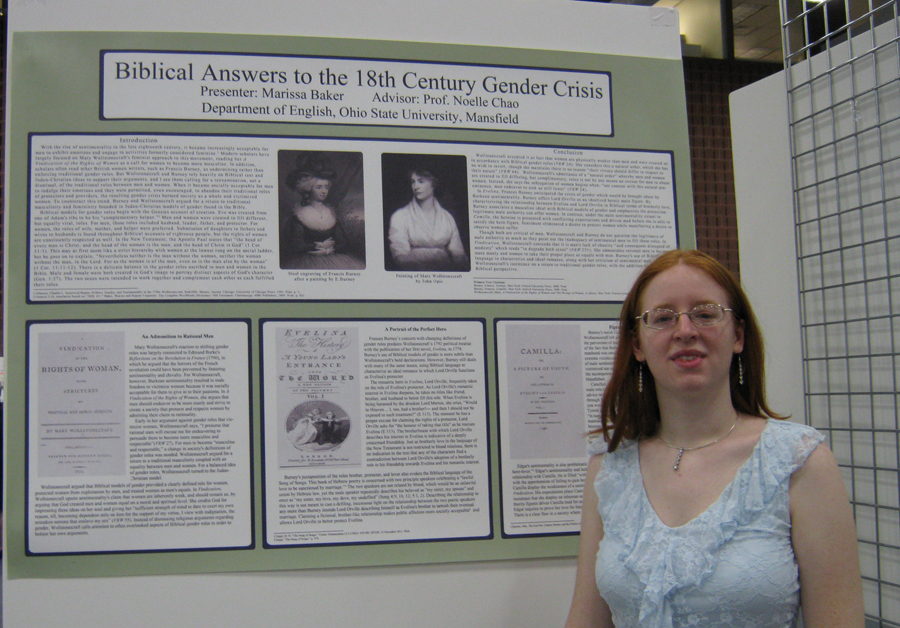
It’s no wonder, then, that when our professor asked me and one other student if we’d like to read more Burney in an independent study I said “yes.” We read Cecelia (1782) and Camilla (1796) – both weighing in at a solid 900+ pages. Then we branched out into Ann Radcliffe with The Romance of the Forest. That lead me to my first undergraduate research project titled “Unmanned Heroes: 18th Century Female Writers and Male Sentimentality. That turned into a 25-page research paper titled “Biblical Answers to the 18th Century Gender Crisis” (click on the title if you’d like to read this), which led me back to reading Evelina academically.

Reading "Evelina" for #ccwomenclassics | marissabaker.wordpress.com
Me at the Denman Undergraduate Research forum in 2012

Now, 4 years later, I’m back reading Evelina and enjoying it more than ever. Frances Burney was a fantastic (and, sadly, under appreciated) writer. Though Evelina was first published anonymously, Burney never hid the fact that she was a female writer. Her novels were quite popular with the general reading public and in artistic circles even during a literary age we often think of as belonging only to “dead white man.” Her style and success paved the way for writers like Jane Austen. In fact, Austen took her title Pride and Prejudice from a scene in Burney’s second novel, Cecilia, and when Austen’s father was seeking publication for that novel he described it as “about the length of Miss Burney’s Evelina.”

Comparing Burney to Austen (another favorite writer of mine), there are clear similarities, especially in Evelina. Both writers focus on a young woman who “marries up” by the end of the novel. Both critique society and social norms with a thinly-veiled sarcastic wit. But the differences are at times even more striking than the similarities. Nowhere in Austen will you find a scene like the one in Evelina when Captain Mirvan impersonates a highwayman and drags Madam Duval into a ditch where he terrifies her for sport. And, though Austen does have her Mr. Willoughbya and Mr. Wickhams, you’ll not find any of her main characters in situations so dangerous as Evelina’s.

Throughout the course of the novel, Evelina is persecuted by a man named Lovel, hounded and even kidnapped by Sir Clement, affronted by a staring Lord (in front of his fiancee), and rudely accosted by strange men at Vauxhall. To quote an essay by Judith Newton that appeared in a 1976 edition of Modern Language Studies, there are few places Evelina can go “without being forced, intruded upon, seized, kidnapped, or in some other way violated.” Newton describes this persecution as a “woman’s fate” once she entered into the marriage market in the 1700s, and points out that Burney “is one of the few writers in the century to take the discomfort of it seriously.”

Indeed, while I’ve frequently thought I might like to visit Jane Austen’s England, Burney’s is much less appealing. It’s populated with aggressive and vulgar people, the public places are unsafe without a large party and/or male protection, and it’s painfully obvious how vulnerable and option-less women were without family and fortune to their name. But it also feels more real. Sense and Sensibility came out in 1811 and Pride and Prejudice in 1813 – a scant 33 and 35 years after Evelina. Things had changed, but not that much. Much as I love Austen, I wonder if Burney was in some ways the braver novelist for calling out her contemporary society on its darker sides.click to read article, "Evelina: A Darker Look At Courtship" | marissabaker.wordpress.com

Click here to get a copy of Evelina. Please note that this is an affiliate link. This means that, at no additional cost to you, I will receive a commission if you click on the link and make a purchase.
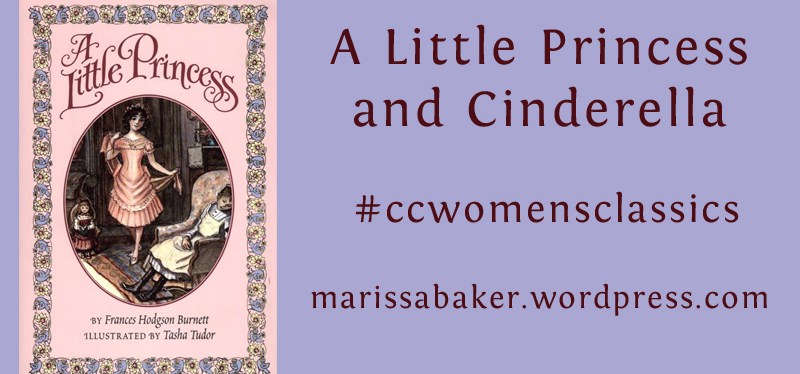
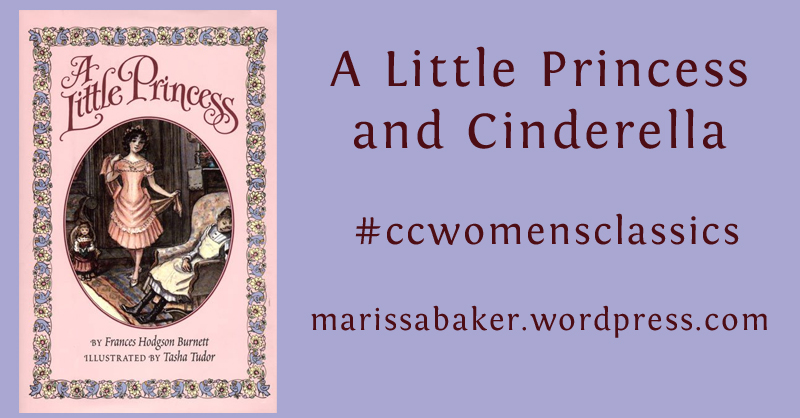
 

A Little Princess and Cinderella

Last week, I compared A Secret Garden to my favorite fairy tale, Beauty and the Beast. The subject of this week’s Classics Club post, A Little Princess by Frances Hodgson Burnett, has fairy tale elements which are even more obvious.click to read "A Little Princess and Cinderella" | marissabaker.wordpress.com

It’s pretty much the exact same story as Cinderella — an only child whose sweet disposition is unaffected by being spoiled is left in the care of an unkind woman after her father’s unexpected death. The austere and jealous guardian transforms the girl into a servant who lives in an attic and makes friends with rodents and birds. Eventually, a wealthy man swoops in and rescues her (Tweet about it).

There are even jealous “step-sister” figures in the form of some of the girls at the school (we’re looking at you, Lavinia). And you could call Ram Dass a “fairy godmother” of sorts, since he transforms Sara’s dingy attic into a princess room simply because he notices she’s so kind and wants to do something nice for her. It’s a key fairy-tale trope — eventually Magic (or it’s human equivalent) will step in and set things right if only you’re a good person.

Read more