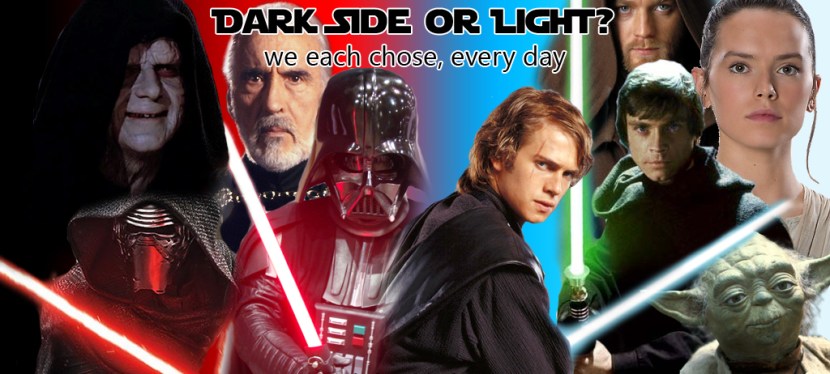
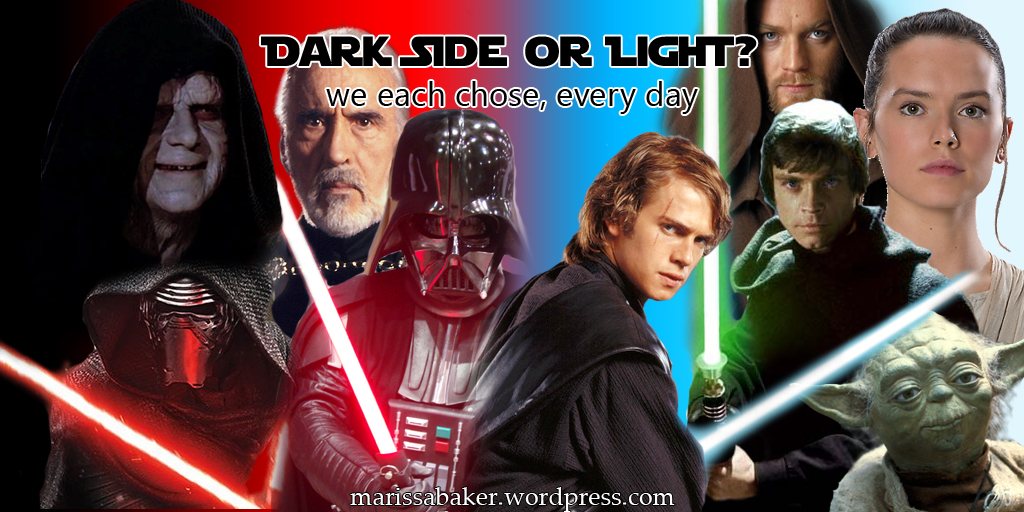
The dark side is quick, easy and powerful. The light side requires commitment, bravery and peace. They are always at odds, always battling in the galaxy as a whole, between groups of people, and even within individual hearts and minds.
Star Wars has always been about the classic battle between good and evil. This same battle rages in our world as well, which is one of the reasons this franchise is so popular. We can all relate to the humanity and struggles of the people in this “galaxy far, far away.” It’s a sort of myth or fairy tale for the modern age. And, like many iconic stories, it can prompt discussions about a variety of topics important today, including faith and religion.
In Star Wars, the Dark Side is the “quick and easy” path, just as in the Bible the path toward destruction is wide and easy to find. Darkness has a strong, seductive pull which actually mirrors an analogy in Proverbs where evil is compared to a crafty harlot while wisdom is a gentle, godly woman. Like the Bible, Star Wars teaches the Dark Side isn’t better – the good characters resist it and win, the bad characters find that it ruins their lives and the lives of those around them. Read more →
Like many with even a hint of interest in film and/or science-fiction, I’m eagerly awaiting Star Wars Episode 7. In anticipation of its release, I’ve been re-watching all the movies, branching out into the animated series and some of the in-cannon books, and working on a new Myers-Briggs Star Wars chart.
While trying to type Anakin Skywalker, I discovered I’d started writing a blog post within a blog post. And so, rather than waiting until December to start blogging about my Star Wars obsession, I decided to give Anakin his own post. Read more →
My sister and I had yesterday all planned out. Doctor Who in the morning, lunch with our cousin, then an afternoon of dress shopping for a dance in a couple weeks. The first complication happened when we thought we were running early so we swung by a dance store looking for shoes. We got lost, finally stopped at the store, and when we left the car wouldn’t start. Not too much of a complication though — we changed out the faulty fuse that’s been plaguing my sister’s car, and finally got to lunch 1/2 an hour late.
Lunch was great, so that part of the plan went well. But then the car wouldn’t start again and changing fuses didn’t cut it (the mechanic warned this day would come). So there we were, stuck in Raising Cane’s parking lot waiting for a tow truck driver and my sister was starting to see things, to put it delicately, in a rather negative light.
Now, I’m all for the occasional cry-and-eat-chocolate pity party, but the sun was shining and it was a beautiful fall day and we just ate an awesome lunch with our cousin. I mean, it’s not like we were in the middle of nowhere when it was raining and dark. So I rolled out a guaranteed negativity buster:
I watched this film more times than I care to admit when I was younger. I’m worried it won’t hold up well to rewatching, especially after reading Jules Verne’s original In Search of the Castaways, so I haven’t seen it in a while. But I could still (mostly) sing this song.
There’s really quite a bit of truth in “Enjoy It” for such a silly little song. So much of whether or not we have a “bad day” or a “good day” depends on how we respond to the things that happen to us. Advice like, “A hurricane comes your way, enjoy the breeze” sounds ridiculous, but the principle of reframing incidents and looking on the bright side is sound. As the song points out, there’s no point in crying about things we can’t change — “Each moment is a treasure, enjoy it!”
If there’s a complication, enjoy it!
You’ve got imagination, employ it!
And you’ll see roses in the snow,
Joie de vivre will make them grow,
Voila, that’s life, enjoy it!
This is one of those rare books where the last line sums-up my feelings about the rest of the story.
But since ’tis as ’tis, why, it might have been worse, and I feel my thanks accordingly.
In my own words, “Well, the book ended the way it did, and it might have been worse, so I’m glad it’s over.” Though those were my thoughts, this Classics Club selection actually wasn’t a “bad” book. As a fan of British literature, I enjoyed it — the writing style and way Hardy uses description and dialogue is intriguing, as are his depictions of three very different courtships. As someone who reads for pleasure, though, I don’t really like it — none of the characters really captured my sympathy and the plot didn’t hold my attention except in a few parts.
The story follows Bathsheba Everdene, who first catches the eye of farmer Gabriel Oak as a young woman living with her aunt. He proposes marriage, and she turns him down. They meet again with their fortunes reversed — she has inherited a prosperous farm and he is seeking work as a shepherd. As the novel progresses, she is courted by the next-door farmer, confirmed bachelor William Boldwood, and also handsome womanizer Sergeant Frank Troy. The remainder of the novel can basically be summed up as fairly average people making bad decisions and having to live (or in some cases, die) with the consequences. It does have a happy, if somewhat predictable, ending.
If you’re looking for an alternative to seeing Avengers: Age of Ultron this weekend (and you can find a theater playing it), there’s a new film version of Far From The Madding Crowd released May 1st. It stars Carey Mulligan as Bathsheba Everdene, Matthias Schoenaerts as Gabriel Oak, Michael Sheen as William Boldwood, and Tom Sturridge as Frank Troy. My Avengers weekend has been planned for 6 months, but this looks like a good adaptation — I’ll probably see it when it comes out on DVD.
Click here to get a copy of Far From the Madding Crowd. Please note that this is an affiliate link. This means that, at no additional cost to you, I will receive a commission if you click on the link and make a purchase.
You may have seen those images with a Myers-Briggs chart that matches up an MBTI type for each character in a series or film. I did one for Lord of the Rings, the Star Wars one was quite popular for a while, and I’ve seen others for Hunger Games and Downton Abbey, to name just a few. Another you might have seen features Disney princesses.
The problem with these types of charts is it assumes there’s an example of each of the 16 types available. Unfortunately, they’re not always so evenly represented (I had this problem trying to type people in Lord of the Rings — there’s an unusually high number of introverts). Since there’s only 13 “official” Disney princess (if you count Elsa and Anna, who haven’t been officially crowned yet), that makes it rather difficult to come up with 16 types. On top of that, there also seems to be certain personality types which make “better” princesses than others, so there is some overlap. All together, the 13 official princesses represent 11 different personality types:
I’ll give descriptions of each type in a moment, along with a bit on why I think they fit each princess. But first, 13 princesses really isn’t that many — they couldn’t have filled out the chart even if there wasn’t any overlap. So let’s add a few of the “unofficial” princesses: Jane, Kida, Giselle, Megara, Nala, and Esmerelda. We’ve now added six more characters, but only filled in two more MBTI types.
The “missing” princesses can be explained by the fact that the NF and NT types are less common in real life. The lack of ESTJs (with the possible exceptions of Jane and Kida) is explainable by Isabel Myer’s observation that it is “the most traditionally ‘masculine’ type.” But one of the reasons Disney has been pressured to introduce more racially diverse Princesses is that little girls should be able to see people like them represented in the stories they enjoy. But what about the little INTJ and INTP girls, who see very few positive portrayals of their personality type, especially as female characters? (I asked my INTJ sister if she could think of any female characters who she identifies with as a similar personality and the only one she could come up with was Dr. Temperance Brennan from Bones.)
Looking back at the chart of just the 13 official princesses, most of the missing personality types are thinkers: ESTJ, ENTJ, INTJ, and INTP. You could say that’s because most women are feeling types, but that’s a bit like saying most books are paperback instead of hardcover. There are more feeling-type women, but there are certainly plenty of thinking-type women as well. The only official Disney princesses who are thinking types right now are Jasmine, Mulan, Merida, and Tiana. The next Disney movie will feature their first Polynesian princess, Moana, and I think I would be awesome if she was also their first “official” princess who was an ESTJ, ENTJ, INTJ, or INTP. Or an ENFJ, since they’ve been left out, too.
Type Explanations for The Princesses
Disclaimer: typing fictional characters is a great way to stir-up disagreements, and it’s very rare that people agree on a typing. The types I’ve gone with for each character reflect my personal feelings, supported by reading other people’s thoughts on websites like personalitycafe.com and this excellent blog post. Please feel free to disagree, and let me know in the comments how you’d type these princesses 🙂
SJ types
The personality group that David Keirsey refereed to as “Guardians” is the best represented in this grouping of Disney characters. It’s really not surprising — they make good heroes and about 40 to 45 percent of the population falls into this group. SJ types are hardworking people who enjoy helping others and want to “do their duty.”
ESTJs are take-charge people who are practical, well-grounded, loyal and organized. They enjoy new experiences that appeal to their senses, such as meeting new people and traveling to a new place. They often ignore their intuition and base most of their decision on past experience. None of the official princesses fit this type, but Jane Porter from Tarzan and Kida from Atlantis might be ESTJs (honestly, I’m not sure, but I’m not sure where else to put them either).
The ISTJ is a very responsible type, and they are extremely hardworking. They value decisiveness and logic, with little time for make-believe or patience with other people’s oversights. Practical and fact-oriented, they are honest and dependable. Tiana from The Princess and the Frog is an ISTJ.
ESFJs are warm, friendly, and people-oriented. They value loyalty, friendship, and harmony. They are typically practical people with well-defined ideas that they aren’t afraid to share. Anna from Frozen is a very good example of this type, particularly in showing the strongly social side of ESFJs and their tendency to trust people quickly. Snow White is another example, and we could also add the “unofficial” princess Giselle, since she was patterned after Snow White’s personality.
ISFJs are as hardworking as ISTJs, but more interested in people than than in facts. They are very considerate, loyal, and will put up with quite a bit of abuse before provoking a conflict. ISFJs aren’t likely to express their inner ideas and feelings except with close friends. Cinderella is a good example of this type.
SP types
Keirsey called the SP types “Artisans,” because they work well with solid objects — whether it’s a weapon or a paintbrush. This group of personality types focuses on the now, and tends to be both fun-loving and realistic. 30 to 35 percent of the population fits in this group.
ESTPs like to take action — they don’t enjoy sitting around and waiting for something to happen. They are realistic, adaptable, and enjoy physical activities. In the case of Merida from Brave, this includes horseback riding and archery. They hate feeling confined, and are impatient with theories or ideas that they can’t see practical application for.
ISTP types are good with tasks that involve some kind of physical skill, and they like to take the time to think before acting so they can complete tasks in them most efficient way. They might seem aloof from other people, but do care about equality and fairness for groups and individuals. Mulan is an example of this type, and so is the “unofficial” princess Megara from Hercules.
ESFPs are friendly and focused on other people. They like observing as well as interacting with others, and have a powerful sense of curiosity. Material possessions interest them, and they often have some kind of a collection that they find ascetically pleasing. They hate structure and confinement as much as ESTPs. Ariel from The Little Mermaid is an excellent example of this type.
The ISFP type likes to work with people and meet their needs, but is generally quiet and reserved. Isabel Myer says they often “have a special love of nature and a sympathy for animals.” Like other SP types, they work well with their hands and are in tune with external sensory details (including things like music). Aurora from Sleeping Beauty is hard to type since she has so little screen-time, but she seems like an ISFP to me.
NF types
Types who rely on Intuition are more rare than Sensing types. The NF types who Keirsey called “Idealists” make up only 15 to 20 percent of the population. They are romantic, intuitive, spiritual, and seek good. Though their rarity in Disney is reflected by rarity in reality, it’s really surprising that this type isn’t more prevalent in fairy tale stories, especially since most NF types (though certainly not all) are women.
ENFJs are very social and have excellent people stills. They have a gift for expressing themselves and can influence other people (usually they have a very strong aversion to hurting others, but they have the potential to be manipulative). Typically honest and imaginative, they may hide their opinions in order to avoid disagreements and maintain harmony. None of the Disney princesses are ENFJs.
We finally got an INFJ Disney princess when Frozen was released last year (and I’ve already written about Elsa as an INFJ). This is the rarest personality type. INFJs are focused on their inner worlds of possibility and rely heavily on their intuition. They care deeply about other people, and avoid conflict as much as possible even if it means hiding their true self.
ENFPs are creative, imaginative, and artistic. They are easily excited by new ideas, but only follow through on pursuing the most important goals. Possibility excites them, and they love interacting with people and sharing their dreams and ideas. Rapunzel, sometimes typed as an ENFJ, is more typical of the ENFP type.
INFPs value internal harmony and have deep feelings that are rarely expressed to other people. They often seem like outsiders in their society and are more concerned with their inner moral code than with external expectations. Even so, they interact well with other people and are very loyal. Belle from Beauty and the Beast and Pocahontas are both examples of this type.
NT types
“Rationals,” as Keirsey described the NT types, are the rarest group — only 5 to 10 percent of the population. They are skeptical, analytical, and independent. Their rarity helps explain why there aren’t more Disney princesses in this category, along with the fact that most (though certainly not all) NT types are men.
ENTJs are problem-solvers who like to lead. They are curious about new possibilities, and enjoy theoretical problem solving as well as coming up with practical solutions for current problems. They are very forceful and decisive. None of the human princesses fit this type. Nala from The Lion King acts very much like an ENTJ, though, especially as an adult who leaves her pride to go off and find a solution to the problem of Scar.
The INTJ personality type is almost as rare as INFJs, and female INTJs are the rarest gender-type combination. They are often cast as villains in fiction, which is a shame because they make such wonderful scientists and detectives (like Basil of Bakerstreet from The Great Mouse Detective, to use Disney as an example [Update: after re-watching this film, I now type Basil as an INTP. Click here to read why]). INTJs are innovative, clever, and very organized. If something isn’t logically challenging, it rarely holds their interest.
ENTPs tend to be independent and a bit impersonal. They are more concerned with their projects and plans than with how those plans will affect other people. They don’t like routine, preferring new experiences that challenge their quick minds. ENTPs are versatile, clever, and enthusiastic about understanding their worlds. Jasmine and the “unofficial” princess Esmeralda are examples of this type.
INTPs are described by Isabel Myer as “the most intellectually profound of all the types.” They are curious, logical, easily bored, and focus on creating theory regardless of whether or not it has practical application. They often have trouble relating to people because they see little value in feelings and find it hard to explain their ideas in a way that makes sense non-experts. None of the Disney princesses fit this type.
Honestly I have no idea what to write about for today’s post. Guardians of the Galaxy, which I recently watched? The book I just read about HSPs? How much I hate the head cold that kept me from attending a friend’s wedding?
Let’s go with a combo of the first two. My sister talked our whole family into going with her to see Guardians of the Galaxy yesterday. After being … less than impressed with the trailers, I found that I actually enjoyed the film for the most part. I’d thought it would be the characters or humor or plot that I didn’t enjoy, but that that wasn’t what bothered me.
It was the violence. You expect a certain level of violence in a Marvel superhero film. But at least in The Avengers they were trying to minimize casualties and none of the main characters enjoys killing. The Guardians (spoiler warning) do save an entire planet, but there’s a lot of collateral damage in a mining colony that no one seems concerned about, and Rocket Raccoon, Drax, and Groot are all seen laughing or grinning while killing people. The deaths are played for audience laughs too, like when Groot grows a tree limb through about 5 bad guys and batters them around inside a spaceships corridor to kill them and their companions. I think Peter Quinn and I were the only ones in the theater not laughing.
Sensitive to violence
If you take Elaine Aron’s self-test for High Sensitivity, one of the questions is “True or False: I make a point to avoid violent movies and TV shows.”
When I first took the test, I answered “false.” I wouldn’t watch things with what I considered excessive violence, but I would watch the occasional Criminal Minds episode and I had seen too many R-rated movies to count on one hand (but just barely, and most in a film class at college). Even so, during our yearly re-watching of The Lord of the Rings, I’d leave the room for most of the Battle of Helm’s Deep and if I was watching Henry V on my own I hit the skip button for Agincourt.
Now I think I’d answer “true,” mostly because I’m becoming more aware of how violence affects me and I’ve stopped trying to pretend that it doesn’t. I had to stop watching Criminal Minds because the nightmares got too bad (and even after I quit, they came back after reading Kristin Cashore’s Bitterblue). I wish I hadn’t seen X-Men: Days of Future Past in theaters because the battle scenes were so dark and raw. I’d still see it, but I’d have enjoyed it more on a smaller screen since I’m much more interested in character development than in impressive battle sequences. And now more recently, I find myself troubled by Guardians of the Galaxy.
Please tell me I’m not the only one who flinches when a character gets stabbed, punched, kicked, shot or otherwise maimed? That there’s other people who think even superhero movies could do with fewer explosions, mayhem, and destruction?
I suppose one solution would be to give up watching moves, but I’ll still go see Avengers: Age of Ultron for the same reason I let my sister talk me into seeing Guardians of the Galaxy. Marvel films are addictive. And hopefully in this one, there won’t be so much casual violence.

 This is one of those rare books where the last line sums-up my feelings about the rest of the story.
 . Please note that this is an affiliate link. This means that, at no additional cost to you, I will receive a commission if you click on the link and make a purchase.


 Like An Anchor