Who Pays For Other People’s Sins?

I’d planned to write more about the Hebrew word shamar (which we covered last week) today, but I heard an excellent sermon on the Parable of the Prodigal Son that made me want to write about this topic today. The main point was that we can learn from all three of the characters in this parable. At different points in our lives, we can be the prodigal son, the compassionate father, or the angry brother. The speaker made a point near the end of the message when talking about the angry brother that really stood out to me. He said, “We don’t pay the price of others’ sins.”

Now, at first, something in me grew hot and angry hearing this. I thought, “I’ve absolutely paid a price for other people’s sins when they’ve hurt me.” But then I realized that wasn’t the point of this statement. Yes, other people’s sins can affect us, sometimes very badly. However, the price of their sins that we’re talking about here refers to the price that God’s justice demands a sinner pay for violating His law. Ultimately, this price is death, or it would be without the sacrifice of Jesus (Rom. 6:23).

You see, while we can still suffer because of other people’s sins, we’re not the ones paying the price for forgiveness. We couldn’t; we also deserve a death penalty for our sins and we can’t offer ourselves in exchange for someone else’s soul even if we wanted to (Ezk. 18:20). This also means we don’t have the right to withhold forgiveness.
Image of a man pushing open doors to go outside overlaid with text from Col. 2:13-14, NET version: "And even though you were dead in your transgressions and in the uncircumcision of your flesh, he nevertheless made you alive with him, having forgiven all your transgressions. He has destroyed what was against us, a certificate of indebtedness expressed in decrees opposed to us. He has taken it away by nailing it to the cross."
Image by Pearl from Lightstock

Forgiveness and Restoration

Forgiveness can be a tough subject for many of us. Many of us struggle with forgiveness even if we know we should do it, or we come up with reasons why we don’t need to forgive in particular cases. Trust me, I know it’s hard. It’s not like I’ve never been hurt by anyone and I’m saying “just forgive them” without knowing how hard that is. But even if you go through something traumatic and still have occasional panicked flashbacks, you need to forgive. Even if you ended up in counseling for 3 years trying to figure out how to process what happened, you need to forgive.

For if you forgive others their sins, your heavenly Father will also forgive you. But if you do not forgive others, your Father will not forgive you your sins.

Matthew 5:14-15, NET

We think of forgiveness as something God offers us freely, but in reality it’s conditional on something. If we want forgiveness, then we need to forgive others. There’s no wiggle room in here. There are, however, some things forgiveness doesn’t necessarily entail.

Forgiveness doesn’t always mean restoring relationships–sometimes it’s not safe or healthy to continue having any kind of relationship with the person who wronged you. This is especially true if they don’t repent. For example, Paul told the Corinthians to stop associating with someone who was flagrantly sinning without repentance (1 Cor. 5), then later told them to restore someone that we assume is the same man to their fellowship of believers after his repentance (2 Cor. 2:5-11; 7:8-12). The relationship wasn’t restored until the person repented and changed his conduct. Jesus also gave step-by-step instructions for attempting to reconcile with a fellow believer if they sin, but also said that if it doesn’t work you don’t have to keep trying (Matt. 18:15-17).

Reconciliation, peace, and restored relationships is the goal for Christians, but there’s also only so much we can do if the other person isn’t repenting, changing, or trying. We’re only responsible for our own actions and can’t control others (Rom. 12:9-21). One of the actions that we can take on our own without the other person doing anything is forgive. In the New Testament, sin is often framed as a debt (e.g. when we sin, we owe God something that we can’t pay back). This is reflected in one line from Jesus’s model prayer: “forgive us our debts, as we ourselves have forgiven our debtors.” If someone owes you something, you can cancel that debt. In other words, we can let go of bitterness, anger, resentment, and the sense that we’re owed something. Forgiveness is a necessary and healthy thing to do, whether or not the other person asks for it.
Image of a woman's peaceful face overlaid with text from Col. 2:13-14, NET version: "Therefore, as the elect of God, holy and dearly loved, clothe yourselves with a heart of mercy, kindness, humility, gentleness, and patience, bearing with one another and forgiving one another, if someone happens to have a complaint against anyone else. Just as the Lord has forgiven you, so you also forgive others."
Image by PhotoGranary from Lightstock

Why We Must Forgive

One of Jesus’s parables expands on why forgiveness is something He can and does command us to do (Matt. 18:21-35). In this parable, a king (who pictures God) forgives a servant who owes him a massive sum of money. His debt is 10,000 talents, which is equal to about what a typical person could earn in 164,384 years of work (1 talent=6,000 denarii, and 1 denarius=1 day of work; see NET footnote on Matt. 18:24). Incredibly, the king forgives the debt. Then, right after receiving forgiveness, the man goes out and shakes down a fellow slave who owed him just 100 denarii, or about 3 months’ wages. He refuses to forgive right after he’s been forgiven.

 “When his fellow slaves saw what had happened, they were very upset and went and told their lord everything that had taken place. Then his lord called the first slave and said to him, ‘Evil slave! I forgave you all that debt because you begged me! Should you not have shown mercy to your fellow slave, just as I showed it to you?’ And in anger his lord turned him over to the prison guards to torture him until he repaid all he owed. So also my heavenly Father will do to you, if each of you does not forgive your brother from your heart.”

Matthew 18:31-35, NET

As people who’ve received God’s forgiveness, we’re obligated to forgive others. As in this parable, we should be able to recognize how ridiculous it is for someone forgiven an unfathomably large debt to then refuse to forgive others a paltry sum. No matter how much someone “owes” us (or seems to) for their sin, they owe God more. If He, who is owed so much, can choose to forgive and remove the death penalty for sin, how much more should we, who are owed comparatively little, choose to stop inflicting a penalty on people who’ve wronged us.

God’s instruction to forgive should be enough for us. But there’s also research to back-up the importance of forgiveness for our own wellbeing. According to surveys by the American Bible Society published in their ebook “State of the Bible USA 2024,” people who can forgive are much better off than those who can’t or won’t. The survey asked if the respondent agreed with the statement, “I am able to sincerely forgive whatever someone else has done to me, regardless of whether they ever ask for forgiveness or not.” Those who agreed also scored higher on Human Flourishing and Hope Agency (p. 54-55), demonstrated more pro-social behaviors (p. 73), and were significantly less lonely than unforgiving people (p. 166). Forgiveness is healthy for us, helps us move forward with hope, and improves relationships with other people. God tells us to do this for our own good.

Who Paid For Sin?
Image of a woman in a flowered dress sanding on old railroad tracks holding a book, overlaid with blog's title text and the words, " We might suffer because of other people's sins, but we're not the ones paying the price for forgiveness and we don’t have the right to withhold forgiveness."
Image by Kristen McDow from Lightstock

One of the things that Jesus didn’t touch on in the parable we just looked at is who paid the price for sins. When God forgives a sin, it’s not quite like the king who just waved a hand and made the debt go away. Someone still pays for that debt, and that someone is Jesus Christ.

 For to this you were called, since Christ also suffered for you, leaving an example for you to follow in his steps. He committed no sin nor was deceit found in his mouth. When he was maligned, he did not answer back; when he suffered, he threatened no retaliation, but committed himself to God who judges justly. He himself bore our sins in his body on the tree, that we may cease from sinning and live for righteousness. By his wounds you were healed. For you were going astray like sheep but now you have turned back to the shepherd and guardian of your souls.

1 Peter 2:21-25, NET (bold italics mark quotations from Is. 53:5-6, 9; 53:4, 12)

Jesus took our sins on Himself. He “is the atoning sacrifice for our sins, and not only for our sins but also for the whole world” (1 John 2:2, NET). We often think of Jesus as “my savior,” but we might not always think of the implications of Him being the savior of the whole world. God didn’t just love me and send Jesus for me: He agape-loves everyone and sent Jesus to save the whole world (John 3:16).

I’m not preaching universal salvation here. God doesn’t apply salvation to everyone automatically–we have to accept the gift by repenting, believing, and entering a covenant relationship with God. But He does make salvation available to everyone because “he does not wish for any to perish but for all to come to repentance” (2 Pet. 3:9, NET). In other words, He’s already decided to forgive people if they ask Him for it.

Here, we come back to the point we started with: “We don’t pay the price of others’ sins.” Jesus did that when He offered His own life in exchange for the world. He canceled the debts of everyone who will come to God and take advantage of that offer. We don’t (and can’t) pay the final, cosmic price of others’ sins and we don’t have the right to withhold forgiveness from them. This is especially true if they repent and ask us to cancel their debt, but it’s also true that we need to let go and let God handle things even if the other person doesn’t repent or ask us for forgiveness.


Featured image by Chris Mainland from Lightstock

Forgive Us Our Debts, as We Have Forgiven Our Debtors

Today’s post is our 5th on Jesus’s model prayer. If you need/want to catch up on the previous posts, here are the links: “Hallowed Be Your Name,” “May Your Kingdom Come,” “May Your Will Be Done On Earth As It Is In Heaven,” and “Give Us Today Our Daily Bread.” As mentioned in those posts, we find versions of Jesus’s model prayer in two gospels. We’ve been focusing on the one in Matthew, which is part of the Sermon on the Mount when He’s talking about good and bad examples for how to pray (Matt. 6:5-15). There’s also a near-identical one in Luke, where Jesus responds to a disciple’s request that Jesus teach them to pray (Luke 11:1-13).

So pray this way:
Our Father in heaven, may your name be honored,
may your kingdom come,
may your will be done on earth as it is in heaven.
Give us today our daily bread,
and forgive us our debts, as we ourselves have forgiven our debtors.
And do not lead us into temptation, but deliver us from the evil one

Matthew 6:9-13, NET

We can think of this prayer as a helpful outline for our own prayers. We’re not locked into repeating it word-for-word; He’s showing us the way to pray rather than giving us a specific prayer to recite (though there can be a time and place for that, too, just like we can read or sing psalms other people wrote at times when we can’t think of what to say or the psalms/prayers speak to our own situations). In this post, we’re looking at the second personal request that’s part of the model prayer: “forgive us our debts, as we ourselves have forgiven our debtors.”

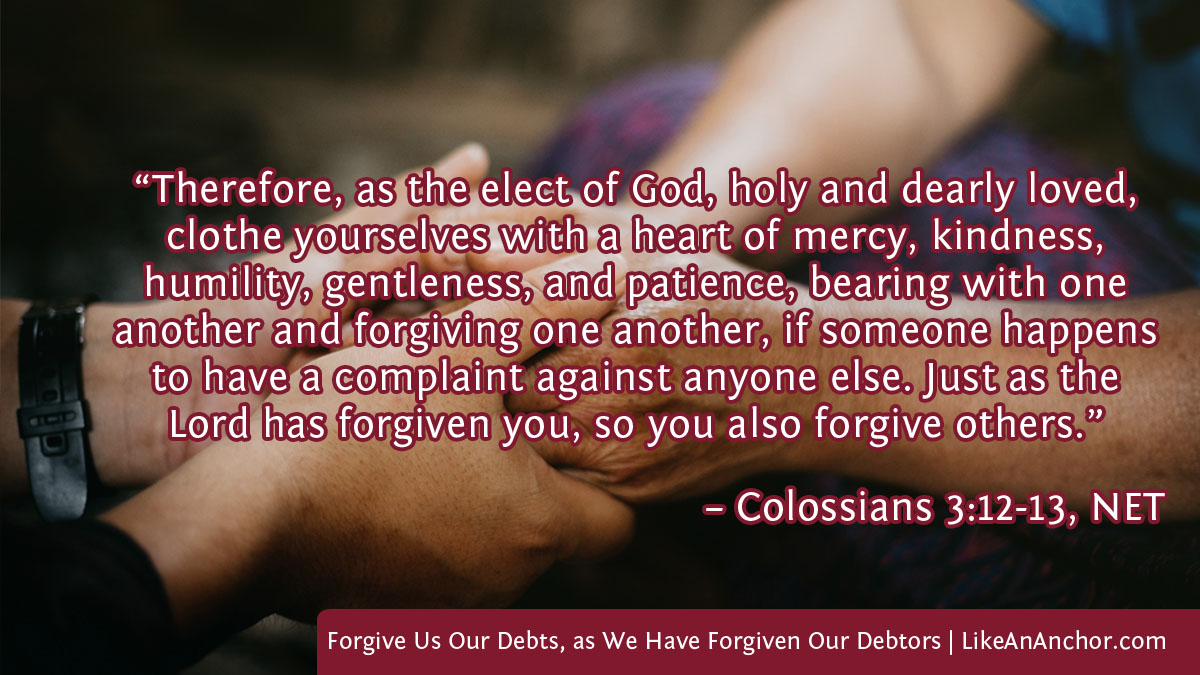
Image of two people's clasped hands overlaid with text from Colossians 3:12-13, NET version: “Therefore, as the elect of God, holy and dearly loved, clothe yourselves with a heart of mercy, kindness, humility, gentleness, and patience, bearing with one another and forgiving one another, if someone happens to have a complaint against anyone else. Just as the Lord has forgiven you, so you also forgive others.”
Image by Jantanee from Lightstock

Forgiving Debts

“Forgive us our debts, as we ourselves have forgiven our debtors” is the only point in this prayer that Jesus explains in more detail. Right after wrapping up the outline, He adds this:

“For if you forgive others their sins, your heavenly Father will also forgive you. But if you do not forgive others, your Father will not forgive you your sins.”

Matthew 6:14-15, NET

There are two different Greek words used here, which is reflected in the English translations “debts” and “sins.” In the prayer, the word used is opheilema, which means “that which is owed” as “a debt” (Thayer’s Dictionary, entry G3783). It’s metaphorically used of sins. “Debtors” is the related word opheiletes, which as you might guess means the person who owes something to another (Thayer; G3781). This word for debtor is also used in Matthew 18, which we’ll be looking at in a moment.

“Sin” is translated from paraptoma, which means “to fall beside or near” or “a lapse or deviation from truth and uprightness” (Thayer; G3900). When it appears in the New Testament it’s translated with English words like “trespass,” “offense,” “fault,” or “sin.” Interestingly, this still isn’t the most commonly used Greek word for sin. That would be hamartia, which means “to miss the mark” or “that which is done wrong, sin, and offense, a violation of the divine law” (Thayer; G266). Harmartia is the word used for “sin” in the version of Jesus’s model prayer that Luke records (Luke 11:4).

Despite the different words, “forgive us our debts, as we ourselves have forgiven our debtors” is clearly connected with “forgive others their sins” so your Father will forgive you. Jesus uses parallel wording to make the connection, and the word for “forgive” is the same in both cases. It’s translated from aphiemi, which means “to let go, give up a debt, forgive, to remit” (Thayer; G863). When we sin, it’s like we owe God something because we messed up. When Jesus died, He paid the penalty in our place, remitting our debts. We need to understand this sin-debt analogy if we’re going to make sense of what’s going on in this part of the model prayer.

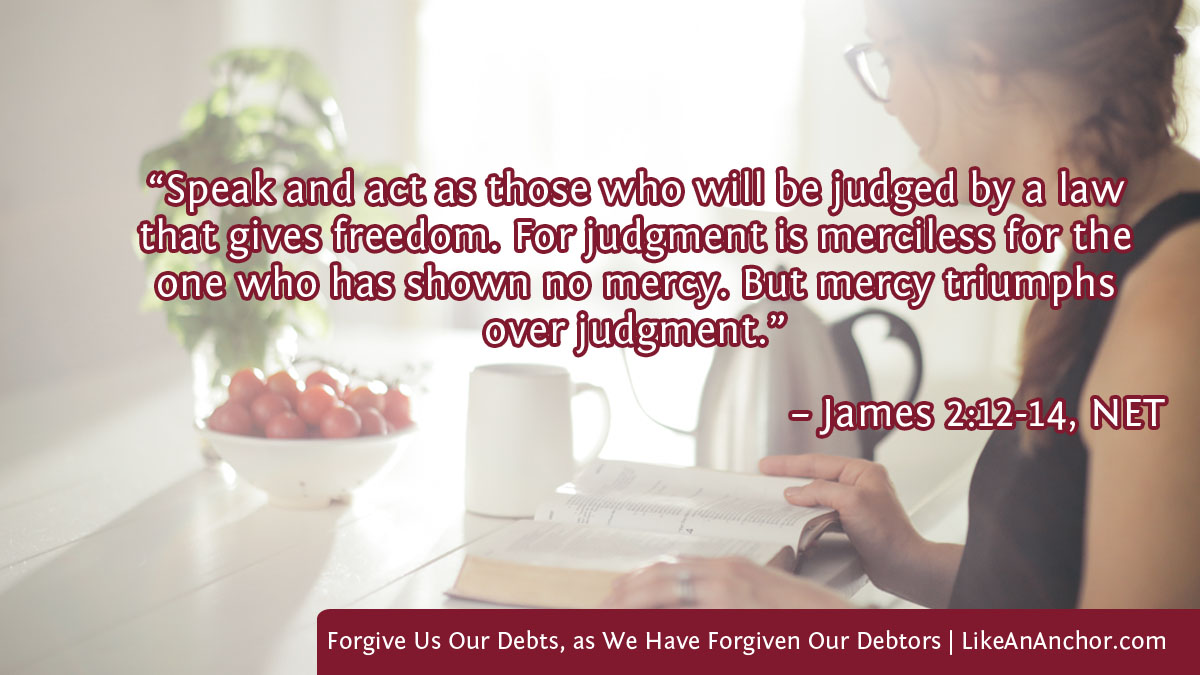
Image of a woman reading the Bible at a table, overlaid with text from James 2:12-14, NET version: “Speak and act as those who will be judged by a law that gives freedom. For judgment is merciless for the one who has shown no mercy. But mercy triumphs over judgment.”
Image by MarrCreative from Lightstock

The Necessity of Forgiveness

It might feel kind of weird to think that God’s forgiveness of us is conditional on our forgiveness of others. We like to think of His forgiveness and grace as something freely given that we don’t need to do anything in order to receive. But though we can’t do anything to earn His grace or forgiveness, there are some things we can do to reject them. Later in Jesus’s ministry, He shares a parable that sheds light on the connection between us forgiving others and us receiving forgiveness from God.

Then Peter came to him and said, “Lord, how many times must I forgive my brother who sins against me? As many as seven times?” Jesus said to him, “Not seven times, I tell you, but seventy-seven times!

“For this reason, the kingdom of heaven is like a king who wanted to settle accounts with his slaves. As he began settling his accounts, a man who owed 10,000 talents was brought to him. Because he was not able to repay it, the lord ordered him to be sold, along with his wife, children, and whatever he possessed, and repayment to be made. Then the slave threw himself to the ground before him, saying, ‘Be patient with me, and I will repay you everything.’ The lord had compassion on that slave and released him, and forgave him the debt. 

Matthew 18:21-27, NET

This is mercy. The man was an opheiletes, a debtor, who was incapable of repaying what he owed. Just one talent was “equal to 6,000 denarii. One denarius was the usual day’s wage for a worker” (NET footnote on Matt. 18:24). That means for a typical worker at the time, 10,000 talents was equal to 60,000,000 day’s wages, or about 164,384 years of work. A slave could never dream of repaying that, just like human beings can never do enough to make up for the sins we’ve committed against God (Rom. 3-6). As readers or listeners, we’re supposed to appreciate just what an incredible gift this lord gave the slave.

After he went out, that same slave found one of his fellow slaves who owed him 100 silver coins. So he grabbed him by the throat and started to choke him, saying, ‘Pay back what you owe me!’ Then his fellow slave threw himself down and begged him, ‘Be patient with me, and I will repay you.’ But he refused. Instead, he went out and threw him in prison until he repaid the debt. When his fellow slaves saw what had happened, they were very upset and went and told their lord everything that had taken place.  Then his lord called the first slave and said to him, ‘Evil slave! I forgave you all that debt because you begged me! Should you not have shown mercy to your fellow slave, just as I showed it to you?’ And in anger his lord turned him over to the prison guards to torture him until he repaid all he owed. So also my heavenly Father will do to you, if each of you does not forgive your brother from your heart.”

Matthew 18:28-35, NET

The fellow slave owed only 100 silver coins, or denarii, so about 3 months’ pay (NET footnote on Matt. 18:28). It’s a real debt, but compared to what the first slave owed the lord it’s a tiny sum. The difference between what the slave was forgiven and what he refused to forgive is enormous. We can see how ridiculous he’s being. But it’s just as ridiculous if we refuse to forgive another human being’s offenses against us after God has forgiven our offenses against Him.

It’s not just crazy for us to hold on to a tiny debt someone owes us when God has forgiven us a huge debt against Him. It’s dangerous. Jesus doesn’t leave room for ambiguity in interpreting this parable. The lord takes back His forgiveness, and Jesus says, “So also my heavenly Father will do to you, if each of you does not forgive your brother from your heart.” It’s exactly like He said after sharing the model prayer: “if you forgive others their sins, your heavenly Father will also forgive you. But if you do not forgive others, your Father will not forgive you your sins” (Matt. 6:14-15, NET). There’s an “if” in these verses, making forgiveness conditional. We need to show forgiveness if we want to receive forgiveness.

How To Let Go

Earlier, I said that aphiemi, the Greek word translated “forgive” means “to let go, give up a debt, forgive, to remit” (Thayer; G863). That’s the sense in which it usually applies to forgiveness. But it’s a complex word, and it can also mean “to send away,” “yield up,” “let alone, let be,” or “to leave, go away from one.” If we forgive, we stop holding on to the sins, offenses, debts, and trespasses of other people. We “let it alone,” send away our resentment, and walk away from what we might be owed. It’s much the same thing as our English definition of forgiveness.

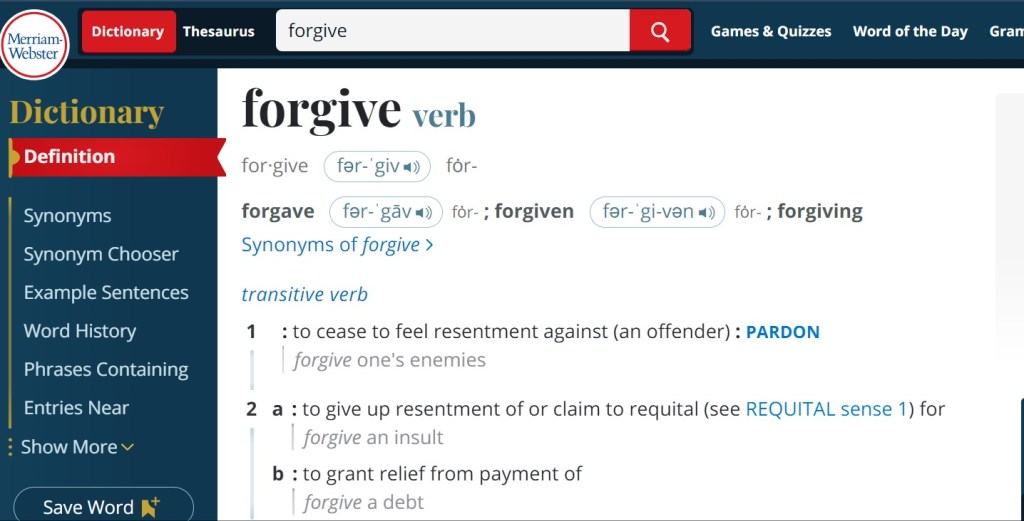
Screenshot of the definition of "forgive" in the Merriam-Webster dictionary. Definitions shown include " to cease to feel resentment against (an offender)," "to give up resentment of or claim to requital," and "to grant relief from payment of"

Notice that none of the things involved with forgiveness require the other person to take action. We can grant forgiveness–let go of resentment and yield any claim to payment owed us–without the other person asking for it. In fact, we should forgive as soon as possible regardless of the other person because we want God to respond positively when we ask Him to forgive us.

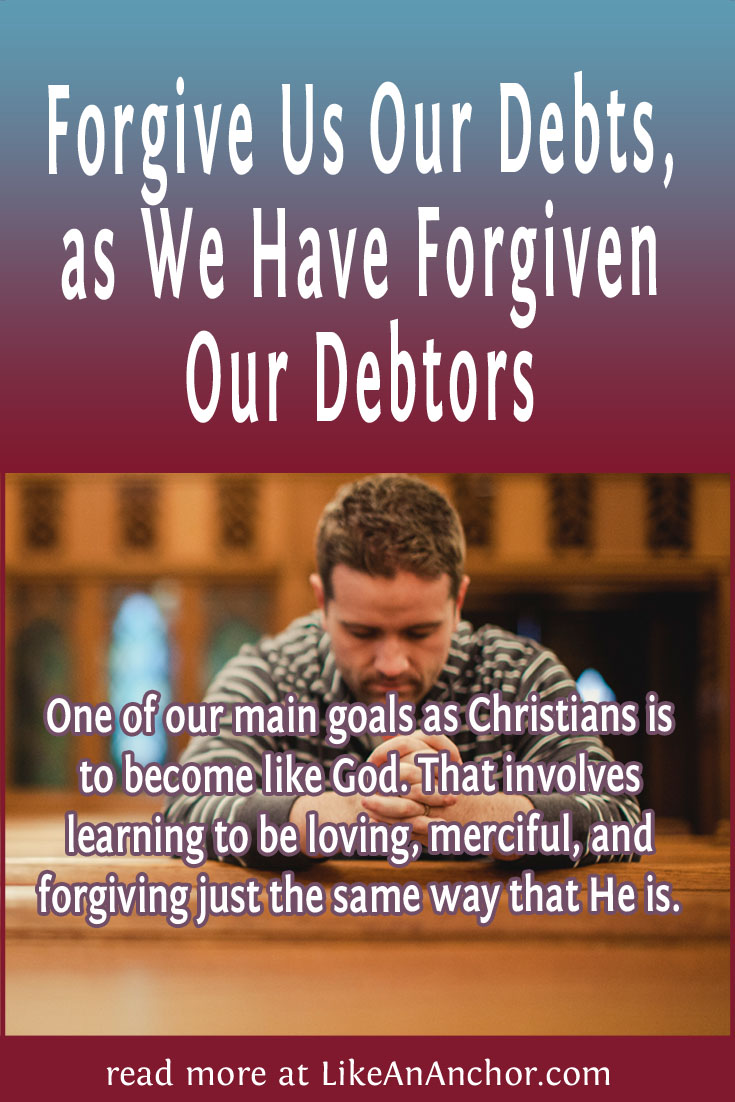
Image of a man praying in a church, overlaid with blog's title text and the words, "One of our main goals as Christians is to become like God. That involves learning to be loving, merciful, and forgiving just the same way that He is."
Image by Shaun Menary from Lightstock

One of the things I’ve struggled with related to forgiveness is how to tell if I’ve actually forgiven someone. Some things are relatively easy to forgive, and you might legitimately forget them when you release the debt. There are others, though, that can still color your perception of a person even if you don’t feel resentment or think they owe you something. In certain situations, that can be okay. It’s not always safe to reconcile or restore a relationship, but it’s always right to let go of resentment and the feeling that someone who hurt us owes us for something.

 “If your brother sins, go and show him his fault when the two of you are alone. If he listens to you, you have regained your brother. But if he does not listen, take one or two others with you, so that at the testimony of two or three witnesses every matter may be established. If he refuses to listen to them, tell it to the church. If he refuses to listen to the church, treat him like a Gentile or a tax collector.

Matthew 18:15-17, NET

This short formula for Christian reconciliation comes before Peter’s question about forgiveness and Jesus’s parable about the unforgiving slave. Ideally, we should reconcile if there’s an issue with a “brother” or “fellow believer.” The primary goal is reconciliation and restored relationship. But if that doesn’t work after repeated attempts, you don’t “associate with such a person” (NET footnote on Matt. 18:17). It’s our responsibility to try to reconcile, especially with a fellow believer, but regardless of how that goes we have an obligation to forgive and “live peaceably with all people” (Rom. 12:18, NET; see Rom. 12:16-21).

The conditionality of forgiveness from God should prompt us to extend forgiveness to others. But I don’t think He wants that to be the main reason why we forgive (just like the threat of punishment shouldn’t be the main reason we obey His laws). When we realize what a great debt God forgives us, we should want to forgive others. Similarly, as recipients of God’s great mercy, we should be eager to show mercy to others. Like forgiveness, there’s a reciprocity involved in mercy: “Blessed are the merciful, for they will be shown mercy” (Matt. 5:7, NET) and “For judgment is merciless for the one who has shown no mercy” (James 2:13, NET). One of our main goals as Christians is to become like God. That involves learning to be loving, merciful, and forgiving just the same way that He is. When we pray, “Forgive us our debts, as we ourselves have forgiven our debtors,” we acknowledge that we have an essential role to play in giving and receiving forgiveness.


Featured image by Pearl from Lightstock

Song Recommendation: “Mercy” by Casting Crowns

Forgiveness and Fear: Companions, Not Opposites

Often, we think of fear and love as opposite sides of a spectrum. It reminds me of reading Machiavelli in college. Even all these years later, I remember him advising that though it’s better for a prince to be both feared and loved, if he must chose one it should be fear. I looked up that quote again while working on this post, and I’d like to share part of it with you. It comes from The Prince, Machiavelli’s advice for ruling, which he dedicated to Lorenzo di Piero de’ Medici in 1532.

Upon this a question arises: whether it be better to be loved than feared or feared than loved? It may be answered that one should wish to be both, but, because it is difficult to unite them in one person, is much safer to be feared than loved, when, of the two, either must be dispensed with. Because this is to be asserted in general of men, that they are ungrateful, fickle, false, cowardly, covetous, and as long as you succeed they are yours entirely; they will offer you their blood, property, life and children, as is said above, when the need is far distant; but when it approaches they turn against you. … and men have less scruple in offending one who is beloved than one who is feared, for love is preserved by the link of obligation which, owing to the baseness of men, is broken at every opportunity for their advantage; but fear preserves you by a dread of punishment which never fails.

The Prince: Chapter 17 by Niccolo Machiavelli

It’s a rather bleak view of human nature. We might not like it, but I suspect some of us are nodding our heads in agreement. An individual person might be honorable enough to stay loyal to a beloved ruler or friend, but people in general likely would turn on a leader they didn’t fear if he needed their aid. To human reasoning, Machiavelli’s advice makes a lot of sense even if we’d rather it didn’t.

God takes a very different view. He risks loving even though it would be very easy for Him to only relate to us through fear of a dreadful punishment. And throughout human history, a lot of people proved Machiavelli’s point right—they did take advantage of God’s mercy and run away from Him when things were going well for them, only turning back when they needed His help or He did something shocking. We learn a lot about how God felt during these cycles of faith and disobedience in ancient Israel’s history when reading prophets like Isaiah and Hosea. It hurt God and angered Him that His people were so fickle but rather than changing His character, He leaned even more into making sure He was both feared and loved. Ultimately, while He deserves fear and honor as our Lord, Master, and Creator, He chooses to relate to us primarily through a love that ought to inspire awe.

Image of a man reading a Bible overlaid with text from Ephesians 1:7, NET version:  “In him we have redemption through his blood, the forgiveness of our offenses, according to the riches of his grace that he lavished on us in all wisdom and insight.”
Image by Creative Clicks Photography from Lightstock

You Forgive, and So We Fear

I didn’t actually start this study intending to talk about Machiavelli. It was originally inspired by reading one little verse in Psalm 130 as part of the Dec. 16 reading in Chris Tiegreen’s OneYear Worship the King Devotional. It’s a short psalm so I’ll quote the whole thing here, but the part we’ll focus on is verse 4.

Out of the depths I have cried to you, Yahweh.
Lord, hear my voice.
    Let your ears be attentive to the voice of my petitions.
If you, Yah, kept a record of sins,
    Lord, who could stand?
But there is forgiveness with you,
    therefore you are feared.
I wait for Yahweh.
    My soul waits.
    I hope in his word.
My soul longs for the Lord more than watchmen long for the morning,
    more than watchmen for the morning.
Israel, hope in Yahweh,
    for there is loving kindness with Yahweh.
    Abundant redemption is with him.
He will redeem Israel from all their sins.

Psalm 130, WEB

I’m sure I’ve read this dozens of times before, but this time the wording for verse 4 really jumped out at me. “There is forgiveness with you, therefore you are feared” shows a causal link between forgiveness and fear. In other words, because God offers forgiveness, we fear Him. Here are a few other translations:

  • “But with you is forgiveness, so that you may be feared.” (LEB)
  • “But you are willing to forgive, so that you might be honored.” (NET)
  • “For with You there is forgiveness, so You may be revered.” (TLV)

It seems odd at first that God forgiving us would make us fear Him, but the more I meditate on this the more it makes sense. Why do we need forgiveness? Because “the compensation due sin is death, but the gift of God is eternal life in Christ Jesus our Lord” (Rom. 6:23, LEB). If God was only interested in justice, then we’d be dead. But He decided to do something else—Jesus died in our place and, as the lawgiver and judge, God accepts that substitutionary sacrifice and pardons us. He is the one with our fate in His hands, and yet He chooses to forgive. When we start trying to wrap our minds around what He’s done to give us our lives, we can’t help but tremble in fear, awe, and reverence.

Image of hands clasped on a Bible overlaid with text from Psalm 130:3-4, NET version: "If you, O Lord, were to keep track of sins, O Lord, who could stand before you? But you are willing to forgive, so that you might be honored."
Image by Jantanee from Lightstock

Fear, Awe, Righteousness, and Worship

Jamieson, Fausset, and Brown’s commentary on this verse in Psalm 130 points out that “pardon produces filial fear and love. … the sense of forgiveness, so far from producing licentiousness, produces holiness” (MySword app, JFB module, commentary on Psalms 130:4). Similarly, Barnes’s commentary says, “The offender is so pardoned that he is disposed to worship and honor God, for God has revealed himself as one who forgives sin, in order that the sinner may be encouraged to come to him, and be his true worshipper” (MySword app, Barnes module, commentary on Psalms 130:4). When God forgives us, we’re not supposed to take that as license to go out and do sinful things that would require more forgiveness. We’re supposed to recognize that forgiveness is a big deal, and take seriously what God chose to do for us. Our reaction should involve awe, reverence, worship, and honor for the God who saves our lives.

It’s also important that we don’t make the mistake of thinking “fear” here ought to be understood only as honor or reverence. While the concepts of fear and reverence are distinct in English, they aren’t so separated in Hebrew. Biblical uses of the word yare fall “into five general categories: 1) the emotion of fear, 2) the intellectual anticipation of evil without emphasis on the emotional reaction, 3) reverence or awe, 4) righteous behavior or piety, and 5) formal religious worship” (Harris, Archer, and Waltke, Theological Wordbook of the Old Testament, entry 907). Translators figure out which of those meanings to emphasize based on context, but we need to remember people hearing or reading this word originally would have had all five of those connections in mind even when one was the primary meaning.

Our respect for God includes a certain amount of fearful emotion simply because we have a proper view of His power and importance. If you don’t think, “It is a fearful thing to fall into the hands of the living God,” then you don’t really understand Him (Heb. 10:31, WEB). But if fear is the only thing you feel, then you don’t understand the truth that “God is love” (1 John 4:8, 16, WEB). We need both fear and love for our wonderful God who seeks a deep, lasting relationship with us. And understanding/appreciating forgiveness seems key to deepening that relationship.

The Depth of God’s Forgiveness

Image of a woman worshiping with the blog's title text and the words "Forgiveness is the result of a great victory over sin and death. It demonstrates both God's fearsome power and His amazing love."
Image by PhotoGranary from Lightstock

Forgiveness is too large a topic to fully cover in the concluding section for a single blog post. But we can look at how the early church talked about forgiveness and see the emphasis they placed on it. In Acts, we see that the forgiveness of sins through Jesus Christ was a central part of the gospel message preached (Acts 2:37-39; 5:30-31; 10:40-43; 13:35-39). We learn even more about how the apostles saw forgiveness in Paul’s letter to the Colossians.

giving thanks to the Father who has qualified you to share in the saints’ inheritance in the light. He delivered us from the power of darkness and transferred us to the kingdom of the Son he loves, in whom we have redemption, the forgiveness of sins. …

For God was pleased to have all his fullness dwell in the Son and through him to reconcile all things to himself by making peace through the blood of his cross—through him, whether things on earth or things in heaven. And you were at one time strangers and enemies in your minds as expressed through your evil deeds, but now he has reconciled you by his physical body through death to present you holy, without blemish, and blameless before him— if indeed you remain in the faith, established and firm, without shifting from the hope of the gospel that you heard. …

And even though you were dead in your transgressions and in the uncircumcision of your flesh, he nevertheless made you alive with him, having forgiven all your transgressions. He has destroyed what was against us, a certificate of indebtedness expressed in decrees opposed to us. He has taken it away by nailing it to the cross. 

Colossians 1:12-14, 19-23, 2:13-14, NET

If you skimmed that last quote (as I often skim parts of articles when I’m reading), you might want to go back and read it again more slowly. Look at what Paul says is involved in forgiveness. When God forgives us, He’s taking us out of a kingdom of darkness and turning strangers and enemies into family. Forgiveness is the result of a great victory over sin and death. It demonstrates both God’s power and His love.


Featured image by Temi Coker from Lightstock

God Chose You Even Knowing You’ll Mess Up

This Sabbath follows shortly after the Passover–a day when we remember Jesus’s death and His sacrifice for sins. He told us to keep that day “in remembrance of me” with the symbols of His new covenant. As we think about His sacrifice, we’re forced to consider the terrible price that justice for humanity’s sins–including our sins–demanded. Jesus died an excruciating death. He endured that with His eyes fixed on “the joy set out for him” because He knew that sacrifice was needed to grow His and His father’s family.

Recognizing the high price Jesus paid for us should humble us deeply and move us to genuine repentance. It should also boggle our minds with a realization of His overflowing love. God has been inviting people into His family for thousands of years even though He knew the cost of that welcome. Moreover, He still chooses us today knowing that even after we receive the gift of forgiveness we’ll mess up again. Thankfully, Jesus’s perfect sacrifice keeps covering those sins when we repent after making a mistake; He doesn’t need to be sacrifice again each time we slip-up (Hebrews 10:1-18). God chooses us and keeps showing us mercy even knowing we’ll mess up. This is a kind of love that people rarely offer to each other, but the Creator of all things gives it to us.

A History of Gracious Relationships

Long ago, God chose to form a covenant with Abraham and with his children. Those descendants grew into a nation called Israel, and God delivered them from Egypt on the first Passover. About 50 days later (very likely on the day of Pentecost), God made a covenant with them as well. About 40 years later, when Israel was finally ready to go into the promised land, God had this conversation with Moses:

“Behold, you shall sleep with your fathers. This people will rise up and play the prostitute after the strange gods of the land where they go to be among them, and will forsake me and break my covenant which I have made with them. Then my anger shall be kindled against them in that day, and I will forsake them, and I will hide my face from them, and they shall be devoured, and many evils and troubles shall come on them; so that they will say in that day, ‘Haven’t these evils come on us because our God is not among us?’ I will surely hide my face in that day for all the evil which they have done, in that they have turned to other gods.

“Now therefore write this song for yourselves, and teach it to the children of Israel. Put it in their mouths, that this song may be a witness for me against the children of Israel. For when I have brought them into the land which I swore to their fathers, flowing with milk and honey, and they have eaten and filled themselves, and grown fat, then they will turn to other gods, and serve them, and despise me, and break my covenant. It will happen, when many evils and troubles have come on them, that this song will testify before them as a witness; for it will not be forgotten out of the mouths of their descendants; for I know their ways and what they are doing today, before I have brought them into the land which I promised them.”

Deut. 31:16-21, WEB

God knew Israel wouldn’t be faithful, but He chose them anyway and told them to keep coming back to Him when (not if) they strayed from the right path. Similarly, He choses us knowing we’ll make mistakes and already planning to keep welcoming us each time we turn back to Him repentantly asking for forgiveness. When we begin this relationship with God He asks us for faithfulness, we promise to be faithful, and He accepts that promise even though he knows we’ll slip up and He’ll need to forgive us again.

Even at my best, my faithfulness involves falling, picking myself up (or Him picking me up), and then recommitting to walking with God. I’m encouraged looking at centuries of Bible history that records God’s grace-fueled relationships with people. There’s so much forgiveness available from God; so many calls in His word for people to keep coming back to Him. The whole process of us trying to be faithful to God is enabled by His faithfulness.

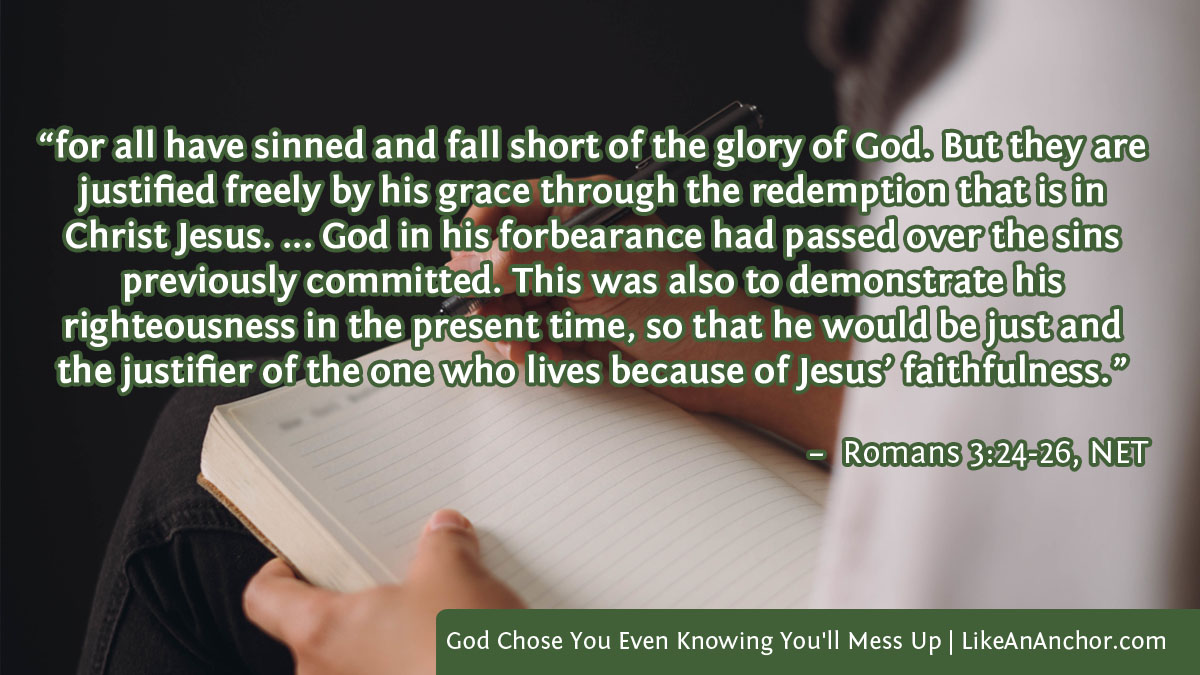
Image of a woman writing in a notebook, with text from Romans 3:24-26,  NET version: “for all have sinned and fall short of the glory of God. But they are justified freely by his grace through the redemption that is in Christ Jesus. ... God in his forbearance had passed over the sins previously committed. This was also to demonstrate his righteousness in the present time, so that he would be just and the justifier of the one who lives because of Jesus’ faithfulness.”
Image by Corey David Robinson from Lightstock

Saved Before We Were Good

Paul’s letter to Rome is one of the Bible books that I find most fascinating. There’s so much packed into this letter about our relationship with God and how His expectations for us work in the New Covenant. Paul spends quite a bit of time discussing the topic of God choosing us even though it’s still a battle for us to live in the spirit rather than in the flesh.

Therefore, since we have been declared righteous by faith, we have peace with God through our Lord Jesus Christ, through whom we have also obtained access into this grace in which we stand, and we rejoice in the hope of God’s glory. Not only this, but we also rejoice in sufferings, knowing that suffering produces endurance, and endurance, character, and character, hope. And hope does not disappoint, because the love of God has been poured out in our hearts through the Holy Spirit who was given to us.

For while we were still helpless, at the right time Christ died for the ungodly. (For rarely will anyone die for a righteous person, though for a good person perhaps someone might possibly dare to die.) But God demonstrates his own love for us, in that while we were still sinners, Christ died for us. Much more then, because we have now been declared righteous by his blood, we will be saved through him from God’s wrath. For if while we were enemies we were reconciled to God through the death of his Son, how much more, since we have been reconciled, will we be saved by his life? Not only this, but we also rejoice in God through our Lord Jesus Christ, through whom we have now received this reconciliation.

Romans 5:1-11, NET

God’s love is so amazing. No one could reasonably expect someone as perfect or as important as God to die for people like us. Most human beings would hesitate to die even for a good person, and we weren’t even good (Rom. 3:24-26). We are family, though, because God the Father decided He wants us to be His children. He claims us as His, justifies us even though we fall short of His glory, and gives us life through Jesus’s faithfulness.

Image of a smiling woman with her arm raised in worship with text from Lamentations 3:22-23, TLV version: “Because of the mercies of Adonai
    we will not be consumed,
    for His compassions never fail.
They are new every morning!
    Great is Your faithfulness.”
Image by Pearl from Lightstock

Mercies and Great Faithfulness

It’s incredible to think of how much God loves us and of the high price He was willing to pay to remove our sins and get us into His family. Knowing that God chose us despite our past sins and even though we aren’t perfect yet should both humble and inspire us.

It’s a strange sort of balance that we’re to have in our thinking. We’re supposed to be confident while acknowledging we have no power or strength on our own. We can fully embrace our importance to God, yet we must never become puffed up and self-important. We get to be heirs in God’s family alongside Jesus, but we must give thanks for God’s mercy and continue following His example rather than boasting about what He has given us.

Image of a man praying with the blog's title text and the words "Knowing that God chose us despite our past sins and even though we aren't perfect yet should both humble and inspire us."
Image by WhoisliketheLord Studio from Lightstock

So in the same way at the present time there is a remnant chosen by grace. And if it is by grace, it is no longer by works, otherwise grace would no longer be grace. What then? Israel failed to obtain what it was diligently seeking, but the elect obtained it. The rest were hardened …

But if you boast, remember that you do not support the root, but the root supports you. Then you will say, “The branches were broken off so that I could be grafted in.” Granted! They were broken off because of their unbelief, but you stand by faith. Do not be arrogant, but fear! For if God did not spare the natural branches, perhaps he will not spare you. Notice therefore the kindness and harshness of God—harshness toward those who have fallen, but God’s kindness toward you, provided you continue in his kindness; otherwise you also will be cut off. And even they—if they do not continue in their unbelief—will be grafted in, for God is able to graft them in again.

Romans 11:5-6, 18-21, NET

Here, Paul explains to his readers that even though many of the the peoples descended from ancient Israel turned their backs on God, He hasn’t given up on anyone. Rather, the Lord “has consigned all people to disobedience so that he may show mercy to them all” (Rom. 11:32, NET). This is a tricky verse, but I think it means that God chooses to treat people who ignore Him or who’ve broken covenants their ancestors made with Him as if they are ignorant and disobedient rather than unredeemably wicked. We’re accountable for what we know and what we do (see Rom. 2-3), but God still chooses mercy over judgment whenever He can (James 2:13).

As we embrace our godly identities more and more fully, we also become more and more like God. And the better we understand His holiness the more easily we see how far from being like Him we really are even as we get better at living His way of life. Alongside that comes an increased appreciation for the incredible gifts of His faithfulness, forgiveness, and mercy that keep guiding us back to Him when we miss the mark. God isn’t surprised that we aren’t perfect yet. He chose us anyway, and He keeps choosing us. We can take comfort in that, knowing that He’s just as invested (and often more so) in getting us into His kingdom as we are in being there.

Featured image by Shaun Menary from Lightstock

Song Recommendation: “Who Am I?” by Casting Crowns

Uprooting Your Sukaminos Trees

Have you ever heard someone read a familiar Bible passage–something from the gospels, for instance, which you’ve read many times before–and spotted something entirely new to you? It’s been right there the whole time, but you’d never noticed or thought about it before. That happened this past Sabbath when our pastor read Luke 17. He stopped after just a couple verses, but I kept reading and something struck me.

In Matthew, when Jesus says “if you have faith as a grain of mustard seed” He follows that up by saying you can move mountains (Matt. 17:20; 21:21). In this chapter of Luke, though, Jesus says faith like a grain of mustard seed can do something else. He’s using the analogy in different situational contexts. The one in Matthew’s gospel comes after the disciples couldn’t cast out a demon and Jesus had to take care of it. In Luke, it comes after a conversation about forgiveness. Let’s take a look at that:

Jesus said to his disciples, “Stumbling blocks are sure to come, but woe to the one through whom they come! It would be better for him to have a millstone tied around his neck and be thrown into the sea than for him to cause one of these little ones to sin. Watch yourselves! If your brother sins, rebuke him. If he repents, forgive him. Even if he sins against you seven times in a day, and seven times returns to you saying, ‘I repent,’ you must forgive him.”

The apostles said to the Lord, “Increase our faith!” So the Lord replied, “If you had faith the size of a mustard seed, you could say to this black mulberry tree, ‘Be pulled out by the roots and planted in the sea,’ and it would obey you.”

Luke 17:1-6, NET

I find it interesting that when Jesus told the apostles they needed to forgive people more freely and more often, they responded by asking for more faith. Then Jesus used the mustard seed analogy to say your faith could root up a “black mulberry tree.” That’s the part I hadn’t noticed before. He changes the analogy for this conversation about radical forgiveness. Why?

A Stubborn Root

Answering the question “why a black mulberry tree?” is complicated by the fact that we’re not 100% sure how to translate the word used there. It’s sukaminos in the Greek (G4807). There are two different trees that this word might represent:

Black mulberry tree (Morus nigra). This is the translation chosen by several modern translations including NIV, TLV, and NET. The NET’s footnote says, “A black mulberry tree is a deciduous fruit tree that grows about 20 ft (6 m) tall and has black juicy berries. This tree has an extensive root system, so to pull it up would be a major operation.”

Sycamine tree (Ficus sycomorus). This is the translation used by the KJV and WEB (among others). Thayer’s dictionary says it has “the form and foliage of the mulberry, but fruit resembling the fig.” This tree also has an extensive root system and it’s fruit is so bitter if you want to eat it raw you need to eat it in tiny pieces.

With either translation, the tree Jesus is talking about has a large root system. It would be extremely difficult to dig a large, full-grown mulberry or sycamine tree out of the ground–much less pluck it up by the roots. Yet Jesus says, “If you had faith the size of a mustard seed, you could say to this sukaminos tree, ‘Be pulled out by the roots and planted in the sea,’ and it would obey you.” This impossible thing is made simple with God’s help.

God’s perfectly capable of moving trees, but the chances of you literally needing to yank up a tree with faith are slim. Jesus isn’t talking about how to clear land here; He’s talking about faith and forgiveness. And it’s not just any forgiveness–this is forgiveness that keeps giving over and over again. From other scriptures, we know that someone doesn’t even need to turn to you and say “I repent” in order for you to forgive (Matt. 6:15; 18:21-35). We need to forgive always, in every situation where someone offends, hurts, or sins against us. We’re called to participate in God’s forgiveness–showing to others the same sort of mercy God shows toward us.

Rooting Out Bitterness to Produce Better Fruit

One of the reasons some translators opt for sycamine tree over mulberry tree is because the sycamine’s fruit is so bitter. This makes the tree a great analogy for the “root of bitterness” that can block us from forgiveness. The Bible does speak of people being rooted in bad things that aren’t associated with bitterness (for example: “the love of money is the root of all evils” [1 Tim. 6:10, NET]). However, if we’re looking for verses that speak of a specific thing that can take root in us, damage our hearts, and block forgiveness then bitterness is the most likely suspect in both the Old and New Testament.

Neither do I make this covenant and this oath with you only, but with those who stand here with us today before Yahweh our God, and also with those who are not here with us today … lest there should be among you a root that produces bitter poison; and it happen, when he hears the words of this curse, that he bless himself in his heart, saying, “I shall have peace, though I walk in the stubbornness of my heart”

Deuteronomy 29:14-15, 18-19, WEB

See to it that no one comes short of the grace of God, that no one be like a bitter root springing up and causing trouble, and through it many become defiled.

Hebrews 12:15, NET

The Hebrew words rō’š (H7219) and laʿănâ (H3939) for “bitter poison” refer to gall, venom, and poisonous plants (BDB Dictionary). Greek is similar, with pikra (G4088) literally meaning bitter gall and poison, and figuratively covering bitterness, hatred, and bitter roots that bear bitter fruit (Thayer’s dictionary). Considering scripture’s emphasis on us bearing good fruit, the possibility of producing something bitter, acrid, and poisonous should make us sit up and take notice.

On the topic of roots, God’s word spends more time urging us to root ourselves in good things than it does warning us away from bad things. The person who trusts in God will flourish, rooted in righteousness (Prov. 12:3, 12; Jer. 17:7-8). God promised His people a day when they would take root and thrive, bearing good fruit even though they’d failed to do that in the past (Is. 27:6; 37:30-32; Hos. 9:15-17; Mat. 3:9-11). This fruitfulness is enabled by the prophesied Messiah, “the root of David” (Is. 11:1-3, 9-10; Rev. 5:5; 22:16). Now, with Jesus Christ dwelling in our hearts, we can be “rooted and grounded in love” and in Him rather than in bitterness or other unstable foundations (Rom. 11:15-18; Eph. 3:16-18; Col. 2:6-7).

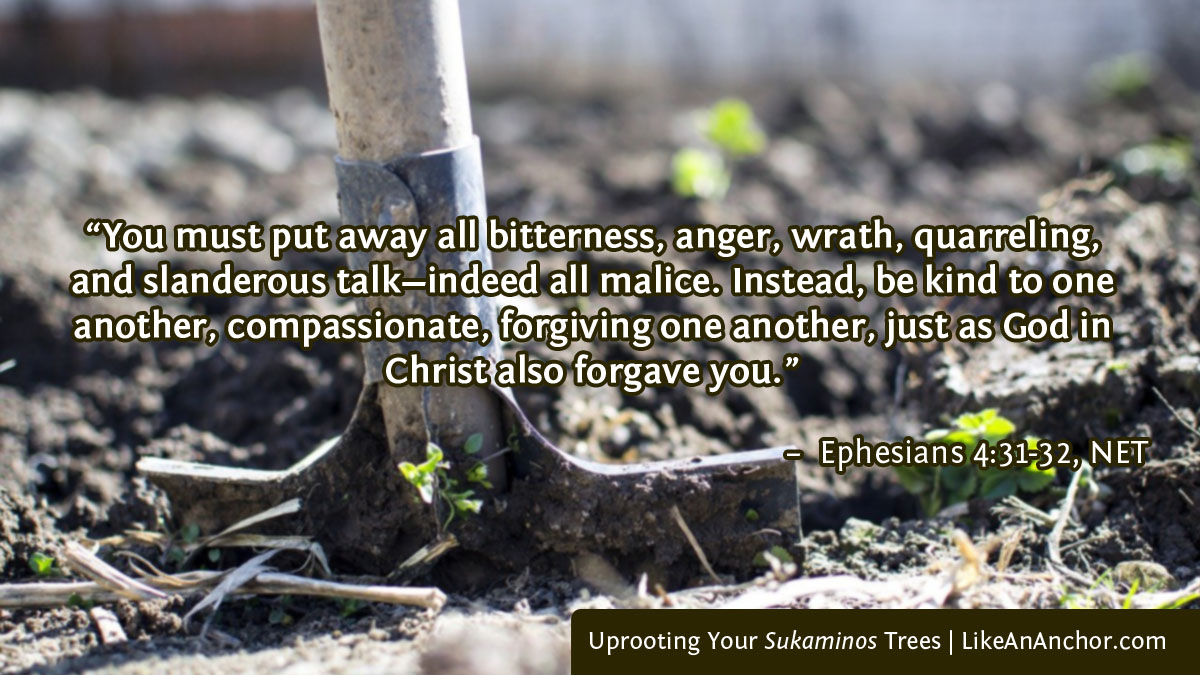
Image of a shovel digging into dirt, with text from Ephesians 4:31-32, NET version: "You must put away all bitterness, anger, wrath, quarreling, and slanderous talk—indeed all malice. Instead, be kind to one another, compassionate, forgiving one another, just as God in Christ also forgave you."
Image by Goumbik from Pixabay

Connecting To Forgiveness

It is imperative that we put away things like “bitterness, anger, wrath, quarreling, and slanderous talk—indeed all malice” and replace that with the compassionate, forgiving nature of God (Eph. 4:31-32, NET). That’s the main emphasis in this passage of Luke. We’re supposed to change. Once we’re following Jesus, we don’t react to people who offend us or sin against us the way that our human nature typically wants to. Rather, we’re to forgive them in the same way that we want God to forgive us. Let’s go back to Luke 17 and read a little farther this time. Here’s the whole conversation:

Jesus said to his disciples, “Stumbling blocks are sure to come, but woe to the one through whom they come! It would be better for him to have a millstone tied around his neck and be thrown into the sea than for him to cause one of these little ones to sin. Watch yourselves! If your brother sins, rebuke him. If he repents, forgive him. Even if he sins against you seven times in a day, and seven times returns to you saying, ‘I repent,’ you must forgive him.”

The apostles said to the Lord, “Increase our faith!” So the Lord replied, “If you had faith the size of a mustard seed, you could say to this black mulberry tree, ‘Be pulled out by the roots and planted in the sea,’ and it would obey you.”.

“Would any one of you say to your slave who comes in from the field after plowing or shepherding sheep, ‘Come at once and sit down for a meal’? Won’t the master instead say to him, ‘Get my dinner ready, and make yourself ready to serve me while I eat and drink. Then you may eat and drink’? He won’t thank the slave because he did what he was told, will he? So you too, when you have done everything you were commanded to do, should say, ‘We are slaves undeserving of special praise; we have only done what was our duty.’”

Luke 17:1-10, NET

This sort of deep change requires time, faith, and God’s spirit inside us transforming us to be more and more like Him. We need to commit to this change and work with God as He works in us. Forgiveness is part of our duty as people serving God the Father and following Jesus Christ. It’s not even like Jesus is asking us to go above and beyond–when we forgive the way that He does “we have only done what was our duty.”

God expects that we’ll get rid of “bitter jealousy and selfishness” and replace it with “the fruit that consists of righteousness” and the wisdom that is “first pure, then peacefulgentlereasonablefull of mercy and good fruitswithout partiality, and without hypocrisy” (James 3:14-18). He knows it’s an ongoing process, but He does expect us to work toward this goal of having His character and nature define us. In the final week before Passover (which we’ll be keeping April 14th after sunset), let’s consider and pray about whether there’s anything like bitterness that we should dig-up out of our lives. We can ask for faith, just as the disciples did, and God will help us move the stubborn struggles in our lives no matter how deeply rooted they are.

Featured image by Susan Cipriano from Pixabay

Song Recommendation: “Lord Reign In Me” by Vineyard

The Beatitudes, Part Five: Blessed Are The Merciful

I recently read Just Mercy by Brian Stevenson, shortly after watching the film adaptation (both are excellent, by the way; I highly recommend reading and watching). Mercy and justice are tricky things for us humans to balance. We don’t have perfect perspective on every situation. We don’t know all the relevant facts. We want justice but we often mishandle it badly. And for some reason, it’s often hard to show mercy or to convince others it’s a good idea.

“Blessed are the merciful, for they shall obtain mercy.” (Matt. 5:7, all quotes from WEB translation)

We all need mercy, particularly from God. We also all need to give mercy, otherwise we won’t receive any. It’s the same principle as forgiveness. As Jesus says just a little later in the same sermon where He gives us the Beatitudes,

“For if you forgive men their trespasses, your heavenly Father will also forgive you. But if you don’t forgive men their trespasses, neither will your Father forgive your trespasses.” (Matt. 6:14-15)

Reciprocal Mercy

The relation between the character trait and how God rewards it is very direct in this particular Beatitude. You give mercy, you get mercy. And it’s not just about passively letting mercy happen or giving it only when absolutely necessary. The Greek word eleemon (G1655) is “active compassion and benevolence involving thought and action.” It is an expression of the love inside you, and it’s closely related to other words like elos (G1656, applied grace, pity, compassion) and eleemosune (G1654, actions of mercy) (Zodhiates’ dictionary). Here’s the only other place this specific form of the word for “mercy” is used in scripture:

Therefore he was obligated in all things to be made like his brothers, that he might become a merciful and faithful high priest in things pertaining to God, to make atonement for the sins of the people. (Heb. 2:17)

We’re to have the same kind of mercy that Jesus has as a result of His life here on earth as a human being. He learned what it’s like to be human and that gave Him an even deeper compassion for us than God had before (which was already bountiful).

It is because of Yahweh’s loving kindnesses that we are not consumed, because his compassion doesn’t fail. They are new every morning. Great is your faithfulness. (Lam. 3:22-23)

Yahweh is gracious, merciful, slow to anger, and of great loving kindness. Yahweh is good to all. His tender mercies are over all his works. (Ps. 145:8-9)

Don’t Miss The Point

Mercy is something Jesus was looking for, and which He taught, while on this earth. One of the things He taught was that faith which refuses to show mercy is empty and dead. For example, when the Pharisees berated him for eating with tax collectors and sinners, Jesus said,

“Those who are healthy have no need for a physician, but those who are sick do. But you go and learn what this means: ‘I desire mercy, and not sacrifice,’ for I came not to call the righteous, but sinners to repentance.” (Matt. 9:12-13)

He was quoting Hosea 6:6, no doubt a very familiar verse to the religious leaders and experts of His day, and telling them they didn’t understand what it means. At least a few of them probably had all of Hosea memorized, and here’s this young rabbi from Nazareth (of all places) telling them they’re missing the point of this scripture. It’s no wonder the Pharisees were offended, nor is it any wonder so many of the people they’d treated without mercy responded with joy to Jesus’s message. Jesus was boldly proclaiming the mercy which has always been a part of God’s plan, and He made very clear that this mercy did not belong only to an elite group. It is for all His people.

To Ransom With Mercy

If you are reading this the weekend it posted, we just observed Yom Kippur (Day of Atonement) less than a week ago. This solemn, holy day represents God’s covering mercy. A more direct translation of the Hebrew words kippur and kaphar might be “to cover (G3722, Strong’s dictionary; Brown, Driver, and Briggs lexicon). However, the Theological Wordbook of the Old Testament challenges that interpretation and instead links atonement, ransom, and the mercy seat. This word family is about reconciliation made possible by the removal of sins rather than by covering them over (TWOT entry 1023).

On Yom Kippur, the Old Testament priest made a special sacrifice and sprinkled the blood on the mercy seat — the place of atonement/propitiation (TWOT 1023c). Sacrifice in this situation, as well as in the more general sense, “was the symbolic expression of an innocent life given for a guilty life” (TWOT 1023a). This concept gains even more meaning in the New Covenant observance of Yom Kippur because Jesus the Messiah is the innocent life given in ransom for our guilty lives.

So what does this have to do with the Beatitudes? Everything. To receive this sort of mercy, we have to show this sort of mercy. it is an imperative. God makes the first move — Jesus has already died for us and grace in Him is given freely, not earned by anything we do. But if we do not respond to His gift by showing mercy, He can take back His mercy (Matt. 18:21-35).

What Mercy Looks Like

Jesus told a parable about a man who owed his lord an impossible debt (about 300 metric tons of silver) and was forgiven everything he owed. That man went to one of the other servants who owed him a very small amount (about 500 grams of silver) and refused offer forgiveness. He didn’t even respond to that man’s pleas for patience in repaying the debt. At the end of the parable, the lord says, “Shouldn’t you also have had mercy on your fellow servant, even as I had mercy on you?” (Matt. 18:33).

If we want to know what mercy looks like, we need only look to God. How has He been merciful to you? Go and treat other people that way. Show mercy, as the good Samaritan did (Luke 10:25-37). And to it with cheerfulness, not out of grudging necessity (Rom. 12:8). Present yourself a living sacrifice to do God’s will, remembering His great mercy toward you (Rom. 12:1). Be tender and compassionate to your brethren (Phil. 2:1-2).

It seems so simplistic to say that God just wants us to love each other and treat each other with compassion and mercy. But that is what He wants. It’s not too much to ask, and the more we become like Him the easier it will be to respond with love and mercy to everyone around us.

Featured image credit: Who Is Like The Lord via Lightstock