I’m guessing you all know about the fruit of the spirit. You might have them memorized: “love, joy, peace, patience, kindness, goodness, faithfulness, gentleness, and self-control” (Gal. 5:22-23, NET). You might even have done in-depth studies on them, such as spending a month writing scriptures about each trait with my free 30-day scripture writing plans.
There’s another list in Galatians, though. It comes right before the fruit of the spirit passage and details the works of the flesh. We’re meant to read both and notice a contrast between the two because Paul is making a point about how Christians live. When he says you’re “not under the law,” he doesn’t mean God gives you freedom to go out and live a hedonistic, sinful life. Quite the opposite, in fact. We’re given freedom so we can fully follow God from the heart, with all the fruit of the spirit in our lives and none of the works of the flesh.
The Works of the Flesh
There’s a lot going on in Paul’s letter to the Galatians. He wrote to correct errors in the Galatian believers’ theology. They were confused, even following what Paul described as other gospels. It seems their main issue involved a too-strict reliance on Old Covenant law and Jewish additions to the law. Paul reinforces the good news he originally preached to them: the Old Covenant ended with Jesus’s death and a New Covenant took its place. Jesus’s faithfulness is what brings us righteousness and justification, not our own efforts. That doesn’t mean we break God’s law (Christ does not encourage sin nor did He do away with God’s law [Matt. 5:17-20; Rom. 3:28-31]), but Jesus didn’t redeem us and give us the Spirit so that we could then try to save ourselves by our own efforts. He saved us, and we’re to reciprocate with faith that involves active, relational loyalty.
For you were called to freedom, brothers and sisters; only do not use your freedom as an opportunity to indulge your flesh, but through love serve one another. For the whole law can be summed up in a single commandment, namely, “You must love your neighbor as yourself.” However, if you continually bite and devour one another, beware that you are not consumed by one another. But I say, live by the Spirit and you will not carry out the desires of the flesh. For the flesh has desires that are opposed to the Spirit, and the Spirit has desires that are opposed to the flesh, for these are in opposition to each other, so that you cannot do what you want. But if you are led by the Spirit, you are not under the law.
Galatians 5:13-18, NET (bold italics mark a quotation from Lev. 19:18)
When we’re baptized into Jesus Christ, we symbolically die to our “old man” and we’re reborn as children of God (Paul covers this extensively in Romans). That transformation has (or should have) a profound effect on our lives. We’re to change, becoming less and less like fleshy, selfish humans and more and more like spirit beings in God’s family. That involves putting off things associated with fallen humanity living in a world influenced by Satan.
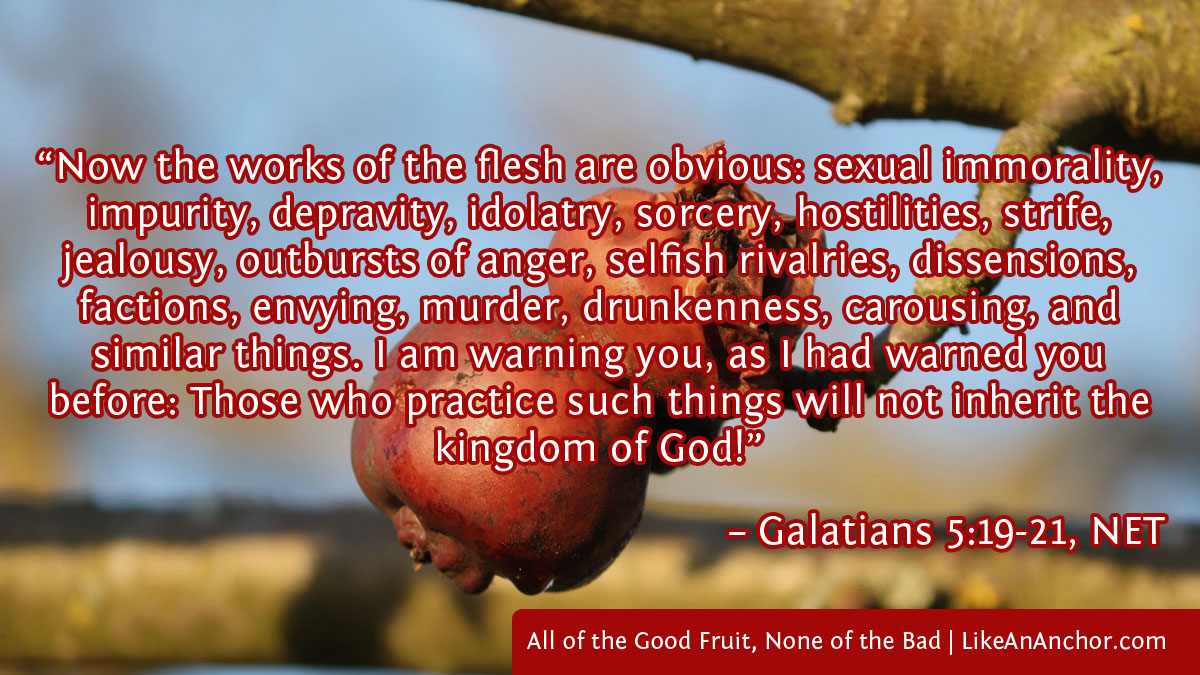
Now the works of the flesh are obvious: sexual immorality, impurity, depravity, idolatry, sorcery, hostilities, strife, jealousy, outbursts of anger, selfish rivalries, dissensions, factions, envying, murder, drunkenness, carousing, and similar things. I am warning you, as I had warned you before: Those who practice such things will not inherit the kingdom of God!
Galatians 5:19-21, NET
This isn’t a complete list (Paul has similar ones in other letters, like 1 Cor 6:9-11; Eph. 5:1-6; Col. 3:1-10), but the message is clear. If we continue to do things that God defines as sinful or unrighteous we will not inherit as His children or be in His kingdom. That’s one of the reasons it’s still important for us to know about God’s law; His law defines sin and acts as a tutor or guardian pointing to Christ (Rom. 3:20; Gal. 3:24).
Live In The Spirit
Cleaning things God hates out of our lives is an important part of our relationship with Him. It’s not the most important part, though. First, Jesus is the one who initially washes us clean; only believing in Him, repenting of our sins, and accepting His sacrifice can make us clean. Then, we’re called to participate in His ongoing work in us. We’re supposed to keep examining ourselves, putting away bad things, and putting in good things as we become more and more like Him. If we don’t take any action, then we’re like the person Jesus warned about in this analogy:
“When an unclean spirit goes out of a person, it passes through waterless places looking for rest but does not find it. Then it says, ‘I will return to the home I left.’ When it returns, it finds the house empty, swept clean, and put in order. Then it goes and brings with it seven other spirits more evil than itself, and they go in and live there, so the last state of that person is worse than the first. It will be that way for this evil generation as well!”
Matthew 12:43-45, NET
If you remove something evil from your life and don’t replace it with something good, then there’s a chance something worse is going to move in. It’s like if you give up eating candy so you can be healthier, but don’t add any good eating habits, then take up smoking on top of going back to eating tons of sugar. Except in this case, we’re taking out works of the flesh and we’re supposed to replace them with fruit of the spirit. If we try to take out something like “outbursts of anger” without putting in things like love, peace, and patience then the anger isn’t going to stay gone and might get worse.
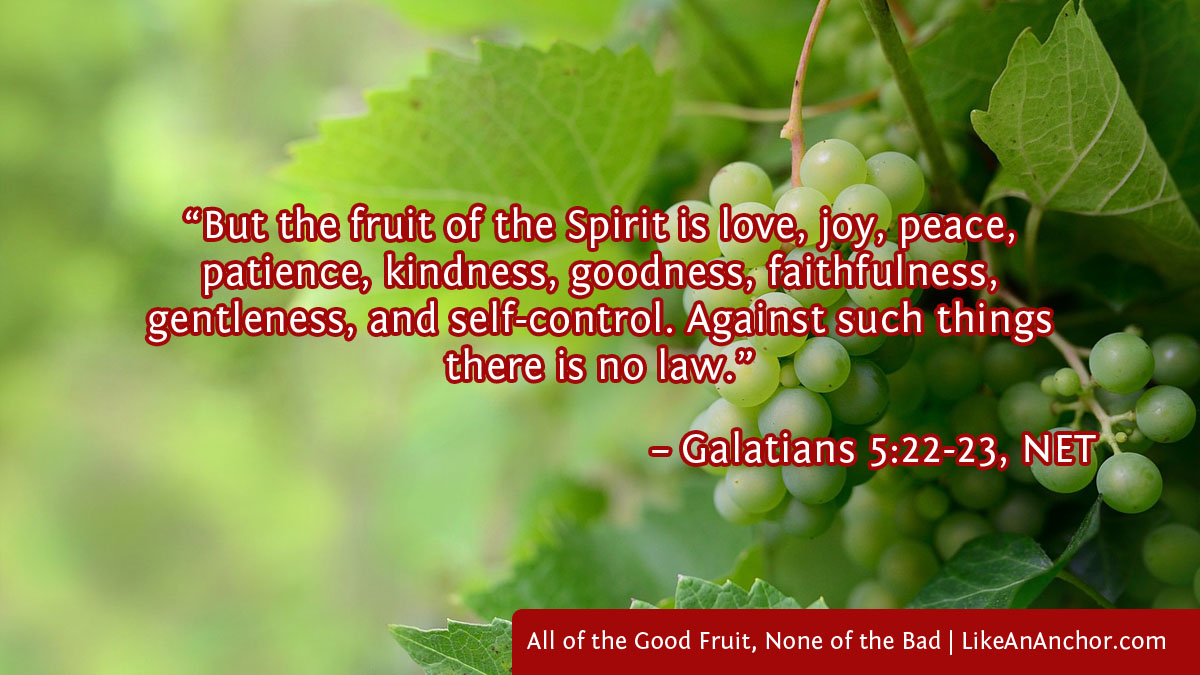
But the fruit of the Spirit is love, joy, peace, patience, kindness, goodness, faithfulness, gentleness, and self-control. Against such things there is no law. Now those who belong to Christ have crucified the flesh with its passions and desires. If we live by the Spirit, let us also behave in accordance with the Spirit.
Galatians 5:22-25, NET
We need to have all of the fruit of the spirit AND none of the works of the flesh. It’ll be a life-long process, but that’s the goal. We can’t be content with getting rid of most of the works of the flesh or having just some of the fruit of the spirit. God’s people shouldn’t look at themselves, shrug their shoulders and think, “Eh, guess I’m good enough now” (Rom. 11:18-21; 1 Cor. 8:2; 10:12). We need to stay faithful, keep learning, humble ourselves and repent as needed, and ask God to guide our growth.
Helping Each Other
If we just stopped at the end of chapter 5, we might think that removing the works of the flesh and putting on the fruit of the spirit is just an individual, private thing. In some ways it is: we’re each responsible for ourselves and we’re the ones who will answer to God for what we did with the gifts He gives us and the work He does in us. But at the same time, we’re also responsible for how we interact with other people. Christians are not called to isolated, individual walks. God calls us into a family, a collective body of believers who are meant to support each other.
Brothers and sisters, if a person is discovered in some sin, you who are spiritual restore such a person in a spirit of gentleness. Pay close attention to yourselves, so that you are not tempted too. Carry one another’s burdens, and in this way you will fulfill the law of Christ. For if anyone thinks he is something when he is nothing, he deceives himself. Let each one examine his own work. Then he can take pride in himself and not compare himself with someone else. For each one will carry his own load.
Galatians 6:1-5, NET
We’re supposed to help each other put away the works of the flesh and cultivate the fruit of the spirit. Notice that Paul doesn’t say “judge,” “condemn,” or even “correct.” He says to “restore” this person. The Greek word is katartizo, and it means to mend something that’s broken or “to strengthen, perfect, complete, make one what he ought to be” (Thayer’s Dictionary entry G2675). Sometimes, we’ll be the one in need of mending who needs help from other believers. Other times, we’ll be “carrying our own load” well enough that we can be the one who helps another.
Now the one who receives instruction in the word must share all good things with the one who teaches it. Do not be deceived. God will not be made a fool. For a person will reap what he sows, because the person who sows to his own flesh will reap corruption from the flesh, but the one who sows to the Spirit will reap eternal life from the Spirit. So we must not grow weary in doing good, for in due time we will reap, if we do not give up. So then, whenever we have an opportunity, let us do good to all people, and especially to those who belong to the family of faith.
Galatians 6:6-10, NET
The sowing and reaping analogy fits so well with calling godly characteristics “fruit of the spirit.” Right before His crucifixion, Jesus told His disciples that He chose them to bear fruit, that their fruitfulness honors the Father, and that it shows they are genuine followers of God (John 15:8, 16). Our connection with Jesus should be a fruitful one. If we invest or “sow” into the life of the spirit–our life following Jesus and becoming like Him and Our Father–then we’ll produce good fruit to replace the works of the flesh that He’s working with us to remove from our lives.
Featured image by Manfred Richter from Pixabay

Song Recommendation: “I Am New” by Jason Gray










 Like An Anchor