Spared No Expense

When I hear the phrase “spared no expense,” the first thing that comes to mind is John Hammond advertizing his Jurassic Park. But recently I heard it twice in a completely different context — in two different sermons just a couple Sabbaths ago. In one message, the speaker was talking about showing hospitality, and in the other the subject was David’s generous offering when he welcomed the Ark in to Jerusalem (1 Chr. 16:1-18).

But anything humans can come up with when we “spare no expense” can’t begin to compare with what God can accomplish when He “spares no expense.”

With One Sacrifice

We all know John 3:16 — probably have it memorized. But please take the time to read it again with me.

For God so loved the world that He gave His only begotten Son, that whoever believes in Him should not perish but have everlasting life. (John 3:16)

Talk about sparing no expense! God delivered up His only Son to die in our places. Let’s think about this for a moment. We believe that God and the Word are Eternal and didn’t have a beginning point — They’ve always been there. It follows, then, that God the Father had never been alone before. Imagine how long those three days that Jesus spent dead in the grave must have seemed!

And now think of it from Christ’s perspective. He was the Word who “was with God, and the Word was God. … All things were made through Him, and without Him nothing was made that was made” (John 1:1, 3). He had equality with God and the power needed to make all things. And what did He do with that power?

made Himself of no reputation, taking the form of a bondservant, and coming in the likeness of men. And being found in appearance as a man, He humbled Himself and became obedient to the point of death, even the death of the cross. (Phil. 2:7-8)

Christ gave up all this power, and risked His eternal life (for if He had failed there was no one else to sacrifice for sin), all to save us. That sacrifice was so valuable that “by one offering He has perfected forever those who are being sanctified” (Heb. 10:14). His life was so precious — so “expensive,” if you will — that it could cancel out forever the debts of the whole world. Christ and the Father truly “spared no expense” in freeing us from captivity.

What then shall we say to these things? If God is for us, who can be against us? He who did not spare His own Son, but delivered Him up for us all, how shall He not with Him also freely give us all things? (Rom. 8:31-32)

Given All Things

What does “all things” in Romans 8:32 include? Well, having given the most valuable thing they could — Jesus Christ Himself — the Father and Son continue to “spare no expense” in blessing us. We touched on this last week when talking about god rewarding prayer, and promising “no good thing will He withhold from those who walk uprightly (Ps. 84:11). Eternal life is one of these gifts, and a direct result of Christ’s sacrifice.

For the wages of sin is death, but the gift of God is eternal life in Christ Jesus our Lord. (Rom. 6:23)

Another extremely important gift that God gives through Jesus is His Holly Spirit. Peter calls it “the gift of God” in Acts 8:20, and John 7:39 notes that the Holy Spirit was only given after Christ was glorified, tying it directly to the greatest gift.

If you then, being evil, know how to give good gifts to your children, how much more will your heavenly Father give the Holy Spirit to those who ask Him! (Luke 11:13)

You can finds lists of some spiritual gifts which God gives in 1 Corinthians 12:1-11 and Romans 12:6-8. Jesus told His disciples, “it has been given to you to know the mysteries of the kingdom of heaven,” so all His teaching to us are also a gift (Matt. 13:11). James says we can ask God for anything we lack, like wisdom, with faith because God “gives to all liberally and without reproach” (James 1:5). We don’t have to worry about God thinking our requests are silly or not worth His time. He wants to give us things.

Every good gift and every perfect gift is from above, and comes down from the Father of lights, with whom there is no variation or shadow of turning.  (James 1:17)

God is happy to pour good things our on us. Having already given us the most valuable gift ever — eternal life through Christ’s sacrifice for sin — He just keeps giving us more and more of the good things we want and need.

Present Yourselves

Our response to God’s generosity should involve following His example of giving. With this context, the following verse takes on some additional significance, I think.

So let each one give as he purposes in his heart, not grudgingly or of necessity; for God loves a cheerful giver. (2 Cor. 9:7)

This is typically read in the context of monetary giving. But God is not focused on giving us physical prosperity (though that does happen sometimes), so why should we only focus on giving God physical things?

I beseech you therefore, brethren, by the mercies of God, that you present your bodies a living sacrifice, holy, acceptable to God, which is your reasonable service. (Rom. 12:1)

Paul describes sacrificing ourselves as “reasonable.” Knowing God has freely given us “all things,” it does seem reasonable that we should freely give Him all that we are and have, particularly since He promises to increase His generosity to us as our generosity increases toward others.

Give, and it will be given to you: good measure, pressed down, shaken together, and running over will be put into your bosom. For with the same measure that you use, it will be measured back to you. (Luke 6:38)

We see a perfect example of this in Matthew 25, where Christ tells us how He will divide the sheep from the goats. The people who gave food to those who were hungry, water to the thirsty, and clothing to those who needed it, who took in strangers and gave up their time to visit prisoners — those are the people Christ will have in His kingdom. Giving sacrificially of our time and resources to any of Christ’s brethren counts as giving it directly to Him.


Should God’s Daughters Prophesy?

As a jumping-off point for today’s post, I want to tell you a bit about a booklet my mother recently dredged up from an old filing cabinet. It was “The Christian Woman” by Ronald L. Dart (published 2000 by Christian Education Ministries). The first part was about the history of women’s (mis)treatment in the church over the years, contrasting that with the high value Jesus placed on women. After that he moved into more controversial waters of women’s role in the church, which is what I want to dive into today as well.

One of the things I appreciated about this booklet was the distinction Dart drew between personal and public ministries to explain why our churches have traditionally assigned preaching and teaching roles to men. He does not believe that women were not meant to have an active role in the church, but rather that their role should look different than men. It’s basically an extension of the different-but-equal mentality we’ve adapted toward the roles of godly men and women.

Prophetic Gifts

Near the end of this booklet, Dart addresses the idea of spiritual gifts in the church. He argues that because “There are diversities of gifts, but the same Spirit” that no one should be exulted or demeaned based on the gift they do or do not have, i.e. women should not be looked down on because they do have a gift/calling to preach. Quoting page 38, “there are many other gifts that are vital to the church — faith, healing, prophecy, discernment, and especially the greatest gift of all, love.”
Should God's Daughters Prophesy? marissabaker.wordpress.comThis surprised me a bit, because I know of people who wouldn’t include “prophecy” in a list of gifts that women might have. If you go with “inspired speaking” as the meaning of “prophecy” in this context, that’s too close to preaching and teaching for them to be comfortable with the idea of women being involved.

Yet God would not give someone a gift He did not intend them to use, and we can see quite clearly in Acts 21:9 that Philip the Evangelist “had four virgin daughters who prophesied.” This word translated “prophesied” is the Greek propheuo (G4395) and it can either mean “to foretell things to come” or “to tell forth God’s message.” A prophet in this sense is “one who speaks out the counsel of God with the clearness, energy, and authority which springs from the consciousness of speaking in God’s name and having received a direct message from Him to deliver” (Zodhiates). Women may not have been giving sermons in church, but they were not keeping silent about God’s message.

Another example in the New Testament of women prophesying is found on the Day of Pentecost in Acts 2. The opening verses say “they were all with one accord in one place” and that “they were all filled with the Holy Spirit and began to speak with other tongues, as the Spirit gave them utterance” (Acts 2:1, 4). We know from Acts 1:14 that this “all” included women, which is also mentioned when Peter explains what is going on.

But this is what was spoken by the prophet Joel: “And it shall come to pass in the last days, says God, that I will pour out of My Spirit on all flesh; your sons and your daughters shall prophesy, your young men shall see visions, your old men shall dream dreams. And on My menservants and on My maidservants I will pour out My Spirit in those days; and they shall prophesy.” (Acts 2:16-18)

My Gift?

I first became interested in exactly what the word “prophecy” refers to several years ago. There was a Bible study in our local church group about discovering your spiritual gifts. A quiz was passed out to help point you in the right direction, and my result was tied between the “cognitive” gift of prophecy and the “emotional” gift of mercy/compassion. I’m starting to see the mercy/compassion side more now as I become more aware of strengths in my personality type. The prophecy part, though, has been terribly confusing for me.

The word translated “prophecy” in the spiritual gifts passage in 1 Corinthians 12 is propheteia (G4394), and it is derived from the word used in Acts. The 5th, 6th, and 7th definitions in Zodhiates’ Complete WordStudy Dictionary of the New Testament help shed some light on what someone is supposed to do with a gift of prophecy.

(V) A prophecy is something that any believer may exercise as telling forth God’s word. …

(VI) Prophecy was a distinctive charisma (5486), gift, distinguishable from that of the apostle and the teacher. While the apostle was  a traveling missionary, the prophets and teachers were in general attached to a specific church. … Neither the prophet nor teacher was appointed by the apostles, as were bishops and elders; the gifts were an endowment of the spirit and both fulfilled the function of speaking in the Spirit.

(VII) That which is revealed constitutes a prophecy. The reception of such revelation and its communication did not entail states of rapture or ecstasy accompanied by unintelligible utterances. … Prophecy was a gift exercised with a consciousness of the subject, and it issued in something logically intelligible.

For years I had absolutely no idea what to do with this if it was indeed my gift. This blog has now given me an outlet, but I still wonder if there is something more I ought to be doing. Paul says, “he who prophesies speaks edification and exhortation and comfort to men” (1 Cor. 14:3). By this definition, the role of someone with a gift of prophecy is to build up others, encourage them towards virtue, and to console them. This can certainly be done in writing, and I pray my posts here could be described as words that edify, exhort, and comfort. But that doesn’t quite seem like enough.

I beseech you therefore, brethren, by the mercies of God, that you present your bodies a living sacrifice, holy, acceptable to God, which is your reasonable service. … Having then gifts differing according to the grace that is given to us, let us use them: if prophecy, let us prophesy in proportion to our faith (Rom. 12:1, 6)

Any one have thoughts on this? What should one do if one has the gift of prophecy? As we grow in the faith, our use of the gifts given by God should become more noticeable and effective, right? How should that look in “women professing godliness” (1 Tim. 2:10)?

Ways to Teach

I just quoted part of 1 Timothy 2 where Paul speaks about the conduct of women in the church. Reading on, we come to one of the (in)famous verses about women keeping silent in church.

Let a woman learn in silence with all submission. And I do not permit a woman to teach or to have authority over a man, but to be in silence. For Adam was formed first, then Eve.(1 Tim. 2:11-13)

The focus of these verses seem to be about not upsetting God’s ordained order, much like in 1 Corinthians 14. Because husband and wife relationships model the relationship between Christ and the church, husbands are the head in a marriage (Eph. 5:22-32). It would be indecent for the church to try and take over Christ’s roles, and it would be similarly unseemly for women to “usurp authority over a man” (as the KJV reads). While the conduct of unmarried women is not mentioned directly, I think we can infer that they should also behave in a respectful manner toward men in authority in the church, though no specific man has the authority of a husband over them.

This does not mean women could never teach under any circumstances. The word “teach” here in 1 Timothy 2:12 is didaskalia (G1319). Like prophecy, it is a spiritual gift (Rom. 12:7). Zodhiates says that “Prophecy was a specialized form of teaching,” and has the following to say about differences between the two.

The differences between the two apparently lay in the fact that while prophecy was the utterance of a revelation received directly from God, teaching was the utterance of what one had gained by thought and reflection. The teacher must be led and guided by the Spirit to be a true teacher and have genuine spiritual teaching, but what he said was in a real sense his own. Some prophets were able also to teach, but not all teachers were able to prophesy.

I’m not exactly sure which scriptures he uses to arrive at this distinction, so I quote it as “food for thought” and to segue into connecting teaching and prophecy as what I’ll call “gifts of meaningful instruction.”

We can find several examples of godly women in instructive roles. Both Priscilla and her husband were involved in teaching Apollo (Acts 18:26) and Paul calls them his “fellow workers in Christ Jesus” (Rom. 18:3). There’s the aforementioned daughters of Philip who prophesied (Acts 21:9). We can assume Timothy’s mother and grandmother both taught him (2 Tim. 1:5). Paul instructs older women to be “teachers of good things” and in particular to “admonish the young women” (Tit. 2:3-4). Women are described as praying and prophesying (1 Cor. 11:5). Miriam (Ex. 15:20), Deborah the judge of Israel (Judges 4:4), Huldah (2 Kings 22:14; 2 Chron. 34:22), Isaiah’s wife (Is. 8:3), and Anna (Luke 2:36-37) are all called prophetesses.

Decently and In Order

The important thing to remember if we want to teach as women in the church is that we must still hold to the instructions for godly femininity. If we are not adorned with a “a gentle and quiet spirit” while teaching, then we’re doing something wrong (1 Pet. 3:4). If our teaching challenges proper godly authority or is inconsistent with instruction that believers submit “to one another in the fear of God,” then something’s wrong (Eph. 5:21). We must not contribute to confusion in the church, but “Let all things be done for edification” (1 Cor. 14:26)

Let two or three prophets speak, and let the others judge. But if anything is revealed to another who sits by, let the first keep silent. For you can all prophesy one by one, that all may learn and all may be encouraged. And the spirits of the prophets are subject to the prophets. For God is not the author of confusion but of peace, as in all the churches of the saints.

Let your women keep silent in the churches, for they are not permitted to speak; but they are to be submissive, as the law also says. And if they want to learn something, let them ask their own husbands at home; for it is shameful for women to speak in church. (1 Cor. 14:29-35)

Both the booklet I referenced at the beginning of this post and Zodhiates’ commentary in my study Bible agree that this instruction of silence for women is specific rather than general. The church at Corinth apparently had a problem with maintaining order in church gatherings. The phrase “keep silent” is also used in verse 28 to instruct a man who speaks in an unknown tongue to stay silent if no interpreter is present.

Should God's Daughters Prophesy? marissabaker.wordpress.comThe word “to speak” used in this chapter is laleo (G2980) which, depending on the context, can simply mean to utter words or “to talk at random.” In the context of verse 34, Zodhiates says it should be interpreted as “uttering sounds that are incoherent and not understood by others.”  It is less an instruction for women to never speak, than it is a warning not to babble meaninglessly just for the sake of being heard.

I also find the emphasis on asking their husbands “if they want to learn something” interesting. That seems to indicate some women were interrupting the church meeting to ask clarifying questions or to debate something they really didn’t understand. That would conflict with Paul’s wrap up for this chapter: “Let all things be done decently and in order” (1 Cor. 14:40)

But I want you to know that the head of every man is Christ, the head of woman is man, and the head of Christ is God. Every man praying or prophesying, having his head covered, dishonors his head. But every woman who prays or prophesies with her head uncovered dishonors her head, for that is one and the same as if her head were shaved. (1 Cor. 11:3-5)

I’m not going to get into the head coverings discussion. I just want to point out here that Paul was discussing “God’s ordained order” (as my study Bible titles this section) and the fact of women praying and prophesying was mentioned rather casually. It is not the subject of this passage — it’s simply accepted as one of the things both men and women were doing in the church. There is a right way and a wrong way to pray or prophesy, but both men and women were speaking about God’s message. As far as  I can tell, we should be doing this still.

I don’t know for sure what this should look like in the churches today. I’m not ready to advocate women giving formal sermons, but women are studying their Bibles and many of us are learning things we feel like we should be sharing. There have to be more ways for us to serve than by supervising the snack table.

Five More Favorite Proverbs

Five More Favorite Proverbs by marissabaker.wordpress.comAs I continue my study of Proverbs, I keep finding more and more to put on my favorites list. Last week, I shared five favorites from the first 10 chapters of Proverbs. Here are my top five from chapters 11 through 20.

I’m having a hard enough time narrowing it down to five verses for every 10 chapters — I’m not sure how I’ll settle on just one favorite for our study discussion next month. Perhaps I’ll bring a list roughly organized by which one I want to talk about most, and then cross-off any that someone mentions before I do.

6: Graciousness

A gracious woman retains honor, but ruthless men retain riches. (Prov. 11:16)

It is for the first half of this verse that I have included it here. Ever since my career adviser at OSU told me I was very gracious in the way I responded when she had to take a phone call while we were meeting, I’ve paid extra attention to verses like this. I liked how it felt to be considered gracious — it was a description I’ve always thought held value, but this was the first time someone applied it to me. I want to be a grace-filled woman, and I hope to give people that impression of me.

7: Desire

Hope deferred makes the heart sick, but when the desire comes, it is a tree of life. (Prov. 13:12)

There are many hopes I have that have been deferred (marriage and a family of my own, to name one). I have to believe, though, that God does not want to make our hearts sick. Therefore, when our hopes are deferred, it must be for a good reason. Perhaps it is to teach us to trust Him long-term — if all our hopes were fulfilled instantly I doubt we would appreciate His gifts very much. Psalm 37 says if we delight in the Lord, “He shall give you the desires of your heart.” If we trust in Him and commit lives to following Him, He will bring about our desires (Ps. 37:4-5). God wants to give us good things. He wants us to be delighted.

8: Peace

Five More Favorite Proverbs by marissabaker.wordpress.comA soft answer turns away wrath, but a harsh word stirs up anger. (Prov. 15:1)

A cross reference in my study Bible gives an example of this in Judges 8:1-3. The men of Ephraim were chiding Gideon sharply for not calling them to fight with him against Midian. Instead of answering them in kind, he diplomatically diffused the situation and “their anger toward him subsided.” The flip side of this principle, of course, is that being snappish and peevish stirs up an angry response in others and leads to escalating arguments. We need to be moving toward peace instead of anger. “Blessed are the peacemakers,” Christ said, “for they shall be called sons of God” (Matt. 5:9).

9: Thoughts

Commit your works to the Lord, and your thoughts will be established. (Prov. 16:3)

I find it interesting that in this verse, it says your “thoughts will be established.” Related verses talk about God establishing our ways and caring for our wants, but this one focuses on the state of our minds. It is like Philippians 4:6-9 in a single verse.

10: Quiet

He that hath knowledge spareth his words: and a man of understanding is of an excellent spirit. Even a fool, when he holdeth his peace, is counted wise: and he that shutteth his lips is esteemed a man of understanding. (Prov. 17:27-28)

How little we value the skill and gift of quietness in today’s society. Words fitly spoken are beautiful (Prov. 25:11), but there are also many times when it is more beautiful to be “swift to hear, slow to speak” (James 1:19).

Come To The Well

We were talking about The Woman at the Well last week, in the women’s book group at church (we’ve been reading Bad Girls of the Bible by Liz Curtis Higgs). One of the ladies in the group suggested that this meeting in John 4 between Christ and the woman at the well might be symbolically connected with Isaac, Jacob, and Moses all meeting their wives at a well. Does the woman here symbolize the Bride of Christ, and His invitation for us to drink from the well of eternal life?

The Living Water

On Jesus’ journey from Judea to Galilee in John 4, He stops to rest at Jacob’s well. A woman comes to the well and the Lord asks her for a drink. She wonders at this, since men did not normally talk to women and Jews had no dealings with Samaritans. A Jewish man certainly didn’t ask a Samaritan woman for a drink.

“Living Water” by Simon Dewey

Jesus answered and said to her, “If you knew the gift of God, and who it is who says to you, ‘Give Me a drink,’ you would have asked Him, and He would have given you living water.”

The woman said to Him, “Sir, You have nothing to draw with, and the well is deep. Where then do You get that living water? Are You greater than our father Jacob, who gave us the well, and drank from it himself, as well as his sons and his livestock?”

Jesus answered and said to her, “Whoever drinks of this water will thirst again, but whoever drinks of the water that I shall give him will never thirst. But the water that I shall give him will become in him a fountain of water springing up into everlasting life.” (John 4:10-14)

This comparison between the Lord and a fountain or well of living water is not confined to this passage in John’s gospel. (Ps. 36:9; Jer. 2:12-13, 17:13; John 6:35).

Behold, God is my salvation, I will trust and not be afraid; For Yah, the Lord, is my strength and song; He also has become my salvation. Therefore with joy you will draw water from the wells of salvation. (Is. 12:2-3)

An Ambassador

In Genesis 24, Abraham sends his servant to find a wife for Isaac. When the servant reaches his destination, he stops at a well and asks God to show him a sign.

“Rebekah At The Well” by Michael Deas

Behold, here I stand by the well of water, and the daughters of the men of the city are coming out to draw water. Now let it be that the young woman to whom I say, ‘Please let down your pitcher that I may drink,’ and she says, ‘Drink, and I will also give your camels a drink’—let her be the one You have appointed for Your servant Isaac. And by this I will know that You have shown kindness to my master.” (Gen. 24:13-14

God answered this prayer, and Rebekah not only drew water for this servant and his camels, but agreed to follow him into a different country and marry a man she had never met. Like Abraham’s servant, Jesus Christ is a messenger sent by a father who is seeking to add someone to His family. Abraham’s servant and Christ both ask the woman for a drink, and end up offering her something even more valuable than water in a desert.

A Bridegroom

For Jacob’s meeting with Rachel and Moses’s meeting with Zipporah, the woman is a shepherdess who comes to the well to draw water but is prevented by an obstacle. This obstacle is removed by the man, who then waters her flock.

“Jacob Encountering Rachel with her Father’s Herds” by Josef von Führich

Now while he was still speaking with them, Rachel came with her father’s sheep, for she was a shepherdess. And it came to pass, when Jacob saw Rachel the daughter of Laban his mother’s brother, and the sheep of Laban his mother’s brother, that Jacob went near and rolled the stone from the well’s mouth, and watered the flock of Laban his mother’s brother. (Gen. 29:9-10)

Now the priest of Midian had seven daughters. And they came and drew water, and they filled the troughs to water their father’s flock. Then the shepherds came and drove them away; but Moses stood up and helped them, and watered their flock. When they came to Reuel their father, he said, “How is it that you have come so soon today?” And they said, “An Egyptian delivered us from the hand of the shepherds, and he also drew enough water for us and watered the flock.” (Ex. 2:16-19)

Like Jacob and Moses met their wives at a well and provided water for her flock of sheep, so does the Good Shepherd Jesus Christ meet His church and offer her living water (John 10:11-16). He is a Bridegroom seeking His bride, and as a new believer this woman at the well became part of that group.

Becoming A Fountain

We have been given the same offer as the woman at the well. Come to the source of eternal life and drink freely of the living water. Become the Lamb’s bride.

For I am jealous for you with godly jealousy. For I have betrothed you to one husband, that I may present you as a chaste virgin to Christ. (2 Cor. 11:2)

This incredible offer is blessing enough, but on top of that we are offered the  chance to share this living water with others. “But the water that I shall give him will become in him a fountain of water springing up into everlasting life” (John 4:14). He wants us to become fountains as well (Song 4:12-15).

I don’t often listen to contemporary Christian music, but of late I’ve become quite attached to Casting Crowns’ music. This song, from their CD “Come To The Well” seems an appropriate way to end this post.

Gift of Mortality

We tend to approach death with a kind of horror, even though we know that it is not permanent (1 Thes. 4:13-18). It is natural to value life, to not want to die and to not want to lose the people we love. I think much of our longing to live forever comes from a desire God has given us to become part of his family. But sometimes I hear people say they want to live forever, and they mean an indefinite extension of our human lives here on the earth.  Personally, I wouldn’t want to live with myself the way I am now for that long.

Elves leaving Middle Earth, from The Lord of The Rings

When I think about the idea of immortality or living a really long time as a human, it makes me think of Tolkein’s elves in Middle Earth. Unless something interferes (they can be killed and they can fade away with grief) they’ll live forever. One of the things I find most interesting is that in The Silmarillion, the immortality of the elves is described as a sorrow and death is presented as a gift given to men.

the children of Men dwell only a short space in the world alive, and are not bound to it, and depart soon whither the Elves know not. Whereas the Elves remain until the end of days, and their love of the Earth and all the world is more single and more poignant therefore, and as the years lengthen ever more sorrowful. For the Elves die not till tile world dies, unless they are slain or waste in grief (and to both these seeming deaths they are subject); neither does age subdue their strength, unless one grow weary of ten thousand centuries; and dying they are gathered to the halls of Mandos in Valinor, whence they may in time return. But the sons of Men die indeed, and leave the world; wherefore they are called the Guests, or the Strangers. Death is their fate, the gift of Iluvatar, which as Time wears even the Powers shall envy.

Sown in Weakness

Death became something that every human being must face as a consequence of Adam and Eve’s sin. I wonder, however, if after the fall mortality might have been as much a gift as a curse. Yes, death is a penalty associated with disobedience to God and it is an enemy that will be conquered in the future. But the absence of death in our fallen state would not have been a kindness.

Foolish one, what you sow is not made alive unless it dies. And what you sow, you do not sow that body that shall be, but mere grain—perhaps wheat or some other grain. But God gives it a body as He pleases, and to each seed its own body. (1 Cor. 15:36-37)"Gift of Mortality" a blog post by marissabaker.wordpress.com

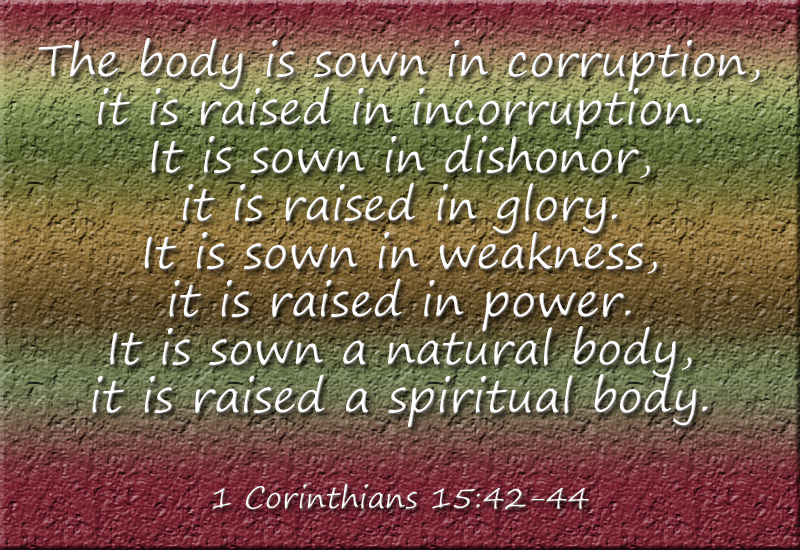
We are “bare grain,” as the KJV says, which after it dies to this existence will spring up into the far more glorious body that God gives us. Thank God that immortality is not give not us as we are now — corrupted, dishonored, weak, and natural. Living like this forever would not be a gift. We cannot have eternal life as we are now, nor would we want to. We need to be changed first.

For this corruptible must put on incorruption, and this mortal must put on immortality. So when this corruptible has put on incorruption, and this mortal has put on immortality, then shall be brought to pass the saying that is written: “Death is swallowed up in victory.” (1 Cor. 15:53-54).

“Daddy, give me sixpence”

marissabaker.wordpress.comWe had evening services yesterday, so there was a whole free day to fill with activities. My plan was to find all the book stores in the area and visit each, but we ended up at two antique stores and a mall instead. There was, however, a used book store in the mall, so I have one of the bookstores here checked off my list. I was particularly glad we stopped because I finally found a copy of C.S. Lewis’s Mere Christianity in hardcover for less than Amazon.com sells the paperback.

Some time ago, I signed up for an e-newsletter through biblegateway.com that sends a C.S. Lewis quote every day. This morning, it was a quote from Mere Christianity. It’s long, but I’d like to share it with you, if you don’t mind.

As a great Christian writer (George MacDonald) pointed out, every father is pleased at the baby’s first attempt to walk: no father would be satisfied with anything less than a firm, free, manly walk in a grown-up son. In the same way, he said, “God is easy to please, but hard to satisfy.”

I think every one who has some vague belief in God, until he becomes a Christian, has the idea of an exam or of a bargain in his mind. The first result of real Christianity is to blow that idea into bits. When they find it blown into bits, some people think this means that Christianity is a failure and give up. They seem to imagine that God is very simple-minded! In fact, of course, He knows all about this. One of the very things Christianity was designed to do was to blow this idea to bits. God has been waiting for the moment at which you discover that there is no question of earning a pass mark in this exam or putting Him in your debt.

Then comes another discovery. Every faculty you have, your power of thinking or of moving your limbs from moment to moment, is given you by God. If you devoted every moment of your whole life exclusively to His service you could not give Him anything that was not in a sense His own already. So that when we talk of a man doing anything for God or giving anything to God, I will tell you what it is really like. It is like a small child going to his father and saying, “Daddy, give me sixpence to buy you a birthday present.” Of course, the father does, and he is pleased with the child’s present. It is all very nice and proper, but only an idiot would think that the father is sixpence to the good on the transaction. When a man has made these two discoveries God can really get to work. It is after this that real life begins.

I think this is a great way to look at our relationship with God as His children. There’s not a thing we can do to earn salvation on our own. The second paragraph in this quote is saying basically the same thing Paul says when he writes, “For by grace you have been saved through faith, and that not of yourselves; it is the gift of God,not of works, lest anyone should boast” (Eph. 2:8-9). Every good thing in our lives is a gift directly from God. All that is good in us is a result of His work in our lives. We bring nothing to our relationship with God but our broken selves, desperately in need of Him to make us whole.

Such a realization is important because we cannot have a relationship with God without humility, and we cannot have humility if we think we are doing God a favor by agreeing to be part of His family. God’s family will be made up of people who know they have nothing to offer God and are wild with joy that He wanted to work with them anyway.