Big Questions of the Bible

Since last week’s post, inspired by the big questions Leo Tolstoy asked in his book A Confession, I’ve been thinking about the questions that people in the Bible asked. From the sorts of questions recorded in Job, Psalms, Ecclesiastes, and elsewhere in scripture, it seems clear that God is okay with us asking Him things such as “Why am I here?”, “What is the purpose of suffering?”, and “What ought I do with my life?”

Today, we still have a lot of questions for God. Some of them are specific, such as “Why did that bad thing happen to me?” or “How can I decided what the next step for my life is?” Others are more general, the sorts of things that most thinking people wondered at some point in their lives, such as “What is the meaning of life?” and “Where do I fit into the universe?”

It often seems like these types of questions are too big to answer and so we shouldn’t try to ask them. Or it might seem as if we’re the only ones who haven’t figured this out yet, since everyone else seems like they’re functioning just fine. But we’re all asking questions and we all have things we’re uncertain about, just like people in the Bible. Even the “heroes of faith” like Job and David asked big questions, some of which seem audacious to us. We might expect God to get angry or offended at questions like “Why did you make me like this?” or “What do you think you’re doing, letting this terrible thing happen to me?” But throughout scripture, God shows remarkable patience with His people’s questions and also a willingness to answer. One of the most amazing things about Job’s story, for example, isn’t that Job asked questions about his suffering; it’s that God showed up to give an answer and ask questions of His own.

If you search for question marks in the Bible, you come back with 3,256 results in the WEB translation and 2,990 in the NET. The exact number varies depending on how translators choose to interpret phrases and where they put punctuation marks, but however you figure it up that’s a lot of questions. We can’t cover them all in one post, and not all fit in the “big questions” category. I’ve picked out four types of these questions I want to look at today, and there are plenty more that we could examine. If this inspires you to do a study on questions for yourself, I’d love to hear about it in the comments below or in an email.
Image by Free-Photos from Pixabay

What is the point of anything?

In his darkest trials, Job asked why he’d even been born if this is what was going to happen (Job 3:11-16; 6:11-13; 10:18). It wasn’t a self-destructive thought for him, but it does seem to be one of frustration and despair. Why even live if suffering is the main result? What’s the point of being born, and living, and dying in a world where such terrible things can happen to good people?

Similarly, Solomon in Ecclesiastes wonders what the point is of living and working here on earth (Ecc. 1:3; 3:9; 4:8). Life seems to just go on and on with no real profit or gain, especially if you’re working alone rather than in a community. If there’s no satisfaction, or wealth, or any sort of meaningful profit then it’s all “vanity. Yes, it is a miserable business” (Ecc. 4:8, WEB). Others ask this type of question more specifically, wondering “What is the point of serving God?” (Job 21:15; Mal. 3:13-14).

God counters this sort of thinking with a question of His own: “Why do you spend money for that which is not bread, and your labor for that which doesn’t satisfy? Listen diligently to me, and eat that which is good, and let your soul delight itself in richness” (Is. 55:2, WEB). In other words, if our lives and efforts seems pointless it’s because we’re devoting them to the wrong sorts of things. This reminds me of one of Tolstoy’s observations in A Confession* that I wrote about last week. He realized that just because it felt as if his life wasn’t meaningful that didn’t mean all life had no meaning.

Another answer that God offers to this question is a clearer picture of Himself. He answered Job’s questions about the meaning of life and the purpose of suffering by revealing Himself to Job more fully (for an interesting take on that aspect of Job, see Philip Yancey’s The Bible Jesus Read*). It might seem an oddly indirect answer to us, but it’s one that appeared to satisfy Job. The clearer we can see and understand God, the more meaningful life seems.

*please note that this is an affiliate link, which means I'll earn a small commission (at no extra cost to you) if you purchase this book.
Image from Lightstock by Jantanee

Does God really care?

Faith in God answers a lot of life’s big questions. But it also brings up new questions. Once you believe that God exists and that He’s all powerful, it often follows that we wonder why He lets certain things happen. Why is there suffering? Why are there wars? How could a loving God allow such terrible things? Doesn’t He care?

The psalms are full of these sorts of questions. “Why do you stand far off, Yahweh?  Why do you hide yourself in times of trouble?” (Ps. 10:1, WEB), “My God, my God, why have you forsaken me?” (Ps. 22:1, WEB), and many more questions like these echo through history in the cries of many hurting people today (Ps. 13:1; 43:2; 44:24; 74:1, 11; 89:46; 108:11). We wonder why it seems that God leaves us alone in our times of trouble, and why it seems like He’s ignoring our cries for help (Lam 5:20; Hab. 1:2). Doesn’t He care about us at all?

There’s a story of a time when Jesus and his disciples were on a boat and a storm blew up. Jesus was sleeping through it, but they woke Him with the question, “Teacher, don’t you care that we are dying?” (Mark 4:38, WEB). Jesus hadn’t been worried at all, but at their question He got up and stopped the storm. I suspect there’s a reason Jesus wasn’t worried. With God on our side, the storms of life don’t present a real danger to us. Even if He seems to not be paying attention, He’s still very present and protective. He has the power to stop the storms instantly, and sometimes He does to show us His power and reliability, but things are still going to work together for good in the end even if He decides to let us go through the storms.

Perhaps a better question would be, “Why does God care so much?” There’s tons of evidence that God cares deeply about humanity. The main proof of that is found in Jesus’s sacrifice–God cares enough about us to die in our place. With that perspective in mind, our question may become “What are we that God should even think of us, much less care so much about us?” (Job 7:17; Ps. 8:4; Heb. 2:6). It’s awe-inspiring to think about the creator of the universe wanting us to be part of His family simply because He loves so much.
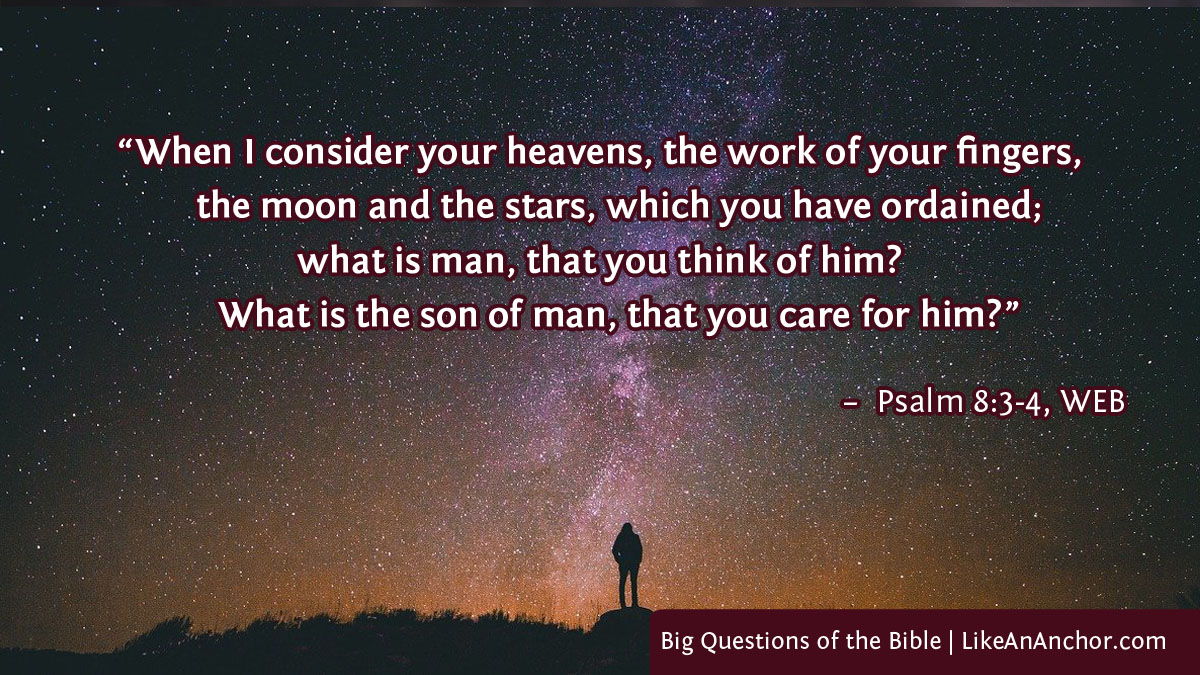
Image by Free-Photos from Pixabay

Why isn’t God doing things the way I want?

This next question is closely related to the last one. We wonder how long our trials will last, sure it would be better if God stepped in now and took care of things for us. We wonder how long it will be until the end comes, since it seems like the sooner the better for Jesus to return and stop pain, suffering, death, and evil. Similarly, we may question God’s planning and timing in other areas, wondering if He is unfair in the things that He commands or the way He interacts with people.

Even though these questions can sound like a lack of faith or an accusation, they’re still questions that it’s okay to ask. Jesus didn’t get upset when His disciples said, “Tell us, when will these things be? What is the sign of your coming, and of the end of the age?”–He just answered their question (Matt. 24:3, WEB). Yahweh didn’t cut-off Moses for asking, “How long must this suffering last?” (Ps. 90:13, NET). We can ask these things. It only becomes problematic when we decided the answer must be that God is wrong and we’re right.

Tolstoy talks about the insanity of this attitude by comparing “learned and liberal” people who reject God to kids who tear apart a watch without understanding how to put it back together, then complain that it doesn’t work. That’s similar to the analogies found in the Bible. When people accuse God of unfairness or of not knowing what He’s doing, God turns some big questions back on them. He says, “You turn things upside down!” It’s not for the creation to question the Creator and decide that He’s the one who lacks understanding. “Yet the house of Israel says, ‘The way of the Lord is not fair.’ House of Israel, aren’t my ways fair? Aren’t your ways unfair?” (Job 8:3; Is. 29:16; Jer. 2:5; Ezk. 18:23-29). God’s not the problem here; our limited understanding and lack of trust are what’s to blame.

What must I do now?

A rich young man once asked Jesus, “Good teacher, what good thing shall I do, that I may have eternal life?” When Jesus replied that this man should keep the commandments, he responded, ““All these things I have observed from my youth. What do I still lack?” (Matt. 19:16-20; Mark 10:17-21; Luke 18:18-23). That question is at the top of my list for things I’d like to ask God and get a clear answer on right now. I grew up in the church and didn’t really have a rebellious phase (though that doesn’t mean I haven’t sinned/missed the mark on God’s commandments). But I do sympathize with this young man. I’ve been following God my whole life; what do I still lack?

Whether you’re just starting out your journey as a Christian–like those in Acts whose response to hearing the gospel was, “What shall we do?” (Acts 2:37; 16:30)– or you’ve been following God for many years, the question of what to do now is a good one. Throughout scripture, people asked questions like, “How can man be just with God?”, “Where does wisdom come from?”, “Where is the good way?”, and “How shall I come before Yahweh?” (Job 9:2; 28:12, 20; Ps. 119:9; Jer. 6:16; Mic. 6:6-8). We treat these questions like they’re very complicated, but God gives us simple answers.

He has shown you, O man, what is good.
What does Yahweh require of you, but to act justly,
to love mercy, and to walk humbly with your God?

Micah 6:8, WEB

Jesus reiterates the simplicity of this point in the gospels. His answer to “How can we know the way?” is “I am the way, the truth, and the life” (John 14:5-6, WEB). His answer to “Which is the greatest commandment in the law?” and “What shall I do to inherit eternal life?” is to love God and love your neighbor (Matt. 22:35-40; Luke 10:25-29). It’s not that complicated.

God welcomes His people to engage with Him in real, dynamic relationship. Part of that relationship involves asking questions. If we have concerns, we’re invited to take them to God. If we have questions about Him or for Him, we ought to ask and then seek answers from Him through prayer, Bible study, meditation on the Word, and fasting.

Featured image from Lightstock by Jantanee

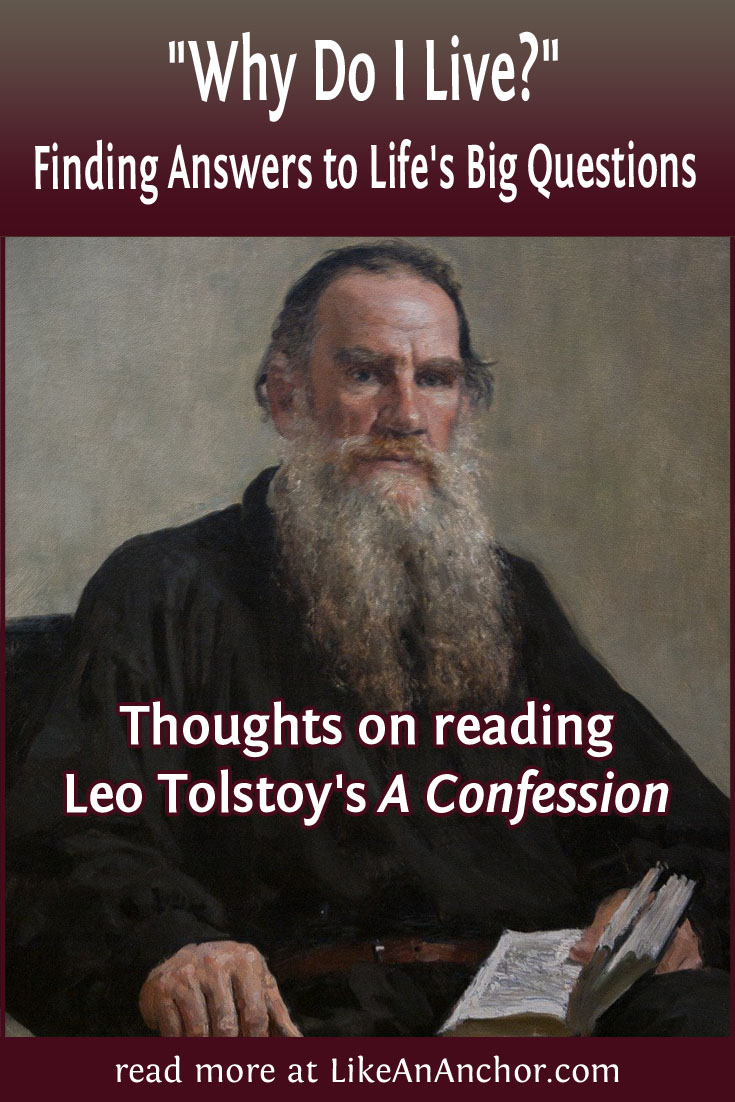
“Why Do I Live?” Finding Answers to Life’s Big Questions

If you’re familiar with Leo Tolstoy, chances are it’s in the context of him being one of the greatest Russian novelists rather than as a Christian writer. He published his two best-known works in the mid-to-late 19th century: War and Peace in 1869 and Anna Karenina in 1878. It was after finishing Anna Karenina early in 1877, and before resuming his literary work in 1885, that he devoted himself to a close study of faith (reference: Aylmer Maude’s introduction to A Confession, The Gospel in Brief, What I Believe, printed by Oxford University Press).

Tolstoy’s essay titled A Confession was mostly written in 1879 and was first circulated in Russia (with a short additional note from the author) in 1882 despite efforts to suppress its publication. In this essay, Tolstoy recounts his own loss of faith, the years of his life spent in dissipation among other “learned and liberal” people, and finally his disillusionment with that sort of life. He describes himself as coming to a seemingly inescapable realization that life is meaningless and that he ought to kill himself. This was a time of mental agony for him. Tolstoy was a highly successful and respected author, with a wife and children whom he loved, yet he had to hide ropes and guns lest he use them against himself.

As he recalls his reasoning in those days, Tolstoy talks about asking questions such as, “What am I with my desires?” and “Why do I live?” As a well-educated man, he naturally turned to science and reason for answers. Yet there, he found that people aren’t so much interested in answering these questions as they are in studying and observing the world. What he found from science indicated that everything happened by chance and you must understand “infinite complexity” and “the laws of those mutations of form” before you could hope to understand why you’re alive. Then Tolstoy turned to philosophy, where he found that philosophers had been asking his same questions for thousands of years. Yet they didn’t have an answer which satisfied him either–they just gave back “the same question, only in a complex form” (Section V).

People in the Bible also asked big questions, and we’re still doing that today as well. The questioner from the Bible whom Tolstoy focused on in his writings was Solomon, and he quotes extensively from Ecclesiastes (which I’ve written about in “Crash Course in Ecclesiastes”). Other Bible people who asked big questions include Job and his three friends. And while Solomon and Job are the first people who come to mind as wrestling with big questions, other questions like “If it is like this, why do I live?” (Gen. 25:22), “My God, my God, why have you forsaken me?” (Psalm 22:1), and “Is there unrighteousness with God?” (Rom. 3:5; 9:14) fill the pages of the Bible. We serve a God who invites us to ask big, difficult, and troubling questions and then come to Him for answers.

It’s fitting, then, that Tolstoy found the most satisfying answers for his big questions when he turned to faith. He realizes that just because he’d decided that his life was not meaningful did not mean all life was without meaning. As he looked around him, he realized that people had been acting as if life were meaningful for thousands of years. Perhaps they hadn’t been wrong. Perhaps they–and the people alive now who saw value in living–knew something that he’d missed. And so Tolstoy began seeking answers among those who believe that life is worth living in spite of the hardships, namely, among people of faith. He was not impressed by those Christians among his wealthy, highly educated acquaintances because most professed faith but did not live it out, but Tolstoy did find something to admire in the simple working people. Those people lived with faith that deeply affected their lives and which answered their big questions.

Image from jacqueline macou from Pixabay

At this point, Tolstoy describes the highly educated and intelligent people who reject God as those who “have decided that the master is stupid or does not exist, and that we are wise, only we feel that we are quite useless and that we must somehow do away with ourselves” (Section XI). These sorts of people are so impressed with themselves that they’ve missed what gives life meaning. He also says, “Were it not so terrible it would be ludicrous with what pride and self-satisfaction we, like children, pull the watch to pieces, take out the spring, make a toy of it, and are then surprised that the watch does not go” (Section IX). It should be no surprise that if we try to take out God and faith–which make life worth living and reveal the meaning of existence– we’ll feel as if life is worthless and meaningless. Tolstoy found this born out in his own experiences: “I need only be aware of God to live; I need only forget Him, or disbelieve Him, and I died” (Section XII).

A Confession is a fascinating read. Tolstoy speaks frankly about terribly difficult subjects, including his struggles with suicidal thoughts and with finding answers to life’s most important questions. He also touches on his conflicts with church dogma (in this case the doctrines of the Russian Orthodox church), which I understand he develops more fully in writings that I haven’t yet read. In a way that reminds me a little of C.S. Lewis, Tolstoy left his childhood Christian faith and then later came back as a more mature and intelligent adult, concluding that God is the only thing which can give life meaning.

So many people in the modern world like to set up “faith” and “reason” as things that are opposed. I love reading about highly intelligent people like Lewis and Tolstoy who come to the conclusion that faith in God is the only reasonable answer to life’s big questions. It helps encourage me that a life of faith is not a life that’s opposed to reason, logic, and intelligence–that, in fact, the most reasonable use of our intelligence leads to the conclusion that faith in God is right and good.

Featured image by Dariusz Sankowski from Pixabay

Living Jesus Clearly in an World of Darkness

One of the things I often struggle with in settings like work and school is how much of my faith to share. I’m not an evangelist sort of person, and trying to convert people who don’t know Jesus yet is never something I’ve felt a strong calling to do. I’m much more comfortable–and feel I’m using my gifts far more effectively–when working with an audience of people who already have some kind of Christian framework for how they view the world. I also want to be respectful of other people’s time, personal beliefs, and conversational boundaries. Yet at the same time, I’m not ashamed of my faith and I want to live it out boldly the way I see heroes of faith doing in the Bible. At the very least, I want to let others see that faith is a central part of my life.

This struggle is one I think many Christians today can identify with, particularly as pressure to keep your beliefs to yourself increases. Many Christians in the Western world aren’t facing overt, clear, and violent persecution the way our brethren are in other parts of the world; we’re facing a more subtle, seemingly less dangerous pressure to not talk about Jesus in public, or say “God bless you,” or mention anything which may offend those who believe differently. Yet when we look at the examples of people in the New Testament, we see the apostles and other disciples risking ostracization from their communities as well as death, beatings, and imprisonment rather than be quiet about the gospel. At the same time, though, we’re also told to be wise about how we navigate the world around us. How do we balance all that? And what scriptures might help us figure out the answer?

Loving and Obeying

As we approach this question, I think we need to start from the position of seeking, “What does God ask of me?” and “How can I love Him more fully?” Beginning this sort of studying by wondering how low-profile we can be while still meeting the bare minimum requirements for Christianity would mean prioritizing what the world thinks of us over our relationship with God. We certainly don’t want that, so let’s start our search for answers by putting our relationship with God first.

As I wrote about more extensively last year in a post called “Do I Love God Enough To Obey Him?“, it’s impossible to overstate how important it is for us to know and be known by God. Love is a central part of that relationship–both God’s love for us and our love for God and for the people around us. The Apostle John’s writings make it clear that this love must involve obeying Jesus and the Father. Our relationship with God should change the way we live, and the form that change takes can be described as obedience to God’s commandments on a spiritual level. We’re to love God’s law and become righteous in the same way that He is righteous.

Obedience is not our means to righteousness; it is the clearest expression of our devotion to Jesus. … If we truly love Him, as we say we do, what He says will matter to us profoundly. We will not follow the acceptable parts of His teachings and ignore the objectionable parts. We will not approach our relationship with Him as though we are trying to get by with the bare minimum behavioral changes. We will devour His teachings, turning them over in our hearts, meditating on their application, and living them as clearly as we can.

Chris Tiegreen, 365 Pocket Devotions, Day 159

With that background, the question of how to live out our faith in this world becomes secondary to the question of how we ought to live our lives in close alignment with God. It is as a result of our relationship with God that we have “good works” which we can let shine as a light before all people (Matt. 5:14-16; Phil. 2:15; 4:5; 1 Pet 2:12). We’re supposed to be fully-engaged in living for God, and if that is truly our focus it will be obvious to the people around us. We should want others to notice that there’s something different about us so they will realize God deserves all the glory and praise for whatever is good about us.

Wise, Harmless, and Bold

When looking at scriptures that talk about how to share your faith, there are a few key points that stand out to me. The first is how many times the New Testament talks about boldness when preaching. That description is used over and over in the book of Acts, where the disciples kept talking about Jesus even though they faced threats of imprisonment, beatings, excommunication, and even death for sharing the gospel (Acts 4:29, 31; 9:27; 14:3; 18:26; 19:8; 28:31). Paul also writes about speaking boldly. He encourages others to be bold and asks for prayers that he might speak with boldness (2 Cor. 3:12; Eph. 6:19-20; Phil. 1:14, 20; 1 Thes. 2:2; 1 Tim. 3:13). We should not let fear hold us back from talking about Jesus but being bold isn’t always easy; even Paul wanted the support of prayers so that he could keep preaching the gospel.

Behold, I send you out as sheep among wolves. Therefore be wise as serpents and harmless as doves. But beware of men, for they will deliver you up to councils, and in their synagogues they will scourge you. Yes, and you will be brought before governors and kings for my sake, for a testimony to them and to the nations. But when they deliver you up, don’t be anxious how or what you will say, for it will be given you in that hour what you will say. For it is not you who speak, but the Spirit of your Father who speaks in you.

Matthew 10:16-20, WEB

While we are supposed to be bold and courageous, not worrying about the possibility that we’ll face resistance or prosecution for our faith, we’re also supposed to be wise. Part of that is knowing when to speak and when not to speak. Peter says we should always be ready to give an answer if someone asks us about our faith (1 Pet. 3:15), but that doesn’t mean always speaking up when you haven’t been asked. The world is not a safe place. That fact should never terrify us, especially since we know God is on our side, but it should make us exercise wisdom. A wise person thinks before they speak. They seek God’s help in figuring out when to “hold their peace” and when silence is not an appropriate option (Est. 7:3-4; Prov. 11:12; Is. 62:1; Acts 11:18). As we seek to live rightly and shine Jesus’s light clearly, we also ought to be “wise serpents” and “innocent doves” who are careful to do no harm.

I know that conclusion doesn’t really give a clear answer to the questions we started with about how much you should talk about your faith as society increasingly pressures Christians to stay quiet about their beliefs. Still, I think Bible studies like this one help us keep our priorities clear. It’s easy to get caught up in the day-to-day-level worries about how people might respond to us or whether or not we said the right thing in a conversation. We ought to take a more big-picture approach, seeking first to honor God and letting all the other things fall into place around that central relationship.

Running Toward the God Who Is Running to Us

Have you ever noticed how persistent God is when seeking a relationship with His people? He went looking for Adam and Eve in the garden after they’d sinned and hidden from Him (Gen. 3:8-9). He called to little Samuel four times to make sure He got his attention (1 Sam. 3:1-10). He helped Elijah do great things then followed him into hiding to speak reassurance in a still, small voice (1 Kings 19:1-8). He portrays Himself through the prophets as Israel’s husband, who loved her so much that He kept seeking a restored relationship even when she was unfaithful (Hos. 1-3). He’s the Father in Jesus’s parable who runs out to meet his prodigal son (Luke 15:11-24). God consistently makes active moves to initiate, deepen, and restore relationship.

This is a really good thing for us. How would we dare come before Almighty Yahweh, the Creator of the Universe, unless He wanted us there? Though we haven’t done anything to deserve His attention or desire, He makes it very clear that He wants us. He also makes it clear that His choice to seek relationship with us comes with an invitation for us to seek Him just as fervently.

Therefore since we have a great high priest who has passed through the heavens, Jesus the Son of God, let us hold fast to our confession. For we do not have a high priest incapable of sympathizing with our weaknesses, but one who has been tempted in every way just as we are, yet without sin. Therefore let us confidently approach the throne of grace to receive mercy and find grace whenever we need help.

Hebrews 4:14-16, NET

Over and over, God calls people into relationship with Him. He’s so serious about building relationships that Jesus died in order to ransom us from sin and make a close, familial relationship between humans and God possible for all eternity. He will never run away or abandon us (John 10:12-15), and so we ought to run toward Him.

Image by Sasin Tipchai from Pixabay

Running To God

This idea of us running to God isn’t mentioned very often in scripture. It does, however, appear several times in the Old Testament and once in the New Testament writings. It seems that “running to God” is similar to the idea of boldly approaching Him, but there are a few other meanings as well. For example, in these two verses the focus is on running to God for protection:

Rescue me from my enemies, O Lord.
I run to you for protection.

Psalm 143:8, NET

Yahweh’s name is a strong tower:
the righteous run to him, and are safe.

Proverbs 18:10, WEB

Scripture also talks about people running toward God in response to His call. Isaiah talks about nations running to God. Similarly, in John’s gospel, he records that the Pharisees recognized “running” as the way people responded to Jesus (even if they didn’t think to link it with this scripture in Isaiah).

“Behold, you shall call a nation that you don’t know;
and a nation that didn’t know you shall run to you,
because of Yahweh your God,
and for the Holy One of Israel;
for he has glorified you.”

Isaiah 55:5, WEB

Thus the Pharisees said to one another, “You see that you can do nothing. Look, the world has run off after him!”

John 12:19, NET

Like the people Isaiah prophesied about and those whose devotion to Jesus worried the Pharisees so much, we also ought to run to God. When He calls us, we ought to respond eagerly. When we’re in trouble, He should be the first person we turn to. This topic makes me think of a song I first heard shortly after I started attending a Messianic congregation. I think music is one of the best ways to engage our whole selves in our relationships with God, so here’s the song, if you’re interested in listening to it:

Running With Faith

The Bible also talks about a specific way that we’re supposed to run. In this sense, “run” is used as a metaphor for how we live as Christians. Paul in particular uses this analogy several times to talk about how he lived and how we ought to live (1 Cor. 9.24-26; Gal. 2:2; 5:7; Phil. 2:16). Staying in a close, faithful relationship with God our entire lives requires the same commitment, endurance, and perseverance as running a race.

Therefore let’s also, seeing we are surrounded by so great a cloud of witnesses, lay aside every weight and the sin which so easily entangles us, and let’s run with perseverance the race that is set before us, looking to Jesus, the author and perfecter of faith, who for the joy that was set before him endured the cross, despising its shame, and has sat down at the right hand of the throne of God.

Hebrews 12:1-2, WEB

This type of running isn’t something we do on our own. God runs to us, so we run to God, and then we run the race that is our lives together with Him.

Those who wait for Yahweh will renew their strength.
They will mount up with wings like eagles.
They will run, and not be weary.
They will walk, and not faint.

Isaiah 40:31, WEB

Running To The Right Thing

Image by Daniel Reche from Pixabay

There are a lot of things that we could run to other than God. Many of us ran toward the things of the word in times past, or currently struggle with keeping on-track running toward God. Even when we are running properly in a God-ward direction, people in the world around us will “think it is strange that you don’t run with them into the same excess of riot, blaspheming” (1 Pet. 4:1-6, WEB). The more we align ourselves correctly as we run toward God, the more it will look the the world as if we’re running in a very strange direction.

As Christians today, we should ask ourselves questions like the ones my dad brought up when I shared this study with him. “How can I run to God today? How can I draw near to Him? How can I become more like Him?” Those are the sorts of things which ought to be our focus as we discipline ourselves to run our race of faith the way Paul talked of in 1 Corinthians, Galatians, and Philippians: with self-control, with purpose, and with perseverance.

God runs to us. He persistently pursues a relationship with us because of His great love and desire to have us in His family. We also can run to God, boldly seeking Him out for protection and simply because we love Him. The more we run toward Him, the stronger our relationship will be and the less we’ll care about how odd our choice to pursue the things of God looks to the world. Then, as we stay close to God, we receive strength to keep running “the race set before us” without getting tired or discouraged.

Featured image by David Mark from Pixabay

Crash-Course In Jude: Pre-Reqs for Paul, Part Four

The final general epistle is the shortest section of scripture we’ll look at in this blog series. Jude only wrote one letter that we have in our Bibles, and it’s just 25 verses long. That will leave us with enough space in this post for a wrap-up looking at common themes in all the letters that we’ve been studying over the past month.

Before we dive into Jude, here are links to the posts on James’s, Peter’s, and John’s letters. As I mentioned in those posts, there’s evidence that when the books of the New Testament were first put together the order had these letters between Acts and Romans (click here to learn more). This meant that if you read straight-through the New Testament, you’d read the general epistles before getting to Paul’s letters. The general epistles give us a foundation for understanding the connections between Jesus’s teachings, the Old Testament, and our lives as New Covenant believers, all of which is essential for properly interpreting Paul’s more complicated teachings. We can think of the general epistles as a kind of pre-requisite course for understanding Paul.

The identity of Jude is as debated as that of James (see that first post for more detail), and people went back-and-forth for centuries on whether or not to include his letter in canon. Now, though, it is “generally received over the whole Christian world” (Clarke’s Commentary). This letter’s theme is similar to 2 Peter and, as we’ll see later in this post, it also connects to themes that all the general epistles share. Taken as a whole, the general epistles by all four writers connect the New Testament back to the Old Testament, warn about dangers from outside persecutions and from evil men working within the churches, offer hope and encouragement, and tell their readers to do good and keep the commandments of God.

Warnings and Punishments

Jude addresses his letter “to those who are called, wrapped in the love of God the Father and kept for Jesus Christ” (Jude 1:1, all scriptures from NET). Like most other general epistle writers, he has a broad audience that includes all Christian believers. He said he’d planned to write “about our common salvation,” but even though that topic is exciting he felt compelled to write about something else. He wrote “to encourage you to contend earnestly for the faith that was once for all entrusted to the saints” (1:3). The NET footnote on this verse says, “The verb ἐπαγωνίζομαι (epagōnizomai) is an intensive form of ἀγωνίζομαι (agōnizomai). As such, the notion of struggling, fighting, contending, etc. is heightened.” When Jude talks about us contending for our faith, he means we need to fight and struggle for it with focus and determination.

In this letter, Jude focuses his warnings and encouragement to fight on a specific problem: “ungodly men who have turned the grace of our God into a license for evil and who deny our only Master and Lord, Jesus Christ” (1:4). He further describes them as people who “as a result of their dreams, defile the flesh, reject authority, and insult the glorious ones” (1:8). They are murderous, blasphemous, rebellious, spiritually dead, double-minded, unstable, and a danger to everyone they encounter (1:10-13). They’re
“grumblers and fault-finders who go wherever their desires lead them, and they give bombastic speeches, enchanting folks for their own gain” (1:16). Jude elaborates on the dangers these people pose and the evil they’re practicing throughout most of this letter. By the end, there’s no danger that we could see those who try to undermine the church as anything other than a serious threat.

These warnings about those who’ve “secretly slipped in” to the churches are placed alongside reminders from Jude that people who do such wicked things won’t get away with them. He bids his readers remember “that Jesus, having saved the people out of the land of Egypt, later destroyed those who did not believe” and references a couple other Old Testament examples as well (1:5-7). This verse is one of several in the New Testament that explicitly identifies Jesus as the member of the God family who worked directly with Israel. With this short phrase, Jude reminds us that God is the same yesterday, today, and forever and that He still values justice and judgement as well as mercy (Jude 1:14-15).

How Ought We Behave

Jude doesn’t just focus on scathing indictments of those seeking to undermine the church while pretending to be faithful believers. He also warns us about how to recognize those people and gives us guidelines for how we ought to respond. As part of this, he references a scene that we don’t get anywhere else in the Bible.

Jude tells his readers, “But even when Michael the archangel was arguing with the devil and debating with him concerning Moses’ body, he did not dare to bring a slanderous judgment, but said, ‘May the Lord rebuke you!'” (1:9). This story serves two roles in Jude’s epistle. First, it shows that those who dare slander spiritual beings, even the wicked ones, have no idea what they’re messing with. Even angels don’t go up against the devil directly; they call on the Lord to rebuke him. Secondly, the story gives us hints for how we ought to respond when faced with wickedness. We, too, can call on the Lord to handle the matter of wicked beings, be they human or otherwise. That’s the safest and wisest thing to do. This is a good illustration to keep in mind when reading things Paul would later elaborate on, including the fact that we’re involved in spiritual warfare and that vengeance belongs to God, not us (Rom. 12:17-20; 2 Cor. 10:1-6; Eph. 6:10-20).

Finally, Jude ends his epistle with encouraging remarks. He’s confident that those he’s writing to are not part of the problem he’s describing. Rather, they’re part of the solution as they continue to build up their faith, pray in the Spirit, stay in God’s love, and practice mercy.

But you, dear friends—recall the predictions foretold by the apostles of our Lord Jesus Christ. For they said to you, “At the end of time there will come scoffers, propelled by their own ungodly desires.” These people are divisive, worldly, devoid of the Spirit. But you, dear friends, by building yourselves up in your most holy faith, by praying in the Holy Spirit, maintain yourselves in the love of God, while anticipating the mercy of our Lord Jesus Christ that brings eternal life. And have mercy on those who waver; save others by snatching them out of the fire; have mercy on others, coupled with a fear of God, hating even the clothes stained by the flesh.

Now to the one who is able to keep you from falling, and to cause you to stand, rejoicing, without blemish before his glorious presence, to the only God our Savior through Jesus Christ our Lord, be glory, majesty, power, and authority, before all time, and now, and for all eternity. Amen.

Jude 1:17-25, NET

Common Themes in the General Epistles

As mentioned in the introduction, the general epistles all connect the Old and New Testaments, warn about dangers coming from inside and sometimes outside the church, offer hope and encouragement, and remind us to do good and keep the commandments of God. I won’t spend too much time on these shared points, but I want to make a few comments and share scriptures that show this overlap.

OT Connections

All the writers of the general epistles were very familiar with the writings we now call the Old Testament, and frequently reference the law and the prophets. Their insistence that Jesus did not do away with these writings and that we do well to read them today are a great foundation for understanding how Paul talks about the law operating on a spiritual level for New Covenant believers.

James 2:8-13; 4:11-12

1 Peter 1:10-12; 2:4-10

2 Peter 3:1-2

1 John 2:3-3:11

Jude 1:5; 14-16

Warnings

These four writers do not shy away from the fact that those who follow Jesus Christ will face opposition and trials. Most of them also talk about the possibility that theses trails will come from other people who are (ostensibly, at least) part of the church fellowship. These are warnings to help ensure that we don’t get caught off-guard by threats to our faith or discouraged when trials come.

James 1:2-4

1 Peter 1:6-9; 2:19-25; 3:14-18

2 Peter 2:1-22; 3:3-7

1 John 2:18-19, 22-26; 4:1-3

2 John 1:7-11

Jude 1:3-4, 6-19

Hope

It would be terribly depressing if all the general epistles focused on warnings and trials without offering hope and encouragement. All four of these writers encourage their readers to be ready, to hope in God, and to keep living faithfully. They also speak about the help God offers us, the certainty that He hears our prayers, and the wonderful future He has prepared for us. We are precious to God and He’s fully invested in us.

James 1:17-18; 5:7-11

1 Peter 1:3-5, 18-21; 2:4-10; 5:5-13

2 Peter 2:4-11; 3:8-10

1 John 2:12-14; 2:28-3:3; 5:4-5, 14-17

Jude 1:20-21, 24-25

Do Well

Finally, all four writers of the general epistles tell us that there’s something we’re expected to do. We need to love God and keep His commandments. That’s what shows our faith is real rather than just a surface-level thing that we talk about without actually practicing.

James 1:22-25; 2:8-26; 5:17

1 Peter 1:13-17; 1:22-2:3; 4:2-6

2 Peter 1:2-11; 3:14-18

1 John 2:3-6; 3:4-10, 18-24

2 John 1:5-6

Jude 1:20-22

Featured image by Lamppost Collective from Lightstock

Crash-Course In John: Pre-Reqs for Paul, Part Three

For the last two weeks, we’ve been studying the general epistles. Here are links to the posts on James’s and Peter’s letters. As I mentioned in those posts, there’s evidence that when the books of the New Testament were first put together the order had James, Peter, John, and Jude’s letters between Acts and Romans (click here to learn more). This meant that if you read straight-through the New Testament, you’d read the general (also called “catholic”) epistles before getting to Paul’s letters. That reading order makes sense, since the letters that James, Peter, John, and Jude write are phrased in simpler language than Paul’s writings. The general epistles also give us a foundation for understanding the connections between Jesus’s teachings, the Old Testament, and our lives as New Covenant believers. You can think of the general epistles as a kind of pre-requisite course to help us with understanding Paul’s writings, similar to how you’d need to take intro to composition courses before specializing in teaching writing.

In today’s post, we’re going to focus on John’s three epistles. The first of these epistles begins without addressing a specific group, though from the context of the letter it’s clear he’s speaking to Christians–those who whom the gospel was preached and who chose to believe it. James’s letter addressed those of Israelite descent who believed in Jesus, Peter’s letters addressed Jewish and Gentile believers, and now John’s letter is written to everyone. The purpose he gives for writing this letter is “so that our joy may be complete” (or “your joy” depending on the Greek manuscript you use) (1 John 1:4, all quotes from NET).The mention of joy comes at the beginning of all three of his letters, and frames the encouraging and weighty subjects he’ll be covering.

Walk in the Light

The strongest theme throughout John’s three epistles is love. Here is where we learn “God is love,” and are reminded over and over that because God loves us we must love one another. Though John brings up other topics as well, he ties them all back to this core message. God is love, and because we’ve received God’s love we are duty-bound to respond to God and to other people in certain ways.

We’ll return to love before the end of this post, but that word actually doesn’t show up in John’s first letter until the second chapter. Originally, of course, there wouldn’t have been chapters dividing up the text of this letter, but that fact does make me curious about what things John felt it was important to talk about before diving into the main theme of his letter.

Now this is the gospel message we have heard from him and announce to you: God is light, and in him there is no darkness at all. If we say we have fellowship with him and yet keep on walking in the darkness, we are lying and not practicing the truth. But if we walk in the light as he himself is in the light, we have fellowship with one another and the blood of Jesus his Son cleanses us from all sin. If we say we do not bear the guilt of sin, we are deceiving ourselves and the truth is not in us. But if we confess our sins, he is faithful and righteous, forgiving us our sins and cleansing us from all unrighteousness. If we say we have not sinned, we make him a liar and his word is not in us.

1 John 1:5-10, NET

This recap of the gospel is what John starts his letter with. “God is light” is something that he wants to establish for his readers before sharing that “God is love.” If he just started off with “God is love,” then perhaps his readers might make the mistake that so many modern people have of assuming that because God is love, His love doesn’t come with any expectations placed on us. We who’ve received God’s love and who’ve been cleansed from our sins by Jesus’s sacrifice must walk in the light as well as live in God’s love. In short, we must “walk just as Jesus walked” (1 John 2:6).

John’s instruction to walk in God’s light is not a new commandment (1 John 2:7). It echoes all the commands from the Old Testament that could be summed-up as “love your neighbor as yourself” (Rom. 13:9-10; James 2:8). On the other hand, John also describes this as “a new commandment” because the darkness of old has now passed away and we have a far clearer picture of the true light shining through Jesus Christ (1 John 2:8). As Jesus said, he came to fill the “law and the prophets” to their fullest extent. Doing that magnifies what obedience looks like now as we follow the spirit of God’s commands. With that background, John moves into talking about love.

The one who says “I have come to know God” and yet does not keep his commandments is a liar, and the truth is not in such a person. But whoever obeys his word, truly in this person the love of God has been perfected. …

The one who says he is in the light but still hates his fellow Christian is still in the darkness. The one who loves his fellow Christian resides in the light, and there is no cause for stumbling in him.

1 John 2:4-5, 9-10, NET
Image by Pearl from LightStock

Be Warry of Dangers

John’s not writing about the contrast between people who are in God’s love and light and the people who are living a lie in order to scare us. Indeed, he has some very reassuring things to say to his readers (1 John 2:12-14). He’s writing to them, and to us, because we’ve been forgiven, we know God, and we are already overcoming the evil one. But John also knows that Christians face many challenges, and it’s easy to slip away if we don’t have reminders for how to follow God. So he writes to us about the wonderful life that God offers. He reminds us of all the wonderful things that await us as people who God calls His very own children. He also talks about the fact that if we have that hope inside us, we will work to purify ourselves just as God is pure (1 John 3:1-3). Alongside all this talk of love and light, John highlights the need to keep God’s commandments and stay faithful to Him in spite of the dangers we face.

Over and over again in these letters and in the gospel he wrote, John links love with commandment keeping. Alongside that, John highlights the importance of living according to the truth. This idea goes along with walking in the light, keeping God’s commandments, and practicing righteousness. In both of his two shorter letters, John says that he rejoices to learn that his children (apparently referring to those he taught this faith to) are living in the truth (2 John 1:4; 3 John 1:4). Living and walking in the truth ought to be our intention as well, but there are many things that try to work against that goal.

Many dangers face God’s people, and a lot of them are spiritual. One example that John talks about is people who are “antichrist.” Though there is a figure known as “the antichrist” coming in the end times, Johan says we’re currently in “the last hour” and that “many antichrists” have already appeared. These are often people who were once part of the Christian body, but have now left and who deny both the Father and the Son (1 John 2:18-19, 22-26). Much like Peter did in his second epistle, John warns that the most dangerous antichrists are those who are working from inside the church to subvert people into denying the Father and/or the Son. For that reason, we need to “test the spirits to determine if they are from God, because many false prophets have gone out into the world” (1 John 4:1-6; see also 2 John 1:7-11).

Even though John is very reassuring to his readers and continually reminds them of things like “we have eternal life” (1 John 5:12-13), he also does not soften the strength of his warnings. In the second letter, he even says, “Watch out, so that you do not lose the things we have worked for, but receive a full reward. Everyone who goes on ahead and does not remain in the teaching of Christ does not have God. The one who remains in this teaching has both the Father and the Son” (2 John 1:7-8). John wants us to take these warnings seriously and let them inspire us to remain in holiness. Whether or not we choose light, love, and commandment keeping is a choice that has eternal consequences.

Image by Anggie from LightStock

Love Always

It’s in the context of all these reminders, reassurances, and warnings that John highlights the vital importance of love. In these three letters, “love” is translated from agape or its root word agapao. This is a selfless, benevolent love that always seeks the good of the one who is loved. Agape is often described as “godly love,” although other words, like philos are also used of God’s love in the New Testament. As we read through John’s letters, we’re warned not to “love the world or the things in the world,” but rather to focus our love on God as we practice the things which are in accordance with His will (1 John 2:15-17).

John tells us, “Everyone who does not practice righteousness—the one who does not love his fellow Christian—is not of God” (1 John 3:10). From that, we can infer that practicing righteousness involves loving our brethren. Indeed, John goes on to say, “We know that we have crossed over from death to life because we love our fellow Christians” (1 John 3:14). It’s worthwhile at this point to go and read all of chapters 3 and 4 because that section of the letter goes into so much depth on this particular topic. Because of God’s love for us–which results in us being redeemed by Jesus’s sacrifice and being called the Father’s children–“we also ought to love one another “(1 John 4:11). If we don’t genuinely love each other, we can’t even say that we love God. Unless our love includes other believers, we have no concept of what God’s love truly means. And our love must also include keeping God’s commandments (2 John 1:5-6).

Image by HarveyMade from Lightstock

As John wraps up his letter, he looks back on everything discussed so far and says this:

We know that everyone fathered by God does not sin, but God protects the one he has fathered, and the evil one cannot touch him. We know that we are from God, and the whole world lies in the power of the evil one. And we know that the Son of God has come and has given us insight to know him who is true, and we are in him who is true, in his Son Jesus Christ. This one is the true God and eternal life. Little children, guard yourselves from idols.

1 John 5:18-21, NET

I find John’s writings some of the most poetic and inspiring of the New Testament. His emphasis on God’s light and love is beautiful, and I love the way he talks about God welcoming us into His light and His family. In a compassionate, empathetic way, John also writes about the need for Christians to live and walk in a certain way. We’re not to be fearful, worried that God will cut us off and cast us away if we slip-up, but we must at the same time commit to practicing righteousness instead of sin. God has given us everything we need for salvation. He loves us and He wants us as part of His family. We just need to be on guard to make sure we don’t let those good things slip away from us through neglect or rejection. We know the truth of what’s going on in this world and behind the scenes, including that the world lies under the power of the evil one. With that in mind, we can be vigilant in order to guard against putting any idols before God or falling prey to the influences of those who are antichrist.

Featured image by Lamppost Collective from Lightstock